A multi-eigenbasis approach to covariance matrix denoising for cosmological inference
Pith reviewed 2026-06-28 08:20 UTC · model grok-4.3
The pith
A multi-eigenbasis method projects noisy covariance matrices onto mock-derived bases and corrects residuals to recover accurate estimates for Lyα forest cosmological inference.
A machine-rendered reading of the paper's core claim, the machinery that carries it, and where it could break.
Core claim
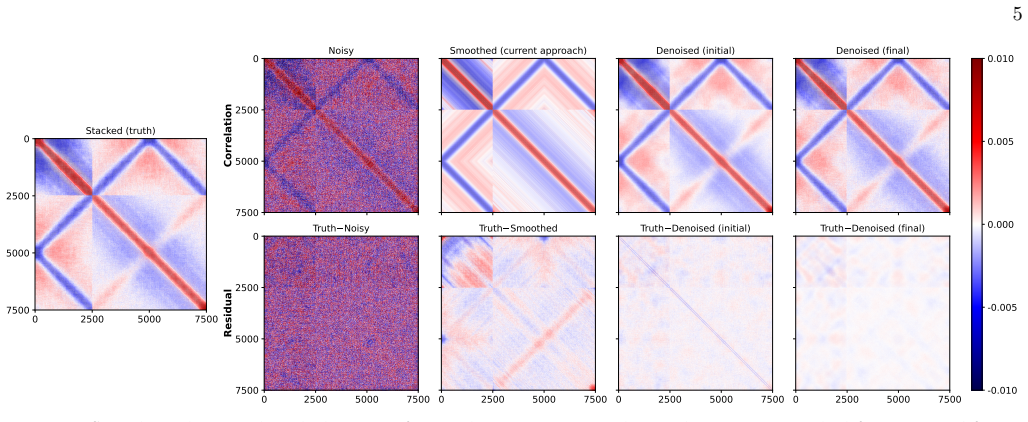
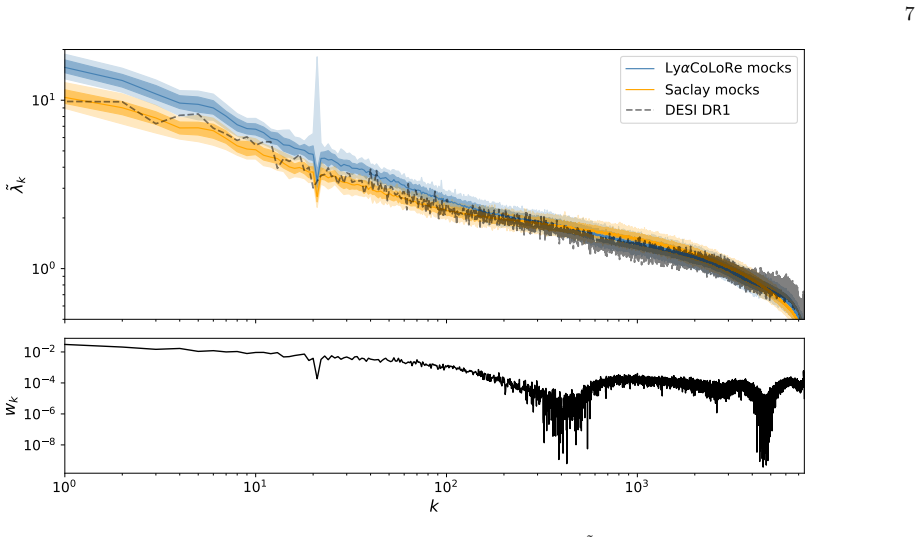
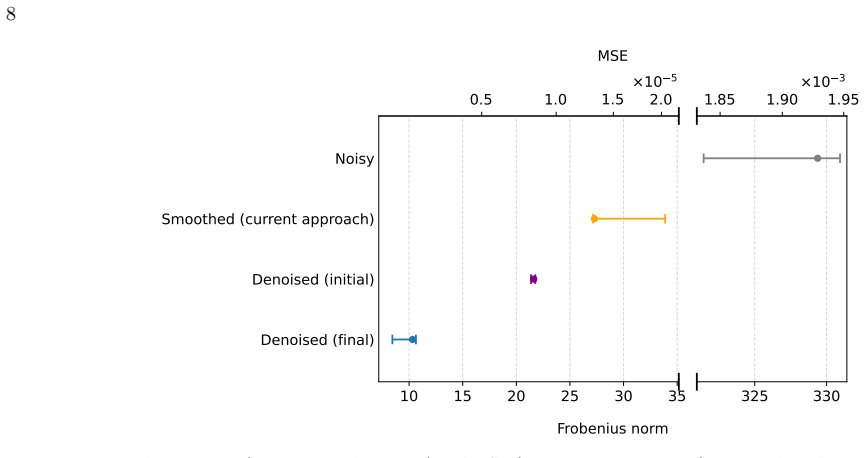
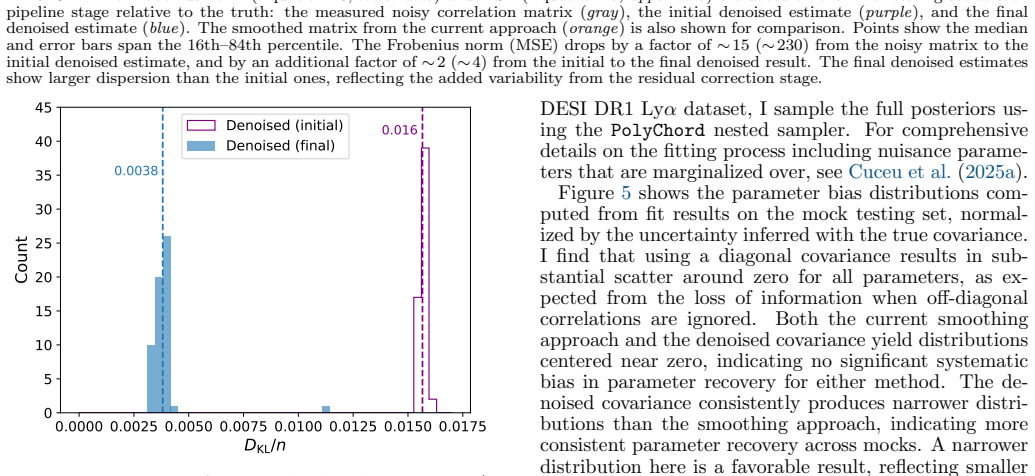
The measured noisy covariance is first projected onto the eigenbasis of a mock-based reference to yield an initial denoised estimate; a weighted residual correction is then formed by projecting the noisy residual onto a second eigenbasis derived from a mock-trained classifier, and this combined reconstruction improves matrix-level metrics and cosmological parameter posterior recovery relative to smoothing when tested on withheld mock covariances.
What carries the argument
The multi-eigenbasis denoising procedure that performs an initial projection of the noisy covariance onto a mock-reference eigenbasis followed by a residual correction onto a classifier-derived eigenbasis.
If this is right
- The resulting covariance matrix becomes invertible and yields well-calibrated uncertainties in likelihood analyses.
- Cosmological parameter constraints from the denoised matrix align more closely with those from the true covariance than constraints from the smoothed matrix.
- The method reduces bias in recovered off-diagonal correlations compared with simple smoothing for the same data vector size.
- It enables joint use of auto- and cross-correlation measurements in the 3D Lyα forest without requiring an impractically large number of realizations.
Where Pith is reading between the lines
- The two-stage basis approach could be tested on other large-scale structure analyses that face similar sample-size limits.
- If the classifier eigenbasis encodes features shared across different mock suites, the method might transfer to real data with minimal retraining.
- Combining more than two reference eigenbases might further reduce residual noise in even higher-dimensional covariance matrices.
Load-bearing premise
The eigenbases extracted from the mock simulations accurately capture the true correlation structure that exists in the real observational data.
What would settle it
On held-out mocks, the parameter posteriors obtained with the denoised covariance deviate from those obtained with the covariance measured from many independent realizations by more than the reported improvement margin.
Figures
read the original abstract
Accurate covariance matrix estimation is crucial to cosmological analyses, enabling unbiased parameter inference with well-calibrated uncertainties. Obtaining a reliable estimate generally requires far more independent samples than the dimension of the data vector, which is not always feasible. This challenge is especially relevant for the 3D Ly$\alpha$ forest analysis, which measures the Ly$\alpha$ auto-correlation and its cross-correlation with quasars in bins of comoving separation to jointly constrain cosmological parameters. The consequence is a very large data vector, and the data-driven covariance measured from sub-samples is non-invertible. The current approach applies a smoothing procedure to the off-diagonals of the correlation matrix to establish invertibility, but this does not fully capture the true correlation structure. In this work, I present a novel multi-eigenbasis denoising method for the data-driven covariance matrix, developed in the context of the 3D Ly$\alpha$ forest analysis and conditioned on DESI DR1 mock simulations. The measured noisy covariance is first projected onto the eigenbasis of a mock-based reference, yielding an initial denoised estimate. A weighted residual correction is then constructed by projecting the noisy residual onto a second eigenbasis derived from a mock-trained classifier, capturing correlation structure not recovered in the initial reconstruction. I validate the method on mock covariances withheld from classifier training and find significant improvements over the current smoothing-based approach in matrix-level reconstruction metrics and in the recovery of cosmological parameter posteriors when compared to those obtained from the true covariance measured from many mock realizations.
Editorial analysis
A structured set of objections, weighed in public.
Referee Report
Summary. The paper proposes a multi-eigenbasis denoising method for covariance matrices in 3D Lyα forest analyses. The noisy data-driven covariance is first projected onto the eigenbasis of a mock-derived reference covariance; a weighted residual is then projected onto a second eigenbasis obtained from a mock-trained classifier to capture additional correlation structure. Validation on mock covariances withheld from classifier training reports improvements over the standard smoothing procedure both in matrix reconstruction metrics and in the recovery of cosmological parameter posteriors relative to the covariance measured from a large number of mocks.
Significance. If the reported gains hold when the method is applied to real observations, the approach would address a practical bottleneck in high-dimensional cosmological analyses where the sample covariance is singular or noisy. The explicit use of withheld mocks for validation and the comparison against both smoothing and the “true” mock covariance constitute a clear, reproducible test of the internal consistency of the procedure.
major comments (2)
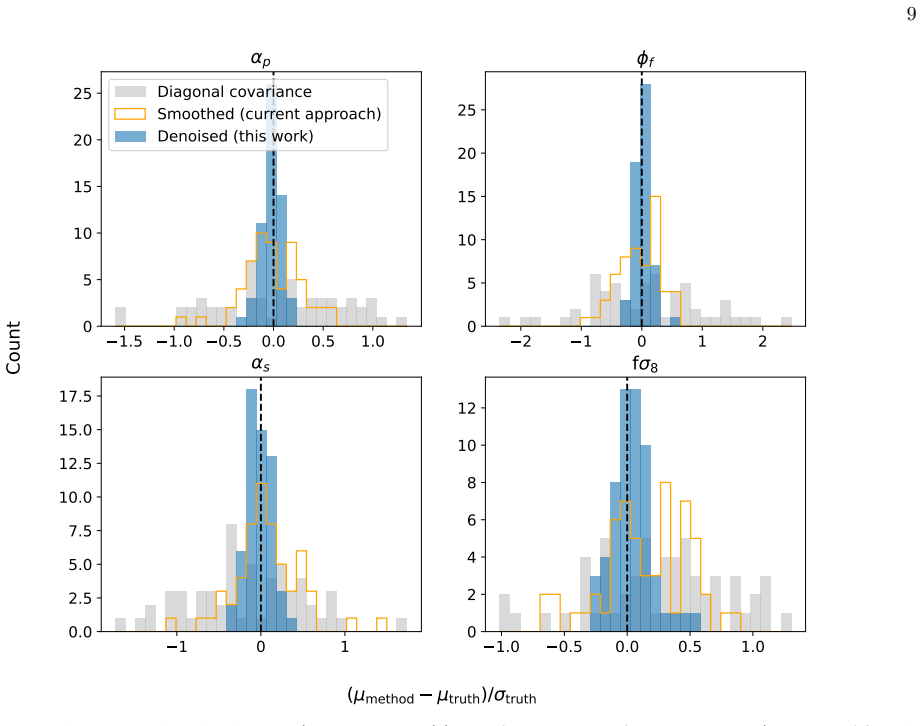
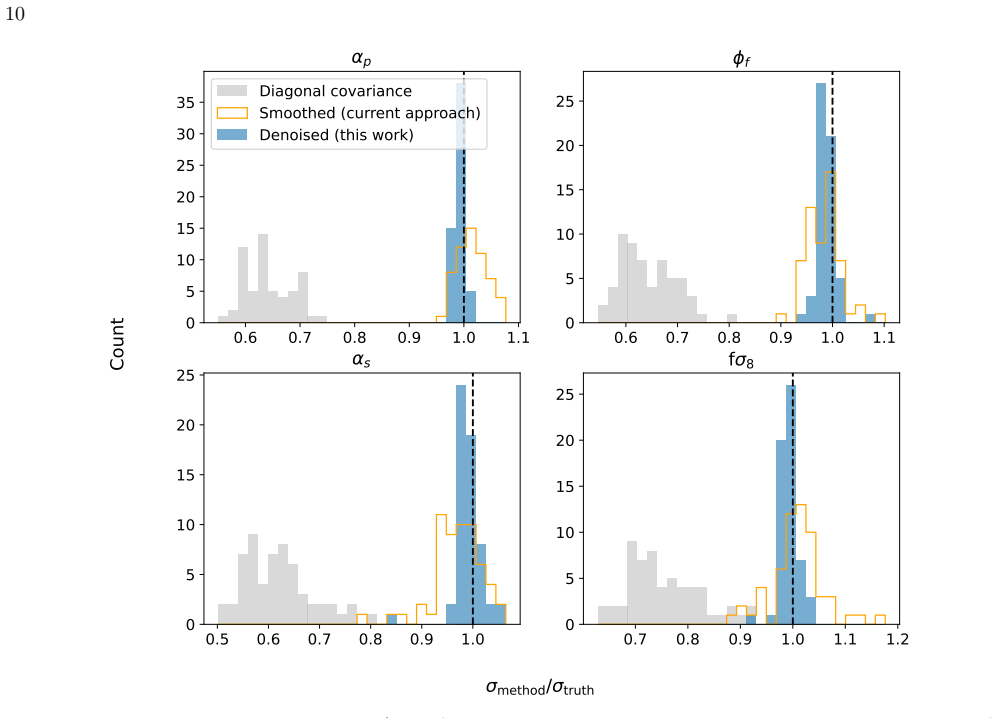
- [§4] §4 (validation): all quantitative improvements in matrix metrics and posterior recovery are demonstrated exclusively on mock covariances drawn from the same DESI DR1 mock suite used to construct both eigenbases. No test is presented that quantifies degradation when the mock correlation structure is deliberately mismatched to the test covariance (e.g., by rescaling off-diagonal elements or altering the input cosmology), which is the central assumption required for application to real data.
- [§3.2] §3.2 (residual correction): the scalar weight multiplying the classifier-derived residual correction is tuned on the training mocks. The manuscript does not show that the optimal weight remains stable under variations in mock realism or that the final cosmological posteriors are insensitive to reasonable changes in this weight; because the weight is the only free parameter, its robustness is load-bearing for the claim of improved inference.
minor comments (2)
- [§2] The notation for the two eigenbases (reference vs. classifier) is introduced without a compact symbol table; a short table in §2 or §3 would improve readability.
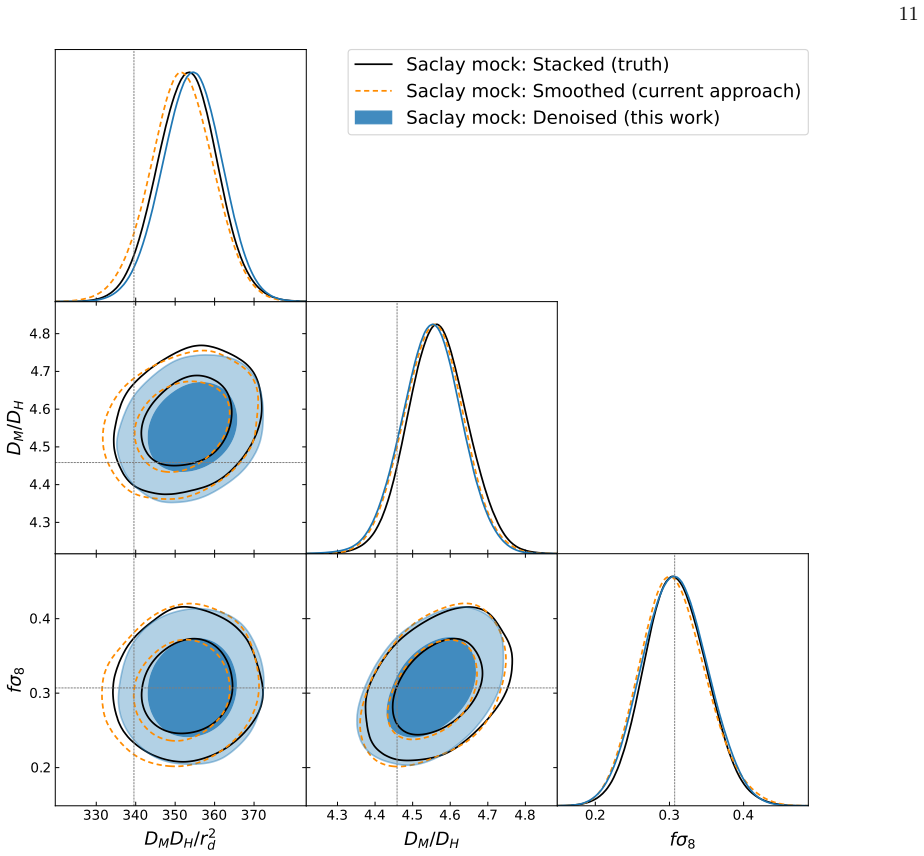
- [Figure 3] Figure 3 caption does not state the number of withheld mocks used for the posterior comparison; adding this number would allow direct assessment of statistical significance of the reported improvement.
Simulated Author's Rebuttal
We thank the referee for their detailed and constructive report. We address the major comments below and propose revisions to strengthen the manuscript.
read point-by-point responses
-
Referee: [§4] §4 (validation): all quantitative improvements in matrix metrics and posterior recovery are demonstrated exclusively on mock covariances drawn from the same DESI DR1 mock suite used to construct both eigenbases. No test is presented that quantifies degradation when the mock correlation structure is deliberately mismatched to the test covariance (e.g., by rescaling off-diagonal elements or altering the input cosmology), which is the central assumption required for application to real data.
Authors: We agree that the lack of tests on mismatched mocks is a limitation for claiming applicability to real data. The current results validate the method when the test covariance shares the same underlying structure as the training mocks. To address this concern, we will add a new analysis in the revised §4, where we deliberately mismatch the test covariances by altering the input cosmology or rescaling off-diagonal correlations, and quantify the performance relative to the true covariance and the smoothing method. revision: yes
-
Referee: [§3.2] §3.2 (residual correction): the scalar weight multiplying the classifier-derived residual correction is tuned on the training mocks. The manuscript does not show that the optimal weight remains stable under variations in mock realism or that the final cosmological posteriors are insensitive to reasonable changes in this weight; because the weight is the only free parameter, its robustness is load-bearing for the claim of improved inference.
Authors: The scalar weight is the sole tunable parameter and was optimized on the training set. We will revise the manuscript to include a sensitivity analysis, varying the weight around its optimal value and assessing the impact on the recovered cosmological posteriors. Additionally, we will test the stability using different training mock subsets to demonstrate robustness. revision: yes
Circularity Check
No significant circularity; method is an empirical denoising procedure validated on held-out mocks.
full rationale
The paper defines a multi-eigenbasis procedure that projects a noisy data-driven covariance first onto a mock-derived reference eigenbasis and then applies a residual correction from a second mock-trained classifier eigenbasis. Validation metrics and posterior recovery are computed on withheld mock covariances and compared to the ensemble 'true' covariance obtained from many independent mock realizations. No equation or step in the provided description reduces the claimed improvement to a fitted parameter or self-definition by construction; the mock bases are external inputs, the test set is withheld, and the comparison target is the direct ensemble average rather than any quantity derived from the denoising itself. No self-citations, uniqueness theorems, or ansatzes are invoked as load-bearing elements. The derivation chain is therefore self-contained as a simulation-conditioned algorithm whose performance claims rest on explicit out-of-sample comparison rather than tautological reduction.
Axiom & Free-Parameter Ledger
free parameters (1)
- weight for residual correction
axioms (1)
- domain assumption Mock simulations accurately reproduce the true covariance structure of the observational data
Reference graph
Works this paper leans on
-
[1]
G., Aguilar, J., Ahlen, S., et al
Adame, A. G., Aguilar, J., Ahlen, S., et al. 2025, J. Cosmology Astropart. Phys., 2025, 124, doi: 10.1088/1475-7516/2025/01/124
-
[2]
Alcock, C., & Paczynski, B. 1979, Nature, 281, 358, doi: 10.1038/281358a0
-
[3]
Bautista, J. E., Busca, N. G., Guy, J., et al. 2017, A&A, 603, A12, doi: 10.1051/0004-6361/201730533
-
[4]
Blomqvist, M., du Mas des Bourboux, H., Busca, N. G., et al. 2019, A&A, 629, A86, doi: 10.1051/0004-6361/201935641
-
[5]
2025, arXiv e-prints, arXiv:2506.15262
Busca, N., Rich, J., Bautista, J., et al. 2025, arXiv e-prints, arXiv:2506.15262. https://arxiv.org/abs/2506.15262
arXiv 2025
-
[6]
G., Delubac, T., Rich, J., et al
Busca, N. G., Delubac, T., Rich, J., et al. 2013, A&A, 552, A96, doi: 10.1051/0004-6361/201220724
-
[7]
Casas, L., Herrera-Alcantar, H. K., Chaves-Montero, J., et al. 2025, arXiv e-prints, arXiv:2503.14741, doi: 10.48550/arXiv.2503.14741
-
[8]
2021, MNRAS, 506, 5439, doi: 10.1093/mnras/stab1999
Cuceu, A., Font-Ribera, A., Joachimi, B., & Nadathur, S. 2021, MNRAS, 506, 5439, doi: 10.1093/mnras/stab1999
-
[9]
2023, MNRAS, 523, 3773, doi: 10.1093/mnras/stad1546
Cuceu, A., Font-Ribera, A., Martini, P., et al. 2023, MNRAS, 523, 3773, doi: 10.1093/mnras/stad1546
-
[10]
Cuceu, A., Herrera-Alcantar, H. K., Gordon, C., et al. 2025a, arXiv e-prints, arXiv:2509.15308, doi: 10.48550/arXiv.2509.15308 —. 2025b, J. Cosmology Astropart. Phys., 2025, 148, doi: 10.1088/1475-7516/2025/01/148
-
[11]
The Baryon Oscillation Spectroscopic Survey of SDSS-III
Dawson, K. S., Schlegel, D. J., Ahn, C. P., et al. 2013, AJ, 145, 10, doi: 10.1088/0004-6256/145/1/10
work page internal anchor Pith review doi:10.1088/0004-6256/145/1/10 2013
-
[12]
Dawson, K. S., Kneib, J.-P., Percival, W. J., et al. 2016, AJ, 151, 44, doi: 10.3847/0004-6256/151/2/44 de Sainte Agathe, V., Balland, C., du Mas des Bourboux, H., et al. 2019, A&A, 629, A85, doi: 10.1051/0004-6361/201935638 de Santi, N. S. M., & Abramo, L. R. 2022, J. Cosmology Astropart. Phys., 2022, 013, doi: 10.1088/1475-7516/2022/09/013
-
[13]
The DESI Experiment Part I: Science,Targeting, and Survey Design
Delubac, T., Bautista, J. E., Busca, N. G., et al. 2015, A&A, 574, A59, doi: 10.1051/0004-6361/201423969 DESI Collaboration, Adame, A. G., Aguilar, J., et al. 2016, The DESI Experiment Part I: Science,Targeting, and Survey Design, doi: 10.48550/arXiv.1611.00036 —. 2022, AJ, 164, 207, doi: 10.3847/1538-3881/ac882b —. 2024, arXiv e-prints, arXiv:2404.03002,...
work page internal anchor Pith review Pith/arXiv arXiv doi:10.1051/0004-6361/201423969 2015
-
[14]
Dodelson, S., & Schneider, M. D. 2013, Phys. Rev. D, 88, 063537, doi: 10.1103/PhysRevD.88.063537 du Mas des Bourboux, H., Le Goff, J.-M., Blomqvist, M., et al. 2017, A&A, 608, A130, doi: 10.1051/0004-6361/201731731 du Mas des Bourboux, H., Rich, J., Font-Ribera, A., et al. 2020, ApJ, 901, 153, doi: 10.3847/1538-4357/abb085
-
[15]
Etourneau, T., Goff, J.-M. L., Rich, J., et al. 2024, J. Cosmology Astropart. Phys., 2024, 077, doi: 10.1088/1475-7516/2024/05/077
-
[16]
Denoising clustering covariance matrices with Rotational Invariant Estimators
Farina, A., Guidi, M., Veropalumbo, A., & Guida, C. 2026, arXiv e-prints, arXiv:2604.13851, doi: 10.48550/arXiv.2604.13851
work page internal anchor Pith review Pith/arXiv arXiv doi:10.48550/arxiv.2604.13851 2026
-
[17]
Farr, J., Font-Ribera, A., Bourboux, H. d. M. d., et al. 2020, J. Cosmology Astropart. Phys., 2020, 068, doi: 10.1088/1475-7516/2020/03/068
-
[18]
Font-Ribera, A., Arnau, E., Miralda-Escud´ e, J., et al. 2013, J. Cosmology Astropart. Phys., 2013, 018, doi: 10.1088/1475-7516/2013/05/018
-
[19]
Font-Ribera, A., Kirkby, D., Busca, N., et al. 2014, J. Cosmology Astropart. Phys., 2014, 027, doi: 10.1088/1475-7516/2014/05/027
-
[20]
2024, MNRAS, 528, 2667, doi: 10.1093/mnras/stae092 G´ orski, K
Font-Ribera, A. 2024, MNRAS, 528, 2667, doi: 10.1093/mnras/stae092 G´ orski, K. M., Hivon, E., Banday, A. J., et al. 2005, ApJ, 622, 759, doi: 10.1086/427976
-
[21]
Hartlap, J., Simon, P., & Schneider, P. 2007, A&A, 464, 399, doi: 10.1051/0004-6361:20066170
-
[22]
K., Mu˜ noz-Guti´ errez, A., Tan, T., et al
Herrera-Alcantar, H. K., Mu˜ noz-Guti´ errez, A., Tan, T., et al. 2025, J. Cosmology Astropart. Phys., 2025, 141, doi: 10.1088/1475-7516/2025/01/141
-
[23]
2017, MNRAS, 466, L83, doi: 10.1093/mnrasl/slw240 Kara¸ caylı, N
Joachimi, B. 2017, MNRAS, 466, L83, doi: 10.1093/mnrasl/slw240 Kara¸ caylı, N. G., Cuceu, A., Aguilar, J., et al. 2026, arXiv e-prints, arXiv:2603.04281, doi: 10.48550/arXiv.2603.04281
-
[24]
Kirkby, D., Margala, D., Slosar, A., et al. 2013, J. Cosmology Astropart. Phys., 2013, 024, doi: 10.1088/1475-7516/2013/03/024
-
[25]
Kullback, S., & Leibler, R. A. 1951, Ann. Math. Stat., 22, 79
1951
-
[26]
Lam, C. 2016, Ann. Stat., 44, 928, doi: 10.1214/15-AOS1393
-
[27]
Ledoit, O., & Wolf, M. 2012, Ann. Stat., 40, 1024, doi: 10.1214/12-aos989
-
[28]
2021, MNRAS, 502, 3510, doi: 10.1093/mnras/stab177
Liu, B., & Bordoloi, R. 2021, MNRAS, 502, 3510, doi: 10.1093/mnras/stab177
-
[29]
Looijmans, M. J., Wang, M. S., & Beutler, F. 2025, MNRAS, 537, 21, doi: 10.1093/mnras/stae2786 14
-
[30]
2021, simqso: Simulated quasar spectra generator, Astrophysics Source Code Library, record ascl:2106.008
McGreer, I., Moustakas, J., & Schindler, J. 2021, simqso: Simulated quasar spectra generator, Astrophysics Source Code Library, record ascl:2106.008. http://ascl.net/2106.008
2021
-
[31]
J., Friedrich, O., Sellentin, E., & Heavens, A
Percival, W. J., Friedrich, O., Sellentin, E., & Heavens, A. 2022, MNRAS, 510, 3207, doi: 10.1093/mnras/stab3540
-
[32]
Percival, W. J., Ross, A. J., S´ anchez, A. G., et al. 2014, MNRAS, 439, 2531, doi: 10.1093/mnras/stu112
-
[33]
Philcox, O. H. E., Ivanov, M. M., Zaldarriaga, M., Simonovi´ c, M., & Schmittfull, M. 2021, Phys. Rev. D, 103, 043508, doi: 10.1103/PhysRevD.103.043508
-
[34]
2025, A&A, 698, A292, doi: 10.1051/0004-6361/202453377 Planck Collaboration, Ade, P
Pistis, F., Fumagalli, M., Fossati, M., et al. 2025, A&A, 698, A292, doi: 10.1051/0004-6361/202453377 Planck Collaboration, Ade, P. A. R., Aghanim, N., et al. 2016, A&A, 594, A13, doi: 10.1051/0004-6361/201525830 Planck Collaboration, Aghanim, N., Akrami, Y., et al. 2020, A&A, 641, A6, doi: 10.1051/0004-6361/201833910
-
[35]
Pope, A. C., & Szapudi, I. 2008, MNRAS, 389, 766, doi: 10.1111/j.1365-2966.2008.13561.x Pˆ aris, I., Petitjean, P., Rollinde, E., et al. 2011, A&A, 530, A50, doi: 10.1051/0004-6361/201016233 Ram´ ırez-P´ erez, C., Sanchez, J., Alonso, D., & Font-Ribera, A. 2022, J. Cosmology Astropart. Phys., 2022, 002, doi: 10.1088/1475-7516/2022/05/002 Ram´ ırez-P´ erez...
-
[36]
Sellentin, E., & Heavens, A. F. 2016, MNRAS, 456, L132, doi: 10.1093/mnrasl/slv190
-
[37]
Slosar, A., Font-Ribera, A., Pieri, M. M., et al. 2011, J. Cosmology Astropart. Phys., 2011, 001, doi: 10.1088/1475-7516/2011/09/001
-
[38]
Slosar, A., Irˇ siˇ c, V., Kirkby, D., et al. 2013, J. Cosmology Astropart. Phys., 2013, 026, doi: 10.1088/1475-7516/2013/04/026
-
[39]
Suzuki, N., Tytler, D., Kirkman, D., O’Meara, J. M., & Lubin, D. 2005, ApJ, 618, 592, doi: 10.1086/426062
-
[40]
2014, MNRAS, 442, 2728, doi: 10.1093/mnras/stu996
Taylor, A., & Joachimi, B. 2014, MNRAS, 442, 2728, doi: 10.1093/mnras/stu996
-
[41]
2013, MNRAS, 432, 1928, doi: 10.1093/mnras/stt270
Taylor, A., Joachimi, B., & Kitching, T. 2013, MNRAS, 432, 1928, doi: 10.1093/mnras/stt270
-
[42]
Turner, W., Martini, P., Kara¸ caylı, N. G., et al. 2024, ApJ, 976, 143, doi: 10.3847/1538-4357/ad8239
-
[43]
Turner, W., Cuceu, A., Martini, P., et al. 2026, J. Cosmology Astropart. Phys., 2026, 010, doi: 10.1088/1475-7516/2026/05/010 APPENDIX SENSITIVITY TO CHOICE OF REFERENCE MATRIX As discussed in Section 3, I derive the initial eigenbasis from a reference correlation matrix based on a combina- tion of Saclay and LyαCoLoRe mocks. I assume that the true correl...
discussion (0)
Sign in with ORCID, Apple, or X to comment. Anyone can read and Pith papers without signing in.