REVIEW 5 major objections 7 minor 74 references
Navigating Cookie Consent Violations Across the Globe
T0 review · 5 major / 7 minor · reviewed 2026-08-07 · deepseek-v4-flash
Pith's one-line read Across eight regions, 96–98% of popular websites violate cookie consent choices.
desk verdict A solid cross-region cookie consent measurement whose headline violation rates lean on a circular ground truth and are likely inflated, but the regional-difference story and tooling are real contributions. read the letter →
The pith
A machine-rendered reading of the paper's core claim, the machinery that carries it, and where it could break.
The reading
What carries the argument
The load-bearing object is ConsentChk, an end-to-end cookie consent auditing system. ConsentChk combines a random-forest cookie-button extractor that finds and clicks the hidden elements that open consent preference menus, a cookie consent exerciser that rejects all rejectable categories and reads the CMP's recorded choices, and a violation classifier that labels each observed cookie by comparing it with the CMP declaration list under simple logical rules: a cookie used despite rejection is an Ignored Cookie Rejection; a cookie used without appearing in the declaration is Undeclared; a cookie placed in both an accepted and a rejected category is a Wrong Cookie Category violation. The system's formal model equates cookies by name, domain, and path, and treats the consent cookie's domain as the scope of consent. This machinery lets the authors attribute each violation to a concrete mismatch between users' expressed preference, the CMP's declared cookie library, and the cookies actually transmitted.
What would settle it
Manually inspect the CMP dashboards or source code of a random sample of, say, 100 of the studied sites and check whether the cookies ConsentChk labeled 'undeclared' actually appear in the developer's own cookie inventory or in a full CMP rescan; if most of them are known to developers, the undeclared-cookie violation counts would shrink substantially.
Extended reading notes
Core claim
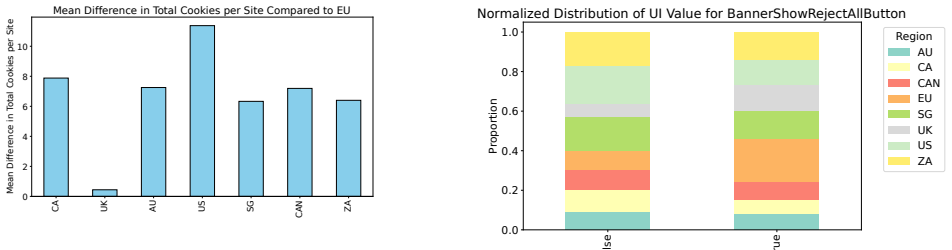
The paper's central claim is that cookie consent violations are the norm rather than the exception, and that they are strongly geolocation-dependent. Using its ConsentChk crawler, the authors measured 1,793 websites with cookie banners from servers in Ireland, the UK, California, Michigan, Canada, South Africa, Singapore, and Australia. They report that 96.18% to 97.72% of sites contain at least one violation, dominated by undeclared cookies (cookies placed without appearing in the CMP's declared cookie list) and ignored cookie rejections (cookies used despite explicit rejection). The same websites, accessed from the US, carry on average almost 12 more cookies and 10 more violations per site than when accessed from the EU; Canada, Singapore, South Africa, and Australia sit between these extremes with 6–8 more cookies and 5–7 more violations. The authors attribute this to CMPs shipping regional templates and geolocation rulesets, plus developers failing to keep cookie libraries and script blocking updated, producing banners whose text, consent model, and actual cookie behavior differ by region.
Load-bearing premise
The whole violation count rests on treating the CMP's cookie declaration list as the ground truth for which cookies are 'declared'; a cookie that developers knew about but that the CMP's automatic scanner missed is counted as an undeclared cookie.
Editorial extensions
If this is right
- If the claim holds, a user who clicks 'reject all' on a typical site cannot assume tracking has stopped: Google Analytics (_ga, _gid) and Meta (_fbp) cookies are among the most common consent-ignoring cookies.
- Regulators outside the EU and UK face a larger compliance gap than GDPR-focused audits suggest, with undeclared cookies appearing on 90.19% to 94.15% of sites depending on region.
- The EU and UK's higher rate of ignored rejections relative to undeclared cookies implies that better cookie declarations expose broken script blocking, so fixing declarations alone will not restore consent.
- CMPs' regional templates and geolocation rulesets, not just developer sloppiness, are a primary driver of cross-region differences, making the CMPs a natural point of regulatory and standardization pressure.
Reading between the lines
- A testable extension is to run the same ConsentChk procedure from residential IP addresses; if the regional gaps persist, the result is about CMP rulesets rather than datacenter IP geolocation artifacts.
- The inverse correlation between undeclared and ignored-rejection violations suggests a 'declaration compliance' trade-off that could be studied directly by instrumenting CMP dashboards to see which cookies developers consciously left uncategorized.
- If violations continue to rise by one to three percentage points every three years, as the paper's comparison with prior work hints, then regulatory enforcement targeting CMPs could be evaluated by re-measuring the same 1,793 sites after any enforcement action.
- The paper's personal-information detector could be turned into a continuous public audit: a recurring crawl of the same site list would yield an up-to-date, per-region violation index that regulators and users could consult.
Editorial analysis
A structured set of objections, weighed in public.
Referee Report
Summary. The paper presents ConsentChk, an automated system that crawls websites, interacts with cookie banner preference menus, rejects cookie categories, and classifies three types of cookie consent violations (Ignored Cookie Rejection, Undeclared Cookies, Wrong Cookie Category) using a formal rule-based model. The system is deployed on 1,793 English-language websites using select consent management platforms (OneTrust, CookiePro, Cookiebot) across eight regions, with ten repeated measurements per site. The central empirical claims are that 96.18% to 97.72% of sites contain at least one violation, that US sites have roughly 12 more cookies and 10 more violations per site than EU sites, and that these regional differences are associated with CMP geolocation rulesets and regional privacy-law interpretations.
Significance. If the claims hold, this is a valuable cross-regional measurement contribution: it extends prior single-region cookie-compliance studies to eight jurisdictions with the same website set, quantifies violation types at the individual-cookie level, and offers a concrete root-cause discussion grounded in CMP documentation. Strengths include the reproducible design (code and data released, albeit with patent-related restrictions), the use of repeated crawls, and the explicit formal definitions of violation types. The regional comparison is a genuinely new angle relative to much of the prior work. However, the headline violation rate rests on several assumptions that are not fully validated in the manuscript, including the personal-information filter, the denominator of sites actually analyzable for violations, and the treatment of the CMP's cookie library as the ground truth for 'declared' cookies. These issues do not appear fatal, but they currently make the quantitative headline stronger than the evidence presented.
major comments (5)
- [§5.1 and Contribution list] The denominator for the headline violation rate is ambiguous. The text states that ConsentChk found 1,793 websites with cookie banners and consent settings but analyzed the cookie consent behavior of only 1,312 sites containing cookie preference menus. The contribution section and abstract report a violation rate over '1,793 websites,' and Table 6 reports '% Websites.' If violation detection requires a preference menu, the correct denominator is 1,312, and reporting 1,793 either understates the rate or mixes two populations. Please state explicitly which denominator is used for each percentage in Table 6 and in the abstract, and justify the choice.
- [§5.4 and Table 5] The pairwise regional comparisons in §6.2 (Finding 5) and §6.4 are claimed to be 'statistically significant,' but the only tests reported in Table 5 are omnibus Levene and Kruskal-Wallis tests. The Kruskal-Wallis H test does not identify which region pairs differ, and no pairwise test statistics, p-values, or multiple-comparison corrections are presented. The claim that 'all other regions, particularly the US, have a significant increase compared to the EU and UK' is therefore not supported by the reported analysis. Please add appropriate pairwise tests (e.g., Dunn's test or Mann-Whitney with a correction such as Holm) or soften the claim to describe only the omnibus result.
- [§5.2 and Table 6] The personal-information filter is load-bearing but unvalidated. Section 5.2 states that 'unless stated otherwise, the reported results only include cookies that were detected to have personal information,' and Table 6 and the headline violation percentages are based on these filtered cookies. The PI detector is a keyword/regex/zxcvbn heuristic, yet no precision, recall, or manual validation is reported for it. If the PI detector has nontrivial error, the violation counts and the 96.18–97.72% claim could change materially. Please provide a validation of the PI classifier (e.g., a hand-labeled sample) or report the main results for both PI-only and all cookies.
- [§4.6 and §7.1] The validation of Undeclared Cookies is partly circular, and the ground-truth definition should be clarified. The detector flags a cookie as undeclared when it is absent from the CMP's cookie library, and §4.6 says correctness was checked 'using the CMP and sites' storage objects, such as en.json'—the same source that defines the violation. The manual check of whether cookies were unspecified in the actual cookie banner is the appropriate independent test, but its results are not reported separately from the storage-object check. In addition, §7.1 acknowledges that CMP crawlers can miss context-dependent cookies; by the paper's definition those cookies are undeclared, which is consistent as a user-visible disclosure measure, but the paper should state this explicitly and discuss how much of the 90.19–94.15% undeclared-cookie site rate could be driven by CMP crawler incompleteness rather than by developer inaction.
- [§5.3] The use of a union across ten repeated measurements in Table 6 can inflate the per-site violation percentages. Section 5.3 states that 'in reporting total violation counts (Table 6), we report the union across the 10 measurements,' and the headline '% Websites' figures are likely derived from this union. Given the paper's own observation that cookie loading is non-deterministic, a site with a single one-off cookie in one crawl counts as a violator. Please also report the violation rate for a single crawl or the per-measurement consistency, so readers can assess whether the headline is dominated by rare, context-dependent cookies.
minor comments (7)
- [§3 and Table 3] The terminology is inconsistent: the text in §3 calls the third violation 'Wrong Cookie Category,' while Table 3 labels it 'Ambiguous Cookie Category Violation.' Please unify the naming.
- [§4.6] The sentence 'This roughly 90% FPR from manual validation or reproduction likely resulted...' mislabels the reported numbers as false positive rates; the preceding text reports precisions of 92.1%, 91.2%, and 87%, which are not FPRs. Please correct the terminology.
- [Table 5] The column header 'Levene's H-Test (p)' appears to conflate two different tests: the first value in each cell is the Levene p-value and the second is a Kruskal-Wallis H statistic with its p-value. Please split these into clearly labeled columns.
- [§5.1] The text says 'the five categories defined by cookie libraries we selected — OneTrust, CookiePro, and Cookiebot,' but only three CMPs are listed; please correct the count or specify what the five categories refer to.
- [§4.2] The description of cookie-name pattern matching is unclear: '_gaxxx or _ga### ... an x or # to match any single character. However, a single # at the end matches any alpha-numeric string.' Please give a precise grammar or examples for how wildcard characters are interpreted.
- [§6.3 and §6.4] The US per-site cookie averages are reported inconsistently: §6.3 says 'US sites average 46.5 first-party and 37.3 third-party cookies per site,' while Finding 2 in §6.2 reports 'roughly 35.4 (1st-party) and 29.03 (3rd-party) cookies per site' for US-MI. Please reconcile these numbers or clarify whether they refer to different subsets or measurement periods.
- [§3 and Abstract] The paper's own caveat in §3 that these behaviors 'may not violate the laws' sits uneasily with the abstract's language of 'non-compliant' cookie consent. Please align the wording so that the legal interpretation is stated as a possibility rather than a settled conclusion.
Circularity Check
Undeclared-cookie violations and their precision validation reduce by construction to the CMP's own cookie library (e.g., en.json); since undeclared cookies dominate the violation counts, the headline 96-98% rate is partly inflated, though independent violations remain.
-
self definitional
[Section 3 (Table 3), Section 4.5, Section 4.6; Section 7.1]
"Undeclared Cookies Violation Cookie used without appearing in cookie library Undeclared ⇔ c ∉ Ac ∧ c ∉ Rc. ... Cookies placed without being declared in the cookie library set by the CMP are Undeclared Cookie Violations. ... We checked the correctness of the detected cookie consent violations using the CMP and sites' storage objects, such as en.json."
By Table 3, an Undeclared Cookies violation is defined as a cookie absent from the CMP cookie library (Ac/Rc are derived from CMP declarations such as OneTrust en.json), and Section 4.5 classifies exactly that set difference. The precision validation in Section 4.6 then re-checks the same storage objects ('using the CMP and sites' storage objects, such as en.json'), so for the dominant violation type the ground truth and the detector share the same source; the reported >91% precision cannot detect false positives caused by CMP scanning gaps. Section 7.1 concedes that content loaded only in specific contexts can evade CMP auto-crawlers, so absence from en.json conflates developer nondisclosure with scanner failure.
full rationale
The paper's central empirical contribution is a measurement study, not a derived first-principles model, and most of its pipeline is not circular: cookie placement is observed via network traffic, consent choices are exercised through real banner interactions, and regional comparisons are based on repeated crawls rather than fitted parameters. The formal model in Table 3 is a pre-specified taxonomy, not a result derived from the data. There are no load-bearing self-citations or imported uniqueness theorems; the self-citations that appear are for minor methodological points (e.g., recall@k, contradictory-policy analysis) and do not carry the central claim. The one substantive circularity is the Undeclared Cookies definition and its validation. The violation is defined as absence from the CMP cookie library, the classifier implements that definition, and the precision check reuses the same library as ground truth. The paper's own Section 7.1 further admits that CMP crawlers can miss context-dependent cookies, so the set difference that constitutes 'undeclared' may include cookies that were never omitted by the developer but simply not scanned by the CMP. Because undeclared cookies form the largest share of the reported violations and drive the 96-98% headline, part of the central claim reduces by construction. I therefore assign a partial circularity score of 6, while noting that the ignored-rejection findings (over 80% of sites in every region) and the cross-region cookie-count differences are independently measured and would remain meaningful even if the undeclared-cookie counts were recalibrated.
Assumptions & free parameters
free parameters (2)
- Button extractor threshold n_t=9 =
9 tokens
- Top-k candidate buttons k=5 =
5
assumptions (4)
- domain assumption CMP cookie declaration lists (e.g., OneTrust en.json) are a reliable ground truth for which cookies are declared or undeclared.
- domain assumption The three consent-enforcement conditions (consent recorded, cookie matches, page in scope) correctly determine when a website should block a cookie after rejection.
- domain assumption Cloud provider IP addresses (AWS, DigitalOcean) are adequate proxies for the legal jurisdiction of real users in each region.
- domain assumption The random subpage navigation produces a representative sample of cookies used on the whole site.
invented entities (1)
-
No new entities are introduced.
Cite this review
Pith. "Pith review of Navigating Cookie Consent Violations Across the Globe." pith.science (2026). https://pith.science/paper/BHCEJRIP
@misc{pith2026250608996,
  author       = {Pith},
  title        = {Pith review of: Navigating Cookie Consent Violations Across the Globe},
  year         = {2026},
  howpublished = {\url{https://pith.science/paper/BHCEJRIP}},
  note         = {Machine review of arXiv:2506.08996}
}
read the original abstract
Online services provide users with cookie banners to accept/reject the cookies placed on their web browsers. Despite the increased adoption of cookie banners, little has been done to ensure that cookie consent is compliant with privacy laws around the globe. Prior studies have found that cookies are often placed on browsers even after their explicit rejection by users. These inconsistencies in cookie banner behavior circumvent users' consent preferences and are known as cookie consent violations. To address this important problem, we propose an end-to-end system, called ConsentChk, that detects and analyzes cookie banner behavior. ConsentChk uses a formal model to systematically detect and categorize cookie consent violations. We investigate eight English-speaking regions across the world, and analyze cookie banner behavior across 1,793 globally-popular websites. Cookie behavior, cookie consent violation rates, and cookie banner implementations are found to be highly dependent on region. Our evaluation reveals that consent management platforms (CMPs) and website developers likely tailor cookie banner configurations based on their (often incorrect) interpretations of regional privacy laws. We discuss various root causes behind these cookie consent violations. The resulting implementations produce misleading cookie banners, indicating the prevalence of inconsistently implemented and enforced cookie consent between various regions.
Figures


Figures from the paper (12 more)




Reference graph
Works this paper leans on
-
[1]
A.T. v. Globe24h.com, 2017 FC 114 (CanLII), 2017. URL: https : / / www . canlii . org / en / ca / fct / doc / 2017 / 2017fc114/2017fc114.html
work page 2017
-
[2]
The web changes everything: understanding the dynamics of web content
Eytan Adar, Jaime Teevan, Susan T Dumais, and Jonathan L Elsas. The web changes everything: understanding the dynamics of web content. In Proceedings of the Second ACM International Conference on Web Search and Data Mining, 2009
work page 2009
-
[3]
Adding, Editing, and Managing Cookie Consent Templates | MyOneTrust, 2024. URL: https : / / my . onetrust . com / s / article / UUID - e7563ab0 - d1f6 - 8a0f - a2c6 - 101b7e363fba ? language = en _ US & topicId = 0TO1Q000000ItTNWA0
work page 2024
-
[4]
PolicyLint: Investigating Internal Privacy Pol- icy Contradictions on Google Play
Benjamin Andow, Samin Yaseer Mahmud, Wenyu Wang, Justin Whitaker, William Enck, Bradley Reaves, Kapil Singh, and Tao Xie. PolicyLint: Investigating Internal Privacy Pol- icy Contradictions on Google Play. In 28th USENIX Secu- rity Symposium (USENIX Security 19), 2019. URL: https: //www.usenix.org/conference/usenixsecurity19/ presentation/andow
work page 2019
-
[5]
Say hello to cookie auto-blocking
Ashlea Cartee. Say hello to cookie auto-blocking. CookiePro
-
[6]
HTTP state management mechanism
Adam Barth. HTTP state management mechanism. 2011. URL: https://tools.ietf.org/html/rfc6265 (visited on 12/31/2024)
work page 2011
-
[7]
Puppeteer-extra-plugin-stealth
Berstend. Puppeteer-extra-plugin-stealth. npm. 2021. URL: https://www.npmjs.com/package/puppeteer-extra- plugin-stealth (visited on 06/30/2024)
work page 2021
-
[8]
European Data Protection Board. The belgian DPA has im- posed a fine of C15000 on a website specialized in legal news | european data protection board. 2019.URL: https://edpb. europa.eu/news/national-news/2019/belgian-dpa- has- imposed- fine- eu15000- website- specialized- legal-news_en (visited on 06/02/2024)
work page 2019
Show all 74 references
-
[9]
Automating cookie consent and GDPR violation detection
Dino Bollinger, Karel Kubicek, Carlos Cotrini, and David Basin. Automating cookie consent and GDPR violation detection. In 31st USENIX Security Symposium (USENIX Security 22) , 2022. URL: https : / / www . usenix . org / conference / usenixsecurity22 / presentation / bollinger
2022
-
[10]
Automated, large-scale analysis of cookie notice compliance
Ahmed Bouhoula, Karel Kubicek, Amit Zac, Carlos Cotrini, and David Basin. Automated, large-scale analysis of cookie notice compliance. In USENIX Security Symposium, 2023
2023
-
[11]
A us-uk usabil- ity evaluation of consent management platform cookie con- sent interface design on desktop and mobile
Elijah Robert Bouma-Sims, Megan Li, Yanzi Lin, Adia Sakura-Lemessy, Alexandra Nisenoff, Ellie Young, Eleanor Birrell, Lorrie Faith Cranor, and Hana Habib. A us-uk usabil- ity evaluation of consent management platform cookie con- sent interface design on desktop and mobile. In ...
2023
-
[12]
Shin, Jong-Min Choi, and Jun- bum Shin
Duc Bui, Yuan Yao, Kang G. Shin, Jong-Min Choi, and Jun- bum Shin. Consistency analysis of data-usage purposes in mobile apps. In ACM SIGSAC Conference on Computer and Communications Security (CCS), 2021
2021
-
[13]
Privacy Compliance Usage Distribution in the Top 1 Million Sites
BuiltWith. Privacy Compliance Usage Distribution in the Top 1 Million Sites. 2022. URL: https://web.archive. org / web / 20220528205303 / https : / / trends . builtwith.com/widgets/privacy-compliance (visited on 05/28/2024)
2022
-
[14]
URL: https://www.oag.ca.gov/privacy/ccpa
California Consumer Privacy Act (CCPA), 2025. URL: https://www.oag.ca.gov/privacy/ccpa
2025
-
[15]
Make entire div clickable
Chris Coyier. Make entire div clickable. CSS-Tricks. 2021. URL: https : / / css - tricks . com / snippets / jquery / make-entire-div-clickable/ (visited on 03/01/2024). 15
2021
-
[16]
Goldenshores technologies, LLC, and erik m
Federal Trade Commission. Goldenshores technologies, LLC, and erik m. geidl, in the matter of. Federal Trade Com- mission. 2013. URL: http : / / www . ftc . gov / legal - library / browse / cases - proceedings / 132 - 3087 - goldenshores - technologies - llc - erik - m - geidl...
2013
-
[17]
Functions | The Cookiebot CMP solution, 2021
Cookiebot. Functions | The Cookiebot CMP solution, 2021. URL: https : / / www . cookiebot . com / en / functions/ (visited on 08/03/2024)
2021
-
[18]
New UK-GDPR law after Brexit, 2021
Cookiebot. New UK-GDPR law after Brexit, 2021. URL: https://www.cookiebot.com/en/uk-gdpr/ (visited on 09/19/2024)
2021
-
[19]
Cookiebot Set Up Guide - How to Install Cookiebot CMP,
-
[20]
OneTrust cookie auto-blocking™
CookiePro. OneTrust cookie auto-blocking™. 2021. URL: https://community.cookiepro.com/s/article/UUID- c5122557- 2070- 65cb- 2612- f2752c0cc4aa (visited on 01/14/2025)
2021
-
[21]
Automatic cookie blocking - how does it work? Cook- iebot Support
Cybot. Automatic cookie blocking - how does it work? Cook- iebot Support. 2019. URL: https://support.cookiebot. com/hc/en- us/articles/360009063100- Automatic- Cookie - Blocking - How - does - it - work - (visited on 01/14/2025)
2019
-
[22]
Cookiebot: check your ’unclassified cookies’
Cybot. Cookiebot: check your ’unclassified cookies’. Cook- iebot Support. 2021. URL: https : / / bit . ly / 383S0aV (visited on 01/14/2025)
2021
-
[23]
Developer - setting up cookiebot CMP
Cybot. Developer - setting up cookiebot CMP. 2021. URL: https://www.cookiebot.com/en/developer/ (visited on 01/14/2025)
2021
-
[24]
Duration of CookieConsent 2020
Cybot. Duration of CookieConsent 2020. Cookiebot Sup- port. 2020. URL: https://bit.ly/3yWzpcE (visited on 08/16/2021)
2020
-
[25]
France: CNIL fines société du figaro C50,000 for placing advertising cookies without user consent
DataGuidance. France: CNIL fines société du figaro C50,000 for placing advertising cookies without user consent. DataGuidance. 2021. URL: https://www.dataguidance. com / news / france - cnil - fines - soci % C3 % A9t % C3 % A9- du- figaro- %E2%82%AC50000- placing (visited on 0...
2021
-
[26]
We value your privacy
Martin Degeling, Christine Utz, Christopher Lentzsch, Henry Hosseini, Florian Schaub, and Thorsten Holz. We value your privacy ... now take some cookies: measuring the GDPR’s impact on web privacy. In Proceedings 2019 Network and Distributed System Security Symposium, 2019
2019
-
[27]
A large-scale study of cookie banner inter- action tools and their impact on users’ privacy.Proceedings on Privacy Enhancing Technologies, 2024
Nurullah Demir, Tobias Urban, Norbert Pohlmann, and Chris- tian Wressnegger. A large-scale study of cookie banner inter- action tools and their impact on users’ privacy.Proceedings on Privacy Enhancing Technologies, 2024
2024
-
[28]
The impact of user location on cookie notices (inside and outside of the european union)
Rob van Eijk, Hadi Asghari, Philipp Winter, and Arvind Narayanan. The impact of user location on cookie notices (inside and outside of the european union). In Workshop on Technology and Consumer Protection (ConPro’19), 2019
2019
-
[29]
TCF v2.0 - IAB europe
IAB Europe. TCF v2.0 - IAB europe. https://iabeurope.eu/
-
[30]
Official Journal of the European Union , L119, 2016
Regulation (EU) 2016/679 of the European Parliament and of the Council of 27 April 2016 on the protection of natu- ral persons with regard to the processing of personal data and on the free movement of such data, and repealing Direc- tive 95/46/EC (General Data Protection Regu...
2016
-
[31]
Ghostery/autoconsent, 2022
Ghostery. Ghostery/autoconsent, 2022. URL: https : / / github . com / ghostery / autoconsent (visited on 01/11/2025)
2022
-
[32]
Compact Language Detector v3 (CLD3), 2021
Google Inc. Compact Language Detector v3 (CLD3), 2021. URL: https : / / github . com / google / cld3(visited on 06/27/2021)
2021
-
[33]
URL: https : / / www
Guidelines on privacy and online behavioural advertising - Office of the Privacy Commissioner of Canada, 2021. URL: https : / / www . priv . gc . ca / en / privacy - topics / technology / online - privacy - tracking - cookies / tracking-and-ads/gl_ba_1112
2021
-
[34]
Shin, and Karl Aberer
Hamza Harkous, Kassem Fawaz, Rémi Lebret, Florian Schaub, Kang G. Shin, and Karl Aberer. Polisis: Automated Analysis and Presentation of Privacy Policies Using Deep Learning. In 27th USENIX Security Symposium (USENIX Security 18), 2018
2018
-
[35]
Woods, and Rainer Böhme
Maximilian Hils, Daniel W. Woods, and Rainer Böhme. Mea- suring the emergence of consent management on the web. In Proceedings of the ACM Internet Measurement Confer- ence, 2020. URL: https://doi.org/10.1145/3419394. 3423647
2020 doi
-
[36]
Chrome DevTools Protocol, 2021
Google Inc. Chrome DevTools Protocol, 2021. URL: https: / / chromedevtools . github . io / devtools - protocol/ (visited on 12/29/2024)
2021
-
[37]
Swarm mode, 2021
Docker Inc. Swarm mode, 2021. URL: https : / / docs . docker.com/engine/swarm/ (visited on 08/01/2021)
2021
-
[38]
Johnny can’t revoke con- sent either: measuring compliance of consent revocation on the web
Gayatri Priyadarsini Kancherla, Nataliia Bielova, Cristiana Santos, and Abhishek Bichhawat. Johnny can’t revoke con- sent either: measuring compliance of consent revocation on the web. arXiv preprint arXiv:2411.15414, 2024
2024 arXiv
-
[39]
CookieEnforcer: Automated Cookie Notice Analysis and Enforcement
Rishabh Khandelwal, Asmit Nayak, Hamza Harkous, and Kassem Fawaz. CookieEnforcer: Automated Cookie Notice Analysis and Enforcement. Technical report arXiv:2204.04221, arXiv, 2022. URL: http://arxiv.org/ abs/2204.04221 (visited on 05/31/2022)
2022 arXiv
-
[40]
Section 11 Consent, justification and ob- jection - POPIA
Accessible Law. Section 11 Consent, justification and ob- jection - POPIA. POPIA, 2020. URL: https : / / popia . co . za / section - 11 - consent - justification - and - objection
2020
-
[41]
Section 5 Rights of data subjects - POPIA
Accessible Law. Section 5 Rights of data subjects - POPIA. POPIA, 2019. URL: https://popia.co.za/section-5- rights-of-data-subjects
2019
-
[42]
Tranco: a research-oriented top sites ranking hardened against manipulation
Victor Le Pochat, Tom Van Goethem, Samaneh Ta- jalizadehkhoob, Maciej Korczy ´nski, and Wouter Joosen. Tranco: a research-oriented top sites ranking hardened against manipulation. In Proceedings of the 26th Annual Network and Distributed System Security Symposium, 2019. 16
2019
-
[43]
Opted Out, Yet Tracked: Are Regulations Enough to Protect Your Privacy? Technical report arXiv:2202.00885, arXiv, 2022.URL: http: //arxiv.org/abs/2202.00885
Zengrui Liu, Umar Iqbal, and Nitesh Saxena. Opted Out, Yet Tracked: Are Regulations Enough to Protect Your Privacy? Technical report arXiv:2202.00885, arXiv, 2022.URL: http: //arxiv.org/abs/2202.00885
2022
-
[44]
Linking without an ’a’ tag
Will Bontrager Software LLC. Linking without an ’a’ tag
-
[45]
Do cookie banners respect my choice? : measuring legal compli- ance of banners from IAB europe’s transparency and consent framework
Célestin Matte, Nataliia Bielova, and Cristiana Santos. Do cookie banners respect my choice? : measuring legal compli- ance of banners from IAB europe’s transparency and consent framework. In 2020 IEEE Symposium on Security and Pri- vacy (SP), 2020
2020
-
[46]
Microsoft/playwright-python, 2025
Microsoft. Microsoft/playwright-python, 2025. URL: https: //github.com/microsoft/playwright-python (visited on 01/18/2025)
2025
-
[47]
Ninja cookie. 2022. URL: https://ninja- cookie.com/ (visited on 01/21/2025)
2022
-
[48]
URL: https://www.willmaster.com/library/ web- development/linking- without- an- a- tag.php (visited on 03/01/2024)
2024
-
[49]
OneTrust cookies
LLC OneTrust. OneTrust cookies. 2021. URL: https:// bit.ly/3nDfUAV (visited on 05/02/2024)
2021
-
[50]
Data protection act, 2018, 2018
IV PART. Data protection act, 2018, 2018
2018
-
[51]
URL: https : / / sso
Personal Data Protection Act 2012 - Singapore Statutes Online, 2025. URL: https : / / sso . agc . gov . sg / Act / PDPA2012?ProvIds=P14-P21-#pr16-
2012
-
[52]
The UK GDPR, 2025
Information Commissioner’s Office. The UK GDPR, 2025. URL: https://ico.org.uk/for- organisations/dp- at - the - end - of - the - transition - period / data - protection- and- the- eu- in- detail/the- uk- gdpr/ (visited on 01/19/2025)
2025
-
[53]
Privacy online: fair information practices in the electronic marketplace: a federal trade commission report to congress
Robert Pitofsky, Sheila F Anthony, Mozelle W Thompson, Orson Swindle, and Thomas B Leary. Privacy online: fair information practices in the electronic marketplace: a federal trade commission report to congress. Privacy Online: Fair Information Practices in the Electronic Marke...
2000
-
[54]
Exploring the cookieverse: a multi-perspective anal- ysis of web cookies
Ali Rasaii, Shivani Singh, Devashish Gosain, and Oliver Gasser. Exploring the cookieverse: a multi-perspective anal- ysis of web cookies. In International Conference on Passive and Active Network Measurement. Springer, 2023
2023
-
[55]
URL: https: //www.oaic.gov.au/privacy/australian- privacy- principles / read - the - australian - privacy - principles
Read the Australian Privacy Principles, 2025. URL: https: //www.oaic.gov.au/privacy/australian- privacy- principles / read - the - australian - privacy - principles
2025
-
[56]
PIPEDA Fair Information Principle 3 – Consent - Office of the Privacy Commissioner of Canada, 2025. URL: https:// www.priv.gc.ca/en/privacy-topics/privacy-laws- in-canada/the-personal-information-protection- and - electronic - documents - act - pipeda / p _ principle/principle...
2025
-
[57]
Cristiana Santos, Nataliia Bielova, and Célestin Matte. Are cookie banners indeed compliant with the law? : decipher- ing eu legal requirements on consent and technical means to verify compliance of cookie banners.Technology and Regula- tion, 2020, 2020. URL: https://techreg.o...
2020
-
[58]
Consent management platforms under the gdpr: processors and/or controllers? In Annual Privacy Forum
Cristiana Santos, Midas Nouwens, Michael Toth, Nataliia Bielova, and Vincent Roca. Consent management platforms under the gdpr: processors and/or controllers? In Annual Privacy Forum. Springer, 2021
2021
-
[59]
Html2text, 2025
Alireza Savand. Html2text, 2025. URL: https://github. com/Alir3z4/html2text (visited on 01/11/2025)
2025
-
[60]
Can i opt out yet? GDPR and the global illusion of cookie control
Iskander Sanchez-Rola, Matteo Dell’Amico, Platon Kotzias, Davide Balzarotti, Leyla Bilge, Pierre-Antoine Vervier, and Igor Santos. Can i opt out yet? GDPR and the global illusion of cookie control. In Proceedings of the 2019 ACM Asia Con- ference on Computer and Communications...
2019
-
[61]
Towards more accurate retrieval of duplicate bug reports
Chengnian Sun, David Lo, Siau-Cheng Khoo, and Jing Jiang. Towards more accurate retrieval of duplicate bug reports. In 2011 26th IEEE/ACM International Conference on Auto- mated Software Engineering (ASE 2011). IEEE, 2011
2011
-
[62]
Sweepatic releases GDPR cookie violation de- tection feature, 2022
Sweepatic. Sweepatic releases GDPR cookie violation de- tection feature, 2022. URL: https : / / blog . sweepatic . com/sweepatic- releases- gdpr- cookie- violation- detection/ (visited on 06/02/2022)
2022
-
[63]
URL: https://www.oaic
Targeted online marketing, 2025. URL: https://www.oaic. gov . au / privacy / your - privacy - rights / social - media - and - online - privacy / targeted - online - marketing
2025
-
[64]
URL: https : / / www
Solutions, 2025. URL: https : / / www . onetrust . com / solutions/#regulations
2025
-
[65]
The European Parliament and the Council of the European Union. Regulation (EU) 2016/679 of the European Parlia- ment and of the Council of 27 April 2016 on the protection of natural persons with regard to the processing of personal data and on the free movement of such data, a...
2016
-
[66]
Automated li- brary recommendation
Ferdian Thung, David Lo, and Julia Lawall. Automated li- brary recommendation. In 2013 20th Working conference on reverse engineering (WCRE). IEEE, 2013
2013
-
[67]
Cookiepedia: all you need to know about cookies | cookiepedia
One Trust. Cookiepedia: all you need to know about cookies | cookiepedia. 2025. URL: https://cookiepedia.co.uk/ (visited on 01/19/2025)
2025
-
[68]
The European Parliament and the Council of the European Union. Directive 2002/58/EC of the European Parliament and of the Council of 12 July 2002 concerning the processing of personal data and the protection of privacy in the electronic communications sector (Directive on priv...
2002
-
[69]
Zxcvbn: {low-budget} password strength estimation
Daniel Lowe Wheeler. Zxcvbn: {low-budget} password strength estimation. In 25th USENIX Security Symposium (USENIX Security 16), 2016. 17 CA UK AU US SG CAN ZA 0 2 4 6 8 10Mean Difference in T otal Cookies per Site Mean Difference in T otal Cookies per Site Compared to EU Figur...
2016
-
[73]
Cavi-au/Consent-O-Matic, 2025
Aarhus University. Cavi-au/Consent-O-Matic, 2025. URL: https : / / github . com / cavi - au / Consent - O - Matic (visited on 01/17/2025)
2025
-
[2016]
URL: https : / / eur - lex . europa . eu / eli / reg / 2016/679/oj
2016
-
[2019]
URL: https://www.cookiepro.com/blog/cookie- auto-blocking/ (visited on 01/03/2025)
2025
-
[2021]
URL: https://iabeurope.eu/tcf- 2- 0/ (visited on 01/13/2025)
2025
-
[2023]
URL: https://www.cookiebot.com/en/manual- implementation
Reviewed August 7, 2026 · model on record in the stance chip above.
Discussion (0). Sign in to comment.