REVIEW 4 major objections 4 minor 96 references
Transfer Your Perspective: Controllable 3D Generation from Any Viewpoint in a Driving Scene
T0 review · 4 major / 4 minor · reviewed 2026-08-08 · deepseek-v4-flash
Pith's one-line read The paper claims that a single ego vehicle's LiDAR sweep, together with editable semantic labels, is enough to generate a realistic point cloud from any chosen reference viewpoint in the same scene, and that this generation turns any…
desk verdict A new problem and a useful two-stage pipeline for turning ego-only LiDAR data into collaborative training data; the evaluation needs controls to separate the cross-view transfer from the semantic label prior. read the letter →
The pith
A machine-rendered reading of the paper's core claim, the machinery that carries it, and where it could break.
The reading
What carries the argument
The load-bearing machinery is a latent diffusion model over VQ-VAE tokens of Bird's-Eye-View voxelized LiDAR occupancy. Point clouds are voxelized into $512 \times 512 \times 20$ volumes and encoded into $64 \times 64 \times 8$ feature maps; object boxes become binary BEV maps encoded in the same way. Stage 1 trains a latent diffusion model $P(x|y)$ conditioned only on the object map, using real single-agent data. Stage 2 freezes that model and adds a T2I-Adapter-style control module, a lightweight adapter that injects conditioning features into a frozen diffusion backbone, so that the ego point cloud's encoding enters every scale of the denoising U-Net; this stage is trained on simulated paired views $(x_r,x_e,y_r)$ from OPV2V. Between stages, a discriminator adapts the simulated data's VQ-VAE features to the real target distribution, and optional fine-tuning uses a dummy ego input with self-training on the target dataset.
What would settle it
Take a real scene with a ground-truth reference agent, run TYP with the standard ego labels, and measure whether the generated reference point cloud contains points on objects that are invisible in the ego sweep, such as a pedestrian fully hidden behind a truck. If removing every label of such occluded objects from the reference condition leaves the generated reference view essentially unchanged, then TYP is re-rendering known layouts rather than transferring perspective. The same test can be quantified as downstream detection AP for objects visible only to the reference agent, comparing TYP-generated data against oracle reference data.
Extended reading notes
Core claim
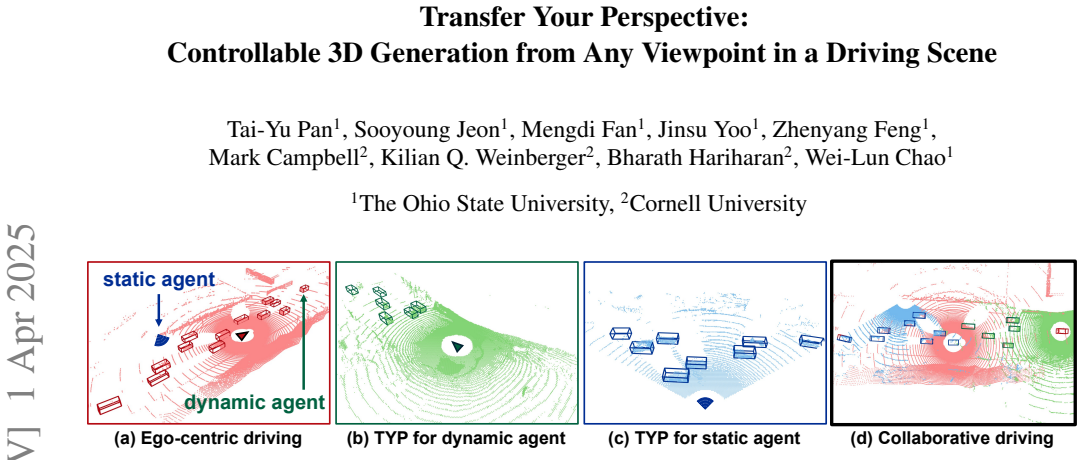
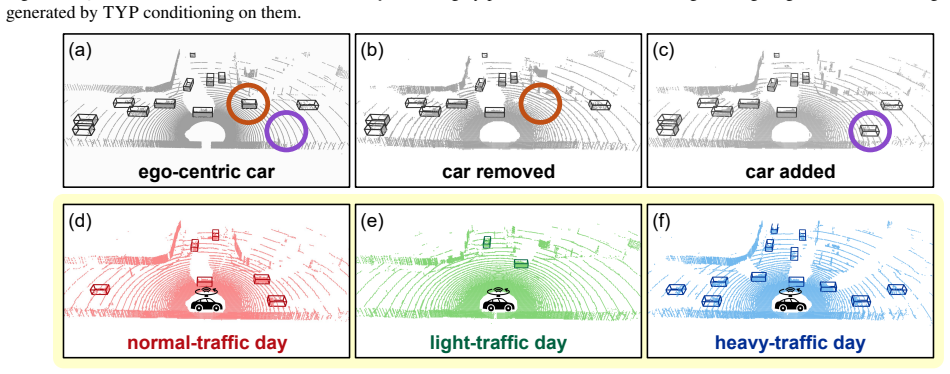
On its own terms, the central discovery is that viewpoint transfer in driving scenes can be learned without any real paired multi-agent data. TYP trains a conditioned diffusion model in two stages: first it learns to generate realistic ego-style point clouds from object-location maps using real single-agent data; second, with the generator frozen, it learns a lightweight conditioning module that grounds generation on the ego agent's translated point cloud, using simulated collaborative pairs from OPV2V. A GAN-style discriminator aligns simulated and real feature spaces so the resulting model can generate reference-vehicle point clouds for real datasets such as Waymo and V2V4Real. The empirical claim is that detectors trained with these generated point clouds reach performance comparable to using ground-truth reference point clouds (0.46 vs. 0.49 overall AP for early fusion on OPV2V; 0.53 vs. 0.60 on V2V4Real), and that pre-training on the generated 'ColWaymo' version of Waymo improves fine-tuning on V2V4Real beyond pre-training on the simulated OPV2V data.
Load-bearing premise
The method assumes that the labels supplied as the reference-view condition already include objects and surfaces hidden from the ego car, meaning someone must already know about occluded content or manually add it to the labels.
Editorial extensions
If this is right
- Collaborative perception algorithms trained on TYP-generated reference point clouds reach performance comparable to training on ground-truth reference point clouds, across early, late, and intermediate fusion baselines.
- A large ego-only dataset like Waymo can be converted into a collaborative dataset, and pre-training on this 'ColWaymo' data improves fine-tuning on real V2V4Real data beyond pre-training on purely simulated OPV2V data.
- Reference viewpoints are not restricted to actual vehicle positions, so the same model can generate views for arbitrary dynamic agents or static roadside units, and can edit scenes by adding or removing vehicles.
- The main data-collection bottleneck for CAV shifts from coordinated multi-agent collection to single-agent driving data plus labels, since paired multi-agent data are only needed in simulation.
Reading between the lines
- One implication the paper leaves implicit is that the method's practical value is bounded by the cost of constructing reference-view labels; if occluded objects must be manually added in most scenes, some of the saved collection effort reappears as annotation effort.
- A direct extension would be to measure downstream collaborative detection AP as a function of how many occluded-object labels are supplied, which would separate the benefit of viewpoint transfer from the benefit of the labels themselves.
- The same two-stage recipe could in principle be applied to other labeled ego-only datasets, but only where labels cover occluded geometry and static infrastructure, so quantifying label coverage is the natural first test for scaling beyond Waymo.
Editorial analysis
A structured set of objections, weighed in public.
Referee Report
Summary. The manuscript introduces Transfer Your Perspective (TYP), a method for generating a LiDAR point cloud at a reference viewpoint from an ego agent's point cloud and a semantic map at that viewpoint. The method trains a latent diffusion model in two stages: a first stage learns P(x|y) on real single-agent data, and a second stage, after a domain-adaptation step for the VQ-VAE encoder/decoder from simulated to real data, trains a T2I-Adapter-style control module on simulated paired collaborative data to produce P(xr|xe, yr). The authors validate the approach on OPV2V, apply it as a zero-shot transfer to V2V4Real, and scale it to create ColWaymo from the Waymo Open Dataset. Evaluation is downstream: fusion detectors trained on TYP-generated reference scans are compared with the same detectors trained on ground-truth reference scans, and ColWaymo is used for pre-training before fine-tuning on V2V4Real. The central claim is that TYP can convert a single-agent ego-car dataset into a collaborative-driving dataset, reducing the need for real-world collaborative data collection.
Significance. TYP addresses a real bottleneck: simultaneous multi-agent data collection for collaborative autonomous driving. The manuscript's strengths are the clear problem formulation, the two-stage training recipe with an interleaved domain-adaptation step, and a downstream evaluation that goes beyond generative metrics. The appendix includes repeated-run statistics (Table 8), which is a useful reproducibility practice, and the OPV2V-to-V2V4Real transfer experiment is a meaningful test of generality. If the improvements in Tables 1-3 are attributable to the perspective-transfer mechanism itself, the method would be a valuable data engine for CAV. The current evidence, however, does not isolate that mechanism, because generation is conditioned on object-location labels that may already encode the occluded content, and the experiments never compare against a same-viewpoint control. Resolving this issue is essential before the central claim can be accepted.
major comments (4)
- [Sec. 4.3, Tables 1-2] The central comparison between TYP and the oracle is not fully specified. State whether the semantic condition yr used at inference is built from ground-truth object boxes of the scene and whether those same boxes are used as supervision when training the fusion detectors. If both are true, the evaluation is circular in an important sense: the generated xr is conditioned on the annotated object locations, so the reported AP measures whether the generator respects the input boxes rather than whether it discovers occluded geometry. Please report the source of yr in every experiment and add a variant in which yr contains only boxes visible from the ego view.
- [Sec. 4.3, Sec. 4.4, Eq. (7)] Add a same-viewpoint control to isolate the contribution of the perspective change. Specifically, run the full pipeline with the reference viewpoint identical to the ego viewpoint (i.e., xe' = xe, with the same yr) and train the fusion detectors on the resulting 'reference' scans. Also report the AP obtained by the stage-1 model P(xr|yr) without the control module. If these controls perform as well as TYP, the gains in Tables 1-3 are due to label-conditioned generation rather than cross-view transfer, which would directly undercut the paper's central claim. If they perform worse, the controls will strengthen the claim.
- [Sec. 3.4, Sec. 4.5] The claim of 'little or no real-world collaborative data' depends on the semantic map yr. The paper says object boxes can be 'translated and edited' and that reference locations are 'sampled from labeled vehicles,' but it never quantifies how much of yr consists of content not visible from the ego view. Report, for the ColWaymo generation: (i) the fraction of generated objects in xr that are outside the ego sensor's field of view, (ii) how many boxes were added or edited per scene on average, and (iii) how reference locations were chosen. Without these numbers, the reader cannot assess the data-annotation effort behind the scalability claim.
- [Sec. 4.3-4.5, Tables 1-3] Several simple baselines are missing and would help interpret the absolute gains. In particular, compare against (i) using the ego scan xe translated to the reference frame without generation, and (ii) placing a template or box-shaped point pattern at each box in yr. These baselines do not require retraining and would demonstrate whether the learned P(xr|xe, yr) adds value beyond the information already contained in xe and yr. Such controls are inexpensive and would substantially strengthen the claim that the learned cross-view transfer is responsible for the reported improvements.
minor comments (4)
- [Sec. 4.3] The parenthetical comparison for AttFuse in the text appears inconsistent with Table 1; the numbers seem reversed relative to the other examples, and the intended order (TYP vs. oracle) should be stated uniformly.
- [Sec. 4.3, App. C] There are typos that should be corrected: 'adpot' in the Sec. 4.3 baseline description and 'Fushion' in Table 7 of the appendix.
- [Sec. 4.1] The post-processing low/high thresholds and Gaussian perturbation parameters are described only as 'tuned on a small hold-out set'; please report the actual values for reproducibility.
- [Table 5] The column label 'Num. Steps' is unclear; it appears to denote the number of training stages rather than sampling steps. Please rename it or clarify in the caption.
Circularity Check
No significant circularity: the viewpoint-generation model is a conditional generative model trained on paired simulated data and evaluated on external benchmarks, with the semantic-label input explicitly acknowledged.
full rationale
TYP's derivation is self-contained. The generation target is P(xr|xe, yr), where yr is an explicit semantic-map input, not a quantity the paper claims to predict or discover. The paper states in Sec. 3.1: 'This semantic information can be easily translated and edited to become yr ... enabling the reference agent to “see” those objects and surfaces beyond the ego's view' and in Sec. 1: 'object boxes can be manually added to make the map appear more realistic from the reference viewpoint.' Thus the occluded-object content is supplied as conditioning, not derived from xe alone, and the downstream gains on occluded objects are attributable to the input labels as much as to the learned cross-view transfer. This is an experimental attribution gap (a same-viewpoint or label-free control would isolate the contribution), but it is not circular: no equation defines xr in terms of yr by construction, and the generative model is learned from paired (xr, xe, yr) tuples using the diffusion losses in Eqs. (4) and (7), then tested on held-out OPV2V scenes, zero-shot V2V4Real, and fine-tuning on real V2V4Real after ColWaymo pre-training. The evaluation is external: Tables 1-3 compare against ground-truth oracle point clouds and against pre-training on simulated OPV2V, so the central claim is not fitted to the test data. The only author self-citations ([46], [47], [84]) support standard techniques (self-training, a pre-training/fine-tuning protocol, and the challenge of GPS/sync errors) and are not load-bearing for the generative derivation. No uniqueness theorem, ansatz-by-citation, or renamed known result appears. The paper's own limitation statement (Sec. 5: 'TYP focuses on vehicle-like objects') narrows scope but does not indicate circularity. Overall, no circular step is present.
Assumptions & free parameters
free parameters (2)
- Voxel grid range and resolution =
[-51.2, 51.2] m x/y, 4 m z, 512x512x20 (dataset-dependent)
- Post-processing low/high thresholds and Gaussian perturbation =
not disclosed (tuned on a small hold-out set)
assumptions (4)
- ad hoc to paper Scene-level semantic labels yr covering objects beyond the ego field of view are available or can be manually added.
- domain assumption The ego-to-reference viewpoint mapping learned from the CARLA-based OPV2V simulator transfers to real LiDAR sensors.
- domain assumption BEV voxel occupancy at 512x512x20 with a 51.2m range is a faithful representation of LiDAR for training downstream detectors.
- domain assumption The first-stage prior P(x|y) trained on real single-agent data provides a sufficient target-domain prior for the second-stage grounding.
Cite this review
Pith. "Pith review of Transfer Your Perspective: Controllable 3D Generation from Any Viewpoint in a Driving Scene." pith.science (2026). https://pith.science/paper/BHICSO5Z
@misc{pith2026250206682,
  author       = {Pith},
  title        = {Pith review of: Transfer Your Perspective: Controllable 3D Generation from Any Viewpoint in a Driving Scene},
  year         = {2026},
  howpublished = {\url{https://pith.science/paper/BHICSO5Z}},
  note         = {Machine review of arXiv:2502.06682}
}
read the original abstract
Self-driving cars relying solely on ego-centric perception face limitations in sensing, often failing to detect occluded, faraway objects. Collaborative autonomous driving (CAV) seems like a promising direction, but collecting data for development is non-trivial. It requires placing multiple sensor-equipped agents in a real-world driving scene, simultaneously! As such, existing datasets are limited in locations and agents. We introduce a novel surrogate to the rescue, which is to generate realistic perception from different viewpoints in a driving scene, conditioned on a real-world sample - the ego-car's sensory data. This surrogate has huge potential: it could potentially turn any ego-car dataset into a collaborative driving one to scale up the development of CAV. We present the very first solution, using a combination of simulated collaborative data and real ego-car data. Our method, Transfer Your Perspective (TYP), learns a conditioned diffusion model whose output samples are not only realistic but also consistent in both semantics and layouts with the given ego-car data. Empirical results demonstrate TYP's effectiveness in aiding in a CAV setting. In particular, TYP enables us to (pre-)train collaborative perception algorithms like early and late fusion with little or no real-world collaborative data, greatly facilitating downstream CAV applications.
Figures


Figures from the paper (5 more)



Reference graph
Works this paper leans on
-
[1]
Learning representations and generative models for 3d point clouds
Panos Achlioptas, Olga Diamanti, Ioannis Mitliagkas, and Leonidas Guibas. Learning representations and generative models for 3d point clouds. In ICML, 2018. 12
2018
-
[2]
Domain-adversarial neural networks
Hana Ajakan, Pascal Germain, Hugo Larochelle, Fran c ¸ois Laviolette, and Mario Marchand. Domain-adversarial neural networks. arXiv preprint arXiv:1412.4446, 2014. 13
arXiv 2014
-
[3]
ediff-i: Text-to-image diffusion models with an ensemble of expert denoisers
Yogesh Balaji, Seungjun Nah, Xun Huang, Arash Vahdat, Jiaming Song, Qinsheng Zhang, Karsten Kreis, Miika Ait- tala, Timo Aila, Samuli Laine, et al. ediff-i: Text-to-image diffusion models with an ensemble of expert denoisers. arXiv preprint arXiv:2211.01324, 2022. 12
arXiv 2022
-
[4]
Mip-nerf: A multiscale representation for anti-aliasing neural radiance fields
Jonathan T Barron, Ben Mildenhall, Matthew Tancik, Peter Hedman, Ricardo Martin-Brualla, and Pratul P Srinivasan. Mip-nerf: A multiscale representation for anti-aliasing neural radiance fields. In CVPR, 2021. 13
2021
-
[5]
Mip-nerf 360: Unbounded anti-aliased neural radiance fields
Jonathan T Barron, Ben Mildenhall, Dor Verbin, Pratul P Srinivasan, and Peter Hedman. Mip-nerf 360: Unbounded anti-aliased neural radiance fields. In CVPR, 2022. 13
2022
-
[6]
Also: Automotive lidar self- supervision by occupancy estimation
Alexandre Boulch, Corentin Sautier, Bj¨orn Michele, Gilles Puy, and Renaud Marlet. Also: Automotive lidar self- supervision by occupancy estimation. In CVPR, 2023. 8
2023
-
[7]
nuscenes: A multimodal dataset for autonomous driving
Holger Caesar, Varun Bankiti, Alex H Lang, Sourabh V ora, Venice Erin Liong, Qiang Xu, Anush Krishnan, Yu Pan, Gi- ancarlo Baldan, and Oscar Beijbom. nuscenes: A multimodal dataset for autonomous driving. In CVPR, 2020. 4, 5
2020
-
[8]
F-cooper: Feature based cooperative perception for autonomous vehicle edge computing system using 3d point clouds
Qi Chen, Xu Ma, Sihai Tang, Jingda Guo, Qing Yang, and Song Fu. F-cooper: Feature based cooperative perception for autonomous vehicle edge computing system using 3d point clouds. In Proceedings of the 4th ACM/IEEE Symposium on Edge Computing, 2019. 1
2019
Show all 96 references
-
[9]
Cooper: Cooperative perception for connected autonomous vehicles based on 3d point clouds
Qi Chen, Sihai Tang, Qing Yang, and Song Fu. Cooper: Cooperative perception for connected autonomous vehicles based on 3d point clouds. In International Conference on Distributed Computing Systems (ICDCS). IEEE, 2019. 1, 6, 7, 13, 14
2019
-
[10]
Multi-view 3d object detection network for autonomous driv- ing
Xiaozhi Chen, Huimin Ma, Ji Wan, Bo Li, and Tian Xia. Multi-view 3d object detection network for autonomous driv- ing. In CVPR, 2017. 4
2017
-
[11]
Depth-supervised nerf: Fewer views and faster training for free
Kangle Deng, Andrew Liu, Jun-Yan Zhu, and Deva Ramanan. Depth-supervised nerf: Fewer views and faster training for free. In CVPR, 2022. 13
2022
-
[12]
Diffusion models beat gans on image synthesis
Prafulla Dhariwal and Alexander Nichol. Diffusion models beat gans on image synthesis. In NeurIPS, 2021. 4, 12
2021
-
[13]
Cogview: Mastering text-to-image generation via transformers
Ming Ding, Zhuoyi Yang, Wenyi Hong, Wendi Zheng, Chang Zhou, Da Yin, Junyang Lin, Xu Zou, Zhou Shao, Hongxia Yang, et al. Cogview: Mastering text-to-image generation via transformers. In NeurIPS, 2021. 12
2021
-
[14]
CARLA: An open urban driving simulator
Alexey Dosovitskiy, German Ros, Felipe Codevilla, Antonio Lopez, and Vladlen Koltun. CARLA: An open urban driving simulator. In CoRL, 2017. 2, 3
2017
-
[15]
A point set generation network for 3d object reconstruction from a single image
Haoqiang Fan, Hao Su, and Leonidas J Guibas. A point set generation network for 3d object reconstruction from a single image. In CVPR, 2017. 12
2017
-
[16]
Training-free structured diffusion guidance for compositional text-to-image synthesis
Weixi Feng, Xuehai He, Tsu-Jui Fu, Varun Jampani, Arjun Akula, Pradyumna Narayana, Sugato Basu, Xin Eric Wang, and William Yang Wang. Training-free structured diffusion guidance for compositional text-to-image synthesis. In ICLR,
-
[17]
Make-a-scene: Scene-based text-to-image generation with human priors
Oran Gafni, Adam Polyak, Oron Ashual, Shelly Sheynin, Devi Parikh, and Yaniv Taigman. Make-a-scene: Scene-based text-to-image generation with human priors. In ECCV, 2022. 12
2022
-
[18]
Unsupervised domain adaptation by backpropagation
Yaroslav Ganin and Victor Lempitsky. Unsupervised domain adaptation by backpropagation. In ICML, 2015. 13
2015
-
[19]
Domain-adversarial training of neural networks
Yaroslav Ganin, Evgeniya Ustinova, Hana Ajakan, Pascal Germain, Hugo Larochelle, Franc ¸ois Laviolette, Mario March, and Victor Lempitsky. Domain-adversarial training of neural networks. Journal of machine learning research, 17(59):1–35,
-
[20]
Are we ready for autonomous driving? the kitti vision benchmark suite
Andreas Geiger, Philip Lenz, and Raquel Urtasun. Are we ready for autonomous driving? the kitti vision benchmark suite. In CVPR, 2012. 4
2012
-
[21]
Generative adversarial nets
Ian Goodfellow, Jean Pouget-Abadie, Mehdi Mirza, Bing Xu, David Warde-Farley, Sherjil Ozair, Aaron Courville, and Yoshua Bengio. Generative adversarial nets. In NeurIPS,
-
[22]
Waymax: An accelerated, data-driven simulator for large-scale autonomous driving research
Cole Gulino, Justin Fu, Wenjie Luo, George Tucker, Eli Bron- stein, Yiren Lu, Jean Harb, Xinlei Pan, Yan Wang, Xiangyu Chen, et al. Waymax: An accelerated, data-driven simulator for large-scale autonomous driving research. In NeurIPS,
-
[23]
Prompt-to-prompt image editing with cross-attention control
Amir Hertz, Ron Mokady, Jay Tenenbaum, Kfir Aberman, Yael Pritch, and Daniel Cohen-or. Prompt-to-prompt image editing with cross-attention control. In ICLR, 2023. 12
2023
-
[24]
Denoising diffu- sion probabilistic models
Jonathan Ho, Ajay Jain, and Pieter Abbeel. Denoising diffu- sion probabilistic models. In NeurIPS, 2020. 3, 4, 12
2020
-
[25]
Rangeldm: Fast realistic lidar point cloud generation
Qianjiang Hu, Zhimin Zhang, and Wei Hu. Rangeldm: Fast realistic lidar point cloud generation. In ECCV, 2025. 2, 3, 12
2025
-
[26]
Where2comm: Communication-efficient collaborative perception via spatial confidence maps
Yue Hu, Shaoheng Fang, Zixing Lei, Yiqi Zhong, and Siheng Chen. Where2comm: Communication-efficient collaborative perception via spatial confidence maps. In NeurIPS, 2022. 1
2022
-
[27]
Neural lidar fields for novel view synthesis
Shengyu Huang, Zan Gojcic, Zian Wang, Francis Williams, Yoni Kasten, Sanja Fidler, Konrad Schindler, and Or Litany. Neural lidar fields for novel view synthesis. In ICCV, 2023. 13
2023
-
[28]
Image-to-image translation with conditional adversarial net- works
Phillip Isola, Jun-Yan Zhu, Tinghui Zhou, and Alexei A Efros. Image-to-image translation with conditional adversarial net- works. In CVPR, 2017. 13
2017
-
[29]
Categorical reparam- eterization with gumbel-softmax
Eric Jang, Shixiang Gu, and Ben Poole. Categorical reparam- eterization with gumbel-softmax. In ICLR, 2017. 6
2017
-
[30]
Variational diffusion models
Diederik Kingma, Tim Salimans, Ben Poole, and Jonathan Ho. Variational diffusion models. In NeurIPS, 2021. 4, 12 9
2021
-
[31]
Pointpillars: Fast encoders for object detection from point clouds
Alex H Lang, Sourabh V ora, Holger Caesar, Lubing Zhou, Jiong Yang, and Oscar Beijbom. Pointpillars: Fast encoders for object detection from point clouds. In CVPR, 2019. 4, 6
2019
-
[32]
Pseudo-label: The simple and efficient semi-supervised learning method for deep neural networks
Dong-Hyun Lee et al. Pseudo-label: The simple and efficient semi-supervised learning method for deep neural networks. In Workshop on challenges in representation learning, ICML,
-
[33]
Controlnet++: Improv- ing conditional controls with efficient consistency feedback
Ming Li, Taojiannan Yang, Huafeng Kuang, Jie Wu, Zhaoning Wang, Xuefeng Xiao, and Chen Chen. Controlnet++: Improv- ing conditional controls with efficient consistency feedback. In ECCV, 2025. 12
2025
-
[34]
Learning distilled collaboration graph for multi-agent perception
Yiming Li, Shunli Ren, Pengxiang Wu, Siheng Chen, Chen Feng, and Wenjun Zhang. Learning distilled collaboration graph for multi-agent perception. In NeurIPS, 2021. 1
2021
-
[35]
V2x-sim: Multi-agent collab- orative perception dataset and benchmark for autonomous driving
Yiming Li, Dekun Ma, Ziyan An, Zixun Wang, Yiqi Zhong, Siheng Chen, and Chen Feng. V2x-sim: Multi-agent collab- orative perception dataset and benchmark for autonomous driving. In Robotics and Automation Letters, pages 10914– 10921. IEEE, 2022. 3
2022
-
[36]
Kitti-360: A novel dataset and benchmarks for urban scene understanding in 2d and 3d
Yiyi Liao, Jun Xie, and Andreas Geiger. Kitti-360: A novel dataset and benchmarks for urban scene understanding in 2d and 3d. IEEE TPAMI, 45(3):3292–3310, 2022. 5
2022
-
[37]
Geometric gan
Jae Hyun Lim and Jong Chul Ye. Geometric gan. arXiv preprint arXiv:1705.02894, 2017. 5, 13
2017 arXiv
-
[38]
When2com: Multi-agent perception via communication graph grouping
Yen-Cheng Liu, Junjiao Tian, Nathaniel Glaser, and Zsolt Kira. When2com: Multi-agent perception via communication graph grouping. In CVPR, 2020. 1
2020
-
[39]
Learning transferable features with deep adaptation networks
Mingsheng Long, Yue Cao, Jianmin Wang, and Michael Jor- dan. Learning transferable features with deep adaptation networks. In ICML, 2015. 12
2015
-
[40]
V oxnet: A 3d convo- lutional neural network for real-time object recognition
Daniel Maturana and Sebastian Scherer. V oxnet: A 3d convo- lutional neural network for real-time object recognition. In IROS, 2015. 4
2015
-
[41]
Nerf: Representing scenes as neural radiance fields for view synthe- sis
Ben Mildenhall, Pratul P Srinivasan, Matthew Tancik, Jonathan T Barron, Ravi Ramamoorthi, and Ren Ng. Nerf: Representing scenes as neural radiance fields for view synthe- sis. In ECCV. ACM New York, NY , USA, 2021. 13
2021
-
[42]
Rangenet++: Fast and accurate lidar semantic segmenta- tion
Andres Milioto, Ignacio Vizzo, Jens Behley, and Cyrill Stach- niss. Rangenet++: Fast and accurate lidar semantic segmenta- tion. In IROS, 2019. 4
2019
-
[43]
T2i-adapter: Learning adapters to dig out more controllable ability for text-to-image diffusion models
Chong Mou, Xintao Wang, Liangbin Xie, Yanze Wu, Jian Zhang, Zhongang Qi, and Ying Shan. T2i-adapter: Learning adapters to dig out more controllable ability for text-to-image diffusion models. In AAAI, 2024. 5, 6, 12
2024
-
[44]
Lidar data synthesis with denoising diffusion probabilistic models
Kazuto Nakashima and Ryo Kurazume. Lidar data synthesis with denoising diffusion probabilistic models. In ICRA, 2024. 2, 3, 12
2024
-
[45]
Glide: Towards photorealistic image genera- tion and editing with text-guided diffusion models
Alexander Quinn Nichol, Prafulla Dhariwal, Aditya Ramesh, Pranav Shyam, Pamela Mishkin, Bob Mcgrew, Ilya Sutskever, and Mark Chen. Glide: Towards photorealistic image genera- tion and editing with text-guided diffusion models. In ICML,
-
[46]
To- wards open-world segmentation of parts
Tai-Yu Pan, Qing Liu, Wei-Lun Chao, and Brian Price. To- wards open-world segmentation of parts. In CVPR, 2023. 6
2023
-
[47]
Pre-training lidar-based 3d object detectors through colorization
Tai-Yu Pan, Chenyang Ma, Tianle Chen, Cheng Perng Phoo, Katie Z Luo, Yurong You, Mark Campbell, Kilian Q Wein- berger, Bharath Hariharan, and Wei-Lun Chao. Pre-training lidar-based 3d object detectors through colorization. In ICLR,
-
[48]
Pointnet: Deep learning on point sets for 3d classification and segmentation
Charles R Qi, Hao Su, Kaichun Mo, and Leonidas J Guibas. Pointnet: Deep learning on point sets for 3d classification and segmentation. In CVPR, 2017. 4
2017
-
[49]
Pointnet++: Deep hierarchical feature learning on point sets in a metric space
Charles Ruizhongtai Qi, Li Yi, Hao Su, and Leonidas J Guibas. Pointnet++: Deep hierarchical feature learning on point sets in a metric space. In NeurIPS, 2017. 4
2017
-
[50]
Zero-shot text-to-image generation
Aditya Ramesh, Mikhail Pavlov, Gabriel Goh, Scott Gray, Chelsea V oss, Alec Radford, Mark Chen, and Ilya Sutskever. Zero-shot text-to-image generation. In ICML, 2021. 12
2021
-
[51]
Towards realistic scene generation with lidar diffusion models
Haoxi Ran, Vitor Guizilini, and Yue Wang. Towards realistic scene generation with lidar diffusion models. In CVPR, 2024. 2, 3, 12
2024
-
[52]
Collabora- tive automated driving: A machine learning-based method to enhance the accuracy of shared information
Zaydoun Yahya Rawashdeh and Zheng Wang. Collabora- tive automated driving: A machine learning-based method to enhance the accuracy of shared information. In Inter- national Conference on Intelligent Transportation Systems (ITSC). IEEE, 2018. 1
2018
-
[53]
Dense depth priors for neural radiance fields from sparse input views
Barbara Roessle, Jonathan T Barron, Ben Mildenhall, Pratul P Srinivasan, and Matthias Nießner. Dense depth priors for neural radiance fields from sparse input views. In CVPR,
-
[54]
High-resolution image synthesis with latent diffusion models
Robin Rombach, Andreas Blattmann, Dominik Lorenz, Patrick Esser, and Bj ¨orn Ommer. High-resolution image synthesis with latent diffusion models. In CVPR, 2022. 2, 4, 12
2022
-
[55]
U-net: Convolutional networks for biomedical image segmentation
Olaf Ronneberger, Philipp Fischer, and Thomas Brox. U-net: Convolutional networks for biomedical image segmentation. In MICCAI, 2015. 5
2015
-
[56]
Focal loss for dense object detection
T-YLPG Ross and GKHP Doll´ar. Focal loss for dense object detection. In CVPR, 2017. 4
2017
-
[57]
Pho- torealistic text-to-image diffusion models with deep language understanding
Chitwan Saharia, William Chan, Saurabh Saxena, Lala Li, Jay Whang, Emily L Denton, Kamyar Ghasemipour, Raphael Gontijo Lopes, Burcu Karagol Ayan, Tim Salimans, et al. Pho- torealistic text-to-image diffusion models with deep language understanding. In NeurIPS, 2022. 12
2022
-
[58]
Pointr- cnn: 3d object proposal generation and detection from point cloud
Shaoshuai Shi, Xiaogang Wang, and Hongsheng Li. Pointr- cnn: 3d object proposal generation and detection from point cloud. In CVPR, 2019. 4
2019
-
[59]
3d point cloud generative adversarial network based on tree struc- tured graph convolutions
Dong Wook Shu, Sung Woo Park, and Junseok Kwon. 3d point cloud generative adversarial network based on tree struc- tured graph convolutions. In ICCV, 2019. 12
2019
-
[60]
Deep unsupervised learning using nonequilibrium thermodynamics
Jascha Sohl-Dickstein, Eric Weiss, Niru Maheswaranathan, and Surya Ganguli. Deep unsupervised learning using nonequilibrium thermodynamics. In ICML, 2015. 12
2015
-
[61]
Denoising diffusion implicit models
Jiaming Song, Chenlin Meng, and Stefano Ermon. Denoising diffusion implicit models. In ICLR, 2021. 6
2021
-
[62]
Deep coral: Correlation alignment for deep domain adaptation
Baochen Sun and Kate Saenko. Deep coral: Correlation alignment for deep domain adaptation. In ECCV Workshops,
-
[63]
Scalability in perception for autonomous driving: Waymo open dataset
Pei Sun, Henrik Kretzschmar, Xerxes Dotiwalla, Aurelien Chouard, Vijaysai Patnaik, Paul Tsui, James Guo, Yin Zhou, Yuning Chai, Benjamin Caine, et al. Scalability in perception for autonomous driving: Waymo open dataset. InCVPR, 2020. 2, 3, 4, 5, 6, 7, 8 10
2020
-
[64]
Lidar-nerf: Novel lidar view synthesis via neural radiance fields
Tang Tao, Longfei Gao, Guangrun Wang, Yixing Lao, Peng Chen, Hengshuang Zhao, Dayang Hao, Xiaodan Liang, Math- ieu Salzmann, and Kaicheng Yu. Lidar-nerf: Novel lidar view synthesis via neural radiance fields. In ACM MM, 2024. 13
2024
-
[65]
Deep domain confusion: Maximizing for domain invariance
Eric Tzeng, Judy Hoffman, Ning Zhang, Kate Saenko, and Trevor Darrell. Deep domain confusion: Maximizing for domain invariance. arXiv preprint arXiv:1412.3474, 2014. 12
2014 arXiv
-
[66]
Simultaneous deep transfer across domains and tasks
Eric Tzeng, Judy Hoffman, Trevor Darrell, and Kate Saenko. Simultaneous deep transfer across domains and tasks. In ICCV, 2015. 12
2015
-
[67]
Adversarial discriminative domain adaptation
Eric Tzeng, Judy Hoffman, Kate Saenko, and Trevor Darrell. Adversarial discriminative domain adaptation. InCVPR, 2017. 2, 5, 13
2017
-
[68]
Learn- ing localized generative models for 3d point clouds via graph convolution
Diego Valsesia, Giulia Fracastoro, and Enrico Magli. Learn- ing localized generative models for 3d point clouds via graph convolution. In ICLR, 2018. 12
2018
-
[69]
Neural discrete representation learning
Aaron Van Den Oord, Oriol Vinyals, et al. Neural discrete representation learning. In NeurIPS, 2017. 4, 6
2017
-
[70]
Pretraining is all you need for image-to-image translation
Tengfei Wang, Ting Zhang, Bo Zhang, Hao Ouyang, Dong Chen, Qifeng Chen, and Fang Wen. Pretraining is all you need for image-to-image translation. arXiv preprint arXiv:2205.12952, 2022. 12
2022 arXiv
-
[71]
V2vnet: Vehicle- to-vehicle communication for joint perception and prediction
Tsun-Hsuan Wang, Sivabalan Manivasagam, Ming Liang, Bin Yang, Wenyuan Zeng, and Raquel Urtasun. V2vnet: Vehicle- to-vehicle communication for joint perception and prediction. In ECCV, 2020. 1
2020
-
[72]
Squeezeseg: Convolutional neural nets with recurrent crf for real-time road-object segmentation from 3d lidar point cloud
Bichen Wu, Alvin Wan, Xiangyu Yue, and Kurt Keutzer. Squeezeseg: Convolutional neural nets with recurrent crf for real-time road-object segmentation from 3d lidar point cloud. In ICRA, 2018. 4
2018
-
[73]
Text2lidar: Text-guided lidar point cloud generation via equirectangular transformer
Yang Wu, Kaihua Zhang, Jianjun Qian, Jin Xie, and Jian Yang. Text2lidar: Text-guided lidar point cloud generation via equirectangular transformer. In ECCV. Springer, 2024. 2, 3, 12
2024
-
[74]
V2x-real: a largs-scale dataset for vehicle-to-everything cooperative perception
Hao Xiang, Zhaoliang Zheng, Xin Xia, Runsheng Xu, Letian Gao, Zewei Zhou, Xu Han, Xinkai Ji, Mingxi Li, Zonglin Meng, et al. V2x-real: a largs-scale dataset for vehicle-to-everything cooperative perception. arXiv preprint arXiv:2403.16034, 2024. 1
2024 arXiv
-
[75]
Pandaset: Advanced sensor suite dataset for au- tonomous driving
Pengchuan Xiao, Zhenlei Shao, Steven Hao, Zishuo Zhang, Xiaolin Chai, Judy Jiao, Zesong Li, Jian Wu, Kai Sun, Kun Jiang, et al. Pandaset: Advanced sensor suite dataset for au- tonomous driving. In International Intelligent Transportation Systems Conference (ITSC). IEEE, 2021. 5
2021
-
[76]
Pointcontrast: Unsupervised pre- training for 3d point cloud understanding
Saining Xie, Jiatao Gu, Demi Guo, Charles R Qi, Leonidas Guibas, and Or Litany. Pointcontrast: Unsupervised pre- training for 3d point cloud understanding. In ECCV, 2020. 8
2020
-
[77]
Learning compact representations for lidar completion and generation
Yuwen Xiong, Wei-Chiu Ma, Jingkang Wang, and Raquel Ur- tasun. Learning compact representations for lidar completion and generation. In CVPR, 2023. 3, 4
2023
-
[78]
Ultralidar: Learning compact representations for lidar completion and generation
Yuwen Xiong, Wei-Chiu Ma, Jingkang Wang, and Raquel Urtasun. Ultralidar: Learning compact representations for lidar completion and generation. In CVPR, 2023. 2, 4, 12
2023
-
[79]
V2x-vit: Vehicle-to-everything cooperative perception with vision transformer
Runsheng Xu, Hao Xiang, Zhengzhong Tu, Xin Xia, Ming- Hsuan Yang, and Jiaqi Ma. V2x-vit: Vehicle-to-everything cooperative perception with vision transformer. In ECCV,
-
[80]
Opv2v: An open benchmark dataset and fusion pipeline for perception with vehicle-to-vehicle communica- tion
Runsheng Xu, Hao Xiang, Xin Xia, Xu Han, Jinlong Li, and Jiaqi Ma. Opv2v: An open benchmark dataset and fusion pipeline for perception with vehicle-to-vehicle communica- tion. In ICRA, 2022. 2, 3, 5, 6, 7, 8, 13, 14
2022
-
[81]
V2v4real: A real-world large-scale dataset for vehicle-to-vehicle cooperative perception
Runsheng Xu, Xin Xia, Jinlong Li, Hanzhao Li, Shuo Zhang, Zhengzhong Tu, Zonglin Meng, Hao Xiang, Xiaoyu Dong, Rui Song, et al. V2v4real: A real-world large-scale dataset for vehicle-to-vehicle cooperative perception. In CVPR, 2023. 1, 3, 6, 7, 8, 14
2023
-
[82]
Second: Sparsely em- bedded convolutional detection
Yan Yan, Yuxing Mao, and Bo Li. Second: Sparsely em- bedded convolutional detection. Sensors, 18(10):3337, 2018. 4
2018
-
[83]
Proposal- contrast: Unsupervised pre-training for lidar-based 3d object detection
Junbo Yin, Dingfu Zhou, Liangjun Zhang, Jin Fang, Cheng- Zhong Xu, Jianbing Shen, and Wenguan Wang. Proposal- contrast: Unsupervised pre-training for lidar-based 3d object detection. In ECCV, 2022. 8
2022
-
[84]
Learning 3d perception from others’ predictions
Jinsu Yoo, Zhenyang Feng, Tai-Yu Pan, Yihong Sun, Cheng Perng Phoo, Xiangyu Chen, Mark Campbell, Kilian Q Weinberger, Bharath Hariharan, and Wei-Lun Chao. Learning 3d perception from others’ predictions. In ICLR, 2025. 1
2025
-
[85]
Hindsight is 20/20: Leveraging past traversals to aid 3d perception
Yurong You, Katie Z Luo, Xiangyu Chen, Junan Chen, Wei- Lun Chao, Wen Sun, Bharath Hariharan, Mark Campbell, and Kilian Q Weinberger. Hindsight is 20/20: Leveraging past traversals to aid 3d perception. In ICLR, 2022. 8
2022
-
[86]
Dair-v2x: A large-scale dataset for vehicle- infrastructure cooperative 3d object detection
Haibao Yu, Yizhen Luo, Mao Shu, Yiyi Huo, Zebang Yang, Yifeng Shi, Zhenglong Guo, Hanyu Li, Xing Hu, Jirui Yuan, and Zaiqing Nie. Dair-v2x: A large-scale dataset for vehicle- infrastructure cooperative 3d object detection. InCVPR, 2022. 3
2022
-
[87]
Efficient convolutions for real-time semantic segmentation of 3d point clouds
Chris Zhang, Wenjie Luo, and Raquel Urtasun. Efficient convolutions for real-time semantic segmentation of 3d point clouds. In 3DV, 2018. 4
2018
-
[88]
Nerf-lidar: Generating realistic lidar point clouds with neural radiance fields
Junge Zhang, Feihu Zhang, Shaochen Kuang, and Li Zhang. Nerf-lidar: Generating realistic lidar point clouds with neural radiance fields. In AAAI, 2024. 13
2024
-
[89]
Adding conditional control to text-to-image diffusion models
Lvmin Zhang, Anyi Rao, and Maneesh Agrawala. Adding conditional control to text-to-image diffusion models. In CVPR, 2023. 12
2023
-
[90]
Lidar4d: Dynamic neural fields for novel space-time view lidar synthesis
Zehan Zheng, Fan Lu, Weiyi Xue, Guang Chen, and Changjun Jiang. Lidar4d: Dynamic neural fields for novel space-time view lidar synthesis. In CVPR, 2024. 13
2024
-
[91]
V oxelnet: End-to-end learning for point cloud based 3d object detection
Yin Zhou and Oncel Tuzel. V oxelnet: End-to-end learning for point cloud based 3d object detection. In CVPR, 2018. 4
2018
-
[92]
Rethinking pre- training and self-training
Barret Zoph, Golnaz Ghiasi, Tsung-Yi Lin, Yin Cui, Hanx- iao Liu, Ekin Dogus Cubuk, and Quoc Le. Rethinking pre- training and self-training. In NeurIPS, 2020. 6
2020
-
[93]
Un- supervised domain adaptation for semantic segmentation via class-balanced self-training
Yang Zou, Zhiding Yu, BVK Kumar, and Jinsong Wang. Un- supervised domain adaptation for semantic segmentation via class-balanced self-training. In ECCV, 2018. 6
2018
-
[94]
Learning to generate realistic lidar point clouds
Vlas Zyrianov, Xiyue Zhu, and Shenlong Wang. Learning to generate realistic lidar point clouds. In ECCV, 2022. 2, 3, 12
2022
-
[95]
Lidardm: Generative lidar simulation in a generated world
Vlas Zyrianov, Henry Che, Zhijian Liu, and Shenlong Wang. Lidardm: Generative lidar simulation in a generated world. arXiv preprint arXiv:2404.02903, 2024. 2, 3, 12 11 In this appendix, we provide more details and experiment results in addition to the main paper: • App. A: pro...
2024
-
[96]
This stage grounds the generation process, ensuring that the outputs align with given semantic cues
during the second stage of our framework. This stage grounds the generation process, ensuring that the outputs align with given semantic cues. Domain Adaptation. Unsupervised domain adaptation (UDA) has been extensively studied. A common approach for domain adaptation is to le...
Reviewed August 8, 2026 · model on record in the stance chip above.
Discussion (0). Continue with ORCID to comment.