Understanding deconfined quantum critical points from crystalline categorical Landau paradigm
Pith reviewed 2026-06-27 23:48 UTC · model grok-4.3
The pith
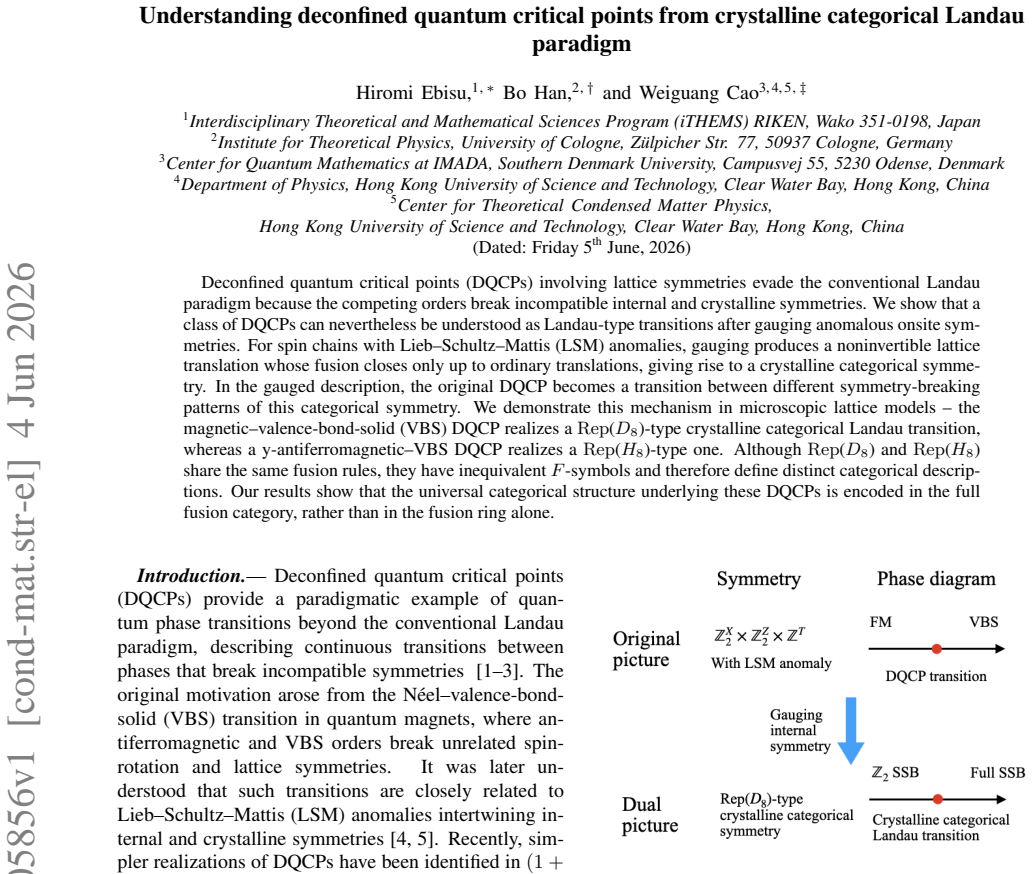
Deconfined quantum critical points become Landau transitions between breaking patterns of a crystalline categorical symmetry after gauging anomalous onsite symmetries.
A machine-rendered reading of the paper's core claim, the machinery that carries it, and where it could break.
Core claim
After gauging the anomalous onsite symmetries, a noninvertible lattice translation arises whose fusion closes only up to ordinary translations, producing a crystalline categorical symmetry. In this gauged description the magnetic-valence-bond-solid DQCP realizes a Rep(D8)-type crystalline categorical Landau transition while the y-antiferromagnetic-VBS DQCP realizes a Rep(H8)-type one. Although the two categories share the same fusion rules, they possess inequivalent F-symbols and therefore constitute distinct categorical descriptions, showing that the universal structure of these DQCPs resides in the full fusion category.
What carries the argument
The crystalline categorical symmetry generated by the noninvertible lattice translation after gauging, whose distinct breaking patterns correspond to the phases separated by the DQCP.
If this is right
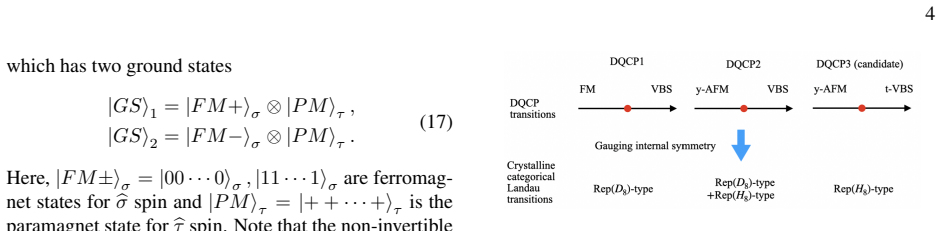
- The magnetic-VBS DQCP corresponds to a transition between distinct breaking patterns of a Rep(D8) categorical symmetry.
- The y-antiferromagnetic-VBS DQCP corresponds to a transition between distinct breaking patterns of a Rep(H8) categorical symmetry.
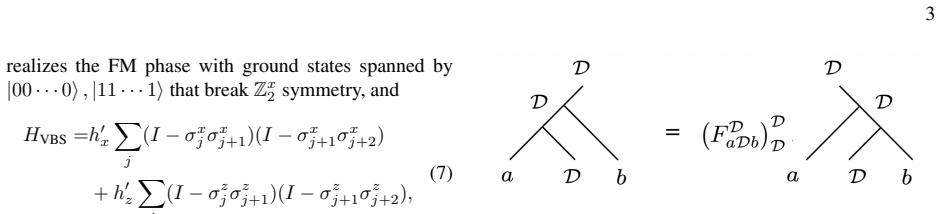
- Rep(D8) and Rep(H8) share fusion rules but differ in F-symbols, so their categorical descriptions are inequivalent.
- The universal categorical structure of these DQCPs is carried by the full fusion category rather than the fusion ring alone.
Where Pith is reading between the lines
- The same gauging construction may classify additional DQCPs in two-dimensional lattices or models with different LSM anomalies using other fusion categories.
- Quantum simulators could search for signatures of the noninvertible translation symmetry in the low-energy spectrum of the gauged models.
- The distinction between Rep(D8) and Rep(H8) suggests that microscopic details beyond fusion rules can select which categorical description applies to a given DQCP.
Load-bearing premise
Gauging the anomalous onsite symmetries produces a noninvertible lattice translation whose fusion closes only up to ordinary translations and thereby generates the crystalline categorical symmetry.
What would settle it
Explicit computation of the fusion rules or F-symbols in the gauged theory for either the magnetic-VBS or y-antiferromagnetic-VBS model that fails to match those of Rep(D8) or Rep(H8).
Figures
read the original abstract
Deconfined quantum critical points (DQCPs) involving lattice symmetries evade the conventional Landau paradigm because the competing orders break incompatible internal and crystalline symmetries. We show that a class of DQCPs can nevertheless be understood as Landau-type transitions after gauging anomalous onsite symmetries. For spin chains with Lieb-Schultz-Mattis (LSM) anomalies, gauging produces a noninvertible lattice translation whose fusion closes only up to ordinary translations, giving rise to a crystalline categorical symmetry. In the gauged description, the original DQCP becomes a transition between different symmetry breaking patterns of this categorical symmetry. We demonstrate this mechanism in microscopic lattice models; the magnetic-valence-bond-solid (VBS) DQCP realizes a Rep($D_8$)-type crystalline categorical Landau transition, whereas a y-antiferromagnetic-VBS DQCP realizes a Rep($H_8$)-type one. Although Rep($D_8$) and Rep($H_8$) share the same fusion rules, they have inequivalent $F$-symbols and therefore define distinct categorical descriptions. Our results show that the universal categorical structure underlying these DQCPs is encoded in the full fusion category, rather than in the fusion ring alone.
Editorial analysis
A structured set of objections, weighed in public.
Referee Report
Summary. The paper claims that DQCPs involving incompatible internal and crystalline symmetries can be recast as Landau-type transitions after gauging anomalous onsite symmetries in spin chains with LSM anomalies. Gauging yields a noninvertible lattice translation whose fusion generates a crystalline categorical symmetry; the magnetic-VBS DQCP is identified as a Rep(D8)-type transition and the y-antiferromagnetic-VBS DQCP as a Rep(H8)-type transition. These categories share fusion rules but are distinguished by inequivalent F-symbols, so the universal structure is encoded in the full fusion category. The mechanism is demonstrated explicitly in microscopic lattice models.
Significance. If the central mapping holds, the work supplies a concrete categorical extension of the Landau paradigm that accommodates DQCPs without invoking deconfined excitations as the primary diagnostic. Explicit construction of the noninvertible translation and the lattice-model demonstrations are strengths; the emphasis on F-symbols (rather than the fusion ring alone) is a clear technical contribution that can be checked in other models.
minor comments (3)
- [§2] §2: the definition of the gauged translation operator should include the explicit commutation relations with the original LSM anomaly generators to make the noninvertible fusion rule fully self-contained.
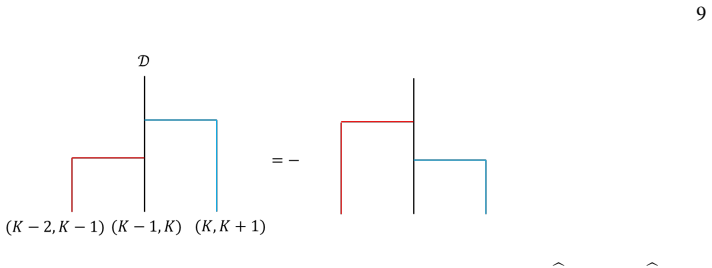
- [§4.2] §4.2: the statement that Rep(D8) and Rep(H8) have inequivalent F-symbols would be strengthened by displaying at least one differing F-symbol component (or citing the explicit 3-cocycle data) rather than asserting inequivalence.
- [Figure 3] Figure 3 caption: the color coding for the two distinct breaking patterns should be defined in the caption itself rather than only in the main text.
Simulated Author's Rebuttal
We thank the referee for the careful reading and positive assessment of our manuscript, including the recognition of the explicit lattice constructions and the emphasis on F-symbols as a technical contribution. The recommendation for minor revision is noted.
Circularity Check
No significant circularity; derivation self-contained
full rationale
The paper derives its reinterpretation of DQCPs by applying the standard gauging procedure to known LSM anomalies, producing a noninvertible lattice translation whose fusion rules generate a crystalline categorical symmetry (Rep(D8) or Rep(H8)). The distinction between these categories rests on inequivalent F-symbols, a standard feature of fusion categories, and is demonstrated explicitly in microscopic lattice models. No equations or steps reduce by construction to fitted parameters, self-definitions, or load-bearing self-citations; the central claim remains independent of the paper's own inputs.
Axiom & Free-Parameter Ledger
axioms (1)
- domain assumption Gauging anomalous onsite symmetries in spin chains with LSM anomalies produces a noninvertible lattice translation whose fusion closes only up to ordinary translations
Reference graph
Works this paper leans on
-
[1]
It is interesting to find nontrivial DQCPs only de- scribed by dual Rep(H8)-type crystalline symme- try
The yAFM-VBS transition has both ordinary and twist translations across the whole phase dia- gram, and is thus described by both Rep(D8)- and Rep(H8)-type Landau transition after the duality. It is interesting to find nontrivial DQCPs only de- scribed by dual Rep(H8)-type crystalline symme- try. Consider the following twisted VBS phase HtV BS = X k (I−σ x...
-
[2]
A systematic classification of LSM anomalies that generate distinct crystalline categorical symme- tries after gauging would help determine how broadly categorical Landau descriptions apply to DQCPs [38]
-
[3]
Acknowledgments.— We thank Masazumi Honda, Hosho Katsura, Linhao Li, Tsubasa Oishi, Takuma Saito, Qingrui Wang, Xueda Wen, Han Yan, and Ruizhen Huang for fruitful discussions
It would also be valuable to extend the present construction beyond one spatial dimension, where crystalline symmetries, higher-form symmetries, and lattice anomalies can intertwine in richer ways [9, 24, 39]. Acknowledgments.— We thank Masazumi Honda, Hosho Katsura, Linhao Li, Tsubasa Oishi, Takuma Saito, Qingrui Wang, Xueda Wen, Han Yan, and Ruizhen Hua...
2004
-
[4]
Vishwanath, L
A. Vishwanath, L. Balents, S. Sachdev, and M. P. Fisher, Science303, 1490 (2004)
2004
-
[5]
Senthil, L
T. Senthil, L. Balents, S. Sachdev, A. Vishwanath, and M. P. Fisher, Physical Review B—Condensed Matter and Materials Physics70, 144407 (2004)
2004
-
[6]
Senthil, 50 Years of the Renormalization Group: Ded- icated to the Memory of Michael E Fisher , 169 (2024)
T. Senthil, 50 Years of the Renormalization Group: Ded- icated to the Memory of Michael E Fisher , 169 (2024)
2024
-
[7]
E. Lieb, T. Schultz, and D. Mattis, Annals of Physics16, 407 (1961)
1961
-
[8]
M. A. Metlitski and R. Thorngren, Physical Review B98, 085140 (2018)
2018
-
[9]
Jiang and O
S. Jiang and O. Motrunich, Physical Review B99, 075103 (2019)
2019
-
[10]
Xi and R
N. Xi and R. Yu, Chinese Physics B31, 057501 (2022)
2022
-
[11]
S. D. Pace, ¨O. M. Aksoy, and H. T. Lam, SciPost Phys. 20, 007 (2026), arXiv:2507.02036 [cond-mat.str-el]
arXiv 2026
-
[12]
Ebisu, B
H. Ebisu, B. Han, and W. Cao, SciPost Phys.20, 117 (2026)
2026
-
[13]
Seifnashri, SciPost Phys.16, 098 (2024), arXiv:2308.05151 [cond-mat.str-el]
S. Seifnashri, SciPost Phys.16, 098 (2024), arXiv:2308.05151 [cond-mat.str-el]
arXiv 2024
-
[14]
Oishi, T
T. Oishi, T. Saito, and H. Ebisu, Phys. Rev. B113, 205140 (2026)
2026
-
[15]
Feiguin, S
A. Feiguin, S. Trebst, A. W. W. Ludwig, M. Troyer, A. Kitaev, Z. Wang, and M. H. Freedman, Phys. Rev. Lett.98, 160409 (2007)
2007
-
[16]
W. Cao, L. Li, and M. Yamazaki, SciPost Phys.17, 104 (2024), arXiv:2406.05454 [cond-mat.str-el]
arXiv 2024
-
[17]
W. Cao, Y . Miao, and M. Yamazaki, SciPost Phys. Core 8, 070 (2025), arXiv:2501.12514 [cond-mat.str-el]
arXiv 2025
-
[18]
W. Cao, M. Yamazaki, and L. Li, Phys. Rev. Lett.136, 8 040402 (2026), arXiv:2502.20435 [cond-mat.str-el]
arXiv 2026
-
[19]
P.-S. Hsin, R. Kobayashi, and C. Zhang, SciPost Phys. 17, 095 (2024), arXiv:2405.20401 [cond-mat.str-el]
arXiv 2024
-
[20]
P.-S. Hsin, R. Kobayashi, and C. Zhang, SciPost Phys. 20, 006 (2026), arXiv:2503.00105 [cond-mat.str-el]
arXiv 2026
-
[21]
N. Seiberg and S.-H. Shao, SciPost Phys.16, 064 (2024), arXiv:2307.02534 [cond-mat.str-el]
arXiv 2024
-
[22]
W. Cao, L. Li, M. Yamazaki, and Y . Zheng, SciPost Phys. 15, 155 (2023), arXiv:2304.09886 [cond-mat.str-el]
arXiv 2023
-
[23]
N. Seiberg, S. Seifnashri, and S.-H. Shao, SciPost Phys. 16, 154 (2024), arXiv:2401.12281 [cond-mat.str-el]
arXiv 2024
-
[24]
P. Gorantla, S.-H. Shao, and N. Tantivasadakarn, Phys. Rev. X15, 041006 (2025), arXiv:2406.12978 [quant-ph]
arXiv 2025
-
[25]
Zhang and M
C. Zhang and M. Levin, Phys. Rev. Lett.130, 026801 (2023)
2023
- [26]
-
[27]
Su and M
L. Su and M. Zeng, Phys. Rev. B109, 245108 (2024)
2024
-
[28]
Y .-H. Chen and T. Grover, Phys. Rev. B112, 195129 (2025), arXiv:2506.01131 [cond-mat.str-el]
arXiv 2025
-
[29]
Chatterjee and X.-G
A. Chatterjee and X.-G. Wen, Phys. Rev. B108, 075105 (2023)
2023
-
[30]
Bhardwaj, L
L. Bhardwaj, L. E. Bottini, S. Sch ¨afer-Nameki, and A. Tiwari, SciPost Phys.20, 134 (2026)
2026
-
[31]
Chen, Phys
X. Chen, Phys. Rev. Lett.135, 250001 (2025)
2025
-
[32]
However, the square of lattice translation is gauge invari- antT 2Gj =G j+1T 2 and is a valid symmetry in the dual models
-
[33]
Kennedy and H
T. Kennedy and H. Tasaki, Communications in mathe- matical physics147, 431 (1992)
1992
-
[34]
L. Li, M. Oshikawa, and Y . Zheng, Phys. Rev. B108, 214429 (2023), arXiv:2301.07899 [cond-mat.str-el]
arXiv 2023
-
[35]
Roberts, S
B. Roberts, S. Jiang, and O. I. Motrunich, Phys. Rev. B 99, 165143 (2019)
2019
-
[36]
L. Bhardwaj and Y . Tachikawa, JHEP03, 189 (2018), arXiv:1704.02330 [hep-th]
arXiv 2018
-
[37]
See [33] for a detailed dis- cussion
Actually there is another data called Frobenius-Schur (FS) indicator, and there are in total four different TY(Z2×Z2) fusion categories. See [33] for a detailed dis- cussion. Here we only focus on Rep(D8) and Rep(H8)
-
[38]
Kawagoe and M
K. Kawagoe and M. Levin, Phys. Rev. B104, 115156 (2021)
2021
-
[39]
Furukawa, (2025), arXiv:2505.11419 [cond-mat.str- el]
Y . Furukawa, (2025), arXiv:2505.11419 [cond-mat.str- el]
arXiv 2025
-
[40]
O. Diatlyk, C. Luo, Y . Wang, and Q. Weller, JHEP03, 127 (2024), arXiv:2311.17044 [hep-th]
arXiv 2024
-
[41]
Zou, Y .-C
L. Zou, Y .-C. He, and C. Wang, Phys. Rev. X11, 031043 (2021)
2021
-
[42]
T. Oishi and H. Ebisu, (2026), arXiv:2604.02856 [cond- mat.str-el]
Pith/arXiv arXiv 2026
-
[43]
X. Chen, S. Liu, D.-c. Lu, and N. Tantivasadakarn, (2026), arXiv:2605.27672 [cond-mat.str-el]
Pith/arXiv arXiv 2026
-
[44]
e 1,2 ∞ - type lieb-schultz-mattis anomalies, deconfined quantum critical points, and non-invertible symmetry breaking (to appear),
H.-R. Zhang, H. Lin, S. Yang, and Q.-R. Wang, “e 1,2 ∞ - type lieb-schultz-mattis anomalies, deconfined quantum critical points, and non-invertible symmetry breaking (to appear),” (2026). A. Evaluation of theF-symbol In this section, following an approach presented in [10, 20, 35], we evaluate theF-symbol in Eq. (15) using the topological defect construct...
2026
discussion (0)
Sign in with ORCID, Apple, or X to comment. Anyone can read and Pith papers without signing in.