Story Operators: Decomposing the Original to Sequel Transformation in Embedding Space
Pith reviewed 2026-06-25 21:17 UTC · model grok-4.3
The pith
The displacement from an original novel to its sequel decomposes into interpretable literary axes via embedding space geometry.
A machine-rendered reading of the paper's core claim, the machinery that carries it, and where it could break.
Core claim
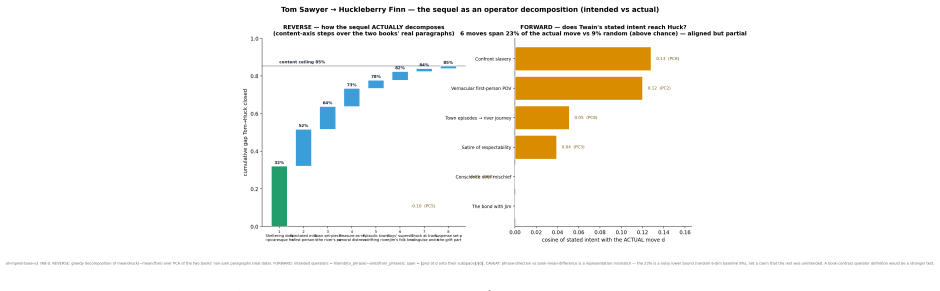
Treating books as points in embedding space, the displacement d between original and sequel mean embeddings can be projected onto a PCA basis derived from the paragraphs of the two books themselves. This yields a decomposition into interpretable components, each defined by opposing passages, revealing that sequels vary in how their changes distribute across axes, with the canonical case showing a primary structural move toward adventure rather than surface thematic shifts.
What carries the argument
The displacement vector d equals the mean embedding of the sequel minus the mean embedding of the original, decomposed via greedy projection onto PCA axes from the combined paragraphs of both books.
If this is right
- Sequels fall into three types: formulaic with tiny low-rank change, concentrated with one dominant axis, and compositional with many small axes.
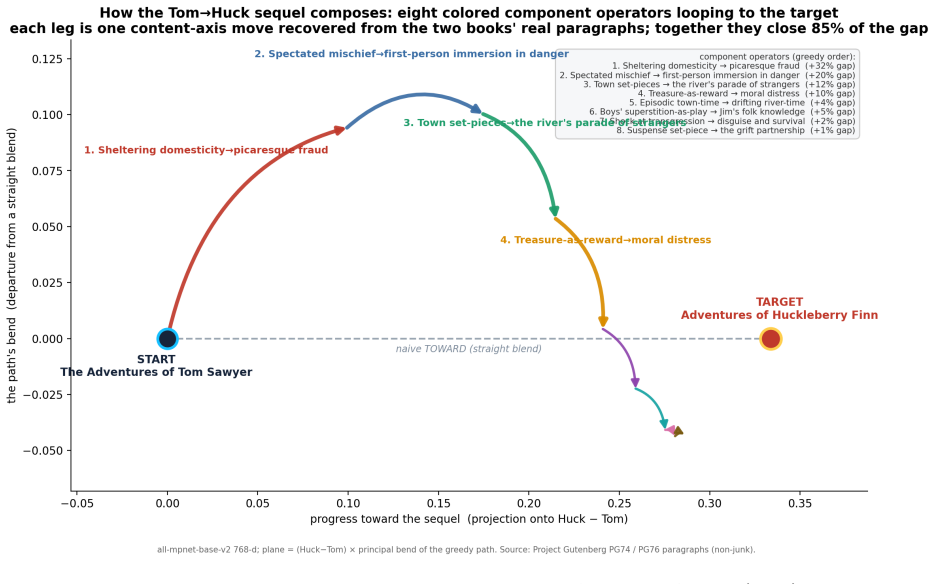
- In the canonical case the dominant axis reflects a structural change from sheltering domesticity to picaresque road.
- The transformation routes through adventure-journey space rather than generic realism.
- The decomposition can be checked against documented authorial intent.
Where Pith is reading between the lines
- If the axes prove stable across different embedding models, the method could generalize to other narrative transformations such as revisions or adaptations.
- The taxonomy suggests a way to quantify how much a sequel innovates versus repeats prior patterns.
- Extending the decomposition to multiple sequels in a series might reveal cumulative changes in an author's body of work.
- This geometric lens could connect to questions in narrative theory about what constitutes a meaningful story evolution.
Load-bearing premise
The average embedding difference between the two books captures the core literary transformation and the principal component axes from their paragraphs represent meaningful literary dimensions instead of model artifacts.
What would settle it
Finding that the leading axis in the canonical decomposition does not correspond to passages contrasting domestic settings with journey narratives, or that surface themes dominate the first component, would falsify the structural interpretation.
Figures

read the original abstract
I treat a book as a point in a sentence-embedding space and a literary transformation as an operation on points. Given an original novel and its sequel, I ask what it takes, geometrically, to turn the first into the second. Using all-mpnet-base-v2 paragraph embeddings drawn from a precomputed index of the PG19 corpus, I form the displacement $d=\bar{x}_{\rm seq}-\bar{x}_{\rm orig}$ and greedily decompose it along a content basis obtained by PCA over the two books' own paragraphs. Each component is an interpretable axis anchored by real passages at its poles. Across thirteen verified author pairs from Project Gutenberg, the decomposition reveals a small taxonomy of sequels: formulaic (a tiny, low-rank change: Doyle's Holmes collections, $\|d\|=0.12$), concentrated (one dominant axis: Alcott's Little Women $\to$ Little Men, 75% on a single move), and compositional (many small axes: Twain, Burroughs's Barsoom, Nesbit). For the canonical case, Tom Sawyer $\to$ Huckleberry Finn, the dominant recovered axis is structural -- the collapse of sheltering domesticity into a picaresque road -- rather than the famous surface themes of vernacular voice or slavery, which ride later, smaller axes; and the transformation routes through adventure-journey space rather than diluting toward generic realism. I corroborate the recovered geometry against Twain's documented authorial intent (his 1875--76 letters to Howells), which names the first-person picaresque move years in advance, and I quantify, with an explicit representation caveat, how much of the realized transformation his stated intentions span. All computations are reproducible from the released scripts and data.
Editorial analysis
A structured set of objections, weighed in public.
Referee Report
Summary. The paper treats novels as points in sentence-embedding space and sequels as vector displacements d = mean(sequel) - mean(original). It decomposes each d by greedy projection onto the top principal components obtained from PCA on the concatenated paragraph embeddings of the two books alone, interprets the resulting axes via their pole passages, and reports a taxonomy of sequel types (formulaic, concentrated, compositional) across 13 Project Gutenberg pairs. The Tom Sawyer to Huckleberry Finn case is singled out as having a dominant structural axis (collapse of domesticity into picaresque road) rather than surface themes, with partial corroboration from Twain's letters.
Significance. If the recovered axes can be shown to align with literary dimensions rather than embedding artifacts, the method supplies a reproducible geometric taxonomy of narrative transformations and a concrete, falsifiable link between authorial statements and realized embedding geometry. The explicit release of scripts and data is a clear strength that supports verification.
major comments (2)
- [Method] Method (PCA construction and decomposition): the basis is obtained by PCA on the exact paragraphs whose means define d. By construction the leading components therefore capture the largest variance directions within the data used to form d, yet the manuscript supplies no independent test (e.g., correlation with external literary annotations, held-out books, or comparison against a control corpus) that these directions correspond to the claimed structural or thematic literary moves rather than model-specific statistical modes.
- [Results] Results (taxonomy and case studies): the classification into formulaic/concentrated/compositional sequels and the specific claim that the dominant Twain axis is structural rather than thematic rest entirely on post-hoc interpretation of pole passages. No quantitative metrics are reported (explained-variance ratios per component, reconstruction error of d, inter-rater reliability on axis labels, or baseline comparisons), leaving the taxonomy and the Twain interpretation without measurable support.
minor comments (1)
- [Abstract] Abstract: the phrase 'with an explicit representation caveat' is used but the caveat itself is not stated in the abstract or immediately elaborated in the provided text.
Simulated Author's Rebuttal
We thank the referee for the detailed and constructive report. We respond point-by-point to the major comments, indicating planned revisions where appropriate.
read point-by-point responses
-
Referee: [Method] Method (PCA construction and decomposition): the basis is obtained by PCA on the exact paragraphs whose means define d. By construction the leading components therefore capture the largest variance directions within the data used to form d, yet the manuscript supplies no independent test (e.g., correlation with external literary annotations, held-out books, or comparison against a control corpus) that these directions correspond to the claimed structural or thematic literary moves rather than model-specific statistical modes.
Authors: The PCA is performed on the concatenated paragraphs of the specific original-sequel pair by design, so that the resulting basis spans the variance relevant to the observed displacement d. This choice keeps the decomposition internal to the transformation under study. We agree that the absence of an external validation step (such as correlation with literary annotations or held-out corpora) leaves open the possibility that recovered axes reflect embedding artifacts. In the revision we will add an explicit limitations subsection acknowledging this and outlining how future work could incorporate such tests. revision: partial
-
Referee: [Results] Results (taxonomy and case studies): the classification into formulaic/concentrated/compositional sequels and the specific claim that the dominant Twain axis is structural rather than thematic rest entirely on post-hoc interpretation of pole passages. No quantitative metrics are reported (explained-variance ratios per component, reconstruction error of d, inter-rater reliability on axis labels, or baseline comparisons), leaving the taxonomy and the Twain interpretation without measurable support.
Authors: The taxonomy is grounded in the reported magnitudes of d and the concentration of its decomposition (e.g., ||d|| = 0.12 for formulaic cases and 75 % on a single axis for concentrated cases). The Twain structural claim follows from the content of the top pole passages, which contrast domestic shelter with picaresque journey, consistent with the cited letters. We accept that additional quantitative detail would strengthen the presentation. The revised manuscript will report per-component explained-variance ratios, reconstruction error of d using the leading axes, and the full set of pole passages for all thirteen pairs. Inter-rater reliability is not applicable to this single-author interpretive study, but the explicit passages enable reader verification. revision: yes
- Providing independent external validation (correlation with literary annotations, held-out books, or control corpora) for the PCA axes, as this requires new annotated data collection beyond the scope of the present revision.
Circularity Check
No circularity: data-driven decomposition with post-hoc literary interpretation
full rationale
The paper defines the transformation via the explicit displacement d = mean(seq) - mean(orig) and obtains a basis via PCA on the identical paragraph set, then projects and interprets pole passages qualitatively. This construction is fully stated and reproducible from the released scripts; the resulting taxonomy (formulaic/concentrated/compositional) and specific claims (e.g., Twain structural axis) are presented as observations from that decomposition rather than as predictions or theorems that reduce to the inputs by definition. No self-citations, ansatzes, or uniqueness theorems appear, and the method does not rename a known result or fit parameters to a subset then relabel the output. The derivation chain therefore remains self-contained against external benchmarks.
Axiom & Free-Parameter Ledger
free parameters (2)
- embedding model
- PCA component selection
axioms (2)
- domain assumption Sentence embeddings capture literary content and transformations in a geometrically meaningful way.
- domain assumption PCA on the paragraphs of the two books alone produces axes that correspond to literary content rather than embedding artifacts.
Reference graph
Works this paper leans on
-
[1]
Sentence-BERT: Sentence Embeddings using Siamese BERT-Networks
N. Reimers and I. Gurevych. Sentence-BERT: Sentence Embeddings using Siamese BERT-Networks. EMNLP, 2019. arXiv:1908.10084. 7
work page internal anchor Pith review Pith/arXiv arXiv 2019
- [2]
-
[3]
J. W. Rae, A. Potapenko, S. M. Jayakumar, T. P. Lillicrap. Compressive Transformers for Long-Range Sequence Modelling (PG19 corpus).ICLR, 2020. arXiv:1911.05507
work page internal anchor Pith review Pith/arXiv arXiv 2020
-
[4]
W. F. Zimmerman.Story Operators. Story Operators New Media, Ann Arbor, Michigan, 2026
2026
-
[5]
S. L. Clemens to W. D. Howells, 5 July 1875 and 9 August 1876. InMark Twain–Howells Letters, ed. H. N. Smith and W. M. Gibson (Harvard Univ. Press, 1960); also Mark Twain Project critical edition of Adventures of Huckleberry Finn
1960
-
[6]
A Sound Heart and a Deformed Conscience,
S. L. Clemens, Notebook entry, c. 1895; see H. N. Smith, “A Sound Heart and a Deformed Conscience,” inMark Twain’s Humor. 8
discussion (0)
Sign in with ORCID, Apple, or X to comment. Anyone can read and Pith papers without signing in.