REVIEW 3 major objections 5 minor 1 cited by
The fixed boundary plasma equilibrium basis for a one Gigawatt electric stellarator power plant
T0 review · 3 major / 5 minor · reviewed 2026-07-13 · grok-4.5
Pith's one-line read A fixed-boundary stellarator plasma shape is shown to meet the full set of design targets for a 1 GW-electric, 3 GW-fusion power plant.
desk verdict Solid plant-scale fixed-boundary optimization package; the evolved equilibrium's full alpha-power claim is still one step short of the evidence they already ran for the conceptual design. read the letter →
The pith
A machine-rendered reading of the paper's core claim, the machinery that carries it, and where it could break.
The reading
What carries the argument
Multi-objective fixed-boundary optimization of the plasma shape (Garabedian boundary modes) inside a volume-renormalized VMEC equilibrium and a modified STELLOPT loop that targets ballooning, Γ_C fast-ion proxy, g_rr turbulence proxy, neoclassical ripple, bootstrap current (via BOOTSJ/DKES/PENTA), rotational transform, and core radial electric field while holding on-axis field fixed.
What would settle it
A full collisional slowing-down calculation of fusion-born alphas on the evolved free-boundary equilibrium that returns alpha power confinement below 85 percent, or a self-consistent free-boundary bootstrap current that exceeds 50 kA and destabilizes the n = 1 or n = 2 kink families.
Extended reading notes
Core claim
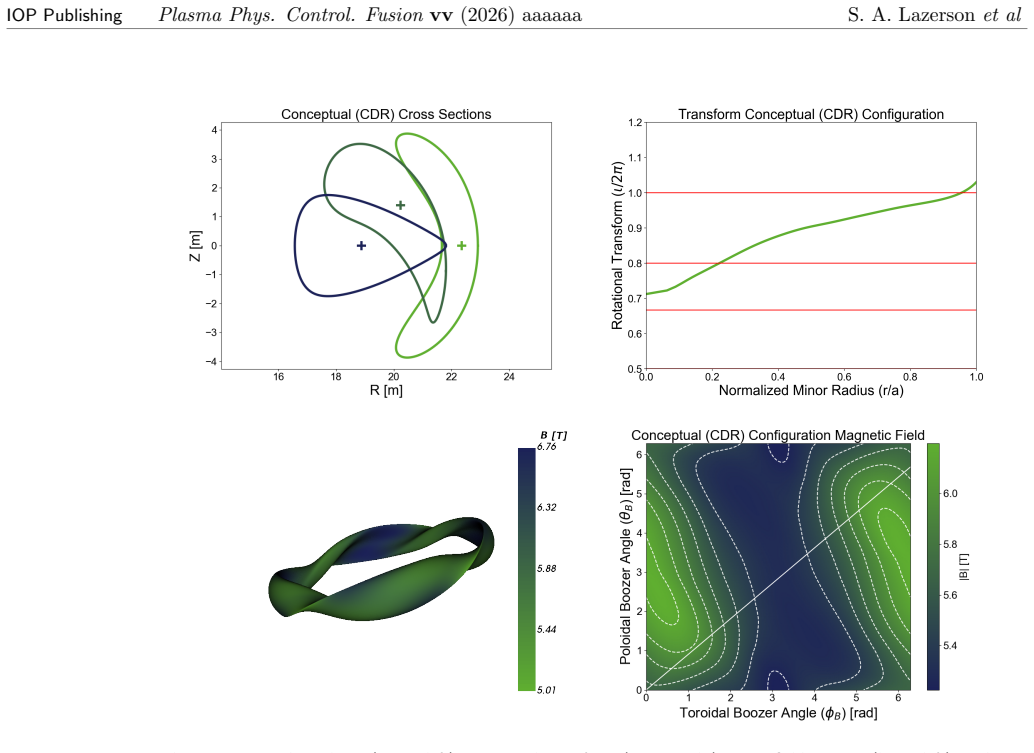
The final evolved fixed-boundary equilibrium (GIGA v549) satisfies the full requirement set for a 1500 m^{3}, 6 T, four-period stellarator that produces 3 GW of fusion power: alpha power confinement above 85 percent, effective helical ripple below 0.01, net toroidal current below 50 kA, ballooning and kink stability for the n = 0, 1, 2 families, no large core-to-edge Alfvén gaps, reduced turbulent heat fluxes relative to W7-X, and a positive core radial electric field.
Load-bearing premise
That optimizing the fixed plasma boundary with proxy figures of merit and only limited a-posteriori checks is enough to guarantee reactor-level alpha confinement and transport once free-boundary coils and self-consistent profiles are included.
Editorial extensions
If this is right
- Coil sets can be designed to a single fixed plasma boundary that already meets the plant’s confinement, current, and stability targets.
- An island divertor becomes feasible because the edge rotational transform sits just below the 4/4 resonance with low net current.
- Core electron-root conditions become an explicit design target rather than an afterthought for impurity control.
- 0.5-D power-balance limits (volume, field, density, temperature) can be treated as hard constraints while the shape is varied.
- Further free-boundary and divertor work can proceed from a documented plasma that already clears the listed physics gates.
Reading between the lines
- If free-boundary vertical-field response reopens bootstrap current, a second-stage coil-plus-plasma optimization will be required before the design is frozen.
- The same volume-fixed, field-fixed optimization template could be reused for higher-field or lower-power variants once materials set wall-load limits.
- Demonstrating the same proxy-to-performance chain on an existing device (shape-driven turbulence and alpha-proxy reduction) would raise confidence that the plant-scale targets are not only numerical.
- Positive core Er at near-equal ion and electron temperatures, if realized, would couple impurity exhaust directly to the optimized magnetic spectrum.
Editorial analysis
A structured set of objections, weighed in public.
Referee Report
Summary. The manuscript presents a fixed-boundary stellarator equilibrium (GIGA v549), evolved from a modified high-iota W7-X configuration, as the plasma design basis for a 1 GWe (3 GW fusion) power plant. Requirements are quantified via 0.5D POPCON/ISS04 scoping (volume 1500 m³, B_axis ≈ 6 T, 4 field periods, island-divertor-compatible edge ι, etc.). STELLOPT/VMEC optimizations target ballooning stability, Γ_C, g_rr, ε_eff, bootstrap (BOOTSJ/DKES/PENTA), and core Er, with successive conceptual (v515) and evolved (v549) designs. A-posteriori checks cover Mercier/well, TERPSICHORE kink families, STELLGAP Alfvén gaps, NEO/PENTA/THRIFT neoclassical quantities, electrostatic stella turbulence, and (for v515) collisional BEAMS3D/ASCOT5 alpha slowing-down. Table 5 and §5 assert that v549 meets all design targets, including ≥85% alpha power confinement, net current <50 kA, and reduced turbulent heat fluxes.
Significance. A documented, multi-objective fixed-boundary equilibrium for a GW-class stellarator plant is of clear community and industrial value. The paper is explicit about requirements capture, code modifications (volume-renormalized VMEC; STELLOPT bootstrap, Er, and B_axis targets), and the progression from initial to conceptual to evolved designs. Proxy-based optimization plus external checks (TERPSICHORE, STELLGAP, stella, PENTA/THRIFT) is standard practice and usefully recorded. If the performance claims hold under free-boundary coils and full collisional alpha/transport modeling, this would be a substantive design-basis contribution for HELIAS-class reactors.
major comments (3)
- [Abstract; Table 5; §5 (Fig. 11)] Abstract, Table 5, and §5 claim that the evolved equilibrium (v549)—the stated design basis—achieves alpha power confinement ≥85% (Table 5: “>520” MW of 600 MW). For the conceptual design (v515), that claim is supported by full collisional BEAMS3D/ASCOT5 slowing-down. For v549 the paper only shows collisionless losses of deeply trapped mid-radius markers (Fig. 11, losses <1%) and states that full slowing-down “has yet to be modeled.” Collisionless trapped confinement is necessary but not sufficient for integrated alpha power (passing orbits, pitch-angle scattering, finite-orbit and wall-load effects over a slowing-down time). Either provide collisional slowing-down for v549 comparable to v515, or revise the abstract/Table 5/§5 language so that “achieves all necessary requirements” does not assert a quantified power-confinement number that is not yet computed.
- [Tables 4–5; Fig. 13; §7] Net toroidal current <50 kA is a load-bearing target (Tables 4–5; THRIFT/PENTA results in Fig. 13). §7 correctly notes that fixed-boundary equilibria imply a vertical field balancing the hoop force and that free-boundary coil effects may change the bootstrap. Given that bootstrap minimization required iterative current–equilibrium feedback even in fixed boundary, the claim that v549 meets the <50 kA requirement for the plant should be stated as provisional pending free-boundary self-consistency, or a quantitative estimate of the expected free-boundary correction should be given.
- [Abstract; Table 5; §5 (Fig. 14)] Turbulence optimization is central to the requirements (Table 4; “reduced turbulent heat fluxes”; Fig. 14 stella results vs W7-X). The paper acknowledges that electrostatic, collisionless stella runs are insufficient and that electromagnetic treatment with collisions is needed. The claim of a turbulence-optimized reactor basis should be qualified accordingly in the abstract and Table 5 (e.g., “reduced electrostatic ion heat flux relative to W7-X under fixed gradients”), rather than left as an unqualified design-requirement fulfillment.
minor comments (5)
- [§1–§2] Systems-engineering sectioning (System Description / Design Basis / Concept Definition / Qualification Record / Plan) is clear but dense; a short traditional roadmap paragraph early in §1 would help non-systems readers navigate.
- [Table 2] Table 2 lists plasma volume as 1500 m^{-3}; units should be m^3 (consistent with the rest of the paper).
- [Figs. 7–9] Figure captions for boundary/Boozer plots (Figs. 7–9) are informative; ensure print-resolution of mid-radius |B| contours so field-line and symmetry features remain legible.
- [§5; Table 3] The 5% Te > Ti assumption used to access CERC while holding pressure fixed is stated in §5; flag it also in Table 3 or the requirements list so profile assumptions are collected in one place.
- [Front matter; References] Several references and the arXiv date line use 2026 placeholders; normalize bibliographic and front-matter dates before production.
Circularity Check
No significant circularity: requirements from independent 0.5D scoping; optimization against external physics proxies; a-posteriori codes provide non-tautological checks.
-
other
[§3.1 Tools / §4.2 Development of the Evolved Plasma Configuration]
"It was found necessary to include the predicted bootstrap from the previous optimization step in the next, in order to properly minimize the bootstrap current. ... after each optimization, the THRIFT code was used to compute the bootstrap current, which was then incorporated into the equilibrium computation of the next simulation."
Bootstrap current is recomputed from the previous equilibrium and re-inserted as the current profile for the next VMEC solve. This is ordinary iterative self-consistency inside a fixed-boundary model, not a claim that an independent prediction equals its input by definition; free-boundary effects are explicitly flagged as remaining open (§7). Mild and non-load-bearing for the overall design claim.
full rationale
This is an engineering design/optimization paper, not a first-principles derivation of a new physical law. Requirements (volume 1500 m^{3}, 3 GW fusion, B_axis=6 T, ε_eff^{3/2}<0.01, bootstrap <50 kA, α confinement ≥85 %, ballooning/kink stability, etc.) are set by 0.5-D POPCON/ISS04 modeling with assumed profile shapes and literature scalings (Tables 2–4, §3.2); they are not derived from the optimized boundary. STELLOPT minimizes χ^{2} against independent proxies (COBRA ballooning, Γ_C, NEO ε_eff, g_rr/prox-1d, PENTA/BOOTSJ bootstrap, QI/QP metrics) whose definitions pre-exist the present equilibria. Volume is held fixed by a VMEC renormalization and B_axis by a vacuum pre-solve—standard constraints, not self-definition of the performance claims. Bootstrap is iterated for fixed-boundary self-consistency (previous-step current fed into next VMEC), which is ordinary fixed-point iteration, not a prediction forced by construction. A-posteriori verification uses external codes (TERPSICHORE, STELLGAP, stella, BEAMS3D/ASCOT, THRIFT) whose outputs are not algebraically identical to the optimization targets. The incomplete collisional α assessment for the final (v549) equilibrium is an evidence gap, not circularity. Self-citations (prior Lazerson/STELLOPT/BEAMS3D papers) supply tools, not load-bearing uniqueness theorems that force the result. Score 1 reflects only the mild, standard self-consistency loop for bootstrap; the central claim that the evolved equilibrium meets the design envelope remains independent of its inputs.
Assumptions & free parameters
free parameters (7)
- Plasma volume
- On-axis magnetic field
- Temperature and density profile shapes
- ISS04 renormalization factor f_ren
- STELLOPT target weights (sigmas) and χ² composition
- Alpha power loss / confinement requirement
- Balance-of-plant conversion efficiency ~33%
assumptions (6)
- domain assumption Ideal nested-flux-surface MHD equilibria (VMEC) adequately represent the reactor plasma for optimization and stability metrics.
- domain assumption Proxy metrics (Γ_C for fast ions, g_rr/prox-1d for turbulence, ε_eff for 1/ν transport) correlate sufficiently with reactor-relevant confinement.
- domain assumption ISS04 energy confinement scaling with assumed profiles predicts auxiliary power and burn accessibility.
- domain assumption Island divertor requires edge ι near a low-order rational just outside the boundary (ι_edge ≲ 1 for 4 periods).
- standard math Levenberg–Marquardt / GADE minimization of weighted χ² yields a physically meaningful multi-objective optimum.
- ad hoc to paper Slight Te > Ti (5%) is acceptable to access core electron root while holding pressure fixed.
Cite this review
Pith. "Pith review of The fixed boundary plasma equilibrium basis for a one Gigawatt electric stellarator power plant." pith.science (2026). https://pith.science/paper/BIOFANXY
@misc{pith2026260709346,
  author       = {Pith},
  title        = {Pith review of: The fixed boundary plasma equilibrium basis for a one Gigawatt electric stellarator power plant},
  year         = {2026},
  howpublished = {\url{https://pith.science/paper/BIOFANXY}},
  note         = {Machine review of arXiv:2607.09346}
}
abstract
A fixed boundary stellarator equilibrium capable of producing 3 GW of fusion power (1 GW-electric) is presented as the design basis for the GIGA fusion power plant being developed by Gauss Fusion GmbH. The stellarator concept provides a steady-state, transient free, low recirculating power approach to a fusion power plant, which builds on 50 years of progress in plasma physics. A set of requirements for a fixed boundary equilibrium were determined through application of 0.5 D modeling. Optimization of a modified Wendelstein 7-X (W7-X) equilibrium was performed to achieve these requirements including alpha power confinement greater than $85\%$, neoclassical effective ripple below 0.01, bootstrap current below 50 kA, and reduced turbulent heat fluxes. In order to fix the plasma volume of $1500~m^3$ during optimization, the VMEC code was modified to renormalize the boundary coefficient to the desired plasma volume. The STELLOPT stellarator optimization code was modified as well to include new bootstrap current targets, a new target for the radial electric field, and the capability to hold the magnetic field on axis at a fixed value. An intermediary conceptual design plasma and final evolved fixed boundary equilibria are compared to the original modified W7-X equilibrium. The final evolved equilibrium is shown to achieve all the necessary requirements for the GIGA fusion power plant through more detailed modeling of stability, fast ion confinement, and transport.
Figures


Figures from the paper (12 more)




Forward citations
Cited by 1 Pith paper
-
Divertor topology and vacuum vessel design for stellarators
Joint coil–vessel optimization with a stable fixed-point solver yields quasi-axisymmetric stellarators with controlled divertor topologies, including precise snowflake divertors.
Reference graph
Works this paper leans on
-
[1]
Giga conceptual design report - executive summary
Gauss Fusion GmbH. Giga conceptual design report - executive summary. Report, Gauss Fusion GmbH, 2025. https://gauss-fusion.com/cdr-executive-summary
2025
-
[2]
The Stellarator Concept.Physics of Fluids, 1(4):253, 1958
Lyman Spitzer. The Stellarator Concept.Physics of Fluids, 1(4):253, 1958
1958
-
[3]
Allen H. Boozer. Stellarator design.Journal of Plasma Physics, 81(6):515810606, December 2015
2015
-
[4]
A. J. H. Donn´ e, M. Cox, N. Sauthoff, and K. Schoenberg. Beyond power gain: Toward a comprehensive milestone framework for all fusion energy concepts.Physics of Plasmas, 32(9):090602, September 2025
2025
-
[5]
Najmabadi, A
F. Najmabadi, A. R. Raffray, S. I. Abdel-Khalik, L. Bromberg, L. Crosatti, L. El-Guebaly, P. R. Garabedian, A. A. Grossman, D. Henderson, A. Ibrahim, T. Ihli, T. B. Kaiser, B. Kiedrowski, L. P. Ku, J. F. Lyon, R. Maingi, S. Malang, C. Martin, T. K. Mau, B. Merrill, R. L. Moore, R. J. Peipert, D. A. Petti, D. L. Sadowski, M. Sawan, J. H. Schultz, R. Slayba...
2008
-
[6]
Physics design for ARIES-CS.Fusion Science and Technology, 54:673–693, 2008
L P Ku, P R Garabedian, J Lyon, A Turnbull, A Grossman, T K Mau, and M Zarnstorff. Physics design for ARIES-CS.Fusion Science and Technology, 54:673–693, 2008
2008
-
[7]
R. Kemp, H. Lux, M. Kovari, J. Morris, R. Wenninger, H. Zohm, W. Biel, and G. Federici. Dealing with uncertainties in fusion power plant conceptual development.Nuclear Fusion, 57(4):046024, March 2017
2017
-
[8]
Grieger, J
G. Grieger, J. N¨ uhrenberg, H. Renner, J. Sapper, and H. Wobig. HELIAS stellarator reactor studies and related European technology studies.Fusion Engineering and Design, 25(1):73–84, August 1994
1994
Show all 155 references
-
[9]
Warmer, S
F. Warmer, S. B. Torrisi, C. D. Beidler, A. Dinklage, Y. Feng, J. Geiger, F. Schauer, Y. Turkin, R. Wolf, P. Xanthopoulos, R. Kemp, P. Knight, H. Lux, and D. Ward. System Code Analysis of HELIAS-Type Fusion Reactor and Economic Comparison With Tokamaks. IEEE Transactions on Pl...
2016
-
[10]
Maris, Allen Wang, Cristina Rea, Robert Granetz, and Earl Marmar
Andrew D. Maris, Allen Wang, Cristina Rea, Robert Granetz, and Earl Marmar. The Impact of Disruptions on the Economics of a Tokamak Power Plant.Fusion Science and Technology, 80(5):636–652, July 2024
2024
-
[11]
Yu Gao, Joachim Geiger, Marcin W. Jakubowski, Peter Drewelow, Michael Endler, Kian Rahbarnia, Sergey Bozhenkov, Matthias Otte, Yasuhiro Suzuki, Yuhe Feng, Holger Niemann, Fabio Pisano, Adnan Ali, Aleix Puig Sitjes, Marco Zanini, Heinrich Laqua, Torsten Stange, Stefan Marsen, T...
2019
-
[12]
Geiger, C.D
J. Geiger, C.D. Beidler, M. Drevlak, H. Maaßberg, C. N¨ uhrenberg, Y. Suzuki, and Yu. Turkin. Effects of Net Currents on the Magnetic Configuration of W7-X.Contributions to Plasma Physics, 50(8):770–774, July 2010. 28 IOP PublishingPlasma Phys. Control. Fusionvv(2026) aaaaaa S...
2010
-
[13]
Neuner, K
U. Neuner, K. Rahbarnia, C. D. Beidler, A. Dinklage, Y. Turkin, T. Stange, T. Andreeva, J. Schilling, H. Thomsen, M. Beurskens, S. Bozhenkov, K. J. Brunner, H. Damm, G. Fuchert, J. Geiger, U. Hergenhahn, U. H¨ ofel, J. Knauer, M. Krychowiak, S. Kwak, A. Langenberg, N. Pablant,...
2021
-
[14]
Sunn Pedersen, M
T. Sunn Pedersen, M. Otte, S. Lazerson, P. Helander, S. Bozhenkov, C. Biedermann, T. Klinger, R. C. Wolf, H. S. Bosch, and The Wendelstein 7-X Team. Confirmation of the topology of the Wendelstein 7-X magnetic field to better than 1:100,000.Nature Communications, 7(1):13493, D...
2016
-
[15]
Erckmann, U
V. Erckmann, U. Gasparino, and H. MaaBberg. Current drive and bootstrap current in stellarators.Plasma Physics and Controlled Fusion, 34(13):1917, December 1992
1917
-
[16]
D. T. Anderson, A. Abdou, A. F. Almagri, F. S. B. Anderson, J. M. Canik, W. Guttenfelder, C. Lechte, K. M. Likin, H. Lu, S. Oh, P. H. Probert, J. Radder, V. Sakaguchi, J. Schmitt, J. N. Talmadge, K. Zhai, D. L. Brower, and C. Deng. Overview of Recent Results from HSX. Fusion S...
2006
-
[17]
J. N. Talmadge, F. S. B. Anderson, D. T. Anderson, C. Deng, W. Guttenfelder, K. M. Likin, J. Lore, J. C. Schmitt, and K. Zhai. Experimental Tests of Quasisymmetry in HSX.Plasma and Fusion Research, 3:S1002–S1002, 2008
2008
-
[18]
R.C. Wolf, A. Ali, A. Alonso, J. Baldzuhn, C. Beidler, M. Beurskens, C. Biedermann, H.-S. Bosch, S. Bozhenkov, R. Brakel, A. Dinklage, Y. Feng, G. Fuchert, J. Geiger, O. Grulke, P. Helander, M. Hirsch, U. H¨ ofel, M. Jakubowski, J. Knauer, G. Kocsis, R. K¨ onig, P. Kornejew, A...
2026
-
[19]
Klinger, T
T. Klinger, T. Andreeva, S. Bozhenkov, C. Brandt, R. Burhenn, B. Buttensch¨ on, G. Fuchert, B. Geiger, O. Grulke, H.P. Laqua, N. Pablant, K. Rahbarnia, T. Stange, A. von Stechow, N. Tamura, H. Thomsen, Y. Turkin, T. Wegner, I. Abramovic, S. ¨Ak¨ aslompolo, J. Alcuson, P. Aleyn...
2026
-
[20]
Grulke, G
O. Grulke, G. Acton, J. Adamek, D. Aggelis, R.-M. Alamo-Calderon, C. Albert, P. Aleynikov, K. Aleynikova, A. Alonso, G.C. Amanekwe, G. Anda, T. Andreeva, E. Andrew, A. Arkuszewski, S. Arnold, M. Arranz, M. Arvanitou, E. Ascasibar, M. Astrain Etxezarreta, O. Asztalos, K. Avrami...
2026
-
[21]
J Cheng, Y Xu, H F Liu, X Q Wang, W M Xuan, J Huang, H Liu, X Zhang, J F Shen, J Hu, H Lan, Y C Li, W Li, H Zhou, J R Shao, A Shimizu, M Isobe, S Okamura, M Shoji, K Ogawa, D Yin, C Tang, and the CFQS team. Construction progress of the Chinese First Quasi-axisymmetric Stellara...
2025
-
[22]
Single-stage gradient-based stellarator coil design: stochastic optimization.Nuclear Fusion, 62(7):076034, May 2022
Florian Wechsung, Andrew Giuliani, Matt Landreman, Antoine Cerfon, and Georg Stadler. Single-stage gradient-based stellarator coil design: stochastic optimization.Nuclear Fusion, 62(7):076034, May 2022. 32 IOP PublishingPlasma Phys. Control. Fusionvv(2026) aaaaaa S. A. Lazersonet al
2022
-
[23]
Single-stage gradient-based stellarator coil design: Optimization for near-axis quasi-symmetry.Journal of Computational Physics, 459:111147, June 2022
Andrew Giuliani, Florian Wechsung, Antoine Cerfon, Georg Stadler, and Matt Landreman. Single-stage gradient-based stellarator coil design: Optimization for near-axis quasi-symmetry.Journal of Computational Physics, 459:111147, June 2022
2022
-
[24]
Jorge, A
R. Jorge, A. Goodman, M. Landreman, J. Rodrigues, and F. Wechsung. Single-stage stellarator optimization: combining coils with fixed boundary equilibria.Plasma Physics and Controlled Fusion, 65(7):074003, June 2023
2023
-
[25]
C. B. Smiet, J. Loizu, E. Balkovic, and A. Baillod. Efficient single-stage optimization of islands in finite-βstellarator equilibria.Physics of Plasmas, 32(1):012504, January 2025
2025
-
[26]
Kovrizhnykh and S.V
L.M. Kovrizhnykh and S.V. Shchepetov. MHD equilibrium and stability of a stellarator plasma.Nuclear Fusion, 23(7):859, July 1983
1983
-
[27]
V. D. Shafranov. Magnetohydrodynamic theory of plasma equilibrium and stability in stellarators: Survey of results.The Physics of Fluids, 26(2):357–364, February 1983
1983
-
[28]
Bauer, O
F. Bauer, O. Betancourt, and P. Garabedian. Nonlinear magnetohydrodynamic stability.The Physics of Fluids, 24(1):48–54, January 1981
1981
-
[29]
Ho and Russell M
Darwin D.-M. Ho and Russell M. Kulsrud. Neoclassical transport in stellarators.The Physics of Fluids, 30(2):442–461, February 1987
1987
-
[30]
Maassberg, W
H. Maassberg, W. Lotz, and J. N¨ uhrenberg. Neoclassical bootstrap current and transport in optimized stellarator configurations.Physics of Fluids B: Plasma Physics, 5(10):3728–3736, October 1993
1993
-
[31]
Collisional transport in plasma
Fred Hinton. Collisional transport in plasma. InHandbook of Plasma Physics, volume 1, page
-
[32]
North-Holland, Amsterdam, 1983
1983
-
[33]
K. C. Shaing, E. C. Crume, J. S. Tolliver, S. P. Hirshman, and W. I. van Rij. Bootstrap current and parallel viscosity in the low collisionality regime in toroidal plasmas.Physics of Fluids B: Plasma Physics, 1(1):148–152, January 1989
1989
-
[34]
C. T. Hsu, K. C. Shaing, R. P. Gormley, and D. J. Sigmar. Bootstrap current induced by fusion born alpha particles.Physics of Fluids B: Plasma Physics, 4(12):4023–4032, December 1992
1992
-
[35]
A. S. Ware, D. A. Spong, L. A. Berry, S. P. Hirshman, and J. F. Lyon. Bootstrap Current in Quasi-Symmetric Stellarators.Fusion Science and Technology, 50(2):236–244, August 2006. eprint: https://doi.org/10.13182/FST06-A1241
2006 doi
-
[36]
Helander and J
P. Helander and J. N¨ uhrenberg. Bootstrap current and neoclassical transport in quasi-isodynamic stellarators.Plasma Physics and Controlled Fusion, 51(5):055004, February 2009
2009
-
[37]
Effects of the radial electric field in a quasisymmetric stellarator.Plasma Physics and Controlled Fusion, 53(1):015004, January 2011
Matt Landreman and Peter J Catto. Effects of the radial electric field in a quasisymmetric stellarator.Plasma Physics and Controlled Fusion, 53(1):015004, January 2011
2011
-
[38]
Neoclassical flow, current, and electric field in a quasi-isodynamic stellarator.Plasma Physics and Controlled Fusion, 53(3):035016, March 2011
Matt Landreman and Peter J Catto. Neoclassical flow, current, and electric field in a quasi-isodynamic stellarator.Plasma Physics and Controlled Fusion, 53(3):035016, March 2011
2011
-
[39]
B. F. Lee, S. A. Lazerson, H. M. Smith, C. D. Beidler, and N. A. Pablant. Direct optimization of neoclassical ion transport in stellarator reactors.Nuclear Fusion, 64(10):106054, September 2024
2024
-
[40]
Beidler, M
C.D. Beidler, M. Drevlak, J. Geiger, P. Helander, H.M. Smith, and Y. Turkin. Reduction of neoclassical bulk-ion transport to avoid helium-ash retention in stellarator reactors.Nuclear Fusion, 64(12):126030, December 2024
2024
-
[41]
W. Horton. Drift waves and transport.Reviews of Modern Physics, 71(3):735–778, April 1999. 33 IOP PublishingPlasma Phys. Control. Fusionvv(2026) aaaaaa S. A. Lazersonet al
1999
-
[42]
A. M. Dimits, G. Bateman, M. A. Beer, B. I. Cohen, W. Dorland, G. W. Hammett, C. Kim, J. E. Kinsey, M. Kotschenreuther, A. H. Kritz, L. L. Lao, J. Mandrekas, W. M. Nevins, S. E. Parker, A. J. Redd, D. E. Shumaker, R. Sydora, and J. Weiland. Comparisons and physics basis of tok...
2000
-
[43]
A. J. Brizard and T. S. Hahm. Foundations of nonlinear gyrokinetic theory.Reviews of Modern Physics, 79(2):421–468, April 2007
2007
-
[44]
Dominguez, B
N. Dominguez, B. A. Carreras, V. E. Lynch, and P. H. Diamond. Dissipative trapped electron modes inl= 2 torsatrons.Physics of Fluids B: Plasma Physics, 4(9):2894–2906, September 1992
1992
-
[45]
Optimization, mhd mode and alpha particle confinement behaviour of helias equilibria.Plasma Physics and Controlled Nuclear Fusion Research, 2:603, 1990
W Lotz, J N¨ uhrenberg, and C Schwab. Optimization, mhd mode and alpha particle confinement behaviour of helias equilibria.Plasma Physics and Controlled Nuclear Fusion Research, 2:603, 1990
1990
-
[46]
Simulating fusion alpha heating in a stellarator reactor.Plasma Physics and Controlled Fusion, 63(12):125033, December 2021
Samuel A Lazerson, Alexandra LeViness, and Jorrit Lion. Simulating fusion alpha heating in a stellarator reactor.Plasma Physics and Controlled Fusion, 63(12):125033, December 2021
2021
-
[47]
Bader, D.T
A. Bader, D.T. Anderson, M. Drevlak, B.J. Faber, C.C. Hegna, S. Henneberg, M. Landreman, J.C. Schmitt, Y. Suzuki, and A. Ware. Modeling of energetic particle transport in optimized stellarators.Nuclear Fusion, 61(11):116060, October 2021
2021
-
[48]
Protecting ITER walls: fast ion power loads in 3D magnetic field.Plasma Physics and Controlled Fusion, 59(1):014013, October 2016
T Kurki-Suonio, K S¨ arkim¨ aki, S¨Ak¨ aslompolo, J Varje, Y Liu, S Sipil¨ a, O Asunta, E Hirvijoki, A Snicker, J Ter¨ av¨ a, M Cavinato, M Gagliardi, V Parail, and G Saibene. Protecting ITER walls: fast ion power loads in 3D magnetic field.Plasma Physics and Controlled Fusion...
2016
-
[49]
Mark J. H. Cornelissen, Samuel A. Lazerson, Yu Gao, Josefine H. E. Proll, Paul McNeely, Norbert Rust, Dirk Hartmann, Marcin W. Jakubowski, Adnan Ali, Fabio Pisano, Holger Niemann, Aleix Puig Sitjes, Ralf K¨ onig, Robert C. Wolf, and the W7-X. Team. Identification of fast ion w...
2022
-
[50]
Placement of a fast ion loss detector array for neutral beam injected particles in Wendelstein 7-X.Plasma Physics and Controlled Fusion, 64(3):035006, March 2022
D Kulla, S Lazerson, S G¨ unter, M Hirsch, D Hartmann, P McNeely, N Rust, and R C Wolf. Placement of a fast ion loss detector array for neutral beam injected particles in Wendelstein 7-X.Plasma Physics and Controlled Fusion, 64(3):035006, March 2022
2022
-
[51]
S. P. Hirshman and J.C. Whitson. Steepest-descent moment method for three-dimensional magnetohydrodynamic equilibria.Physics of Fluids, 26(12):3553, 1983
1983
-
[52]
D. W. Dudt and E. Kolemen. DESC: A stellarator equilibrium solver.Physics of Plasmas, 27(10):102513, October 2020
2020
-
[53]
GVEC: A flexible 3D MHD equilibrium solver.Journal of Open Source Software, 11(120):9670, April 2026
Florian Hindenlang, Omar Maj, Robert Babin, Robert K¨ oberl, Dean Muir, Tiago Tamissa Ribeiro, Markus Rampp, and Eric Sonnendr¨ ucker. GVEC: A flexible 3D MHD equilibrium solver.Journal of Open Source Software, 11(120):9670, April 2026
2026
-
[54]
A High Performance Spectral Code for Nonlinear MHD Stability.Journal of Computational Physics, 110(2):407–418, February 1994
Mark Taylor. A High Performance Spectral Code for Nonlinear MHD Stability.Journal of Computational Physics, 110(2):407–418, February 1994
1994
-
[55]
S. P. Hirshman, R. Sanchez, and C. R. Cook. SIESTA: A scalable iterative equilibrium solver for toroidal applications.Physics of Plasmas, 18(6):062504, June 2011
2011
-
[56]
Development and application of HINT2 to helical system plasmas.Nuclear Fusion, 46(11):L19–L24, November 2006
Yasuhiro Suzuki, Noriyoshi Nakajima, Kiyomasa Watanabe, Yuji Nakamura, and Takaya Hayashi. Development and application of HINT2 to helical system plasmas.Nuclear Fusion, 46(11):L19–L24, November 2006
2006
-
[57]
Ferraro, S.C
Yao Zhou, N.M. Ferraro, S.C. Jardin, and H.R. Strauss. Approach to nonlinear magnetohydrodynamic simulations in stellarator geometry.Nuclear Fusion, 61(8):086015, July 2021
2021
-
[58]
M. J. Hole, S. R. Hudson, and R. L. Dewar. Stepped pressure profile equilibria in cylindrical plasmas via partial Taylor relaxation.Journal of Plasma Physics, 72(6):1167–1171, December 2006. 34 IOP PublishingPlasma Phys. Control. Fusionvv(2026) aaaaaa S. A. Lazersonet al
2006
-
[59]
S. R. Hudson, R. L. Dewar, G. Dennis, M. J. Hole, M. McGann, G. von Nessi, and S. Lazerson. Computation of multi-region relaxed magnetohydrodynamic equilibria.Physics of Plasmas, 19(11):112502, November 2012
2012
-
[60]
Loizu, S
J. Loizu, S. Hudson, A. Bhattacharjee, and P. Helander. Magnetic islands and singular currents at rational surfaces in three-dimensional magnetohydrodynamic equilibria.Physics of Plasmas, 22(2):022501, February 2015
2015
-
[61]
Loizu, S
J. Loizu, S. R. Hudson, A. Bhattacharjee, S. Lazerson, and P. Helander. Existence of three-dimensional ideal-magnetohydrodynamic equilibria with current sheets.Physics of Plasmas, 22(9):090704, September 2015
2015
-
[62]
Loizu, S
J. Loizu, S. R. Hudson, and C. N¨ uhrenberg. Verification of the SPEC code in stellarator geometries.Physics of Plasmas, 23(11):112505, November 2016
2016
-
[63]
Ramasamy, G
R. Ramasamy, G. Bustos Ramirez, M. Hoelzl, J. Graves, G. Su´ arez L´ opez, K. Lackner, S. G¨ unter, and JOREK team. Modeling of saturated external MHD instabilities in tokamaks: A comparison of 3D free boundary equilibria and nonlinear stability calculations.Physics of Plasmas...
2022
-
[64]
Ramasamy, M
R. Ramasamy, M. Hoelzl, S. Henneberg, E. Strumberger, K. Lackner, and S. G¨ unter. How well can VMEC predict the initial saturation of external kink modes in near circular tokamaks and l=2 stellarators?Physics of Plasmas, 30(6):062506, June 2023
2023
-
[65]
Kinetic shielding of magnetic islands in 3D equilibria.Plasma Physics and Controlled Fusion, 53(2):024003, February 2011
C C Hegna. Kinetic shielding of magnetic islands in 3D equilibria.Plasma Physics and Controlled Fusion, 53(2):024003, February 2011
2011
-
[66]
C.C. Hegna. Healing of magnetic islands in stellarators by plasma flow.Nuclear Fusion, 51(11):113017, November 2011
2011
-
[67]
C. C. Hegna. Plasma flow healing of magnetic islands in stellaratorsa).Physics of Plasmas, 19(5):056101, March 2012
2012
-
[68]
Narushima, S
Y. Narushima, S. Sakakibara, Y. Suzuki, K.Y. Watanabe, S. Ohdachi, Y. Takemura, M. Yoshinuma, K. Ida, F. Castej´ on, D. L´ opez-Bruna, C.C. Hegna, M. Kobayashi, H. Tanaka, T. Akiyama, N. Ohno, and The LHD Experiment Group. Observations of sustained phase shifted magnetic islan...
2017
-
[69]
Lazerson, Joaquim Loizu, Steven Hirshman, and Stuart R
Samuel A. Lazerson, Joaquim Loizu, Steven Hirshman, and Stuart R. Hudson. Verification of the ideal magnetohydrodynamic response at rational surfaces in the VMEC code.Physics of Plasmas, 23(1):012507, January 2016
2016
-
[70]
J. D. King, E. J. Strait, S. A. Lazerson, N. M. Ferraro, N. C. Logan, S. R. Haskey, J.-K. Park, J. M. Hanson, M. J. Lanctot, Yueqiang Liu, R. Nazikian, M. Okabayashi, C. Paz-Soldan, D. Shiraki, and A. D. Turnbull. Experimental tests of linear and nonlinear three-dimensional eq...
2015
-
[71]
Equilibrium and stability of a toroidal magnetohydrodynamic system in the neighbourhood of a magnetic axis.Nuclear Fusion, 4(3):213, September 1964
Claude Mercier. Equilibrium and stability of a toroidal magnetohydrodynamic system in the neighbourhood of a magnetic axis.Nuclear Fusion, 4(3):213, September 1964
1964
-
[72]
A brief review of magnetic wells
J M Greene. A brief review of magnetic wells. Technical Report GA-A22135, General Atomics, April 1998
1998
-
[73]
Magnetic well and Mercier stability of stellarators near the magnetic axis.Journal of Plasma Physics, 86(5):905860510, October 2020
Matt Landreman and Rogerio Jorge. Magnetic well and Mercier stability of stellarators near the magnetic axis.Journal of Plasma Physics, 86(5):905860510, October 2020
2020
-
[74]
Tang, J.W
W.M. Tang, J.W. Connor, and R.J. Hastie. Kinetic-ballooning-mode theory in general geometry.Nuclear Fusion, 20(11):1439, November 1980
1980
-
[75]
W. A. Cooper, D. B. Singleton, and R. L. Dewar. Spectrum of ballooning instabilities in a stellarator.Physics of Plasmas, 3(1):275–280, January 1996
1996
-
[76]
M. D. Kruskal and R. M. Kulsrud. Equilibrium of a Magnetically Confined Plasma in a Toroid.The Physics of Fluids, 1(4):265–274, July 1958. 35 IOP PublishingPlasma Phys. Control. Fusionvv(2026) aaaaaa S. A. Lazersonet al
1958
-
[77]
C. Z. Cheng and M. S. Chance. Low-n shear Alfv´ en spectra in axisymmetric toroidal plasmas.The Physics of Fluids, 29(11):3695–3701, November 1986
1986
-
[78]
G. Y. Fu and J. W. Van Dam. Excitation of the toroidicity-induced shear Alfv´ en eigenmode by fusion alpha particles in an ignited tokamak.Physics of Fluids B: Plasma Physics, 1(10):1949–1952, October 1989
1949
-
[79]
Ohdachi, K.Y
S. Ohdachi, K.Y. Watanabe, K. Tanaka, Y. Suzuki, Y. Takemura, S. Sakakibara, X.D. Du, T. Bando, Y. Narushima, R. Sakamoto, J. Miyazawa, G. Motojima, T. Morisaki, and LHD Experiment Group. Observation of the ballooning mode that limits the operation space of the high-density su...
2017
-
[80]
Sanchez, S.P
R. Sanchez, S.P. Hirshman, J.C. Whitson, and A.S. Ware. COBRA: An Optimized Code for Fast Analysis of Ideal Ballooning Stability of Three-Dimensional Magnetic Equilibria. Journal of Computational Physics, 161(2):576–588, July 2000
2000
-
[81]
C. J. Ham, I. T. Chapman, A. Kirk, and S. Saarelma. Modelling of three dimensional equilibrium and stability of MAST plasmas with magnetic perturbations using VMEC and COBRA.Physics of Plasmas, 21(10):102501, October 2014
2014
-
[82]
Dynamics of ideal modes and subsequent ELM crashes in 3D tokamak geometry from external magnetic perturbations.Plasma Physics and Controlled Fusion, 61(1):014019, January 2019
M Willensdorfer, T B Cote, M Griener, D A Ryan, E Strumberger, W Suttrop, N Wang, M Cavedon, S S Denk, M Dunne, R Fischer, J Galdon-Quiroga, C J Ham, C C Hegna, M Hoelzl, A Kirk, M Maraschek, F Mink, N Leuthold, F Orain, E P Seliunin, H Zohm, the ASDEX Upgrade Team, and the MS...
2019
-
[83]
Anderson, W
David V. Anderson, W. Anthony Cooper, Ralf Gruber, Silvio Merazzi, and Ulrich Schwenn. TERPSICHORE: A Three-Dimensional Ideal Magnetohydrodynamic Stability Program. In Jozef T. Devreese and Piet E. Van Camp, editors,Scientific Computing on Supercomputers II, pages 159–174. Spr...
1990
-
[84]
Ideal magnetohydrodynamics: Global mode analysis of three-dimensional plasma configurations.Physics of Fluids B: Plasma Physics, 5(9):3195–3206, September 1993
Carolin Schwab. Ideal magnetohydrodynamics: Global mode analysis of three-dimensional plasma configurations.Physics of Fluids B: Plasma Physics, 5(9):3195–3206, September 1993
1993
-
[85]
Alfv´ enic fluctuations measured by in-vessel Mirnov coils at the Wendelstein 7-X stellarator
K Rahbarnia, H Thomsen, J Schilling, S vaz Mendes, M Endler, R Kleiber, A K¨ onies, M Borchardt, C Slaby, T Bluhm, M Zilker, B B Carvalho, and Wendelstein 7-X Team. Alfv´ enic fluctuations measured by in-vessel Mirnov coils at the Wendelstein 7-X stellarator. Plasma Physics an...
2021
-
[86]
Vaz Mendes, K
S. Vaz Mendes, K. Rahbarnia, C. Slaby, H. Thomsen, J. Schilling, M. Borchardt, R. Kleiber, A. K¨ onies, J.-P. B¨ ahner, A. von Stechow, T. Sunn Pedersen, T. Klinger, and the W7-X. Team. Broadband Alfv´ enic excitation correlated to turbulence level in the Wendelstein 7-X stell...
2023
-
[87]
AE3D, January 2016
Donald Spong. AE3D, January 2016
2016
-
[88]
Slaby, A
C. Slaby, A. K¨ onies, and R. Kleiber. A perturbative multi-mode model with finite parallel electric field for fast-ion-driven Alfv´ en eigenmodes.Nuclear Fusion, 64(12):126016, October 2024
2024
-
[89]
D. A. Spong, R. Sanchez, and A. Weller. Shear Alfv´ en continua in stellarators.Physics of Plasmas, 10(8):3217–3224, August 2003
2003
-
[90]
Transport phenomena in a collisionless plasma in a toroidal magnetic system.Soviet Journal of Experimental and Theoretical Physics, 26(1):233–240, January 1968
A A Galeev and R Z Sagdeev. Transport phenomena in a collisionless plasma in a toroidal magnetic system.Soviet Journal of Experimental and Theoretical Physics, 26(1):233–240, January 1968
1968
-
[91]
A. A. Galeev, R. Z. Sagdeev, H. P. Furth, and M. N. Rosenbluth. Plasma Diffusion in a Toroidal Stellarator.Physical Review Letters, 22(11):511–514, March 1969
1969
-
[92]
Garabedian
Paul R. Garabedian. Quasi-axially symmetric stellarators.Proceedings of the National Academy of Sciences, 95(17):9732–9737, August 1998. 36 IOP PublishingPlasma Phys. Control. Fusionvv(2026) aaaaaa S. A. Lazersonet al
1998
-
[93]
Quasi-helical symmetry in stellarators.Plasma Physics and Controlled Fusion, 37(11A):A103–A117, November 1995
A H Boozer. Quasi-helical symmetry in stellarators.Plasma Physics and Controlled Fusion, 37(11A):A103–A117, November 1995
1995
-
[94]
Physics issues of compact drift optimized stellarators.Nuclear Fusion, 41(6):711–716, June 2001
D.A Spong, S.P Hirshman, L.A Berry, J.F Lyon, R.H Fowler, D.J Strickler, M.J Cole, B.N Nelson, D.E Williamson, A.S Ware, D Alban, R S´ anchez, G.Y Fu, D.A Monticello, W.H Miner, and P.M Valanju. Physics issues of compact drift optimized stellarators.Nuclear Fusion, 41(6):711–7...
2001
-
[95]
Evaluation of 1/νneoclassical transport in stellarators.Phys
V V Nemov, S V Kasilov, W Kernbichler, and M F Heyn. Evaluation of 1/νneoclassical transport in stellarators.Phys. Plasmas, 6(12):11, 1999
1999
-
[96]
W. I. van Rij and S. P. Hirshman. Variational bounds for transport coefficients in three-dimensional toroidal plasmas.Physics of Fluids B: Plasma Physics, 1(3):563–569, March 1989
1989
-
[97]
Goodman, Pavlos Xanthopoulos, Gabriel G
Alan G. Goodman, Pavlos Xanthopoulos, Gabriel G. Plunk, H˚ akan Smith, Carolin N¨ uhrenberg, Craig D. Beidler, Sophia A. Henneberg, Gareth Roberg-Clark, Michael Drevlak, and Per Helander. Quasi-Isodynamic Stellarators with Low Turbulence as Fusion Reactor Candidates.PRX Energy...
2024
-
[98]
R. J. Bickerton, J. W. Connor, and J. B. Taylor. Diffusion Driven Plasma Currents and Bootstrap Tokamak.Nature Physical Science, 229(4):110–112, January 1971
1971
-
[99]
D. A. Spong. Generation and damping of neoclassical plasma flows in stellarators.Physics of Plasmas, 12(5):056114, April 2005
2005
-
[100]
Landreman, H
M. Landreman, H. M. Smith, A. Moll´ en, and P. Helander. Comparison of particle trajectories and collision operators for collisional transport in nonaxisymmetric plasmas.Physics of Plasmas, 21(4):042503, April 2014
2014
-
[101]
van Ham, S.A
L. van Ham, S.A. Lazerson, J.C. Schmitt, B.F. Lee, M. Beurskens, K.J. Brunner, N. Chaudhary, G. Fuchert, J. Geiger, M. Hirsch, J. Knauer, A. Langenberg, J.W. Oosterbeek, N. Pablant, E. Pasch, K. Rahbarnia, G. Weir, and the W7-X. Team. Modeling resistive-inductive evolution of ...
2025
-
[102]
Paulett C. Liewer. Measurements of microturbulence in tokamaks and comparisons with theories of turbulence and anomalous transport.Nuclear Fusion, 25(5):543, May 1985
1985
-
[103]
A. J. Wootton, B. A. Carreras, H. Matsumoto, K. McGuire, W. A. Peebles, Ch. P. Ritz, P. W. Terry, and S. J. Zweben. Fluctuations and anomalous transport in tokamaks.Physics of Fluids B: Plasma Physics, 2(12):2879–2903, December 1990
1990
-
[104]
M. N. A. Beurskens, S. A. Bozhenkov, O. Ford, P. Xanthopoulos, A. Zocco, Y. Turkin, A. Alonso, C. Beidler, I. Calvo, D. Carralero, T. Estrada, G. Fuchert, O. Grulke, M. Hirsch, K. Ida, M. Jakubowski, C. Killer, M. Krychowiak, S. Kwak, S. Lazerson, A. Langenberg, R. Lunsford, N...
2021
-
[105]
D Carralero, T Estrada, E Maragkoudakis, T Windisch, J A Alonso, J L Velasco, O Ford, M Jakubowski, S Lazerson, M Beurskens, S Bozhenkov, I Calvo, H Damm, G Fuchert, J M Garc´ ıa-Rega˜ na, U H¨ ofel, N Marushchenko, N Pablant, E S´ anchez, H M Smith, E Pasch, T Stange, and the...
2022
-
[106]
Electron temperature gradient driven turbulence.Phys
F Jenko, W Dorland, M Kotschenreuther, and B N Rogers. Electron temperature gradient driven turbulence.Phys. Plasmas, 7(5):8, 2000
2000
-
[107]
Barnes, F
M. Barnes, F. I. Parra, and M. Landreman. stella: An operator-split, implicit–explicit δf-gyrokinetic code for general magnetic field configurations.Journal of Computational Physics, 391:365–380, August 2019. 37 IOP PublishingPlasma Phys. Control. Fusionvv(2026) aaaaaa S. A. L...
2019
-
[108]
H. E. Mynick, N. Pomphrey, and P. Xanthopoulos. Optimizing Stellarators for Turbulent Transport.Physical Review Letters, 105(9):095004, August 2010
2010
-
[109]
Xanthopoulos, H
P. Xanthopoulos, H. E. Mynick, P. Helander, Y. Turkin, G. G. Plunk, F. Jenko, T. G¨ orler, D. Told, T. Bird, and J. H. E. Proll. Controlling Turbulence in Present and Future Stellarators.Physical Review Letters, 113(15):155001, October 2014
2014
-
[110]
TEM turbulence optimisation in stellarators.Plasma Physics and Controlled Fusion, 58(1):014006, January 2016
J H E Proll, H E Mynick, P Xanthopoulos, S A Lazerson, and B J Faber. TEM turbulence optimisation in stellarators.Plasma Physics and Controlled Fusion, 58(1):014006, January 2016
2016
-
[111]
Lazerson, Pavlos Xanthopoulos, Harry Mynick, and David Gates
Samuel A. Lazerson, Pavlos Xanthopoulos, Harry Mynick, and David Gates. Ion temperature gradient turbulence modification in quasi-axisymmetry.Physics of Plasmas, 26(2):022509, February 2019
2019
-
[112]
S. A. Bozhenkov, Y. Kazakov, O. P. Ford, M. N. A. Beurskens, J. Alcus´ on, J. A. Alonso, J. Baldzuhn, C. Brandt, K. J. Brunner, H. Damm, G. Fuchert, J. Geiger, O. Grulke, M. Hirsch, U. H¨ ofel, Z. Huang, J. Knauer, M. Krychowiak, A. Langenberg, H. P. Laqua, S. Lazerson, N. B. ...
2020
-
[113]
V. V. Nemov, S. V. Kasilov, W. Kernbichler, and G. O. Leitold. Poloidal motion of trapped particle orbits in real-space coordinates.Physics of Plasmas, 15(5):052501, May 2008
2008
-
[114]
Velasco, I
J.L. Velasco, I. Calvo, S. Mulas, E. S´ anchez, F.I. Parra, ´A. Cappa, and the W7-X Team. A model for the fast evaluation of prompt losses of energetic ions in stellarators.Nuclear Fusion, 61(11):116059, November 2021
2021
-
[115]
Schmitt, Samuel A
Alexandra LeViness, John C. Schmitt, Samuel A. Lazerson, Aaron Bader, Benjamin J. Faber, Kenneth C. Hammond, and David A. Gates. Energetic particle optimization of quasi-axisymmetric stellarator equilibria.Nuclear Fusion, 63(1):016018, December 2022
2022
-
[116]
High-performance orbit-following code ASCOT5 for Monte Carlo simulations in fusion plasmas, August 2019
Jari Varje, Konsta S¨ arkim¨ aki, Joona Kontula, Patrik Ollus, Taina Kurki-Suonio, Antti Snicker, Eero Hirvijoki, and Simppa ¨Ak¨ aslompolo. High-performance orbit-following code ASCOT5 for Monte Carlo simulations in fusion plasmas, August 2019. arXiv:1908.02482 [physics.plasm-ph]
2019 arXiv
-
[117]
BEAMS3D Neutral Beam Injection Model
Matthew McMillan and Samuel A Lazerson. BEAMS3D Neutral Beam Injection Model. Plasma Physics and Controlled Fusion, 56(9):095019, September 2014
2014
-
[118]
Jucker, W.A
M. Jucker, W.A. Cooper, and J.P. Graves. Integrated modelling of ICRH in a quasi-axisymmetric stellarator.Nuclear Fusion, 52(1):013015, December 2011
2011
-
[119]
T P Kiviniemi, T Kurki-Suonio, S Lazerson, S ¨Ak¨ aslompolo, P Ollus, L Sanchis, D Kulla, and the W7-X. Team. The role of SOL plasma in the confinement of NBI fast ions in W7-X. Plasma Physics and Controlled Fusion, 67(2):025034, January 2025
2025
-
[120]
Ollus, R
P. Ollus, R. Akers, B. Colling, H. El-Haroun, D. Keeling, T. Kurki-Suonio, R. Sharma, A. Snicker, J. Varje, and the MAST-U. team, and the EUROfusion MST1 team. Simulating the impact of charge exchange on beam ions in MAST-U.Plasma Physics and Controlled Fusion, 64(3):035014, F...
2022
-
[121]
Lazerson and the DIII-D Team
S.A. Lazerson and the DIII-D Team. Three-dimensional equilibrium reconstruction on the DIII-D device.Nuclear Fusion, 55(2):023009, February 2015
2015
-
[122]
Goldberg.Genetic Algorithms in Search, Optimization, and Machine Learning
D.E. Goldberg.Genetic Algorithms in Search, Optimization, and Machine Learning. Addison-Wesley, 1989
1989
-
[123]
H. E. Mynick, N. Pomphrey, and S. Ethier. Exploration of stellarator configuration space with global search methods.Physics of Plasmas, 9(3):869–876, March 2002. 38 IOP PublishingPlasma Phys. Control. Fusionvv(2026) aaaaaa S. A. Lazersonet al
2002
-
[124]
The Large Helical Device (LHD) helical divertor.Nuclear Fusion, 34(3):387–399, March 1994
N Ohyabu, T Watanabe, H Ji, H Akao, T Ono, T Kawamura, K Yamazaki, K Akaishi, N Inoue, A Komori, Y Kubota, N Noda, A Sagara, H Suzuki, O Motojima, M Fujiwara, and A Iiyoshi. The Large Helical Device (LHD) helical divertor.Nuclear Fusion, 34(3):387–399, March 1994
1994
-
[125]
Feng and W7-X-team
Y. Feng and W7-X-team. Review of magnetic islands from the divertor perspective and a simplified heat transport model for the island divertor.Plasma Physics and Controlled Fusion, 64(12):125012, November 2022
2022
-
[126]
Bader, A
A. Bader, A. H. Boozer, C. C. Hegna, S. A. Lazerson, and J. C. Schmitt. HSX as an example of a resilient non-resonant divertor.Physics of Plasmas, 24(3):032506, March 2017
2017
-
[127]
D. A. Gates, D. P. Brennan, L. Delgado-Aparicio, Q. Teng, and R. B. White. Thermo-resistive disruptions and the tokamak density limit.Physics of Plasmas, 23(5):056113, May 2016
2016
-
[128]
Stellarator and tokamak plasmas: a comparison.Plasma Physics and Controlled Fusion, 54(12):124009, November 2012
P Helander, C D Beidler, T M Bird, M Drevlak, Y Feng, R Hatzky, F Jenko, R Kleiber, J H E Proll, Yu Turkin, and P Xanthopoulos. Stellarator and tokamak plasmas: a comparison.Plasma Physics and Controlled Fusion, 54(12):124009, November 2012
2012
-
[129]
Fuchert, K
G. Fuchert, K. J. Brunner, K. Rahbarnia, T. Stange, D. Zhang, J. Baldzuhn, S. A. Bozhenkov, C. D. Beidler, M. N. A. Beurskens, S. Brezinsek, R. Burhenn, H. Damm, A. Dinklage, Y. Feng, P. Hacker, M. Hirsch, Y. Kazakov, J. Knauer, A. Langenberg, H. P. Laqua, S. Lazerson, N. A. P...
2020
-
[130]
Stellopt
Samuel Lazerson, John Schmitt, Caoxiang Zhu, Joshua Breslau, and All STELLOPT Developers. Stellopt. [Computer Software] https://doi.org/10.11578/dc.20180627.6, may 2020
2020 doi
-
[131]
H. E. Mynick, N. Pomphrey, and P. Xanthopoulos. Reducing turbulent transport in toroidal configurations via shapinga).Physics of Plasmas, 18(5):056101, April 2011
2011
-
[132]
Turbulent optimization of toroidal configurations.Plasma Physics and Controlled Fusion, 56(9):094001, September 2014
H Mynick, P Xanthopoulos, B Faber, M Lucia, M Rorvig, and J N Talmadge. Turbulent optimization of toroidal configurations.Plasma Physics and Controlled Fusion, 56(9):094001, September 2014
2014
-
[133]
Turnbull, W.A
A.D. Turnbull, W.A. Cooper, L.L. Lao, and Long-Poe Ku. Ideal MHD spectrum calculations for the ARIES-CS configuration.Nuclear Fusion, 51(12):123011, November 2011
2011
-
[134]
Characterization of energy confinement in net-current free plasmas using the extended International Stellarator Database.Nuclear Fusion, 45(12):1684–1693, December 2005
H Yamada, J.H Harris, A Dinklage, E Ascasibar, F Sano, S Okamura, J Talmadge, U Stroth, A Kus, S Murakami, M Yokoyama, C.D Beidler, V Tribaldos, K.Y Watanabe, and Y Suzuki. Characterization of energy confinement in net-current free plasmas using the extended International Stel...
2005
-
[135]
Improved formulas for fusion cross-sections and thermal reactivities.Nuclear Fusion, 32(4):611–631, April 1992
H.-S Bosch and G.M Hale. Improved formulas for fusion cross-sections and thermal reactivities.Nuclear Fusion, 32(4):611–631, April 1992
1992
-
[136]
Richarson.NRL plasma formulary
A.S. Richarson.NRL plasma formulary. Naval Research Laboratory, Washington, DC, 2019
2019
-
[137]
Improved calculation of synchrotron radiation losses in realistic tokamak plasmas.Nuclear Fusion, 41(6):665–678, June 2001
F Albajar, J Johner, and G Granata. Improved calculation of synchrotron radiation losses in realistic tokamak plasmas.Nuclear Fusion, 41(6):665–678, June 2001
2001
-
[138]
Synchrotron radiation loss in tokamaks of arbitrary geometry.Nuclear Fusion, 41(12):1755–1758, December 2001
I Fidone, G Giruzzi, and G Granata. Synchrotron radiation loss in tokamaks of arbitrary geometry.Nuclear Fusion, 41(12):1755–1758, December 2001
2001
-
[139]
Major results from the stellarator Wendelstein 7-AS.Plasma Physics and Controlled Fusion, 50(5):053001, May 2008
M Hirsch, J Baldzuhn, C Beidler, R Brakel, R Burhenn, A Dinklage, H Ehmler, M Endler, V Erckmann, Y Feng, J Geiger, L Giannone, G Grieger, P Grigull, H-J Hartfuß, D Hartmann, R Jaenicke, R K¨ onig, H P Laqua, H Maaßberg, K McCormick, F Sardei, E Speth, U Stroth, F Wagner, A We...
2008
-
[140]
Warmer, C
F. Warmer, C. D. Beidler, A. Dinklage, Y. Turkin, and R. Wolf. Limits of Confinement Enhancement for Stellarators.Fusion Science and Technology, 68(4):727–740, November
-
[141]
39 IOP PublishingPlasma Phys
eprint: https://doi.org/10.13182/FST15-131. 39 IOP PublishingPlasma Phys. Control. Fusionvv(2026) aaaaaa S. A. Lazersonet al
2026 doi
-
[142]
The magnetic gradient scale length explains why certain plasmas require close external magnetic coils.Plasma Physics and Controlled Fusion, 66(2):025018, January 2024
John Kappel, Matt Landreman, and Dhairya Malhotra. The magnetic gradient scale length explains why certain plasmas require close external magnetic coils.Plasma Physics and Controlled Fusion, 66(2):025018, January 2024
2024
-
[143]
Global ideal magnetohydrodynamic stability analysis for the configurational space of Wendelstein 7–X.Physics of Plasmas, 3(6):2401–2410, June 1996
Carolin N¨ uhrenberg. Global ideal magnetohydrodynamic stability analysis for the configurational space of Wendelstein 7–X.Physics of Plasmas, 3(6):2401–2410, June 1996
1996
-
[144]
Computing local sensitivity and tolerances for stellarator physics properties using shape gradients.Nuclear Fusion, 58(7):076023, June 2018
Matt Landreman and Elizabeth Paul. Computing local sensitivity and tolerances for stellarator physics properties using shape gradients.Nuclear Fusion, 58(7):076023, June 2018
2018
-
[145]
Sissonen, S.A
J. Sissonen, S.A. Lazerson, K. S¨ arkim¨ aki, A. Snicker, D. Douqa, M. Moscheni, and K. Revel. Fusion-born alpha particles and the role of full gyro-orbit simulation in the gauss giga stellarator: a study with ascot5. Manuscript in preparation, 2026
2026
-
[146]
Garc´ ıa-Rega˜ na, I
J.M. Garc´ ıa-Rega˜ na, I. Calvo, E. S´ anchez, H. Thienpondt, J.L. Velasco, and J.A. Capit´ an. Reduced electrostatic turbulence in the quasi-isodynamic stellarator configuration CIEMAT-QI4.Nuclear Fusion, 65(1):016036, December 2024
2024
-
[147]
Mitigation of Alfv´ enic activity by 3D magnetic perturbations on NSTX.Plasma Physics and Controlled Fusion, 58(8):085003, August 2016
G J Kramer, A Bortolon, N M Ferraro, D A Spong, N A Crocker, D S Darrow, E D Fredrickson, S Kubota, J-K Park, M Podest` a, W W Heidbrink, and the NSTX Team. Mitigation of Alfv´ enic activity by 3D magnetic perturbations on NSTX.Plasma Physics and Controlled Fusion, 58(8):08500...
2016
-
[148]
Samuel A. Lazerson, Joachim Geiger, David Kulla, Alexandra LeViness, Sergey Bozhenkov, Carsten Killer, Kunihiro Ogawa, Mitsutaka Isobe, Paul McNeely, Norbert Rust, Dirk Hartmann, and the W7-X. Team. Fast ion confinement in the presence of core magnetic islands in Wendelstein 7...
2024
-
[149]
Doctoral Thesis, Technischen Universit¨ at Berlin, Berlin, Germany, 2026
David Kulla.Effect of magnetic islands on fast ions in Wendelstein 7-X and ASDEX Upgrade. Doctoral Thesis, Technischen Universit¨ at Berlin, Berlin, Germany, 2026
2026
-
[150]
Lazerson, David Kulla, Paul McNeely, Norbert Rust, Lucas van Ham, Dirk Hartmann, and W7-X Team
Samuel A. Lazerson, David Kulla, Paul McNeely, Norbert Rust, Lucas van Ham, Dirk Hartmann, and W7-X Team. OPTEMIST: A neutral beam for measuring quasi-omnigenity in Wendelstein 7-X.Physics of Plasmas, 31(7):072506, July 2024
2024
-
[151]
Aleynikova, Chang Liu, and N
Yao Zhou, K. Aleynikova, Chang Liu, and N. M. Ferraro. Benign Saturation of Ideal Ballooning Instability in a High-Performance Stellarator.Physical Review Letters, 133(13):135102, September 2024
2024
-
[152]
Weller, S
A. Weller, S. Sakakibara, K. Y. Watanabe, K. Toi, J. Geiger, M. C. Zarnstorff, S. R. Hudson, A. Reiman, A. Werner, C. N¨ uhrenberg, S. Ohdachi, Y. Suzuki, H. Yamada, W7-AS Team, and LHD Team. Significance of MHD Effects in Stellarator Confinement.Fusion Science and Technology,...
2006
-
[153]
Pandey, T
A. Pandey, T. S. Pedersen, G. Fuchert, T. Szepesi, D. Zhang, T. Stange, A. Buzas, T. Romba, F. Reimold, V. Perseo, S. Kwak, G. Kocsis, G. Cseh, T. Gonda, G. Schlisio, M. Hirsch, N. Chaudhary, and W7-X team. Stable Small Plasmas at the Density Limit in the W7-X Stellarator.Phys...
2025
-
[154]
Qarnot: Ready-to-use cloud hpc for engineers.https://qarnot.com,
Qarnot Computing. Qarnot: Ready-to-use cloud hpc for engineers.https://qarnot.com,
-
[155]
Accessed: 31 May 2026. 40
2026
Reviewed July 13, 2026 · model on record in the stance chip above.
Discussion (0). Continue with ORCID to comment.