REVIEW 3 major objections 5 minor 1 cited by
Bayesian inference of strangeon matter using the measurements of PSR J0437-4715 and GW190814
T0 review · 3 major / 5 minor · reviewed 2026-08-12 · deepseek-v4-flash
Pith's one-line read Under a discrete set of possible quark numbers, the authors' Bayesian analysis finds that current data select the 18-quark strangeon and predict maximum masses near 3.6 solar masses.
desk verdict Useful posterior constraints on the strangeon EOS, but the headline Nq=18 claim does not survive the paper's own evidence table and is driven by a prior boundary. read the letter →
The pith
A machine-rendered reading of the paper's core claim, the machinery that carries it, and where it could break.
The reading
What carries the argument
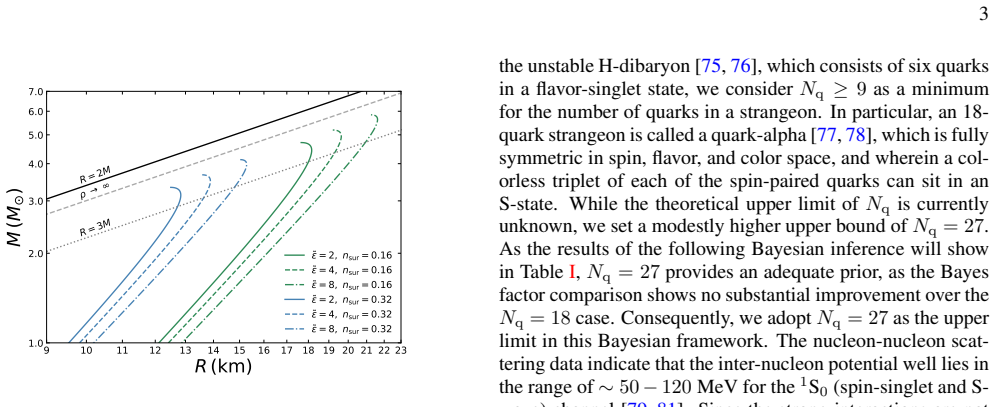
The machinery is a scaled Lennard-Jones equation of state for strangeon matter. Strangeons interact through $U(r)=4\epsilon[(\sigma/r)^{12}-(\sigma/r)^6]$, and the resulting density and pressure lead to the key identity of Eq. (4): after scaling by $\tilde{\epsilon}=\epsilon/N_q$ and $\bar n=N_q n/n_{\rm sur}$, the mass-radius relation depends only on $\tilde{\epsilon}$ and the surface baryon density $n_{\rm sur}$. This degeneracy is why the paper compares discrete $N_q$ values through Bayesian evidence rather than fitting $\epsilon$ and $N_q$ separately. The model comparison runs on Bayes factors $\log K=\log(Z_1/Z_2)$, and the preferred configuration is the quark-$\alpha$ state, 18 quarks arranged symmetrically in color, flavor, and spin.
What would settle it
Rerun the same Bayesian analysis with the prior lower bound on $\epsilon$ lowered from 10 MeV to about 1 MeV (or with a continuous prior on $N_q$); if the Bayes factor against $N_q=9$ stops being enormous, the claimed preference is prior-driven. Observationally, measure the radius of a compact star near 2.6 solar masses: the strangeon EOS predicts roughly 14.3 km, and a measured radius far from that value would falsify the stiff branch.
Extended reading notes
Core claim
On the paper's own terms, the discovery is that a Bayesian comparison of nested finite-$N_q$ strangeon models, using the same likelihoods for each, selects $N_q=18$ with decisive evidence once PSR J0437-4715 is included. Without that pulsar, the Bayes factor for $N_q=18$ over $N_q=9$ is about 99.5; with it, the factor is 89,322. The authors identify $N_q=18$ with the quark-$\alpha$ state, whose $2\times3\times3=18$ internal degrees of freedom are exactly filled by spin, flavor, and color symmetry. With $N_q$ fixed at 18, the posterior predictions are $M_{\max}=3.58^{+0.16}_{-0.12}\,M_\odot$ for the three-parameter EOS and $3.65^{+0.18}_{-0.16}\,M_\odot$ for the two-parameter EOS at 90% confidence, with radii $12.04^{+0.27}_{-0.31}$ km and $12.16^{+0.26}_{-0.31}$ km for a 1.4-solar-mass star. Both parameterizations agree, which the authors take as evidence that the inferred stiffness is a property of strangeon matter rather than of one particular parametrization.
Load-bearing premise
The preference for 18-quark strangeons rests on the assumed lower limit for the potential-well depth and on restricting the quark number to a few discrete values, because the star's mass-radius curve depends on the depth per quark rather than the total depth; with a lower allowed depth, 9-quark strangeons could fit the data and the strong evidence gap would shrink.
Editorial extensions
If this is right
- If strangeon matter is the true ground state, the dense-matter equation of state is stiff enough to support compact stars up to roughly 3.8 solar masses, comfortably above the 2.6-solar-mass secondary of GW190814.
- The GW190814 secondary can be a strangeon star without needing a large pairing gap, which distinguishes this model from some color-flavor-locked quark star scenarios.
- The inferred radius of a 1.4-solar-mass star is about 12.0–12.2 km, consistent with the small radius reported for PSR J0437-4715 and with the GW170817 tidal-deformability constraint.
- The three-parameter and two-parameter models give consistent posteriors, suggesting the observable predictions are governed mainly by the per-quark potential depth and the surface baryon density rather than by the total quark number.
- A future radius measurement of a compact star near 2.6 solar masses would provide a sharp test of the predicted stiff branch of the strangeon EOS.
Reading between the lines
- My inference: the enormous Bayes factor against $N_q=9$ is likely produced by the prior floor $\epsilon\ge10$ MeV. Because the mass-radius relation depends on $\tilde{\epsilon}=\epsilon/N_q$, the 9-quark model is confined to $\tilde{\epsilon}\ge1.11$ MeV while the data favor $\tilde{\epsilon}\approx0.6$ MeV; lowering the floor would let $N_q=9$ reach the favored region and would probably erase the
- A quick test would be to rerun the same inference with a lower bound on $\epsilon$ near 1 MeV or with a continuous prior on $N_q$; if the evidence gap collapses, the $N_q=18$ conclusion is a prior choice rather than a data-driven feature.
- If the stiff strangeon EOS is right, the 2.6-solar-mass secondary of GW190814 would be predicted to have a radius near 14.3 km, a quantity that future X-ray or gravitational-wave observations could measure and thereby discriminate between strangeon matter and other stiff quark-matter models.
- The paper's degeneracy result suggests that future data should be used to constrain $\tilde{\epsilon}$ and $n_{\rm sur}$ jointly; mass-radius measurements at several different masses would break the remaining parameter correlations.
Signed reviews
Editorial analysis
A structured set of objections, weighed in public.
Referee Report
Summary. The paper performs Bayesian inference of the strangeon matter equation of state (EOS), using a Lennard-Jones based three-parameter model (Nq, epsilon, nsur) and a two-parameter model (tilde_epsilon, nsur). The analysis incorporates NICER mass-radius measurements of PSR J0030+0451, PSR J0740+6620, and the recent PSR J0437-4715, together with gravitational-wave constraints from GW170817 and GW190814. The authors report posterior constraints on the EOS parameters, M-R relations, maximum masses around 3.5-3.65 solar masses, and claim that the data support a strangeon with Nq=18, symmetric in color, flavor, and spin spaces. The paper emphasizes that the three-parameter and two-parameter model results are consistent.
Significance. If the Nq=18 claim were robust, this would be an interesting microphysical inference connecting neutron star observations to the internal structure of strangeons. The paper also demonstrates a reusable open-source Bayesian inference framework and includes the recent PSR J0437-4715 measurement in a strangeon EOS analysis. The M-R and maximum-mass constraints are plausible and potentially useful. However, the central Nq preference claim is not supported by the evidence table and is dominated by a prior-boundary effect, as detailed in the major comments. The consistency between the three- and two-parameter models is a built-in consequence of the model reparametrization rather than an independent validation.
major comments (3)
- [Section IV.A, Table I] The evidence values in Table I do not support the claim that Nq=18 is preferred over other Nq values. With PSR J0437-4715 included, log Z = -36.0 for Nq=27 and -36.7 for Nq=18, giving a Bayes factor of exp(0.7) ~ 2.0 in favor of Nq=27. The text states that the evidence "reaches a local maximum at Nq=18 compared to Nq=24 and Nq=9 models," but Nq=27 has higher evidence than Nq=18. The subsequent claim that "the preference for Nq=18 is further strengthened" under PSR J0437-4715 is inconsistent with the paper's own table. The abstract's statement that the results "support" Nq=18 is therefore not supported by the reported evidence.
- [Section III.A and Eq. (4)] The large Bayes factor against Nq=9 (K=89,322 quoted in Section IV.A) is an artifact of the prior lower bound on epsilon. Equation (4) shows that the M-R relation depends only on tilde_epsilon = epsilon/Nq and nsur. With the uniform prior epsilon in [10,170] MeV and the discrete grid Nq = 9,18,21,24,27, the implied tilde_epsilon ranges are [1.11,18.9] MeV for Nq=9 and [0.56,9.4] MeV for Nq=18. The posterior for both the two-parameter model and the fixed-Nq=18 model concentrates at tilde_epsilon ~ 0.5-0.7 MeV (Table II), a region that Nq=9 cannot access because its tilde_epsilon lower bound is 1.11 MeV. The huge evidence ratio against Nq=9 therefore reflects the prior boundary rather than a data-driven feature. A sensitivity test with a lower epsilon lower bound (or a continuous treatment of Nq) is needed before any claim about Nq preference can be made.
- [Section II.A and Section IV.B] The claimed consistency between the three-parameter and two-parameter models is a reparametrization consequence of Eq. (4), not an independent check of the physics. Since the M-R relation and the EOS depend only on tilde_epsilon = epsilon/Nq and nsur, fixing Nq in the three-parameter model and fitting (epsilon, nsur) is equivalent to fitting (tilde_epsilon, nsur) with a rescaled prior. The agreement of the inferred tilde_epsilon values is therefore built into the model definition. The paper should present this agreement as a validation of the numerical sampling, not as a new physical prediction or as independent support for Nq=18.
minor comments (5)
- [Section IV.A] In the sentence listing Bayes factors, "17 9872" appears to be a typographical error for "179 872" (or "179872") for the Nq=27 versus Nq=9 comparison.
- [Abstract and Section V] The phrase "with a relatively strong Bayesian evidence" for Nq=18 is misleading given Table I, where the only decisive comparison is against Nq=9, and that comparison is prior-dominated as noted above.
- [Section III.A] The text says the choice of the tilde_epsilon prior in the two-parameter model is "based on our prior choices for epsilon and Nq separately," but the two-parameter model uses an independent uniform prior U(0.3,3) MeV; this sentence should be clarified to avoid implying a derived prior.
- [Section IV.A] The word "consquently" should be "consequently."
- [Table II] The row for the three-parameter model lists "[epsilon/Nq (MeV)]" in brackets but the table caption does not define this derived quantity; please define it in the caption.
Circularity Check
The headline Nq=18 claim reduces to the chosen epsilon prior and discrete Nq grid, because Eq. (4) makes the M-R sequence depend only on tilde_epsilon = epsilon/Nq and nsur; the paper's own evidence table even slightly favors Nq=27.
-
self definitional
[Section II.A Eq. (4); Section III.A priors; Section IV.A Bayes-factor discussion]
"By defining ˜ϵ = ϵ/Nq and ¯n = Nqn/nsur, the simpler form of strangeon matter EOS can be derived as follows [53]: ... In other words, changing the values of ϵ and Nq while keeping the ˜ϵ constant does not impact the M-R relations. ... in this Bayesian analysis we choose ϵ spanning in the range of 10 − 170 MeV. ... we assume the parameter Nq takes values from the set Nq = 9, 18, 21, 24, 27"
Eq. (4) makes the M-R sequence depend only on tilde_epsilon = epsilon/Nq and nsur, so all Nq choices give identical stellar models at fixed tilde_epsilon; the likelihood is flat in Nq. The evidence differences in Table I therefore come entirely from the priors. With the Section III.A bounds, Nq=9 forces tilde_epsilon >= 1.11 MeV while the posteriors in Table II concentrate at tilde_epsilon ~ 0.5–0.7 MeV; Nq=18 can access that region. Hence K=89,322 against Nq=9 is a prior-boundary effect, not a data-driven feature. Also Table I shows log Z(Nq=27) = -36.0 > log Z(Nq=18) = -36.7 (K=2.01), so Nq=18 is not even the preferred discrete value. The headline Nq=18 preference reduces to the chosen epsilon lower bound and discrete grid.
-
self definitional
[Section IV.B and Section V (Summary)]
"The free parameters for strangeon matter EOS can be reduced to two by defining ˜ϵ = ϵ/Nq and ¯n = Nqn/nsur. ... the parameters ˜ϵ and nsur fully determine the EOS stiffness and the shape of the M-R curve. ... Despite differences in their theoretical formulations, the results from both models exhibit consistency."
The claimed consistency between the three-parameter and two-parameter models is built in by Eq. (4): the two-parameter model is exactly the three-parameter model at fixed Nq with (epsilon, Nq) replaced by their ratio. Any Bayesian inference on (epsilon/Nq, nsur) at fixed Nq must reproduce the two-parameter posterior up to the different prior measure on the ratio, so the consistent prediction is a reparametrization identity rather than an independent cross-check.
full rationale
The maximum-mass, radius, and tidal-deformability constraints are genuine posterior predictions and are not circular. However, the central Nq=18 claim is prior-driven: Eq. (4) makes Nq drop out of the stellar structure equations except through the ratio tilde_epsilon = epsilon/Nq, so the data cannot distinguish Nq values at fixed tilde_epsilon. The large Bayes factor against Nq=9 is produced by the epsilon >= 10 MeV lower bound, and the paper's own evidence table gives Nq=27 a slightly higher log Z than Nq=18. The model comparison Nq=18 vs Nq=9 is thus equivalent to comparing the chosen priors, not to inferring a microphysical bound state. The paper's consistency between three- and two-parameter models is also a reparametrization identity. Self-citations such as [53] for Eq. (4) and [84] for the inference package are not load-bearing here because the algebra is explicit and the posterior computations are standard; no independent circularity arises from those citations. Overall score 6: partial circularity, where the headline Nq prediction reduces to the prior construction while the M-R and maximum-mass results retain independent content.
Assumptions & free parameters
free parameters (4)
- epsilon (Lennard-Jones potential depth) =
11.02 to 12.63 MeV (68.3% CI across cases)
- nsur (surface baryon number density) =
0.18 to 0.23 fm^-3
- eps_tilde (per-quark potential depth) =
0.48 to 0.62 MeV
- Nq (number of quarks per strangeon) =
18 (discrete prior set 9,18,21,24,27)
assumptions (5)
- domain assumption Strangeon matter EOS is described by the Lennard-Jones potential with A12=6.2, A6=8.4, and quark mass mq=300 MeV (Eqs. 1-4).
- ad hoc to paper Priors: epsilon uniform on [10,170] MeV, nsur uniform on [0.17,0.36] fm^-3, Nq in {9,18,21,24,27}.
- domain assumption GW190814's secondary is a compact star, so its mass of 2.59+0.08-0.09 Msun is a lower bound on the maximum mass.
- standard math TOV equations and Bayes theorem with nuisance-marginalized likelihoods apply.
- domain assumption Reported NICER credible intervals and GW likelihoods are treated as independent measurements.
Cite this review
Pith. "Pith review of Bayesian inference of strangeon matter using the measurements of PSR J0437-4715 and GW190814." pith.science (2026). https://pith.science/paper/BIWDE5NJ
@misc{pith2026241114938,
  author       = {Pith},
  title        = {Pith review of: Bayesian inference of strangeon matter using the measurements of PSR J0437-4715 and GW190814},
  year         = {2026},
  howpublished = {\url{https://pith.science/paper/BIWDE5NJ}},
  note         = {Machine review of arXiv:2411.14938}
}
abstract
The observations of compact star inspirals from LIGO/Virgo combined with mass and radius measurements from NICER provide a valuable tool to study the highly uncertain equation of state (EOS) of dense matter at the densities characteristic of compact stars. In this work, we constrain the solid states of strange-cluster matter, called strangeon matter, as the putative basic units of the ground state of bulk strong matter using a Bayesian statistical method, incorporating the mass and radius measurements of PSR J0030+0451, PSR J0740+6620, and the recent data for the $1.4\ M_{\odot}$ pulsar PSR J0437-4715. We also include constraints from gravitational wave events GW170817 and GW190814. Under the prior assumption of a finite number of quarks in a strangeon, $N_{\rm q}$, our analysis reveals that current mass-radius measurements favor a larger $N_{\rm q}$. Specifically, the results support the scenario where a strangeon forms a stable bound state with $N_{\rm q}=18$, symmetric in color, flavor, and spin spaces, compared to the minimum $N_{\rm q}$ prior. The comparative analyses of the posterior EOS parameter spaces derived from three-parameter model and two-parameter model demonstrate a consistent prediction under identical observational constraints. In particular, our results indicate that the most probable values of the maximum mass are found to be $3.58^{+0.16}_{-0.12}\ M_{\odot}$ ($3.65^{+0.18}_{-0.16}\ M_{\odot}$) at $90\%$ confidence level for three-parameter (two-parameter) EOS considering the constraints of GW190814. The corresponding radii for $1.4\ M_{\odot}$ and $2.1\ M_{\odot}$ stars are $12.04^{+0.27}_{-0.31}~\rm km$ ($12.16^{+0.26}_{-0.31}~\rm km$) and $13.43^{+0.31}_{-0.32}~\rm km$ ($13.60^{+0.29}_{-0.34}~\rm km$), respectively. This result may impact interestingly on the research of multiquark states, which could improve our understanding of the nonperturbative strong force.
Figures


Figures from the paper (1 more)

Forward citations
Cited by 1 Pith paper
-
Strangeon Ergostars
Strangeon-matter equations of state support dynamically stable, uniformly rotating ergostars with about 0.01 solar masses of extractable energy.
Reference graph
Works this paper leans on
-
[1]
[8, 11, 12], for PSR J0030 + 0451 we use the result from Ref
Constraints from NICER data We consider the masses and radii inferred from the NICER data by Riley et al. [8, 11, 12], for PSR J0030 + 0451 we use the result from Ref. [11] ( M = 1 .34+0.15 −0.16 M⊙ and R = 12.71+1.14 −1.19 km) and the heavy pulsar PSR J0740 + 6620 (M = 2 .072+0.067 −0.066 M⊙ and R = 12 .39+1.30 −0.98 km) by X-ray pulse profile modeling o...
-
[2]
Here, we incorporate the constraints from the gravita- tional wave events GW170817 [9, 10] and GW190814 [55] reported by the LIGO Scientific Collaboration
Constraints from gravitational wave events The tidal deformability inferred from gravitational wave detection of binary neutron star mergers have also led to a steady improvement in our understanding of the dense matter EOS. Here, we incorporate the constraints from the gravita- tional wave events GW170817 [9, 10] and GW190814 [55] reported by the LIGO Sc...
-
[3]
Madsen, 1999, Hadrons in Dense Matter and Hadrosynthe- sis, 162
J. Madsen, 1999, Hadrons in Dense Matter and Hadrosynthe- sis, 162
1999
-
[4]
Weber, 2005, Prog
F. Weber, 2005, Prog. Part. Nucl. Phys., 54, 193
2005
-
[5]
Oertel, M
M. Oertel, M. Hempel, T. Kl¨ahn, et al. 2017, Rev. Mod. Phys., 89, 015007
2017
-
[6]
G. Baym, T. Hatsuda, T. Kojo, et al. 2018, Rep. Prog. Phys., 81, 056902
2018
-
[7]
Baiotti, 2019, Prog
L. Baiotti, 2019, Prog. Part. Nucl. Phys., 109, 103714
2019
-
[8]
Komoltsev, & A
O. Komoltsev, & A. Kurkela, 2022, Phys. Rev. Lett., 128, 202701
2022
Show all 111 references
-
[9]
M. C. Miller, F. K. Lamb, A. J. Dittmann, et al. 2021, Astro- phys. J. Lett., 918, L28
2021
-
[10]
T. E. Riley, et al., Astrophys. J. 918, L27 (2021)
2021
-
[11]
B. P. Abbott, et al., Phys. Rev. Lett. 119, 161101 (2017)
2017
-
[12]
B. P. Abbott, et al., Phys. Rev. Lett. 121, 161101 (2018)
2018
-
[13]
T. E. Riley, et al., Astrophys. J. 887, L21 (2019)
2019
-
[14]
Vinciguerra, T
S. Vinciguerra, T. Salmi, A. L. Watts, et al. 2024, Astrophys. J., 961, 62
2024
-
[15]
M. C. Miller, F. K. Lamb, A. J. Dittmann, et al. 2019, Astro- phys. J. Lett., 887, L24
2019
-
[16]
Choudhury, T
D. Choudhury, T. Salmi, S. Vinciguerra, et al. 2024, Astro- phys. J. Lett., 971, L20
2024
-
[17]
Rutherford, M
N. Rutherford, M. Mendes, I. Svensson, et al. 2024, Astro- phys. J. Lett., 971, L19
2024
-
[18]
A. R. Bodmer, 1971, Phys. Rev. D, 4, 1601
1971
-
[19]
Witten, 1984, Phys
E. Witten, 1984, Phys. Rev. D, 30, 272
1984
-
[20]
Chakrabarty, 1993, Phys
S. Chakrabarty, 1993, Phys. Rev. D, 48, 1409
1993
-
[21]
M. Dey, I. Bombaci, J. Dey, et al. 1998, Phys. Lett. B, 438, 123. 10
1998
-
[22]
Chakrabarty, S
S. Chakrabarty, S. Raha, & B. Sinha, 1989, Phys. Lett. B, 229, 112
1989
-
[23]
Buballa, & M
M. Buballa, & M. Oertel, 1999, Phys. Lett. B, 457, 261
1999
-
[24]
G. X. Peng, H. C. Chiang, J. J. Yang, et al. 1999, Phys. Rev. C, 61, 015201
1999
-
[25]
X. J. Wen, X. H. Zhong, G. X. Peng, et al. 2005, Phys. Rev. C, 72, 015204
2005
-
[26]
A. Li, R. X. Xu, & J. F. Lu, 2010, Mon. Not. R. Astron. Soc., 402, 2715
2010
-
[27]
E. P. Zhou, X. Zhou, & A. Li, 2018, Phys. Rev. D,97, 083015
2018
-
[28]
C. M. Li, Y . Yan, J. J. Geng, et al. 2018, Phys. Rev. D, 98, 083013
2018
-
[29]
C. J. Xia, T. Maruyama, N. Yasutake, et al. 2019, Phys. Rev. D, 99, 103017
2019
-
[30]
G. X. Peng, H. C. Chiang, B. S. Zou, et al. 2000, Phys. Rev. C, 62, 025801
2000
-
[31]
Bai, & Y
Z. Bai, & Y . X. Liu. 2021, Eur. Phys. J. C,81, 612
2021
-
[32]
C. J. Xia, , Z. Zhu, X. Zhou, et al. 2021, Chinese Phys. C, 45, 055104
2021
-
[33]
W. L. Yuan, A. Li, Z. Q. Miao, et al. 2022, Phys. Rev. D, 105, 123004
2022
-
[34]
Y . R. Zhou, C. Zhang, J. Zhao, et al. 2024, Phys. Rev. D,110, 103012
2024
-
[35]
X. L. Zhang, Y . F. Huang, & Z. C. Zou, 2024, Front. Astron. Space Sci., 11, 1409463
2024
-
[36]
Holdom, J
B. Holdom, J. Ren, & C. Zhang, 2018, Phys. Rev. Lett., 120, 222001
2018
-
[37]
T. Zhao, W. Zheng, F. Wang, et al. 2019, Phys. Rev. D, 100, 043018
2019
-
[38]
Ren, & C
J. Ren, & C. Zhang, 2020, Phys. Rev. D, 102, 083003
2020
-
[39]
Zhang, 2020, Phys
C. Zhang, 2020, Phys. Rev. D, 101, 043003
2020
-
[40]
Zhang, & R
C. Zhang, & R. B. Mann, 2021, Phys. Rev. D, 103, 063018
2021
-
[41]
L. Q. Su, C. Shi, Y . F. Huang, et al. 2024, Astrophys.Space Sci., 369, 29
2024
-
[42]
R. X. Xu, 2003, Astrophys. J. Lett., 596, L59
2003
-
[43]
R. X. Xu, D. J. Tao, & Y . Yang, 2006, Mon. Not. R. Astron. Soc., 373, L85
2006
-
[44]
Peng, & R
C. Peng, & R. X. Xu, 2008, Mon. Not. R. Astron. Soc., 384, 1034
2008
-
[45]
X. Y . Lai, & R. X. Xu, 2009, Mon. Not. R. Astron. Soc., 398, L31
2009
-
[46]
X. W. Liu, , J. D. Liang, R. X. Xu, et al. 2012, Mon. Not. R. Astron. Soc., 424, 2994
2012
-
[47]
E. P. Zhou, J. G. Lu, H. Tong, et al. 2014, Mon. Not. R. Astron. Soc., 443, 2705
2014
-
[48]
X. Y . Lai, & R. X. Xu, 2016, Chinese Phys. C, 40, 095102
2016
-
[49]
X. Y . Lai, Y . W. Yu, E. P. Zhou, et al. 2018, Res. Astron. As- trophys., 18, 024
2018
-
[50]
X. Y . Lai, E. P. Zhou, &R. X. Xu, 2019, Eur. Phys. J. A., 55, 60
2019
-
[51]
X. Y . Lai, C. J. Xia, Y . W. Yu, et al. 2021, Res. Astron. Astro- phys., 21, 250
2021
-
[52]
Y . Gao, X. Y . Lai, L. J. Shao, et al. 2022, Mon. Not. R. Astron. Soc., 509, 2758
2022
-
[53]
Z. Q. Miao, C. J. Xia, X. Y . Lai, et al. 2022, Int. J. Mod. Phys. E, 31, 2250037
2022
-
[54]
Zhang, Y
C. Zhang, Y . Gao, C. J. Xia, et al. 2023, Phys. Rev. D, 108, 063002
2023
-
[55]
Zhang, Y
C. Zhang, Y . Gao, C. J. Xia, et al. 2023, Phys. Rev. D, 108, 123031
2023
-
[56]
P. B. Demorest, T. Pennucci, S. M. Ransom, et al. 2010, Na- ture (London), 467, 1081
2010
-
[57]
Abbott, T
R. Abbott, T. D. Abbott, S. Abraham, et al. 2020, Astrophys. J. Lett., 896, L44
2020
-
[58]
J. E. Jones, 1924, Proc. R. soc. Lond. Ser. A, 106, 441
1924
-
[59]
A. W. Steiner, J. M. Lattimer, & E. F. Brown, 2010, Astrophys. J., 722, 33
2010
-
[60]
S. K. Greif, G. Raaijmakers, K. Hebeler, et al. 2019, Mon. Not. R. Astron. Soc., 485, 5363
2019
-
[61]
Raaijmakers, T
G. Raaijmakers, T. E. Riley, A. L. Watts, et al. 2019, Astro- phys. J. Lett., 887, L22
2019
-
[62]
Raaijmakers, S
G. Raaijmakers, S. K. Greif, T. E. Riley, et al. 2020, Astro- phys. J. Lett., 893, L21
2020
-
[63]
Traversi, P
S. Traversi, P. Char, & G. Pagliara, 2020, Astrophys. J., 897, 165
2020
-
[64]
W. J. Xie, &B. A. Li, 2021, Phys. Rev. C, 103, 035802
2021
-
[65]
Tak ´atsy, P
J. Tak ´atsy, P. Kov´acs, G. Wolf, et al. 2023, Phys. Rev. D, 108, 043002
2023
-
[66]
Huang, G
C. Huang, G. Raaijmakers, A. L. Watts, et al. 2024, Mon. Not. R. Astron. Soc., 529, 4650
2024
-
[67]
K. D. Marquez, T. Malik, H. Pais, et al. 2024, Phys. Rev. D, 110, 063040
2024
-
[68]
2024, Phys
Guha Roy, D., Venneti, A., Malik, T., et al. 2024, Phys. Lett. B, 859, 139128
2024
- [69]
-
[70]
Traversi, & P
S. Traversi, & P. Char, 2020, Astrophys. J., 905, 9
2020
-
[71]
Z. Q. Miao, J. L. Jiang, A. Li, et al. 2021, Astrophys. J. Lett., 917, L22
2021
-
[72]
A. Li, Z. Q. Miao, J. L. Jiang, et al. 2021, Mon. Not. R. Astron. Soc., 506, 5916
2021
-
[73]
Z. Wang, Y . Gao, D. Liang, J. Zhang, & L. J. Shao. 2024, arXiv:2409.11103
2024 arXiv
-
[74]
F. M. da Silva, A. Issifu, L. L. Lopes, et al. 2024, Phys. Rev. D, 109, 043054
2024
-
[75]
Fonseca, H
E. Fonseca, H. T. Cromartie, T. T. Pennucci, et al. 2021, As- trophys. J. Lett., 915, L12
2021
-
[76]
Salmi, D
T. Salmi, D. Choudhury, Y . Kini, et al. 2024, Astrophys. J., 974, 294
2024
-
[77]
S. V . Bashinsky, & R. L. Jaffe, 1997, Nucl. Phys. A,625, 167
1997
-
[78]
Wetzorke, F
I. Wetzorke, F. Karsch, & E. Laermann, 2000, Nucl. Phys. B, Proc. Suppl., 83, 218
2000
-
[79]
F. C. Michel, 1988, Phys. Rev. Lett., 60, 677
1988
-
[80]
Curtis Michel, 1991, Nucl
F. Curtis Michel, 1991, Nucl. Phys. B, Proc. Suppl., 24, 33
1991
-
[81]
V . G. J. Stoks, R. A. M. Klomp, C. P. F. Terheggen, et al. 1994, Phys. Rev. C, 49, 2950
1994
-
[82]
R. B. Wiringa, V . G. J. Stoks, & R. Schiavilla, 1995, Phys. Rev. C, 51, 38
1995
-
[83]
Machleidt, 2001, Phys
R. Machleidt, 2001, Phys. Rev. C, 63, 024001
2001
-
[84]
D. J. Reardon, M. Bailes, R. M. Shannon, et al. 2024, Astro- phys. J. Lett., 971, L18
2024
-
[85]
Raaijmakers, S
G. Raaijmakers, S. K. Greif, K. Hebeler, et al. 2021, Astro- phys. J. Lett., 918, L29
2021
- [86]
-
[87]
Huang, G
C. Huang, G. Raaijmakers, A. L. Watts, L. Tolos, C. Provid ˆencia, N. Osborn, & N. Whitsett, 2023, GitHub Repository, version 1.9. https://doi.org/10. 5281/zenodo.10927600; https://github.com/ ChunHuangPhy/EoS_inference/tree/v.1.9
2023
-
[88]
Buchner, 2021, arXiv e-prints, arXiv:2101.09604
J. Buchner, 2021, arXiv e-prints, arXiv:2101.09604. https: //johannesbuchner.github.io/UltraNest/; https://arxiv.org/abs/2101.09604 [stat.CO]
2021 arXiv
-
[89]
R. E. Kass and A. E. Raftery, Bayes Factors, Journal of the American Statistical Association 90, no. 430, pp. 773–795 (1995)
1995
-
[90]
Bombaci, A
I. Bombaci, A. Drago, D. Logoteta, et al. 2021, Phys. Rev. Lett., 126, 162702. doi:10.1103/PhysRevLett.126.162702 11
2021 doi
-
[91]
Z. Cao, L. W. Chen, P. C. Chu , et al. 2022, Phys. Rev. D,106, 083007
2022
-
[92]
H. Chen, W. Chen, X. Liu, et al. 2016, Phys. Rep., 639, 1-121
2016
-
[93]
F. Guo, C. Hanhart, U. Meißner, et al. 2018, Rev. Mod. Phys., 90, 015004
2018
-
[94]
A. W. Steiner, S. Reddy, & M. Prakash, 2002, Phys. Rev. D, 66, 094007
2002
-
[95]
Alford, & K
M. Alford, & K. Rajagopal, 2002, J. High Energy Phys., 2002, 031
2002
-
[96]
Alford, & S
M. Alford, & S. Reddy, 2003, Phys. Rev. D, 67, 074024
2003
-
[97]
Huang, P
M. Huang, P. Zhuang, & W. Chao, 2003, Phys. Rev. D, 67, 065015
2003
-
[98]
Mannarelli, K
M. Mannarelli, K. Rajagopal, & Sharma, R. 2007, Phys. Rev. D, 76, 074026
2007
-
[99]
Roupas, G
Z. Roupas, G. Panotopoulos, & I. Lopes, 2021, Phys. Rev. D, 103, 083015
2021
-
[100]
Ivanytskyi, & D
O. Ivanytskyi, & D. Blaschke, 2022, Phys. Rev. D, 105, 114042
2022
-
[101]
W. L. Yuan, J. Chao, & A. Li, 2023, Phys. Rev. D, 108, 043008
2023
-
[102]
W. L. Yuan,&A. Li, 2024, Astrophys. J., 966, 3
2024
- [103]
-
[104]
McLerran, &R
L. McLerran, &R. D. Pisarski, 2007, Nucl. Phys. A, 796, 83
2007
-
[105]
T. K. Herbst, J. M. Pawlowski, & B.-J. Schaefer, 2011, Phys. Lett. B, 696, 58
2011
-
[106]
G. Y . Shao, M. di Toro, V . Greco, et al. 2011, Phys. Rev. D, 84, 034028
2011
-
[107]
Kojo, 2012, Nucl
T. Kojo, 2012, Nucl. Phys. A, 877, 70
2012
-
[108]
T. Q. Zhao, &J. M. Lattimer, 2020, Phys. Rev. D, 102, 023021
2020
-
[109]
G. Q. Cao, 2022, Phys. Rev. D, 105, 114020
2022
-
[110]
C. J. Xia, H. M. Jin, & T. T. Sun, 2023, Phys. Rev. D, 108, 054013
2023
-
[111]
B. K. Gao, & M. Harada, 2024, arXiv:2410.16649
2024 arXiv
Reviewed August 12, 2026 · model on record in the stance chip above.
Discussion (0). Continue with ORCID to comment.