Modular molecular toolkit for photochemical energy conversion in a self-assembling nanocontainer
Pith reviewed 2026-06-26 01:59 UTC · model grok-4.3
The pith
Confining a photosystem and cytochrome c inside a self-assembling virus nanocontainer increases light-driven electron transfer efficiency.
A machine-rendered reading of the paper's core claim, the machinery that carries it, and where it could break.
Core claim
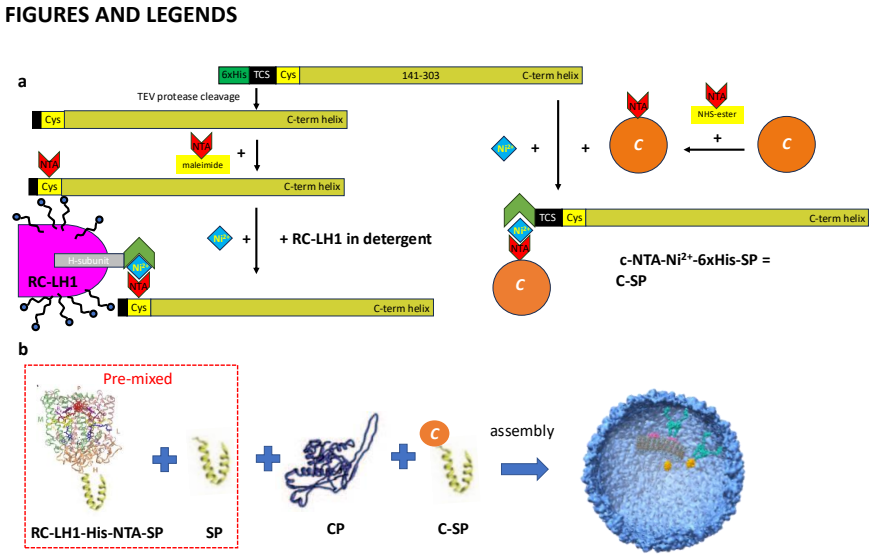
The photosynthetic system from the phototrophic bacterium Cereibacter sphaeroides and cytochrome c were conjugated to a bacteriophage P22 scaffolding protein and co-incorporated into the 50 nm diameter virus shell in vitro. The porous shell confined the macromolecular components for efficient electron transfer while allowing free exchange of small electron mediators. Sustainable and accelerated light-driven electron transfer between the encapsulated components was confirmed by optical spectroscopy. This self-assembly system presents a versatile platform for developing nanoreactors that combine photosystems with complex redox pathways.
What carries the argument
The self-assembling P22 virus shell that confines the conjugated photosystem and redox protein for proximity while permitting small-mediator diffusion through its pores.
If this is right
- The porous shell enables free exchange of small electron mediators while keeping macromolecules in proximity.
- Sustainable light-driven electron transfer occurs between the encapsulated photosystem and redox protein.
- The modular conjugation and self-assembly can be used to combine photosystems with complex redox enzyme pathways.
- Electron transfer efficiency rises when the components are held inside the 50 nm container.
Where Pith is reading between the lines
- The same conjugation-to-scaffolding step could be used to add more enzymes downstream in a longer redox chain.
- Varying shell porosity or diameter would test how tightly confinement must be tuned for different mediator sizes.
- The platform could be adapted to non-virus porous containers if the self-assembly chemistry can be replicated elsewhere.
Load-bearing premise
The observed acceleration of electron transfer is caused by spatial confinement inside the nanocontainer rather than by the conjugation chemistry or other changes during assembly.
What would settle it
A side-by-side measurement of light-driven electron transfer rates using the same conjugated components with and without encapsulation into the virus shell, checking whether acceleration disappears when confinement is removed.
Figures
read the original abstract
Production of useful chemicals using photoelectrochemical biohybrid devices offers an environmentally friendly alternative to existing energetically demanding processes. These devices exploit light-driven charge separation, e.g. by a photosystem, and require efficient electron transfer to a tailored redox enzyme cascade. Here we demonstrate that electron transfer efficiency can be increased by confining the photosystem with the redox protein inside a self-assembling, virus-based nanocontainer. The photosynthetic system from the phototrophic bacterium Cereibacter sphaeroides and cytochrome c were conjugated to a bacteriophage P22 scaffolding protein and co-incorporated into the 50 nm diameter virus shell in vitro. The porous shell confined the macromolecular components for efficient electron transfer while allowing free exchange of small electron mediators. Sustainable and accelerated light-driven electron transfer between the encapsulated components was confirmed by optical spectroscopy. This self-assembly system presents a versatile platform for developing nanoreactors that combine photosystems with complex redox pathways.
Editorial analysis
A structured set of objections, weighed in public.
Referee Report
Summary. The manuscript describes conjugation of the photosynthetic system from Cereibacter sphaeroides and cytochrome c to bacteriophage P22 scaffolding protein, followed by co-incorporation into the 50 nm P22 virus shell. The central claim is that the porous shell confines the macromolecular components to enable efficient and accelerated light-driven electron transfer (while permitting small-mediator exchange), with this acceleration and sustainability confirmed by optical spectroscopy; the system is presented as a modular, self-assembling platform for nanoreactors combining photosystems with redox pathways.
Significance. If the confinement-driven acceleration is robustly isolated from other variables, the approach could supply a versatile, scalable toolkit for biohybrid photoelectrochemical devices. The self-assembly and modularity are potential strengths for integrating complex redox cascades.
major comments (2)
- [Abstract] Abstract: the statement that 'sustainable and accelerated light-driven electron transfer ... was confirmed by optical spectroscopy' supplies no quantitative rates, controls, error bars, or comparison data, leaving the central efficiency claim unsupported by the information given.
- [Abstract] Abstract / Results (implied): the attribution of accelerated electron transfer to spatial confinement inside the P22 shell is not isolated from conjugation chemistry or orientation effects; no side-by-side comparison of the same conjugated pair measured inside versus outside the assembled shell (or equivalent non-confining control) is described, so the causal link to shell geometry remains untested.
minor comments (1)
- [Abstract] Abstract: the title refers to 'photochemical energy conversion' but the text reports only electron transfer without product formation, turnover numbers, or energy-conversion metrics.
Simulated Author's Rebuttal
We thank the referee for their thorough review and valuable comments on our manuscript. We address each of the major comments below and have revised the manuscript to improve clarity and support for our claims.
read point-by-point responses
-
Referee: [Abstract] Abstract: the statement that 'sustainable and accelerated light-driven electron transfer ... was confirmed by optical spectroscopy' supplies no quantitative rates, controls, error bars, or comparison data, leaving the central efficiency claim unsupported by the information given.
Authors: We agree that the abstract would benefit from more quantitative information to support the central claim. In the revised manuscript, we have modified the abstract to include specific quantitative rates from the optical spectroscopy data, along with references to the controls and error bars presented in the main text and figures. This provides the necessary context for the efficiency claim. revision: yes
-
Referee: [Abstract] Abstract / Results (implied): the attribution of accelerated electron transfer to spatial confinement inside the P22 shell is not isolated from conjugation chemistry or orientation effects; no side-by-side comparison of the same conjugated pair measured inside versus outside the assembled shell (or equivalent non-confining control) is described, so the causal link to shell geometry remains untested.
Authors: We appreciate this point regarding the isolation of the confinement effect. The manuscript does describe experiments comparing the co-encapsulated system to the conjugated components in free solution (non-confining conditions), using the same conjugated pair. These comparisons demonstrate that the acceleration is observed specifically upon incorporation into the P22 shell. To further address potential concerns about conjugation chemistry or orientation, we have added additional discussion in the revised manuscript clarifying how these factors are controlled for across the experiments. A direct 'inside vs outside' measurement for the assembled shell is not feasible as the shell defines the confined state, but the solution-based controls serve as the equivalent non-confining comparison. revision: partial
Circularity Check
No derivation chain present; experimental report only
full rationale
The manuscript is a purely experimental demonstration of a self-assembling nanocontainer system. No equations, parameters, derivations, or predictive models appear in the provided text or abstract. Claims rest on optical spectroscopy measurements of electron transfer rates, not on any logical reduction to fitted inputs or self-citations. The central attribution of rate changes to confinement is an empirical interpretation open to experimental controls, but it does not constitute a circular derivation. This is the normal case for an experimental methods paper with no mathematical content.
Axiom & Free-Parameter Ledger
Reference graph
Works this paper leans on
-
[1]
Molecular mechanisms of photosynthesis, Edn
Blankenship, R.E. Molecular mechanisms of photosynthesis, Edn. Third edition. (Wiley, Hoboken; 2021)
2021
-
[2]
Blankenship, R.E. et al. Comparing Photosynthetic and Photovoltaic Efficiencies and Recognizing the Potential for Improvement. Science 332, 805-809 (2011)
2011
-
[3]
& Tian, H.N
Cai, B., Pavliuk, M.V., Berggren, G. & Tian, H.N. Bio-hybrid photoelectrochemical catalysis for solar fuels and chemicals conversion. Nat. Commun. 16, 9131 (2025)
2025
-
[4]
& Qu, J.H
Chen, L., Wen, Y ., Chen, M., An, X.Q. & Qu, J.H. Biohybrid technologies for CO2 conversion to fuels and chemicals: Advances in bio-electro-, bio-photoelectro-, and bio-photocatalysis. Bioresour. Technol. 435, 132949 (2025). 16
2025
-
[5]
Photo/Biohybrid Catalytic System for Application in Semiartificial Photosynthesis of CO2 to Chemicals
Amao, Y . Photo/Biohybrid Catalytic System for Application in Semiartificial Photosynthesis of CO2 to Chemicals. Chem. Rev. 126, 1635-1685 (2026)
2026
-
[6]
& Reisner, E
Kar, S. & Reisner, E. Solar Air-to-Fuel Technologies for a Circular Carbon Economy. J. Am. Chem. Soc. 148, 10267-10285 (2026)
2026
-
[7]
& Fukuzumi, S
El-Khouly, M.E., El-Mohsnawy, E. & Fukuzumi, S. Solar energy conversion: From natural to artificial photosynthesis. J. Photochem. Photobiol. C 31, 36-83 (2017)
2017
-
[8]
& Frese, R.N
Friebe, V.M. & Frese, R.N. Photosynthetic reaction center-based biophotovoltaics. Curr Opin Electroche 5, 126-134 (2017)
2017
-
[9]
Sokol, K.P . et al. Photoreduction of CO2 with a Formate Dehydrogenase Driven by Photosystem II Using a Semi-artificial Z-Scheme Architecture. J. Am. Chem. Soc. 140, 16418-16422 (2018)
2018
-
[10]
& Lisdat, F
Morlock, S., Schenderlein, M., Kano, K., Zouni, A. & Lisdat, F. Coupling of formate dehydrogenas to inverse opal ITO-PSI electrodes for photocatlytic CO2 reduction. Biosensors and Bioelectronics X 14, 100359 (2023)
2023
-
[11]
The Artificial Leaf
Nocera, D.G. The Artificial Leaf. Acc. Chem. Res. 45, 767-776 (2012)
2012
-
[12]
Zhang, C.X. et al. A synthetic Mn4Ca-cluster mimicking the oxygen-evolving center of photosynthesis. Science 348, 690-693 (2015)
2015
-
[13]
& Wächtler, M
Kranz, C. & Wächtler, M. Characterizing photocatalysts for water splitting: from atoms to bulk and from slow to ultrafast processes. Chem. Soc. Rev. 50, 1407-1437 (2021)
2021
-
[14]
& Mulfort, K.L
Utschig, L.M. & Mulfort, K.L. Photosynthetic biohybrid systems for solar fuels catalysis. Chemical Communications 60, 10642-10654 (2024)
2024
-
[15]
Zhou, E.B. et al. Artificial Photosynthetic Cell with Molecular Biomimetic Thylakoid. Angew Chem Int Edit 64, e202416289 (2025)
2025
-
[16]
& Allakhverdiev, S.I
Voloshin, R.A., Lokteva, E.S. & Allakhverdiev, S.I. Photosystem I in the electrodes. Curr Opin Green Sust 41, 100816 (2023)
2023
-
[17]
Tulus, T. et al. Purple Bacteria Reaction Center Based Solid State Bio-Solar Cell With a Large Open Circuit Voltage. Chemphotochem 9 (2025)
2025
-
[18]
Lebedev, N. et al. Conductive wiring of immobilized photosynthetic reaction center to electrode by cytochrome. J. Am. Chem. Soc. 128, 12044-12045 (2006)
2006
-
[19]
& Lisdat, F
Stieger, K.R., Feifel, S.C., Lokstein, H. & Lisdat, F. Advanced unidirectional photocurrent generation cytochrome c as reaction partner for directed assembly of photosystem I. Phys. Chem. Chem. Phys. 16, 15667-15674 (2014)
2014
-
[20]
& Friebe, V.M
Nawrocki, W.J., Jones, M.R., Frese, R.N., Croce, R. & Friebe, V.M. time-resolved spectroelectrochemistry reveals limitations of biohybrid photoelectrode performance. Joule 7, 529-544 (2023)
2023
-
[21]
& Young, M
Douglas, T. & Young, M. Viruses: Making friends with old foes. Science 312, 873-875 (2006)
2006
-
[22]
Essus, V.A. et al. Bacteriophage P22 Capsid as a Pluripotent Nanotechnology Tool. Viruses-Basel 15, 516 (2023)
2023
-
[23]
& Douglas, T
O'Neil, A., Reichhardt, C., Johnson, B., Prevelige, P .E. & Douglas, T. Genetically Programmed In Vivo Packaging of Protein Cargo and Its Controlled Release from Bacteriophage P22. Angew Chem Int Edit 50, 7425-7428 (2011)
2011
-
[24]
& Wang, Q
Liu, Z., Qiao, J., Niu, Z.W. & Wang, Q. Natural supramolecular building blocks: from virus coat proteins to viral nanoparticles. Chem. Soc. Rev. 41, 6178-6194 (2012)
2012
-
[25]
Uchida, M. et al. Modular Self-Assembly of Protein Cage Lattices for Multistep Catalysis. Acs Nano 12, 942-953 (2018). 17
2018
-
[26]
& King, J
Prevelige, P .E., Thomas, D. & King, J. Nucleation and Growth Phases in the Polymerization of Coat and Scaffolding Subunits into Icosahedral Procapsid Shells. Biophys. J. 64, 824-835 (1993)
1993
-
[27]
& Prevelige, P .E
Parker, M.H., Casjens, S. & Prevelige, P .E. Functional domains of bacteriophage P22 scaffolding protein. J. Mol. Biol. 281, 69-79 (1998)
1998
-
[28]
Abresch, E.C. et al. Characterization of a highly purified, fully active, crystallizable RC- LH1-PufX core complex from. Photosynth. Res. 86, 61-70 (2005)
2005
-
[29]
& Beatty, J.T
Jaschke, P .R., Saer, R.G., Noll, S. & Beatty, J.T. Modification of the Genome of and Construction of Synthetic Operons. Methods in Enzymology 497, 519-538 (2011)
2011
-
[30]
& Beatty, J.T
Jun, D., Saer, R.G., Madden, J.D. & Beatty, J.T. Use of new strains of and a modified simple culture medium to increase yield and facilitate purification of the reaction centre. Photosynth. Res. 120, 197-205 (2014)
2014
-
[31]
& Bizzotto, D
Jun, D., Beatty, J.T. & Bizzotto, D. Highly Sensitive Method to Isolate Photocurrent Signals from Large Background Redox Currents on Protein-Modified Electrodes. Chemelectrochem 6, 2870-2875 (2019)
2019
-
[32]
Jun, D. et al. In vivo assembly of a truncated H subunit mutant of the photosynthetic reaction centre and direct electron transfer from the Q quinone to an electrode. Photosynth. Res. 137, 227-239 (2018)
2018
-
[33]
Tuma, R. et al. A helical coat protein recognition domain of the bacteriophage P22 scaffolding protein. J. Mol. Biol. 281, 81-94 (1998)
1998
-
[34]
& Wang, R.T
Clayton, R.K. & Wang, R.T. Photochemical reaction centers from Rhodopseudomonas sphaeroides. Methods in Enzymology 23, 696-704 (1971)
1971
-
[35]
& Douglas, T
Wang, Y ., Selivanovitch, E. & Douglas, T. Enhancing Multistep Reactions: Biomimetic Design of Substrate Channeling Using P22 Virus-Like Particles. Adv Sci 10 (2023)
2023
-
[36]
& Douglas, T
Patterson, D.P ., Prevelige, P .E. & Douglas, T. Nanoreactors by Programmed Enzyme Encapsulation Inside the Capsid of the Bacteriophage P22. Acs Nano 6, 5000-5009 (2012)
2012
-
[37]
Kuk, S.K. et al. Photoelectrochemical Reduction of Carbon Dioxide to Methanol through a Highly Efficient Enzyme Cascade. Angew Chem Int Edit 56, 3827-3832 (2017)
2017
-
[38]
Wang, P .P . et al. Hybrid Enzyme-Electrocatalyst Cascade Modified Gas-Diffusion Electrodes for Methanol Formation from Carbon Dioxide. Angew Chem Int Edit 64 (2025)
2025
-
[39]
& Kaplan, S
Donohue, T.J. & Kaplan, S. Genetic Techniques in Rhodospirillaceae. Methods in Enzymology 204, 459-485 (1991)
1991
-
[40]
Kozelková, T. et al. Insight Into the Dynamics of the Nymphal Midgut Proteome. Mol Cell Proteomics 22, 100663 (2023)
2023
-
[41]
Fedorova, G. et al. Psychoactive Contaminants Alter Fish Sperm Function via Neurotransmitter Signaling. Environ Sci Tech Let 13, 14-20 (2026)
2026
-
[42]
& Mann, M
Cox, J. & Mann, M. MaxQuant enables high peptide identification rates, individualized p.p.b.-range mass accuracies and proteome-wide protein quantification. Nat. Biotechnol. 26, 1367-1372 (2008)
2008
-
[43]
& Siffel, P
Bina, D., Litvin, R., Vacha, F. & Siffel, P . New multichannel kinetic spectrophotometer- fluorimeter with pulsed measuring beam for photosynthesis research. Photosynth. Res. 88, 351-356 (2006)
2006
-
[44]
Sun, Y .H. et al. Structure of the coat protein-binding domain of the scaffolding protein from a double-stranded DNA virus. J. Mol. Biol. 297, 1195-1202 (2000). 18
2000
-
[45]
Chen, D.H. et al. Structural basis for scaffolding-mediated assembly and maturation of a dsDNA virus. Proc. Natl. Acad. Sci. 108, 1355-1360 (2011). 19 FIGURES AND LEGENDS Figure 1: Schematics of assembly toolkit. (a) Scaffolding protein conjugation scheme. The minimal scaffolding fragment encompassing residues 141-303 (olive) was further engineered to con...
2011
-
[46]
a) Flash-induced absorption change of the RC, measured at 3 s after the actinic flash
Here we illustrate the reproducibility of the spectra and kinetics. a) Flash-induced absorption change of the RC, measured at 3 s after the actinic flash. Data correspond to a mean ± RMS noise of 4 technical replicates. The noise is well below 0.0002, in agreement with our earlier report 43; b) and c) show the comparison three biological replicates of me...
discussion (0)
Sign in with ORCID, Apple, or X to comment. Anyone can read and Pith papers without signing in.