A high-fidelity two-qubit gate for multimode superconducting P-mon qubits
Pith reviewed 2026-06-25 23:59 UTC · model grok-4.3
The pith
P-mon qubits implement a 180 ns CZ gate at 99.62% fidelity by coupling through protected mediator modes while suppressing idle ZZ interactions below 3.6 kHz.
A machine-rendered reading of the paper's core claim, the machinery that carries it, and where it could break.
Core claim
By exploiting the mediator modes of P-mons for on-demand coupling, the cross-Kerr interaction between the qubit and hybridized mediator modes produces a qubit-state dependent frequency shift; selectively addressing these transitions yields a 180 ns CZ gate with 99.62(4)% fidelity, while idle ZZ interactions remain below 3.6(5) kHz.
What carries the argument
Mediator modes of the P-mon qubit, which hybridize on resonance to generate a tunable cross-Kerr interaction that shifts qubit transition frequencies in a state-dependent manner.
If this is right
- Idle ZZ interactions stay below 3.6(5) kHz because direct qubit-mode coupling is suppressed.
- A 180 ns CZ gate is realized by addressing the state-dependent transitions created by the cross-Kerr shift.
- The fidelity reaches 99.62(4)% when the mediator modes are tuned on resonance.
- The approach reduces unwanted interactions compared with direct qubit-qubit coupling schemes.
Where Pith is reading between the lines
- Similar mediator-mode tuning could be tested in three-qubit chains to check whether crosstalk remains low at larger scale.
- The same protected-mode separation might reduce calibration overhead when mapping logical qubits onto physical P-mon arrays.
- If the mediator hybridization can be made fast and repeatable, the gate time could be shortened further without raising idle errors.
Load-bearing premise
Resonant tuning of the mediator modes produces a clean qubit-state-dependent frequency shift without introducing extra decoherence or calibration errors that would change the reported gate fidelity.
What would settle it
An experiment that measures the CZ gate fidelity after independently calibrating all error channels and finds it below 99.5% would falsify the claim that the reported fidelity is accurate.
Figures
read the original abstract
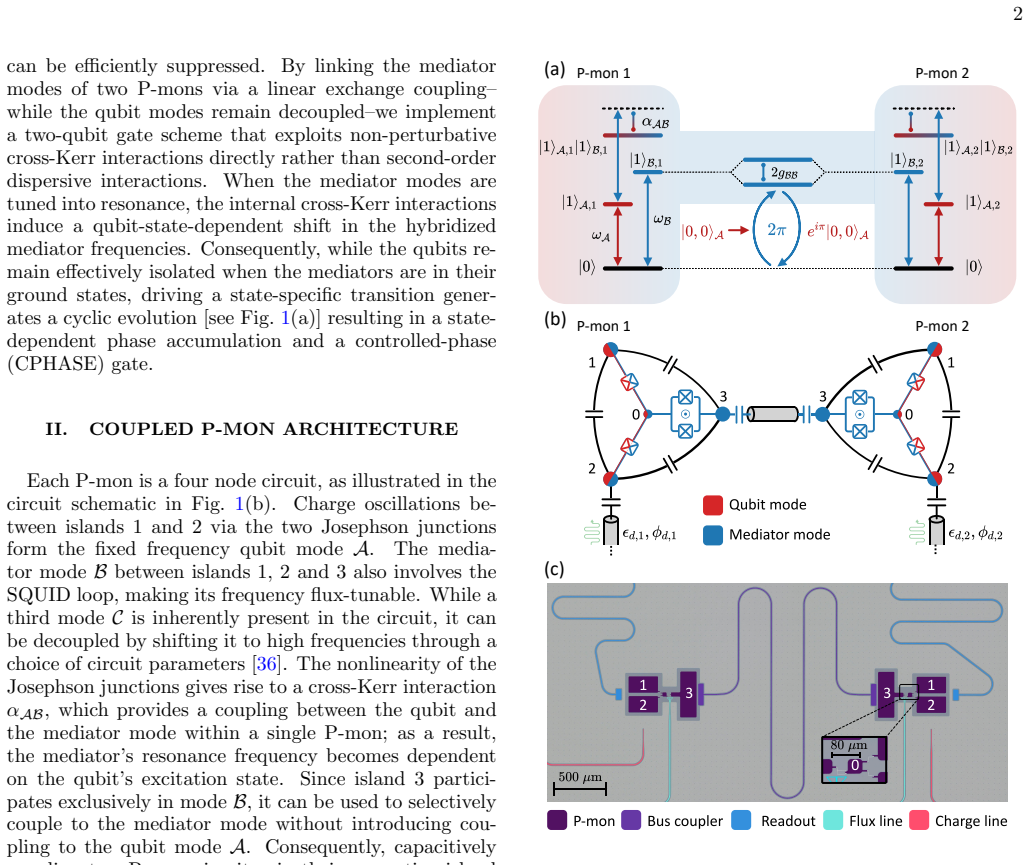
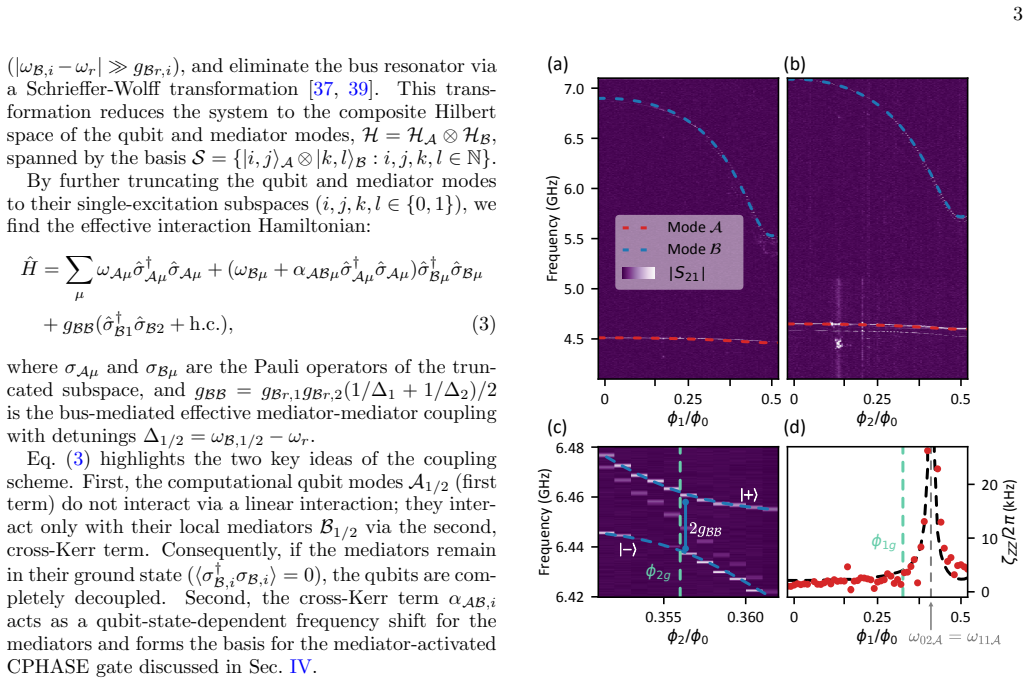
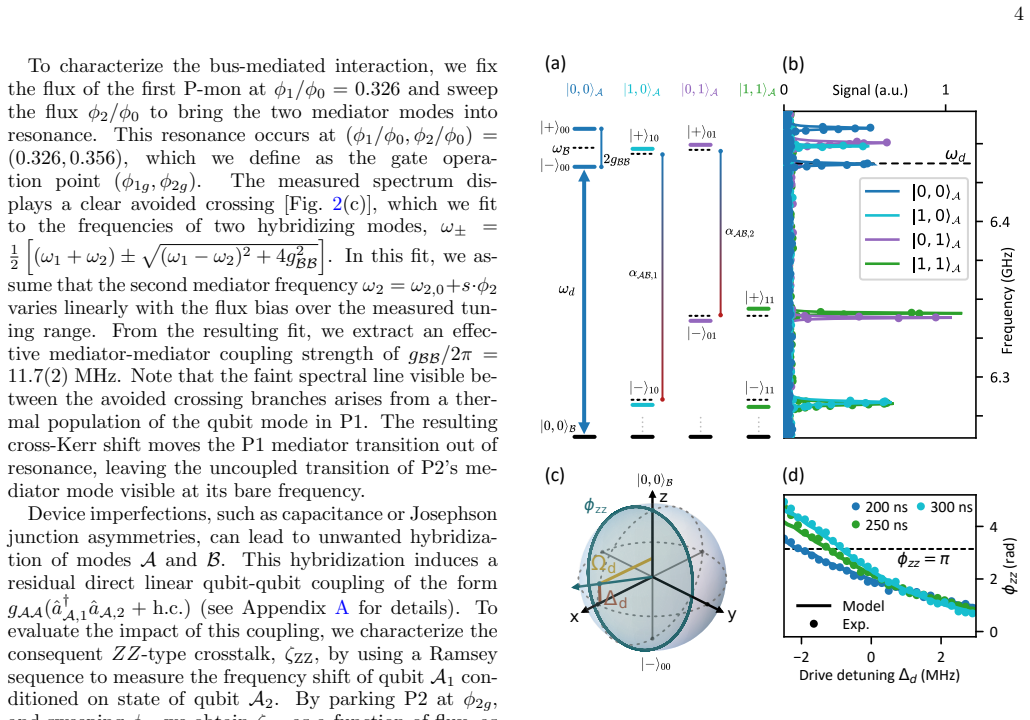
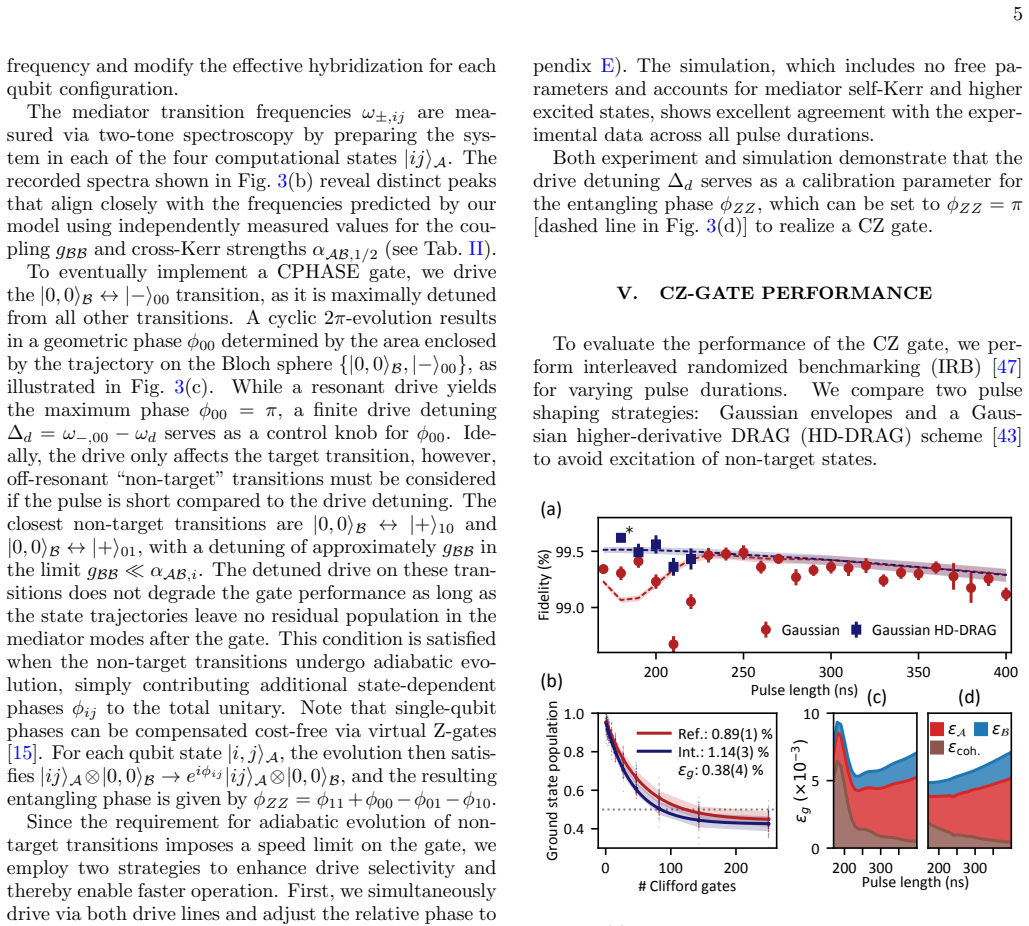
To scale superconducting quantum processors, it is essential to achieve long coherence times while engineering interactions that do not introduce additional decoherence channels. In superconducting qubit systems, this can be realized using multimode circuits that feature a protected qubit mode alongside a distinct mediator mode. Building on this concept, our recently developed P-mon qubit provides intrinsic protection against decoherence from the readout environment. We extend this approach to controlled two-qubit interactions, by exploiting the mediator modes of P-mons for on-demand coupling. Because direct interactions between the qubit modes are strongly suppressed, unwanted $ZZ$-type interactions are significantly reduced to below $3.6(5)~\text{kHz}$ in the idle state. When tuning the coupled mediator modes on resonance, the cross-Kerr interaction between the qubit and the hybridized mediator modes leads to a qubit-state dependent frequency shift. By selectively addressing these transitions, we implement a $180~\text{ns}$ long CZ gate and determine a fidelity of $99.62(4)~\text{%}$. These results represent a significant step toward a scalable superconducting architecture that maintains high performance at scale.
Editorial analysis
A structured set of objections, weighed in public.
Referee Report
Summary. The manuscript claims that multimode P-mon superconducting qubits enable a protected architecture where idle ZZ interactions are suppressed below 3.6(5) kHz; by tuning mediator modes on resonance to activate a cross-Kerr interaction, the authors implement a 180 ns CZ gate with measured fidelity 99.62(4)%.
Significance. If the fidelity result holds after full error analysis, the work would demonstrate a concrete route to high-fidelity two-qubit gates in a multimode circuit that intrinsically limits unwanted interactions and readout-induced decoherence, which is relevant for scaling superconducting processors.
major comments (2)
- [Abstract] Abstract: the central fidelity claim of 99.62(4)% is stated with an uncertainty but the text supplies neither the pulse sequence, the tomography or randomized-benchmarking protocol, nor the raw data and fitting procedure used to extract it; without these the number cannot be verified and is load-bearing for the headline result.
- [Abstract] Abstract: the statement that resonant mediator tuning produces only the intended qubit-state-dependent shift is not accompanied by any quantitative bound on additional decoherence rates, leakage, or calibration residuals once the mediators are brought on resonance; if these rates approach the inverse gate time (~5.6 MHz) the reported fidelity would be invalidated.
Simulated Author's Rebuttal
We thank the referee for their thoughtful review and constructive comments on our manuscript. We respond to each major comment below and indicate where revisions will be made.
read point-by-point responses
-
Referee: [Abstract] Abstract: the central fidelity claim of 99.62(4)% is stated with an uncertainty but the text supplies neither the pulse sequence, the tomography or randomized-benchmarking protocol, nor the raw data and fitting procedure used to extract it; without these the number cannot be verified and is load-bearing for the headline result.
Authors: We agree that the abstract is too concise to include protocol details. The main text describes the CZ gate implementation, but to enable independent verification of the fidelity number we will expand the methods section (and, if space permits, the abstract) with an explicit description of the randomized benchmarking sequence, the pulse parameters, and the fitting procedure used to obtain 99.62(4)%. Raw data and analysis code will be added to the supplementary information. revision: yes
-
Referee: [Abstract] Abstract: the statement that resonant mediator tuning produces only the intended qubit-state-dependent shift is not accompanied by any quantitative bound on additional decoherence rates, leakage, or calibration residuals once the mediators are brought on resonance; if these rates approach the inverse gate time (~5.6 MHz) the reported fidelity would be invalidated.
Authors: The referee is correct that no explicit quantitative bounds appear in the abstract. The manuscript reports idle-state ZZ suppression and coherence times, but does not directly quantify extra decoherence or leakage under resonant mediator tuning. In the revised version we will include dedicated measurements of T1, T2, and leakage rates with the mediators on resonance, together with an upper bound showing that any additional error channels remain well below ~5.6 MHz. revision: yes
Circularity Check
No circularity: experimental fidelity measurement with no derivation chain
full rationale
This is an experimental demonstration paper. The central claim (180 ns CZ gate at 99.62(4)% fidelity) is obtained by direct measurement of a physical device after resonant tuning of mediator modes. No equations, parameters, or predictions are derived that reduce by construction to fitted inputs or self-citations. The idle-state ZZ bound and fidelity number are reported experimental outcomes, not outputs of a self-referential model. Self-citation to prior P-mon work exists but is not load-bearing for the fidelity result. The derivation chain is empty; the result is self-contained against external benchmarks.
Axiom & Free-Parameter Ledger
Reference graph
Works this paper leans on
-
[1]
bright state
with the suppression of inter-qubit crosstalk pre- sented here, the P-mon architecture is a compelling can- didate for scalable quantum processors. Investigating high-connectivity topologies and multi-qubit gates re- mains a promising direction for future research. VII. ACKNOWLEDGMENTS This research was funded by the BMW Group. We ac- knowledge financial ...
2020
-
[2]
The respective rates are derived from experimental coherence times listed in Tab. III. We evaluate Eq. (E4) numerically using QuTiP [46]. Truncating each mediator mode to three energy lev- els was found to be sufficient for numerical convergence across all studied parameter regimes. We trace out the mediator modes from the full density matrix ˆρ(t) to obt...
2000
-
[3]
For the Gaussian HD-DRAG pulse, we additionally calibrate the DRAG parameter
to finalize the CZ unitary. For the Gaussian HD-DRAG pulse, we additionally calibrate the DRAG parameter. The drive signal consists of an in-phase component Ω I and a quadrature compo- nent ΩQ defined as: ΩI(t)∝[g(t) +c 1¨g(t)],ΩQ(t)∝c 2[ ˙g(t) +c1 ...g(t)]. (G2) In the frequency domain, spectrum of Ω IQ = ΩI +i·Ω Q takes the form: ˆΩIQ(f)∝[1−(2πf) 2c1]·[...
-
[4]
Krinner, N
S. Krinner, N. Lacroix, A. Remm, A. Di Paolo, E. Genois, C. Leroux, C. Hellings, S. Lazar, F. Swiadek, J. Her- rmann, G. J. Norris, C. K. Andersen, M. M¨ uller, A. Blais, C. Eichler, and A. Wallraff, Realizing repeated quantum error correction in a distance-three surface code, Nature 605, 669 (2022)
2022
-
[5]
Google Quantum AI, Suppressing quantum errors by scaling a surface code logical qubit, Nature614, 676 (2023)
2023
-
[6]
Google Quantum AI, Quantum error correction below the surface code threshold, Nature638, 920 (2025)
2025
-
[7]
A. P. Place, L. V. Rodgers, P. Mundada, B. M. Smitham, M. Fitzpatrick, Z. Leng, A. Premkumar, J. Bryon, A. Vrajitoarea, S. Sussman, G. Cheng, T. Madhavan, H. K. Babla, X. H. Le, Y. Gang, B. J¨ ack, A. Gyenis, N. Yao, R. J. Cava, N. P. de Leon, and A. A. Houck, New material platform for superconducting transmon qubits with coherence times exceeding 0.3 mil...
2021
-
[8]
Tuokkola, Y
M. Tuokkola, Y. Sunada, H. Kivij¨ arvi, J. Albanese, L. Gr¨ onberg, J.-P. Kaikkonen, V. Vesterinen, J. Gove- nius, and M. M¨ ott¨ onen, Methods to achieve near- millisecond energy relaxation and dephasing times for a superconducting transmon qubit, Nature Communica- tions16, 5421 (2025)
2025
-
[9]
M. P. Bland, F. Bahrami, J. G. C. Martinez, P. H. Preste- gaard, B. M. Smitham, A. Joshi, E. Hedrick, S. Kumar, A. Yang, A. C. Pakpour-Tabrizi, A. Jindal, R. D. Chang, G. Cheng, N. Yao, R. J. Cava, N. P. de Leon, and A. A. Houck, Millisecond lifetimes and coherence times in 2D transmon qubits, Nature647, 343 (2025)
2025
-
[10]
Bruckmoser, L
N. Bruckmoser, L. Koch, I. Tsitsilin, M. Grammer, D. Bunch, L. Richard, J. Schirk, F. Wallner, J. Feigl, C. Schneider, S. Gepr¨ ags, V. Bader, M. Althammer, L. S¨ odergren, and S. Filipp, Niobium air bridges as low- loss components for superconducting quantum hardware, Phys. Rev. Appl.25, 024007 (2026)
2026
-
[11]
J. M. Gambetta, A. D. C´ orcoles, S. T. Merkel, B. R. Johnson, J. A. Smolin, J. M. Chow, C. A. Ryan, C. Rigetti, S. Poletto, T. A. Ohki, M. B. Ketchen, and M. Steffen, Characterization of addressability by simulta- neous randomized benchmarking, Phys. Rev. Lett.109, 240504 (2012)
2012
-
[12]
Mundada, G
P. Mundada, G. Zhang, T. Hazard, and A. Houck, Sup- pression of qubit crosstalk in a tunable coupling super- conducting circuit, Phys. Rev. Appl.12, 054023 (2019)
2019
-
[13]
Krinner, S
S. Krinner, S. Lazar, A. Remm, C. K. Andersen, N. Lacroix, G. J. Norris, C. Hellings, M. Gabureac, C. Eichler, and A. Wallraff, Benchmarking coherent er- rors in controlled-phase gates due to spectator qubits, Phys. Rev. Appl.14, 024042 (2020)
2020
-
[14]
J. Koch, T. M. Yu, J. Gambetta, A. A. Houck, D. I. Schuster, J. Majer, A. Blais, M. H. Devoret, S. M. Girvin, and R. J. Schoelkopf, Charge-insensitive qubit design de- rived from the Cooper pair box, Phys. Rev. A76, 042319 (2007)
2007
-
[15]
DiCarlo, J
L. DiCarlo, J. M. Chow, J. M. Gambetta, L. S. Bishop, B. R. Johnson, D. I. Schuster, J. Majer, A. Blais, L. Frun- zio, S. M. Girvin, and R. J. Schoelkopf, Demonstration of two-qubit algorithms with a superconducting quantum processor, Nature460, 240 (2009)
2009
-
[16]
Barends, J
R. Barends, J. Kelly, A. Megrant, A. Veitia, D. Sank, E. Jeffrey, T. C. White, J. Mutus, A. G. Fowler, B. Campbell, Y. Chen, Z. Chen, B. Chiaro, A. Dunsworth, C. Neill, P. O’Malley, P. Roushan, A. Vainsencher, J. Wenner, A. N. Korotkov, A. N. Cle- land, and J. M. Martinis, Superconducting quantum cir- cuits at the surface code threshold for fault toleranc...
2014
-
[17]
Y. Chen, C. Neill, P. Roushan, N. Leung, M. Fang, R. Barends, J. Kelly, B. Campbell, Z. Chen, B. Chiaro, A. Dunsworth, E. Jeffrey, A. Megrant, J. Y. Mu- tus, P. J. J. O’Malley, C. M. Quintana, D. Sank, A. Vainsencher, J. Wenner, T. C. White, M. R. Geller, A. N. Cleland, and J. M. Martinis, Qubit architecture with high coherence and fast tunable coupling, ...
2014
-
[18]
D. C. McKay, S. Filipp, A. Mezzacapo, E. Magesan, J. M. Chow, and J. M. Gambetta, Universal gate for fixed- frequency qubits via a tunable bus, Phys. Rev. Appl.6, 064007 (2016)
2016
-
[19]
Goto, Double-transmon coupler: Fast two-qubit gate with no residual coupling for highly detuned supercon- ducting qubits, Phys
H. Goto, Double-transmon coupler: Fast two-qubit gate with no residual coupling for highly detuned supercon- ducting qubits, Phys. Rev. Appl.18, 034038 (2022)
2022
-
[20]
R. Li, K. Kubo, Y. Ho, Z. Yan, Y. Nakamura, and H. Goto, Realization of high-fidelity CZ gate based on a double-transmon coupler, Phys. Rev. X14, 041050 (2024)
2024
-
[21]
J. An, H. Zhang, Q. Ding, L. Ding, Y. Sung, R. Winik, J. Kim, I. T. Rosen, K. Azar, R. D. Pi˜ nero,et al., ZZ-free two-transmon CZ gate mediated by a fluxonium coupler, arXiv:2511.02115 (2025)
arXiv 2025
-
[22]
J. M. Gambetta, A. A. Houck, and A. Blais, Supercon- ducting qubit with Purcell protection and tunable cou- pling, Phys. Rev. Lett.106, 030502 (2011)
2011
-
[23]
A. J. Hoffman, S. J. Srinivasan, J. M. Gambetta, and A. A. Houck, Coherent control of a superconducting qubit with dynamically tunable qubit-cavity coupling, Phys. Rev. B84, 184515 (2011)
2011
-
[24]
S. J. Srinivasan, A. J. Hoffman, J. M. Gambetta, and A. A. Houck, Tunable coupling in circuit quantum elec- trodynamics using a superconducting charge qubit with av-shaped energy level diagram, Phys. Rev. Lett.106, 083601 (2011)
2011
-
[25]
T. Roy, S. Kundu, M. Chand, S. Hazra, N. Nehra, R. Cos- mic, A. Ranadive, M. P. Patankar, K. Damle, and R. Vi- jay, Implementation of pairwise longitudinal coupling in a three-qubit superconducting circuit, Phys. Rev. Appl. 7, 054025 (2017)
2017
-
[26]
T. Roy, M. Chand, A. Bhattacharjee, S. Hazra, S. Kundu, K. Damle, and R. Vijay, Multimode superconducting cir- cuits for realizing strongly coupled multiqubit processor units, Phys. Rev. A98, 052318 (2018)
2018
-
[27]
Zhang, Y
G. Zhang, Y. Liu, J. J. Raftery, and A. A. Houck, Sup- pression of photon shot noise dephasing in a tunable cou- pling superconducting qubit, npj Quantum Information 3, (2017)
2017
-
[28]
Dassonneville, T
R. Dassonneville, T. Ramos, V. Milchakov, L. Planat, E. Dumur, F. Foroughi, J. Puertas, S. Leger, K. Bharad- waj, J. Delaforce, C. Naud, W. Hasch-Guichard, J. J. Garc´ ıa-Ripoll, N. Roch, and O. Buisson, Fast high- fidelity quantum nondemolition qubit readout via a 14 nonperturbative cross-Kerr coupling, Phys. Rev. X10, 011045 (2020)
2020
-
[29]
Dassonneville, T
R. Dassonneville, T. Ramos, V. Milchakov, C. Mori, L. Planat, F. Foroughi, C. Naud, W. Hasch-Guichard, J. Garc´ ıa-Ripoll, N. Roch, and O. Buisson, Transmon- qubit readout using an in situ bifurcation amplification in the mesoscopic regime, Phys. Rev. Appl.20, 044050 (2023)
2023
-
[30]
Hazra, W
S. Hazra, W. Dai, T. Connolly, P. D. Kurilovich, Z. Wang, L. Frunzio, and M. H. Devoret, Benchmark- ing the readout of a superconducting qubit for repeated measurements, Phys. Rev. Lett.134, 100601 (2025)
2025
-
[31]
J. B. Kline, A. Yen, S. Chen, and K. P. O’Brien, The arm qubit: A superconducting qubit co-designed for co- herence and coupling, arXiv:2506.05315 (2025)
arXiv 2025
-
[32]
K. V. Salunkhe, S. Kundu, S. Das, J. Deshmukh, M. P. Patankar, and R. Vijay, The quantromon: A qubit- resonator system with orthogonal qubit and readout modes, Applied Physics Letters126, 254001 (2025)
2025
-
[33]
C. Mori, F. D. Esposito, A. Petrescu, L. Ruela, S. Ku- mar, V. N. Suresh, W. Ardati, D. Nicolas, G. Cappelli, A. Ranadive,et al., Suppression of measurement-induced state transitions in cosϕ-coupling transmon readout, arXiv:2509.05126 (2025)
arXiv 2025
-
[34]
C. Mori, V. Milchakov, F. d’Esposito, L. Ruela, S. Ku- mar, V. N. Suresh, W. Ardati, D. Nicolas, G. Cap- pelli, A. Ranadive,et al., High-power readout of a trans- mon qubit using a nonlinear coupling, arXiv:2507.03642 (2025)
arXiv 2025
- [35]
-
[36]
Finck, S
A. Finck, S. Carnevale, D. Klaus, C. Scerbo, J. Blair, T. McConkey, C. Kurter, A. Carniol, G. Keefe, M. Kumph, and O. Dial, Suppressed crosstalk between two-junction superconducting qubits with mode-selective exchange coupling, Phys. Rev. Appl.16, 054041 (2021)
2021
-
[37]
A. W. Cross and J. M. Gambetta, Optimized pulse shapes for a resonator-induced phase gate, Phys. Rev. A91, 032325 (2015)
2015
-
[38]
H. Paik, A. Mezzacapo, M. Sandberg, D. T. McClure, B. Abdo, A. D. C´ orcoles, O. Dial, D. F. Bogorin, B. L. T. Plourde, M. Steffen, A. W. Cross, J. M. Gambetta, and J. M. Chow, Experimental demonstration of a resonator- induced phase gate in a multiqubit circuit-qed system, Phys. Rev. Lett.117, 250502 (2016)
2016
-
[39]
Pfeiffer, M
F. Pfeiffer, M. Werninghaus, C. Schweizer, N. Bruck- moser, L. Koch, N. J. Glaser, G. B. P. Huber, D. Bunch, F. X. Haslbeck, M. Knudsen, G. Krylov, K. Liegener, A. Marx, L. Richard, J. H. Romeiro, F. A. Roy, J. Schirk, C. Schneider, M. Singh, L. S¨ odergren, I. Tsitsilin, F. Wallner, C. A. Riofr´ ıo, and S. Filipp, Efficient decou- pling of a nonlinear qu...
2024
-
[40]
Majer, J
J. Majer, J. M. Chow, J. M. Gambetta, J. Koch, B. R. Johnson, J. A. Schreier, L. Frunzio, D. I. Schuster, A. A. Houck, A. Wallraff, A. Blais, M. H. Devoret, S. M. Girvin, and R. J. Schoelkopf, Coupling superconducting qubits via a cavity bus, Nature449, 443 (2007)
2007
-
[41]
Filipp, M
S. Filipp, M. G¨ oppl, J. M. Fink, M. Baur, R. Bianchetti, L. Steffen, and A. Wallraff, Multimode mediated qubit- qubit coupling and dark-state symmetries in circuit quan- tum electrodynamics, Phys. Rev. A83, 063827 (2011)
2011
-
[42]
Blais, A
A. Blais, A. L. Grimsmo, S. M. Girvin, and A. Wallraff, Circuit quantum electrodynamics, Rev. Mod. Phys.93, 025005 (2021)
2021
-
[43]
Wills, G
J. Wills, G. Campanaro, S. Cao, S. D. Fasciati, P. J. Leek, and B. Vlastakis, Spatial charge sensitivity in a multimode superconducting qubit, Phys. Rev. Appl.17, 024058 (2022)
2022
-
[44]
Pfeiffer et al., In preparation, (2026)
F. Pfeiffer et al., In preparation, (2026)
2026
-
[45]
Filipp, A
S. Filipp, A. F. van Loo, M. Baur, L. Steffen, and A. Wallraff, Preparation of subradiant states using lo- cal qubit control in circuit qed, Phys. Rev. A84, 061805 (2011)
2011
-
[46]
Hyypp¨ a, A
E. Hyypp¨ a, A. Veps¨ al¨ ainen, M. Papiˇ c, C. F. Chan, S. Inel, A. Landra, W. Liu, J. Luus, F. Marxer, C. Ockeloen-Korppi, S. Orbell, B. Tarasinski, and J. Heinsoo, Reducing leakage of single-qubit gates for su- perconducting quantum processors using analytical con- trol pulse envelopes, PRX Quantum5, 030353 (2024)
2024
-
[47]
Singh, E
S. Singh, E. Y. Huang, J. Hu, F. Yilmaz, M. F. S. Zwa- nenburg, P. Kumaravadivel, S. Wang, T. V. Stefanski, and C. K. Andersen, Fast microwave-driven two-qubit gates between fluxonium qubits with a transmon coupler, Phys. Rev. Appl.25, 024020 (2026)
2026
-
[48]
Ganzhorn, G
M. Ganzhorn, G. Salis, D. J. Egger, A. Fuhrer, M. Mer- genthaler, C. M¨ uller, P. M¨ uller, S. Paredes, M. Pechal, M. Werninghaus, and S. Filipp, Benchmarking the noise sensitivity of different parametric two-qubit gates in a single superconducting quantum computing platform, Phys. Rev. Res.2, 033447 (2020)
2020
-
[49]
Lambert, E
N. Lambert, E. Gigu‘ere, P. Menczel, B. Li, P. Hopf, G. Su’arez, M. Gali, J. Lishman, R. Gadhvi, R. Agarwal, A. Galicia, N. Shammah, P. Nation, J. R. Johansson, S. Ahmed, S. Cross, A. Pitchford, and F. Nori, Qutip 5: The quantum toolbox in Python, Physics Reports1153, 1 (2026)
2026
-
[50]
Magesan, J
E. Magesan, J. M. Gambetta, B. R. Johnson, C. A. Ryan, J. M. Chow, S. T. Merkel, M. P. da Silva, G. A. Keefe, M. B. Rothwell, T. A. Ohki, M. B. Ketchen, and M. Steffen, Efficient measurement of quantum gate er- ror by interleaved randomized benchmarking, Phys. Rev. Lett.109, 080505 (2012)
2012
-
[51]
Yoshihara, K
F. Yoshihara, K. Harrabi, A. O. Niskanen, Y. Nakamura, and J. S. Tsai, Decoherence of flux qubits due to 1/fflux noise, Phys. Rev. Lett.97, 167001 (2006)
2006
-
[52]
Kakuyanagi, T
K. Kakuyanagi, T. Meno, S. Saito, H. Nakano, K. Semba, H. Takayanagi, F. Deppe, and A. Shnirman, Dephasing of a superconducting flux qubit, Phys. Rev. Lett.98, 047004 (2007)
2007
-
[53]
Bylander, S
J. Bylander, S. Gustavsson, F. Yan, F. Yoshihara, K. Harrabi, G. Fitch, D. G. Cory, Y. Nakamura, J. S. Tsai, and W. D. Oliver, Noise spectroscopy through dy- namical decoupling with a superconducting flux qubit, Nature Physics7, 565 (2011)
2011
-
[54]
M. D. Hutchings, J. B. Hertzberg, Y. Liu, N. T. Bronn, G. A. Keefe, M. Brink, J. M. Chow, and B. L. T. Plourde, Tunable superconducting qubits with flux-independent coherence, Phys. Rev. Appl.8, 044003 (2017)
2017
-
[55]
D. C. McKay, S. Sheldon, J. A. Smolin, J. M. Chow, and J. M. Gambetta, Three-qubit randomized benchmarking, Phys. Rev. Lett.122, 200502 (2019)
2019
-
[56]
Osman, J
A. Osman, J. Simon, A. Bengtsson, S. Kosen, P. Krantz, D. P. Lozano, M. Scigliuzzo, P. Delsing, J. Bylander, and A. Fadavi Roudsari, Simplified Josephson-junction fabri- cation process for reproducibly high-performance super- 15 conducting qubits, Applied Physics Letters118, 064002 (2021)
2021
-
[57]
J. B. Hertzberg, E. J. Zhang, S. Rosenblatt, E. Mage- san, J. A. Smolin, J. B. Yau, V. P. Adiga, M. Sandberg, M. Brink, J. M. Chow, and J. S. Orcutt, Laser-annealing josephson junctions for yielding scaled-up superconduct- ing quantum processors, npj Quantum Information7, (2021)
2021
-
[58]
A. A. Houck, J. A. Schreier, B. R. Johnson, J. M. Chow, J. Koch, J. M. Gambetta, D. I. Schuster, L. Frunzio, M. H. Devoret, S. M. Girvin, and R. J. Schoelkopf, Con- trolling the spontaneous emission of a superconducting transmon qubit, Phys. Rev. Lett.101, 080502 (2008)
2008
-
[59]
Vigneau, S
F. Vigneau, S. Majumder, A. Rath, P. Parrado- Rodr´ ıguez, F. R. F. Pereira, H.-S. Ku, F. ˇSimkovic, S. Pogorzalek, T. Jones, N. Wurz, M. Renger, J. Verjauw, P. Yang, W. Kindel, F. Deppe, and J. Heinsoo, Quantum error detection in qubit-resonator star architecture, PRX Quantum6, 040369 (2025)
2025
-
[60]
Virtanen, R
P. Virtanen, R. Gommers, T. E. Oliphant, M. Haber- land, T. Reddy, D. Cournapeau, E. Burovski, P. Peter- son, W. Weckesser, J. Bright, and et al., SciPy 1.0: Fun- damental Algorithms for Scientific Computing in Python, Nature Methods17, 261 (2020)
2020
-
[61]
M. A. Nielsen, A simple formula for the average gate fi- delity of a quantum dynamical operation, Physics Letters A303, 249 (2002)
2002
-
[62]
Motzoi, J
F. Motzoi, J. M. Gambetta, P. Rebentrost, and F. K. Wilhelm, Simple pulses for elimination of leakage in weakly nonlinear qubits, Phys. Rev. Lett.103, 110501 (2009)
2009
-
[63]
Werninghaus, D
M. Werninghaus, D. J. Egger, F. Roy, S. Machnes, F. K. Wilhelm, and S. Filipp, Leakage reduction in fast super- conducting qubit gates via optimal control, npj Quantum Information7, (2021)
2021
-
[64]
H. Yan, S. Zhao, Z. Xiang, Z. Wang, Z. Yang, K. Xu, Y. Tian, H. Yu, D. Zheng, H. Fan, and S. Zhao, Calibra- tion and cancellation of microwave crosstalk in supercon- ducting circuits, Chinese Physics B32, 094203 (2023)
2023
-
[65]
D. C. McKay, C. J. Wood, S. Sheldon, J. M. Chow, and J. M. Gambetta, Efficientzgates for quantum comput- ing, Phys. Rev. A96, 022330 (2017)
2017
-
[66]
Glaser, F
N. Glaser, F. Roy, I. Tsitsilin, L. Koch, N. Bruck- moser, J. Schirk, J. Romeiro, G. Huber, F. Wallner, M. Singh, G. Krylov, A. Marx, L. S¨ odergren, C. Schnei- der, M. Werninghaus, and S. Filipp, Closed-loop opti- mization for high-fidelity controlled-Zgates in supercon- ducting qubits, Phys. Rev. Appl.24, 024048 (2025)
2025
discussion (0)
Sign in with ORCID, Apple, or X to comment. Anyone can read and Pith papers without signing in.