REVIEW 2 major objections 5 minor 33 references
TWICE: Two-Clock, Two-Window Learning for Long-Horizon Conversion Prediction in Online Advertising
T0 review · 2 major / 5 minor · reviewed 2026-08-01 · deepseek-v4-flash
Pith's one-line read The paper claims that long-horizon conversion prediction improves when target-window conversion probability and conversion-delay distribution are learned separately from two event clocks, yielding monotone horizon predictions and a 2.5% pro
desk verdict Genuinely new two-clock delayed-feedback CVR with strong production evidence; the self-referential exposure-mass loop needs an in-situ calibration check before I'd fully trust it. read the letter →
The pith
A machine-rendered reading of the paper's core claim, the machinery that carries it, and where it could break.
The reading
What carries the argument
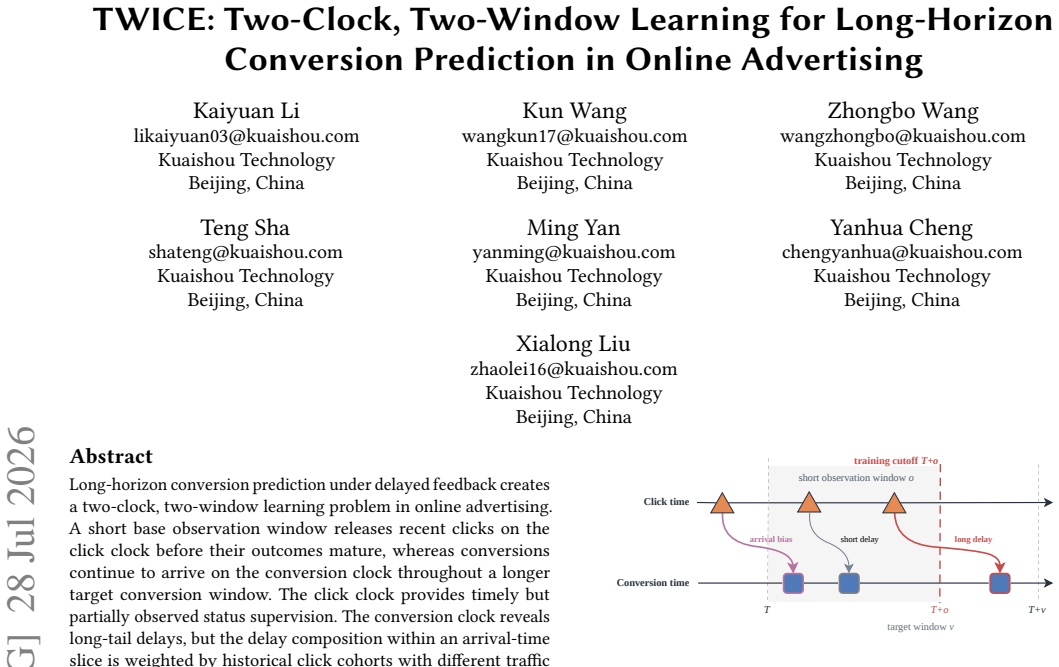
The central machinery is the two-clock/two-window factorization p̂_u(x) = p_θ(x)·F_φ(u|G(x)) combined with an arrival-conditioned temporal-convolution likelihood. The delay head is a softmax over K elapsed-delay buckets whose prefix sums form a monotone CDF; at each conversion arrival, timestamp range sums over the logged pCVR index give R_{i,k}, and the likelihood compares the model's arrival intensity Λ_i to the realized bucket. Stop-gradients keep click-clock and conversion-clock supervision on disjoint parameter sets, so late conversions improve timing estimates without replaying historical clicks through the CVR backbone, and one checkpoint serves every horizon u≤v by multiplying p_θ by
What would settle it
Take mature 30-day data, split conversions by realized delay bucket and delay context G(x), and compare the average logged pCVR mass of converters in each bucket with that of non-converters; if the two diverge (calibration error correlates with delay), the arrival-conditioned likelihood is biased and the learned F_φ will not reproduce the empirical within-group delay CDF—a per-group KS test between F_φ and the empirical CDF would detect the failure.
Extended reading notes
Core claim
On a public delayed-feedback benchmark and a large industrial dataset, the paper claims that the two-clock split recovers 82–90% of the recoverable gap between training on one-hour-old clicks and training on mature 30-day labels, beating all deployable baselines. The central formula is p̂_u(x) = p_θ(x)·F_φ(u|G(x)): the CVR head p_θ estimates conversion within the target window v, the delay head F_φ estimates the fraction of those converters that have arrived by horizon u, and G(x) is a compact grouping of clicks with similar delay behavior. TWICE trains p_θ on click-clock records using the base-window status Y^(o) with the delay factor frozen (stop-gradient), and trains F_φ on conversion-clo
Load-bearing premise
The delay likelihood is exact only if the model's own logged predicted conversion rates are calibrated in aggregate within each delay context and click-time range and delay distributions are stationary there; since that mass is the model's self-generated prediction and the CVR loss sees only the product, miscalibration correlated with conversion delay would bias the delay head and silently leak into every horizon prediction.
Editorial extensions
If this is right
- One trained TWICE checkpoint produces monotone CVR estimates for every horizon up to the 30-day target window; horizons shorter than the base observation window are handled by the same model without retraining.
- Because late conversions update only a compact delay head via scalar pCVR masses, the delay stream does not require historical click features, keeping hourly training and 36 ms serving latency unchanged.
- On both the public and industrial datasets, TWICE recovers roughly 82–90% of the Vanilla-to-Oracle headroom, and the relative gain over the strongest baseline grows with conversion delay—from a 0.00012 AUC gain for sub-hour delays to 0.00405 for 14–30 day delays on the public benchmark.
- In the production A/B test, expected revenue, revenue, and conversions rose 2.486%, 1.858%, and 2.061% (all p<0.01) while PCOC moved from 0.961 to 0.990, and the system was subsequently deployed to full traffic.
Reading between the lines
- Because the delay head is trained with the model's own stopped pCVR predictions as exposure, the method's unbiasedness rests on p_θ being calibrated within each delay context and click-time range; an in-situ calibration check of logged a_j versus mature outcomes, stratified by G(x) and click time, would make the assumption testable and could be added as a production monitoring signal.
- The paper's working approximation F(b_m|x)≈F(b_m|G(x)) means horizon-monotonicity holds per group, not per click; a natural extension is a hierarchical delay context that gives finer per-click delay estimates while falling back to a coarser key to keep risk sets non-singleton, which the paper itself identifies as the reason it avoids full-feature keys.
- The production A/B measures full-system lift, not the mechanism in isolation; an online or large-scale offline ablation that disables only the pCVR-weighting in the arrival-conditioned likelihood would test whether cohort-exposure correction, rather than the factorization alone, drives the gain.
- If delay distributions drift within a group due to policy or product changes, the stationarity assumption of Section 4.3 is violated; conditioning the delay head on calendar time or allowing a slowly varying delay kernel is a testable extension for non-stationary regimes.
Editorial analysis
A structured set of objections, weighed in public.
Referee Report
Summary. The paper proposes TWICE, a delayed-feedback CVR model that factorizes the target-window conversion probability into a full-feature CVR head p_theta(x) and a grouped, elapsed-delay CDF F_phi(u|G(x)). The CVR head is trained on fresh click-clock records with a stopped delay factor (Eq. 9–10), while the delay head is trained on conversion-clock arrivals through an arrival-conditioned temporal-convolution objective that weights historical cohorts by stopped pCVR mass (Eq. 17–21). The authors claim monotone multi-horizon predictions from a single checkpoint, no serving-time historical lookup, and report offline gains on Criteo and an industrial dataset, plus an online A/B test with statistically significant lifts in expected revenue, revenue, and conversions.
Significance. If the claims hold, TWICE is a practically valuable contribution: it provides a clean two-clock formulation of delayed feedback, a monotone CDF for arbitrary horizons up to the target window, and an efficient training scheme requiring only a scalar pCVR-mass index rather than historical feature replay. The paper is unusually transparent: Section 4.3 states the exactness conditions for Eq. (21), and Appendices C–D explicitly disclaim statistical consistency, proving only mass conservation and gradient equivalence for fixed stopped scores. The ablations (Table 3) and the delayed-feedback-stratified analysis (Figure 5) are informative and support the claim that the temporal-convolution mechanism, not just the factorization, drives the gains. The main weakness is that a central assumption—aggregate calibration of the self-generated pCVR mass within delay contexts and click-time ranges—is stated but never directly verified in situ, leaving a plausible feedback-loop bias in the very quantity the method improves.
major comments (2)
- [§4.3, Eq. (21)] The arrival-conditioned likelihood is exact only when the logged pCVR mass a_j = sg[p_theta(x_j)] is calibrated in aggregate within each delay context and click-time range, and when within-group delay is stationary. Since a_j is the model's own prediction, and since the click-clock loss (Eq. 10) supervises only the product p_theta * sg[F_phi(o|g)], any miscalibration of a_j that correlates with conversion delay biases F_phi, and that bias is then absorbed into p_theta through the stopped delay factor. The paper acknowledges these conditions are only approximated and explicitly disclaims statistical consistency, but it reports no in-situ calibration diagnostic for a_j (e.g., reliability by group and click-time cohort, or a sensitivity analysis with recalibrated a_j). Table 3's w/o pCVR Weighting ablation is a useful stress test but does not substitute for verifying the calibration conditi
- [§4.2, Eq. (11) discussion] The working approximation F(b_m|x) ≈ F(b_m|G(x)) is load-bearing for the design of the delay head, but the paper does not provide a direct measure of how much delay heterogeneity is lost by conditioning on a compact group G(x). Table 4 shows that doubling a 10-field context to a 20-field context yields little gain, which is reassuring, but it does not quantify the approximation error relative to the full-feature delay CDF. Given that the full-x objective is degenerate by construction, this may be the best feasible check, but a short analysis of within-group delay heterogeneity (e.g., group-level delay CDF variance or a calibration plot of F vs. group) would strengthen the claim that the grouping sufficiency is not a major source of bias.
minor comments (5)
- [§5.7] The A/B test baseline is described only as 'an enhanced FSIW-style baseline sharing the same features, conversion definition, deployed backbone, and serving stack.' Please specify what enhancements are applied and whether the comparison is apples-to-apples in training data and model capacity. Also report confidence intervals for the lifts, not just p-values.
- [Table 4] The 'Fields' column formatting is difficult to read (e.g., 'Minimal 𝐺 0 6'). Please align the numbers and clarify whether 0 fields for Global means a single shared context key.
- [Figure 2] The annotations 'stop gradient ×', 'training only', and 'only' are dense and partly illegible in the reproduction. Consider separating the gradient-path diagram from the data-flow diagram for readability.
- [Appendix E] lambda_d = 1 is set without sensitivity analysis. Since Eq. (22) jointly trains two loss terms, a brief lambda_d sweep or a statement that results are stable would help.
- [§5.6] The traffic-dynamics case study is qualitative ('visually closer'). Consider adding a quantitative agreement measure (e.g., correlation or Wasserstein distance) for the reconstruction in Figure 6(b).
Circularity Check
No significant circularity: TWICE's factorization and delay objective are plug-in modeling choices, not predictions derived from their own inputs.
full rationale
The derivation chain is self-contained and does not reduce to its inputs by construction. Equation 6 is a tautological decomposition p_o(x)=p_v(x)F(o|x), and Equation 15 defines the horizon predictor as a product of two separately parameterized heads; neither equation defines a fitted quantity as the predicted quantity. The click-clock loss (Eqs. 9–10) supervises the product p_theta * sg[F_phi(o)] against observed short-window labels, while the delay loss (Eqs. 17–21) uses stopped pCVR mass a_j = sg[p_theta(x_j)] as an exposure weight. That is a plug-in/EM-style estimation loop, not a definitional circle: F_phi is not defined as p_o/p_theta, and p_theta is not defined as p_o/F_phi. The paper itself flags the key caveat in Section 4.3 ('Assumptions and Scope'): Equation 21 is exact only when logged pCVR mass is calibrated in aggregate within delay context and click-time range and delays are stationary; it explicitly disclaims universally unbiased delay estimation, and Appendices C and D prove only algebraic identities for fixed stopped scores, not statistical consistency. This is a calibration/robustness risk, not a circularity. There is no load-bearing self-citation: DFM and PI are external prior work, and the empirical claims are supported by public-benchmark comparisons and an online A/B test. The self-referential mechanism flagged by the reader is a legitimate identifiability concern but does not make the central claim equivalent to its inputs.
Assumptions & free parameters
free parameters (6)
- λ_d (delay loss weight) =
1
- Base observation window o =
1 hour
- Delay bucket partition B_1..B_12 =
0,1,2,4,8,12,24h,2,4,7,14,21,30d
- Delay context G(x) =
Default: 10 stable fields (industrial); all released categoricals (Criteo)
- Stopped pCVR mass a_j = sg[p_θ(x_j)] =
CVR-head outputs at click time
- Learning rates =
selected per method from 7 values
assumptions (6)
- domain assumption Delay-CDF factorization p_o(x) = p_v(x)·F(o|x) (Eq. 6)
- domain assumption pCVR mass calibration: a_j ≈ p_v(x_j) in aggregate within each delay context and click-time range
- domain assumption Stationary within-group delay distribution over the retained target window
- domain assumption Superposition/convolvability of arrival intensity: Λ(t) = (m*f)(t) (Eq. 7)
- ad hoc to paper Grouping sufficiency: F(b_m|x) ≈ F(b_m|G(x)) for m=1..K (Eq. 11 discussion)
- ad hoc to paper Piecewise-uniform delay CDF inside buckets (Eq. 14)
invented entities (2)
-
Two-clock abstraction (click clock vs. conversion clock)
-
Stopped pCVR mass index (a_j records keyed by click time and group)
Cite this review
Pith. "Pith review of TWICE: Two-Clock, Two-Window Learning for Long-Horizon Conversion Prediction in Online Advertising." pith.science (2026). https://pith.science/paper/BJ7KC2DF
@misc{pith2026260725404,
  author       = {Pith},
  title        = {Pith review of: TWICE: Two-Clock, Two-Window Learning for Long-Horizon Conversion Prediction in Online Advertising},
  year         = {2026},
  howpublished = {\url{https://pith.science/paper/BJ7KC2DF}},
  note         = {Machine review of arXiv:2607.25404}
}
read the original abstract
Long-horizon conversion prediction under delayed feedback creates a two-clock, two-window learning problem in online advertising. A short base observation window releases recent clicks on the click clock before their outcomes mature, whereas conversions continue to arrive on the conversion clock throughout a longer target conversion window. The click clock provides timely but partially observed status supervision. The conversion clock reveals long-tail delays, but the delay composition within an arrival-time slice is weighted by historical click cohorts with different traffic volumes and target-window conversion rates. We present TWICE, a framework that factorizes long-horizon post-click conversion rate (CVR) into a target-window conversion probability and a grouped elapsed-delay cumulative distribution function (CDF). The two clocks provide complementary supervision. Click-clock records train the target-window CVR head through a current-status likelihood over the base observation window. Newly arrived conversions train the delay model on the conversion clock. To account for the cohort mixture, TWICE uses fixed click-time predicted CVR (pCVR) mass as cohort exposure in an arrival-conditioned likelihood. This accounts for differences in cohort traffic and conversion propensity. The resulting aggregate records are self-contained. A single learned CDF produces monotone predictions for all requested horizons up to the target conversion window. Serving requires neither historical lookup nor convolution. Experiments on a public benchmark and an industrial advertising dataset demonstrate the effectiveness of TWICE. In an online A/B test in Kwai's advertising system, TWICE increased expected revenue, revenue, and conversions by 2.486%, 1.858%, and 2.061%, respectively. It was subsequently deployed to full traffic.
Figures


Figures from the paper (2 more)


Reference graph
Works this paper leans on
-
[1]
Ashwinkumar Badanidiyuru, Andrew Evdokimov, Vinodh Krishnan, Pan Li, Wynn Vonnegut, and Jayden Wang. 2021. Handling Many Conversions per Click in Modeling Delayed Feedback. arXiv:2101.02284 [cs.LG] https://arxiv.org/abs/ 2101.02284
arXiv 2021
-
[2]
Ashwinkumar Badanidiyuru Varadaraja, Zhe Feng, Tianxi Li, and Haifeng Xu
-
[3]
Olivier Chapelle. 2014. Modeling Delayed Feedback in Display Advertising. In Proceedings of the 20th ACM SIGKDD International Conference on Knowledge Discovery and Data Mining (KDD ’14). Association for Computing Machinery, New York, NY, USA, 1097–1105. doi:10.1145/2623330.2623634
arXiv 2014
-
[4]
Yu Chen, Jiaqi Jin, Hui Zhao, Pengjie Wang, Guojun Liu, Jian Xu, and Bo Zheng
-
[5]
Sunhao Dai, Yuqi Zhou, Jun Xu, and Ji-Rong Wen. 2023. Dually Enhanced Delayed Feedback Modeling for Streaming Conversion Rate Prediction. InPro- ceedings of the 32nd ACM International Conference on Information and Knowledge Management (CIKM ’23). Association for Computing Machinery, New York, NY, USA, 390–399. doi:10.1145/3583780.3614856
arXiv 2023
-
[6]
InProceedings of the ACM Web Conference 2022 (WWW ’22)
Asymptotically Unbiased Estimation for Delayed Feedback Modeling via Label Correction. InProceedings of the ACM Web Conference 2022 (WWW ’22). Association for Computing Machinery, New York, NY, USA, 369–379. doi:10. 1145/3485447.3511965
arXiv 2022
-
[7]
Hui Gao and Yihan Yang. 2022. Multi-Head Online Learning for Delayed Feedback Modeling. arXiv:2205.12406 [cs.LG] https://arxiv.org/abs/2205.12406
arXiv 2022
-
[8]
Chenlu Ding, Jiancan Wu, Yancheng Yuan, Cunchun Li, Xiang Wang, Dingxian Wang, Frank Yang, and Andrew Rabinovich. 2026. Delayed Feedback Model- ing with Influence Functions.Proceedings of the AAAI Conference on Artificial Intelligence40, 17 (2026), 14648–14656. doi:10.1609/aaai.v40i17.38483
Show all 33 references
-
[9]
Zhigang Huangfu, Gongduo Zhang, Zhengwei Wu, Qintong Wu, Zhiqiang Zhang, Lihong Gu, Jun Zhou, and Jinjie Gu. 2022. A Multi-Task Learning Approach for Delayed Feedback Modeling. InCompanion Proceedings of the Web Conference 2022 (WWW ’22 Companion). Association for Computing Ma...
2022
-
[10]
Siyu Gu, Xiang-Rong Sheng, Ying Fan, Guorui Zhou, and Xiaoqiang Zhu. 2021. Real Negatives Matter: Continuous Training with Real Negatives for Delayed Feedback Modeling. InProceedings of the 27th ACM SIGKDD Conference on Knowledge Discovery & Data Mining (KDD ’21). Association ...
2021
-
[11]
Kuang-chih Lee, Burkay Orten, Ali Dasdan, and Wentong Li. 2012. Estimating Conversion Rate in Display Advertising from Past Performance Data. InProceed- ings of the 18th ACM SIGKDD International Conference on Knowledge Discovery and Data Mining (KDD ’12). Association for Compu...
2012
-
[12]
Sofia Ira Ktena, Alykhan Tejani, Lucas Theis, Pranay Kumar Myana, Deepak Dilipkumar, Ferenc Huszar, Steven Yoo, and Wenzhe Shi. 2019. Addressing Delayed Feedback for Continuous Training with Neural Networks in CTR Pre- diction. InProceedings of the 13th ACM Conference on Recom...
2019
-
[13]
Qiming Liu, Xiang Ao, Yuyao Guo, and Qing He. 2024. Online Conversion Rate Prediction via Multi-Interval Screening and Synthesizing under Delayed Feedback.Proceedings of the AAAI Conference on Artificial Intelligence38, 8 (2024), 8796–8804. doi:10.1609/aaai.v38i8.28726
2024 doi
-
[14]
Qiming Liu, Haoming Li, Xiang Ao, Yuyao Guo, Zhihong Dong, Ruobing Zhang, Qiong Chen, Jianfeng Tong, and Qing He. 2023. Online Conversion Rate Predic- tion via Neural Satellite Networks in Delayed Feedback Advertising. InProceed- ings of the 46th International ACM SIGIR Confer...
2023
-
[15]
Haoming Li, Feiyang Pan, Xiang Ao, Zhao Yang, Min Lu, Junwei Pan, Dapeng Liu, Lei Xiao, and Qing He. 2021. Follow the Prophet: Accurate Online Conversion Rate Prediction in the Face of Delayed Feedback. InProceedings of the 44th International ACM SIGIR Conference on Research a...
2021
-
[16]
Xiao Ma, Liqin Zhao, Guan Huang, Zhi Wang, Zelin Hu, Xiaoqiang Zhu, and Kun Gai. 2018. Entire Space Multi-Task Model: An Effective Approach for Estimating Post-Click Conversion Rate. InThe 41st International ACM SIGIR Conference on Research & Development in Information Retriev...
2018 doi
-
[17]
Yuta Saito, Gota Morishita, and Shota Yasui. 2020. Dual Learning Algorithm for Delayed Conversions. InProceedings of the 43rd International ACM SIGIR Conference on Research and Development in Information Retrieval (SIGIR ’20). Association for Computing Machinery, New York, NY,...
2020
-
[18]
Mingxuan Luo, Guipeng Xv, Sishuo Chen, Xinyu Li, Li Zhang, Zhangming Chan, Xiang-Rong Sheng, Han Zhu, Jian Xu, Bo Zheng, and Chen Lin. 2026. Modeling Cascaded Delay Feedback for Online Net Conversion Rate Prediction: Benchmark, Insights and Solutions. InProceedings of the ACM ...
2026
-
[19]
Yumin Su, Liang Zhang, Quanyu Dai, Bo Zhang, Jinyao Yan, Dan Wang, Yongjun Bao, Sulong Xu, Yang He, and Weipeng Yan. 2020. An Attention-based Model for Conversion Rate Prediction with Delayed Feedback via Post-click Calibration. InProceedings of the Twenty-Ninth International ...
2020 doi
-
[20]
Hao Wang, Tai-Wei Chang, Tianqiao Liu, Jianmin Huang, Zhichao Chen, Chao Yu, Ruopeng Li, and Wei Chu. 2022. ESCM2: Entire Space Counterfactual Multi- Task Model for Post-Click Conversion Rate Estimation. InProceedings of the 45th International ACM SIGIR Conference on Research ...
2022
-
[21]
Hongzu Su, Lichao Meng, Lei Zhu, Ke Lu, and Jingjing Li. 2024. DDPO: Direct Dual Propensity Optimization for Post-Click Conversion Rate Estimation. In Proceedings of the 47th International ACM SIGIR Conference on Research and Development in Information Retrieval (SIGIR ’24). A...
2024
-
[22]
Hong Wen, Jing Zhang, Yuan Wang, Fuyu Lv, Wentian Bao, Quan Lin, and Keping Yang. 2020. Entire Space Multi-Task Modeling via Post-Click Behavior Decom- position for Conversion Rate Prediction. InProceedings of the 43rd International ACM SIGIR Conference on Research and Develop...
2020
-
[23]
Jiaqi Yang and De-Chuan Zhan. 2022. Generalized Delayed Feedback Model with Post-Click Information in Recommender Systems. InAdvances in Neural Information Processing Systems, Vol. 35. Curran Associates, Inc., New Orleans, LA, USA, 26192–26203. https://proceedings.neurips.cc/p...
2022
-
[24]
Yifan Wang, Peijie Sun, Min Zhang, Qinglin Jia, Jingjie Li, and Shaoping Ma. 2023. Unbiased Delayed Feedback Label Correction for Conversion Rate Prediction. InProceedings of the 29th ACM SIGKDD Conference on Knowledge Discovery and Data Mining (KDD ’23). Association for Compu...
2023
-
[25]
Shota Yasui and Masahiro Kato. 2022. Learning Classifiers under Delayed Feed- back with a Time Window Assumption. InProceedings of the 28th ACM SIGKDD Conference on Knowledge Discovery and Data Mining (KDD ’22). Association for Computing Machinery, New York, NY, USA, 2286–2295...
2022 doi
-
[26]
Shota Yasui, Gota Morishita, Komei Fujita, and Masashi Shibata. 2020. A Feedback Shift Correction in Predicting Conversion Rates under Delayed Feedback. In Proceedings of The Web Conference 2020 (WWW ’20). Association for Computing Machinery, New York, NY, USA, 2740–2746. doi:...
2020
-
[27]
Jia-Qi Yang, Xiang Li, Shuguang Han, Tao Zhuang, De-Chuan Zhan, Xiaoyi Zeng, and Bin Tong. 2021. Capturing Delayed Feedback in Conversion Rate Prediction via Elapsed-Time Sampling.Proceedings of the AAAI Conference on Artificial Intelligence35, 5 (2021), 4582–4589. doi:10.1609...
2021 doi
-
[28]
Xin Zhang, Weiliang Li, Rui Li, Zihang Fu, Tongyi Tang, Zhengyu Zhang, Wen-Yen Chen, Nima Noorshams, Nirav Jasapara, Xiaowen Ding, Ellie Wen, and Xue Feng. 2025. Personalized Interpolation: Achieving Efficient Conver- sion Estimation with Flexible Optimization Windows. InProce...
2025
-
[29]
Han Zhu, Junqi Jin, Chang Tan, Fei Pan, Yifan Zeng, Han Li, and Kun Gai. 2017. Optimized Cost per Click in Taobao Display Advertising. InProceedings of the 23rd ACM SIGKDD International Conference on Knowledge Discovery and Data Mining (KDD ’17). Association for Computing Mach...
2017
-
[30]
Yuya Yoshikawa and Yusaku Imai. 2020. A Nonparametric Delayed Feed- back Model for Conversion Rate Prediction. InProceedings of the 26th ACM SIGKDD International Conference on Knowledge Discovery & Data Mining (KDD ’20). Association for Computing Machinery, New York, NY, USA, ...
2020
-
[33]
The delay head uses separate embeddings for the fields in𝐺, a two-layer ReLU MLP with widths[64, 32], and a𝐾-way softmax; it shares no trainable parameters with the CVR branch
For 𝑣= 30days, the 𝐾= 12delay intervals use boundaries 0, 1, 2, 4, 8, 12, 24hours followed by2 , 4, 7, 14, 21, and30days. The delay head uses separate embeddings for the fields in𝐺, a two-layer ReLU MLP with widths[64, 32], and a𝐾-way softmax; it shares no trainable parameters...
-
[195]
doi:10.1145/3298689.3347002
-
[2022]
InAdvances in Neural Information Processing Systems, S
Incrementality Bidding via Reinforcement Learning under Mixed and Delayed Rewards. InAdvances in Neural Information Processing Systems, S. Koyejo, S. Mohamed, A. Agarwal, D. Belgrave, K. Cho, and A. Oh (Eds.), Vol. 35. Curran Associates, Inc., Red Hook, NY, USA, 2142–2153. doi...
Reviewed August 1, 2026 · model on record in the stance chip above.
Discussion (0). Continue with ORCID to comment.