REVIEW 3 minor 1 cited by
The limit shape and emergence of the Discrete Gaussian level lines
T0 review · 0 major / 3 minor · reviewed 2026-06-27 · grok-4.3
Pith's one-line read The n-th top level line in the discrete Gaussian model converges in Hausdorff distance to a deterministic shape featuring the Wulff shape near the corners at scale L^{1-o(1)}, while each macroscopic h-level line emerges in a sharp transitio
desk verdict This paper closes the global Hausdorff limit and the emergence window for discrete Gaussian level lines by linking them to prior local laws and the plateau result. read the letter →
The pith
A machine-rendered reading of the paper's core claim, the machinery that carries it, and where it could break.
The reading
What carries the argument
the deterministic limit shape ℒ_n of the n-th level line, which incorporates the Wulff shape at scale L^{1-o(1)} near the corners and governs both global convergence and the location of the critical emergence window
What would settle it
Numerical or analytic evidence that the Hausdorff distance from the n-th level line to the claimed shape ℒ_n fails to tend to zero for some fixed n, or that the width of the emergence window for some h exceeds L^{1/2+o(1)}.
Extended reading notes
Core claim
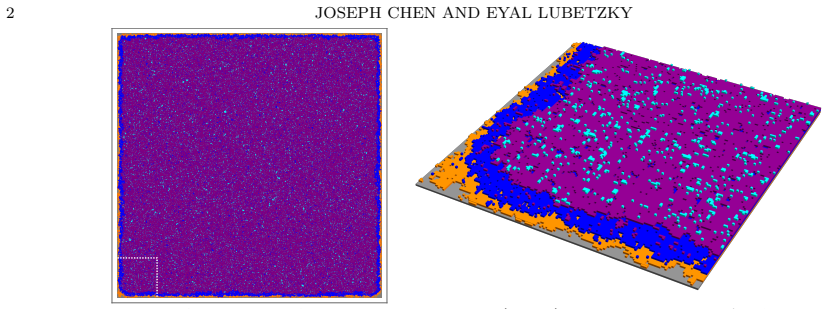
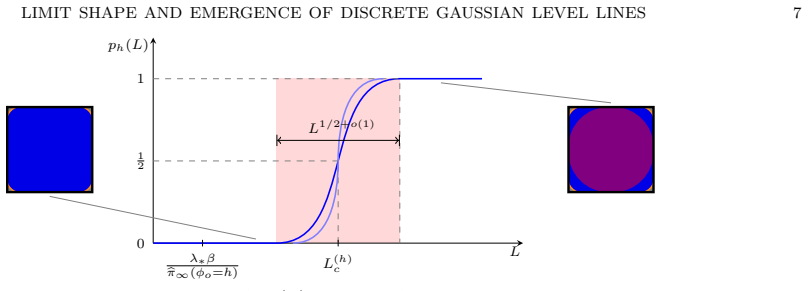
For every fixed n the n-th from-the-top level line converges in Hausdorff distance to a deterministic shape ℒ_n featuring the Wulff shape at scale N_n=L^{1-o(1)} near the four corners of the box. For every h the probability of a macroscopic h-level line undergoes a sharp monotone transition from near 0 to near 1 in a window of width ≤ L^{1/2+o(1)} around L_c^{(h)}, after which the line occupies nearly the full box and obeys the global and local limits. The results extend to the (2+1)D | ablaφ|^p-models for every fixed p>1.
Load-bearing premise
The proofs rely on the low-temperature regime together with the plateau statement of Martinelli-Sly and the local convergence from the companion paper.
Editorial extensions
If this is right
- Once a macroscopic h-level line emerges it immediately occupies nearly the entire box.
- Both the global Wulff-type limit and the local Ferrari-Spohn scaling apply to the newly emerged line.
- The probability of emergence is monotone in L up to an o(1) error term.
- The same global shapes and sharp transitions hold for every fixed p>1 in the |∇φ|^p family.
Reading between the lines
- The critical lengths L_c^{(h)} are implicitly fixed by the competition between the Wulff-shaped interface costs at consecutive heights.
- The combination of global shape and local scaling supplies a complete description of every interface that appears above the floor.
Editorial analysis
A structured set of objections, weighed in public.
Referee Report
Summary. The paper studies the (2+1)D Discrete Gaussian model (and |∇φ|^p variants) on an L×L box with floor at height 0 and zero boundary conditions in the low-temperature regime. Building on the Martinelli-Sly (2016) plateau result and a companion paper's local Ferrari-Spohn limits, it proves that for each fixed n the n-th top level line converges in Hausdorff distance to a deterministic shape ℒ_n featuring the Wulff shape at scale N_n = L^{1-o(1)} near the corners; it further shows that for each h the probability of a macroscopic h-level line undergoes a sharp monotone transition (from near 0 to near 1) in a window of width ≤ L^{1/2+o(1)} around a critical side length L_c^{(h)}, after which the line fills nearly the full box and obeys the global/local limits.
Significance. If the claims hold, the work completes the global picture for level lines by connecting the plateau height, local side behavior, and global shape, while identifying the precise emergence window. The deterministic limit shapes (Wulff corners at explicit scale) and the sharp transition (with immediate filling of the box) are parameter-free consequences of the prior local/plateau inputs; the direct extension to all p>1 is a further strength.
minor comments (3)
- The o(1) exponents in the window width L^{1/2+o(1)} and corner scale L^{1-o(1)} are stated without explicit dependence on temperature or p; a brief remark on how these exponents arise from the companion paper would clarify the range of validity.
- Notation for the critical value L_c^{(h)} is introduced in the abstract but its explicit characterization (or lack thereof) is not indicated; adding a sentence in the introduction on whether L_c^{(h)} is given by a variational formula or left implicit would help readers.
- The extension statement for |∇φ|^p models (p>1) is presented as a direct carry-over; a short paragraph or remark indicating which steps require only minor adaptation versus those that reuse the p=2 proofs verbatim would strengthen the claim.
Simulated Author's Rebuttal
We thank the referee for their positive assessment of the manuscript, including the significance of connecting the plateau height, local side behavior, and global shape, as well as the recommendation for minor revision. No specific major comments appear in the report.
Circularity Check
No significant circularity identified
full rationale
The paper derives new global Hausdorff convergence of the n-th level line to a deterministic shape featuring Wulff corners and a sharp monotone transition for macroscopic h-level lines in a window of width ≤ L^{1/2+o(1)}. These statements link the Martinelli-Sly (2016) plateau result and companion-paper local Ferrari-Spohn limits as inputs to obtain independent global and emergence conclusions; no equation or argument reduces the claimed limits to fitted parameters, self-definitions, or renamings within this manuscript. The cited priors are external to the present work and the new claims do not reduce to them by construction.
Assumptions & free parameters
assumptions (2)
- standard math Standard axioms of probability spaces and weak convergence of random sets in Hausdorff distance
- domain assumption Low-temperature regime with hard floor at height zero and zero boundary conditions
Cite this review
Pith. "Pith review of The limit shape and emergence of the Discrete Gaussian level lines." pith.science (2026). https://pith.science/paper/BJL5CYZF
@misc{pith2026260606612,
  author       = {Pith},
  title        = {Pith review of: The limit shape and emergence of the Discrete Gaussian level lines},
  year         = {2026},
  howpublished = {\url{https://pith.science/paper/BJL5CYZF}},
  note         = {Machine review of arXiv:2606.06612}
}
abstract
Consider the $(2+1)$D Discrete Gaussian model (ZGFF) on an $L\times L$ box with a hard floor at height zero and zero boundary conditions, at low temperature. The second author, Martinelli and Sly (2016) showed that the surface has a plateau, filling nearly the full square, at height either $H$ or $H+1$ for an explicit function $H(L)$. In a companion paper, we studied the local laws of the top level lines near the four sides of the box, and showed that after rescaling each by $(L^{2/3-o(1)},L^{1/3-o(1)})$, they converge to a product of Ferrari--Spohn diffusions. Two key features of the top level lines remained unaddressed: their global limit shape, and the critical window marking the transition from a top plateau at height $H$ to one at height $H+1$. These features are intrinsically linked: deriving the global limit of the top level line is needed for determining whether it is preferable to be at height $H$ or $H+1$ near criticality. This work completes this picture as follows. First, we obtain the global limit of the top level lines: for every fixed $n$, the $n$-th from-the-top level line converges in Hausdorff distance to a deterministic shape $\mathscr{L}_n$ that features the Wulff shape at scale $N_n=L^{1-o(1)}$ near the four corners of the box. Second, we identify, for every $h$, the point of emergence of a macroscopic $h$ level line: the probability of this event is monotone increasing in $L$ (up to a $o(1)$ error), and undergoes a sharp transition from near $0$ to near $1$ in a critical window of width $\leq L^{1/2+o(1)}$ around a side length $L=L_c^{(h)}$. This transition is discontinuous in that, once a macroscopic level $h$ emerges, it immediately occupies nearly all the box, and the above global and local scaling limits (Wulff, Ferrari--Spohn) hold for it. The new results extend to the $(2+1)$D $|\nabla\phi|^p$-models (ZGFF is the case $p=2$) for every fixed $p> 1$.
Figures


Figures from the paper (6 more)



Forward citations
Cited by 1 Pith paper
-
The law of (1+1)D SOS with an area tilt in a wedge
For wedge-tilted (1+1)D SOS curves, the non-separated lower curves converge to a Brownian GATE with cube-root fluctuations while the separated upper curves converge to independent Brownian bridges at explicit critical points.
Reference graph
Works this paper leans on
-
[1]
M. Aizenman, M. Harel, R. Peled, and J. Shapiro. Depinning in integer-restricted Gaussian fields and BKT phases of two-component spin models, 2021. Preprint,arXiv:2110.09498
-
[2]
Basu Roy Chowdhury, P
M. Basu Roy Chowdhury, P. Caputo, and S. Ganguly. Characterizing Gibbs states for area-tilted Brownian lines. Ann. Probab.To appear
-
[3]
V. L. Berezinski ˘i. Destruction of long-range order in one-dimensional and two-dimensional systems having a continuous symmetry group. I. Classical systems.Sov. Phys. JETP, (32):493–500, 1971
1971
-
[4]
Brandenberger and C
R. Brandenberger and C. E. Wayne. Decay of correlations in surface models.J. Statist. Phys., 27(3):425–440, 1982
1982
-
[5]
Bricmont, A
J. Bricmont, A. El Mellouki, and J. Fr¨ ohlich. Random surfaces in statistical mechanics: roughening, rounding, wetting,. . ..J. Statist. Phys., 42(5-6):743–798, 1986
1986
-
[6]
W. K. Burton, N. Cabrera, and F. C. Frank. The growth of crystals and the equilibrium structure of their surfaces.Philos. Trans. Roy. Soc. London Ser. A, 243:299–358, 1951
1951
-
[7]
Caddeo, Y
P. Caddeo, Y. H. Kim, and E. Lubetzky. On level line fluctuations of SOS surfaces above a wall.Forum Math. Sigma, 12:Paper No. e91, 59, 2024
2024
-
[8]
Caputo and S
P. Caputo and S. Ganguly. Uniqueness, mixing, and optimal tails for Brownian line ensembles with geometric area tilt.Probab. Math. Phys., 6(1):195–239, 2025
2025
Show all 40 references
-
[9]
Caputo, D
P. Caputo, D. Ioffe, and V. Wachtel. Confinement of Brownian polymers under geometric area tilts.Electron. J. Probab., 24:Paper No. 37, 21, 2019
2019
-
[10]
Caputo, D
P. Caputo, D. Ioffe, and V. Wachtel. Tightness and line ensembles for Brownian polymers under geometric area tilts. InStatistical mechanics of classical and disordered systems, volume 293 ofSpringer Proc. Math. Stat., pages 241–266. Springer, Cham, 2019
2019
-
[11]
Caputo, E
P. Caputo, E. Lubetzky, F. Martinelli, A. Sly, and F. L. Toninelli. The shape of the (2 + 1)DSOS surface above a wall.C. R. Math. Acad. Sci. Paris, 350(13-14):703–706, 2012
2012
-
[12]
Caputo, E
P. Caputo, E. Lubetzky, F. Martinelli, A. Sly, and F. L. Toninelli. Dynamics of (2 + 1)-dimensional SOS surfaces above a wall: Slow mixing induced by entropic repulsion.Ann. Probab., 42(4):1516–1589, 2014
2014
-
[13]
Caputo, E
P. Caputo, E. Lubetzky, F. Martinelli, A. Sly, and F. L. Toninelli. Scaling limit and cube-root fluctuations in SOS surfaces above a wall.J. Eur. Math. Soc. (JEMS), 18(5):931–995, 2016
2016
-
[14]
Chen and E
J. Chen and E. Lubetzky. The limiting law of the Discrete Gaussian level lines, 2025. Preprint,arXiv:2509.04333
2025 arXiv
-
[15]
S. T. Chui and J. D. Weeks. Phase transition in the two-dimensional coulomb gas, and the interfacial roughening transition.Phys. Rev. B, 14:4978–4982, Dec 1976
1976
-
[16]
Dembo, E
A. Dembo, E. Lubetzky, and O. Zeitouni. On the limiting law of line ensembles of Brownian polymers with geometric area tilts.Ann. Inst. Henri Poincar´ e Probab. Stat., 60(1):113–125, 2024
2024
-
[17]
P. L. Ferrari and H. Spohn. Constrained Brownian motion: fluctuations away from circular and parabolic barriers. Ann. Probab., 33(4):1302–1325, 2005
2005
-
[18]
Fr¨ ohlich and T
J. Fr¨ ohlich and T. Spencer. Kosterlitz-Thouless transition in the two-dimensional plane rotator and Coulomb gas.Phys. Rev. Lett., 46(15):1006–1009, 1981
1981
-
[19]
Fr¨ ohlich and T
J. Fr¨ ohlich and T. Spencer. The Kosterlitz-Thouless transition in two-dimensional abelian spin systems and the Coulomb gas.Comm. Math. Phys., 81(4):527–602, 1981
1981
-
[20]
Garban and A
C. Garban and A. Sep´ ulveda. Statistical reconstruction of the GFF and KT transition.Journal of the European Mathematical Society, 26(2):639–694, 2023
2023
-
[21]
Hegde, Y
M. Hegde, Y. H. Kim, and C. Serio. Scaling limit and tail bounds for a random walk model of SOS level lines,
-
[22]
Preprint,arXiv:2502.10384
-
[23]
Heinonen, T
J. Heinonen, T. Kilpel¨ ainen, and O. Martio.Nonlinear Potential Theory of Degenerate Elliptic Equations. Oxford Mathematical Monographs. Oxford University Press, Clarendon Press, Oxford, 1993
1993
-
[24]
Holopainen and P
I. Holopainen and P. M. Soardi. p-harmonic functions on graphs and manifolds.Manuscripta Mathematica, 94(1):95–110, 1997
1997
-
[25]
Ioffe, S
D. Ioffe, S. Shlosman, and Y. Velenik. An invariance principle to Ferrari-Spohn diffusions.Comm. Math. Phys., 336(2):905–932, 2015
2015
-
[26]
J. M. Kosterlitz and D. J. Thouless. Ordering, metastability and phase transitions in two-dimensional systems. Journal of Physics C: Solid State Physics, 6(7):1181–1203, 1973
1973
-
[27]
P. Lammers. Height function delocalisation on cubic planar graphs.Probab. Theory Related Fields, 182(1-2):531– 550, 2022
2022
-
[28]
Lammers and S
P. Lammers and S. Ott. Delocalisation and absolute-value-FKG in the Solid-On-Solid model.Probab. Theory Related Fields, 188(1-2):63–87, 2024. 72 JOSEPH CHEN AND EYAL LUBETZKY
2024
-
[29]
G. F. Lawler.Intersections of random walks. Modern Birkh¨ auser Classics. Birkh¨ auser/Springer, New York, 2013. Reprint of the 1996 edition
2013
-
[30]
Lubetzky, F
E. Lubetzky, F. Martinelli, and A. Sly. Harmonic pinnacles in the discrete Gaussian model.Comm. Math. Phys., 344(3):673–717, 2016
2016
-
[31]
Maz’ya.Sobolev Spaces: With Applications to Elliptic Partial Differential Equations, volume 342 of Grundlehren der mathematischen Wissenschaften
V. Maz’ya.Sobolev Spaces: With Applications to Elliptic Partial Differential Equations, volume 342 of Grundlehren der mathematischen Wissenschaften. Springer, Berlin/Heidelberg, 2 edition, 2011
2011
-
[32]
Ott and F
S. Ott and F. Schweiger. Quantitative delocalization for Solid-On-Solid models at high temperature and arbitrary tilt, 2025. Preprint,arxiv:2505.16804
2025
-
[33]
R. H. Schonmann and S. B. Shlosman. Complete analyticity for 2D Ising completed.Comm. Math. Phys., 170(2):453–482, 1995
1995
-
[34]
R. H. Schonmann and S. B. Shlosman. Constrained variational problem with applications to the Ising model. Journal of statistical physics, 83(5):867–905, 1996
1996
-
[35]
C. Serio. Scaling limit for line ensembles of random walks with geometric area tilts.Electron. J. Probab., 28:Paper No. 124, 14, 2023
2023
-
[36]
Sheffield
S. Sheffield. Random surfaces.Ast´ erisque, (304):vi+175, 2005
2005
-
[37]
P. M. Soardi.Potential theory on infinite networks. Springer, 2006
2006
-
[38]
Spitzer.Principles of random walk, volume Vol
F. Spitzer.Principles of random walk, volume Vol. 34 ofGraduate Texts in Mathematics. Springer-Verlag, New York-Heidelberg, second edition, 1976
1976
-
[39]
van Engelenburg and M
D. van Engelenburg and M. Lis. An elementary proof of phase transition in the planar XY model.Comm. Math. Phys., 399(1):85–104, 2023
2023
-
[40]
J. Villain. Theory of one- and two-dimensional magnets with an easy magnetization plane. II. The planar, classical, two-dimensional magnet.Journal de Physique, 36(6):581–590, 1975. J. Chen LPSM, Sorbonne Universit´e, 4 Place Jussieu 75252, Paris, France. Email address:jchen@lp...
1975
Reviewed June 27, 2026 · model on record in the stance chip above.
Discussion (0). Continue with ORCID to comment.