REVIEW 3 major objections 5 minor 47 references
Variational approach for pair optimization in the nucleon pair approximation
T0 review · 3 major / 5 minor · reviewed 2026-08-14 · deepseek-v4-flash
Pith's one-line read The paper proposes a pair-condensate variational method to determine the collective pairs an NPA calculation needs, and uses it to settle the mechanism of the I=10 backbend in 132Ba.
desk verdict A new variational method for selecting NPA pairs, with a detailed derivation and a promising Ba test case, but the 'conclusive' backbend claim outruns the evidence. read the letter →
The pith
A machine-rendered reading of the paper's core claim, the machinery that carries it, and where it could break.
The reading
What carries the argument
The central object is an uncoupled collective pair $\Lambda^\dagger = \frac{1}{2}\sum_{ij}\lambda_{ij} C^\dagger_i C^\dagger_j$, whose skew-symmetric structure-coefficient matrix $\lambda$ contains all two-body configuration degrees of freedom and is treated as the variational variable. The trial state is the condensate $(\Lambda^\dagger)^N|0\rangle$, and the Hamiltonian expectation value is minimized with the BFGS algorithm using an analytic derivative formula derived in the appendix. Because no angular momentum or parity is fixed, a single variation explores all NPA pair types; afterwards the converged pair is decomposed by Clebsch-Gordan projection into pairs with definite $L^\pi$, with squared structure coefficients giving quantitative pair weights. Cranking, $H_{\mathrm{crank}} = H - \omega_X J_X$, isolates the pairs that matter for high-spin states such as the I=10 backbend.
What would settle it
A full shell-model diagonalization in a tractable model space of 132Ba that showed the I=10 backbend surviving after the neutron L=10 H pair is removed, or that showed negative-parity pairs dominating the yrast 10+ wavefunction, would refute the paper's central claim.
Extended reading notes
Core claim
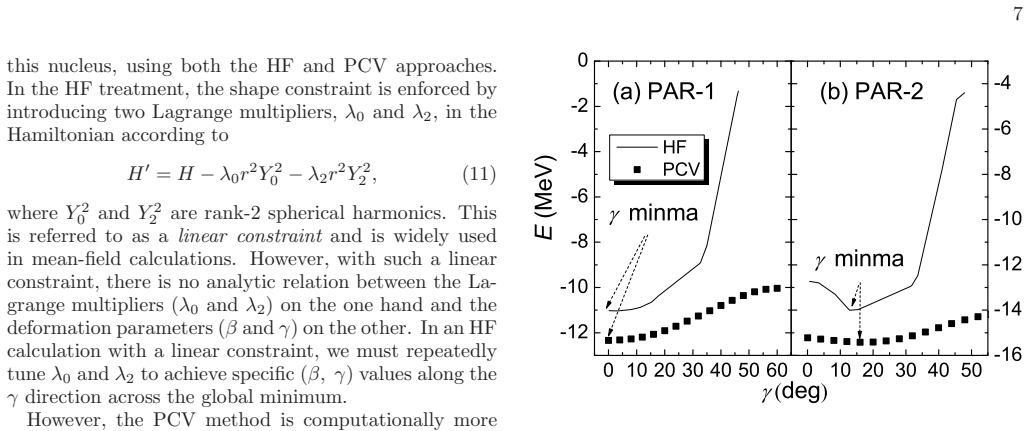
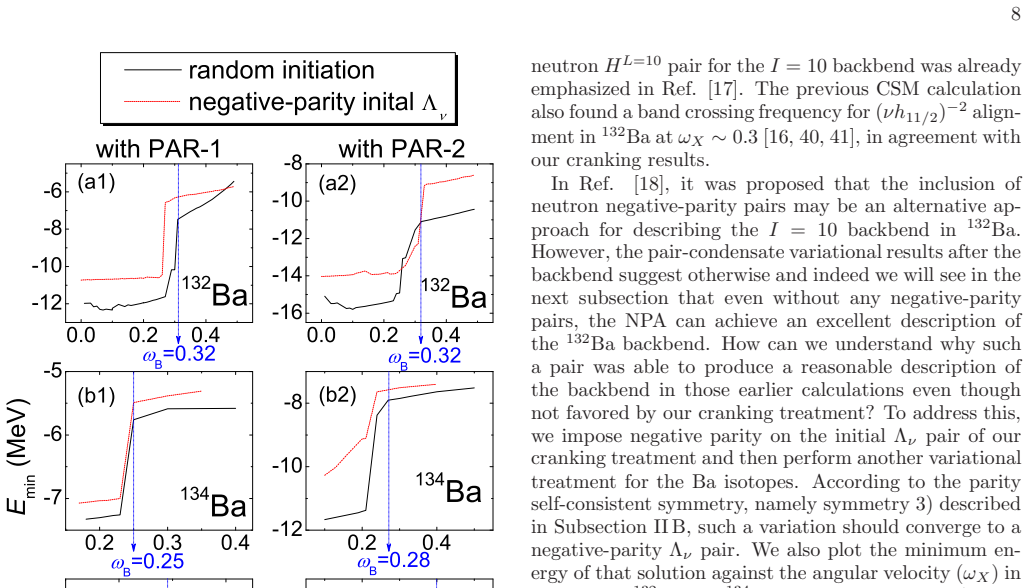
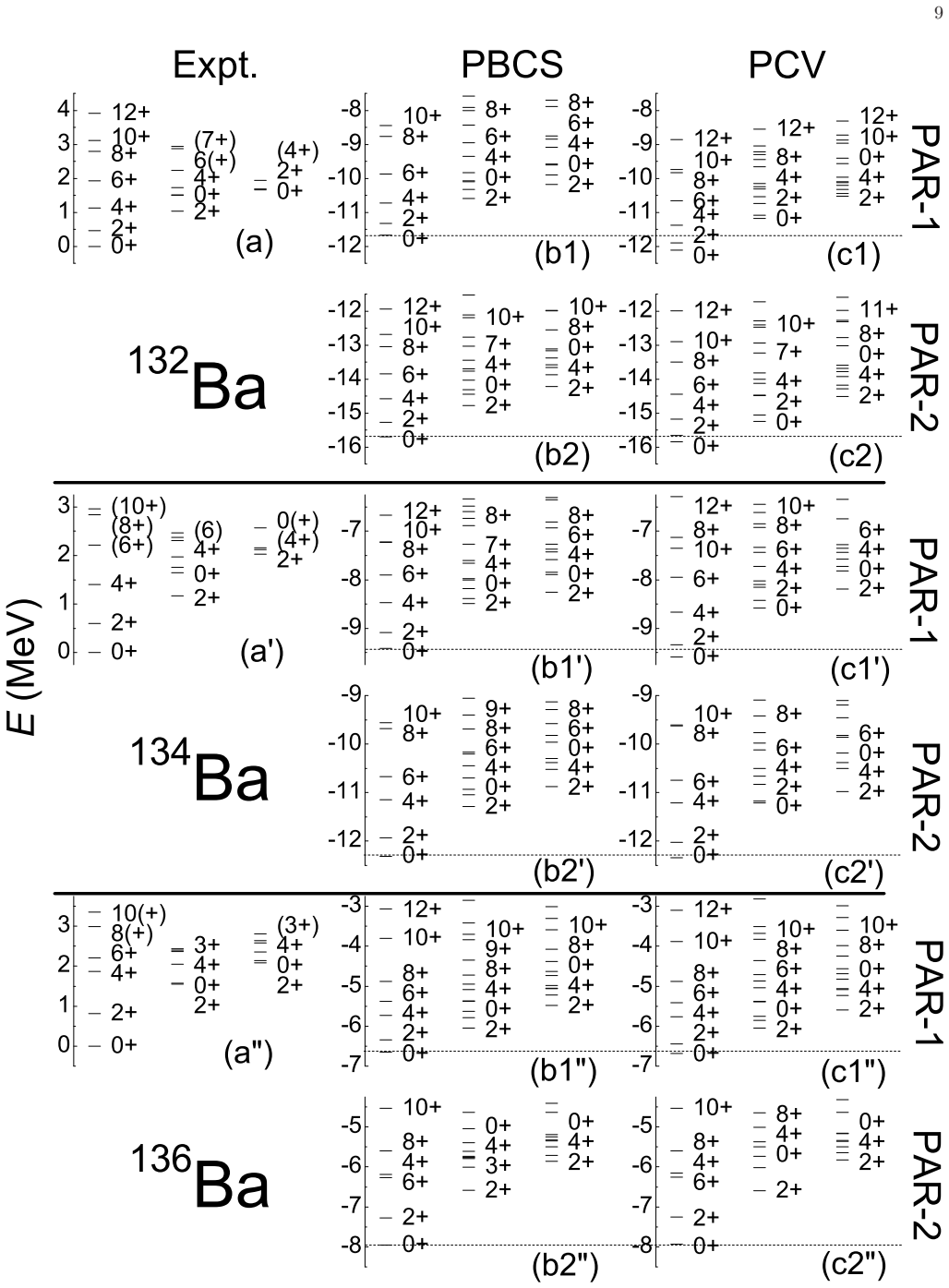
On its own terms, the central discovery is that a particle-number-conserving variational calculation over pair condensates selects the same collective pairs that an NPA calculation needs, without ad hoc pair choice. At the ground-state minimum for each barium isotope, the optimized condensate is dominated by S (L=0) and D (L=2) pairs, with the quadrupole deformation parameter $\beta$ falling from roughly 0.1 to 0.03 as the neutron number approaches N=82 while the $\gamma$ parameter moves from prolate toward oblate values; the potential-energy surface for 132Ba is flat along $\gamma$, confirming its softness. When the same variation is cranked at the backbend frequency, the dominant neutron pair becomes an H pair with L=10 and positive parity built from the $(\nu h_{11/2})^{-2}$ configuration, with proton G (L=4) and I (L=6) pairs contributing in the heavier isotopes; negative-parity neutron pairs are not favored. NPA calculations using these PCV-selected pairs reproduce the yrast, quasi-$\beta$, and quasi-gamma bands and the B(E2) values of 132-136Ba in reasonable agreement with experiment, at lower energies than earlier pair choices.
Load-bearing premise
The load-bearing premise is that the phenomenological Hamiltonian, whose two parameter sets were fitted only to 132Ba, remains reliable for 134Ba and 136Ba; the paper itself notes this could be a difficulty.
Editorial extensions
If this is right
- NPA calculations can replace ad hoc pair selection with pairs obtained from a variational principle, reducing truncation uncertainty.
- The I=10 backbend mechanism in 132Ba is settled: the neutron H L=10 positive-parity pair, not negative-parity pairs, is responsible.
- Cranked PCV offers a systematic recipe for identifying high-spin pairs, potentially applicable to other backbending nuclei.
- The method handles transitional, gamma-soft, and weakly deformed nuclei within one particle-number-conserving framework, and reduces to PBCS-like behavior near shell closure.
- B(E2) values and level energies follow from the same selected pairs, so the truncation is validated by both spectra and transitions.
Reading between the lines
- The same variational pair-selection procedure could serve as a diagnostic for shape coexistence and gamma instability in other mass regions, with pair weights indicating competing structures before a full NPA run.
- If the observed absence of parity mixing in the optimized condensate is proven universal, NPA calculations could safely restrict to fixed-parity pairs and halve the pair space.
- The cranking analysis could be extended to trace how the dominant pair changes continuously with rotational frequency, effectively mapping band-crossing mechanisms without separate NPA fits.
- PCV pair weights could be used as a quantitative convergence criterion: if omitted pairs have weights below a threshold, the NPA truncation error would be correspondingly small.
Signed reviews
Editorial analysis
A structured set of objections, weighed in public.
Referee Report
Summary. The paper proposes a pair-condensate variational (PCV) method to select the most important collective pairs for nucleon-pair approximation (NPA) calculations. The trial wave function is a condensate of uncoupled collective pairs; the pair structure coefficients are treated as variational parameters and optimized with analytic gradients. After optimization, the condensate is decomposed into angular-momentum-projected pairs whose weights are used to rank pair importance. The method is applied to even 132-136Ba using the phenomenological PAR-1/PAR-2 Hamiltonians of Ref. [17]. Shape-constrained PCV gives beta-gamma surfaces and supports the gamma-softness of 132Ba. Cranked PCV yields an abrupt moment-of-inertia change at omega_B about 0.3, and the pairs extracted at that frequency (notably the neutron H L=10 pair) are then used in NPA calculations. The resulting NPA yrast, quasi-beta, quasi-gamma bands and B(E2) values reproduce the I=10 backbend in 132Ba and 134Ba without negative-parity pairs, and the paper argues this pinpoints the backbend mechanism. Agreement for 136Ba is worse, and the authors note limitations including an unproven parity self-consistent symmetry and the absence of overlap validation against full shell-model wave functions.
Significance. If the claims are supported, the PCV method would be a valuable, parameter-free (given the Hamiltonian) tool for reducing the ambiguity in NPA pair selection, which is currently done ad hoc. The paper's strengths include a clear variational principle with analytic derivatives (Eq. A.13), polynomial computational scaling, a pair-decomposition weight criterion, and a concrete application showing that positive-parity H L=10 pairs alone can describe the 132Ba backbend without negative-parity pairs. The method also gives lower NPA energies than the PBCS pair choice and reproduces the cranked shell-model crossing frequency. The main caveat is that the condensate pair weights are only a proxy for importance in exact states; the decisive overlap test is deferred. With strengthened validation or appropriately weakened conclusions, the method is a useful step toward self-consistent NPA truncations.
major comments (3)
- [Sec. III C and Abstract] The phrase "conclusively pin down" the I=10 backbend mechanism (Sec. III C) is not supported by the evidence presented. The pair weights are extracted from a condensate, which is a mean-field-like object, and the only direct test of whether those weights reflect importance in the exact low-lying states--the overlap of NPA wave functions with full shell-model wave functions--is explicitly deferred ("Unfortunately, it is not possible to carry out such an analysis for the Ba isotopes at present"). Condensate weights are a proxy for pair importance, and the claim that the approach "can conclusively determine which collective pairs are critical" outruns the validation provided. Please either add an overlap analysis in a smaller model space or temper the abstract and conclusions to say that the method 'suggests' or 'indicates' the relevant pairs.
- [Sec. II B, symmetry 3 and Sec. III B] The exclusion of negative-parity pairs depends on the parity self-consistent symmetry, which the authors state "has not yet been proven mathematically as universal." The argument compares constrained positive-parity and negative-parity minima, but if a parity-mixed condensate with lower energy existed, that comparison would not establish that negative-parity pairs are disfavored in the exact I=10 state. Since an earlier NPA calculation with negative-parity pairs (Ref. [18]) also reproduced the same backbend, the "not favored" conclusion needs either a proof of the parity symmetry, numerical evidence that parity-mixed random initializations converge to the positive-parity minimum, or an explicit restriction of the conclusion to the present Hamiltonian and parameter sets.
- [Sec. III A and Sec. III C] The Hamiltonian is optimized for 132Ba only, as stated in Sec. III A, and the paper acknowledges the agreement degrades for 134Ba and 136Ba. The abstract claims the approach can be "meaningfully applied to transitional nuclei with a wide spectrum of shapes," but the yrast moments of inertia and quasi-beta/gamma band energies for 134Ba and 136Ba deviate noticeably from experiment. This weakens the demonstration of broad applicability. The authors should either refit or adjust the Hamiltonian for each isotope, or clearly restrict the empirical validation to 132Ba and present the 134,136Ba results as a stress test of the method rather than as quantitative evidence for the general applicability claim.
minor comments (5)
- [Title] The title contains a typo: "nucleon p air approximation" should be "nucleon pair approximation."
- [Sec. III B] In the text following Table III, "as arose in the PVC calculations" should read "PCV calculations".
- [Fig. 3 caption] The caption contains a typo: "the yrast I = 10 backend of the Ba isotopes" should be "I = 10 backbend."
- [Sec. II B] The three "self-consistent symmetries" are introduced as provable properties, but no proof is given in the text or appendix. Since symmetry 3 is explicitly unproven and load-bearing for the negative-parity conclusion, a short proof or a rigorous numerical demonstration would improve the presentation.
- [Sec. III C] The phrase "spontaneously produced" for the I=10 backbend could be misread as implying no external input; consider replacing it with wording such as "produced without manually inserting the H pair" to acknowledge that cranking was used to select the pairs.
Circularity Check
No circularity: PCV pair selection and NPA energies are genuine variational outputs, with limitations only in conclusiveness.
full rationale
The derivation chain is self-contained. Eq. (3) minimizes the expectation value of the adopted two-body Hamiltonian (Eq. (9), taken from Ref. [17]) over the structure coefficients of an uncoupled pair condensate; no NPA level, B(E2), or backbend datum is used as a fit target. The pair weights used to rank importance are obtained after the variation from Eq. (8) and the stated normalization, and the subsequent NPA spectra (Figs. 4-6) are computed by a separate many-body diagonalization, not read off from the variational weights. For 134Ba and 136Ba the same Hamiltonian is applied without refitting, and the authors explicitly concede the parameters may not reproduce these nuclei ('the PAR-1 and -2 parameters are optimized only for 132Ba'), which is a falsifiable extrapolation rather than an input-output identity. The cranking frequency omega_B is taken from the sudden change in the cranked PCV energy curve (Fig. 3), not from the experimental backbend. The self-citations to Refs. [17-19,33] supply the Hamiltonian and baseline NPA results, but the load-bearing variational and diagonalization steps are independent of those fitted pair sets. Two stated limitations reduce the conclusiveness of the mechanism claim but are not circularity: the wave-function overlap validation is deferred ('it is not possible to carry out such an analysis for the Ba isotopes at present'), and the parity symmetry used to exclude negative-parity pairs is admitted to be unproven ('Such an observation has not yet been proven mathematically as universal'). Those are correctness-risk caveats, not reductions of a predicted quantity to an input.
Assumptions & free parameters
free parameters (5)
- PAR-1 two-body interaction parameters =
G0pi=0.130, G2pi=0.030, G0nu=0.130, G2nu=0.026, kappapi=0.045, kappanu=0.065, kappapinu=0.070 MeV
- PAR-2 two-body interaction parameters =
G0pi=0.170, G2pi=0.040, G0nu=0.150, G2nu=0.026, kappapi=0.030, kappanu=0.100, kappapinu=0.080 MeV
- Effective charges for B(E2) =
e_pi = 2e, e_nu = -1e
- Cranking frequency omega_B for backbend pair extraction =
Per isotope, read from Fig. 3 (around 0.3-0.4 MeV)
- Constraint strength C for the quadratic shape constraint =
C = 1000
assumptions (5)
- domain assumption The nuclear Hamiltonian is limited to one- and two-body operators of the form of Eq. (9), and the valence model space is restricted to the 50-82 shell.
- domain assumption The trial wave function is a condensate of N identical uncoupled pairs for each species, (Lambda_dag_pi)^3 (Lambda_dag_nu)^N |0>.
- ad hoc to paper The parity self-consistent symmetry: a variation initiated with a definite-parity Lambda never mixes parity, and the optimized condensate shows no parity mixing.
- domain assumption The cranking model, H_crank = H - omega_X J_X, provides a valid guide to identify collective pairs relevant for a backbend.
- standard math The quadrupole moment expectation of the condensate maps to deformation parameters beta and gamma through Eqs. (5)-(6) and (13).
Cite this review
Pith. "Pith review of Variational approach for pair optimization in the nucleon pair approximation." pith.science (2026). https://pith.science/paper/BKI6JDXF
@misc{pith2026190807693,
  author       = {Pith},
  title        = {Pith review of: Variational approach for pair optimization in the nucleon pair approximation},
  year         = {2026},
  howpublished = {\url{https://pith.science/paper/BKI6JDXF}},
  note         = {Machine review of arXiv:1908.07693}
}
abstract
We propose a pair-condensate variational approach (PCV) to determine a set of the most important collective pairs in the description of low-lying states in atomic nuclei. Having available the precise details on these key collective pairs -- their spin, parity, and structure -- can be particularly useful in calculations based on the nucleon-pair approximation (NPA), helping to reduce their uncertainties. In trial calculations for the transitional Ba isotopes, our variational approach describes the evolution of quadrupole-deformation properties similar to Hartree-Fock treatments, while at the same time highlighting the $\gamma$ softness of $^{132}$Ba. Our approach can conclusively determine which collective pairs are critical for obtaining the lowest possible yrast, quasi-beta, quasi-gamma bands, producing both the level structure of these bands and related B(E2) values in reasonable consistency with experiment. These trial calculations suggest that with our PCV approach the NPA can be meaningfully applied to transitional nuclei with a wide spectrum of shapes. We also show that while neutron negative-parity pairs could in principle have an important impact on backbending in $^{132}$Ba, they are not favored for this nucleus.
Figures

Figures from the paper (3 more)


Reference graph
Works this paper leans on
-
[17]
Y. Lei, Y. M. Zhao, A. Arima, Phys. Rev. C 84 , 044301 (2011)
work page 2011
- [18]
-
[1]
seniority: if the initial or intermediate Λ has only an S pair component, the variation will not allow Λ to develop other non- S pair components
-
[2]
angular-momentum projection: if the initial or inter- mediate Λ has fixed angular-momentum projection, subsequent iterations of the variation will keep this projection until convergence
-
[3]
B” is the abbreviation of “backbend
parity: if the initial or intermediate Λ is labeled with a certain parity, the variation does not change that parity nor mix it with the other parity. One can perform a variation with spherical and axially- symmetric deformation, by imposing symmetries 1) and 2), respectively, on the initial Λ pair. In our trial calcula- tions, we also observe that the op...
- [4]
-
[5]
M. G. Mayer, Phys. Rev. 75, 1969 (1949)
1949
-
[6]
J. H. D. Jensen, et al. , Naturwissenschaften 36, 155 (1949)
work page 1949
Show all 47 references
-
[7]
Y. M. Zhao and A. Arima, Phys. Rep. 545, 1 (2014)
2014
-
[8]
X. F. Meng, F. R. Wang, Y. A. Luo, F. Pan, and J. P. Draayer, Phys. Rev. C 77 , 047304 (2008)
2008
-
[9]
Y. A. Luo, et al. , Nucl. Phys. A 669 , 101 (2000)
2000
-
[10]
Y. M. Zhao, S. Yamaji, N. Yoshinaga, and A. Arima, Phys. Rev. C 62 , 014315 (2000)
2000
-
[11]
L. Y. Jia, H. Zhang, and Y. M. Zhao, Phys. Rev. C 75 , 034307 (2007)
2007
-
[12]
Y. Lei, Z. Y. Xu, Y. M. Zhao, A. Arima, Phys. Rev. C 82, 034303 (2010)
2010
-
[13]
G. A. Jones, P. H. Regan, Z. Podolyak, N. Yoshinaga, K. Higashiyama, G. deAngelis, Y. H. Zhang, A. Gadea, C. A. Ur, et al. , Phys. Rev. C 76 , 054317 (2007)
2007
-
[14]
Z. Y. Xu, Y. Lei, Y. M. Zhao, S. W. Xu, Y. X. Xie, and A. Arima, Phys, Rev. C 79 , 054315 (2009)
2009
-
[16]
P. Das, R. G. Pillay, V. V. Krishnamurthy, S. N. Mishra, and S. H. Devare, Phys. Rev. C 53 , 1009 (1996)
1996
-
[19]
Harissopulos, A
S. Harissopulos, A. Gelberg, A. Dewald, M. Hass, L. Weissman, and C. Broude, Phys. Rev. C 52, 1796 (1995)
1995
-
[20]
Sugawara-Tanabe and A
K. Sugawara-Tanabe and A. Arima, Phys. Lett. B 110 , 87 (1982)
1982
-
[21]
Higashiyama, N
K. Higashiyama, N. Yoshinaga, K. Tanabe, Phys. Rev. C 67 , 044305 (2003)
2003
-
[22]
Lei and Z
Y. Lei and Z. Y. Xu, Phys. Rev. C 92 , 014317 (2015)
2015
-
[23]
Y. Y. Cheng, Y. Lei, Y. M. Zhao, and A. Arima, Phys. Rev. C 92 , 064320 (2015)
2015
-
[24]
Otsuka, M
T. Otsuka, M. Honma, T. Mizusaki, N. Shimizu, and Y. Utsuno, Prog. Part. Nucl. Phys. 47, 319 (2001)
2001
-
[25]
Pittel and J
S. Pittel and J. Dukelsky, Phys. Lett. B 128 , 9 (1983)
1983
-
[26]
Y. Lei, G. J. Fu, and Y. M. Zhao, Phys. Rev. C 87 , 044331 (2013)
2013
-
[27]
Mizusaki and T
T. Mizusaki and T. Otsuka, Prog. Theo. Phys. Supp. 125, 97 (1996)
1996
-
[28]
Goldfarb, Math
D. Goldfarb, Math. Comp. 24, 23 (1970)
1970
-
[29]
http://www.netlib.org/blas
-
[30]
C. G. Broyden, J. Inst. Math. Appl. 6, 76 (1970)
1970
-
[31]
Fletcher, Comp
R. Fletcher, Comp. J. 13, 317 (1970)
1970
-
[32]
J. A. White, S. E. Koonin, and D. J. Dean, Phys. Rev C 61, 034303 (2000)
2000
-
[33]
D. F. Shanno, Math. Comp. 24, 647 (1970)
1970
-
[34]
J. Q. Chen, Nucl. Phys. A 626 , 686 (1997)
1997
-
[35]
Y. M. Zhao, N. Yoshinaga, S. Yamaji, J. Q. Chen, and A. Arima, Phys. Rev. C 62 , 014304 (2000)
2000
-
[36]
D. R. Inglis, Phys. Rev. 103, 1786 (1956)
1956
-
[37]
Y. Lei, Z. Y. Xu, Y. M. Zhao, and A. Arima, Phys. Rev. C 80 , 064316 (2009)
2009
-
[38]
http://www.nndc.bnl.gov/ensdf/
-
[39]
D. R. Inglis, Phys. Rev. 96, 1059 (1954)
1954
-
[40]
E. S. Paul, D. B. Fossan, Y. Liang, R. Ma, and N. Xu, Phys. Rev. C, 40, 1255 (1989)
1989
-
[41]
M. J. A. de Voigt, J. Dudek, and Z. Szyma´ nski, Rev. Mod. Phys., 55, 949 (1983)
1983
-
[42]
A. V. Afanasjev, D. B. Fossan, G. J. Lane, and I. Rag- narsson, Phys. Rep. 322,1 (1999)
1999
-
[43]
Frauendorf, Rev
S. Frauendorf, Rev. Mod. Phys. 73, 463 (2001)
2001
-
[44]
This work also bene- fited from intensive discussions with C
and for helpful suggestions. This work also bene- fited from intensive discussions with C. F. Jiao and J. M. Yao on the possibility of carrying out an HFB calcula- tion for 132Ba. We are grateful for the financial support of the Sichuan Science and Technology Program (Grant No. ...
-
[45]
Juutinen, S
S. Juutinen, S. T¨ orm¨ anen, P. Ahonen, M. Carpenter, C. Fahlander, J. Gascon, et al. , Phys. Rev. C 52, 2946 (1995)
1995
-
[46]
Y. Lei, Z. Y. Xu, Y. M. Zhao, and A. Arima, Phys. Rev. C 82 , 034303 (2010)
2010
-
[47]
Y. Lei, Y. M. Zhao, and A. Arima, Phys. Rev. C 84 , 044301 (2011)
2011
-
[48]
Stetcu and C
I. Stetcu and C. W. Johnson, Phys. Rev. C 66 , 034301(2002); ibid. 67, 044315 (2003); ibid. 69, 024311 (2004)
2002
Reviewed August 14, 2026 · model on record in the stance chip above.
Discussion (0). Continue with ORCID to comment.