REVIEW 4 major objections 4 minor
RISE: Single Static Radar-based Indoor Scene Understanding
T0 review · 4 major / 4 minor · reviewed 2026-08-03 · deepseek-v4-flash
Pith's one-line read A single, stationary millimetre-wave radar can reconstruct room walls and detect furniture by decoding multipath 'ghost' reflections, cutting layout error to 16 cm.
desk verdict RISE is the first single-static-radar layout-plus-object system I've seen, and the BAME idea is genuinely clever, but the headline numbers lean on an unvalidated sim-to-real transfer and no artifacts are out yet. read the letter →
The pith
A machine-rendered reading of the paper's core claim, the machinery that carries it, and where it could break.
The reading
What carries the argument
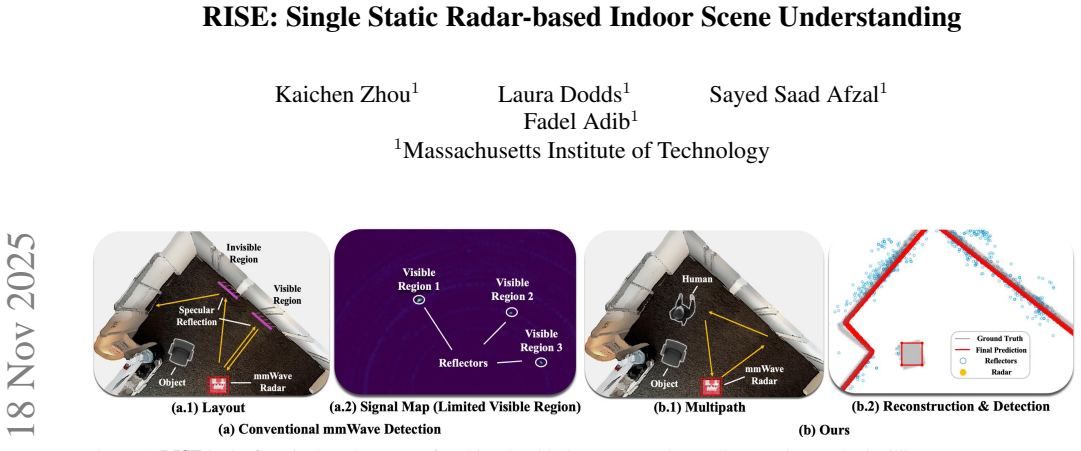
Bi-Angular Multipath Enhancement (BAME): a beamforming step that keeps receiver (AOA) and transmitter (AOD) angles separate rather than merging them into a single virtual array, so off-diagonal ghost reflections survive CFAR detection and are reintegrated into the range–angle map. Multipath inversion then converts ghost ranges and angles into wall reflector points via a derived closed-form relation, and a Sim2Real Hierarchical Diffusion (SRHD) uses two diffusion stages—object mask first, then wall layout—trained on a ray-cast simulator that keeps only the first surface hit per ray, with random missing sectors, rotation, and radial scaling augmentations.
What would settle it
Measure the distribution distance (e.g., Wasserstein or FID) between simulated partial layouts and real BAME reflector estimates on matched floor plans. If the distance is large, or if SRHD trained purely on simulation fails to improve Chamfer distance over the non-diffusion baseline on real data, the claim that the diffusion model understands radar geometry collapses.
Extended reading notes
Core claim
RISE's central claim is that the multipath ghosts induced by a walking human are not noise but a usable geometric channel. By computing a full range–angle-of-arrival–angle-of-departure cube instead of collapsing the two angles into one, the system recovers first-order ghost reflections that standard beamforming suppresses, and from their geometry it estimates reflector points on walls and objects. A hierarchical diffusion model, pretrained on 35,000 synthetic floor plans with randomized missing sectors, rotations, and scalings, then fills in occluded regions and predicts furniture masks, with a reverse optimization that forces the output to be consistent with the human's free-space trajector
Load-bearing premise
The load-bearing premise is that the distribution of partial layouts produced by the simulator (first-surface ray casts with random missing sectors, rotations, and scalings) matches the distribution of reflector estimates produced by BAME on real radar data; the paper does not quantify this domain gap, and the diffusion model's large reported improvement (32.3 → 19.8 cm in ablation) could be fitting synthetic artifacts if the gap is large.
Editorial extensions
If this is right
- If correct, existing mmWave access points or routers already deployed in homes and offices could map rooms and detect furniture without cameras, sidestepping occlusion and privacy concerns.
- The separation of AOA from AOD offers a general recipe for other MIMO radar tasks where multipath components are currently filtered out as noise.
- The hierarchical diffusion completes a room map from a single 30-second walk, and even with only 40% of the trajectory it beats the prior full-trajectory baseline in Chamfer distance.
- The system outputs 2D top-down geometry, which is enough for navigation, elder-care monitoring, fall detection, and safety analysis in privacy-sensitive environments.
- The new benchmark—50,000 frames, 100 trajectories, 11 scenes—provides the first standardized testbed for single-static-radar indoor scene understanding.
Reading between the lines
- The claim that moving reflectors generate usable geometry implies that other moving objects—pets, ceiling fans, robot vacuums—might substitute for human motion; this is a directly testable extension the paper does not explore.
- Because the diffusion prior is trained on simulated first-return ray casts, the method's real-world ceiling is likely set by how faithfully that simulation matches real multipath statistics; a future domain-adaptation step could replace the hand-designed augmentations.
- The 58% IoU is measured on coarse axis-aligned bounding boxes for a handful of furniture types; extending to per-instance segmentation or 3D boxes is a natural next step, and the privacy argument would strengthen if ground truth did not rely on a depth camera.
Editorial analysis
A structured set of objections, weighed in public.
Referee Report
Summary. RISE proposes a single-static mmWave radar framework and benchmark for joint 2D wall layout reconstruction and object detection. The method models multipath ghosts generated by a moving human, derives reflector positions from ghost geometry (Eq. 12), recovers off-diagonal multipath reflections using a Bi-Angular Multipath Enhancement (BAME), and then uses a simulation-trained hierarchical diffusion model (SRHD) plus inference-time overlap optimization to complete fragmented layouts and detect furniture. The paper reports 50,000 frames across 100 trajectories in 11 scenes, a Chamfer distance of 16.03 cm and F1 of 83.63 for layout, and 57.78 IoU / 69.34 Dice for object detection, versus 39.06 cm Chamfer for the baseline EMT [9].
Significance. The central idea—exploiting human-induced multipath ghosts for static-radar indoor mapping—is timely and potentially impactful. The geometric derivation of the first-order reflector position is not fitted and provides a principled signal-processing basis, and the modular ablation in Table 2 gives evidence that each component contributes. The proposed benchmark, if actually released, would be a valuable community asset. However, the main sim-to-real claim underlying the diffusion prior, the validity of the state-of-the-art comparison, and the statistical support for the headline numbers are not yet at the standard the paper's claims require.
major comments (4)
- [Section 4.4 and Table 2] The simulator-to-real transfer claim is load-bearing but unsupported. Table 2 attributes the largest gain to the diffusion model (Chamfer 32.31→19.82 cm, with reverse optimization adding 19.82→16.32 cm), yet no quantitative comparison is provided between the synthetic partial-layout distribution and the real BAME+inversion output distribution. The simulator retains only first surface intersections per ray and applies hand-designed missing, rotation, and scaling augmentations (Eqs. 5–6), whereas real inputs are reflector estimates containing missed detections, spurious clusters, and angle errors whose statistics are unlikely to match random augmentations. The paper calls the simulator "high-fidelity" but gives no domain-gap measure. Please add a quantitative distribution comparison (e.g., coverage statistics, noise/error statistics, or a distribution-distance metric on initial partial lay
- [Section 5.1 and reference [9]] The baseline used for the headline comparison appears to be mischaracterized. The paper refers to EMT [9] as "the multi-frame radar layout reconstruction method" and "the state of the art in mmWave layout reconstruction," but reference [9] is titled "Environment-aware Multi-person Tracking in Indoor Environments with mmWave Radars" and appears to be a tracking method, not a layout-reconstruction method. If EMT does not reconstruct layouts from raw radar, the comparison in Table 2 and Figure 7 (16.03 vs. 39.06 cm Chamfer) is not a valid state-of-the-art comparison. The authors must clarify what EMT outputs, and either compare against actual mmWave layout reconstruction baselines or remove the state-of-the-art claim.
- [Sections 5.2, 5.3, Tables 1–2] The central quantitative claims are reported only as single averages over 100 trajectories, without error bars, standard deviations, confidence intervals, or significance tests. Table 1 shows very large scene-to-scene variation (IoU from 29.48 to 96.02), so the average IoU of 57.78 alone is not informative. Similarly, the layout comparison in Figure 7 and the trajectory-length analysis in Figure 9 would benefit from per-trajectory distributions and statistical tests. Please report variance and, where appropriate, paired comparisons to support the claimed improvements.
- [Abstract and Section 3] The paper is framed as a benchmark contribution and states "Our website and code are available at https://rise-cvpr.github.io," but no dataset, annotations, or evaluation code are included or referenced in the submission; Section 3 says "We'll release" in the future. For a benchmark paper, releasing the dataset and evaluation protocol is central to reproducibility and verifiability. Please include the release, a stable link with an anonymized version, or a clear statement of availability and access conditions.
minor comments (4)
- [Section 8.2.1] The proof of Eq. (12) is only sketched: the path-length equation (10) and the cosine-law substitution (11) are stated, but the algebra leading to Eq. (12) is omitted, and the definitions of θ_s^1 and θ_s^2 are not fully clear. Given that Eq. (12) is the geometric foundation for reflector estimation, please provide a complete derivation and a notation table.
- [Section 4.3] The bi-angular beamforming equation is introduced without a number, and then Step 2 says "Apply Eq. 4 separately," where Eq. (4) is the standard virtual-array formula that the paper argues suppresses multipath. Number the AOA–AOD equation and refer to it explicitly so the reader can follow the BAME pipeline.
- [Table 1] The header "A VG" should read "AVG," and the "Metric Type" entries S and M are not defined in the text. Please clarify what these types mean and how the averages are computed.
- [General] The manuscript contains numerous typos, incomplete sentences, and informal phrases (e.g., "Could be found in our Appendix," "more details could be found," and the abstract's "layouts reconstruction"). A thorough language edit would improve readability.
Circularity Check
No significant circularity: RISE's reflector formula is a geometric derivation and the learned diffusion model is trained on synthetic data and evaluated on independent real annotations.
full rationale
RISE's central 'first-principles' component is the multipath inversion formula (Eq. 3, derived from Eqs. 10-12 in the appendix): the reflector distance is obtained by combining the measured ghost range with the measured human range/angle via the path-length identity 2|sg'1|=|sh|+|hc1|+|sc1| and the cosine law. This is a geometric derivation, not a fitted quantity or a renamed prediction. The BAME module is a signal-processing extension that separates AOA/AOD beamforming; its output is assessed by downstream geometric estimation, not by definition. The SRHD diffusion model is trained on a simulator that ray-casts first-surface intersections from 35,000 floor plans; the trained model is then applied to real BAME+inversion outputs and scored against independently annotated depth-camera ground truth. No equation or table entry reduces to a training constant, and the reported Chamfer/IoU values are not used as fitting targets. The only hand-set quantities are detection tolerances (delta_r=0.15m, delta_theta=15 degrees, tau=0.4) and augmentation distributions, none of which are the predicted metrics. Self-citations ([84], [85]) appear only in related-work context and are not load-bearing; the four-ghost model is attributed to external prior work [68]. The plausible concern that the synthetic partial-layout distribution may not match real BAME outputs is a sim-to-real generalization risk, not a circularity: the paper does not define its inputs in terms of its outputs or fit parameters to the test labels. Therefore, no circular step is exhibited.
Assumptions & free parameters
free parameters (4)
- Ghost association magnitude threshold tau =
0.4
- Range tolerance delta_r =
0.15 m
- Angle tolerance delta_theta =
15 degrees
- Trajectory length =
30 s at 20 Hz (approx. 600 frames)
assumptions (4)
- domain assumption Only first- and second-order ghost paths are considered; higher-order multipath is negligible.
- domain assumption A moving human can be treated as a strong, identifiable point reflector whose ghost clusters can be uniquely associated by the Algorithm 1 heuristics.
- ad hoc to paper The ray-casting simulator that keeps only the first intersection per ray, plus random missing/rotation/scaling augmentations, accurately approximates real BAME-enhanced radar observations.
- domain assumption Depth-camera ground truth, after projection into the radar coordinate system and 'simple measurement rules' for object dimensions, is accurate enough for benchmark labels.
Cite this review
Pith. "Pith review of RISE: Single Static Radar-based Indoor Scene Understanding." pith.science (2026). https://pith.science/paper/BKIZIH47
@misc{pith2026251114019,
  author       = {Pith},
  title        = {Pith review of: RISE: Single Static Radar-based Indoor Scene Understanding},
  year         = {2026},
  howpublished = {\url{https://pith.science/paper/BKIZIH47}},
  note         = {Machine review of arXiv:2511.14019}
}
read the original abstract
Robust and privacy-preserving indoor scene understanding remains a fundamental open problem. While optical sensors such as RGB and LiDAR offer high spatial fidelity, they suffer from severe occlusions and introduce privacy risks in indoor environments. In contrast, millimeter-wave (mmWave) radar preserves privacy and penetrates obstacles, but its inherently low spatial resolution makes reliable geometric reasoning difficult. We introduce RISE, the first benchmark and system for single-static-radar indoor scene understanding, jointly targeting layout reconstruction and object detection. RISE is built upon the key insight that multipath reflections-traditionally treated as noise-encode rich geometric cues. To exploit this, we propose a Bi-Angular Multipath Enhancement that explicitly models Angle-of-Arrival and Angle-of-Departure to recover secondary (ghost) reflections and reveal invisible structures. On top of these enhanced observations, a simulation-to-reality Hierarchical Diffusion framework transforms fragmented radar responses into complete layout reconstruction and object detection. Our benchmark contains 50,000 frames collected across 100 real indoor trajectories, forming the first large-scale dataset dedicated to single, static, radar-based indoor scene understanding. Extensive experiments show that RISE reduces the Chamfer Distance by 60% (down to 16 cm) compared to the state of the art in mmWave layout reconstruction, and delivers the first mmWave-based object detection, achieving 58% IoU. These results establish RISE as a new foundation for geometry-aware and privacy-preserving indoor scene understanding using a single static radar. Our website and code are available at https://rise-cvpr.github.io.
Figures


Figures from the paper (8 more)


Reviewed August 3, 2026 · model on record in the stance chip above.
Discussion (0). Sign in to comment.