Accreting Compact Object Binaries with the SKA
Pith reviewed 2026-06-25 20:58 UTC · model grok-4.3
The pith
The SKA will extend jet and accretion studies from bright black hole binaries to fainter neutron star and white dwarf systems plus nearby galaxies.
A machine-rendered reading of the paper's core claim, the machinery that carries it, and where it could break.
Core claim
Accreting binary systems provide a time-resolved view of the accretion and ejection processes that are seen in all classes of compact objects, from stellar-mass to supermassive. They allow us to study the launching of relativistic jets on human timescales, probing how the jets are coupled to the underlying accretion flow, and providing unique insights that can be extended to supermassive black holes via the well-established mass scale invariance. The SKA will enhance such studies via its high point source and surface brightness sensitivity, high angular resolution, and broad frequency coverage. This will enable the extension of our existing black hole studies to the fainter accreting neutron
What carries the argument
The SKA's high point-source sensitivity, surface-brightness sensitivity, angular resolution, and broad frequency coverage applied to radio emission from jets in accreting binaries.
If this is right
- Jet-launching studies can now include the effects of stellar surfaces and magnetic fields in neutron stars and white dwarfs.
- A more complete census of Galactic black holes becomes possible through detection of their quiescent, low-luminosity states.
- Rare high-accretion-rate phases that trace black-hole growth can be observed directly in nearby galaxies.
- Comparative samples across compact-object types will test how mass, spin, and magnetic field strength control jet power.
- Feedback from jets into the interstellar medium can be quantified for a wider range of source luminosities.
Where Pith is reading between the lines
- Successful SKA observations would strengthen the mass-scaling argument that links stellar-mass jet physics to active galactic nuclei.
- Detection of many new quiescent systems could revise estimates of the total number and evolutionary lifetimes of compact-object binaries.
- Broad frequency coverage may allow spectral decomposition of jet emission that is currently blended in lower-sensitivity data.
- The same sensitivity leap could be used to search for radio counterparts to gravitational-wave events involving compact objects.
Load-bearing premise
The SKA will reach its planned sensitivity, resolution, and frequency performance, and that jet-accretion coupling relations measured in bright black holes will continue to hold for much fainter neutron-star, white-dwarf, and extragalactic systems.
What would settle it
After SKA operations begin, no new population of faint accreting neutron-star or white-dwarf binaries is detected in the Galactic plane or Magellanic Clouds, and no resolved jets appear in any nearby galaxy despite the predicted sensitivity gain.
Figures
read the original abstract
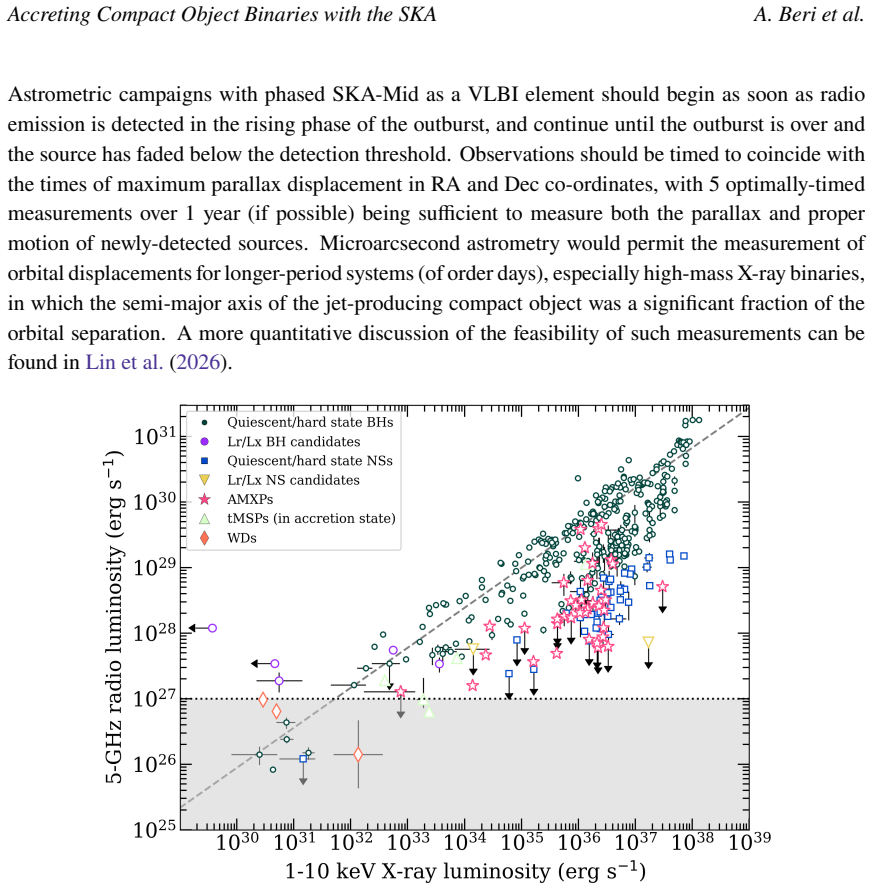
Accreting binary systems provide a time-resolved view of the accretion and ejection processes that are seen in all classes of compact objects, from stellar-mass to supermassive. They allow us to study the launching of relativistic jets on human timescales, probing how the jets are coupled to the underlying accretion flow, and providing unique insights that can be extended to supermassive black holes via the well-established mass scale invariance. Comparative studies of jets from different classes of compact objects allow us to determine the impact of mass, spin, magnetic fields, and stellar surfaces on the launching of jets. The jets from black hole X-ray binaries provide probes of the Galactic black hole population, and an important source of feedback to the surrounding interstellar medium. While existing radio facilities (including the SKA precursors) have made great progress in this field in recent years, the SKA will enhance such studies via its high point source and surface brightness sensitivity, high angular resolution, and broad frequency coverage. This will enable the extension of our existing black hole studies to the fainter accreting neutron star and white dwarf population, the detection of previously-undiscovered systems in a low-luminosity quiescent state, and the extension of our studies to nearby galaxies, revealing rare, high-accretion rate systems that probe a key phase of black hole growth.
Editorial analysis
A structured set of objections, weighed in public.
Referee Report
Summary. The manuscript presents a forward-looking science case for using the Square Kilometre Array (SKA) to study accreting compact object binaries. It reviews how these systems provide time-resolved views of accretion-jet coupling across stellar-mass to supermassive scales, and argues that the SKA's point-source and surface-brightness sensitivity, angular resolution, and frequency coverage will extend existing black-hole X-ray binary work to fainter neutron-star and white-dwarf populations, enable detection of quiescent systems, and permit studies in nearby galaxies.
Significance. If the projected SKA performance specifications are realized, the paper supplies a useful roadmap for comparative jet studies and for probing rare high-accretion phases of black-hole growth. The arguments rest on established mass-scaling relations and standard assumptions about instrument performance rather than new derivations or data.
minor comments (1)
- [Abstract] Abstract, final paragraph: the claim that SKA will enable extension to nearby galaxies would be strengthened by a brief, explicit citation to the relevant SKA design sensitivity or resolution figures that support the extragalactic reach.
Simulated Author's Rebuttal
We thank the referee for their supportive summary and recommendation of minor revision. The review correctly identifies the manuscript as a forward-looking perspective paper that relies on established scaling relations and instrument projections rather than new derivations.
Circularity Check
No significant circularity in this science case review
full rationale
This is a forward-looking perspective paper outlining a science case for SKA observations of accreting binaries. It contains no derivations, equations, fitted parameters, model predictions, or uniqueness theorems. All statements about SKA capabilities and extensions to neutron star/white dwarf populations or nearby galaxies are prospective applications of established accretion-jet scaling relations and instrument specifications, with no self-referential reduction, self-citation load-bearing, or renaming of results. The text is self-contained against external benchmarks of radio astronomy capabilities and does not invoke any internal consistency checks that loop back to its own inputs.
Axiom & Free-Parameter Ledger
Reference graph
Works this paper leans on
-
[2]
doi: 10.1038/s41586-024-07995-9. T. An et al. InAdvancing Astrophysics with the SKA – II (AASKAII)
-
[3]
doi: 10.1093/mnras/stz2335. P. Atri et al.A&A, 696:A223, Apr
-
[4]
doi: 10.1051/0004-6361/202452837. M. Bachetti et al.Nature, 514(7521):202–204, Oct
-
[5]
doi: 10.1038/nature13791. A. Bahramian and A. Rushton. bersavosh/xrb-lrlx_pub: update 20220908. doi: 10.5281/zen- odo.7059313, Sept
-
[6]
doi: 10.3847/2041-8213/accde1. T.M.Belloni. StatesandTransitionsinBlackHoleBinaries. InT.Belloni,editor,LectureNotesin Physics,BerlinSpringerVerlag,volume794,page53.2010.doi: 10.1007/978-3-540-76937-8_3. C. F. Bradshaw, E. B. Fomalont, and B. J. Geldzahler.ApJL, 512(2):L121–L124, Feb
-
[7]
doi: 10.1086/311889. J. Bright et al.Nature Astronomy, 4:1–7, 07
-
[8]
doi: 10.1038/s41550-020-1023-5. F. Carotenuto et al.MNRAS, 504(1):444–468, June
-
[9]
doi: 10.1093/mnras/stab864. F. Carotenuto et al.MNRAS, 533(4):4188–4209, Oct
-
[10]
doi: 10.1093/mnras/stae2049. S. Carpano, F. Haberl, C. Maitra, and G. Vasilopoulos.MNRAS, 476(1):L45–L49, feb
-
[11]
doi: 10.1093/mnrasl/sly030. L. Chomiuk et al.ApJ, 777(1):69, Nov
-
[12]
doi: 10.1088/0004-637X/777/1/69. K. Choudhury, J. A. García, J. F. Steiner, and C. Bambi.ApJ, 851(1):57, Dec
-
[13]
doi: 10.3847/1538-4357/aa9925. E. J. M. Colbert and R. F. Mushotzky.ApJ, 519(1):89–107, July
-
[14]
doi: 10.1086/307356. A. J. Cooper et al.MNRAS, July
-
[15]
doi: 10.1093/mnras/staf1085. D. L. Coppejans et al.MNRAS, 451(4):3801–3813, Aug
-
[16]
doi: 10.1093/mnras/stv1225. D. L. Coppejans et al.MNRAS, 463(2):2229–2241, Dec
-
[17]
doi: 10.1093/mnras/stw2133. M. Coriat et al.MNRAS, 414(1):677–690, June
-
[18]
doi: 10.1111/j.1365-2966.2011.18433.x. J. M. Corral-Santana et al.A&A, 587:A61, Mar
-
[19]
doi: 10.1051/0004-6361/201527130. D. Cseh et al.MNRAS, 439(1):L1–L5, 01
-
[20]
doi: 10.1093/mnrasl/slt166. P. Das and O. Porth.ApJL, 960(2):L12, Jan
-
[21]
doi: 10.3847/2041-8213/ad151f. A.-J. Dong, Q. Wu, and X.-F. Cao.ApJL, 787(2):L20, June
-
[22]
doi: 10.1088/2041-8205/787/2/ L20. K. El-Badry et al.MNRAS, 521(3):4323–4348, May 2023a. doi: 10.1093/mnras/stad799. K. El-Badry et al.MNRAS, 518(1):1057–1085, Jan. 2023b. doi: 10.1093/mnras/stac3140. EventHorizonTelescopeCollaborationetal.ApJL,875(1):L1,Apr.2019.doi: 10.3847/2041-8213/ ab0ec7. S. Fabrika et al.Nature Physics, 11(7):551–553, July
-
[23]
13 Accreting Compact Object Binaries with the SKA A
doi: 10.1038/nphys3348. 13 Accreting Compact Object Binaries with the SKA A. Beri et al. R. Fender and J. Bright.MNRAS, 489(4):4836–4846, Nov
-
[24]
doi: 10.1093/mnras/stz2000. R. Fender and T. Muñoz-Darias. The Balance of Power: Accretion and Feedback in Stellar Mass BlackHoles. InF.Haardtetal.,editors,LectureNotesinPhysics,BerlinSpringerVerlag,volume 905, page
-
[25]
doi: 10.1007/978-3-319-19416-5_3. R. Fender et al.Astronomy and Geophysics, 64(6):6.24–6.30, Dec
-
[26]
doi: 10.1093/astrogeo/ atad059. R. P. Fender, T. M. Belloni, and E. Gallo.MNRAS, 355(4):1105–1118, Dec
-
[27]
2009, MNRAS, 394, 1825, doi:10.1111/j
doi: 10.1111/j. 1365-2966.2004.08384.x. R. P. Fender, J. Bright, K. P. Mooley, and et al. InProceedings of Science (AASKA14), page 51,
work page doi:10.1111/j 2004
-
[28]
Gaia Collaboration et al.A&A, 686:L2, June
doi: 10.1088/0004-637X/697/2/1057. Gaia Collaboration et al.A&A, 686:L2, June
-
[29]
doi: 10.1051/0004-6361/202449763. E. Gallo, R. P. Fender, and G. G. Pooley.MNRAS, 344:60–72,
-
[30]
Gallo et al.Nature, 436(7052):819–821, Aug
E. Gallo et al.Nature, 436(7052):819–821, Aug. 2005a. doi: 10.1038/nature03879. E. Gallo, R. P. Fender, and R. I. Hynes.MNRAS, 356(3):1017–1021, Jan. 2005b. doi: 10.1111/j. 1365-2966.2004.08503.x. E. Gallo, R. P. Fender, J. C. A. Miller-Jones, and et al.MNRAS, 370:1351–1360,
-
[31]
E.Gallo,B.P.Miller,andR.Fender.MNRAS,423(1):590–599,052012. doi: 10.1111/j.1365-2966. 2012.20899.x. E. Gallo et al.MNRAS, 445(1):290–300, Nov
-
[32]
doi: 10.1093/mnras/stu1599. E. Gallo, N. Degenaar, and J. van den Eijnden.MNRAS, 478(1):L132–L136, July
-
[33]
doi: 10.1093/mnrasl/sly083. K. V. S. Gasealahwe et al.MNRAS, 541(4):4011–4024, Aug
-
[34]
doi: 10.1093/mnras/staf1216. B. Giesers et al.MNRAS, 475(1):L15–L19, Mar
-
[35]
doi: 10.1093/mnrasl/slx203. B. Giesers et al.A&A, 632:A3, Dec
-
[36]
doi: 10.1051/0004-6361/201936203. K. Gültekin et al.ApJ, 871(1):80, Jan
-
[37]
doi: 10.3847/1538-4357/aaf6b9. J. F. Hao and S. N. Zhang.ApJ, 702(2):1648–1661, Sept
-
[38]
doi: 10.1088/0004-637X/702/2/
-
[39]
doi: 10.1046/j.1365-8711. 2003.06918.x. G. L. Israel et al.Science, 355(6327):817–819, Feb. 2017a. doi: 10.1126/science.aai8635. G. L. Israel et al.MNRAS, 466(1):L48–L52, Mar. 2017b. doi: 10.1093/mnrasl/slw218. M.Janssenetal.NatureAstronomy,5:1017–1028,July2021. doi: 10.1038/s41550-021-01417-w. P. Kaaret, H. Feng, and T. P. Roberts.ARA&A, 55(1):303–341, Aug
-
[40]
doi: 10.1086/422466. A. King, J.-P. Lasota, and M. Middleton.New Astron. Rev., 96:101672, June
-
[41]
Quantitative ct scan imaging of the airways for diagnosis and management of lung disease,
doi: 10.1016/j. newar.2022.101672. E. Körding et al.Science, 320(5881):1318, June
work page doi:10.1016/j 2022
-
[42]
doi: 10.1126/science.1155492. C. Y. Lam et al.ApJL, 933(1):L23, July
-
[43]
Lhaaso Collaboration et al.National Science Review, 12(12):nwaf496, Dec
doi: 10.3847/2041-8213/ac7442. Lhaaso Collaboration et al.National Science Review, 12(12):nwaf496, Dec
-
[44]
M.Longair.HighEnergyAstrophysics
arXiv search: Report number AASKAII/Lin01. M.Longair.HighEnergyAstrophysics. CambridgeUniversityPress,2011. ISBN9781139494540. T.J.Maccarone. InAdvancingAstrophysicswiththeSquareKilometreArray(AASKA14),page85,
2011
-
[45]
doi: 10.1002/asna.20230028. I. Mariani et al.A&A, 704:A239, Dec
-
[46]
doi: 10.1051/0004-6361/202556290. S. Markoff et al.A&A, 397:645–658, Jan
-
[47]
doi: 10.1051/0004-6361:20021497. A. Merloni, S. Heinz, and T. di Matteo.MNRAS, 345(4):1057–1076, Nov
-
[48]
doi: 10.1046/j. 1365-2966.2003.07017.x. M. J. Middleton et al.Nature, 493(7431):187–190, Jan
work page doi:10.1046/j 2003
-
[49]
doi: 10.1038/nature11697. S. Migliari and R. P. Fender.MNRAS, 366(1):79–91, Feb
-
[50]
doi: 10.1111/j.1365-2966.2005. 09777.x. J. M. Miller, A. C. Fabian, and M. C. Miller.ApJL, 614(2):L117–L120, Oct
-
[51]
doi: 10.1111/j.1365-2966.2011. 20326.x. J. C. A. Miller-Jones et al.MNRAS, 453(4):3918–3931, Nov
-
[52]
doi: 10.1093/mnras/stv1869. J. C. A. Miller-Jones et al.Science, 371(6533):1046–1049, Mar
-
[53]
doi: 10.1126/science. abb3363. I. F. Mirabel et al.Nature, 413(6852):139–141, Sept
-
[54]
doi: 10.1038/35093060. C. Motch et al.Nature, 514(7521):198–201, Oct
-
[55]
doi: 10.1038/nature13730. S. E. Motta et al.A&A, 696:A222, Apr
-
[56]
21 Transforming XRB Astrophysics with SKA+VLBI T
doi: 10.1051/0004-6361/202452838. P.NagarajanandK.El-Badry.PASP,137(3):034203,Mar.2025. doi: 10.1088/1538-3873/adb6d6. R. Narayan and I. Yi.ApJ, 452:710, Oct
-
[57]
doi: 10.1086/176343. R. Narayan, I. V. Igumenshchev, and M. A. Abramowicz.PASJ, 55:L69–L72, Dec
-
[58]
doi: 10.1093/pasj/55.6.L69. M. W. Pakull, R. Soria, and C. Motch.Nature, 466(7303):209–212, July
-
[59]
doi: 10.3847/1538-4357/ad8b9c. K. Parfrey and A. Tchekhovskoy.ApJ, 975(1):57, Nov
-
[60]
doi: 10.3847/1538-4357/ad737b. R. M. Plotkin et al.MNRAS, 503(3):3784–3795, 03
-
[61]
doi: 10.1093/mnras/stab644. A. P. Rushton et al.MNRAS, 468(3):2788–2802, July
-
[62]
doi: 10.1093/mnras/stx526. T. D. Russell et al.ApJ, 883(2):198, Oct
-
[63]
doi: 10.3847/1538-4357/ab3d36. T. D. Russell et al.Nature, 627(8005):763–766, Mar
-
[64]
doi: 10.1038/s41586-024-07133-5. K. C. Sahu et al.ApJ, 933(1):83, July
-
[65]
doi: 10.3847/1538-4357/ac739e. H. Sakemi et al. InAdvancing Astrophysics with the SKA – II (AASKAII)
-
[66]
doi: 10.1093/mnrasl/slz086. N. I. Shakura and R. A. Sunyaev.A&A, 24:337–355, Jan
-
[67]
J.F.SteinerandJ.E.McClintock.ApJ,745(2):136,Feb.2012.doi: 10.1088/0004-637X/745/2/136
doi: 10.1093/mnrasl/slu183. J.F.SteinerandJ.E.McClintock.ApJ,745(2):136,Feb.2012.doi: 10.1088/0004-637X/745/2/136. J. Strader et al.Nature, 490(7418):71–73, Oct
-
[68]
doi: 10.1038/nature11490. A. Tchekhovskoy, R. Narayan, and J. C. McKinney.MNRAS, 418(1):L79–L83, Nov
-
[69]
doi: 10.1111/j.1745-3933.2011.01147.x. A. J. Tetarenko et al.MNRAS, 504(3):3862–3883, July
-
[70]
doi: 10.1093/mnras/stab820. J. van den Eijnden et al.MNRAS, 516(4):4844–4861, Nov
-
[71]
doi: 10.1093/mnras/stac2518. X. Y. Wang, Z. G. Dai, and T. Lu.ApJ, 592(1):347–353, July
-
[72]
doi: 10.1086/375638. N. A. Webb et al.ApJL, 712:L107,
-
[73]
doi: 10.1088/2041-8205/712/1/L107. G. Wiktorowicz et al.ApJ, 885(1):1, Nov
-
[74]
doi: 10.3847/1538-4357/ab45e6. B. Willems et al.ApJ, 625(1):324–346, May
-
[75]
doi: 10.1086/429557. C. M. Wood et al.ApJL, 984(2):L53, May
-
[76]
doi: 10.3847/2041-8213/adc9b3. J. Yang et al.MNRAS, 526(1):L1–L7, 08
-
[77]
X.Zhangetal.arXive-prints,art.arXiv:2504.11945,Apr.2025
doi: 10.1093/mnrasl/slad111. X.Zhangetal.arXive-prints,art.arXiv:2504.11945,Apr.2025. doi: 10.48550/arXiv.2504.11945. 16
discussion (0)
Sign in with ORCID, Apple, or X to comment. Anyone can read and Pith papers without signing in.