REVIEW 2 major objections 2 minor 69 references
Ferromagnetism from the geometry of localized wavefunctions in moir\'e systems
T0 review · 2 major / 2 minor · reviewed 2026-06-27 · grok-4.3
Pith's one-line read The geometry of real-space overlaps between localized orbitals triggers ferromagnetism at unexpectedly low interaction strengths in half-filled moiré bands.
desk verdict The paper derives a real-space overlap mechanism for ferromagnetism in Anderson-localized moiré bands that produces resonances with low critical U, distinct from quantum-geometry routes. read the letter →
The pith
A machine-rendered reading of the paper's core claim, the machinery that carries it, and where it could break.
The reading
What carries the argument
The geometry of real-space overlaps between Anderson-localized orbitals, which sets the strength and sign of the derived exchange interactions.
What would settle it
Measure the interaction strength at which ferromagnetism onsets in a half-filled quasiperiodic moiré system and check whether it matches the lower value predicted by the resonance condition computed from the real-space orbital overlaps.
Extended reading notes
Core claim
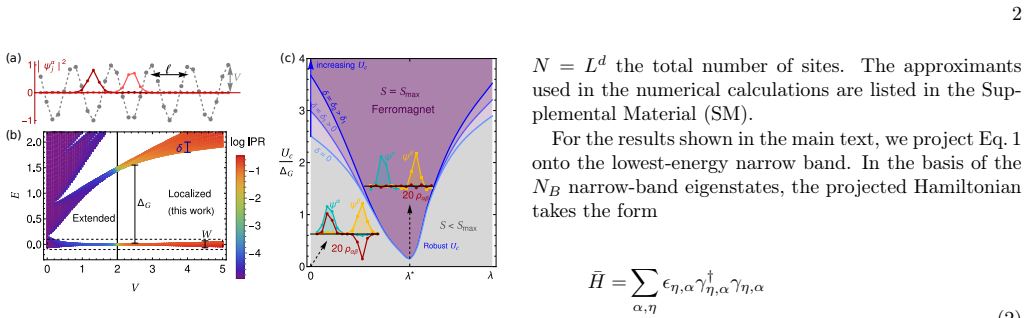
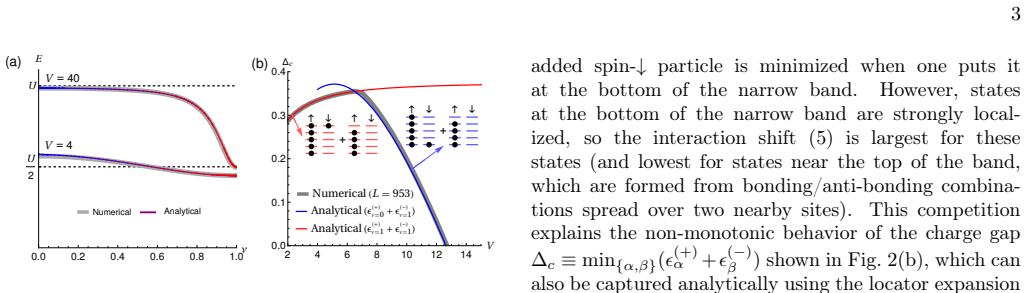
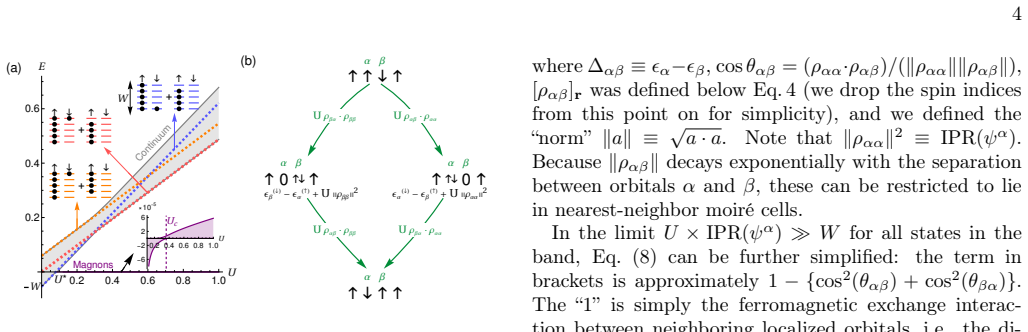
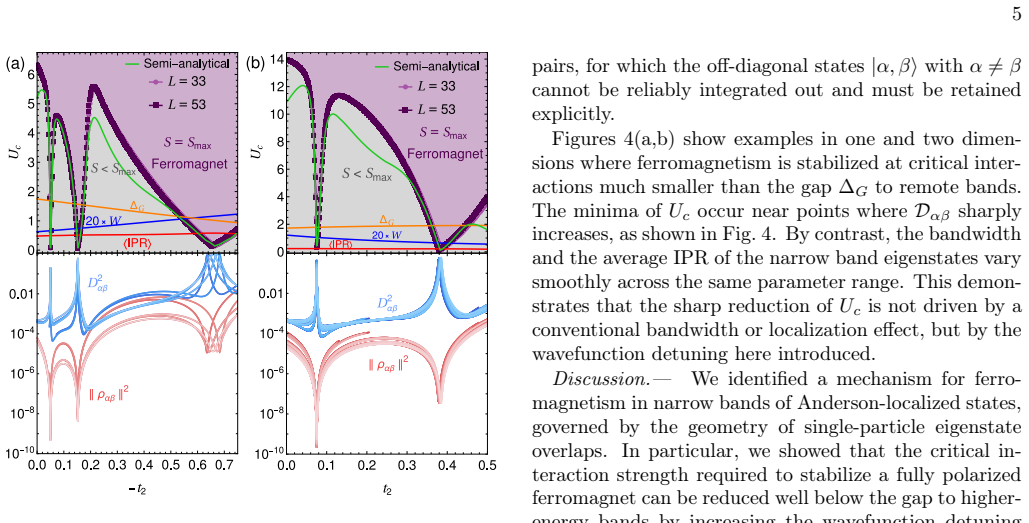
In narrow bands consisting of Anderson-localized states, single-particle localization allows a controlled derivation of exchange interactions within the band. For quasiperiodic systems with a half-filled moiré band, the critical interaction strength for ferromagnetism is highly sensitive to the geometry of real-space overlaps between localized orbitals, producing resonances at which ferromagnetism sets in for interaction energies far lower than the gap to other bands. Near these resonances all approximations are controlled, so the critical-point predictions are quantitative. The work identifies this real-space geometry route to ferromagnetism and illustrates it with one- and two-dimensional
Load-bearing premise
The single-particle states remain Anderson-localized and the derived exchange interactions remain controlled near the identified resonances.
Signed reviews
Editorial analysis
A structured set of objections, weighed in public.
Referee Report
Summary. The manuscript proposes a mechanism for ferromagnetism in narrow bands consisting of Anderson-localized states in quasiperiodic moiré systems. By exploiting single-particle localization to derive exchange interactions from the geometry of real-space orbital overlaps, the authors show that the critical interaction strength for ferromagnetism at half-filling is highly sensitive to overlap geometry, with well-defined resonances where ferromagnetism occurs at interaction energies far below the gap to other bands. They assert that near these resonances all approximations are controlled, yielding quantitative predictions, and present explicit examples in one and two dimensions. The approach is positioned as distinct from mechanisms based on the quantum geometry of Bloch bands.
Significance. If the central derivation holds, the work identifies a geometry-based route to ferromagnetism rooted in real-space overlaps of localized orbitals rather than band topology. The parameter-free character of the exchange derivation from overlaps, together with the claim of controlled approximations near resonances, would make the critical-U predictions falsifiable and potentially relevant to moiré materials. The 1D and 2D examples provide concrete illustrations that could guide experiments.
major comments (2)
- [Abstract] Abstract and the section deriving the effective spin model: the assertion that 'all the approximations in our theory are controlled' near resonances requires an explicit bound demonstrating that the localization length ξ remains ≪ moiré period at the resonance points; without this, the separation of scales justifying the perturbative exchange and the neglect of interband processes is not established, undermining the quantitative critical-U claim.
- [Examples in 1D and 2D] The section presenting the 1D and 2D examples: the reported resonances and critical interactions must be accompanied by direct computation or bound on ξ versus the overlap-geometry parameter to confirm that localization persists and the effective J remains controlled; if ξ grows near resonance, the central claim that ferromagnetism sets in at U far below the gap loses its justification.
minor comments (2)
- Define the precise geometric resonance condition (e.g., in terms of overlap integrals) with an equation or explicit formula.
- Ensure figure captions explicitly label the resonance locations and state the corresponding localization lengths.
Simulated Author's Rebuttal
We thank the referee for their careful reading and constructive comments, which highlight the importance of explicitly verifying the localization length to support our claims of controlled approximations near resonances. We address each major comment below and will revise the manuscript accordingly.
read point-by-point responses
-
Referee: [Abstract] Abstract and the section deriving the effective spin model: the assertion that 'all the approximations in our theory are controlled' near resonances requires an explicit bound demonstrating that the localization length ξ remains ≪ moiré period at the resonance points; without this, the separation of scales justifying the perturbative exchange and the neglect of interband processes is not established, undermining the quantitative critical-U claim.
Authors: We agree that an explicit bound or demonstration of ξ ≪ moiré period at the resonance points would strengthen the justification for the separation of scales. The manuscript argues control based on the resonance condition suppressing higher-order processes, but we acknowledge this requires more direct support. In the revised manuscript we will add a dedicated paragraph (with supporting calculation) in the effective spin model section providing a bound on ξ at the resonance points, confirming the scale separation holds. revision: yes
-
Referee: [Examples in 1D and 2D] The section presenting the 1D and 2D examples: the reported resonances and critical interactions must be accompanied by direct computation or bound on ξ versus the overlap-geometry parameter to confirm that localization persists and the effective J remains controlled; if ξ grows near resonance, the central claim that ferromagnetism sets in at U far below the gap loses its justification.
Authors: We accept this criticism. While the resonance mechanism is intended to keep the effective model valid, the examples section would benefit from explicit verification. In the revision we will augment the 1D and 2D example sections with plots or tabulated values of ξ versus the overlap-geometry parameter, explicitly showing that localization persists (ξ remains ≪ moiré period) at the reported resonance points where the critical U is low. revision: yes
Circularity Check
No significant circularity; derivation from localized orbitals is self-contained
full rationale
The paper starts from single-particle Anderson localization of moiré states and derives an effective exchange theory whose scale is set by real-space orbital overlaps. The abstract and description present this as a controlled perturbative construction whose validity is asserted near geometric resonances, without any quoted reduction of the critical-U prediction to a fitted parameter, self-citation chain, or definitional tautology. No load-bearing step is shown to be equivalent to its input by construction; the geometry dependence is an output of the overlap calculation rather than an input. This is the normal case of an independent derivation.
Assumptions & free parameters
Cite this review
Pith. "Pith review of Ferromagnetism from the geometry of localized wavefunctions in moir\'e systems." pith.science (2026). https://pith.science/paper/BLGYVWHV
@misc{pith2026260611302,
  author       = {Pith},
  title        = {Pith review of: Ferromagnetism from the geometry of localized wavefunctions in moir\'e systems},
  year         = {2026},
  howpublished = {\url{https://pith.science/paper/BLGYVWHV}},
  note         = {Machine review of arXiv:2606.11302}
}
read the original abstract
We present a mechanism for ferromagnetism in narrow bands consisting of Anderson-localized states. We exploit single-particle localization to derive a controlled theory of exchange interactions within the narrow band. For quasiperiodic systems with a half-filled moir\'e band, we show that the critical interaction strength for ferromagnetism is highly sensitive to the geometry of real-space overlaps between localized orbitals: we find well-defined resonances at which ferromagnetism sets in for interaction energies that are far lower than the gap to other bands. Near these resonances, all the approximations in our theory are controlled, so our critical point predictions are quantitative. We show examples both in one and two dimensions. Our work identifies a route to ferromagnetism based on the geometry of real-space wavefunctions, distinct from previously found mechanisms based on the quantum geometry of Bloch bands.
Figures
Figures from the paper (1 more)
Reference graph
Works this paper leans on
-
[1]
Lieb and D
E. Lieb and D. Mattis, Ordering energy levels of inter- acting spin systems, Journal of Mathematical Physics3, 749 (1962)
1962
-
[2]
E. H. Lieb, Two theorems on the hubbard model, Phys. Rev. Lett.62, 1201 (1989)
1989
-
[3]
Miyao, Ground state properties of the holstein– hubbard model, Annales Henri Poincaré19, 2543 (2018)
T. Miyao, Ground state properties of the holstein– hubbard model, Annales Henri Poincaré19, 2543 (2018)
2018
-
[4]
Yoshida and H
H. Yoshida and H. Katsura, Rigorous results on the ground state of the attractiveSU(n)hubbard model, Phys. Rev. Lett.126, 100201 (2021)
2021
-
[5]
Mielke, Ferromagnetic ground states for the Hubbard model on line graphs, J
A. Mielke, Ferromagnetic ground states for the Hubbard model on line graphs, J. Phys. A: Math. Gen.24, L73 (1991)
1991
-
[6]
Mielke, Ferromagnetism in the Hubbard model on line graphs and further considerations, J
A. Mielke, Ferromagnetism in the Hubbard model on line graphs and further considerations, J. Phys. A: Math. Gen.24, 3311 (1991)
1991
-
[7]
Mielke, Exact ground states for the Hubbard model on the kagome lattice, J
A. Mielke, Exact ground states for the Hubbard model on the kagome lattice, J. Phys. A: Math. Gen.25, 4335 (1992)
1992
-
[8]
Tasaki, Ferromagnetism in the hubbard models with degeneratesingle-electrongroundstates,Phys.Rev.Lett
H. Tasaki, Ferromagnetism in the hubbard models with degeneratesingle-electrongroundstates,Phys.Rev.Lett. 69, 1608 (1992)
1992
Show all 69 references
-
[9]
Mielke and H
A. Mielke and H. Tasaki, Ferromagnetism in the hubbard model, Communications in Mathematical Physics158, 341 (1993)
1993
-
[10]
A.Mielke,Stabilityofferromagnetisminhubbardmodels with degenerate single-particle ground states, Journal of Physics A: Mathematical and General32, 8411 (1999)
1999
-
[11]
Gulácsi, A
Z. Gulácsi, A. Kampf, and D. Vollhardt, Exact many- electron ground states on the diamond hubbard chain, Phys. Rev. Lett.99, 026404 (2007)
2007
-
[12]
Katsura, I
H. Katsura, I. Maruyama, A. Tanaka, and H. Tasaki, Fer- romagnetisminthehubbardmodelwithtopological/non- topological flat bands, Europhysics Letters91, 57007 (2010)
2010
-
[13]
Gulácsi, G
M. Gulácsi, G. Kovács, and Z. Gulácsi, Flat band fer- romagnetism without connectivity conditions in the flat band, Europhysics Letters107, 57005 (2014)
2014
-
[14]
Gulácsi, G
M. Gulácsi, G. Kovács, and Z. Gulácsi, Exact ferro- magnetic ground state of pentagon chains, Philosophical Magazine Letters94, 269 (2014)
2014
-
[15]
Kang and O
J. Kang and O. Vafek, Strong coupling phases of partially filled twisted bilayer graphene narrow bands, Phys. Rev. Lett.122, 246401 (2019)
2019
-
[16]
Wu and S
F. Wu and S. Das Sarma, Quantum geometry and stabil- ity of moiré flatband ferromagnetism, Phys. Rev. B102, 165118 (2020)
2020
-
[17]
R. Pons, A. Mielke, and T. Stauber, Flat-band ferromag- netism in twisted bilayer graphene, Phys. Rev. B102, 235101 (2020)
2020
-
[18]
B. A. Bernevig, Z.-D. Song, N. Regnault, and B. Lian, Twisted bilayer graphene. III. interacting hamiltonian and exact symmetries, Phys. Rev. B103, 205413 (2021)
2021
-
[19]
B. A. Bernevig, B. Lian, A. Cowsik, F. Xie, N. Regnault, and Z.-D. Song, Twisted bilayer graphene. V. exact an- alytic many-body excitations in Coulomb hamiltonians: Charge gap, Goldstone modes, and absence of Cooper pairing, Phys. Rev. B103, 205415 (2021)
2021
-
[20]
quantum geometric nesting
Z. Han, J. Herzog-Arbeitman, B. A. Bernevig, and S. A. Kivelson, “quantum geometric nesting” and solv- able model flat-band systems, Phys. Rev. X14, 041004 (2024)
2024
-
[21]
J. Yu, B. A. Bernevig, R. Queiroz, E. Rossi, P. Törmä, and B.-J. Yang, Quantum geometry in quantum materi- als, npj Quantum Materials10, 101 (2025)
2025
-
[22]
Zhang, W
J.-X. Zhang, W. O. Wang, L. Balents, and L. Savary, Identifying instabilities with quantum geometry in flat band systems (2025), arXiv:2504.03882 [cond-mat.str-el]
2025 arXiv
-
[23]
L. Chen, S. A. A. Ghorashi, J. Cano, and V. Crépel, Quantum-geometric dipole: a topological boost to flavor ferromagnetism in flat bands (2026), arXiv:2506.22417 [cond-mat.mes-hall]
2026
-
[24]
Peotta and P
S. Peotta and P. Törmä, Superfluidity in topologically nontrivial flat bands, Nature Communications6, 8944 (2015)
2015
-
[25]
X. Hu, T. Hyart, D. I. Pikulin, and E. Rossi, Geometric and conventional contribution to the superfluid weight in twisted bilayer graphene, Phys. Rev. Lett.123, 237002 (2019)
2019
-
[26]
F. Xie, Z. Song, B. Lian, and B. A. Bernevig, Topology- bounded superfluid weight in twisted bilayer graphene, Phys. Rev. Lett.124, 167002 (2020)
2020
-
[27]
Julku, T
A. Julku, T. J. Peltonen, L. Liang, T. T. Heikkilä, and P. Törmä, Superfluid weight and berezinskii- kosterlitz-thouless transition temperature of twisted bi- layer graphene, Phys. Rev. B101, 060505 (2020)
2020
-
[28]
Herzog-Arbeitman, A
J. Herzog-Arbeitman, A. Chew, K.-E. Huhtinen, P. Törmä, and B. A. Bernevig, Many-body superconduc- tivity in topological flat bands (2022), arXiv:2209.00007 [cond-mat.str-el]
2022
-
[29]
Huhtinen, J
K.-E. Huhtinen, J. Herzog-Arbeitman, A. Chew, B. A. Bernevig, and P. Törmä, Revisiting flat band supercon- ductivity: Dependence on minimal quantum metric and band touchings, Phys. Rev. B106, 014518 (2022)
2022
-
[30]
Törmä, S
P. Törmä, S. Peotta, and B. A. Bernevig, Superconduc- tivity, superfluidity and quantum geometry in twisted multilayer systems, Nature Reviews Physics4, 528 (2022)
2022
-
[31]
Herzog-Arbeitman, V
J. Herzog-Arbeitman, V. Peri, F. Schindler, S. D. Huber, and B. A. Bernevig, Superfluid weight bounds from sym- metry and quantum geometry in flat bands, Phys. Rev. Lett.128, 087002 (2022)
2022
-
[32]
J. S. Hofmann, E. Berg, and D. Chowdhury, Supercon- ductivity, charge density wave, and supersolidity in flat bands with a tunable quantum metric, Phys. Rev. Lett. 130, 226001 (2023)
2023
-
[33]
Z. Han, J. Herzog-Arbeitman, Q. Gao, and E. Khalaf, Exact models of chiral flat-band superconductors (2025), arXiv:2508.21127 [cond-mat.str-el]
2025
-
[34]
Balents, C
L. Balents, C. R. Dean, D. K. Efetov, and A. F. Young, Superconductivity and strong correlations in moiré flat bands, Nat. Phys.16, 725 (2020)
2020
-
[35]
E. Y. Andrei, D. K. Efetov, P. Jarillo-Herrero, A. H. MacDonald, K.F.Mak, T.Senthil, E.Tutuc, A.Yazdani, and A. F. Young, The marvels of moiré materials, Nat. Rev. Mater.6, 201 (2021)
2021
-
[36]
Y. Cao, V. Fatemi, A. Demir, S. Fang, S. L. Tomarken, J. Y. Luo, J. D. Sanchez-Yamagishi, K. Watanabe, T. Taniguchi, E. Kaxiras, R. C. Ashoori, and P. Jarillo- Herrero, Correlated insulator behaviour at half-filling in magic-angle graphene superlattices, Nature556, 80 (2018)
2018
-
[37]
A. L. Sharpe, E. J. Fox, A. W. Barnard, J. Finney, K. Watanabe, T. Taniguchi, M. A. Kastner, and D. Goldhaber-Gordon, Emergent ferromagnetism near 7 three-quarters filling in twisted bilayer graphene, Science 365, 605 (2019)
2019
-
[38]
G. Chen, A. L. Sharpe, E. J. Fox, Y.-H. Zhang, S. Wang, L. Jiang, B. Lyu, H. Li, K. Watanabe, T. Taniguchi, Z. Shi, T. Senthil, D. Goldhaber-Gordon, Y. Zhang, and F. Wang, Tunable correlated Chern insulator and fer- romagnetism in a moiré superlattice, Nature579, 56 (2020)
2020
-
[39]
Tasaki, Stability of ferromagnetism in the hubbard model, Phys
H. Tasaki, Stability of ferromagnetism in the hubbard model, Phys. Rev. Lett.73, 1158 (1994)
1994
-
[40]
Tasaki, Ferromagnetism in hubbard models, Phys
H. Tasaki, Ferromagnetism in hubbard models, Phys. Rev. Lett.75, 4678 (1995)
1995
-
[41]
Tasaki, Stability of ferromagnetism in hubbard models with nearly flat bands, Journal of Statistical Physics84, 535 (1996)
H. Tasaki, Stability of ferromagnetism in hubbard models with nearly flat bands, Journal of Statistical Physics84, 535 (1996)
1996
-
[42]
H. Hu, O. Vafek, K. Haule, and B. A. Bernevig, Ferro- magnetism vs. antiferromagnetism in narrow-band sys- tems: Competitionbetweenquantumgeometryandband dispersion (2025), arXiv:2509.03575 [cond-mat.str-el]
2025
-
[43]
de Jesús Espinosa-Champo and G
A. de Jesús Espinosa-Champo and G. G. Naumis, Magnetic phase transitions protected by topological quantum geometry transitions: effects of electron- electron interactions in the creutz ladder system (2025), arXiv:2509.26320 [cond-mat.str-el]
2025
-
[44]
geun Oh, T
C. geun Oh, T. Kitamura, A. Daido, J.-W. Rhim, and Y. Yanase, Magnetic phase transitions driven by quan- tum geometry (2025), arXiv:2509.13618 [cond-mat.str- el]
2025
-
[45]
Kitamura, H
T. Kitamura, H. Nakai, A. Daido, and Y. Yanase, Quan- tum geometric ferromagnetism by singular saddle point (2025), arXiv:2505.01089 [cond-mat.str-el]
2025 arXiv
-
[46]
A. L. Efros and M. Pollak,Electron-electron interactions in disordered systems, Vol. 10 (Elsevier, 2012)
2012
-
[47]
D.BelitzandT.R.Kirkpatrick,Theanderson-motttran- sition, Rev. Mod. Phys.66, 261 (1994)
1994
-
[48]
Mahmood, D
F. Mahmood, D. Chaudhuri, S. Gopalakrishnan, R. Nandkishore, and N. Armitage, Observation of a marginal fermi glass, Nature Physics17, 627 (2021)
2021
-
[49]
X.ZhangandM.S.Foster,Magneticinstabilityandspin- glass order beyond the anderson-mott transition in inter- acting power-law random banded matrix fermions, Phys. Rev. B110, 155137 (2024)
2024
-
[50]
This is consistent with the lack of a clear topological obstruction to detaching the moiré band from the rest of the spectrum
Although Lieb’s theorem does not apply directly in our setup because we are not at half-filling, in all bipartite cases we findU c ≫∆ G, consistent with the possibility thatU c → ∞. This is consistent with the lack of a clear topological obstruction to detaching the moiré band...
-
[51]
However, this degeneracy can be lifted by simply takingϕj ̸= 0
We note that this is no longer true ifϕj = 0, in which case the atomic limit (V→ ∞) eigenstates are exactly degenerate at mirror symmetric positions due to the ex- istence of an exact inversion symmetry and will hybridize for any finite hopping. However, this degeneracy can be...
-
[52]
P. W. Anderson, Absence of diffusion in certain random lattices, Phys. Rev.109, 1492 (1958)
1958
-
[53]
Ferromagnetism from real-space wavefunction geometry in localized quasiperiodic moiré systems
R. Haydock, The recursive solution of the schrödinger equation, Computer Physics Communications20, 11 (1980). Supplementary Information for “ Ferromagnetism from real-space wavefunction geometry in localized quasiperiodic moiré systems" CONTENTS I. Details on numerical calcula...
1980
-
[54]
Effective charge +1 Hamiltonian 9
-
[55]
Locator expansion around the atomic limit 10
-
[56]
Spin-flip spectrum and effective magnon Hamiltonian 15
Analytical results for charge +1 excitations 13 III. Spin-flip spectrum and effective magnon Hamiltonian 15
-
[57]
Effective two-particle spin-flip Hamiltonian 15
-
[58]
Bound mode counting 16
-
[59]
Robustness of narrow-band projection 21
Effective magnon Hamiltonian 18 IV. Robustness of narrow-band projection 21
-
[60]
Exact diagonalization results including higher-energy states 21
-
[61]
This method allows us to impose periodic boundary conditions without any edge defect and therefore avoid probing edge physics
Exact diagonalization results for different spin sectors 21 9 Appendix I: Details on numerical calculations and commensurate approximants In all numerical calculations we used commensurate approximants of the irrational wave vectorτ=47+ √ 5 58 ≈0.849 (see Eq.1 of the main text...
-
[62]
To derive the effective one-body Hamiltonian, we evaluate separately the projected non-interacting and interacting contributions
Effective charge +1 Hamiltonian Charge +1 excitations above the fully polarized state|⇑⟩=Q α γ† ↑,α |0⟩are spanned by the basis elementsγ† ↓,α |⇑⟩. To derive the effective one-body Hamiltonian, we evaluate separately the projected non-interacting and interacting contributions....
-
[63]
Locator expansion around the atomic limit We now perform a locator expansion [52, 53] around the limitV=∞(or equivalentlyt= 0) for the one-dimensional Aubry-André model. We will be interested in inspecting the localization properties of the single-particle eigenstates, and in ...
-
[64]
(S2.11) yields a long expression which we omit here
Analytical results for charge +1 excitations Substituting the full locator-expanded eigenfunctions into Eq. (S2.11) yields a long expression which we omit here. We instead provide simplified expressions below forν= 0andν= 1, EU ν=0 ≈U 1 + csc4(πτ) V 2 −1 , E U ν=1 ≈U 2 + 4 V 2...
-
[65]
Effective two-particle spin-flip Hamiltonian One-spin-flip excitations above the fully polarized state are spanned by |α, β⟩=S αβ |⇑⟩, S αβ ≡γ † ↓,αγ↑,β,(S3.1) whereαlabels the added spin-↓particle andβthe removed spin-↑particle. The exact projected spin-flip problem therefore...
-
[66]
(S3.9) is to separate the continuum matrix from the binding term
Bound mode counting A useful way of organizing Eq. (S3.9) is to separate the continuum matrix from the binding term. Writing H↓↑ (λδ,αβ) =R (λ,δ),(α,β) −U X j V(λ,δ),j V † j,(α,β),(S3.10) with V(λ,δ),j =ψ δ j ψλ j ∗ , R (λ,δ),(α,β) = (ϵα −ϵ β)δλα +R U λα δδβ ,(S3.11) we can ex...
-
[67]
As discussed in the main text, in the localized regime and forU > U∗ the relevant low-energy subspace is spanned by the local spin-flip states |α, α⟩
Effective magnon Hamiltonian We now derive the effective Hamiltonian acting within the low-energy magnon manifold. As discussed in the main text, in the localized regime and forU > U∗ the relevant low-energy subspace is spanned by the local spin-flip states |α, α⟩. We therefor...
-
[68]
In this way, the fully polarized reference state still hasSmax z =N B/2, but electrons are allowed to visit higher-energy orbitals above the narrow band
Exact diagonalization results including higher-energy states To test the robustness of the narrow-band projection, we enlarge the projected Hilbert space by retaining the lowest Nstates single-particle orbitals of the non-interacting problem, while keeping the total number of ...
-
[69]
for all total spinS)
Exact diagonalization results for different spin sectors We next numerically verify that the local stability of the fully-polarized ferromagnet to one-spin-flip excitations indeed captures the onset of the fully polarized ferromagnet as the global ground-state (i.e. for all to...
Reviewed June 27, 2026 · model on record in the stance chip above.
Discussion (0). Continue with ORCID to comment.