REVIEW 3 major objections 5 minor 50 references
Grasp Prediction based on Local Finger Motion Dynamics
T0 review · 3 major / 5 minor · reviewed 2026-08-07 · deepseek-v4-flash
Pith's one-line read Local finger motion during a reach predicts grasp time to about 21 ms, distance to about 9 mm, and object size to over 97% accuracy.
desk verdict A promising grasp-prediction idea undercut by a leaky cross-validation; the honest leave-one-user-out numbers tell a weaker but still interesting story. read the letter →
The pith
A machine-rendered reading of the paper's core claim, the machinery that carries it, and where it could break.
The reading
What carries the argument
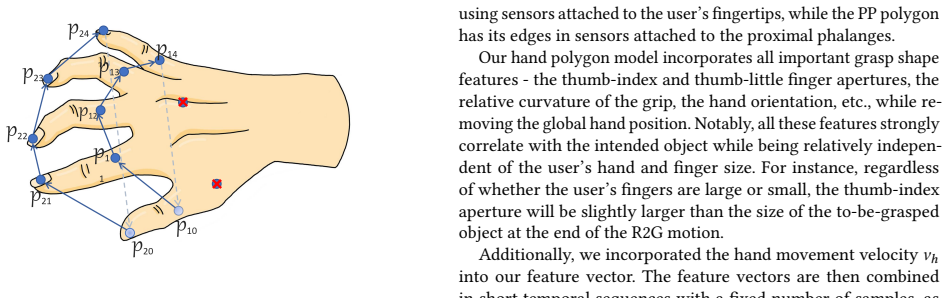
The hand polygon model, built from the five fingertip sensors, represents the grip by a set of edge vectors that encode thumb-index aperture, thumb-little-finger aperture, curvature, and hand orientation while subtracting out global hand position. These 15-dimensional fingertip-polygon features, optionally augmented by a proximal-phalanx polygon, are concatenated with hand speed into 25-sample windows (about 26 ms at the 960 Hz capture rate) and fed to an LSTM with a fully connected output head. The local, hand-relative nature of the features is what allows the network to predict grasp time, distance, and size from a short slice of the motion.
What would settle it
Re-run the evaluation with data split by entire reaches and then by participant, so no window from a training motion appears in the validation set; if the time-to-grasp error rises substantially above the reported roughly 21 ms, the claim of high-precision prediction for known users must be scaled back.
Extended reading notes
Core claim
The central claim is that the relative configuration of the fingertips, encoded as the hand polygon formed by five fingertip positions plus hand speed with global hand position removed, is sufficient for real-time prediction of grasp-related quantities without instrumenting the target object. A single-layer LSTM with 64 hidden units regresses both time-to-grasp and distance-to-target from a 25-sample window, and adding proximal-phalange positions does not improve the result. The same architecture classifies target size and, for objects with distinct grasp affordances, the target identity, with mean discrimination accuracy above 95% during the last 400 ms of the reach. The authors are careful to report that shape discrimination among deliberately similar synthetic solids is much harder, and that when users are held out entirely, distance error rises to about 25 mm and time error to about 72 ms until the network is fine-tuned with a small amount of the new user's data.
Load-bearing premise
The headline accuracy numbers assume that overlapping 25-sample windows cut from the same reach-to-grasp motion can be treated as independent training and test examples, so the reported precision may be artificially high.
Editorial extensions
If this is right
- Hand-redirection and reach-modeling techniques that currently normalize the whole reach to a unit interval can be driven in real time, because the predicted time-to-grasp supplies the missing time-scaling parameter.
- Interfaces can start rendering or executing an action roughly 280–400 ms before contact, directly offsetting point-to-point latency.
- Fingertip-only tracking hardware, such as lightweight magnetic or ring-based sensors, is enough to obtain the predictions, so no instrumented glove or global hand pose is required.
- Distance and size predictions together can narrow the set of candidate targets in mixed reality, especially when the environment is designed with distinguishable grasp affordances.
- Object identity prediction is only reliable when objects differ in grasp affordances; visually or grasply similar objects will be confused, so the method suits affordance-aware interface design more than general object recognition.
Reading between the lines
- Because the 4-fold validation splits overlapping 25-sample windows rather than whole trials, the headline numbers should be read as upper bounds; the leave-one-user-out results, about 25 mm distance and 72 ms time before adaptation, are the more honest estimate for a first-time user.
- A natural next experiment is to close the loop in a real latency-sensitive task, measuring whether acting on the predicted grasp time actually removes perceived latency rather than only reporting offline error.
- The size classifier could be replaced by a continuous grasp-aperture regressor, which would let the same features predict the size of objects never seen in training.
- Fusing gaze direction with the hand-polygon features may resolve the shape confusions the paper documents, since gaze is an independent signal for the intended target during the reach.
Signed reviews
Editorial analysis
A structured set of objections, weighed in public.
Referee Report
Summary. The paper proposes a real-time grasp-prediction system based on local finger-motion dynamics. Using electromagnetic tracking of 16 participants performing 763 reach-to-grasp sequences at 960 Hz, the authors extract velocity and finger-polygon features and feed fixed-length windows into LSTM networks. The trained networks are used for three tasks: regression of the current distance to the target object, regression of the time until grasp, and classification of the object's size and shape. The headline results are mean MAEs of 8.84 mm for distance and 21.53 ms for time-to-grasp, with object-size classification accuracy above 97% under a four-fold cross-validation. Leave-one-user-out results are substantially worse (distance MAE 24.89 mm, time MAE 71.78 ms), with object discrimination often unusable before user-specific adaptation.
Significance. If the quantitative claims hold, this would be a useful contribution to HCI and mixed-reality interaction: local hand kinematics would enable early, high-precision prediction of grasp contact time and target identity, supporting latency mitigation and adaptive interfaces. The paper has clear strengths: a genuinely collected high-frequency hand-motion dataset (16 participants, 763 trials), a well-motivated feature set based on hand-polygon geometry, and an honest report of leave-one-user-out and transfer-learning results. The L1UO results also indicate that a real predictive signal exists even for unseen users, which gives the work scientific value beyond the headline numbers. The central weakness is that the headline evaluation protocol is contaminated by overlapping subsequences, so the specific precision figures stated in the abstract are not established by the paper as written.
major comments (3)
- The 4-fold cross-validation used for all headline numbers is leaky. The paper states that overlapping subsequences were added to balance the data and that the resulting dataset was then split into four equal parts, with no grouping by original R2G trial or participant. For the best-performing 25-sample sequence length at 960 Hz, consecutive windows differ by only one sample and share 24 of 25 samples, so a random four-way split places near-duplicate windows in both training and validation. The LSTM can therefore memorize local trajectory snippets rather than learn to predict unseen reaches. This directly affects the 8.84 mm distance MAE, the 21.53 ms time-to-grasp MAE, and the >97% size/object classification figures in Sections 5.1 and 5.2. The paper's own leave-one-user-out results (Section 5.3) show the magnitude of the effect: distance MAE rises to 24.89 mm, time MAE to 71.78 ms, and object discrimination becomes barely usable without user-specific adaptation. The abstract's unqualified '21 ms / 1 cm / 97%' claims are therefore not supported for unseen reaches or unseen users. The authors should redo the evaluation with splits that respect original trial and participant boundaries and report both within-user and across-user results in the abstract and conclusions.
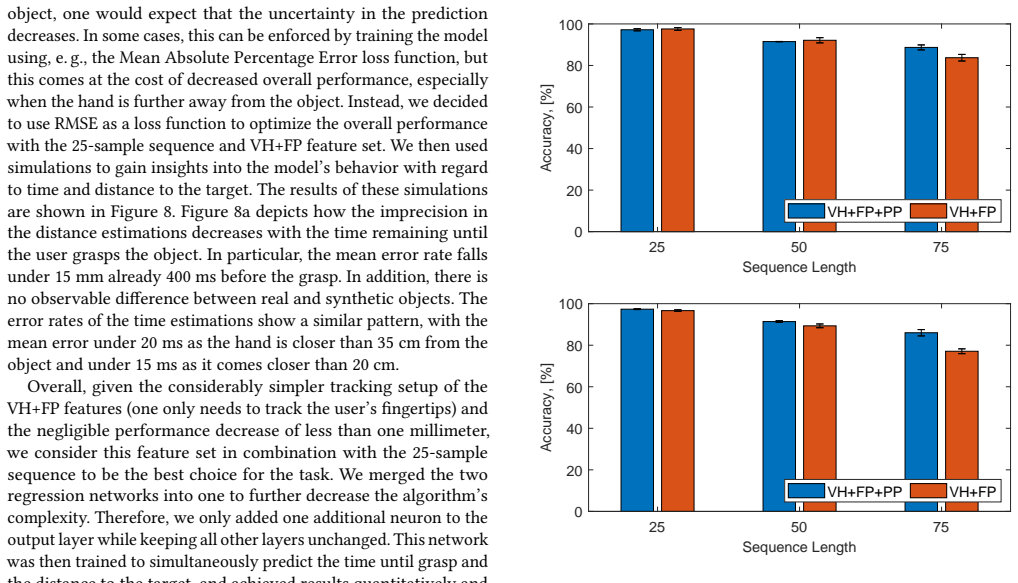
- The time-course analyses in Figure 8 and Figure 11 inherit the same leakage. The paper states that the network was trained on 75% of the 25-sample sequences and that run-time input was simulated with the remaining data; because those sequences overlap across the split, the claims that mean distance error falls below 15 mm already 400 ms before grasp and that accuracy remains above 95% are not trustworthy. These figures are used to support the central practical message that predictions are accurate well before contact. They should be recomputed on a held-out set constructed without overlapping windows or, better, on entire held-out reaches.
- The abstract and the discussion present the 4-fold results as the general performance of the system, but the paper text itself in Section 5.3 concludes that object discrimination is 'barely usable without adaptation' for unknown users and that transfer learning with 150 user-dependent data points is needed to reach 87% (real) and 75% (synthetic) accuracy. This internal contradiction is not merely a presentation issue: the unqualified numerical claims in the abstract are misleading with respect to the paper's own more careful results. The authors should rephrase the abstract so that the high-precision claims are explicitly scoped to conditions where user-specific data are available, and they should state the leave-one-user-out figures as the primary generalization results.
minor comments (5)
- The text says 'word-space coordinate system' where 'world-space' is presumably intended; this typo should be corrected.
- The figure captions contain 'Comparision' instead of 'Comparison'; also, the captions do not explain what the left and right panels represent as clearly as the text does.
- The authors state that they verified differences between feature sets with inferential statistics but omit the details 'for clarity.' Given that the paper already reports standard deviations over folds, a brief note of the test used (e.g., paired t-test or Wilcoxon) and the significance level would improve reproducibility.
- The hyperparameter selection is described only as progressively increasing the number of neurons until good performance is found. A short table listing the explored values and the final choices for each task would make the architecture section more complete.
- The paper does not mention whether the data or source code will be made available. Given the paper's reliance on a newly collected dataset, a data-availability statement would strengthen the contribution.
Circularity Check
Headline grasp-prediction accuracies are computed from a 4-fold split of heavily overlapping subsequences, so train and validation contain near-identical windows and the reported 21 ms / 1 cm / 97% figures are substantially forced by construction.
-
fitted input called prediction
[Section 5, first paragraph (Model Training and Evaluation); abstract and Sections 5.1–5.2 rely on this protocol.]
"The R2G feature sequences were then split into small subsequences of a fixed length of either 25, 50, or 75 samples. To balance the number of data points in the different sets, we added some overlapping subsequences, which resulted in approximately 35.000 data points for each subsequence length. For the 4-fold cross-validation, the respective dataset was split into four equal parts."
At the 960 Hz capture rate, 25 samples span about 26 ms, so consecutive overlapping subsequences differ by only one sample and share 24/25 input frames; the regression targets (time-to-grasp and distance) also change by only about 1 ms and about 1 mm between adjacent windows. Splitting this pool randomly into four equal folds places near-duplicate windows on both sides of the train/validation boundary. The network can therefore memorize the local trajectory segment rather than predict an unseen reach, which is exactly what the reported 8.84 mm distance MAE, 21.53 ms time MAE, and 97% accuracy measure.
full rationale
This is an empirical machine-learning paper rather than a formal derivation, so most circularity categories—imported uniqueness theorems, ansatz smuggling via self-citation, renaming known results—do not apply. The one load-bearing circular step is in the evaluation protocol: Section 5 builds 25–75-sample subsequences with deliberate overlap and then performs a random 4-fold split without grouping by original reach-to-grasp trial or participant. Consecutive windows are near-identical, so training and validation contain effectively the same local finger-motion segments. The headline precision figures therefore measure memorization of near-duplicate windows, not prediction of unseen behavior. This is not speculation about intent: the paper explicitly states that overlapping subsequences were added and that the dataset was split into four equal parts, and the paper's own leave-one-user-out numbers show a several-fold degradation when user identity is truly held out. Because the central quantitative claims as stated rest on that leaky split, the headline results are partially circular; however, the existence of a predictive signal is independently supported by the L1UO and transfer-learning experiments, so the contribution is not wholly empty. The score of 6 reflects that one or more headline 'predictions' reduce by construction, while the underlying phenomenon retains independent support.
Assumptions & free parameters
free parameters (11)
- sequence_length =
25 samples
- LSTM hidden units (regression) =
64
- LSTM hidden units (classification) =
128
- FC hidden units =
16
- dropout_rate =
0.2
- L2 regularization alpha =
1e-4
- learning_rate =
1e-3 for regression; classification not reported
- FIR cutoff frequency =
25 Hz
- velocity spike threshold =
0.1
- training epochs =
60
- mini-batch size =
32
assumptions (4)
- domain assumption Hand preshaping during reach-to-grasp is largely completed before hand-object contact and encodes object size, shape, and intended action.
- ad hoc to paper The 4-fold cross-validation split of overlapping subsequences yields unbiased performance estimates.
- domain assumption Fingertip polygon features are largely independent of hand size and user identity.
- domain assumption The touch sensors and electromagnetic tracker provide accurate event timing and submillimeter positions.
Cite this review
Pith. "Pith review of Grasp Prediction based on Local Finger Motion Dynamics." pith.science (2026). https://pith.science/paper/BLHY5MVN
@misc{pith2026250610818,
  author       = {Pith},
  title        = {Pith review of: Grasp Prediction based on Local Finger Motion Dynamics},
  year         = {2026},
  howpublished = {\url{https://pith.science/paper/BLHY5MVN}},
  note         = {Machine review of arXiv:2506.10818}
}
read the original abstract
The ability to predict the object the user intends to grasp offers essential contextual information and may help to leverage the effects of point-to-point latency in interactive environments. This paper explores the feasibility and accuracy of real-time recognition of uninstrumented objects based on hand kinematics during reach-to-grasp actions. In a data collection study, we recorded the hand motions of 16 participants while reaching out to grasp and then moving real and synthetic objects. Our results demonstrate that even a simple LSTM network can predict the time point at which the user grasps an object with a precision better than 21 ms and the current distance to this object with a precision better than 1 cm. The target's size can be determined in advance with an accuracy better than 97%. Our results have implications for designing adaptive and fine-grained interactive user interfaces in ubiquitous and mixed-reality environments.
Figures


Figures from the paper (9 more)




Reference graph
Works this paper leans on
-
[1]
L A Jones and S J Lederman. 2006.Human Hand Function. Vol. 32. Oxford University Press. https://doi.org/10.1093/acprof:oso/9780195173154.001.0001
arXiv 2006
-
[2]
Bashar I. Ahmad, Chrisminder Hare, Harpreet Singh, Arber Shabani, Briana Lindsay, Lee Skrypchuk, Patrick Langdon, and Simon Godsill. 2018. Selection Facilitation Schemes for Predictive Touch with Mid-Air Pointing Gestures in Automotive Displays. InProceedings of the 10th International Conference on Auto- motive User Interfaces and Interactive Vehicular Ap...
arXiv 2018
- [3]
-
[4]
Caterina Ansuini, Andrea Cavallo, Atesh Koul, Marco Jacono, Yuan Yang, and Cristina Becchio. 2015. Predicting Object Size from Hand Kinematics: A Temporal Perspective.PLOS ONE10, 3 (03 2015), 1–13. https://doi.org/10.1371/journal. pone.0120432
doi:10.1371/journal 2015
-
[5]
Caterina Ansuini, Marco Santello, Stefano Massaccesi, and Umberto Castiello
-
[6]
Takeshi Asano, Ehud Sharlin, Yoshifumi Kitamura, Kazuki Takashima, and Fumio Kishino. 2005. Predictive Interaction Using the Delphian Desktop. InProceedings of the 18th Annual ACM Symposium on User Interface Software and Technology (Seattle, WA, USA)(UIST ’05). Association for Computing Machinery, New York, NY, USA, 133–141. https://doi.org/10.1145/109503...
arXiv 2005
-
[7]
Mahdi Azmandian, Mark Hancock, Hrvoje Benko, Eyal Ofek, and Andrew D. Wilson. 2016. Haptic Retargeting: Dynamic Repurposing of Passive Haptics for Enhanced Virtual Reality Experiences. InProceedings of the 2016 CHI Conference on Human Factors in Computing Systems(San Jose, California, USA)(CHI ’16). Association for Computing Machinery, New York, NY, USA, ...
arXiv 2016
-
[8]
Sonia Betti, Giovanni Zani, Silvia Guerra, Umberto Castiello, and Luisa Sartori
Show all 50 references
-
[10]
Umberto Castiello. 2005. The neuroscience of grasping.Nature reviews. Neuro- science6 (10 2005), 726–36. https://doi.org/10.1038/nrn1744
2005 doi
-
[11]
Andrea Cavallo, Atesh Koul, Caterina Ansuini, Francesca Capozzi, and Cristina Becchio. 2016. Decoding intentions from movement kinematics.Scientific Reports 6 (2016), 37036 EP –. https://doi.org/10.1038/srep37036
2016 doi
-
[12]
Liwei Chan, Yi-Ling Chen, Chi-Hao Hsieh, Rong-Hao Liang, and Bing-Yu Chen
-
[13]
Chen, Wen-Huang Cheng, and Bing-Yu Chen
Liwei Chan, Rong-Hao Liang, Ming-Chang Tsai, Kai-Yin Cheng, Chao-Huai Su, Mike Y. Chen, Wen-Huang Cheng, and Bing-Yu Chen. 2013. FingerPad: Private and Subtle Interaction Using Fingertips. InProceedings of the 26th Annual ACM Symposium on User Interface Software and Technology...
2013
-
[14]
Patel, and Sean Keller
Ke-Yu Chen, Shwetak N. Patel, and Sean Keller. 2016. Finexus: Tracking Precise Motions of Multiple Fingertips Using Magnetic Sensing. InProceedings of the 2016 CHI Conference on Human Factors in Computing Systems(San Jose, California, USA)(CHI ’16). Association for Computing M...
2016
-
[15]
Chen Chen, A
F. Chen Chen, A. Favetto, M. Mousavi, E. P. Ambrosio, S. Appendino, Battezzato A., D. Manfredi, F. Pescarmona, and B. Bona. 2011. Human Hand: Kinematics, Statics and Dynamics. InInternational Conference on Environmental Systems. AIAA, Portland, Oregon, 1–10. https://iris.polit...
2011
-
[16]
Cheng, L
H. Cheng, L. Yang, and Z. Liu. 2016. Survey on 3D Hand Gesture Recognition. IEEE Transactions on Circuits and Systems for Video Technology26, 9 (Sep. 2016), 1659–1673. https://doi.org/10.1109/TCSVT.2015.2469551
2016
-
[17]
Lung-Pan Cheng, Eyal Ofek, Christian Holz, Hrvoje Benko, and Andrew D. Wilson. 2017. Sparse Haptic Proxy: Touch Feedback in Virtual Environments Using a General Passive Prop. InProceedings of the 2017 CHI Conference on Human Factors in Computing Systems(Denver, Colorado, USA)(...
2017
-
[18]
Sergio Chieffi and Maurizio Gentilucci. 1993. Coordination between the Transport and the Grasp Components During Prehension Movements.Experimental brain research. Experimentelle Hirnforschung. Expérimentation cérébrale94 (02 1993), 471–7. https://doi.org/10.1007/BF00230205
1993 doi
-
[19]
Aldrich Clarence, Jarrod Knibbe, Maxime Cordeil, and Michael Wybrow. 2021. Unscripted Retargeting: Reach Prediction for Haptic Retargeting in Virtual Reality. In2021 IEEE Virtual Reality and 3D User Interfaces (VR). 150–159. https://doi.org/ 10.1109/VR50410.2021.00036
2021
-
[20]
Aldrich Clarence, Jarrod Knibbe, Maxime Cordeil, and Michael Wybrow. 2022. Investigating The Effect of Direction on The Limits of Haptic Retargeting. In 2022 IEEE International Symposium on Mixed and Augmented Reality (ISMAR). 612–621. https://doi.org/10.1109/ISMAR55827.2022.00078
2022
-
[21]
Hinrichs
Florian Daiber, Dimitar Valkov, Frank Steinicke, Antonio Krüger, and Klaus H. Hinrichs. 2012. Towards Object Prediction based on Hand Postures for Reach to Grasp Interaction. InProceedings of the ACM CHI 2012 Workshop on Touching the 3rd Dimension of CHI: Touching and Designin...
2012
-
[22]
Cosimo Della Santina, Matteo Bianchi, Giuseppe Averta, Simone Ciotti, Visar Arapi, Simone Fani, Edoardo Battaglia, Manuel Giuseppe Catalano, Marco Santello, and Antonio Bicchi. 2017. Postural Hand Synergies during Envi- ronmental Constraint Exploitation.Frontiers in Neurorobot...
2017
-
[24]
Ida Egmose and Simo Køppe. 2018. Shaping of Reach-to-Grasp Kine- matics by Intentions: A Meta-Analysis.Journal of Motor Behavior 50, 2 (2018), 155–165. https://doi.org/10.1080/00222895.2017.1327407 arXiv:https://doi.org/10.1080/00222895.2017.1327407 PMID: 28644719
2018
-
[25]
Sahar El-Khoury, Miao Li, and Aude Billard. 2013. On the generation of a variety of grasps.Robotics and Autonomous Systems61, 12 (2013), 1335–1349. https: //doi.org/10.1016/j.robot.2013.08.002
2013 doi
-
[26]
D.F. Elliott. 1987.Handbook of Digital Signal Processing: Engineering Applications. Academic Press. https://books.google.de/books?id=7s5yQgAACAAJ
1987
-
[28]
Bullock, and Aaron M
Thomas Feix, Ian M. Bullock, and Aaron M. Dollar. 2014. Analysis of Human Grasping Behavior: Object Characteristics and Grasp Type.IEEE Transactions on Haptics7, 3 (July 2014), 311–323. https://doi.org/10.1109/TOH.2014.2326871
2014
-
[29]
Fu and M
Q. Fu and M. Santello. 2011. Towards a complete description of grasping kine- matics: A framework for quantifying human grasping and manipulation. In2011 Annual International Conference of the IEEE Engineering in Medicine and Biology Society. 8247–8250. https://doi.org/10.1109...
2011
-
[30]
Furmanek, L.F
M.P. Furmanek, L.F. Schettino, and M. Yarossi. 2019. Coordination of reach-to- grasp in physical and haptic-free virtual environments.Journal of NeuroEngi- neering Rehabilitation16, 78 (2019). https://doi.org/10.1186/s12984-019-0525-9
2019 doi
-
[31]
Eric J Gonzalez and Sean Follmer. 2023. Sensorimotor Simulation of Redirected Reaching Using Stochastic Optimal Feedback Control. InProceedings of the 2023 CHI Conference on Human Factors in Computing Systems(Hamburg, Germany) (CHI ’23). Association for Computing Machinery, Ne...
2023
-
[32]
Rorik Henrikson, Tovi Grossman, Sean Trowbridge, Daniel Wigdor, and Hrvoje Benko. 2020. Head-Coupled Kinematic Template Matching: A Prediction Model for Ray Pointing in VR. InProceedings of the 2020 CHI Conference on Human Factors in Computing Systems(Honolulu, HI, USA)(CHI ’2...
2020
-
[33]
Niels Henze, Sven Mayer, Huy Viet Le, and Valentin Schwind. 2017. Improving Software-Reduced Touchscreen Latency. InProceedings of the 19th International Conference on Human-Computer Interaction with Mobile Devices and Services (Vienna, Austria)(MobileHCI ’17). Association for...
2017
-
[34]
Guido Heumer, Heni Ben Amor, and Bernhard Jung. 2008. Grasp Recognition for Uncalibrated Data Gloves: A Machine Learning Approach.Presence17, 2 (2008), 121–142. https://doi.org/10.1162/pres.17.2.121
2008 doi
-
[35]
M. Höll, M. Oberweger, C. Arth, and V. Lepetit. 2018. Efficient Physics-Based Implementation for Realistic Hand-Object Interaction in Virtual Reality. In2018 IEEE Conference on Virtual Reality and 3D User Interfaces (VR). 175–182. https: //doi.org/10.1109/VR.2018.8448284
2018
-
[36]
Sing Bing Kang and K. Ikeuchi. 1994. Determination of motion breakpoints in a task sequence from human hand motion. InProceedings of the 1994 IEEE International Conference on Robotics and Automation. 551–556 vol.1. https: //doi.org/10.1109/ROBOT.1994.351241
1994
-
[37]
Edward Lank, Yi-Chun Nikko Cheng, and Jaime Ruiz. 2007. Endpoint Prediction Using Motion Kinematics. InProceedings of the SIGCHI Conference on Human Factors in Computing Systems(San Jose, California, USA)(CHI ’07). Association for Computing Machinery, New York, NY, USA, 637–64...
2007
-
[38]
1994.The grasping hand
Christine L MacKenzie and Thea Iberall. 1994.The grasping hand. Amsterdam ; New York : North-Holland
1994
-
[39]
Wilson, Eyal Ofek, Mar Gonzalez Franco, and Christian Holz
Sebastian Marwecki, Andrew D. Wilson, Eyal Ofek, Mar Gonzalez Franco, and Christian Holz. 2019. Mise-Unseen: Using Eye Tracking to Hide Virtual Reality Scene Changes in Plain Sight. InProceedings of the 32nd Annual ACM Symposium on User Interface Software and Technology(New Or...
2019
-
[40]
Javier Molina-Vilaplana, Jorge Feliu Batlle, and Juan López Coronado. 2002. A Neural Model of Spatio Temporal Coordination in Prehension. InArtificial Neural Networks — ICANN 2002, José R. Dorronsoro (Ed.). Springer Berlin Heidelberg, Berlin, Heidelberg, 9–14
2002
-
[41]
Pasqual and Jacob O
Phillip T. Pasqual and Jacob O. Wobbrock. 2014. Mouse Pointing Endpoint Prediction Using Kinematic Template Matching. InProceedings of the SIGCHI Conference on Human Factors in Computing Systems(Toronto, Ontario, Canada) (CHI ’14). Association for Computing Machinery, New York...
2014
-
[42]
Paulson, D
B. Paulson, D. Cummings, and T. Hammond. 2011. Object interaction detection using hand posture cues in an office setting.International Journal of Human Computer Studies69, 1-2 (2011), 19–29. https://doi.org/10.1016/j.ijhcs.2010.09.003
2011 doi
-
[43]
Trang Pham, Truyen Tran, Dinh Phung, and Svetha Venkatesh. 2017. Predicting healthcare trajectories from medical records: A deep learning approach.Journal of Biomedical Informatics69 (2017), 218–229. https://doi.org/10.1016/j.jbi.2017. 04.001
2017 doi
-
[44]
Senior, and Françoise Beaufays
Hasim Sak, Andrew W. Senior, and Françoise Beaufays. 2014. Long Short-Term Memory Based Recurrent Neural Network Architectures for Large Vocabulary Speech Recognition.CoRRabs/1402.1128 (2014), 1–10. arXiv:1402.1128 http: //arxiv.org/abs/1402.1128
2014 arXiv
-
[45]
Kappers, Kostas Kyriakopoulos, Alin Albu-Schäffer, Claudio Castellini, and Antonio Bicchi
Marco Santello, Matteo Bianchi, Marco Gabiccini, Emiliano Ricciardi, Gionata Salvietti, Domenico Prattichizzo, Marc Ernst, Alessandro Moscatelli, Henrik Jörntell, Astrid M.L. Kappers, Kostas Kyriakopoulos, Alin Albu-Schäffer, Claudio Castellini, and Antonio Bicchi. 2016. Hand ...
2016 doi
-
[46]
Santello and J
M. Santello and J. F. Soechting. 1998. Gradual molding of the hand to object contours.Journal of neurophysiology79, 3 (1998), 1307–1320. https://doi.org/10. 1152/jn.1998.79.3.1307
1998
-
[47]
Jonathan Taylor, Lucas Bordeaux, Thomas Cashman, Bob Corish, Cem Keskin, Toby Sharp, Eduardo Soto, David Sweeney, Julien Valentin, Benjamin Luff, Arran Topalian, Erroll Wood, Sameh Khamis, Pushmeet Kohli, Shahram Izadi, Richard Banks, Andrew Fitzgibbon, and Jamie Shotton. 2016...
2016
-
[48]
Radu-Daniel Vatavu and Ionu Alexandru Zaii. 2013. Automatic Recognition of Object Size and Shape via User-dependent Measurements of the Grasping Hand. Int. J. Hum.-Comput. Stud.71, 5 (May 2013), 590–607. https://doi.org/10.1016/j. ijhcs.2013.01.002
2013 doi
-
[49]
Haijun Xia, Ricardo Jota, Benjamin McCanny, Zhe Yu, Clifton Forlines, Karan Singh, and Daniel Wigdor. 2014. Zero-Latency Tapping: Using Hover Information to Predict Touch Locations and Eliminate Touchdown Latency. InProceedings of the 27th Annual ACM Symposium on User Interfac...
2014
-
[50]
Difeng Yu, Hai-Ning Liang, Xueshi Lu, Kaixuan Fan, and Barrett Ens. 2019. Modeling endpoint distribution of pointing selection tasks in virtual reality environments.ACM Transactions on Graphics (TOG)38, 6 (2019), 1–13. 10
2019
-
[2006]
https://doi.org/10.1152/jn.01107.2005
Effects of end-goal on hand shaping.Journal of neurophysiology95, 4 (2006), 2456–2465. https://doi.org/10.1152/jn.01107.2005
2006 arXiv
-
[2015]
InProceedings of the 28th Annual ACM Symposium on User Interface Software and Technology(Charlotte, NC, USA)(UIST ’15)
CyclopsRing: Enabling Whole-Hand and Context-Aware Interactions Through a Fisheye Ring. InProceedings of the 28th Annual ACM Symposium on User Interface Software and Technology(Charlotte, NC, USA)(UIST ’15). Association for Computing Machinery, New York, NY, USA, 549–556. http...
-
[2018]
Reach-To-Grasp Movements: A Multimodal Techniques Study.Frontiers in Psychology9, 2 (2018), 990
2018
Reviewed August 7, 2026 · model on record in the stance chip above.
Discussion (0). Continue with ORCID to comment.