Inference-Based Resource Allocation for Multi-Cell Backscatter Sensor Networks
Pith reviewed 2026-05-24 20:27 UTC · model grok-4.3
The pith
A message-passing algorithm allocates frequency sub-channels in multi-cell backscatter networks using only long-term average SINR values.
A machine-rendered reading of the paper's core claim, the machinery that carries it, and where it could break.
Core claim
Average SINR expressions for MRC and ZF detectors are derived from long-term channel statistics and inserted into an integer program that allocates frequency sub-channels to tags; the program is solved exactly by the Max-Sum message-passing algorithm, which is fully parallelizable, uses only addition and comparison operations, and converges in very few iterations.
What carries the argument
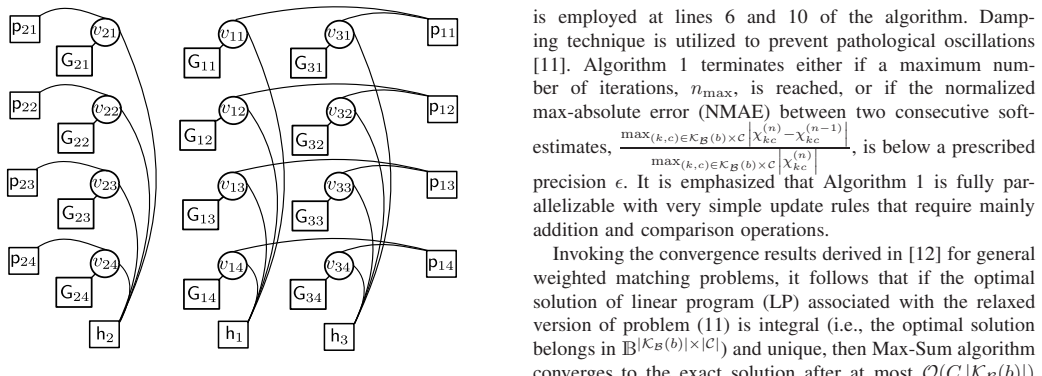
The Max-Sum message-passing algorithm applied to the integer programming formulation of sub-channel allocation.
If this is right
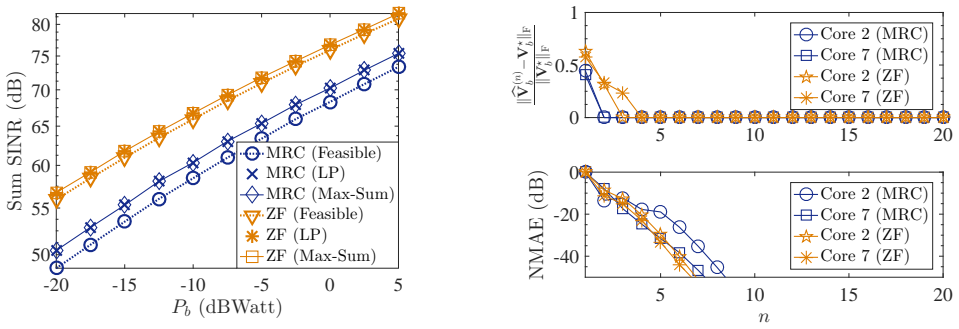
- Zero-forcing detectors cancel intra-cell interference and therefore suit large-scale backscatter deployments better than maximum-ratio combining.
- The message-passing procedure finishes at least an order of magnitude faster than conventional convex optimization solvers.
- Convergence occurs after only a few iteration steps regardless of network size.
- All updates remain simple additions and comparisons and execute independently across tags and sub-channels.
Where Pith is reading between the lines
- If long-term statistics suffice for allocation, feedback overhead can be reduced to occasional channel statistics reports rather than instantaneous CSI.
- The same message-passing structure could be reused for other discrete resource problems in scatter-radio systems once an average performance metric is available.
- Deployment cost models could be updated to reflect that only a small number of multi-antenna cores are needed once sub-channel allocation is solved centrally.
Load-bearing premise
The derived average SINR expressions remain accurate enough to decide sub-channel assignments when only long-term statistics are known.
What would settle it
Run the proposed allocation on measured channels and observe whether the achieved SINR values fall substantially below the values predicted by the average expressions used in the optimizer.
Figures
read the original abstract
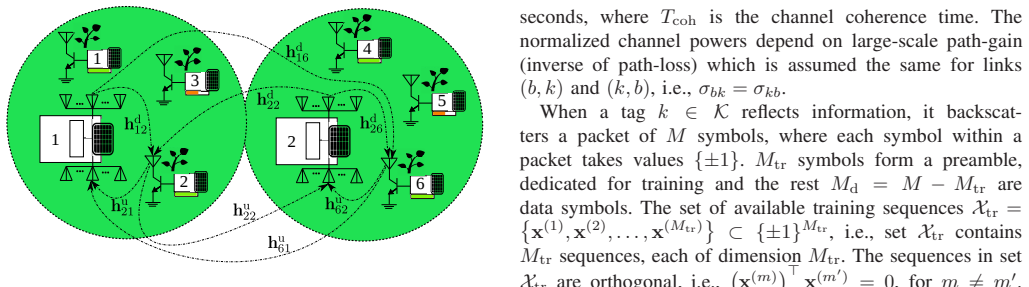
This work studies inference-based resource allocation in ultra low-power, large-scale backscatter sensor networks (BSNs). Several ultra-low cost and power sensor devices (tags) are illuminated by a carrier and reflect the measured information towards a wireless core that uses conventional Marconi radio technology. The development of multi-cell BSNs requires few multi-antenna cores and several low-cost scatter radio devices, targeting at maximum possible coverage. The average signal-to-interference-plus-noise ratio (SINR) of maximum-ratio combining (MRC) and zero-forcing (ZF) linear detectors is found and harnessed for frequency sub-channel allocation at tags, exploiting long-term SINR information. The resource allocation problem is formulated as an integer programming optimization problem and solved through the Max-Sum message-passing algorithm. The proposed algorithm is fully parallelizable and adheres to simple message-passing update rules, requiring mainly addition and comparison operations. In addition, the convergence to the optimal solution is attained within very few iteration steps. Judicious simulation study reveals that ZF detector is more suitable for large scale BSNs, capable to cancel out the intra-cell interference. It is also found that the proposed algorithm offers at least an order of magnitude decrease in execution time compared to conventional convex optimization methods.
Editorial analysis
A structured set of objections, weighed in public.
Referee Report
Summary. The paper studies resource allocation in multi-cell backscatter sensor networks (BSNs). It derives average SINR expressions for MRC and ZF detectors at multi-antenna cores, formulates frequency sub-channel allocation to tags as an integer program that maximizes a function of these SINRs, and solves the program with the Max-Sum message-passing algorithm. The method is presented as fully parallelizable with simple addition/comparison updates that converge to the optimum in few iterations; simulations indicate ZF cancels intra-cell interference effectively in large networks and yields at least 10x runtime reduction versus conventional convex solvers.
Significance. If the average-SINR expressions remain sufficiently accurate for allocation decisions and the message-passing procedure consistently produces high-quality (or optimal) assignments, the work supplies a scalable, low-complexity alternative to centralized convex optimization for large-scale, ultra-low-power BSNs that rely only on long-term channel statistics. The parallelizability and reported speed advantage are practically relevant strengths.
major comments (2)
- [§4–5] §4–5 (formulation and Max-Sum algorithm): The repeated claim that the algorithm attains 'the optimal solution' is not supported. The factor graph is loopy because the objective couples variables through inter-tag and inter-cell interference terms inside the average SINR expressions (derived in §3); Max-Sum therefore lacks a global-optimality guarantee. No tree-structured factorization, submodularity argument, or exhaustive-search validation on small instances is supplied to justify the optimality assertion.
- [§3] §3 (average SINR derivations): The MRC and ZF average-SINR formulas are used directly as the objective for the integer program, yet the paper provides no Monte-Carlo validation that these long-term expressions produce allocations whose realized performance (under instantaneous fading) is close to the performance obtained with perfect instantaneous CSI. This accuracy assumption is load-bearing for the allocation claims.
minor comments (2)
- [Abstract and §5] The abstract and §5 state convergence 'within very few iteration steps' without reporting the iteration counts or convergence tolerance used across the simulated network sizes.
- [Simulations] Simulation section should state the precise convex solver, solver tolerances, and problem dimensions (number of tags, sub-channels, cells) used to support the 'order of magnitude' runtime claim.
Simulated Author's Rebuttal
We thank the referee for the constructive comments on our manuscript. We address each major comment below and propose revisions where appropriate.
read point-by-point responses
-
Referee: [§4–5] §4–5 (formulation and Max-Sum algorithm): The repeated claim that the algorithm attains 'the optimal solution' is not supported. The factor graph is loopy because the objective couples variables through inter-tag and inter-cell interference terms inside the average SINR expressions (derived in §3); Max-Sum therefore lacks a global-optimality guarantee. No tree-structured factorization, submodularity argument, or exhaustive-search validation on small instances is supplied to justify the optimality assertion.
Authors: We agree that the factor graph is loopy due to the coupling through interference terms in the objective, so Max-Sum lacks a theoretical global-optimality guarantee. The manuscript's statements claiming convergence to 'the optimal solution' are therefore not fully supported. We will revise the abstract and sections 4–5 to remove the optimality claim and instead state that the algorithm produces high-quality solutions that converge in few iterations, as observed in our simulations. revision: yes
-
Referee: [§3] §3 (average SINR derivations): The MRC and ZF average-SINR formulas are used directly as the objective for the integer program, yet the paper provides no Monte-Carlo validation that these long-term expressions produce allocations whose realized performance (under instantaneous fading) is close to the performance obtained with perfect instantaneous CSI. This accuracy assumption is load-bearing for the allocation claims.
Authors: We acknowledge that direct validation of the average-SINR-based allocations against instantaneous-CSI performance would strengthen the claims. The derivations in §3 are intended for long-term statistics in low-power BSNs, but we will add Monte-Carlo simulations in the revised manuscript comparing realized SINR and throughput of the proposed allocations versus those obtained with perfect instantaneous CSI. revision: yes
Circularity Check
Derivation self-contained from first-principles SINR expressions and standard message-passing application
full rationale
The paper derives closed-form average SINR expressions for MRC/ZF detectors directly from the system model and long-term channel statistics, formulates the sub-channel allocation as an integer program using those expressions, and applies the Max-Sum algorithm with reported empirical convergence. No step reduces a claimed prediction or optimality result to a fitted parameter, self-defined quantity, or load-bearing self-citation by construction. The approach remains externally falsifiable via simulation against convex solvers and does not invoke uniqueness theorems or ansatzes from prior author work to force the result.
Axiom & Free-Parameter Ledger
axioms (2)
- domain assumption Multi-cell BSNs consist of multi-antenna cores illuminating low-cost scatter tags that reflect measured information.
- domain assumption Average SINR of MRC and ZF detectors can be derived and harnessed for sub-channel allocation using only long-term statistics.
Reference graph
Works this paper leans on
-
[1]
P . N. Alevizos, “Intelligent scatter radio, RF harvesti ng analysis, and resource allocation for ultra-low-power Internet-of-Thi ngs,” Ph.D. dis- sertation, Technical University of Crete, Chania, Greece, Dec. 2017
work page 2017
-
[2]
A software-define d radio system for backscatter sensor networks,
G. V annucci, A. Bletsas, and D. Leigh, “A software-define d radio system for backscatter sensor networks,” IEEE Trans. Wireless Commun., vol. 7, no. 6, pp. 2170–2179, Jun. 2008
work page 2008
-
[3]
Multistatic scatter radio sensor networks for extended coverage,
P . N. Alevizos, K. Tountas, and A. Bletsas, “Multistatic scatter radio sensor networks for extended coverage,” IEEE Trans. Wireless Commun., vol. 17, no. 7, pp. 4522–4535, Jul. 2018
work page 2018
-
[4]
Complete link budgets for b ackscatter- radio and RFID systems,
J. D. Griffin and G. D. Durgin, “Complete link budgets for b ackscatter- radio and RFID systems,” IEEE Antennas Propag. Mag. , vol. 51, no. 2, pp. 11–25, Apr. 2009
work page 2009
-
[5]
Bistatic bac kscatter radio for power-limited sensor networks,
J. Kimionis, A. Bletsas, and J. N. Sahalos, “Bistatic bac kscatter radio for power-limited sensor networks,” in Proc. IEEE Global Commun. Conf. (Globecom), Atlanta, GA, Dec. 2013, pp. 353–358
work page 2013
-
[6]
Coherent detec- tion and channel coding for bistatic scatter radio sensor ne tworking,
N. Fasarakis-Hilliard, P . N. Alevizos, and A. Bletsas, “ Coherent detec- tion and channel coding for bistatic scatter radio sensor ne tworking,” IEEE Trans. Commun. , vol. 63, pp. 1798–1810, May 2015
work page 2015
-
[7]
Noncoh erent short packet detection and decoding for scatter radio sensor netw orking,
P . N. Alevizos, A. Bletsas, and G. N. Karystinos, “Noncoh erent short packet detection and decoding for scatter radio sensor netw orking,” IEEE Trans. Commun., vol. 65, no. 5, pp. 1–13, May 2017
work page 2017
-
[8]
Goldsmith, Wireless Communications
A. Goldsmith, Wireless Communications . New Y ork, NY , USA: Cambridge University Press, 2005
work page 2005
-
[9]
Improvin g backscatter radio tag efficiency,
A. Bletsas, A. G. Dimitriou, and J. N. Sahalos, “Improvin g backscatter radio tag efficiency,” IEEE Trans. Microw. Theory Techn., vol. 58, no. 6, pp. 1502–1509, Jun. 2010
work page 2010
-
[10]
M. Bayati, C. Borgs, J. Chayes, and R. Zecchina, “On the e xactness of the cavity method for weighted b-matchings on arbitrary graphs and its relation to linear programs,” Journal of Statistical Mechanics: Theory and Experiment , vol. 2008, no. 06, Jun. 2008
work page 2008
-
[11]
On the uniqueness of loopy belief propagati on fixed points,
T. Heskes, “On the uniqueness of loopy belief propagati on fixed points,” Neural Comput. , vol. 16, no. 11, pp. 2379–2413, Nov. 2004
work page 2004
-
[12]
M. Bayati, C. Borgs, J. Chayes, and R. Zecchina, “Belief propagation for weighted b-matchings on arbitrary graphs and its relation to linear pr o- grams with integer solutions,” SIAM Journal on Discrete Mathematics , vol. 25, no. 2, pp. 989–1011, Jul. 2011
work page 2011
-
[13]
CVX: Matlab software for discipli ned convex programming, version 2.1,
M. Grant and S. Boyd, “CVX: Matlab software for discipli ned convex programming, version 2.1,” http://cvxr.com/cvx, Mar. 201 4
discussion (0)
Sign in with ORCID, Apple, or X to comment. Anyone can read and Pith papers without signing in.