REVIEW 3 major objections 5 minor 39 references
Diffusion-Guided Uncertainty-Aware Delayed Policy Optimization
T0 review · 3 major / 5 minor · reviewed 2026-07-11 · grok-4.5
Pith's one-line read Random observation delays create an irreducible, delay-amplified gap between what the agent sees and the true state; modeling that gap with a diffusion posterior and uncertainty-weighted actions recovers better policies.
desk verdict Solid delayed-RL engineering with a clean discrepancy lower bound; Theorem 2’s strong-concavity assumptions do not fully underwrite the deep-critic experiments. read the letter →
The pith
A machine-rendered reading of the paper's core claim, the machinery that carries it, and where it could break.
The reading
What carries the argument
Diffusion-Guided Uncertainty-Aware Delayed Policy Optimization (DUPO): a conditional diffusion model that samples the multi-modal posterior p(s_t | delayed message), followed by inverse-variance weighting of the actor that down-weights actions whose Q-values fluctuate most across those samples.
What would settle it
On the same stochastic MuJoCo suite with random delays, replace the diffusion posterior by a single-point predictor or a unimodal Gaussian while keeping the rest of the pipeline fixed; if the performance gap to the full DUPO method vanishes or reverses under long delays, the claim that multi-modal posterior modeling is necessary collapses.
Extended reading notes
Core claim
Any measurable estimator of the current state from a delayed message has irreducible mean-squared error that is at least linear in the delay length; greedy policies built on such point estimates therefore suffer delay-amplified suboptimality. Modeling the full posterior with a conditional diffusion model and reweighting actions by inverse critic variance yields delay-adaptive policies that outperform point-prediction and state-augmentation baselines under random delays.
Load-bearing premise
The linear-in-delay performance lower bound for point-estimate policies assumes the optimal action-value is strongly concave in the action and that the greedy action map is locally inverse-Lipschitz; if either fails, the quantitative delay-amplification claim does not follow from the given proof.
Editorial extensions
If this is right
- Single-point state predictors and pure state-augmentation methods are theoretically limited under long random delays in stochastic MDPs; their regret grows with delay length.
- Sampling a multi-modal posterior of the latent state and reweighting actions by critic variance produces delay-regime-adaptive policies that remain stable when the delay distribution is uniform, truncated Gaussian, or Poisson.
- Increasing the number of posterior samples improves both return and stability, while moderate inverse-variance scaling yields the most reliable action weighting.
- The same uncertainty-weighting idea can be inserted into any actor-critic loop that already trains the critic on delay-free transitions.
Reading between the lines
- The same linear-in-delay discrepancy argument applies to any partially observed control loop whose sensor pipeline injects stochastic latency, not only to MuJoCo locomotion.
- When the optimal Q-function is multi-modal or flat rather than strongly concave, the paper’s quantitative suboptimality bound weakens, yet the practical value of multi-modal sampling may remain.
- A cheaper variational or mixture-density posterior could replace the diffusion model if sampling cost becomes the bottleneck, provided multi-modality is preserved.
Editorial analysis
A structured set of objections, weighed in public.
Referee Report
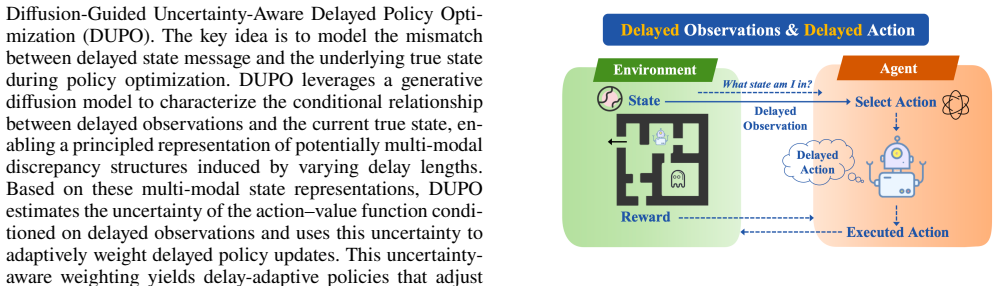
Summary. The paper studies continuous-control RL under random observation delays in stochastic MDPs. It proves that any measurable estimator of the current state from a delayed message has irreducible MSE at least linear in delay length (Theorem 1), and that greedy policies based on point estimates suffer delay-amplified suboptimality under strong-concavity and inverse-Lipschitz assumptions on Q* (Theorem 2). It then proposes DUPO: a conditional diffusion model for the multi-modal posterior p(s_t | M_t), Monte-Carlo estimation of critic variance over posterior samples, and inverse-variance reweighting of a SAC actor. On five MuJoCo-v4 tasks converted to stochastic MDPs (action noise N(0,0.1)) with uniform random delays ΔT_max ∈ {5,10,25}, DUPO reports higher normalized returns than DC/AC, state prediction, and state augmentation, with ablations on delay distributions, sampling mechanisms, and hyperparameters β, N.
Significance. If the theory–algorithm link holds, the work supplies a clean justification for full-posterior modeling over point prediction in delayed RL and a practical diffusion-based recipe that improves sample efficiency and stability under long random delays. Strengths include coherent appendix proofs under explicit regularity conditions, multi-seed reporting with mean±std, ablations of delay priors and posterior samplers, and a hyperparameter sensitivity table. The empirical gains on stochastic MuJoCo under ΔT_max=25 are substantial and of practical interest for real-world delayed control. The main open question is whether Theorem 2’s assumptions are satisfied by the deep critics that drive the experiments; even without that link, the algorithmic contribution remains useful.
major comments (3)
- Theorem 2 (and Lemmas 3–4) requires that Q*(s,·) is μ-strongly concave in a and that the greedy map a*(·) is locally inverse-Lipschitz with constant L_- > 0. Neither condition is checked for the SAC-style deep critics used on MuJoCo. Without them the linear-in-delay lower bound does not follow, so the theory does not rigorously establish that point-estimate methods (State-Pred) must degrade relative to posterior-aware weighting. A verification (e.g., local curvature diagnostics or a controlled low-dimensional MDP where the assumptions hold) or a weaker statement that does not rely on strong concavity would close this load-bearing gap.
- The critic is trained on delay-free transitions (Eqs. 17–18) while the actor is updated from delayed messages with uncertainty weights (Eqs. 19–20). In a true delayed environment the agent never observes s_t at decision time; the paper does not clarify how delay-free (s_t, a_t, r_t, s_{t+1}) tuples are obtained for the critic (privileged simulator access, delayed-label reconstruction, or offline buffer). If privileged state is required, the comparison to pure delayed baselines is not apples-to-apples and should be stated as a limitation.
- Table 1 normalizes every method by the DC/AC mean return. On several cells (e.g., Hopper ΔT_max=10, HalfCheetah ΔT_max=25) the absolute DC/AC returns appear very low, so large normalized ratios can arise from a weak baseline rather than absolute superiority. Reporting absolute returns (or both absolute and normalized) would make the magnitude of the gains clearer and allow readers to judge whether State-Pred/State-Aug are competitive in absolute terms.
minor comments (5)
- Abstract and introduction contain multiple missing spaces (“Reinforcementlearning”, “Existingapproaches”, “weightde-layed”, etc.); a full pass for spacing and hyphenation is needed.
- Figure 1 caption is terse; a short description of the delay timing would help readers who skip the text.
- Notation for the diffusion reverse process mixes n and k for the diffusion step; consistent indexing would reduce confusion.
- Related Work cites Wu et al. (2024a,b) and Wang et al. (2024) but does not discuss how DUPO differs from variational delayed policy optimization beyond the diffusion vs. variational distinction; a sentence of contrast would be useful.
- Hyperparameter table lists Diffusion_num_samples=4 while the main text and ablation use N=10; reconcile or clarify the two quantities.
Circularity Check
No circularity: Theorems 1–2 are standard Bayes-risk / performance-difference lower bounds under explicit regularity conditions; the algorithm and MuJoCo numbers are independent empirical evaluations, not forced by fitted inputs or self-citation.
full rationale
The paper’s load-bearing theoretical claims are Theorem 1 (irreducible MSE of any measurable estimator g(Mt) is at least linear in realized delay) and Theorem 2 (point-estimate greedy policies suffer delay-amplified suboptimality). Both are derived in the appendix from elementary arguments: Lemma 1 is the usual Bayes-risk decomposition E∥s−g(M)∥² ≥ E tr(Σ(M)); Lemma 2 unrolls the conditional-variance recursion under the stated non-vanishing noise and non-contraction assumptions (ν, κ); Lemmas 3–5 invoke µ-strong concavity of Q*, local inverse-Lipschitz of a*, and the standard performance-difference identity. None of these steps define a quantity in terms of itself, fit a free parameter to data and then “predict” a related quantity, or import a uniqueness theorem from the same authors. The free knobs of DUPO (β, N, diffusion schedule) appear only in the algorithm and ablation tables; they are never substituted into the theorems. Empirical comparisons to DC/AC, State-Pred and State-Aug are ordinary baseline evaluations on stochastic MuJoCo, not circular self-predictions. Mild citations of prior delayed-RL work (including Wu et al.) are ordinary related-work references and do not underwrite the lower bounds. Consequently the derivation chain is self-contained and non-circular.
Assumptions & free parameters
free parameters (4)
- uncertainty weight coefficient β =
0.8 (default)
- posterior sample count N =
10 (default)
- action execution noise std =
0.1
- diffusion training/update schedule =
Table 3 defaults
assumptions (5)
- domain assumption Latent dynamics along the delay window are S_{j+1}=f(S_j,A_j)+ξ_j with conditionally centered, non-vanishing noise tr(Cov(ξ_j|F_t))≥ν>0 and non-contracting deterministic map tr(Cov(f|F_t))≥κ tr(Cov(S_j|F_t)), κ≥1.
- domain assumption Q*(s,·) is μ-strongly concave in a and a*(·) is locally inverse-Lipschitz with constant L_->0.
- domain assumption Random observation delay POMDP: agent observes M_t=(s_{t-ΔT}, a_{t-ΔT:t-1}) with ΔT~D bounded by D, and standard discounted return objective.
- standard math Conditional diffusion models can approximate complex multi-modal conditionals p(s_t|M_t) via noise-prediction training (Ho et al. 2020 style).
- domain assumption Critic trained on delay-free transitions while actor is conditioned on delayed messages (standard delayed-RL treatment).
invented entities (2)
-
DUPO uncertainty-weighted delayed policy π′_ϕ
-
Diffusion-based multi-modal delay-free state posterior estimator p_θ(s_t|M_t)
Cite this review
Pith. "Pith review of Diffusion-Guided Uncertainty-Aware Delayed Policy Optimization." pith.science (2026). https://pith.science/paper/BMI274YR
@misc{pith2026260705064,
  author       = {Pith},
  title        = {Pith review of: Diffusion-Guided Uncertainty-Aware Delayed Policy Optimization},
  year         = {2026},
  howpublished = {\url{https://pith.science/paper/BMI274YR}},
  note         = {Machine review of arXiv:2607.05064}
}
read the original abstract
Reinforcement learning in real world environments often suffers from severe performance degradation due to delayed feedback. Existing approaches typically mitigate performance degradation caused by observation delays by constructing augmented states or predicting the true states. However, these methods often overlook the inherent discrepancy between delayed state and true states induced by stochastic MDP. We theoretically prove the existence of such a discrepancy and show that it leads to the degradation of the optimal policy. To address this challenge, we propose Diffusion Guided Uncertainty Aware Delayed Policy Optimization (DUPO). Our method explicitly models the relationship between delayed state message and the current state using a diffusion model, and leverages the resulting discrepancy estimates to weight delayed policies. Extensive experiments on continuous robotic control tasks with multiple stochastic delays demonstrate that DUPO consistently outperforms existing methods and remains effective even under long and random delay scenarios.
Figures


Figures from the paper (2 more)


Reference graph
Works this paper leans on
-
[1]
Science , volume =
A general reinforcement learning algorithm that masters chess, shogi, and Go through self-play , author =. Science , volume =
-
[2]
arXiv preprint arXiv:1912.06680 , year =
Dota 2 with Large Scale Deep Reinforcement Learning , author =. arXiv preprint arXiv:1912.06680 , year =
arXiv 1912
-
[3]
Proceedings of the 35th International Conference on Machine Learning (ICML) , series =
Soft Actor-Critic: Off-Policy Maximum Entropy Deep Reinforcement Learning with a Stochastic Actor , author =. Proceedings of the 35th International Conference on Machine Learning (ICML) , series =. 2018 , publisher =
2018
-
[4]
Nature , volume =
Dense deep reinforcement learning for safety validation of autonomous driving , author =. Nature , volume =
-
[5]
Machine Learning , volume =
Challenges of Real-World Reinforcement Learning: Definitions, Benchmarks and Analysis , author =. Machine Learning , volume =
-
[6]
Journal of Financial Markets , volume =
Low-Latency Trading , author =. Journal of Financial Markets , volume =
-
[7]
Stability and Control of Time-Delay Systems , author =
-
[8]
2003 , note =
Advances in Time-Delay Systems , editor =. 2003 , note =
2003
Show all 39 references
-
[9]
2018 IEEE/RSJ International Conference on Intelligent Robots and Systems (IROS) , pages =
Setting up a Reinforcement Learning Task with a Real-World Robot , author =. 2018 IEEE/RSJ International Conference on Intelligent Robots and Systems (IROS) , pages =. 2018 , organization =
2018
-
[10]
IEEE Transactions on Automatic Control , volume =
Markov decision processes with delays and asynchronous cost collection , author =. IEEE Transactions on Automatic Control , volume =
-
[11]
Proceedings of the 1992 ACM SIGMETRICS Conference on Measurement and Modeling of Computer Systems , pages =
Closed-loop control with delayed information , author =. Proceedings of the 1992 ACM SIGMETRICS Conference on Measurement and Modeling of Computer Systems , pages =
1992
-
[12]
Dynamic Programming and Optimal Control , author =
-
[13]
Autonomous Agents and Multi-Agent Systems , volume =
Learning and planning in environments with delayed feedback , author =. Autonomous Agents and Multi-Agent Systems , volume =
-
[14]
arXiv preprint arXiv:1810.07286 , year =
At Human Speed: Deep Reinforcement Learning with Action Delay , author =. arXiv preprint arXiv:1810.07286 , year =
-
[15]
Proceedings of the International Conference on Automated Planning and Scheduling (ICAPS) , year =
Reinforcement Learning with Delayed Observations , author =. Proceedings of the International Conference on Automated Planning and Scheduling (ICAPS) , year =
-
[16]
ICLR , year=
Addressing Signal Delay in Deep Reinforcement Learning , author=. ICLR , year=
-
[17]
Proceedings of the 30th ACM International Conference on Information & Knowledge Management (CIKM) , year =
Revisiting State Augmentation Methods for Reinforcement Learning with Stochastic Delays , author =. Proceedings of the 30th ACM International Conference on Information & Knowledge Management (CIKM) , year =
-
[18]
International Conference on Learning Representations (ICLR) , year =
Acting in Delayed Environments with Non-Stationary Markov Policies , author =. International Conference on Learning Representations (ICLR) , year =
-
[19]
International Joint Conference on Neural Networks (IJCNN) , year =
Learning a Belief Representation for Delayed Reinforcement Learning , author =. International Joint Conference on Neural Networks (IJCNN) , year =
-
[20]
arXiv preprint arXiv:2402.03141 , year =
Boosting Reinforcement Learning with Strongly Delayed Feedback through Auxiliary Short Delays , author =. arXiv preprint arXiv:2402.03141 , year =
-
[21]
arXiv preprint arXiv:1904.12901 , year =
Challenges of Real-World Reinforcement Learning , author =. arXiv preprint arXiv:1904.12901 , year =
1904 arXiv
-
[22]
2010 IEEE/RSJ International Conference on Intelligent Robots and Systems (IROS) , pages =
Control Delay in Reinforcement Learning for Real-Time Dynamic Systems: A Memoryless Approach , author =. 2010 IEEE/RSJ International Conference on Intelligent Robots and Systems (IROS) , pages =. 2010 , organization =
2010
-
[23]
Autonomous Agents and Multi-Agent Systems , volume =
Learning and Planning in Environments with Delayed Feedback , author =. Autonomous Agents and Multi-Agent Systems , volume =
-
[24]
2021 International Joint Conference on Neural Networks (IJCNN) , pages =
Learning a Belief Representation for Delayed Reinforcement Learning , author =. 2021 International Joint Conference on Neural Networks (IJCNN) , pages =. 2021 , organization =
2021
-
[25]
Neurocomputing , volume =
Delay-Aware Model-Based Reinforcement Learning for Continuous Control , author =. Neurocomputing , volume =
-
[26]
Advances in Neural Information Processing Systems (NeurIPS) , year =
Belief Projection-Based Reinforcement Learning for Environments with Delayed Feedback , author =. Advances in Neural Information Processing Systems (NeurIPS) , year =
-
[27]
International Conference on Learning Representations (ICLR) , year =
Reinforcement Learning with Random Delays , author =. International Conference on Learning Representations (ICLR) , year =
-
[28]
International Conference on Machine Learning (ICML) , year =
Boosting Reinforcement Learning with Strongly Delayed Feedback Through Auxiliary Short Delays , author =. International Conference on Machine Learning (ICML) , year =
-
[29]
arXiv preprint arXiv:2406.03102 , year =
DEER: A Delay-Resilient Framework for Reinforcement Learning with Variable Delays , author =. arXiv preprint arXiv:2406.03102 , year =
-
[30]
arXiv preprint arXiv:2507.18992 , year =
Reinforcement Learning via Conservative Agent for Environments with Random Delays , author =. arXiv preprint arXiv:2507.18992 , year =
-
[31]
International Conference on Machine Learning (ICML) , pages =
Delayed Reinforcement Learning by Imitation , author =. International Conference on Machine Learning (ICML) , pages =. 2022 , organization =
2022
-
[32]
Advances in Neural Information Processing Systems (NeurIPS) , year =
Variational Delayed Policy Optimization , author =. Advances in Neural Information Processing Systems (NeurIPS) , year =
-
[33]
Advances in Neural Information Processing Systems (NeurIPS) , year =
Diffusion-based Reinforcement Learning via Q-weighted Variational Policy Optimization , author =. Advances in Neural Information Processing Systems (NeurIPS) , year =
-
[34]
International Conference on Learning Representations (ICLR) , year =
DMBP: Diffusion Model-Based Predictor for Robust Offline Reinforcement Learning against State Observation Perturbations , author =. International Conference on Learning Representations (ICLR) , year =
-
[35]
Artificial Intelligence , volume =
Planning and Acting in Partially Observable Stochastic Domains , author =. Artificial Intelligence , volume =. 1998 , publisher =
1998
-
[36]
Denoising Diffusion Probabilistic Models , booktitle =
Jonathan Ho and Ajay Jain and Pieter Abbeel , editor =. Denoising Diffusion Probabilistic Models , booktitle =
-
[37]
Diffusion Models Beat GANs on Image Synthesis , booktitle =
Prafulla Dhariwal and Alexander Quinn Nichol , editor =. Diffusion Models Beat GANs on Image Synthesis , booktitle =
-
[38]
Proceedings of the 38th International Conference on Machine Learning (ICML) , series =
Uncertainty Weighted Actor-Critic for Offline Reinforcement Learning , author =. Proceedings of the 38th International Conference on Machine Learning (ICML) , series =. 2021 , publisher =
2021
-
[39]
2012 IEEE/RSJ International Conference on Intelligent Robots and Systems (IROS) , year =
MuJoCo: A physics engine for model-based control , author =. 2012 IEEE/RSJ International Conference on Intelligent Robots and Systems (IROS) , year =
2012
Reviewed July 11, 2026 · model on record in the stance chip above.
Discussion (0). Sign in to comment.