REVIEW 2 major objections 6 minor 33 references
Anti-chiral edge states in Heisenberg ferromagnet on a honeycomb lattice
T0 review · 2 major / 6 minor · reviewed 2026-08-14 · deepseek-v4-flash
Pith's one-line read Anti-chiral edge states arise in a honeycomb Heisenberg ferromagnet when the two sublattices have unequal Dzyaloshinskii-Moriya couplings: both edges carry magnon current the same way, balanced by bulk counterflow.
desk verdict A solid new route to anti-chiral edge states in a ferromagnet, pending a sublattice-resolved mean-field check. read the letter →
The pith
A machine-rendered reading of the paper's core claim, the machinery that carries it, and where it could break.
The reading
What carries the argument
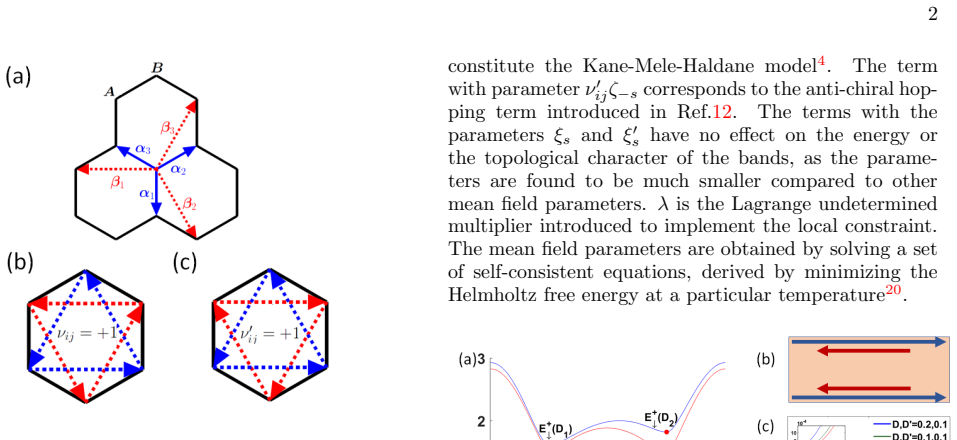
The central object is the mean-field spinon Hamiltonian obtained from a Schwinger-boson decoupling of the spin model, in which the spin operators are represented by two species of bosonic quasiparticles (spinons) and the four-spin terms are reduced to bilinear forms. The Hamiltonian takes the Kane-Mele-Haldane form plus the anti-chiral hopping term $D'\sum_{\langle\langle i,j\rangle\rangle}\nu'_{ij}\hat z\cdot(\mathbf{S}_i\times\mathbf{S}_j)$. Its decisive parameter is the band tilting $T_s^\tau=3\sqrt{3}\,|D'\zeta_{-s}|$: the antisymmetric DMI $D'$ shifts a spinon band upward at one Dirac point and downward at the other, tilting the two species in opposite directions. This tilt, not the Chern number, is what converts opposite edge currents into co-propagating edge currents; the velocity operator $\hat v = -i[\hat r,H]/\hbar$ computed in the ribbon geometry then gives the current profile across the width, showing edge currents of one sign and a compensating near-edge bulk current of the opposite sign.
What would settle it
Measure the magnon branches of a candidate two-sublattice honeycomb ferromagnet by inelastic neutron scattering: if the energies at the $K$ and $K'$ points are equal within each branch, the predicted tilt $T_s^\tau=3\sqrt{3}\,|D'\zeta_{-s}|$ is zero and the anti-chiral edge states cannot exist. Alternatively, rerun the ribbon calculation with independent order parameters for the two sublattices; if the co-propagating edge currents vanish, the single-parameter mean-field ansatz, not the physics, produced the effect.
Extended reading notes
Core claim
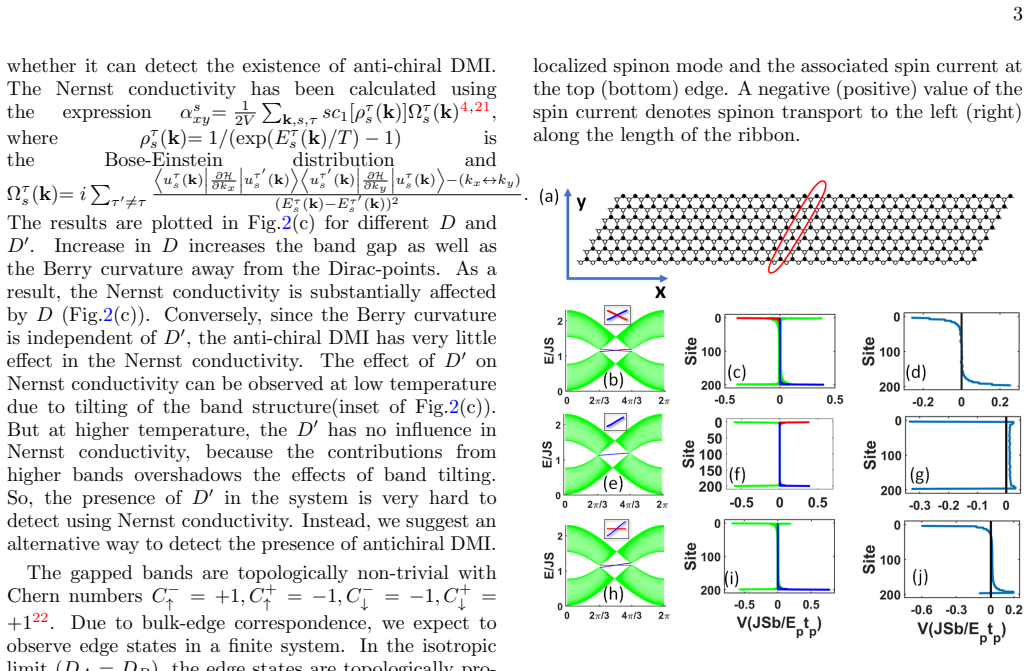
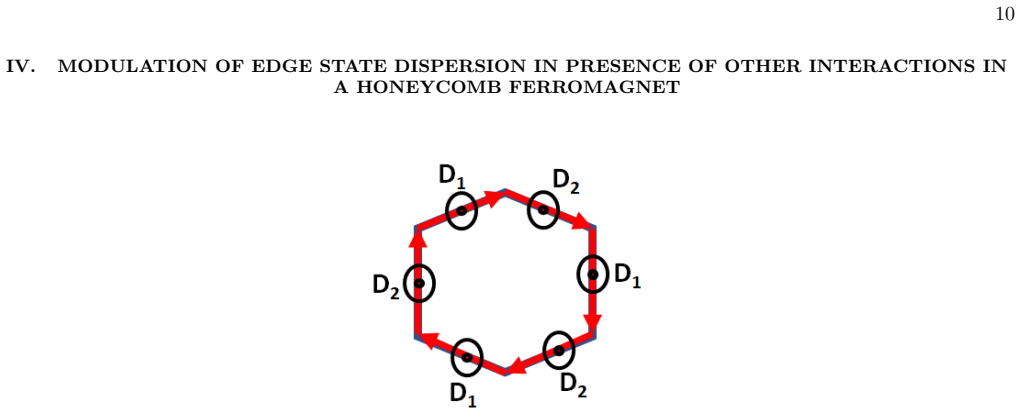
On a honeycomb ferromagnet with inequivalent sublattices, the next-nearest-neighbor DMI can differ between the two sublattices. Writing the two DMIs as $D=(D_A+D_B)/2$ and $D'=(D_A-D_B)/2$, the paper shows that $D'$ does not change the band gap but tilts each spinon band by $T_s^\tau = 3\sqrt{3}\,|D'\zeta_{-s}|$, with opposite tilts for up- and down-spinons. When $D'\gg D$, the edge-state dispersions at the two zigzag edges become identical, so each spinon species carries current in the same direction along both edges—anti-chiral edge states. Conservation of total current is restored by a counter-propagating bulk current concentrated near the edges, which exists because the anti-chiral DMI breaks the chiral symmetry that would otherwise forbid edge-to-bulk scattering. In the intermediate case $D\approx D'$, one edge becomes dispersionless and carries no current. The paper also proposes that replacing every other Ge atom by Si in CrGeTe$_3$ (or an analogous substitution in related honeycomb ferromagnets) breaks inversion symmetry and can realize the required asymmetric DMI.
Load-bearing premise
The calculation assumes that the two kinds of lattice sites participate in identical next-nearest-neighbor magnetic couplings and that two small auxiliary couplings can be dropped; if the two sublattices actually develop different correlations, or those auxiliary couplings matter, the predicted band tilt and co-propagating edge currents could change or disappear.
Editorial extensions
If this is right
- In any honeycomb ferromagnet with two inequivalent sublattices and finite next-nearest-neighbor DMI, the same band-tilting mechanism should produce anti-chiral edge states whenever the antisymmetric part $D'$ dominates the symmetric part $D$; the effect is not tied to one particular compound.
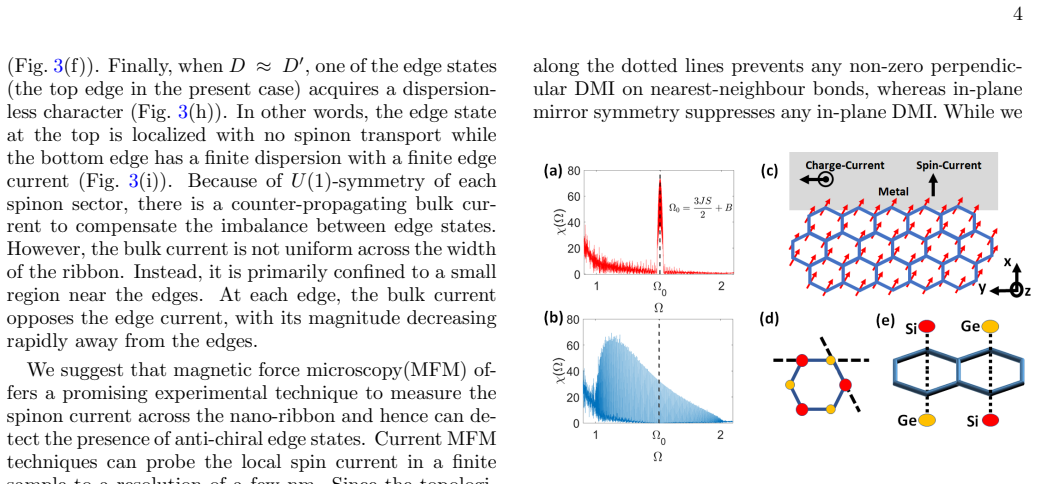
- The predicted spin-current profile across a ribbon—same-direction edge currents plus a near-edge bulk counterflow—offers a spatial fingerprint that magnetic force microscopy can in principle resolve.
- Inelastic neutron scattering should reveal the anti-chiral phase as an energy difference between the $K$ and $K'$ points within each magnon branch, corresponding to the tilt $T_s^\tau$, a feature absent for symmetric DMI.
- The edge dynamical spin structure factor becomes markedly different for the two edges when $|D|\approx |D'|$, giving a spectroscopic signature of anti-chiral edge modes in addition to the current profile.
- In a material realization, anti-chiral magnon transport means the bulk is not passive: currents injected at one edge can scatter into bulk counterflow, which must be accounted for in any magnonic device design.
Reading between the lines
- The paper leaves implicit that the same edge modes should also reverse the sign of the local thermal-Hall contribution near each edge, since the edge magnon group velocities now point the same way; a spatially resolved thermal-gradient measurement could test the picture without imaging currents.
- The essential mechanism—opposite Dirac-point shifts for two counterpropagating channels—may extend beyond magnetic spinons to other bosonic or fermionic Dirac systems with species-dependent hopping or on-site asymmetry, so the prediction is a template rather than a one-material effect.
- A testable extension would be an ab initio estimate of $D'$ in Ge/Si-substituted Cr-based honeycomb magnets, since the mean-field treatment here does not derive $D'$ from microscopic inputs; knowing whether realistic crystal fields can produce $D'\gg D$ would settle practical feasibility.
- Because the compensating bulk current is concentrated near the edges, boundary-only measurements may mistake the anti-chiral phase for ordinary chiral transport; resolving the near-edge bulk counterflow is the key experimental hurdle.
Editorial analysis
A structured set of objections, weighed in public.
Referee Report
Summary. The paper studies a Heisenberg ferromagnet on a honeycomb lattice with different Dzyaloshinskii-Moriya interactions on the two sublattices (D_A and D_B). Writing D=(D_A+D_B)/2 and D'=(D_A-D_B)/2, the authors use Schwinger-boson mean-field theory to show that D' shifts the two Dirac points in opposite directions, tilting the magnon bands. For sufficiently strong asymmetry, the edge modes on a ribbon acquire the same propagation direction on both edges, forming anti-chiral edge states, while a counter-propagating bulk current maintains zero net current. The paper characterizes the band structure, current profiles, and spin Nernst conductivity, proposes detection via magnetic force microscopy, spin Hall noise spectroscopy, and inelastic neutron scattering, and suggests a CrGeTe3/CrSiTe3-based material as a potential realization. The central mechanism is transparent: D' enters the mean-field Hamiltonian as an identity shift in g_s(k), producing a band tilt without changing the Chern numbers, and the edge-state behavior follows from ribbon calculations.
Significance. If the central claim holds, the paper provides a realistic microscopic route to anti-chiral magnon edge channels in insulating magnets, extending earlier electronic proposals (Colomés and Franz) to magnetic systems with broken sublattice symmetry. The derivation is internally consistent: the band structure, the tilting formula T = 3√3|D'ζ_{-s}|, the ribbon dispersions, and the current profiles all follow from the stated Hamiltonian and the SBMFT decomposition. The robustness check in Appendix IV, which includes nearest-neighbor DMI and further Heisenberg terms with CrI3 parameters, is a genuine strength, as are the concrete experimental signatures and the material proposal. The main weakness is that the mean-field ansatz assumes a single next-nearest-neighbor order parameter ζ_s for both sublattices and a uniform Lagrange multiplier λ, even though the physical Hamiltonian breaks sublattice equivalence; this point is central to the band tilting and is not examined in the manuscript.
major comments (2)
- [Eq. (8) and Eq. (13)] The mean-field decoupling uses a single NNN order parameter ζ_s for all next-nearest-neighbor bonds and a uniform λ, despite the Hamiltonian explicitly breaking sublattice equivalence through D_A≠D_B. The self-consistent equation for ζ_s in Eq. (13) defines it as an average over all NNN bonds; nothing in the formalism forces the A-bond and B-bond expectation values to coincide. A sublattice-resolved solution with ζ_A^s≠ζ_B^s would enter Eq. (8) through effective couplings (D+D')ζ_A and (D-D')ζ_B, changing both the identity and the σ_z components of the Hamiltonian and hence the tilting T = 3√3|D'ζ_{-s}| and the edge-state regime boundaries in Fig. 3. Because the anti-chiral edge states are the central claim, the authors should either solve the two-parameter self-consistency or demonstrate numerically that ζ_A^s−ζ_B^s is negligible for the parameters used.
- [Main text after Eq. (2)] The assertion that ξ_s and ξ'_s are 'much smaller' than the other mean-field parameters is not quantified. These parameters enter g_s(k) in Eq. (8) as band shifts and could therefore modify the effective tilting and the edge-state velocities, even though they do not change the Chern numbers. The authors should report the computed values, for example ξ_s/ζ_s, and show that the anti-chiral phase persists when these terms are retained self-consistently.
minor comments (6)
- [Main text after Eq. (2)] The sentence 'The terms with the parameters ξs and ξ′s have no effect on the energy or the topological character of the bands' is imprecise: those terms do shift the band energies through g_s(k); they only leave the Chern character unchanged. Please rephrase.
- [Fig. 3 discussion] In the text discussing Fig. 3, the band dispersions for the three parameter sets are shown in Figs. 3(b), 3(e), and 3(h), not 3(c), 3(f), and 3(i); please correct the figure callouts.
- [Fig. 1(b) and Eq. (8)] The sign convention for ν_ij deserves an explicit sentence: in the usual Haldane convention, the arrows on the two sublattices point oppositely for the same bond vector, which is why D' enters as the identity shift in Eq. (8). Without this explanation, the Fourier transform leading to Eq. (8) is difficult for the reader to verify.
- [Abstract and Sec. III] The manuscript alternates between 'spinon' and 'magnon' without defining the correspondence; state explicitly that at low temperature the down-spinon band is the Holstein-Primakoff magnon.
- [Experimental proposal] The proposal to detect spinon currents with magnetic force microscopy should be qualified: MFM senses static magnetic forces, not a pure spin current directly. Please explain the transduction mechanism or replace this with a technique that measures spin accumulation or spin noise.
- [References] References 26 and 27 appear to be duplicated, and the bibliography is not in numerical order (35 appears before 3); please clean up the reference list.
Circularity Check
No significant circularity: anti-chiral edge states are derived from the D' input via self-consistent SBMFT and stripe diagonalization, not inserted into the premises.
full rationale
The paper's central claim is that unequal sublattice DMI (D_A ≠ D_B) produces D' = (D_A − D_B)/2, which enters the spinon Hamiltonian as an anti-chiral next-nearest-neighbor hopping; the band tilting T_s^τ = 3√3 |D' ζ_{−s}| is computed from the mean-field Hamiltonian (Eq. 8) with ζ_s obtained by solving the self-consistent equations (Eq. 13), not fitted to the target edge-state behavior. The edge-state dispersions and spin-current profiles in Fig. 3 follow from exact diagonalization of the stripe Hamiltonian (Eqs. 14–20) using those same mean-field parameters, and the bulk counter-current is read off from those eigenstates rather than assumed. No load-bearing step defines a quantity in terms of the target result, calls a fitted parameter a prediction, imports a uniqueness claim from the authors' prior work, or demands that the reader accept a self-citation in place of calculation. The term 'anti-chiral DMI' is introduced as a label before the analysis, but the existence of co-propagating edge currents is not asserted as input; it is obtained from the computed band structure. The only self-reference is a robustness check citing the authors' own Supplementary Material for the claim that additional Heisenberg and nearest-neighbor DMI terms distort but do not suppress the edge modes; that claim is peripheral and does not carry the central derivation. The reader's flagged weakness—the sublattice-uniform NNN mean-field ansatz ζ_s and the neglect of ξ_s and ξ'_s—is a validity concern about an uncontrolled approximation, not circularity: even if a more general mean-field solution changed the results, the derivation would still not be equivalent to its inputs. Therefore the circularity score is 0.
Assumptions & free parameters
free parameters (4)
- Spin magnitude S
- DMI parameters D and D' (D_A = D+D', D_B = D-D') =
D = 0.001-0.1 J, D' = 0.001-0.1 J in figures
- Zeeman field B =
0.1 J
- Temperature T =
0.25 J and 0.5 J
assumptions (5)
- domain assumption The spin Hamiltonian (Eq. 1) contains only nearest-neighbor Heisenberg exchange and next-nearest-neighbor DMI with sublattice-dependent magnitudes (D_A ≠ D_B).
- domain assumption Schwinger boson mean-field decoupling of the quartic spin operators into bilinear spinon terms.
- ad hoc to paper A single mean-field order parameter ζ_s is used for all next-nearest-neighbor bonds, with ξ_s and ξ'_s neglected as small.
- domain assumption The ferromagnetic ground state is stable for the chosen parameters, satisfying the stated inequality.
- standard math Bose-Einstein statistics and standard Fourier/linear-algebra diagonalization for the periodic spinon Hamiltonian.
Cite this review
Pith. "Pith review of Anti-chiral edge states in Heisenberg ferromagnet on a honeycomb lattice." pith.science (2026). https://pith.science/paper/BMUAX6JH
@misc{pith2026190804580,
  author       = {Pith},
  title        = {Pith review of: Anti-chiral edge states in Heisenberg ferromagnet on a honeycomb lattice},
  year         = {2026},
  howpublished = {\url{https://pith.science/paper/BMUAX6JH}},
  note         = {Machine review of arXiv:1908.04580}
}
read the original abstract
We demonstrate the emergence of anti-chiral edge states in a Heisenberg ferromagnet with Dzyaloshinskii-Moriya interaction(DMI) on a honeycomb lattice with in-equivalent sub-lattices. The DMI, which acts between atoms of the same species, differs in magnitude for the two sub-lattices, resulting in a shifting of the energy of the magnon bands in opposite directions at the two Dirac points. The chiral symmetry is broken and for sufficiently strong asymmetry, the band shifting leads to anti-chiral edge states (in addition to the normal chiral edge states) in a rectangular strip where the magnon current propagates in the same direction along the two edges. This is compensated by a counter-propagating bulk current that is enabled by the broken chiral symmetry. We analyze the resulting magnon current profile across the width of the system in details and suggest realistic experimental probes to detect them. Finally, we propose a material that can potentially exhibit such anti-chiral edge states.
Figures
Figures from the paper (4 more)


Reference graph
Works this paper leans on
-
[1]
author author F. D. M. \ Haldane ,\ 10.1103/PhysRevLett.61.1029 journal journal Phys. Rev. Lett. \ volume 61 ,\ pages 1029 ( year 1988 ) NoStop
-
[2]
author author L. Chen , author J.-H. \ Chung , author B. Gao , author T. Chen , author M. B. \ Stone , author A. I. \ Kolesnikov , author Q. Huang , \ and\ author P. Dai ,\ 10.1103/PhysRevX.8.041028 journal journal Phys. Rev. X \ volume 8 ,\ pages 041028 ( year 2018 ) NoStop
-
[3]
author author H.-S. \ Kim \ and\ author H.-Y. \ Kee ,\ 10.1038/s41535-017-0021-z journal journal npj Quantum Materials \ volume 2 ,\ eid 20 ( year 2017 ) NoStop
-
[4]
author author S. K. \ Kim , author H. Ochoa , author R. Zarzuela , \ and\ author Y. Tserkovnyak ,\ 10.1103/PhysRevLett.117.227201 journal journal \ volume 117 ,\ eid 227201 ( year 2016 ) NoStop
-
[5]
author author V. A. \ Zyuzin \ and\ author A. A. \ Kovalev ,\ 10.1103/PhysRevLett.117.217203 journal journal Phys. Rev. Lett. \ volume 117 ,\ pages 217203 ( year 2016 ) NoStop
-
[6]
author author R. Cheng , author S. Okamoto , \ and\ author D. Xiao ,\ 10.1103/PhysRevLett.117.217202 journal journal Phys. Rev. Lett. \ volume 117 ,\ pages 217202 ( year 2016 ) NoStop
-
[7]
author author Y. Zhang , author S. Okamoto , \ and\ author D. Xiao ,\ 10.1103/PhysRevB.98.035424 journal journal Phys. Rev. B \ volume 98 ,\ pages 035424 ( year 2018 ) NoStop
-
[8]
author author Y. Onose , author T. Ideue , author H. Katsura , author Y. Shiomi , author N. Nagaosa , \ and\ author Y. Tokura ,\ 10.1126/science.1188260 journal journal Science \ volume 329 ,\ pages 297 ( year 2010 ) NoStop
Show all 33 references
-
[9]
Hirschberger , author J
author author M. Hirschberger , author J. W. \ Krizan , author R. J. \ Cava , \ and\ author N. P. \ Ong ,\ 10.1126/science.1257340 journal journal Science \ volume 348 ,\ pages 106 ( year 2015 ) NoStop
2015 doi
-
[10]
Ideue , author Y
author author T. Ideue , author Y. Onose , author H. Katsura , author Y. Shiomi , author S. Ishiwata , author N. Nagaosa , \ and\ author Y. Tokura ,\ 10.1103/PhysRevB.85.134411 journal journal Phys. Rev. B \ volume 85 ,\ pages 134411 ( year 2012 ) NoStop
-
[11]
Hentrich , author M
author author R. Hentrich , author M. Roslova , author A. Isaeva , author T. Doert , author W. Brenig , author B. B\"uchner , \ and\ author C. Hess ,\ 10.1103/PhysRevB.99.085136 journal journal Phys. Rev. B \ volume 99 ,\ pages 085136 ( year 2019 ) NoStop
-
[12]
Colom\'es \ and\ author M
author author E. Colom\'es \ and\ author M. Franz ,\ 10.1103/PhysRevLett.120.086603 journal journal Phys. Rev. Lett. \ volume 120 ,\ pages 086603 ( year 2018 ) NoStop
2018 doi
-
[13]
Mandal , author R
author author S. Mandal , author R. Ge , \ and\ author T. C. H. \ Liew ,\ 10.1103/PhysRevB.99.115423 journal journal Phys. Rev. B \ volume 99 ,\ pages 115423 ( year 2019 ) NoStop
2019 doi
-
[14]
Vila , author N
author author M. Vila , author N. T. \ Hung , author S. Roche , \ and\ author R. Saito ,\ 10.1103/PhysRevB.99.161404 journal journal Phys. Rev. B \ volume 99 ,\ pages 161404(R) ( year 2019 ) NoStop
2019 doi
-
[15]
author author S. S. \ Pershoguba , author S. Banerjee , author J. C. \ Lashley , author J. Park , author H. gren , author G. Aeppli , \ and\ author A. V. \ Balatsky ,\ 10.1103/PhysRevX.8.011010 journal journal Phys. Rev. X \ volume 8 ,\ pages 011010 ( year 2018 ) NoStop
-
[16]
author author S. A. \ Owerre ,\ 10.1088/0953-8984/28/38/386001 journal journal Journal of Physics Condensed Matter \ volume 28 ,\ eid 386001 ( year 2016 a ) NoStop
2016 doi
-
[17]
author author S. A. \ Owerre ,\ 10.1063/1.4959815 journal journal Journal of Applied Physics \ volume 120 ,\ eid 043903 ( year 2016 b ) NoStop
2016 doi
-
[18]
author author S. A. \ Owerre ,\ 10.1088/2399-6528/aa8843 journal journal Journal of Physics Communications \ volume 1 ,\ pages 021002 ( year 2017 ) NoStop
2017 doi
-
[19]
author author P. A. \ Pantale \' o n , author R. Carrillo-Bastos , \ and\ author Y. Xian ,\ 10.1088/1361-648x/aaf77b journal journal Journal of Physics: Condensed Matter \ volume 31 ,\ pages 085802 ( year 2019 ) NoStop
2019 doi
-
[20]
@noop journal Supplementary Matrial \ NoStop
-
[21]
journal author author A. A. \ Kovalev \ and\ author V. Zyuzin ,\ 10.1103/PhysRevB.93.161106 journal journal Phys. Rev. B \ volume 93 ,\ pages 161106(R) ( year 2016 ) NoStop
2016 doi
-
[22]
Matsuoka , author K
author author E. Matsuoka , author K. Hayashi , author A. Ikeda , author K. Tanaka , author T. Takabatake , \ and\ author M. Matsumura ,\ 10.1143/JPSJ.74.1382 journal journal Journal of the Physical Society of Japan \ volume 74 ,\ pages 1382 ( year 2005 ) NoStop
-
[23]
author author D. G. \ Joshi , author A. P. \ Schnyder , \ and\ author S. Takei ,\ 10.1103/PhysRevB.98.064401 journal journal \ volume 98 ,\ eid 064401 ( year 2018 ) ,\ http://arxiv.org/abs/1803.11239 arXiv:1803.11239 [cond-mat.str-el] NoStop
2018 arXiv
-
[24]
author author E. J. \ Samuelsen , author R. Silberglitt , author G. Shirane , \ and\ author J. P. \ Remeika ,\ 10.1103/PhysRevB.3.157 journal journal Phys. Rev. B \ volume 3 ,\ pages 157 ( year 1971 ) NoStop
1971 doi
-
[25]
Tsubokawa ,\ 10.1143/JPSJ.15.1664 journal journal Journal of the Physical Society of Japan \ volume 15 ,\ pages 1664 ( year 1960 ) NoStop
author author I. Tsubokawa ,\ 10.1143/JPSJ.15.1664 journal journal Journal of the Physical Society of Japan \ volume 15 ,\ pages 1664 ( year 1960 ) NoStop
1960 doi
-
[27]
author author T. J. \ Williams , author A. A. \ Aczel , author M. D. \ Lumsden , author S. E. \ Nagler , author M. B. \ Stone , author J.-Q. \ Yan , \ and\ author D. Mandrus ,\ 10.1103/PhysRevB.92.144404 journal journal Phys. Rev. B \ volume 92 ,\ pages 144404 ( year 2015 b ) NoStop
-
[28]
Gong , author L
author author C. Gong , author L. Li , author Z. Li , author H. Ji , author A. Stern , author Y. Xia , author T. Cao , author W. Bao , author C. Wang , author Y. Wang , author Z. Qiu , author R. Cava , author S. G. Louie , author J. Xia , \ and\ author X. Zhang ,\ 10.1364/CLEO...
-
[29]
Lee , author J
author author H. Lee , author J. H. \ Han , \ and\ author P. A. \ Lee ,\ 10.1103/PhysRevB.91.125413 journal journal Phys. Rev. B \ volume 91 ,\ pages 125413 ( year 2015 ) NoStop
2015 doi
-
[30]
Sarker , author C
author author S. Sarker , author C. Jayaprakash , author H. R. \ Krishnamurthy , \ and\ author M. Ma ,\ 10.1103/PhysRevB.40.5028 journal journal Phys. Rev. B \ volume 40 ,\ pages 5028 ( year 1989 ) NoStop
1989 doi
-
[31]
Tchernyshyov \ and\ author S
author author O. Tchernyshyov \ and\ author S. Sondhi ,\ https://doi.org/10.1016/S0550-3213(02)00482-0 journal journal Nuclear Physics B \ volume 639 ,\ pages 429 ( year 2002 ) NoStop
2002 doi
-
[32]
Guclu , author P
author author A. Guclu , author P. Potasz , author M. Korkusinski , \ and\ author P. Hawrylak ,\ 10.1007/978-3-662-44611-9 title Graphene Quantum Dots \ ( year 2014 ) NoStop
2014 doi
-
[33]
author author G. D. Mahan ,\ 10.1007/978-1-4757-5714-9 \ ( year 2000 ),\ 10.1007/978-1-4757-5714-9 NoStop
2000 doi
-
[34]
author author Laurent ,\ https://physics.stackexchange.com/q/53270 title Typical operators in tight binding , \ howpublished Physics Stack Exchange NoStop
Reviewed August 14, 2026 · model on record in the stance chip above.
Discussion (0). Continue with ORCID to comment.