REVIEW 2 major objections 5 minor 80 references
Mechanistic bridges from receptors to whole-brain dynamics: mean-field reductions, validity domains, and computational trade-offs
T0 review · 2 major / 5 minor · reviewed 2026-08-06 · deepseek-v4-flash
Pith's one-line read Receptor-level synaptic kinetics and spike-frequency adaptation can be carried explicitly through mean-field reductions to whole-brain dynamics, provided every step of the reduction chain is independently validated.
desk verdict A self-critical methodological review of the Destexhe-lineage mean-field models, with genuinely useful new cost-accounting and a scaling-class distinction; the central claim is conditional and honestly hedged, so it deserves peer review. read the letter →
The pith
A machine-rendered reading of the paper's core claim, the machinery that carries it, and where it could break.
The reading
What carries the argument
The load-bearing object is the finite-bin master-equation transition kernel for population activities, closed by a single-neuron transfer function $F_\mu$; a second-order moment closure yields ODEs for mean activities, covariances, and lagged correlations. The transfer function is the semi-analytical $\mathrm{erfc}$-based expression with a phenomenological effective threshold $V^\mathrm{eff}_\mathrm{thresh}$ fitted to single-neuron and in vitro data, and spike-frequency adaptation is promoted to an explicit mesoscopic state variable $W_\mu$ with a slow time constant $\tau_w$. The scaling conclusions come from counting arithmetic work and memory traffic for node-local versus global covariance closures.
What would settle it
Simulate the reference 10,000-neuron conductance-based AdEx network with AMPA, NMDA, and GABAA synapses in the Up-Down slow-wave regime, using the same receptor and adaptation parameters that the mean-field model maps to $(\tau_e, \tau_i, b_e)$; compare population rates, Up/Down dwell-time statistics, and response gain to the first-order adaptive mean-field predictions. If the reduced model fails to reproduce the spiking network's dwell-time distributions or state-dependent responsiveness within a stated tolerance while the transfer functions remain calibrated, the claim that receptor parameters survive the reduction in that regime is falsified.
Extended reading notes
Core claim
The paper's central claim is that mechanistic continuity across scales is possible without retaining microscopic trajectories, but only selectively and conditionally. The lineage examined preserves intervention coordinates — effective synaptic decay times for excitatory and inhibitory receptors and an excitatory adaptation parameter — that can be perturbed and related to population states, large-scale propagation, and empirical observables such as VSDi, BOLD, and perturbational complexity. Node-local biological detail mainly changes computational prefactors, whereas dense propagation of global covariances changes the scaling class; therefore cross-scale models should be judged by the intervention pathways and observables they preserve, their validity domain, identifiability, empirical adequacy, and computational burden, not by output alone.
Load-bearing premise
The load-bearing premise is that the phenomenological effective-threshold transfer functions fitted to single-neuron and in vitro data remain valid closures for population dynamics in regimes outside their calibration domain, including Up-Down slow-wave states and connectome embedding, where asynchronous-irregular, diffusion, and quasi-stationarity assumptions are violated.
Editorial extensions
If this is right
- Effective receptor parameters — inhibitory decay time $\tau_i$, excitatory decay time $\tau_e$, and excitatory adaptation $b_e$ — can shift simulated dynamics between wake-like activity and anesthesia- or NREM-like slow-wave states in the same whole-brain model.
- First-order whole-brain implementations omit the second-order covariance dynamics; the external Ornstein–Uhlenbeck drive they use is not equivalent to endogenous finite-size fluctuations, so variance and transition statistics near critical points are not trustworthy.
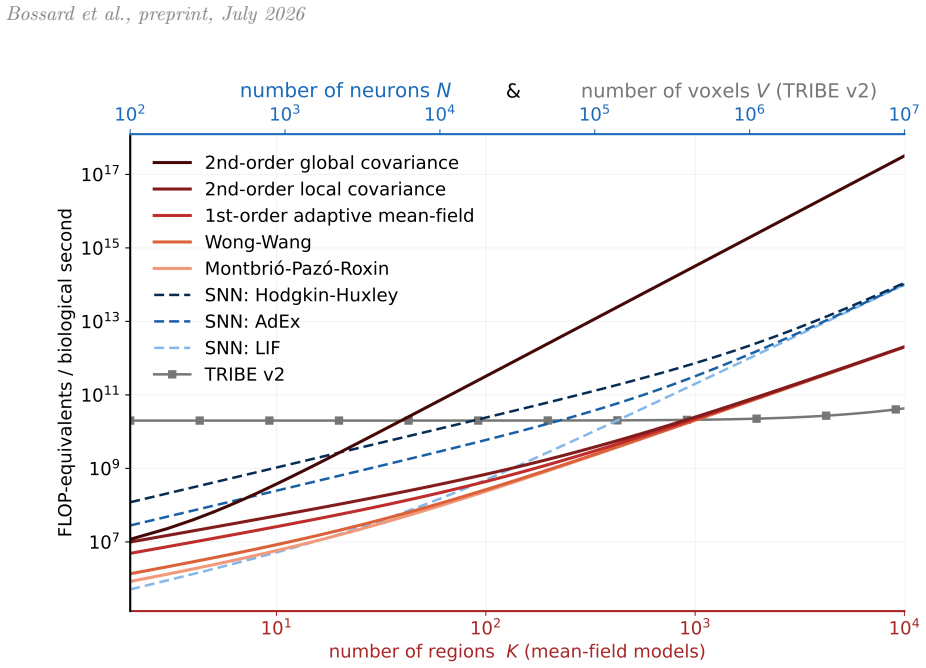
- Retaining covariances only within nodes preserves $\mathcal{O}(K + \rho K^2)$ whole-brain scaling, whereas dense global covariance propagation costs $\mathcal{O}(P^3 K^3)$ compute and $\mathcal{O}(P^2 K^2)$ memory, a different scaling class.
- Matched comparisons between a spiking network and its own mean-field surrogate reveal which observables the reduction preserves and where additional microscopic detail is scientifically irrelevant.
- Macroscopic agreement with BOLD or PCI indicates compatibility, not a unique molecular cause; identifiability and observation models are part of any cross-scale validation.
Reading between the lines
- Clustering neurons by fitted effective-threshold coefficients into a few functional subpopulations per node is a natural extension that could be tested for changes in whole-brain responsiveness and propagation.
- Because the mapping from molecular interventions to $(\tau_e, \tau_i, b_e)$ is non-unique, one can test identifiability directly by perturbing each receptor class separately in the whole-brain model and comparing macroscopic signatures.
- The scaling analysis implies a promising compromise: keep second-order covariances within each region while truncating inter-regional covariances, preserving some finite-size fluctuation structure at acceptable cost; this is a concrete design to benchmark.
- The semi-analytical transfer function could be compared head-to-head with a data-driven transfer function on out-of-distribution inputs to quantify how much mechanistic traceability is lost.
Editorial analysis
A structured set of objections, weighed in public.
Referee Report
Summary. This review reconstructs the master-equation mean-field lineage from El Boustani and Destexhe through Zerlaut, Di Volo, and Sacha, and asks which microscopic mechanisms remain explicit, interpretable, and testable after successive reductions to whole-brain dynamics. It traces the derivation from finite-size population statistics through semi-analytical effective-threshold transfer functions to conductance-based adaptive nodes coupled via the connectome, and it compares this strategy with phenomenological neural masses, exact low-dimensional reductions, population-density methods, large-scale spiking models, and learned or hybrid surrogates. The paper also develops a FLOP-equivalent and memory-traffic accounting framework for comparing computational burden. The central claim is explicitly conditional: receptor-dependent synaptic kinetics, conductance state, and spike-frequency adaptation can remain manipulable across scales when each reduction step is independently validated within its stated validity domain.
Significance. If read as a conditional methodological review, the paper is valuable and timely. Its main strengths are that it makes the reduction chain auditable, explicitly itemizes the assumptions behind each step, and does not claim universality for the receptor-aware mean-field approach. The detailed supplementary derivations, the separation of simulator-to-surrogate faithfulness from empirical adequacy, and the reproducible cost-accounting conventions are genuine contributions that will help researchers choose and benchmark cross-scale models. The central thesis is defensible as a programmatic claim, and the paper is appropriately careful in most places about distinguishing established results from extrapolations. The main gaps are local: two specific points in the transfer-function and whole-brain validation chain need clearer labeling, but they do not invalidate the review's central message.
major comments (2)
- [§7.1 and §6.1, Eq. (7)] The adaptive transfer function used in the whole-brain model removes the explicit logarithmic conductance term P_⟨g⟩ log(⟨g⟩/g_L) that Eq. (7) introduced to improve accuracy at low presynaptic rates, yet the manuscript does not state whether the remaining threshold coefficients were refitted after this removal or why the term is dispensable. Because Down states in the Up-Down regime operate at low rates, this change directly affects the validity of the transfer function in the regime where the flagship whole-brain applications in Section 8 are run. The paper should either justify the removal with reference to refitting or add an explicit caveat that the low-rate calibration of the adaptive transfer function is unverified.
- [§8.1–8.3 and §7.3] The whole-brain applications are carried out in Up-Down slow-wave states and connectome-coupled nodes, which the paper itself identifies as regimes where the asynchronous-irregular, diffusion, and quasi-stationary assumptions underlying the master-equation closure and the fitted transfer functions are violated. The only reported whole-brain evidence is qualitative and explicitly overestimates the structure-function increase (Section 8.3). Therefore, the statement that receptor kinetics and conductance state "can remain manipulable across scales" is currently a research program for the whole-brain endpoint rather than a demonstrated result. The conclusion and abstract should state this explicitly, for example by saying that the whole-brain link is an extrapolation whose validity awaits targeted validation in the Up-Down/connectome regime.
minor comments (5)
- [§5, Eq. (5)] There is a stray "so3," in the text immediately after Eq. (5), likely a LaTeX artifact; it should be removed.
- [Supplementary A.3.1] The sentence beginning "However, too large sparsely connected homogeneous population are not biologically relevant..." is grammatically garbled and obscures the point about the roles of T and N in the finite-bin construction; please rewrite it.
- [Supplementary A.3, footnote 13] The phrase "the master esuation remain defined for allT" contains a typo ("esuation" should be "equation") and a subject-verb agreement error.
- [§10.2] The reference "see Figs. 2-4-3" is unclear; the supplementary figures should be cited with explicit numbers or names.
- [§11 and Abstract] The phrase "when each link in the reduction chain is independently validated" is used several times; consider adding a forward reference to Sections 7.3 and 8.3 so that the reader immediately sees which links are currently validated and which are extrapolated.
Circularity Check
No significant circularity: the reduction chain is openly calibrated, validated against independent spiking-network targets, and the review's claims are conditional rather than forced by self-citation.
full rationale
The paper is a critical review of a specific mean-field lineage and does not present new mechanistic predictions that reduce to fitted inputs. The transfer functions in Eqs. (6)-(7) are explicitly phenomenological and fitted to single-neuron and in vitro data, but the review consistently distinguishes this calibration step from the collective validation against recurrent spiking networks: 'fitting the cellular input-output relation does not by itself guarantee that the reduced model reproduces the collective recurrent dynamics' (Section 3, step 8). The master-equation closure in Eq. (3) is derived from a transition kernel and then tested against spiking-network simulations, so the population dynamics are not defined as the transfer function by construction. The whole-brain applications of Sacha et al. are compared with empirical BOLD functional connectivity and PCI-like indices, and the paper openly reports that the model 'overestimated the magnitude of the increase, so this result supports qualitative state discrimination rather than quantitative validation' (Section 8.3). The review repeatedly flags the conditional nature of the reduction, including violations of the asynchronous-irregular and quasi-stationary assumptions in Up-Down states (Sections 3 and 7.3), the first-order truncation of covariance dynamics (Section 9.1), and the non-uniqueness of the parameter-to-mechanism mapping. Destexhe is a co-author of foundational cited papers [1] and [4], and the review focuses on his own lineage, but this is disclosed and the load-bearing evidence is the cited papers' own validations against spiking networks and empirical data, not the authority of the citations. The removal of the log-conductance term from Eq. (7) in Section 7.1 is an internal consistency gap and a validity concern, not a circular step. No step in the derivation chain is equivalent to its input by definition, and no prediction is renamed as a fitted parameter.
Assumptions & free parameters
free parameters (4)
- Effective-threshold coefficients P0, P_mu, P_sigma, P_tau =
linear regression and nonlinear least squares (Zerlaut et al. 2016)
- Quadratic threshold coefficients P_xy and conductance term P_<g> =
dense single-neuron simulations over the (nu_e, nu_i) plane (Zerlaut et al. 2018)
- Coarse-graining time bin T =
5 ms (VSDi model), 20 ms (default Di Volo), 50 ms (Up-state durations)
- FLOP-equivalent weights and memory accounting conventions =
explicit weights in Supplementary C
assumptions (6)
- domain assumption Coarse-grained Markovianity and time-homogeneity of population activity over bin T.
- domain assumption Conditional independence and statistical homogeneity of neurons within each population.
- domain assumption Quasi-stationary (adiabatic) single-neuron response during each bin.
- ad hoc to paper Second-order moment closure (Gaussianity of marginal activity distribution).
- domain assumption Separation of timescales tau_w >> T for the adaptation variable W.
- domain assumption Asynchronous irregular (AI) state as the validity domain.
Cite this review
Pith. "Pith review of Mechanistic bridges from receptors to whole-brain dynamics: mean-field reductions, validity domains, and computational trade-offs." pith.science (2026). https://pith.science/paper/BMYDVDO2
@misc{pith2026260800306,
  author       = {Pith},
  title        = {Pith review of: Mechanistic bridges from receptors to whole-brain dynamics: mean-field reductions, validity domains, and computational trade-offs},
  year         = {2026},
  howpublished = {\url{https://pith.science/paper/BMYDVDO2}},
  note         = {Machine review of arXiv:2608.00306}
}
read the original abstract
Many pharmacological and pathological perturbations arise at molecular, synaptic, or cellular scales, but are observed through population and whole-brain signals. Cross-scale reductions must preserve relevant mechanisms while remaining tractable. This review asks which microscopic mechanisms remain explicit, interpretable, and testable after reduction, and what claims these models support. Using receptor-aware adaptive mean fields from the master-equation lineage as a worked case, we trace finite-size population statistics and semi-analytical transfer functions into conductance-based adaptive nodes coupled through the connectome. We compare this strategy with phenomenological neural masses, low-dimensional and population-density reductions, large-scale spiking models, and learned or hybrid surrogates, including computational work and memory traffic. Receptor-dependent synaptic kinetics, conductance state, and spike-frequency adaptation can remain manipulable across scales, enabling interpretable interventions and testable mesoscopic and macroscopic consequences. However, this relies on coarse-grained Markovianity, population homogeneity, quasi-stationary transfer functions, moment closure, regional uniformity, and measurement-specific observation models. First-order implementations discard covariance dynamics, while macroscopic agreement cannot identify a unique molecular cause. Node-local biological detail mainly changes prefactors, whereas dense global covariances change the scaling class. Cross-scale models should therefore be judged by the interventions and observables they preserve, validity domain, identifiability, empirical adequacy, and computational burden. Receptor-aware mean fields are not universal, but offer a transparent, tractable strategy for selected mechanistic questions when each reduction step is independently validated.
Figures


Figures from the paper (5 more)


Reference graph
Works this paper leans on
-
[1]
A master equation formalism for macroscopic modeling of asynchronous irregular activity states
Sami El Boustani and Alain Destexhe. “A master equation formalism for macroscopic modeling of asynchronous irregular activity states”. In:Neural computation21.1 (2009), pp. 46–100.doi: 10.1162/neco.2008.02-08-710
-
[2]
Yann Zerlaut et al. “Heterogeneous firing rate response of mouse layer V pyramidal neurons in the fluctuation-driven regime”. In:The Journal of physiology594.13 (2016), pp. 3791–3808.doi: 10.1113/JP272317
-
[3]
YannZerlautetal.“Modelingmesoscopiccorticaldynamicsusingamean-fieldmodelofconductance- based networks of adaptive exponential integrate-and-fire neurons”. In:Journal of computational neuroscience44.1 (2018), pp. 45–61.doi:10.1007/s10827-017-0668-2
-
[4]
Matteo Di Volo et al. “Biologically realistic mean-field models of conductance-based networks of spiking neurons with adaptation”. In:Neural computation31.4 (2019), pp. 653–680.doi: 10.1162/neco_a_01173
-
[5]
A computational approach to evaluate how molecular mechanisms impact large-scale brain activity
Maria Sacha et al. “A computational approach to evaluate how molecular mechanisms impact large-scale brain activity”. In:Nature Computational Science5.5 (2025), pp. 405–417.doi:10. 1038/s43588-025-00796-8
work page 2025
-
[6]
Frederico AC Azevedo et al. “Equal numbers of neuronal and nonneuronal cells make the hu- man brain an isometrically scaled-up primate brain”. In:Journal of comparative neurology513.5 (2009), pp. 532–541.doi:10.1002/cne.21974
-
[7]
The Virtual Brain: a simulator of primate brain network dynamics
Paula Sanz Leon et al. “The Virtual Brain: a simulator of primate brain network dynamics”. In: Frontiers in neuroinformatics7 (2013), p. 10.doi:10.3389/fninf.2013.00010
arXiv 2013
-
[8]
Excitatory and inhibitory interactions in localized popu- lations of model neurons
Hugh R Wilson and Jack D Cowan. “Excitatory and inhibitory interactions in localized popu- lations of model neurons”. In:Biophysical journal12.1 (1972), pp. 1–24.doi:10.1016/S0006- 3495(72)86068-5
doi:10.1016/s0006- 1972
Show all 80 references
-
[9]
A recurrent network mechanism of time integration in perceptual decisions
Kong-Fatt Wong and Xiao-Jing Wang. “A recurrent network mechanism of time integration in perceptual decisions”. In:Journal of Neuroscience26.4 (2006), pp. 1314–1328.doi:10.1523/ JNEUROSCI.3733-05.2006
2006
-
[10]
Dynamics of sparsely connected networks of excitatory and inhibitory spiking neurons
Nicolas Brunel. “Dynamics of sparsely connected networks of excitatory and inhibitory spiking neurons”. In:Journal of computational neuroscience8.3 (2000), pp. 183–208.doi:10.1023/A: 1008925309027
2000 doi
-
[11]
Macroscopic description for networks of spiking neurons
Ernest Montbrió, Diego Pazó, and Alex Roxin. “Macroscopic description for networks of spiking neurons”. In:Physical Review X5.2 (2015), p. 021028.doi:10.1103/PhysRevX.5.021028
2015 doi
-
[12]
Towards a theory of cortical columns: From spiking neurons to interacting neural populations of finite size
Tilo Schwalger, Moritz Deger, and Wulfram Gerstner. “Towards a theory of cortical columns: From spiking neurons to interacting neural populations of finite size”. In:PLoS computational biology13.4 (2017), e1005507.doi:10.1371/journal.pcbi.1005507
2017 doi
-
[13]
Low-dimensional spike rate models derived from networks of adaptive integrate-and-fire neurons: comparison and implementation
Moritz Augustin et al. “Low-dimensional spike rate models derived from networks of adaptive integrate-and-fire neurons: comparison and implementation”. In:PLoS computational biology13.6 (2017), e1005545.doi:10.1371/journal.pcbi.1005545
2017 doi
-
[14]
An integrative data-driven model simulating C. elegans brain, body and environment interactions
Mengdi Zhao et al. “An integrative data-driven model simulating C. elegans brain, body and environment interactions”. In:Nature Computational Science4.12 (2024), pp. 978–990.doi:10. 1038/s43588-024-00738-w
2024
-
[15]
OpenWorm: overview and recent advances in integrative biological simula- tion of Caenorhabditis elegans
Gopal P. Sarma et al. “OpenWorm: overview and recent advances in integrative biological simula- tion of Caenorhabditis elegans”. In:Philosophical Transactions of the Royal Society B: Biological Sciences373.1758 (2018), p. 20170382.doi:10.1098/rstb.2017.0382. 28 Bossard et al.,...
2018
-
[16]
A Drosophila computational brain model reveals sensorimotor processing
Philip K Shiu et al. “A Drosophila computational brain model reveals sensorimotor processing”. In:Nature634.8032 (2024), pp. 210–219.doi:10.1038/s41586-024-07763-9
2024 doi
-
[17]
Neuronal wiring diagram of an adult brain
Sven Dorkenwald et al. “Neuronal wiring diagram of an adult brain”. In:Nature634.8032 (2024), pp. 124–138.doi:10.1038/s41586-024-07558-y
2024 doi
-
[18]
Multi-scale spiking network model of human cerebral cortex
Jari Pronold et al. “Multi-scale spiking network model of human cerebral cortex”. In:Cerebral Cortex34.10 (2024), bhae409.doi:10.1093/cercor/bhae409
2024 doi
-
[19]
Spike sorting biases and information loss in a detailed cortical model
Steeve Laquitaine et al. “Spike sorting biases and information loss in a detailed cortical model”. In:bioRxiv [Preprint](2024).doi:10.1101/2024.12.04.626805.url:https://www.biorxiv. org/content/10.1101/2024.12.04.626805
2024 doi
-
[20]
Modeling and simulation of neocortical micro- and mesocircuitry (Part I, anatomy)
Michael W. Reimann et al. “Modeling and simulation of neocortical micro- and mesocircuitry (Part I, anatomy)”. In:eLife13 (2026), RP99688.doi:10.7554/eLife.99688.3
2026 doi
-
[21]
Modelingandsimulationofneocorticalmicro-andmesocircuitry(PartII, physiology and experimentation)
JamesB.Isbisteretal.“Modelingandsimulationofneocorticalmicro-andmesocircuitry(PartII, physiology and experimentation)”. In:eLife13 (2026), RP99693.doi:10.7554/eLife.99693.3
2026 doi
-
[22]
Noise in the nervous system
A Aldo Faisal, Luc PJ Selen, and Daniel M Wolpert. “Noise in the nervous system”. In:Nature reviews neuroscience9.4 (2008), pp. 292–303.doi:10.1038/nrn2258
2008 doi
-
[23]
Dynamic IV curves are reliable predictors of naturalistic pyramidal-neuron voltage traces
Laurent Badel et al. “Dynamic IV curves are reliable predictors of naturalistic pyramidal-neuron voltage traces”. In:Journal of Neurophysiology99.2 (2008), pp. 656–666.doi:10 . 1152 / jn . 01107.2007
2008 arXiv
-
[24]
Stochastic dynamical systems
Andre Longtin. “Stochastic dynamical systems”. In:Scholarpedia5.4 (2010), p. 1619.doi:10. 4249/scholarpedia.1619
2010
-
[25]
Deterministic, stochastic, and mean-field PDE models in neuroscience
Coşkun Çetin et al. “Deterministic, stochastic, and mean-field PDE models in neuroscience”. In: Frontiers in computational neuroscience20 (2026), p. 1762692.doi:10 . 3389 / fncom . 2026 . 1762692
2026
-
[26]
Master-equation approach to stochastic neurodynamics
Toru Ohira and Jack D Cowan. “Master-equation approach to stochastic neurodynamics”. In: Physical Review E48.3 (1993), p. 2259.doi:10.1103/PhysRevE.48.2259
1993 doi
-
[27]
Field-theoretic approach to fluctuation effects in neural networks
Michael A Buice and Jack D Cowan. “Field-theoretic approach to fluctuation effects in neural networks”. In:Physical Review E—Statistical, Nonlinear, and Soft Matter Physics75.5 (2007), p. 051919.doi:10.1103/PhysRevE.75.051919
2007 doi
-
[28]
Systematic fluctuation expansion for neural network activity equations
Michael A Buice, Jack D Cowan, and Carson C Chow. “Systematic fluctuation expansion for neural network activity equations”. In:Neural computation22.2 (2010), pp. 377–426.doi:10. 1162/neco.2009.02-09-960
2010
-
[29]
Stochasticneuralfieldtheoryandthesystem-sizeexpansion
PaulCBressloff.“Stochasticneuralfieldtheoryandthesystem-sizeexpansion”.In:SIAM Journal on Applied Mathematics70.5 (2010), pp. 1488–1521.doi:10.1137/090756971
2010 doi
-
[30]
A comprehensive neural simulation of slow-wave sleep and highly re- sponsivewakefulnessdynamics
Jennifer S Goldman et al. “A comprehensive neural simulation of slow-wave sleep and highly re- sponsivewakefulnessdynamics”.In:Frontiers in Computational Neuroscience16(2023),p.1058957. doi:10.3389/fncom.2022.1058957
2023
-
[31]
Model of global spontaneous activity and local structured activity during delay periods in the cerebral cortex
Daniel J Amit and Nicolas Brunel. “Model of global spontaneous activity and local structured activity during delay periods in the cerebral cortex.” In:Cerebral cortex (New York, NY: 1991) 7.3 (1997), pp. 237–252.doi:10.1093/cercor/7.3.237
1997 doi
-
[32]
From spiking neuron models to linear-nonlinear models
Srdjan Ostojic and Nicolas Brunel. “From spiking neuron models to linear-nonlinear models”. In: PLoS computational biology7.1 (2011), e1001056.doi:10.1371/journal.pcbi.1001056
2011 doi
-
[33]
Nonlinear responses in fMRI: the Balloon model, Volterra kernels, and other hemodynamics
Karl J Friston et al. “Nonlinear responses in fMRI: the Balloon model, Volterra kernels, and other hemodynamics”. In:NeuroImage12.4 (2000), pp. 466–477.doi:10.1006/nimg.2000.0630
2000
-
[34]
Phenotypic variation of transcriptomic cell types in mouse motor cortex
Federico Scala et al. “Phenotypic variation of transcriptomic cell types in mouse motor cortex”. In:Nature598.7879 (2021), pp. 144–150.doi:10.1038/s41586-020-2907-3
2021 doi
-
[35]
Optimal responsiveness and information flow in networks of heterogeneous neurons
Matteo Di Volo and Alain Destexhe. “Optimal responsiveness and information flow in networks of heterogeneous neurons”. In:Scientific reports11.1 (2021), p. 17611.doi:10.1038/s41598- 021-96745-2
2021 doi
-
[36]
Inhibitory cell type heterogeneity in a spatially structured mean-field model of V1
Soon Ho Kim and Hannah Choi. “Inhibitory cell type heterogeneity in a spatially structured mean-field model of V1”. In:Physical Review E113.5 (2026), p. 054406.doi:10.1103/hmyq- c1j2
2026 doi
-
[38]
Mean-field based framework for forward modeling of LFP and MEG signals
Federico Tesler et al. “Mean-field based framework for forward modeling of LFP and MEG signals”. In:Frontiers in computational neuroscience16 (2022), p. 968278.doi:10.3389/fncom. 2022.968278
2022
-
[39]
Modeling the relationship between neuronal activity and the BOLD signal: contributions from astrocyte calcium dynamics
Federico Tesler, Marja-Leena Linne, and Alain Destexhe. “Modeling the relationship between neuronal activity and the BOLD signal: contributions from astrocyte calcium dynamics”. In: Scientific Reports13.1 (2023), p. 6451.doi:10.1038/s41598-023-32618-0
2023 doi
-
[40]
Mean-field analysis of a neural network with stochastic STDP
Pascal Helson, Etienne Tanré, and Romain Veltz. “Mean-field analysis of a neural network with stochastic STDP”. In:arXiv [Preprint](2025).doi:10 . 48550 / arXiv . 2510 . 02545. arXiv: 2510.02545 [q-bio.NC].url:https://arxiv.org/abs/2510.02545
-
[41]
Model-agnostic neural mean field with a data-driventransferfunction
Alex Spaeth, David Haussler, and Mircea Teodorescu. “Model-agnostic neural mean field with a data-driventransferfunction”.In:Neuromorphic Computing and Engineering4.3(2024),p.034013. doi:10.1088/2634-4386/ad787f
2024 doi
- [42]
-
[43]
Out-of-domain generalization in dynamical systems reconstruc- tion
Niclas Alexander Göring et al. “Out-of-domain generalization in dynamical systems reconstruc- tion”. In:Proceedings of the 41st International Conference on Machine Learning. Vol. 235. Pro- ceedings of Machine Learning Research. 2024, pp. 16071–16114.doi:10.5555/3692070.3692711...
2024
-
[44]
How to train your neural ODE: the world of Jacobian and kinetic regulariza- tion
Chris Finlay et al. “How to train your neural ODE: the world of Jacobian and kinetic regulariza- tion”. In:Proceedings of the 37th International Conference on Machine Learning. Vol. 119. Pro- ceedings of Machine Learning Research. 2020, pp. 3154–3164.doi:10.5555/3524938.352523...
2020
-
[45]
Neural ordinary differential equations
Ricky T. Q. Chen et al. “Neural ordinary differential equations”. In:Advances in Neural Infor- mation Processing Systems. Vol. 31. 2018, pp. 6572–6583.doi:10.5555/3327757.3327764
2018
- [46]
-
[47]
Universal differential equations as a unifying model- inglanguageforneuroscience
Ahmed El-Gazzar and Marcel van Gerven. “Universal differential equations as a unifying model- inglanguageforneuroscience”.In:Frontiers in Computational Neuroscience19(2025),p.1677930. doi:10.3389/fncom.2025.1677930
2025
-
[48]
Neural SDEs as infinite-dimensional GANs
Patrick Kidger et al. “Neural SDEs as infinite-dimensional GANs”. In:Proceedings of the 38th International Conference on Machine Learning. Vol. 139. Proceedings of Machine Learning Re- search. 2021, pp. 5453–5463.url:https://proceedings.mlr.press/v139/kidger21b.html
2021
-
[49]
Neural controlled differential equations for irregular time series
Patrick Kidger et al. “Neural controlled differential equations for irregular time series”. In:Ad- vances in Neural Information Processing Systems. Vol. 33. 2020, pp. 6696–6707.doi:10.5555/ 3495724.3496286
2020
-
[50]
Fourier neural operator for parametric partial differential equations
Zongyi Li et al. “Fourier neural operator for parametric partial differential equations”. In:Inter- national Conference on Learning Representations. 2021.url:https://openreview.net/forum? id=c8P9NQVtmnO
2021
-
[51]
Functional whole-brain models: A new framework for unifying brain struc- ture and cognitive function
Mario Senden et al. “Functional whole-brain models: A new framework for unifying brain struc- ture and cognitive function”. In:arXiv [Preprint](2026).doi:10.48550/arXiv.2605.18118. arXiv:2605.18118 [q-bio.NC].url:https://arxiv.org/abs/2605.18118
-
[52]
Fast and easy whole-brain network model parameter estimation with auto- matic differentiation
Marius Pille et al. “Fast and easy whole-brain network model parameter estimation with auto- matic differentiation”. In:bioRxiv [Preprint](2025).doi:10.1101/2025.11.18.689003.url: https://www.biorxiv.org/content/10.1101/2025.11.18.689003
2025 doi
-
[53]
Training deep neural density estimators to identify mechanistic models of neural dynamics
Pedro J Gonçalves et al. “Training deep neural density estimators to identify mechanistic models of neural dynamics”. In:elife9 (2020), e56261.doi:10.7554/eLife.56261
2020 doi
-
[54]
On structural and practical identifiability
Franz-Georg Wieland et al. “On structural and practical identifiability”. In:Current opinion in systems biology25 (2021), pp. 60–69.doi:10.1016/j.coisb.2021.03.005
2021 doi
-
[55]
A foundation model of vision, audition, and language for in-silico neu- roscience
Stéphane d’Ascoli et al. “A foundation model of vision, audition, and language for in-silico neu- roscience”. In:arXiv [Preprint](2026).doi:10.48550/arXiv.2605.04326. arXiv:2605.04326 [q-bio.NC].url:https://arxiv.org/abs/2605.04326. 30 Bossard et al., arXiv:2608.00306
-
[56]
Knowledge distillation: A survey
Jianping Gou et al. “Knowledge distillation: A survey”. In:International journal of computer vision129.6 (2021), pp. 1789–1819.doi:10.1007/s11263-021-01453-z
2021 doi
-
[57]
Multi-modal and multi-model interrogation of large-scale functional brain networks
Francesca Castaldo et al. “Multi-modal and multi-model interrogation of large-scale functional brain networks”. In:NeuroImage277 (2023), p. 120236.doi:10.1016/j.neuroimage.2023. 120236
2023 doi
-
[58]
Benchmarking methods for mapping functional connectivity in the brain
Zhen-Qi Liu et al. “Benchmarking methods for mapping functional connectivity in the brain”. In:Nature Methods22.7 (2025), pp. 1593–1602.doi:10.1038/s41592-025-02704-4
2025 doi
-
[59]
Extracting interpretable signatures of whole-brain dynamics through systematic comparison
Annie G Bryant et al. “Extracting interpretable signatures of whole-brain dynamics through systematic comparison”. In:PLoS computational biology20.12 (2024), e1012692.doi:10.1371/ journal.pcbi.1012692
2024
-
[60]
Towards an efficient validation of dynamical whole-brain models
Kevin J Wischnewski et al. “Towards an efficient validation of dynamical whole-brain models”. In:Scientific reports12.1 (2022), p. 4331.doi:10.1038/s41598-022-07860-7
2022 doi
-
[61]
Functional connectomics spanning multiple areas of mouse visual cortex
The MICrONS Consortium. “Functional connectomics spanning multiple areas of mouse visual cortex”. In:Nature640.8058 (2025), pp. 435–447.doi:10.1038/s41586-025-08790-w
2025 doi
-
[62]
On the validity of neural mass models
Nicolás Deschle et al. “On the validity of neural mass models”. In:Frontiers in Computational Neuroscience14 (2021), p. 581040.doi:10.3389/fncom.2020.581040
2021
-
[63]
Inference on the macroscopic dynamics of spiking neurons
Nina Baldy et al. “Inference on the macroscopic dynamics of spiking neurons”. In:Neural Com- putation36.10 (2024), pp. 2030–2072.doi:10.1162/neco_a_01701
2024 doi
-
[64]
NNMT: mean-field based analysis tools for neuronal network models
Moritz Layer et al. “NNMT: mean-field based analysis tools for neuronal network models”. In: Frontiers in neuroinformatics16 (2022), p. 835657.doi:10.3389/fninf.2022.835657
2022
-
[65]
neurolib: A simulation framework for whole-brain neural mass modeling
Caglar Cakan, Nikola Jajcay, and Klaus Obermayer. “neurolib: A simulation framework for whole-brain neural mass modeling”. In:Cognitive Computation15.4 (2023), pp. 1132–1152.doi: 10.1007/s12559-021-09931-9
2023 doi
-
[66]
Virtual Brain Inference (VBI), a flexible and integrative toolkit for efficient probabilistic inference on whole-brain models
Abolfazl Ziaeemehr et al. “Virtual Brain Inference (VBI), a flexible and integrative toolkit for efficient probabilistic inference on whole-brain models”. In:eLife14 (2025), RP106194.doi: 10.7554/eLife.106194.4
2025 doi
-
[67]
Roofline: an insightful visual perfor- mance model for multicore architectures
Samuel Williams, Andrew Waterman, and David Patterson. “Roofline: an insightful visual perfor- mance model for multicore architectures”. In:Communications of the ACM52.4 (2009), pp. 65– 76.doi:10.1145/1498765.1498785
2009
-
[68]
Neuronal integration of synaptic input in the fluctuation-driven regime
Alexandre Kuhn, Ad Aertsen, and Stefan Rotter. “Neuronal integration of synaptic input in the fluctuation-driven regime”. In:Journal of Neuroscience24.10 (2004), pp. 2345–2356.doi: 10.1523/JNEUROSCI.3349-03.2004
2004 doi
-
[69]
A mathematical theory of the functional dynamics of cortical and thalamic nervous tissue
Hugh R Wilson and Jack D Cowan. “A mathematical theory of the functional dynamics of cortical and thalamic nervous tissue”. In:Kybernetik13.2 (1973), pp. 55–80.doi:10.1007/BF00288786
1973 doi
-
[70]
A quantitative population model of whisker barrels: re-examining the Wilson-Cowan equations
David J Pinto et al. “A quantitative population model of whisker barrels: re-examining the Wilson-Cowan equations”. In:Journal of computational neuroscience3.3 (1996), pp. 247–264. doi:10.1007/BF00161134
1996 doi
-
[71]
Resting-state functional connectivity emerges from structurally and dy- namically shaped slow linear fluctuations
Gustavo Deco et al. “Resting-state functional connectivity emerges from structurally and dy- namically shaped slow linear fluctuations”. In:Journal of Neuroscience33.27 (2013), pp. 11239– 11252.doi:10.1523/JNEUROSCI.1091-13.2013
2013 doi
-
[72]
Probabilistic decision making by slow reverberation in cortical circuits
Xiao-Jing Wang. “Probabilistic decision making by slow reverberation in cortical circuits”. In: Neuron36.5 (2002), pp. 955–968.doi:10.1016/S0896-6273(02)01092-9
2002 doi
-
[73]
Next generation neural population models
Stephen Coombes. “Next generation neural population models”. In:Frontiers in Applied Mathe- matics and Statistics9 (2023), p. 1128224.doi:10.3389/fams.2023.1128224
2023
-
[74]
Population dynamics of spiking neurons: fast transients, asynchronous states, and locking
Wulfram Gerstner. “Population dynamics of spiking neurons: fast transients, asynchronous states, and locking”. In:Neural computation12.1 (2000), pp. 43–89.doi:10.1162/089976600300015899
2000 doi
-
[75]
Cambridge: Cambridge University Press, 2014.doi:10.1017/CBO9781107447615
Wulfram Gerstner et al.Neuronal dynamics: From single neurons to networks and models of cognition. Cambridge: Cambridge University Press, 2014.doi:10.1017/CBO9781107447615
2014 doi
-
[77]
On the simulation of large pop- ulations of neurons
Ahmet Omurtag, Bruce W. Knight, and Lawrence Sirovich. “On the simulation of large pop- ulations of neurons”. In:Journal of computational neuroscience8.1 (2000), pp. 51–63.doi: 10.1023/A:1008964915724
2000 doi
-
[78]
Which model to use for cortical spiking neurons?
Eugene M Izhikevich. “Which model to use for cortical spiking neurons?” In:IEEE transactions on neural networks15.5 (2004), pp. 1063–1070.doi:10.1109/TNN.2004.832719
2004
-
[79]
Simulation of networks of spiking neurons: a review of tools and strategies
Romain Brette et al. “Simulation of networks of spiking neurons: a review of tools and strategies”. In:Journal of computational neuroscience23.3 (2007), pp. 349–398.doi:10.1007/s10827-007- 0038-6
2007 doi
-
[80]
Adaptive exponential integrate-and-fire model as an effective description of neuronal activity
Romain Brette and Wulfram Gerstner. “Adaptive exponential integrate-and-fire model as an effective description of neuronal activity”. In:Journal of neurophysiology94.5 (2005), pp. 3637– 3642.doi:10.1152/jn.00686.2005
2005
-
[81]
Scaling laws for neural language models
Jared Kaplan et al. “Scaling laws for neural language models”. In:arXiv [Preprint](2020).doi: 10.48550/arXiv.2001.08361. arXiv:2001.08361 [cs.LG].url:https://arxiv.org/abs/ 2001.08361. 32 Bossard et al., arXiv:2608.00306 A. Supplementary Note 1 — Detailed derivation of the fin...
-
[104]
They do not predict wall-clock time or establish real-time feasibility
These estimates show that a small LIF microcircuit per region can overlap with an elaborate local mean-field closure in abstract work count, whereas larger circuits or more detailed neuron models can add orders of magnitude. They do not predict wall-clock time or establish rea...
Reviewed August 6, 2026 · model on record in the stance chip above.
Discussion (0). Continue with ORCID to comment.