REVIEW 3 major objections 6 minor 1 cited by
Critical phenomenon of quantum BTZ black holes
T0 review · 3 major / 6 minor · reviewed 2026-08-07 · deepseek-v4-flash
Pith's one-line read Quantum BTZ black holes exhibit critical exponents that break a standard scaling law.
desk verdict Solid qBTZ extended-thermodynamics paper with one genuinely interesting exponent claim and one load-bearing gap: the coexistence identity z_s z_l = 1 is asserted, not derived. read the letter →
The pith
A machine-rendered reading of the paper's core claim, the machinery that carries it, and where it could break.
The reading
What carries the argument
The argument is carried by the analytic coexistence curve derived from the paired equations f(z_s)=f(z_l) and t(z_s)=t(z_l), whose nontrivial solution satisfies z_s z_l = 1 and 8ν=(z_*+1/z_*)^3 ± $\sqrt$((z_*+1/z_*)^6−64), with explicit root z_*(ν)=½(φ(ν) ± $\sqrt$(φ(ν)^2−4)) where $φ^{3}$=4(ν+1/ν). Near z_*=1 this gives the linear relations t−1 ∝ ±|z−1| and t−1 ∝ (1/3)(ν−1), from which the exponents β and γ are read off. The exponent δ=3 follows from the law of corresponding state ν = 1 + 3t̂ + 3t̂² − (3/64)(72û³ − 540t̂û² + 1254t̂²û − 949t̂³) + …, whose missing t̂û cross term is singled out as decisive: when such a term appears, the mean-field exponents result. The violation of 2−α=β(1+δ) is then interpreted by promoting the two-scale-factor universality hypothesis to a three-scale-factor form, f_s = c_0 t̂^{2−α} + c_1 t̂^{β(1+δ)} y(c_2 m t̂^{−β}), so that the specific-heat singularity and the order-parameter scaling are governed by separate pieces of the thermodynamic potential.
What would settle it
Numerically solve the coexistence equations f(z_s)=f(z_l) and t(z_s)=t(z_l) over a grid of ν values and check whether any solution has z_s z_l ≠ 1; one counterexample would invalidate the coexistence curve, the slope discontinuity, and the derived exponents. A second check is to compute higher-order terms in the expansion of ν(t,u) and test whether the missing t̂û cross term reappears, which would signal a return to mean-field behavior.
Extended reading notes
Core claim
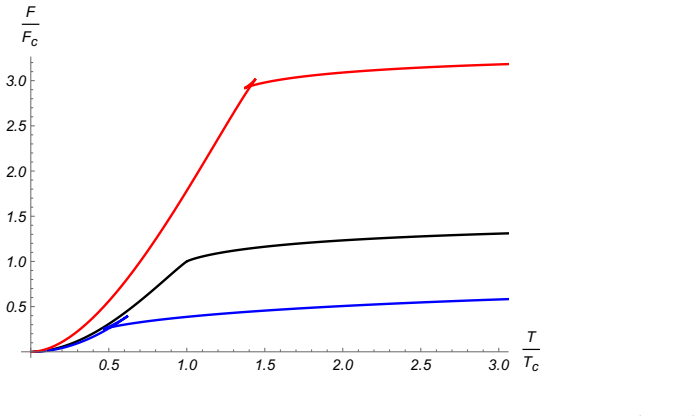
The central discovery is that treating the quantum backreaction strength ν as a thermodynamic variable, with conjugate chemical potential U, turns the static quantum BTZ black hole into a system with a critical point at z_c=ν_c=1 whose coexistence curve can be solved analytically. Solving the coexistence conditions f(z_s)=f(z_l) and t(z_s)=t(z_l) gives coexisting phases with sizes satisfying z_s z_l = 1, and the coexistence curve on the t–ν plane is smooth across the critical point even though the slope on the t–z plane has a discontinuity at z_*=1. Near the critical point, expansions of the equation of state yield the exponents α=0, β=1, γ=2, δ=3. The paper emphasizes that these exponents are significantly different from the mean-field results and that they violate the scaling law 2−α=β(1+δ), a violation it attributes to the absence of the cross term t̂û in the law of corresponding state. To account for this, it proposes that the singular thermodynamic potential has the three-scale-factor form f_s = c_0 t̂^{2−α} + c_1 t̂^{β(1+δ)} y(c_2 m t̂^{−β}), with the leading term controlling the specific heat and the subleading term controlling the order parameter; if correct, this yields the general constraint 2−α ≤ β(1+δ).
Load-bearing premise
The whole coexistence and exponent analysis assumes that the two coexisting black-hole phases always have sizes whose product is exactly 1; the paper states this follows from solving the coexistence equations carefully but does not display the derivation.
Editorial extensions
If this is right
- A static quantum BTZ black hole at ν=1 belongs to a criticality class that is not mean-field, despite the system being a two-dimensional gravitational spacetime.
- The relation γ=β(δ−1) survives while 2−α=β(1+δ) fails, indicating that thermodynamic-potential scaling must separate the normal-phase and ordered-phase contributions.
- The same small–large transition occurs both below the critical temperature for ν<1 and above it for ν>1, with the coexistence curve smooth in the t–ν plane.
- Any nonzero angular momentum, no matter how small, destroys the U–ν criticality because the allowed black-hole size is constrained to a region containing only one stable phase.
- The same non-mean-field exponents were previously found for quantum anomaly corrected black holes, suggesting the violation is not unique to BTZ geometry.
Reading between the lines
- If the coexistence relation z_s z_l = 1 is exact, it hints at an underlying scale or duality symmetry in qBTZ thermodynamics that could be probed by computing higher-order corrections in ν−1.
- The three-scale-factor hypothesis could be tested by checking whether the inequality 2−α ≤ β(1+δ) holds for other quantum-corrected black holes and whether equality is ever saturated.
- The absence of the t̂û term in the law of corresponding state is likely a consequence of the z_s z_l = 1 relation; establishing that link could turn an empirical expansion into a structural result.
- The disappearance of the transition at any nonzero J suggests the critical point is nongeneric and that rotation acts as a relevant perturbation; a direct numerical search for swallow tails at intermediate J would test the scope of the proof.
Editorial analysis
A structured set of objections, weighed in public.
Referee Report
Summary. The paper promotes the quantum backreaction parameter ν of the rotating qBTZ black hole to a thermodynamic variable with conjugate chemical potential U, and studies U-ν criticality in the static limit. The static equation of state has a critical point at ν_c=1, z_c=1. The authors find coexistence curves analytically, report small-large black hole transitions for both ν<1 and ν>1, and identify a slope discontinuity on the t-z coexistence curve. From near-critical expansions they extract exponents α=0, β=1, γ=2, δ=3, which violate the scaling relation 2−α=β(1+δ) while obeying γ=β(δ−1). They propose a three-scale-factor thermodynamic potential to interpret this violation, and argue that any nonzero angular momentum removes the phase transition by restricting the black-hole size.
Significance. If the results are correct, they provide one of the few exact (non-numerical) examples of non-mean-field critical exponents in black hole thermodynamics, computed from the exact quantum-corrected equation of state rather than from a fitted Landau functional. The analytic coexistence curve and the explicit set of exponents are falsifiable predictions that should stimulate further work. The angular-momentum result, if proven, is a clean statement about the fragility of the transition. The paper's main weakness is presentation: two load-bearing algebraic steps are asserted rather than demonstrated.
major comments (3)
- [Section 3.1, Eq. (9)] The identity z_s z_l = 1 is stated to follow from solving f(z_s)=f(z_l) and t(z_s)=t(z_l) "carefully", but no derivation is shown. This identity is used to obtain the coexistence curve (10)-(12), the slope discontinuities (13)-(14), the near-critical proportionality t−1∝|z−1|∝|ν−1| in (22), and the expansions (23)-(24) from which β=1 is extracted. Please provide a complete algebraic proof in the text or an appendix. In particular, it would be helpful to show that f(z)=f(1/z) holds identically and that the temperature equality reduces to a single algebraic equation whose relevant solution is given by (10).
- [Section 4, Eq. (28)] The expansion of the law of corresponding state, ν = 1 + 3t̂ + 3t̂^2 − (3/64)(72û^3 − 540t̂û^2 + 1254t̂^2û − 949t̂^3)+..., is presented without derivation. Since the paper emphasizes that the absence of the linear t̂û term is "of paramount importance" for obtaining β=1 and γ=2 rather than the mean-field values, the reader needs to be able to verify this coefficient structure. Please include the derivation, or at least an appendix with the Taylor expansion, including the statement that higher-order terms do not affect the leading exponents.
- [Section 5, Eq. (46) and Fig. 3] The claimed proof that no coexistence is possible for small angular momenta relies on the assertion that ϕ(z_*) is monotone on each side of z_*=1 and that its minimum is positive at the endpoints z_*=ν^{±1/3}. This is supported only by a figure and by the small-ν limit. Please supply an analytic proof of the monotonicity and of the endpoint bound, since the theorem is stated as a proof.
minor comments (6)
- [Abstract] The word "intepretation" should be "interpretation".
- [Section 4, Eq. (24)] The expression û = (15±4√3)/6 t̂ is potentially confusing because the sign correspondence to the small/large branches is not spelled out. Please clarify which sign refers to z_s>1 and z_l<1 for each side of ν=1, so that the reader can verify the difference u_l−u_s = −(4√3/3)|t−1|.
- [Section 3.1] The naming "small" and "large" for z_s>1 and z_l<1 is counterintuitive because z is inversely related to the horizon radius. A parenthetical remark explaining the convention would help the reader.
- [Figure 2] The left panel shows a numerical coexistence curve that has been shifted vertically; the text should explain why the shift is applied and whether it affects the comparison with the analytic curve.
- [Section 4, Eq. (37)] The phrase "universal three scale factor hypothesis" is stronger than what is demonstrated; the authors themselves note that the proposal is formal. Consider softening the wording or explicitly labeling Eq. (39) as a conjecture.
- [References] Reference [15] contains a typo: "Thoery" should be "Theory".
Circularity Check
No significant circularity: the critical exponents are derived directly from the exact qBTZ equation of state, and the proposed three-scale-factor hypothesis is explicitly post hoc and not used in the derivation.
full rationale
The paper's central derivation is self-contained. It starts from the known qBTZ thermodynamic functions (Emparan et al., an external source), extends the first law by defining U as the conjugate to the quantum-backreaction parameter ν, and locates the critical point via the inflection-point conditions of the exact equation of state. The coexistence curve is obtained by solving f(z_s)=f(z_l) and t(z_s)=t(z_l) analytically; the identity z_s z_l=1 is asserted after a compressed algebraic step, but it is not fitted and can be checked directly from the same equations. All critical exponents are then computed from exact Taylor expansions of t and u near the critical point: α from C_u at fixed u, β from u_l−u_s on the coexistence curve, γ from the isothermal compressibility, and δ from the critical isotherm of the exact equation of state (28). No parameter is fitted to the target exponents, and no 'prediction' is equivalent to an input by construction. The three-scale-factor hypothesis in Eq. (37) is introduced only after the exponents are derived, explicitly labeled as 'a formal explanation' and 'does not tell us when and how this could happen', and it does not feed back into the exponent calculations; it is an interpretive ansatz, not a load-bearing derivation. Self-citations are minimal and non-load-bearing: [10] is cited only as a prior observation of the same exponent set, not as the basis for the derivation. The compressed derivation of Eq. (9) is a readability / completeness gap rather than a circularity, and the paper itself flags the limited status of its interpretive hypothesis. Overall, the derivation chain is independent of its conclusions, so the circularity score is 0.
Assumptions & free parameters
assumptions (6)
- domain assumption The qBTZ black hole thermodynamics from Emparan-Frassino-Way [11] (M, T, S, J, Ω) is correct and obeys the first law.
- domain assumption The quantum backreaction parameter ν can be treated as a thermodynamic variable with conjugate U, so that dM = T dS + Ω dJ + U dν (Eq. 4).
- standard math The coexistence curve is determined by equality of free energy and temperature for the two phases, f(z_s)=f(z_l), t(z_s)=t(z_l).
- ad hoc to paper The non-trivial solutions to the coexistence equations satisfy z_s z_l = 1 (Eq. 9), stated without derivation.
- ad hoc to paper The three-scale-factor hypothesis for the singular thermodynamic potential (Eq. 37) is a valid interpretation of the scaling-law violation.
- domain assumption For small angular momenta, the black hole size is constrained to z ≤ ν^{-1/3} (from Eq. 42), which restricts the coexistence region.
Cite this review
Pith. "Pith review of Critical phenomenon of quantum BTZ black holes." pith.science (2026). https://pith.science/paper/BN6BLM4J
@misc{pith2026250523188,
  author       = {Pith},
  title        = {Pith review of: Critical phenomenon of quantum BTZ black holes},
  year         = {2026},
  howpublished = {\url{https://pith.science/paper/BN6BLM4J}},
  note         = {Machine review of arXiv:2505.23188}
}
abstract
We extend the thermodynamics of quantum BTZ black holes by treating the quantum backreaction strength parameter $\nu$ as a thermodynamic variable. We find various novel features. The critical point appears at $\nu_c=1$ and a first order transition occurs either below the critical temperature for $\nu<\nu_c$ or above the critical temperature for $\nu>\nu_c$. By solving the coexistence curve analytically, we analyze the phase structures and clarify an unexpected discontinuity around the critical point. The critical exponents are significantly different from the mean field theory results and violate one of the scaling laws. We present an intepretation for this by using a universal three scale factor hypothesis for critical behavior of thermodynamic potential. Finally, we prove that given an arbitrarily small angular momenta, only one stable black hole phase can exist and hence no transition will occur.
Figures


Forward citations
Cited by 1 Pith paper
-
Analytical approach to criticality of AdS black holes
A self-reciprocal relation between coexisting black hole phases reduces two coexistence conditions to a single algebraic equation, giving exact coexistence lines for several AdS black holes and the Van der Waals fluid.
Reference graph
Works this paper leans on
-
[9]
S. A. Hosseini Mansoori, J. F. Pedraza and M. Rafiee, Criticality and thermody- namic geometry of quantum BTZ black holes,Phys. Rev. D 111, no.2, 024012 (2025) doi:10.1103/PhysRevD.111.024012 [arXiv:2403.13063 [hep-th]]
arXiv 2025
-
[10]
Y. P. Hu, Y. S. An, G. Y. Sun, W. L. You, D. N. Shi, H. Zhang, X. Chen and R. G. Cai, Quantum anomaly triggers the violation of scaling laws in gravitational system, [arXiv:2410.23783 [gr-qc]]
-
[1]
D. Kubiznak and R. B. Mann, P-V criticality of charged AdS black holes,JHEP 07, 033 (2012) [arXiv:1205.0559 [hep-th]]
arXiv 2012
- [2]
-
[3]
M. Amo, A. M. Frassino and R. A. Hennigar, Entropy Bounds for Ro- tating AdS Black Holes, Phys. Rev. Lett. 131, no.24, 241401 (2023) doi:10.1103/PhysRevLett.131.241401 [arXiv:2307.03011 [gr-qc]]
arXiv 2023
-
[4]
S. W. Wei and Y. X. Liu, Insight into the Microscopic Structure of an AdS Black Hole from a Thermodynamical Phase Transition,Phys. Rev. Lett. 115, no.11, 111302 (2015) [erratum: Phys. Rev. Lett. 116, no.16, 169903 (2016)]
2015
-
[5]
S. W. Wei, Y. X. Liu and R. B. Mann, Repulsive Interactions and Universal Properties of Charged Anti–de Sitter Black Hole Microstructures,Phys. Rev. Lett. 123, no.7, 071103 (2019)
2019
-
[6]
W. Cong, D. Kubiznak and R. B. Mann, Thermodynamics of AdS Black Holes: Critical Behavior of the Central Charge,Phys. Rev. Lett. 127, no.9, 091301 (2021) [arXiv:2105.02223 [hep-th]]
arXiv 2021
Show all 15 references
-
[7]
W. Cong, D. Kubiznak, R. B. Mann and M. R. Visser, Holographic CFT phase transitions and criticality for charged AdS black holes, JHEP 08, 174 (2022) [arXiv:2112.14848 [hep-th]]. 15
2022 arXiv
-
[8]
A. M. Frassino, J. F. Pedraza, A. Svesko and M. R. Visser, Reentrant phase transitions of quantum black holes, Phys. Rev. D 109, no.12, 124040 (2024) doi:10.1103/PhysRevD.109.124040 [arXiv:2310.12220 [hep-th]]
2024 arXiv
-
[11]
Quantum BTZ black hole, Journal of High Energy Physics 2020.11 (2020): 1-43
Emparan, Roberto, Antonia Micol Frassino, and Benson Way. Quantum BTZ black hole, Journal of High Energy Physics 2020.11 (2020): 1-43
2020
-
[12]
Stauffer, M
D. Stauffer, M. Ferer, and M. Wortis, Universality of Second-Order Phase Transitions: The Scale Factor for the Correlation Length, Phys. Rev. Lett. 29, 345
-
[13]
Widom, Equation of state in the neighborhood of the critical point, J
B. Widom, Equation of state in the neighborhood of the critical point, J. Chem, Phys. 43, 3898
-
[14]
H. E. Stanley, Introduction to Phase Transitions and Critical Phenomena, Oxford University, New York
-
[15]
M. E. Peskin and D. V. Schroeder, An introduction to Quantum Field Thoery, BeiJing World Publishing Corporation, BeiJing. 16
Reviewed August 7, 2026 · model on record in the stance chip above.
Discussion (0). Sign in to comment.