REVIEW 3 major objections 4 minor 44 references
DPOT: A DeepParticle method for Computation of Optimal Transport with convergence guarantee
T0 review · 3 major / 4 minor · reviewed 2026-08-06 · deepseek-v4-flash
Pith's one-line read The paper proves that a map-valued loss has a unique minimizer, and that minimizer is exactly the optimal transport map.
desk verdict A simple, genuinely new loss for Monge map estimation with a clean consistency proof; the quantitative stability bound has a fixable but real regularity gap. read the letter →
The pith
A machine-rendered reading of the paper's core claim, the machinery that carries it, and where it could break.
The reading
What carries the argument
The load-bearing object is the functional $P(T)=\lambda\,(I_\mu(T))^{1/2}+W_2(T_\sharp\mu,\nu)$ with $0<\lambda<1$, where $I_\mu(T)$ is the quadratic transport cost of $T$ and $W_2$ is the Wasserstein-2 distance. The consistency proof runs on one inequality chain: $P(T)\ge\lambda W_2(T_\sharp\mu,\mu)+W_2(T_\sharp\mu,\nu)\ge\lambda W_2(\mu,\nu)$, with equality only if $T$ is the Monge map. The quantitative proof decomposes the optimality gap $\epsilon$ into $\epsilon_1+\epsilon_2+\epsilon_3$ and bounds $\|T_\epsilon-\bar T\|_{L^2(\mu)}$ by the sum of a perturbative estimate and a potential-comparison estimate, yielding $\sqrt{\epsilon_1}+\sqrt{\epsilon_2}$.
What would settle it
Construct a family of smooth, uniformly convex densities satisfying Assumption 3.2 with $\operatorname{supp}(\nu)\subseteq\operatorname{supp}(\nu_\epsilon)$ and bounded $|\det(D^2\psi_\epsilon)|$, and compute the minimal eigenvalue of $D^2\psi_\epsilon$ as $\nu_\epsilon\to\nu$; if that eigenvalue tends to zero while the determinant bound stays finite, the asserted uniformity in Lemma 3.3 fails and the $\sqrt{\epsilon_1}+\sqrt{\epsilon_2}$ bound is not established by the given proof.
Extended reading notes
Core claim
The paper claims that a single map-valued functional, $\lambda$ times the transport cost of $T$ plus the Wasserstein-2 distance from $T_\sharp\mu$ to $\nu$, has a unique minimizer and that minimizer is exactly the Monge map between $\mu$ and $\nu$. Moreover, if a learned map $T_\epsilon$ has gap $\epsilon$ in this functional, its $L^2(\mu)$ distance to the true map is $O(\sqrt{\epsilon_1}+\sqrt{\epsilon_2})$, so a small training loss is a certificate of near-optimality. The training objective is min-min rather than adversarial, and it imposes no convexity or Lipschitz constraints on the neural network. The paper also extends the loss to conditional families of maps and to inverse maps, and validates the claims numerically.
Load-bearing premise
The quantitative error bound rests on assuming the source and target supports are smooth, uniformly convex, with densities bounded above and below, and on the asserted but not fully derived claim that the convex potentials stay uniformly strongly convex as the approximation improves; if these regularity conditions fail, only the weak convergence guarantee remains.
Editorial extensions
If this is right
- Any standard neural architecture can be used for optimal-transport-map estimation, because the loss itself enforces push-forward correctness without Lipschitz or convexity constraints.
- The loss gap $\epsilon$ functions as a training certificate, so reaching a small gap controls the $L^2(\mu)$ error by $\sqrt{\epsilon_1}+\sqrt{\epsilon_2}$.
- Conditional maps $T(\cdot|\kappa)$ can be trained once and evaluated at unseen parameters $\kappa$, allowing the method to scale to families of related transport problems without retraining.
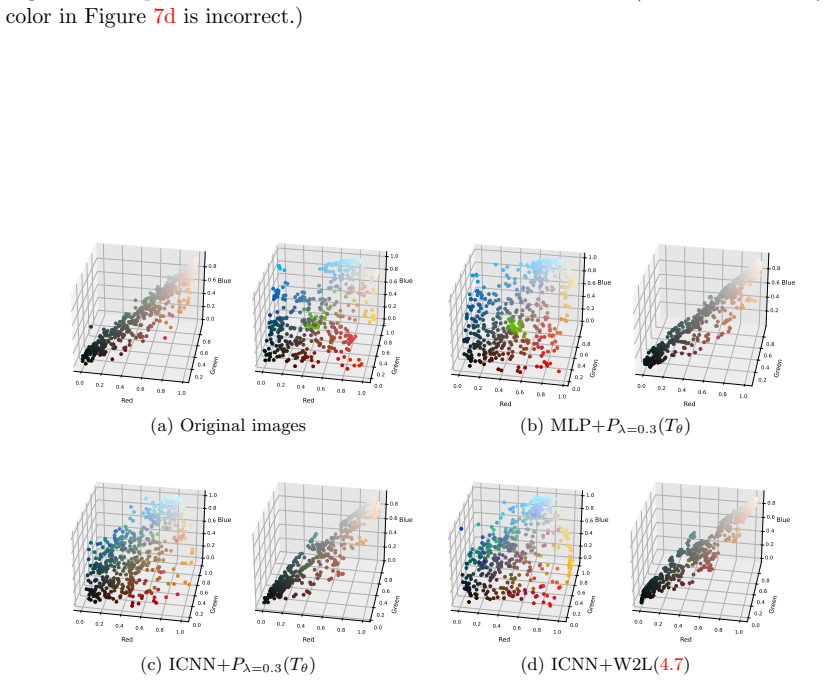
- With added cycle-consistency terms, the same loss learns forward and inverse maps, enabling bidirectional transport in applications such as color transfer.
- Because inference is a single forward pass with no entropic smoothing or iterative sampling, the trained map can generate large numbers of samples quickly, as demonstrated on posterior sampling.
Reading between the lines
- The paper does not propose using the loss gap as a training diagnostic, but Theorem 3.6 makes that a direct corollary: plotting $\epsilon$ during training gives an upper-bound certificate for the map error, so one could use it for early stopping or model selection.
- The quantitative proof's dependence on uniform strong convexity suggests the $\sqrt{\epsilon_1}+\sqrt{\epsilon_2}$ rate is tied to smooth, uniformly convex geometry; testing the method on a target with non-convex support, such as an annulus, would show whether the rate survives outside those assumptions even though weak convergence likely does.
- The consistency argument is specific to the quadratic cost and the Wasserstein-2 triangle inequality; extending the same loss to other costs would require a new lower bound relating the map's cost to the distance between $T_\sharp\mu$ and $\mu$, so the min-min scheme should not be expected to transfer unchanged.
Editorial analysis
A structured set of objections, weighed in public.
Referee Report
Summary. The manuscript proposes DPOT, a neural-network method for computing Monge maps between continuous distributions by minimizing P(T) = λ(I_µ(T))^{1/2} + W2(T♯µ, ν) over maps T, with 0 < λ < 1. Section 3 proves that the unique minimizer of P is the exact optimal transport map (Theorem 3.1), establishes weak convergence of approximately optimal maps (Theorem 3.5), and claims a quantitative L2 error bound of order √ε in terms of the optimality gap ε (Theorem 3.6). Section 3.3 gives a discrete min-min training objective, including a conditional version, and Section 4 reports experiments on synthetic OT problems, inverse maps, a compartmental epidemic model, and image color transfer.
Significance. Theorem 3.1 is a clean and correct elementary result: the term λ(I_µ(T))^{1/2} removes the trivial identity-map degeneracy of the pure Wasserstein objective while preserving the Monge solution. If Theorem 3.6 were fully established, the paper would provide a useful primal-loss-gap to map-error guarantee for neural OT without architectural constraints, which is a valuable complement to dual-potential analyses. The numerical study is broad, spanning multiple architectures and real-world tasks, and the experiments are generally consistent with the qualitative message of the theory. However, the advertised quantitative convergence guarantee is not yet fully supported: the proof of Theorem 3.6 relies on an unproved uniform strong-convexity regularity estimate, and the discretized loss in Eq. (3.21) does not match the continuous objective as written. These issues need to be resolved before the central claim can be accepted.
major comments (3)
- [§3.3, Eq. (3.21)] The quantitative bound (3.9) is not established as stated. The passage from (3.18) to (3.19) invokes Proposition A.5, which requires the Kantorovich potentials ψ_ε to belong to the class X(2K) with a constant K independent of ε. Assumption 3.2 and the Monge–Ampère equation give uniform bounds on det(D²ψ_ε) and interior regularity, but in dimension n > 1 a uniform lower and upper bound on det(D²ψ_ε) does not by itself imply a uniform lower bound on the smallest eigenvalue of D²ψ_ε unless a uniform upper bound on D²ψ_ε (or on its trace) is also available; that upper bound is not proved anywhere. The sentence following Lemma 3.3 and Remark 3.7 assert this uniformity by citing [17] and [40, Theorem 12.50], but they do not supply the required ε-independent constants. Consequently Lemma 3.3, the use of Lemma 3.3 in Theorem 3.5, and Theorem 3.6 all rest on an unproved regularity hypothesis. The authors should either prove the uniform strong convexity of ψ_ε under Assumption 3.2, or add it explicitly as an assumption, and should also verify that the pair (µ, ν) and the potentials satisfy the hypotheses of Proposition A.5 with a common K.
- [Theorem 3.6, Eq. (3.15), Remark 3.7] The discretized first term in (3.21) does not approximate I_µ(T) as defined in (3.1). The continuous functional uses I_µ(T) = ½∫|T(x) − x|²dµ(x), whose empirical counterpart is (2N)^{-1}∑_{i=1}^N |T_θ(x_i) − x_i|². As written, the first term is (2N)^{-1}∑_{i,j=1}^N |T_θ(x_i) − x_j|², which converges to ½∫∫|T(x) − x'|² dµ(x)dµ(x'), not to I_µ(T). Thus the objective actually minimized in the experiments is different from the loss analyzed in Theorems 3.1–3.6. If the double sum is a typo, it should be corrected; if not, the numerical validation does not test the theoretical objective, and the claimed empirical support for the convergence bound needs to be re-examined.
- The regularity of ψ*_ε on supp(ν) used in Eq. (3.15) is not justified by the stated assumptions. The proof applies the first-order convexity inequality for ψ*_ε at points y ∈ supp(ν) and bounds ∇ψ*_ε(y) by a constant R(µ) using only the fact that ∇ψ*_ε pushes ν_ε forward to µ. This requires ψ*_ε to be differentiable and its gradient to be uniformly bounded on supp(ν) (not merely ν_ε-a.e.), which is not derived from Assumption 3.2. The assumption supp(ν) ⊆ supp(ν_ε) is explicit but is an extra condition on T_ε that is not implied by a small gap ε, and Remark 3.7's proposed relaxation is only a sketch: the cited standard extension and [40, Theorem 12.50] are not shown to produce ε-independent constants. This affects the bound on the term I and hence the estimate (3.18).
minor comments (4)
- [Appendix A.1, Proposition A.5] The statement of Proposition A.5 is not self-contained: it defines the class M(K) but never specifies the hypotheses on the target measure Q, even though the conclusion refers to an optimal transport map from P to Q. Please either quote the full statement from [23] or state the needed assumptions explicitly.
- [Eq. (3.16)] The displayed inequality bounds M(ν) − M(ν_ε) from above, but the term II in the decomposition contains M(ν_ε) − M(ν). The needed upper bound follows by the same argument with the roles of ν and ν_ε swapped, but this should be stated to make the proof complete.
- [Section 4, Figures 3a and 3b] The text says that the L2 relative error 'correlates well' with the optimality gap ε, but no quantitative fit is reported. Since Theorem 3.6 predicts a √ε rate, a log-log plot with a fitted slope or a table of exponents would make the empirical validation more convincing.
- [Section 3.3] The sentence 'This optimization scheme maintains convergence while significantly lowering computational overhead' is not supported by any theoretical or experimental analysis of the alternating update of γ and θ; please soften or provide evidence for this claim.
Circularity Check
No circularity: the consistency proof is self-contained and the quantitative error bounds rely on external optimal-transport regularity theorems, not on the paper's own results.
full rationale
The consistency theorem (Theorem 3.1) is derived directly from the definition of the functional P(T), the triangle inequality for W2, and the uniqueness of the Monge map in Proposition 2.1 (Villani). The equality analysis in (3.2)-(3.4) shows that equality forces T to push mu onto nu and to be the optimal map between mu and T#mu, which is the standard definitional characterization of the Monge map, not an assumption of the conclusion. The quantitative bounds in Lemma 3.3 and Theorem 3.6 use external standard results: Proposition A.4 is Proposition 3.3 of Gigli [17], Proposition A.5 is Proposition 10 of Hutter-Rigollet [23], and the weak-convergence argument uses Villani [40,41]. No fitted parameter is renamed as a prediction: the epsilon decomposition (3.6) is an algebraic identity, and the constants in the bounds are tracked rather than calibrated. The self-citations to DeepParticle [42,43] appear only as the lambda=0 special case and as inspiration for the discrete loss (3.21); they are not load-bearing in any proof. The paper does contain a nontrivial regularity gap: the uniform strong convexity and uniform C^2 bounds for the Kantorovich potentials psi_epsilon are asserted via 'the same argument in [17]' and via Remark 3.7 rather than fully proved, and Proposition A.5 is invoked 'under the assumption that psi_epsilon is strongly convex as required by the proposition.' This is a correctness or rigor concern about the quantitative theorem, not circularity, because the assertion is supported by external sources [17,40] and does not presuppose the theorem being proved. Consequently, no circular step is present, and the appropriate score is 0.
Assumptions & free parameters
free parameters (1)
- λ =
0.3
assumptions (5)
- domain assumption µ and ν lie in Pac,2(Rn) with µ absolutely continuous and not charging sets of dimension n−1 (Proposition 2.1)
- ad hoc to paper Assumption 3.2: supp(µ) and supp(νϵ) are C² uniformly convex; µ and νϵ have C^{0,α} densities with uniform positive bounds.
- ad hoc to paper supp(ν)⊆supp(νϵ) in Theorem 3.6
- ad hoc to paper Uniform strong convexity of the Kantorovich potentials ψϵ with modulus independent of ϵ
- standard math External results Proposition A.4 ([17]) and Proposition A.5 ([23]) are correct and applicable under the stated assumptions
Cite this review
Pith. "Pith review of DPOT: A DeepParticle method for Computation of Optimal Transport with convergence guarantee." pith.science (2026). https://pith.science/paper/BNDXIFEI
@misc{pith2026250623429,
  author       = {Pith},
  title        = {Pith review of: DPOT: A DeepParticle method for Computation of Optimal Transport with convergence guarantee},
  year         = {2026},
  howpublished = {\url{https://pith.science/paper/BNDXIFEI}},
  note         = {Machine review of arXiv:2506.23429}
}
read the original abstract
In this work, we propose a novel machine learning approach to compute the optimal transport map between two continuous distributions from their unpaired samples, based on the DeepParticle methods. The proposed method leads to a min-min optimization during training and does not impose any restriction on the network structure. Theoretically we establish a weak convergence guarantee and a quantitative error bound between the learned map and the optimal transport map. Our numerical experiments validate the theoretical results and the effectiveness of the new approach, particularly on real-world tasks.
Figures


Figures from the paper (5 more)


Reference graph
Works this paper leans on
-
[17]
Gigli, N.: On H¨ older continuity-in-time of the optimal transport map towards measures along a curve. Proc. Edinb. Math. Soc. 54(2), 401–409 (2011)
work page 2011
-
[1]
Ambrosio, L., Pratelli, A.: Existence and stability results in the L1 theory of optimal transportation, pp. 123–160. Springer, Berlin, Heidelberg (2003)
work page 2003
-
[2]
Arjovsky, M., Chintala, S., Bottou, L.: Wasserstein generative adversarial net- works. In: Int. Conf. Mach. Learn., pp. 214–223. PMLR (2017)
work page 2017
-
[3]
Azagra, D., Mudarra, C.: An extension theorem for convex functions of class C1,1 on Hilbert spaces. J. Math. Anal. Appl. 446(2), 1167–1182 (2017)
work page 2017
-
[4]
Benamou, J., Froese, B.D., Oberman, A.M.: Numerical solution of the optimal transportation problem using the Monge–Amp` ere equation. J. Comput. Phys. 260, 107–126 (2014)
work page 2014
-
[5]
John Wiley & Sons, New York (1999)
Billingsley, P.: Convergence of Probability Measures, 2 edn. John Wiley & Sons, New York (1999)
work page 1999
-
[6]
Bortoli, V.D., Thornton, J., Heng, J., Doucet, A.: Diffusion schr¨ odinger bridge with applications to score-based generative modeling. In: Adv. Neural Inform. Process. Syst., vol. 34, pp. 17695–17709 (2021)
work page 2021
- [7]
Show all 44 references
-
[8]
In: Proc
Chai, W., Jiang, Z., Hwang, J.N., Wang, G.: Global adaptation meets local gen- eralization: Unsupervised domain adaptation for 3D human pose estimation. In: Proc. IEEE/CVF Int. Conf. Comput. Vis., pp. 14655–14665. IEEE (2023)
2023
-
[9]
arXiv preprint arXiv:2303.02554 (2023)
Cui, T., Dolgov, S., Zahm, O.: Self-reinforced polynomial approximation methods for concentrated probability densities. arXiv preprint arXiv:2303.02554 (2023)
2023 arXiv
-
[10]
Cuturi, M.: Sinkhorn distances: Lightspeed computation of optimal transport. In: Adv. Neural Inform. Process. Syst., vol. 26 (2013) 19
2013
-
[11]
Daniels, M., Maunu, T., Hand, P.: Score-based generative neural networks for large-scale optimal transport. In: Adv. Neural Inform. Process. Syst., vol. 34, pp. 12955–12965 (2021)
2021
-
[12]
E, W., Yu, B.: The Deep Ritz method: a deep learning-based numerical algorithm for solving variational problems. Commun. Math. Stat. 6(1), 1–12 (2018)
2018
-
[13]
arXiv preprint arXiv:2106.03812 (2021)
Fan, J., Liu, S., Ma, S., Chen, Y., Zhou, H.: Scalable computation of Monge maps with general costs. arXiv preprint arXiv:2106.03812 (2021)
2021 arXiv
-
[14]
Fan, J., Liu, S., Ma, S., Zhou, H.M., Chen, Y.: Neural Monge map estimation and its applications. Trans. Mach. Learn. Res. (2023)
2023
-
[15]
Flamary, R., Courty, N., Gramfort, A., et al.: POT: Python optimal transport. J. Mach. Learn. Res. 22(78), 1–8 (2021)
2021
-
[16]
Fournier, N., Guillin, A.: On the rate of convergence in Wasserstein distance of the empirical measure. Probab. Theory Relat. Fields 162(3), 707–738 (2015)
2015
-
[18]
Guminov, S., Dvurechensky, P., Tupitsa, N., Gasnikov, A.: On a combination of alternating minimization and Nesterov’s momentum. In: Int. Conf. Mach. Learn., pp. 3886–3898. PMLR (2021)
2021
-
[19]
arXiv preprint arXiv:2405.14449 (2024)
Gushchin, N., Selikhanovych, D., Kholkin, S., Burnaev, E., Korotin, A.: Adver- sarial Schr¨ odinger bridge matching. arXiv preprint arXiv:2405.14449 (2024)
2024 arXiv
-
[20]
arXiv preprint arXiv:1812.02463 (2018)
Haloui, I., Gupta, J.S., Feuillard, V.: Anomaly detection with Wasserstein GAN. arXiv preprint arXiv:1812.02463 (2018)
2018 arXiv
-
[21]
In: IEEE Conf
He, K., Zhang, X., Ren, S., Sun, J.: Deep residual learning for image recognition. In: IEEE Conf. Comput. Vis. Pattern Recognit. (2016)
2016
-
[22]
Huang, K.W., Chen, G.W., Huang, Z.H., Lee, S.H.: IWGAN: Anomaly detection in airport based on improved Wasserstein generative adversarial network. Appl. Sci. 13(3) (2023)
2023
-
[23]
The Annals of Statistics 49(2) (2021)
H¨ utter, J.C., Rigollet, P.: Minimax estimation of smooth optimal transport maps. The Annals of Statistics 49(2) (2021)
2021
-
[24]
Kantorovich, L.K.: On a problem of Monge. J. Math. Sci. 133(4) (2006)
2006
-
[25]
arXiv preprint arXiv:1909.13082 (2019)
Korotin, A., Egiazarian, V., Asadulaev, A., Safin, A., Burnaev, E.: Wasserstein-2 generative networks. arXiv preprint arXiv:1909.13082 (2019)
2019 arXiv
-
[26]
arXiv preprint arXiv:1902.02934 (2019)
Lei, N., Guo, Y., An, D., Qi, X., Luo, Z., Yau, S.T., Gu, X.: Mode collapse and regularity of optimal transportation maps. arXiv preprint arXiv:1902.02934 (2019)
2019 arXiv
-
[27]
In: International Conference in Communications, Signal Processing, and Systems, pp
Li, B., Liu, D., Yang, J., Zhou, H., Lin, D.: An RF fingerprint data enhancement method based on WGAN. In: International Conference in Communications, Signal Processing, and Systems, pp. 539–547. Springer, Singapore (2024)
2024
-
[28]
Lin, T., Ho, N., Jordan, M.I.: On the efficiency of entropic regularized algorithms for optimal transport. J. Mach. Learn. Res. 23(137), 1–42 (2022) 20
2022
-
[29]
In: The Eleventh International Conference on Learning Representations (2023)
Luo, Y., Jiang, Z., Cohen, S., Grefenstette, E., Deisenroth, M.P.: Optimal trans- port for offline imitation learning. In: The Eleventh International Conference on Learning Representations (2023)
2023
-
[30]
In: Neural Information Processing, pp
Luo, Y., Zhang, S.Y., Zheng, W.L., Lu, B.L.: WGAN domain adaptation for EEG-based emotion recognition. In: Neural Information Processing, pp. 275–286. Springer (2018)
2018
-
[31]
Maggi, F.: Sets of Finite Perimeter and Geometric Variational Problems: An Introduction to Geometric Measure Theory, vol. 135. Cambridge University Press, Cambridge (2012)
2012
-
[32]
Makkuva, A., Taghvaei, A., Oh, S., Lee, J.: Optimal transport mapping via input convex neural networks. In: Int. Conf. Mach. Learn., pp. 6672–6681. PMLR (2020)
2020
-
[33]
Advances in mathe- matics 128(1), 153–179 (1997)
McCann, R.J.: A convexity principle for interacting gases. Advances in mathe- matics 128(1), 153–179 (1997)
1997
-
[34]
Analyst 148(16), 3860–3869 (2023)
McHardy, R.G., Antoniou, G., Conn, J.J.A., Baker, M.J., Palmer, D.S.: Augmen- tation of FTIR spectral datasets using wasserstein generative adversarial networks for cancer liquid biopsies. Analyst 148(16), 3860–3869 (2023)
2023
-
[35]
arXiv preprint arXiv:2304.06094 (2023)
Mokrov, P., Korotin, A., Kolesov, A., Gushchin, N., Burnaev, E.: Energy-guided entropic neural optimal transport. arXiv preprint arXiv:2304.06094 (2023)
2023 arXiv
-
[36]
Monge, G.: M´ emoire sur la th´ eorie des d´ eblais et des remblais. Hist. Acad. Roy. Sci. Paris pp. 666–704 (1781)
-
[37]
arXiv preprint arXiv:2110.02999 (2021)
Rout, L., Korotin, A., Burnaev, E.: Generative modeling with optimal transport maps. arXiv preprint arXiv:2110.02999 (2021)
2021 arXiv
-
[38]
arXiv preprint arXiv:1711.02283 (2017)
Seguy, V., Damodaran, B.B., Flamary, R., Courty, N., Rolet, A., Blondel, M.: Large-scale optimal transport and mapping estimation. arXiv preprint arXiv:1711.02283 (2017)
2017 arXiv
-
[39]
In: In- ternational Conference on Computer Research and Development, pp
Shao, J., Chen, L., Wu, Y.: SR WGANTV: Image super-resolution through Wasser- stein generative adversarial networks with total variational regularization. In: In- ternational Conference on Computer Research and Development, pp. 21–26 (2021)
2021
-
[40]
Villani, C.: Optimal Transport: Old and New, vol. 338. Springer Science & Business Media, Berlin (2009)
2009
-
[41]
Villani, C.: Topics in Optimal Transportation, Graduate Studies in Mathematics , vol. 58. American Mathematical Society, Providence (2021)
2021
-
[42]
Wang, Z., Xin, J., Zhang, Z.: Deepparticle: Learning invariant measure by a deep neural network minimizing Wasserstein distance on data generated from an interacting particle method. J. Comput. Phys. 464, 111309 (2022)
2022
-
[43]
Phys- ica D: Nonlinear Phenomena 460, 134082 (2024)
Wang, Z., Xin, J., Zhang, Z.: A deepparticle method for learning and generating aggregation patterns in multi-dimensional keller–segel chemotaxis systems. Phys- ica D: Nonlinear Phenomena 460, 134082 (2024)
2024
-
[44]
Xie, Y., Wang, Z., Zhang, Z.: Randomized methods for computing optimal trans- port without regularization and their convergence analysis. J. Sci. Comput.100(2), 37 (2024) 21 A Supplementary results and proofs We first recall some crucial definitions to characterize convexity a...
2024
Reviewed August 6, 2026 · model on record in the stance chip above.
Discussion (0). Continue with ORCID to comment.