REVIEW 4 major objections 7 minor 1 cited by
Signatures of a Tidally Induced Spiral Arm at the Anticenter of the Milky Way and a Kinematically Extended Anticenter Stream Using DESI DR2
T0 review · 4 major / 7 minor · reviewed 2026-08-03 · deepseek-v4-flash
Pith's one-line read The Monoceros Ring is a tidally induced spiral arm, and its winding pattern records the Sagittarius dwarf's last two disk passages.
desk verdict Solid observational kinematics for the MRi/ACS pair, but the FFT-based Sgr passage times rest on an unresolved peak and need synthetic-recovery work before they can be believed. read the letter →
The pith
A machine-rendered reading of the paper's core claim, the machinery that carries it, and where it could break.
The reading
What carries the argument
The key instrument is the kinematic signature of a transient tidally induced spiral arm: a spatial coincidence between the minimum of radial velocity, the density peak, and the inflection point of Vφ − ⟨Vφ(R)⟩ (the corotation condition). To turn this into a clock, the paper computes the median V_R in bins of inverse angular momentum L_Z^{-1} (assuming a flat rotation curve) over one 10-degree longitude slice, takes a fast Fourier transform, and maps the two strongest frequency peaks to pericenter times using a published relation (Equation 1). Everything about the timing depends on that mapping's assumption that the observed oscillation is the coherent winding of a single arm.
What would settle it
Construct a DESI-like mock catalog from a smooth, axisymmetric disk model (no satellite perturbation) with the same selection function and completeness; if the identical Fourier pipeline yields comparable power-spectrum peaks, the V_R oscillation is not uniquely attributable to a tidally induced spiral arm. Alternatively, if the two dominant peaks move significantly when the longitude window is expanded from 10° to 20° or shifted by 5°, the coherent single-arm assumption fails.
Extended reading notes
Core claim
The central claim is that the Monoceros Ring (MRi) — a stellar overdensity at Galactocentric radii 14–18 kpc in the anticenter — shows the diagnostic kinematics of a tidally induced spiral arm: the most negative radial velocity V_R coincides with the arm's density peak, and the azimuthal velocity difference Vφ − ⟨Vφ(R)⟩ passes through zero there, meaning the arm corotates with the disk. This is the pattern predicted when a satellite galaxy delivers an impulsive gravitational kick to disk stars, causing their orbits to crowd into a winding arm. Because the arm winds at the disk's circular speed, the oscillation frequency of V_R as a function of inverse angular momentum gives the time since ea
Load-bearing premise
The timing chain rests on treating the wiggles in the median radial velocity across one narrow 10-degree slice of sky as the clean imprint of a single corotating spiral arm winding up, so that the Fourier peak frequencies can be converted directly into Sagittarius passage times.
Editorial extensions
If this is right
- The Monoceros Ring being a tidally induced spiral arm provides a direct observational link between the Sagittarius dwarf's orbit and the spiral structure of the outer Milky Way disk.
- The two pericenter times (0.25 and 1.10 Gyr) add a kinematic constraint on Sgr's recent orbital history that is independent of stream modeling and star-formation fits.
- Because the arm corotates, the same V_R wind-up method can in principle clock other satellite encounters, such as the LMC's first infall.
- The Anticenter Stream's kinematic extension below its photometric boundary shifts its interpretation from a stripped stream to a vertical phase-space fold, meaning future studies should treat it as part of the disk's disequilibrium rather than an accreted remnant.
Reading between the lines
- If the identification is right, the paper implies that the outer disk's spiral pattern is predominantly transient and satellite-driven, rather than a long-lived density wave; a testable extension would be predicting a matching gas response at a slightly different arm phase.
- The timing analysis could be stress-tested by repeating the Fourier fit in adjacent longitude windows (e.g., 165°–175° and 185°–195°); if the recovered peak frequencies do not stay within uncertainties, the single-slice coherent-winding assumption would be in question.
- The vertical-wave interpretation of the ACS suggests the solar-neighborhood phase spiral and the anticenter vertical folds may share a common perturbing event; comparing their inferred perturbation ages (≈0.25 Gyr) could unify both phenomena.
- A natural validation is to run the same pipeline on simulated DESI-like catalogs from an axisymmetric disk with no satellite; if power-spectrum peaks persist, the passage-time extraction would need an independent background subtraction.
Signed reviews
Editorial analysis
A structured set of objections, weighed in public.
Referee Report
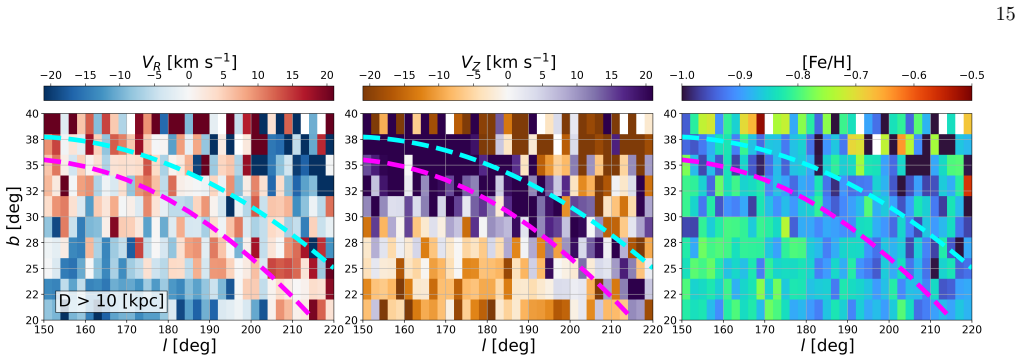
Summary. The paper uses 61,883 main-sequence turn-off stars from DESI DR2 in the anticenter region (150° < l < 220°, 20° < b < 40°) to map the 6D kinematics of the Monoceros Ring (MRi) and Anticenter Stream (ACS). The authors report that the MRi overdensity has kinematics consistent with a tidally induced spiral arm driven by Sagittarius (Sgr), specifically a negative radial velocity region, a V_phi inflection line, and corotation at the overdensity. They then apply the Antoja et al. (2022) frequency-analysis method to the median V_R versus L_Z^{-1} curve and derive two recent Sgr pericenter passage times, 0.25 ± 0.09 Gyr and 1.10 ± 0.23 Gyr. For the ACS, they find positive V_R and V_Z kinematics that extend to lower Galactic latitudes, and they interpret the ACS as part of a broader vertical wave rather than a discrete kinematically distinct stream.
Significance. If the main claims hold, the paper would provide a direct observational identification of the MRi as a corotating, tidally induced spiral arm—a relatively rare classification in the Milky Way—and would demonstrate that outer-disk kinematic oscillations can be used to recover Sgr's recent pericenter timing. The DESI DR2 sample extends previous work to fainter magnitudes and larger distances, and the paper makes its data products publicly available, which is a strength. The MRi/ACS kinematic decoupling and the extension of ACS kinematics to lower latitudes are well supported by Figures 5, 12–14 and are consistent with APOGEE and Gaia-based studies. However, the quantitative passage-time claim rests on a Fourier analysis that, as presented, lacks validation against synthetic or null data and whose lowest-frequency peak is not resolved within the sampled baseline. The timing claim is therefore not yet on the same footing as the spatial/kinematic characterizations.
major comments (4)
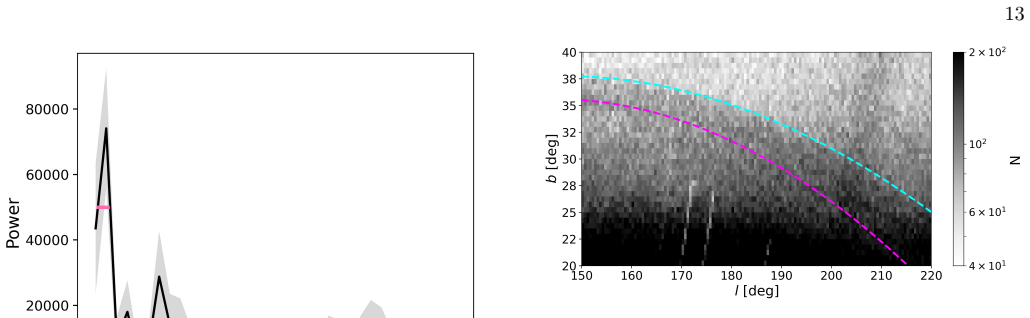
- [§3.4, Fig. 10] The lowest FFT peak is unresolved and is the basis for the headline 0.25 Gyr passage time. For L_Z ∈ [2000, 4500] km s^-1 kpc, the sampled range in x = L_Z^{-1} is T ≈ 2.78×10^-4 (km s^-1 kpc)^-1. The peak at f = 1313 ((km s^-1 kpc)^-1)^-1 has a period ≈ 7.62×10^-4, which is 2.7 times longer than the entire sampled span, so the data contain less than half a cycle of this putative oscillation. The nominal Fourier resolution ~1/T ≈ 3600 is larger than 1313, meaning this peak lies below the Rayleigh resolution; its quoted Gaussian width (477) is smaller than the resolution, consistent with a window/trend artifact rather than a resolved winding frequency. Because this peak directly yields the 0.25 ± 0.09 Gyr timing in Table 1, the central timing claim is not supported without a synthetic recovery test, a null test on a smooth disk model, or a demonstration that the peak is stable under chang
- [§3.4, Eq. (1)] The quoted uncertainties on the passage times (0.09 and 0.23–0.28 Gyr) are only the formal widths from Gaussian fits to the FFT peaks after Monte-Carlo propagation of V_R errors. They do not include systematic errors from: the choice of the restricted l-slice 175° < l < 185°, the completeness correction being applied only in RA/Dec bins (not in distance or l,b), the number and width of L_Z bins, the subtraction of the background disk model, or the arbitrary impulsive-perturber parameters in the Antoja et al. (2022) model (ΔV = 10 km s^-1, D = 20 kpc). The mapping from FFT frequency to time via Eq. (1) assumes a single coherent, corotating tidally induced spiral arm winding in a flat rotation curve; no mock or N-body test is provided to show that a known input passage time is recovered within the claimed errors. The agreement with literature values in Table 1 is reassuring but is not a su
- [§3.2, Fig. 6] The identification of the MRi as a tidally induced spiral arm rests on a visual / qualitative comparison: the overdensity, the −V_R region, and the fitted V_ϕ − ⟨V_ϕ(R)⟩ inflection line all appear spatially coincident. The inflection line itself is fit to the data in a way that is not fully specified (a cubic in each annulus, then a linear fit to the zero crossings), and no uncertainty is given for the magenta line. The paper does not quantitatively compare the observed V_R and V_ϕ patterns to the Antoja et al. (2022) models or the Stelea et al. (2024) simulations, nor does it test whether a simpler disk model (e.g., a warp, flare, or a smooth radial oscillation) could produce the same pattern. Since this classification is the foundation for the subsequent timing analysis, a quantitative model comparison or at least a null test on a smooth, unperturbed disk would materially strengthen th
- [§2.4, Fig. 4] The completeness correction is computed as the ratio of observed MAIN-BLUE targets to the full DESI target catalog in one-degree RA/Dec bins. This corrects for the survey footprint and tiling pattern but does not address completeness as a function of distance, magnitude, or Galactic latitude at fixed RA/Dec. If selection incompleteness correlates with kinematics—for example through distance-dependent MSTO sampling or dust-extinction-dependent proper-motion quality—the median V_R vs L_Z curve in Figure 9 could be biased. Given that the timing analysis uses the shape of this curve, the paper should quantify how robust the FFT peaks are to alternative completeness treatments (e.g., binning in l,b and distance, or weighting by the inverse completeness in each phase-space bin).
minor comments (7)
- [§3.4] The definition of L_Z is given as L_Z = R V_Z, which appears to be a typo: angular momentum about the Galactic center in cylindrical coordinates is L_Z = R V_ϕ (the azimuthal velocity). Please correct and ensure all subsequent uses of L_Z are consistent.
- [§3.4 vs Fig. 9 caption] The text states the median V_R is computed in 75 bins over L_Z ∈ [2000, 4500] km s^-1 kpc, while the Figure 9 caption says 70 bins over L_Z ∈ [1400, 45000] km s^-1 kpc. These numbers and ranges should be reconciled.
- [§3.4] The second passage time is reported as 1.10 ± 0.28 Gyr in the body text but as 1.10 ± 0.23 Gyr in the abstract and Table 1. Please make these consistent and specify which uncertainty (Gaussian width only, or including systematic terms) is being quoted.
- [Eq. (1)] Equation (1) is reproduced from Antoja et al. (2022) but the typesetting is garbled and the units discussion is confusing ('time×length^-2' vs '(time/length)^2×time^-1'). Please provide a clean symbolic derivation or a clear statement of the units of each term so the conversion from frequency to Gyr is reproducible by a reader.
- [Fig. 10] No significance threshold or false-alarm probability is assigned to the FFT peaks. The authors should state how 'significant' is defined (e.g., versus the noise floor or versus peaks in null simulations), or explicitly avoid the word 'significant'.
- [§2.4] Typo: 'We can assume the the completeness' should read 'We can assume that the completeness'.
- [References] Several references appear duplicated with identical DOIs (e.g., Bernet et al. 2022 listed twice; Antoja et al. 2018a and 2018b share the same DOI/page numbers but are cited as separate works). Please check whether these are genuinely distinct papers or should be merged/corrected.
Circularity Check
No circular step found: Sgr passage times are deterministic transforms of measured FFT peaks using an external published relation, not fits to the claimed times.
full rationale
I walked the derivation chain: (i) the MRi overdensity is first located by completeness-corrected star counts after subtracting an exponential disk model fit in an off-MRi longitude bin (Sec. 2.4, Sec. 3.2, Figs. 4,6,7), independent of the kinematic signatures; (ii) the tidal-arm interpretation is supported by matching -V_R and V_phi - <V_phi(R)> inflections to external simulations (Antoja et al. 2022; Stelea et al. 2024) and to APOGEE results (Eilers et al. 2020; Qiao et al. 2024); (iii) the pericenter times in Sec. 3.4 are computed by an FFT of the observed median V_R(L_Z) in a fixed l-slice, followed by a fixed analytic conversion (Eq. 1, taken from Antoja et al. 2022). The peak frequencies 1313 and 5879 are measured from DESI data; the times 0.25 and 1.10 Gyr are deterministic functions of those peaks with stated constants (n=0, V0, R0). No parameter is fitted to the literature passage times, and the results are compared with independent orbit models and star-formation analyses (Table 1). Antoja et al. (2022) does share one co-author with this paper (J. A. S. Amarante), but the equation used is a published analytic relation with stated assumptions, not a private uniqueness claim, and the interpretation is corroborated by non-overlapping simulations and observations; this is model dependence rather than self-referential reduction. The skeptic's concern about the 1313 peak being below the Fourier resolution is a resolvability/systematic-uncertainty issue, not a definitional or construction-level circularity.
Assumptions & free parameters
free parameters (5)
- Exponential disk scale length h_R =
3.46 kpc
- Inflection-line coefficients (magenta line) =
Y = 1.04 X - 15.84
- ACS photometric parabola fits (upper edge, peak) =
not quoted in text
- L_Z binning for FFT =
75 bins, 2000-4500 km/s kpc
- Sample selection boundaries =
M_g 3.3-5.7, g-r 0.2-0.4; b 20-40, l 150-220; Vphi 140-277 km/s
assumptions (7)
- domain assumption Astrometric and spectroscopic inputs (Gaia DR3 proper motions, DESI RVs, rvsdistnn distances) are accurate with quoted uncertainties.
- domain assumption MW circular-velocity curve is flat (n=0) over the relevant radii; V0=239.26 km/s, R0=8.277 kpc.
- domain assumption A tidally induced spiral arm is corotating, has its minimum V_R at the arm overdensity, and has a V_phi inflection at the same radius.
- domain assumption Equation (1) (A22 Eq. 11) correctly converts the V_R oscillation frequency in L_Z^{-1} to the time since the perturber's pericenter passage.
- domain assumption Sgr is the dominant perturber responsible for the MRi feature; the LMC only modulates amplitude.
- domain assumption The completeness correction based on MAIN-BLUE targets applies to the MSTO sample.
- domain assumption The MRi overdensity is composed of Milky Way disk stars rather than accreted material.
Cite this review
Pith. "Pith review of Signatures of a Tidally Induced Spiral Arm at the Anticenter of the Milky Way and a Kinematically Extended Anticenter Stream Using DESI DR2." pith.science (2026). https://pith.science/paper/BNRGV25W
@misc{pith2026260114562,
  author       = {Pith},
  title        = {Pith review of: Signatures of a Tidally Induced Spiral Arm at the Anticenter of the Milky Way and a Kinematically Extended Anticenter Stream Using DESI DR2},
  year         = {2026},
  howpublished = {\url{https://pith.science/paper/BNRGV25W}},
  note         = {Machine review of arXiv:2601.14562}
}
abstract
Using the Dark Energy Spectroscopic Instrument Milky Way Survey (DESI MWS), we examine the 6D space of the anticenter region of the stellar disk (150$^\circ$ $<$ Galactic longitude $<$ 220$^\circ$) using 61,883 main-sequence turnoff stars. We focus on two well-known stellar overdensities in the anticenter, the Monoceros Ring (MRi) and Anticenter Stream (ACS). We find that the MRi overdensity has kinematics consistent with a tidally induced spiral arm, a type of dynamic spiral arm created by an interaction with a satellite galaxy, most likely the Sagittarius dwarf spheroidal galaxy (Sgr). We use the kinematics of the MRi to calculate the two most recent passage times of Sgr are 0.25 $\pm$ 0.09 Gyrs and 1.10 $\pm$ 0.23 Gyrs from the present day. We validate that the ACS is kinematically decoupled from the MRi because they are moving in opposite radial and vertical directions. We find that the kinematics associated with the ACS are not confined to our defined overdensity. The features we see in the ACS region are likely part of a broader distribution of stars with the same kinematic signature as detected in other places, like the vertical wave in the outer disk and phase spiral.
Figures


Figures from the paper (9 more)




Forward citations
Cited by 1 Pith paper
-
Disentangling the Distant Stellar Halo Using K-Giants in the DESI Year 3 Data
DESI K-giant catalog identifies Aleph, Sagittarius, GSE, Cetus-Palca and Orphan-Chenab, then shows residual halo high-angular-momentum stars have bimodal MDFs unlike GSE or Sagittarius.
Reference graph
Works this paper leans on
-
[1]
2025, PhRvD, 112, 083515, doi: 10.1103/tr6y-kpc6
Abdul Karim, M., Aguilar, J., Ahlen, S., et al. 2025, PhRvD, 112, 083515, doi: 10.1103/tr6y-kpc6
-
[2]
Abuchaim, Y., Perottoni, H. D., Rossi, S., et al. 2023, ApJ, 949, 48, doi: 10.3847/1538-4357/acc9bc
-
[3]
G., Aguilar, J., Ahlen, S., et al
Adame, A. G., Aguilar, J., Ahlen, S., et al. 2025, JCAP, 2025, 028, doi: 10.1088/1475-7516/2025/07/028 Allende Prieto, C., Cooper, A. P., Dey, A., et al. 2020, Research Notes of the American Astronomical Society, 4, 188, doi: 10.3847/2515-5172/abc1dc
-
[4]
2024, AJ, 168, 124, doi: 10.3847/1538-3881/ad60c2
Anand, A., Guy, J., Bailey, S., et al. 2024, AJ, 168, 124, doi: 10.3847/1538-3881/ad60c2
-
[5]
2023, Astronomy & Astrophysics, 673, A115, doi: 10.1051/0004-6361/202245518 22
Antoja, T., Ramos, P., Garc ´ ıa-Conde, B., et al. 2023, Astronomy & Astrophysics, 673, A115, doi: 10.1051/0004-6361/202245518 22
-
[6]
2022, Astronomy and Astrophysics, 668, A61, doi: 10.1051/0004-6361/202244064
Antoja, T., Ramos, P., L´ opez-Guitart, F., et al. 2022, Astronomy and Astrophysics, 668, A61, doi: 10.1051/0004-6361/202244064
-
[7]
2018a, Nature, 561, 360, doi: 10.1038/s41586-018-0510-7 —
Antoja, T., Helmi, A., Romero-G´ omez, M., et al. 2018a, Nature, 561, 360, doi: 10.1038/s41586-018-0510-7 —. 2018b, Nature, 561, 360, doi: 10.1038/s41586-018-0510-7 Astropy Collaboration, Robitaille, T. P., Tollerud, E. J., et al. 2013, A&A, 558, A33, doi: 10.1051/0004-6361/201322068 Astropy Collaboration, Price-Whelan, A. M., Sip˝ ocz, B. M., et al. 2018...
-
[8]
Barnes, J. E., & Hernquist, L. 1992, ARA&A, 30, 705, doi: 10.1146/annurev.aa.30.090192.003421
arXiv 1992
Show all 140 references
-
[9]
Baugh, C. M. 2006, Reports on Progress in Physics, 69, 3101, doi: 10.1088/0034-4885/69/12/R02
2006 doi
-
[10]
Deason, A. J. 2018, MNRAS, 478, 611, doi: 10.1093/mnras/sty982
2018 doi
-
[11]
2019, MNRAS, 482, 1417, doi: 10.1093/mnras/sty2813
Bennett, M., & Bovy, J. 2019, MNRAS, 482, 1417, doi: 10.1093/mnras/sty2813
2019 doi
-
[12]
Benson, A. J. 2010, PhR, 495, 33, doi: 10.1016/j.physrep.2010.06.001
2010 doi
-
[13]
G., et al
Bergemann, M., Sesar, B., Cohen, J. G., et al. 2018, Nature, 555, 334, doi: 10.1038/nature25490
2018 doi
-
[15]
2022, Astronomy and Astrophysics, 667, A116, doi: 10.1051/0004-6361/202244070
Bernet, M., Ramos, P., Antoja, T., et al. 2022, Astronomy and Astrophysics, 667, A116, doi: 10.1051/0004-6361/202244070
2022 doi
-
[17]
1981, MNRAS, 196, 455, doi: 10.1093/mnras/196.3.455
Binney, J. 1981, MNRAS, 196, 455, doi: 10.1093/mnras/196.3.455
1981 doi
-
[18]
2008, Galactic Dynamics: Second Edition
Binney, J., & Tremaine, S. 2008, Galactic Dynamics: Second Edition
2008
-
[19]
2024, MNRAS, 527, 1915, doi: 10.1093/mnras/stad3312
Binney, J., & Vasiliev, E. 2024, MNRAS, 527, 1915, doi: 10.1093/mnras/stad3312
2024 doi
-
[20]
2021, Monthly Notices of the Royal Astronomical Society, 504, 3168–3186, doi: 10.1093/mnras/stab704
Bland-Hawthorn, J., & Tepper-Garc ´ ıa, T. 2021, Monthly Notices of the Royal Astronomical Society, 504, 3168–3186, doi: 10.1093/mnras/stab704
2021 doi
-
[21]
D., Rossi, S., et al
Borbolato, L., Perottoni, H. D., Rossi, S., et al. 2024, ApJ, 960, 52, doi: 10.3847/1538-4357/ad02fb
2024 doi
-
[22]
2015, ApJS, 216, 29, doi: 10.1088/0067-0049/216/2/29
Bovy, J. 2015, ApJS, 216, 29, doi: 10.1088/0067-0049/216/2/29
2015 doi
-
[23]
A., et al
Buldgen, G., Noels, A., Baturin, V. A., et al. 2024, A&A, 681, A57, doi: 10.1051/0004-6361/202346928
2024 doi
-
[24]
2024, ApJ, 975, 292, doi: 10.3847/1538-4357/ad7b0e
Cao, C., Li, Z.-Y., Sch¨ onrich, R., & Antoja, T. 2024, ApJ, 975, 292, doi: 10.3847/1538-4357/ad7b0e
2024 doi
-
[25]
G., & Sellwood, J
Carlberg, R. G., & Sellwood, J. A. 1985, ApJ, 292, 79, doi: 10.1086/163134
1985 doi
-
[26]
V., Laporte, C
Carr, C., Johnston, K. V., Laporte, C. F. P., & Ness, M. K. 2022, MNRAS, 516, 5067, doi: 10.1093/mnras/stac2403
2022 doi
- [27]
- [28]
-
[29]
Chiba, R., Friske, J. K. S., & Sch¨ onrich, R. 2021a, MNRAS, 500, 4710, doi: 10.1093/mnras/staa3585 —. 2021b, MNRAS, 500, 4710, doi: 10.1093/mnras/staa3585 Chrob´ akov´ a,ˇZ., Nagy, R., & L´ opez-Corredoira, M. 2022, A&A, 664, A58, doi: 10.1051/0004-6361/202243296
2022 doi
-
[30]
P., & Gerhard, O
Clarke, J. P., & Gerhard, O. 2022, MNRAS, 512, 2171, doi: 10.1093/mnras/stac603
2022 doi
-
[31]
P., Garavito-Camargo, N., et al
Conroy, C., Naidu, R. P., Garavito-Camargo, N., et al. 2021, Nature, 592, 534, doi: 10.1038/s41586-021-03385-7
2021 doi
-
[32]
P., Koposov, S
Cooper, A. P., Koposov, S. E., Allende Prieto, C., et al. 2023, ApJ, 947, 37, doi: 10.3847/1538-4357/acb3c0
2023 doi
-
[33]
2012, Research in Astronomy and Astrophysics, 12, 1197, doi: 10.1088/1674-4527/12/9/003 de Boer, T
Cui, X.-Q., Zhao, Y.-H., Chu, Y.-Q., et al. 2012, Research in Astronomy and Astrophysics, 12, 1197, doi: 10.1088/1674-4527/12/9/003 de Boer, T. J. L., Belokurov, V., & Koposov, S. E. 2018, MNRAS, 473, 647, doi: 10.1093/mnras/stx2391 de la Vega, A., Quillen, A. C., Carlin, J. L...
2012 doi
-
[34]
J., & Belokurov, V
Deason, A. J., & Belokurov, V. 2024, NewAR, 99, 101706, doi: 10.1016/j.newar.2024.101706
2024
-
[35]
J., Belokurov, V., & Koposov, S
Deason, A. J., Belokurov, V., & Koposov, S. E. 2018, MNRAS, 473, 2428, doi: 10.1093/mnras/stx2528 DESI Collaboration, Aghamousa, A., Aguilar, J., et al. 2016a, arXiv e-prints, arXiv:1611.00036, doi: 10.48550/arXiv.1611.00036 —. 2016b, arXiv e-prints, arXiv:1611.00036, doi: 10....
-
[36]
J., Lang, D., et al
Dey, A., Schlegel, D. J., Lang, D., et al. 2019, AJ, 157, 168, doi: 10.3847/1538-3881/ab089d
2019 doi
-
[37]
Dierickx, M. I. P., & Loeb, A. 2017, ApJ, 836, 92, doi: 10.3847/1538-4357/836/1/92
2017 doi
-
[38]
L., Theis, C., Pringle, J
Dobbs, C. L., Theis, C., Pringle, J. E., & Bate, M. R. 2010, MNRAS, 403, 625, doi: 10.1111/j.1365-2966.2009.16161.x
2010
-
[39]
2008, ApJS, 178, 89, doi: 10.1086/589654
Dotter, A., Chaboyer, B., Jevremovi´ c, D., et al. 2008, ApJS, 178, 89, doi: 10.1086/589654
2008 doi
-
[40]
1980, ApJ, 236, 351, doi: 10.1086/157753
Dressler, A. 1980, ApJ, 236, 351, doi: 10.1086/157753
1980 doi
-
[41]
W., Rix, H.-W., et al
Eilers, A.-C., Hogg, D. W., Rix, H.-W., et al. 2020, ApJ, 900, 186, doi: 10.3847/1538-4357/abac0b
2020 doi
-
[42]
W., Rix, H.-W., & Ness, M
Eilers, A.-C., Hogg, D. W., Rix, H.-W., & Ness, M. K. 2019, ApJ, 871, 120, doi: 10.3847/1538-4357/aaf648
2019 doi
-
[43]
2018, MNRAS, 474, 5372, doi: 10.1093/mnras/stx3117
Erwin, P. 2018, MNRAS, 474, 5372, doi: 10.1093/mnras/stx3117
2018 doi
-
[44]
A., van der Marel, R
Fardal, M. A., van der Marel, R. P., Law, D. R., et al. 2019, MNRAS, 483, 4724, doi: 10.1093/mnras/sty3428
2019 doi
-
[45]
2019, Monthly Notices of the Royal Astronomical Society, 488, 3324–3339, doi: 10.1093/mnras/stz1875
Fragkoudi, F., Katz, D., Trick, W., et al. 2019, Monthly Notices of the Royal Astronomical Society, 488, 3324–3339, doi: 10.1093/mnras/stz1875
2019 doi
-
[46]
2024, MNRAS, 533, 4324, doi: 10.1093/mnras/stae2041 Gaia Collaboration, Prusti, T., de Bruijne, J
Funakoshi, N., Matsunaga, N., Kawata, D., et al. 2024, MNRAS, 533, 4324, doi: 10.1093/mnras/stae2041 Gaia Collaboration, Prusti, T., de Bruijne, J. H. J., et al. 2016, A&A, 595, A1, doi: 10.1051/0004-6361/201629272 Gaia Collaboration, Antoja, T., McMillan, P. J., et al. 2021, ...
2024 doi
-
[47]
Garavito-Camargo, N., Besla, G., Laporte, C. F. P., et al. 2019, ApJ, 884, 51, doi: 10.3847/1538-4357/ab32eb G´ omez, F. A., White, S. D. M., Marinacci, F., et al. 2016, MNRAS, 456, 2779, doi: 10.1093/mnras/stv2786
2019 doi
-
[48]
Grand, R. J. J., Bovy, J., Kawata, D., et al. 2015, MNRAS, 453, 1867, doi: 10.1093/mnras/stv1785 GRA VITY Collaboration, Abuter, R., Aimar, N., et al. 2022, A&A, 657, L12, doi: 10.1051/0004-6361/202142465
2015 doi
-
[49]
Grillmair, C. J. 2006, ApJL, 651, L29, doi: 10.1086/509255
2006 doi
-
[50]
J., Carlin, J
Grillmair, C. J., Carlin, J. L., & Majewski, S. R. 2008, ApJL, 689, L117, doi: 10.1086/595973
2008 doi
-
[51]
2023, AJ, 165, 144, doi: 10.3847/1538-3881/acb212
Guy, J., Bailey, S., Kremin, A., et al. 2023, AJ, 165, 144, doi: 10.3847/1538-3881/acb212
2023 doi
-
[52]
J., Ruiz-Macias, O., et al
Hahn, C., Wilson, M. J., Ruiz-Macias, O., et al. 2023, AJ, 165, 253, doi: 10.3847/1538-3881/accff8
2023 doi
-
[53]
J., Conroy, C., & Hernquist, L
Han, J. J., Conroy, C., & Hernquist, L. 2023, Nature Astronomy, 7, 1481, doi: 10.1038/s41550-023-02076-9
2023 doi
-
[54]
H., et al
Helmi, A., Babusiaux, C., Koppelman, H. H., et al. 2018, Nature, 563, 85, doi: 10.1038/s41586-018-0625-x
2018 doi
-
[55]
Hunt, J. A. S., Hong, J., Bovy, J., Kawata, D., & Grand, R. J. J. 2018, Monthly Notices of the Royal Astronomical Society, 481, 3794–3803, doi: 10.1093/mnras/sty2532
2018 doi
-
[56]
Hunt, J. A. S., Price-Whelan, A. M., Johnston, K. V., et al. 2024, MNRAS, 527, 11393, doi: 10.1093/mnras/stad3918
2024 doi
- [57]
-
[58]
Hunter, J. D. 2007, Computing in Science and Engineering, 9, 90, doi: 10.1109/MCSE.2007.55
2007 doi
-
[59]
A., Gilmore, G., & Irwin, M
Ibata, R. A., Gilmore, G., & Irwin, M. J. 1994, Nature, 370, 194, doi: 10.1038/370194a0
1994 doi
-
[60]
C., & Malhotra, S
Joshi, Y. C., & Malhotra, S. 2023, AJ, 166, 170, doi: 10.3847/1538-3881/acf7c8
2023 doi
-
[61]
P., Besla, G., Anderson, J., & Alcock, C
Kallivayalil, N., van der Marel, R. P., Besla, G., Anderson, J., & Alcock, C. 2013, ApJ, 764, 161, doi: 10.1088/0004-637X/764/2/161
2013 doi
-
[62]
Kalnajs, A. J. 1973, PASA, 2, 174, doi: 10.1017/S1323358000013461
1973 doi
-
[63]
2018, Monthly Notices of the Royal Astronomical Society, 479, L108–L112, doi: 10.1093/mnrasl/sly107
Kawata, D., Baba, J., Ciucˇ a, I., et al. 2018, Monthly Notices of the Royal Astronomical Society, 479, L108–L112, doi: 10.1093/mnrasl/sly107
2018 doi
-
[64]
S., Zentner, A
Kazantzidis, S., Bullock, J. S., Zentner, A. R., Kravtsov, A. V., & Moustakas, L. A. 2008, ApJ, 688, 254, doi: 10.1086/591958
2008 doi
-
[65]
2019, Monthly Notices of the Royal Astronomical Society, 489, 4962–4979, doi: 10.1093/mnras/stz2462
Khanna, S., Sharma, S., Tepper-Garcia, T., et al. 2019, Monthly Notices of the Royal Astronomical Society, 489, 4962–4979, doi: 10.1093/mnras/stz2462
2019 doi
-
[66]
2022, A&A, 663, A38, doi: 10.1051/0004-6361/202141836
Khoperskov, S., & Gerhard, O. 2022, A&A, 663, A38, doi: 10.1051/0004-6361/202141836
2022 doi
-
[67]
Koposov, S. E. 2019, R VSpecFit: Radial velocity and stellar atmospheric parameter fitting, Astrophysics Source Code Library, record ascl:1907.013
2019
-
[68]
E., Allende Prieto, C., Cooper, A
Koposov, S. E., Allende Prieto, C., Cooper, A. P., et al. 2024, MNRAS, 533, 1012, doi: 10.1093/mnras/stae1842
2024 doi
-
[69]
E., Li, T
Koposov, S. E., Li, T. S., Allende Prieto, C., et al. 2025, arXiv e-prints, arXiv:2505.14787, doi: 10.48550/arXiv.2505.14787
2025 doi
-
[70]
Laporte, C. F. P., Belokurov, V., Koposov, S. E., Smith, M. C., & Hill, V. 2020, MNRAS, 492, L61, doi: 10.1093/mnrasl/slz167
2020 doi
-
[71]
2018a, MNRAS, 481, 286, doi: 10.1093/mnras/sty1574 —
Garavito-Camargo, N., & Besla, G. 2018a, MNRAS, 481, 286, doi: 10.1093/mnras/sty1574 —. 2018b, MNRAS, 481, 286, doi: 10.1093/mnras/sty1574
-
[72]
Laporte, C. F. P., Johnston, K. V., & Tzanidakis, A. 2019a, Monthly Notices of the Royal Astronomical Society, 483, 1427–1436, doi: 10.1093/mnras/sty2362
-
[73]
Laporte, C. F. P., Koposov, S. E., & Belokurov, V. 2022, Monthly Notices of the Royal Astronomical Society: Letters, 510, L13–L17, doi: 10.1093/mnrasl/slab109
2022 doi
-
[74]
Laporte, C. F. P., Minchev, I., Johnston, K. V., & G´ omez, F. A. 2019b, Monthly Notices of the Royal Astronomical Society, 485, 3134–3152, doi: 10.1093/mnras/stz583
-
[75]
R., & Majewski, S
Law, D. R., & Majewski, S. R. 2010, ApJ, 714, 229, doi: 10.1088/0004-637X/714/1/229 24
2010 doi
- [76]
-
[77]
2019, ApJ, 871, 208, doi: 10.3847/1538-4357/aafa17
Li, C., Zhao, G., Jia, Y., et al. 2019, ApJ, 871, 208, doi: 10.3847/1538-4357/aafa17
2019 doi
-
[78]
E., et al
Li, S., Wang, W., Koposov, S. E., et al. 2025a, arXiv e-prints, arXiv:2512.01350, doi: 10.48550/arXiv.2512.01350 —. 2025b, AJ, 170, 171, doi: 10.3847/1538-3881/adf1a0
-
[79]
S., Sheffield, A
Li, T. S., Sheffield, A. A., Johnston, K. V., et al. 2017a, ApJ, 844, 74, doi: 10.3847/1538-4357/aa7a0d —. 2017b, ApJ, 844, 74, doi: 10.3847/1538-4357/aa7a0d
- [80]
-
[81]
2025, ApJ, 988, 254, doi: 10.3847/1538-4357/adea70
Lin, J., Li, Z.-Y., Guo, R., et al. 2025, ApJ, 988, 254, doi: 10.3847/1538-4357/adea70
2025 doi
-
[82]
2025, MNRAS, 537, 2403, doi: 10.1093/mnras/staf153
Liu, X., He, Z., Luo, Y., & Wang, K. 2025, MNRAS, 537, 2403, doi: 10.1093/mnras/staf153
2025 doi
-
[83]
Lucchini, S., D’Onghia, E., & Aguerri, J. A. L. 2024, MNRAS, 531, L14, doi: 10.1093/mnrasl/slae024
2024 doi
- [84]
-
[85]
Lynden-Bell, D., & Kalnajs, A. J. 1972, MNRAS, 157, 1, doi: 10.1093/mnras/157.1.1
1972 doi
-
[86]
2014, ARA&A, 52, 415, doi: 10.1146/annurev-astro-081811-125615
Madau, P., & Dickinson, M. 2014, ARA&A, 52, 415, doi: 10.1146/annurev-astro-081811-125615
2014 doi
-
[87]
R., Schiavon, R
Majewski, S. R., Schiavon, R. P., Frinchaboy, P. M., et al. 2017, AJ, 154, 94, doi: 10.3847/1538-3881/aa784d
2017 doi
-
[88]
F., Ibata, R
Martin, N. F., Ibata, R. A., Bellazzini, M., et al. 2004, MNRAS, 348, 12, doi: 10.1111/j.1365-2966.2004.07331.x
2004
-
[89]
1996, ApJL, 458, L13, doi: 10.1086/309919
Mateo, M., Mirabal, N., Udalski, A., et al. 1996, ApJL, 458, L13, doi: 10.1086/309919
1996 doi
-
[90]
2010, Proceedings of the 9th Python in Science Conference, 51
McKinney, W. 2010, Proceedings of the 9th Python in Science Conference, 51
2010
-
[91]
McMillan, P. J. 2017, MNRAS, 465, 76, doi: 10.1093/mnras/stw2759
2017 doi
-
[92]
J., Petersson, J., Tepper-Garcia, T., et al
McMillan, P. J., Petersson, J., Tepper-Garcia, T., et al. 2022, Monthly Notices of the Royal Astronomical Society, 516, 4988–5002, doi: 10.1093/mnras/stac2571
2022 doi
-
[93]
2011a, MNRAS, 414, L1, doi: 10.1111/j.1745-3933.2011.01035.x —
Steinmetz, M. 2011a, MNRAS, 414, L1, doi: 10.1111/j.1745-3933.2011.01035.x —. 2011b, MNRAS, 414, L1, doi: 10.1111/j.1745-3933.2011.01035.x
2011
-
[94]
N., Doel, P., Gutierrez, G., et al
Miller, T. N., Doel, P., Gutierrez, G., et al. 2024, AJ, 168, 95, doi: 10.3847/1538-3881/ad45fe
2024 doi
-
[95]
J., & Aivazis, M
Millman, K. J., & Aivazis, M. 2011, Computing in Science and Engineering, 13, 9, doi: 10.1109/MCSE.2011.36
2011 doi
-
[96]
2006, A&A, 451, 515, doi: 10.1051/0004-6361:20054081
Momany, Y., Zaggia, S., Gilmore, G., et al. 2006, A&A, 451, 515, doi: 10.1051/0004-6361:20054081
2006 doi
-
[97]
2019, Astronomy and Astrophysics, 626, A41, doi: 10.1051/0004-6361/201834820
Monari, G., Famaey, B., Siebert, A., Wegg, C., & Gerhard, O. 2019, Astronomy and Astrophysics, 626, A41, doi: 10.1051/0004-6361/201834820
2019 doi
-
[98]
2016, ApJ, 825, 140, doi: 10.3847/0004-637X/825/2/140
Morganson, E., Conn, B., Rix, H.-W., et al. 2016, ApJ, 825, 140, doi: 10.3847/0004-637X/825/2/140
2016 doi
-
[99]
P., Somerville, R
Moster, B. P., Somerville, R. S., Maulbetsch, C., et al. 2010, ApJ, 710, 903, doi: 10.1088/0004-637X/710/2/903
2010 doi
-
[100]
P., Conroy, C., Bonaca, A., et al
Naidu, R. P., Conroy, C., Bonaca, A., et al. 2020, ApJ, 901, 48, doi: 10.3847/1538-4357/abaef4
2020 doi
-
[101]
J., Yanny, B., Rockosi, C., et al
Newberg, H. J., Yanny, B., Rockosi, C., et al. 2002, ApJ, 569, 245, doi: 10.1086/338983
2002 doi
-
[102]
Oliphant, T. E. 2007, Computing in Science and Engineering, 9, 10, doi: 10.1109/MCSE.2007.58 P˜ oder, S., Benito, M., Pata, J., et al. 2023, A&A, 676, A134, doi: 10.1051/0004-6361/202346474 P´ erez-Villegas, A., Portail, M., Wegg, C., & Gerhard, O. 2017, ApJL, 840, L2, doi: 10...
2007 doi
-
[103]
S., & Pe˜ narrubia, J
Petersen, M. S., & Pe˜ narrubia, J. 2021, Nature Astronomy, 5, 251, doi: 10.1038/s41550-020-01254-3
2021 doi
-
[104]
1984, A&A, 134, 373
Pfenniger, D. 1984, A&A, 134, 373
1984
-
[105]
2024, AJ, 168, 245, doi: 10.3847/1538-3881/ad76a4
Poppett, C., Tyas, L., Aguilar, J., et al. 2024, AJ, 168, 245, doi: 10.3847/1538-3881/ad76a4
2024 doi
-
[106]
Laporte, C. F. P., & Sesar, B. 2015, MNRAS, 452, 676, doi: 10.1093/mnras/stv1324
2015 doi
-
[107]
2011, Nature, 477, 301, doi: 10.1038/nature10417
Chakrabarti, S. 2011, Nature, 477, 301, doi: 10.1038/nature10417
2011 doi
-
[108]
2024, ApJ, 961, 65, doi: 10.3847/1538-4357/ad0fd7
Qiao, Y., Tang, B., Lian, J., Li, J., & Xu, C. 2024, ApJ, 961, 65, doi: 10.3847/1538-4357/ad0fd7
2024 doi
-
[109]
R., Loebman, S
Quinn, J. R., Loebman, S. R., Daniel, K. J., et al. 2025, arXiv e-prints, arXiv:2507.22793, doi: 10.48550/arXiv.2507.22793
2025 doi
- [110]
-
[111]
2018, A&A, 619, A72, doi: 10.1051/0004-6361/201833494
Ramos, P., Antoja, T., & Figueras, F. 2018, A&A, 619, A72, doi: 10.1051/0004-6361/201833494
2018 doi
-
[112]
2021, Astronomy & Astrophysics, 646, A99, doi: 10.1051/0004-6361/202039830
Ramos, P., Antoja, T., Mateu, C., et al. 2021, Astronomy & Astrophysics, 646, A99, doi: 10.1051/0004-6361/202039830
2021 doi
-
[113]
2020, A&A, 638, A104, doi: 10.1051/0004-6361/202037819
Ramos, P., Mateu, C., Antoja, T., et al. 2020, A&A, 638, A104, doi: 10.1051/0004-6361/202037819
2020 doi
-
[114]
J., & Brunthaler, A
Reid, M. J., & Brunthaler, A. 2020, ApJ, 892, 39, doi: 10.3847/1538-4357/ab76cd
2020 doi
-
[115]
J., Menten, K
Reid, M. J., Menten, K. M., Brunthaler, A., et al. 2019, ApJ, 885, 131, doi: 10.3847/1538-4357/ab4a11
2019 doi
-
[116]
Crane, J. D. 2003a, ApJL, 594, L115, doi: 10.1086/378668 —. 2003b, ApJL, 594, L115, doi: 10.1086/378668 25 Romero-G´ omez, M., Athanassoula, E., Masdemont, J. J., & Garc ´ ıa-G´ omez, C. 2007, A&A, 472, 63, doi: 10.1051/0004-6361:20077504
2007 doi
-
[117]
J., & Cassisi, S
Ruiz-Lara, T., Gallart, C., Bernard, E. J., & Cassisi, S. 2020, Nature Astronomy, 4, 965, doi: 10.1038/s41550-020-1097-0
2020 doi
-
[118]
Sarkar, S., & Jog, C. J. 2018, A&A, 617, A142, doi: 10.1051/0004-6361/201833510
2018 doi
-
[119]
F., Kirkby, D., Schlegel, D
Schlafly, E. F., Kirkby, D., Schlegel, D. J., et al. 2023, AJ, 166, 259, doi: 10.3847/1538-3881/ad0832
2023 doi
-
[120]
J., Finkbeiner, D
Schlegel, D. J., Finkbeiner, D. P., & Davis, M. 1998, ApJ, 500, 525, doi: 10.1086/305772 Sch¨ onrich, R. 2012, MNRAS, 427, 274, doi: 10.1111/j.1365-2966.2012.21631.x Sch¨ onrich, R., Binney, J., & Dehnen, W. 2010, MNRAS, 403, 1829, doi: 10.1111/j.1365-2966.2010.16253.x
1998
-
[121]
Sellwood, J. A. 2021, MNRAS, 506, 3018, doi: 10.1093/mnras/stab1924
2021 doi
-
[122]
A., & Binney, J
Sellwood, J. A., & Binney, J. J. 2002, MNRAS, 336, 785, doi: 10.1046/j.1365-8711.2002.05806.x
2002
-
[123]
A., Price-Whelan, A
Sheffield, A. A., Price-Whelan, A. M., Tzanidakis, A., et al. 2018, ApJ, 854, 47, doi: 10.3847/1538-4357/aaa4b6
2018 doi
-
[124]
H., Fagrelius, P., Fanning, K., et al
Silber, J. H., Fagrelius, P., Fanning, K., et al. 2023, AJ, 165, 9, doi: 10.3847/1538-3881/ac9ab1
2023 doi
-
[125]
T., Bell, E
Slater, C. T., Bell, E. F., Schlafly, E. F., et al. 2014, The Astrophysical Journal, 791, 9, doi: 10.1088/0004-637X/791/1/9
2014 doi
-
[126]
2020, Galaxies, 8, 37, doi: 10.3390/galaxies8020037
Sofue, Y. 2020, Galaxies, 8, 37, doi: 10.3390/galaxies8020037
2020 doi
-
[127]
2011, ApJL, 730, L6, doi: 10.1088/2041-8205/730/1/L6
Sollima, A., Valls-Gabaud, D., Martinez-Delgado, D., et al. 2011, ApJL, 730, L6, doi: 10.1088/2041-8205/730/1/L6
2011 doi
-
[128]
A., Hunt, J
Stelea, I. A., Hunt, J. A. S., & Johnston, K. V. 2024, ApJ, 977, 252, doi: 10.3847/1538-4357/ad901b
2024 doi
-
[129]
L., & Hwang, J.-S
Struck, C., Dobbs, C. L., & Hwang, J.-S. 2011, Monthly Notices of the Royal Astronomical Society, 414, 2498–2510, doi: 10.1111/j.1365-2966.2011.18568.x
2011
-
[130]
F., Laporte, C
Thomas, G. F., Laporte, C. F. P., McConnachie, A. W., et al. 2019, MNRAS, 483, 3119, doi: 10.1093/mnras/sty3334
2019 doi
-
[131]
2024, MNRAS, 527, 4863, doi: 10.1093/mnras/stad3525 van der Walt, S., Colbert, S
Uppal, N., Ganesh, S., & Schultheis, M. 2024, MNRAS, 527, 4863, doi: 10.1093/mnras/stad3525 van der Walt, S., Colbert, S. C., & Varoquaux, G. 2011, Computing in Science and Engineering, 13, 22, doi: 10.1109/MCSE.2011.37
2024 doi
-
[132]
2024, MNRAS, 527, 437, doi: 10.1093/mnras/stad2612
Vasiliev, E. 2024, MNRAS, 527, 437, doi: 10.1093/mnras/stad2612
2024 doi
-
[133]
R., Mihos, J
Walker, I. R., Mihos, J. C., & Hernquist, L. 1996, ApJ, 460, 121, doi: 10.1086/176956
1996 doi
-
[134]
H., Fragkoudi, F., & Ness, M
Wheeler, A., Abril-Cabezas, I., Trick, W. H., Fragkoudi, F., & Ness, M. 2022, The Astrophysical Journal, 935, 28, doi: 10.3847/1538-4357/ac7da0
2022 doi
-
[135]
2012, ApJL, 750, L41, doi: 10.1088/2041-8205/750/2/L41
Chen, H.-Y. 2012, ApJL, 750, L41, doi: 10.1088/2041-8205/750/2/L41
2012 doi
-
[136]
Williams, M. E. K., Steinmetz, M., Binney, J., et al. 2013, MNRAS, 436, 101, doi: 10.1093/mnras/stt1522
2013 doi
-
[137]
2023, ApJ, 956, 13, doi: 10.3847/1538-4357/acefc0
Xu, Y., Liu, C., Li, Z., et al. 2023, ApJ, 956, 13, doi: 10.3847/1538-4357/acefc0
2023 doi
-
[138]
J., Carlin, J
Xu, Y., Newberg, H. J., Carlin, J. L., et al. 2015, ApJ, 801, 105, doi: 10.1088/0004-637X/801/2/105
2015 doi
-
[139]
2020, ApJ, 905, 6, doi: 10.3847/1538-4357/abc2cb
Xu, Y., Liu, C., Tian, H., et al. 2020, ApJ, 905, 6, doi: 10.3847/1538-4357/abc2cb
2020 doi
-
[140]
2013, The Astrophysical Journal, 777, 91, doi: 10.1088/0004-637X/777/2/91
Yanny, B., & Gardner, S. 2013, The Astrophysical Journal, 777, 91, doi: 10.1088/0004-637X/777/2/91
2013 doi
-
[141]
G., Adelman, J., Anderson, Jr., J
York, D. G., Adelman, J., Anderson, Jr., J. E., et al. 2000, AJ, 120, 1579, doi: 10.1086/301513
2000 doi
-
[142]
W., et al
Zhang, H., Belokurov, V., Evans, N. W., et al. 2025, ApJL, 983, L10, doi: 10.3847/2041-8213/adc261
2025 doi
Reviewed August 3, 2026 · model on record in the stance chip above.
Discussion (0). Continue with ORCID to comment.