Mass-Dependent Non-Extensivity in Tsallis Blast-Wave Fits to Identified Hadron p_T Spectra at RHIC and LHC
Pith reviewed 2026-06-25 21:58 UTC · model grok-4.3
The pith
Fits allowing the non-extensivity parameter q to depend on particle mass improve descriptions of identified hadron spectra from RHIC and LHC collisions.
A machine-rendered reading of the paper's core claim, the machinery that carries it, and where it could break.
Core claim
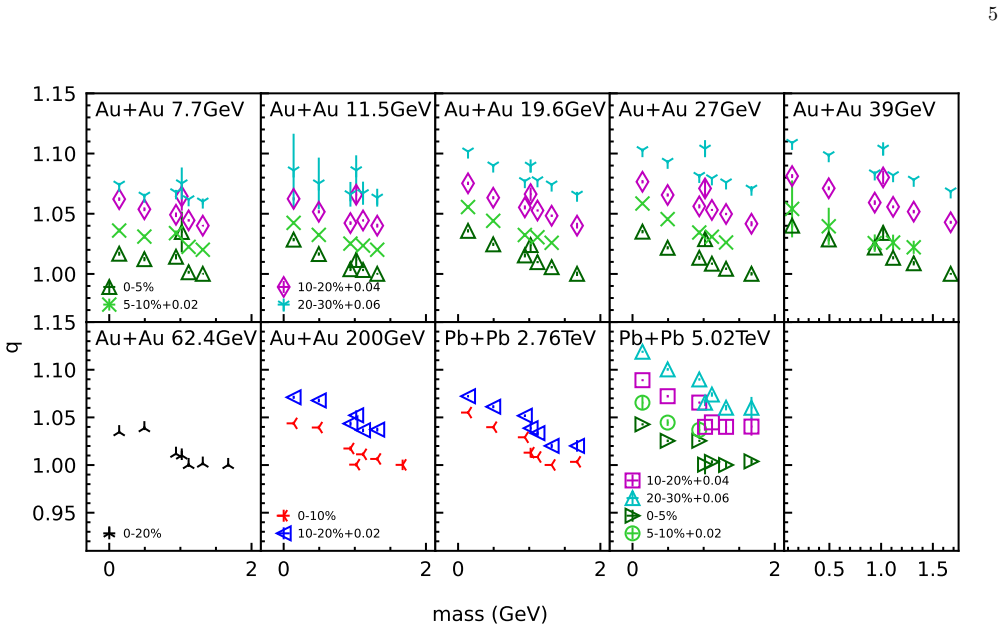
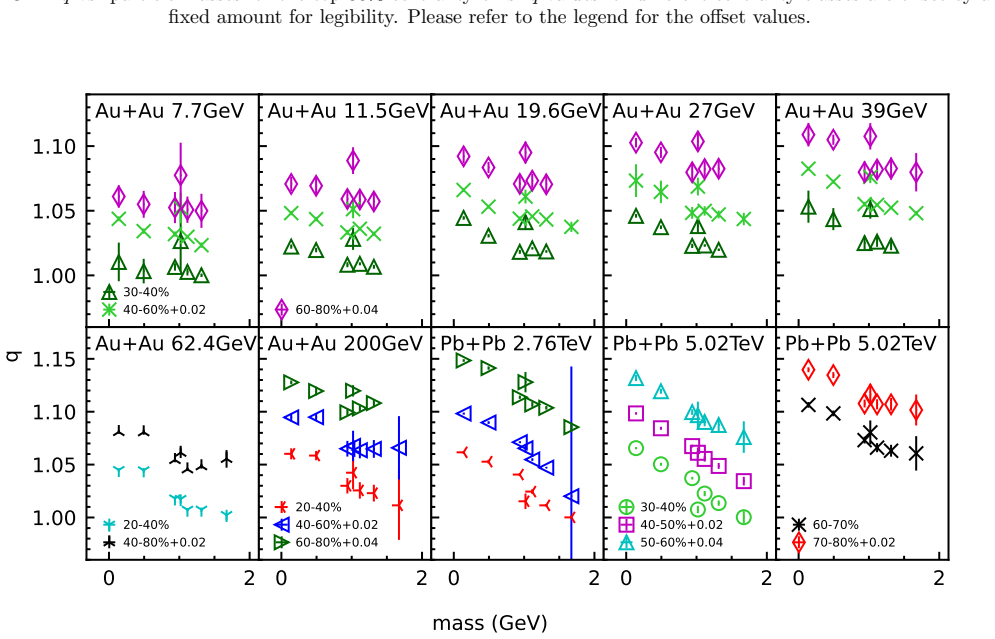
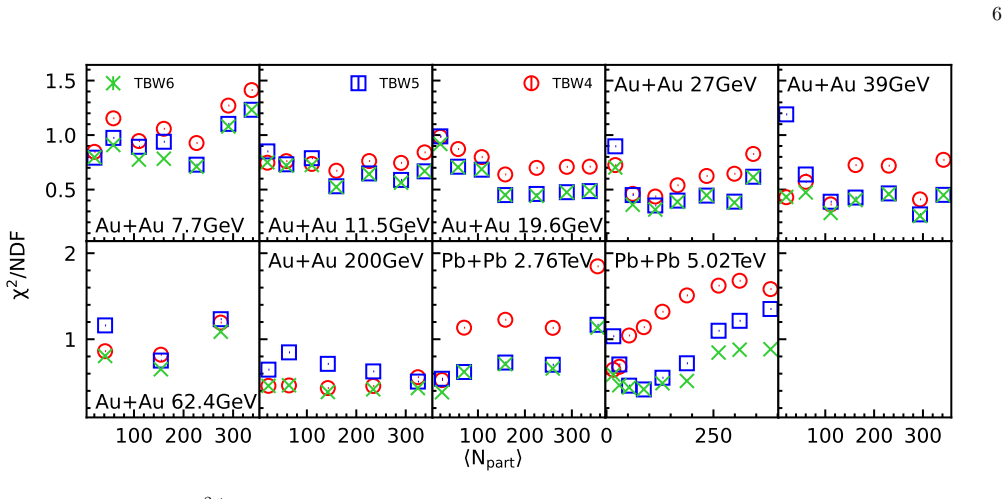
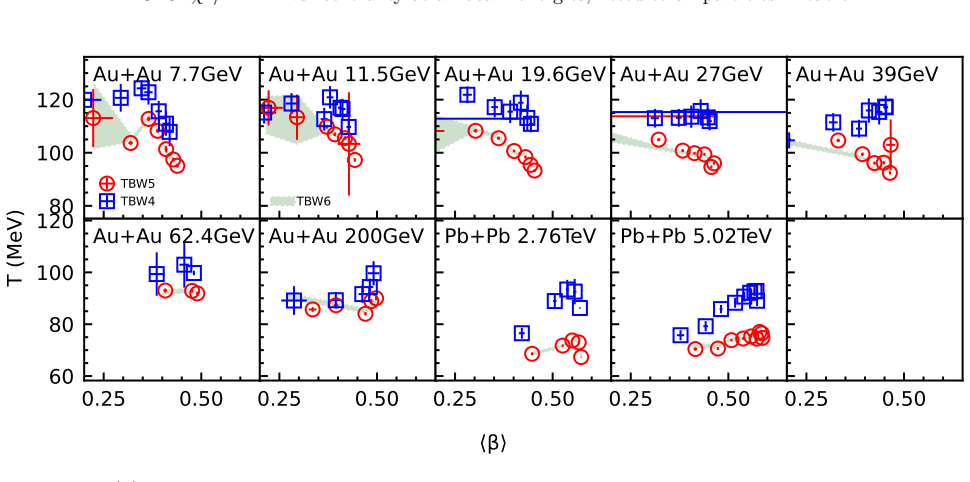
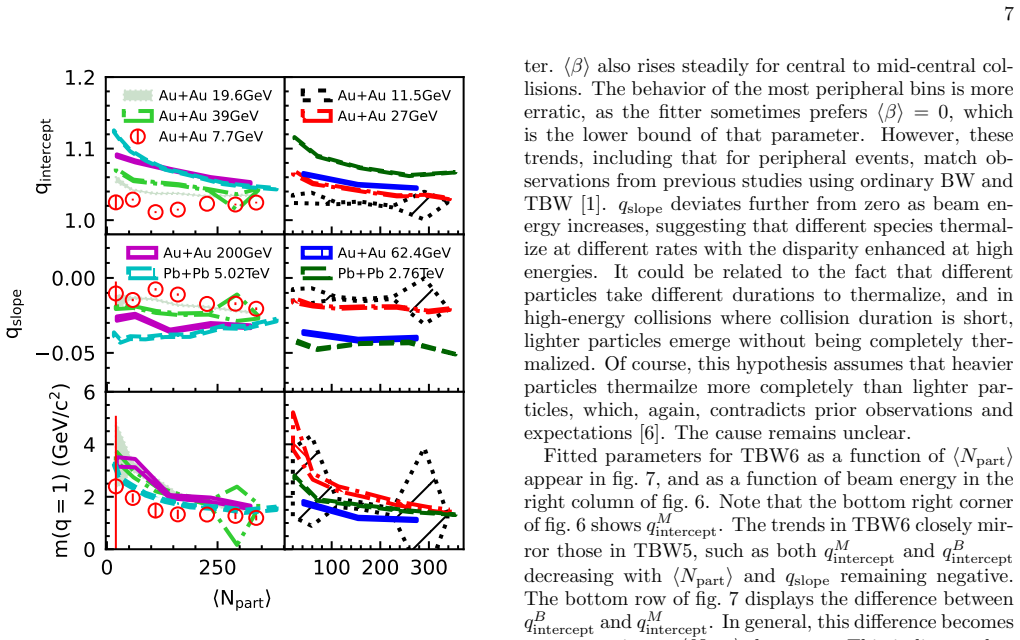
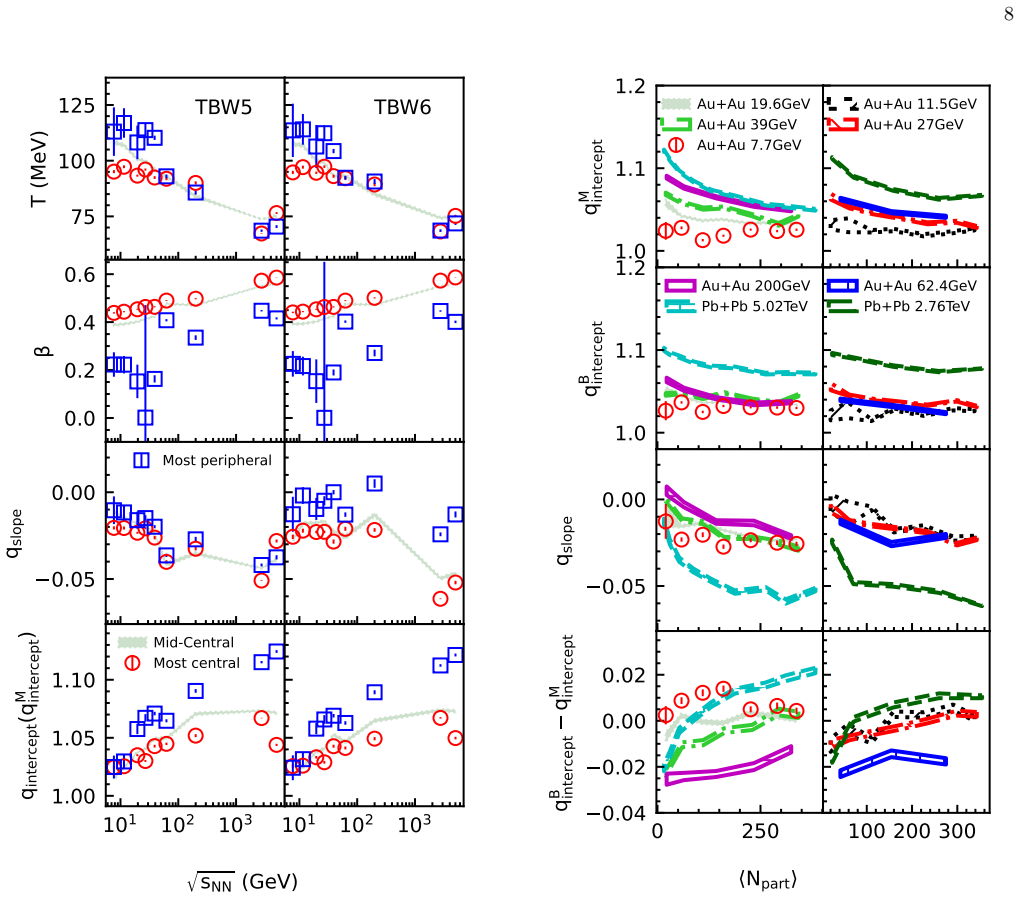
Fits allowing independent non-extensivity parameters q for each species reveal a systematic correlation between q and particle mass, except for quarkonia. Motivated by this trend, TBW5 posits that q depends linearly on particle mass, and TBW6 allows the q intercepts for mesons and baryons to differ. Across all energies and centralities considered, TBW5 improves χ²/NDF relative to the TBW4 fit in 71% of the datasets, while TBW6 shows improvement in 94% of the datasets, especially in central collisions. These results demonstrate a robust mass ordering in non-equilibrium behavior at kinetic freeze-out.
What carries the argument
The Tsallis Blast-Wave model extended so that the non-extensivity parameter q, which quantifies incomplete thermal equilibrium, is allowed to vary with hadron mass.
If this is right
- TBW5 improves χ²/NDF relative to TBW4 in 71% of the datasets.
- TBW6 shows improvement in 94% of the datasets.
- Both variants perform especially well in central collisions.
- The results demonstrate a robust mass ordering in non-equilibrium behavior at kinetic freeze-out.
- They provide a more accurate description of hadron spectra from RHIC to LHC energies.
Where Pith is reading between the lines
- The observed mass ordering may indicate that heavier hadrons decouple earlier from the expanding medium and retain larger deviations from equilibrium.
- The distinct behavior of quarkonia suggests their production or decoupling dynamics differ from those of light mesons and baryons.
- The linear mass dependence could be used to predict spectra for additional hadron species not included in the current fits.
Load-bearing premise
The improvement in fit quality when q is made mass-dependent reflects a genuine physical correlation at kinetic freeze-out rather than an artifact of adding extra free parameters.
What would settle it
A new dataset or independent observable, such as flow coefficients or particle ratios, from which q values extracted without reference to the mass-dependent forms fail to reproduce the same mass ordering.
Figures
read the original abstract
We analyze identified-hadron transverse-momentum spectra from STAR Au+Au and ALICE Pb+Pb collisions over $\sqrt{s_{NN}} = 7.7$~GeV--$5.02$~TeV using an extended Tsallis Blast-Wave (TBW) framework, which includes a non-extensivity parameter $q$ to quantify the degree of incomplete thermal equilibrium. Conventionally, either a common value of $q$, or two separate $q$ values, one for mesons and one for baryons, are used to describe particle spectra in the TBW framework, with the latter being referred to as TBW4 in Ref.~\cite{Chen:2020zuw}. This work extends the TBW framework by studying the dependence of $q$ on different kinds of particles in detail. Fits allowing independent non-extensivity parameters $q$ for each species reveal a systematic correlation between $q$ and particle mass, except for quarkonia. Motivated by this trend, we introduce two new parameterizations: TBW5, which posits that $q$ depends linearly on particle mass, and TBW6, which allows the $q$ intercepts for mesons and baryons to differ. Across all energies and centralities considered in this study, TBW5 improves $\chi^{2}/\mathrm{NDF}$ relative to the TBW4 fit in 71\% of the datasets, while TBW6 shows improvement in 94\% of the datasets. They perform especially well in central collisions. These results demonstrate a robust mass ordering in non-equilibrium behavior at kinetic freeze-out and provide a more accurate description of hadron spectra from RHIC to LHC energies.
Editorial analysis
A structured set of objections, weighed in public.
Referee Report
Summary. The paper analyzes identified-hadron p_T spectra from STAR Au+Au and ALICE Pb+Pb collisions using an extended Tsallis Blast-Wave framework. It finds that independent q values per species exhibit a systematic mass correlation (except quarkonia). This motivates TBW5 (q linear in mass) and TBW6 (separate meson/baryon q intercepts), which improve χ²/NDF over TBW4 (meson/baryon q values) in 71% and 94% of datasets respectively, especially in central collisions, indicating mass ordering in non-equilibrium behavior at kinetic freeze-out.
Significance. If the reported mass dependence of q reflects physics at kinetic freeze-out rather than parameterization flexibility, the result would constrain models of hadronization and freeze-out conditions across RHIC-to-LHC energies. The broad dataset coverage (energies 7.7 GeV–5.02 TeV, multiple centralities) and explicit multi-variant comparisons constitute a strength. However, the absence of nested-model significance tests limits the strength of the central claim that the improvements demonstrate a robust physical trend.
major comments (2)
- [Abstract] Abstract and results section on TBW5/TBW6: the fractions of datasets showing χ²/NDF improvement (71% for TBW5, 94% for TBW6) are reported without an F-test, likelihood-ratio test, or AIC/BIC comparison that accounts for the additional free parameters (slope in TBW5; separate intercepts in TBW6) relative to TBW4. This leaves open whether the gains exceed those expected from extra flexibility alone.
- [Results] Motivation for TBW5 and TBW6 (results section): the linear mass dependence and split-intercept forms are selected after inspecting per-species q values obtained from fits to the identical spectra; this introduces a circularity risk that undermines the claim of an independently verified physical mass correlation at freeze-out.
minor comments (1)
- Add an explicit table or paragraph stating the number of free parameters and NDF for TBW4, TBW5, and TBW6 to allow direct assessment of the reported χ²/NDF changes.
Simulated Author's Rebuttal
We thank the referee for the detailed and constructive feedback on our manuscript. We have carefully considered the major comments regarding statistical validation and potential circularity in model selection. Our point-by-point responses are provided below, and we propose revisions to address these concerns where appropriate.
read point-by-point responses
-
Referee: [Abstract] Abstract and results section on TBW5/TBW6: the fractions of datasets showing χ²/NDF improvement (71% for TBW5, 94% for TBW6) are reported without an F-test, likelihood-ratio test, or AIC/BIC comparison that accounts for the additional free parameters (slope in TBW5; separate intercepts in TBW6) relative to TBW4. This leaves open whether the gains exceed those expected from extra flexibility alone.
Authors: We concur that the use of statistical tests for nested models would strengthen our conclusions. In the revised version, we will perform F-tests to evaluate the significance of the χ² improvements for TBW5 and TBW6 relative to TBW4, accounting for the additional degrees of freedom. We will report the percentage of datasets where the improvement is statistically significant, in addition to the raw fractions of improvement. This addresses the concern about extra flexibility. revision: yes
-
Referee: [Results] Motivation for TBW5 and TBW6 (results section): the linear mass dependence and split-intercept forms are selected after inspecting per-species q values obtained from fits to the identical spectra; this introduces a circularity risk that undermines the claim of an independently verified physical mass correlation at freeze-out.
Authors: The per-species independent q fits are presented as an initial exploration to reveal the mass dependence, which then motivates the functional forms in TBW5 and TBW6. These forms are then applied and compared directly to TBW4. While the selection is data-informed, the subsequent fits are independent, and the consistent improvements across many datasets support the physical relevance. In revision, we will add explicit discussion of this procedure and its limitations to mitigate concerns of circularity, and emphasize that the mass correlation is verified through the improved fits. revision: partial
Circularity Check
No significant circularity; empirical model refinement from data
full rationale
The paper performs a sequence of phenomenological fits to the same identified-hadron pT spectra. It first allows independent q per species, observes a mass trend in those fitted values, then introduces TBW5 (linear q(m)) and TBW6 (split meson/baryon intercepts) motivated by the observed trend and reports that these forms yield lower χ²/NDF than TBW4 in 71% and 94% of datasets. This is ordinary data-driven model building and comparison; no first-principles derivation, uniqueness theorem, or prediction is claimed that reduces by construction to the input fits. The central result remains an empirical statement about relative fit quality on the spectra themselves and does not collapse to a self-definition or re-labeling of the per-species q values.
Axiom & Free-Parameter Ledger
free parameters (3)
- per-species q
- slope of q versus mass (TBW5)
- meson and baryon q intercepts (TBW6)
axioms (2)
- standard math Chi-squared per degree of freedom is a sufficient metric for comparing model quality across datasets
- domain assumption The Tsallis Blast-Wave distribution remains an appropriate description once q is allowed to vary with mass
Reference graph
Works this paper leans on
-
[1]
For the most central 30 % of collisions (across all beam energies), TBW5 should be considered a re- liable baseline for extracting kinetic freeze-out pa- rameters, as it typically matches or exceeds the per- formance of TBW4 while keeping model complexity unchanged
-
[2]
When analyzing peripheral collisions or when the data set includes a very broad range of parti- cle species, TBW6 can be employed to achieve marginally better statistical fits if an increase in de- grees of freedom is not an issue; otherwise, TBW4 may be a preferable choice. VII. CONCLUSION We performed a systematic study of the optimal way to vary the Ts...
-
[3]
J. Chen, J. Deng, Z. Tang, Z. Xu, and L. Yi, Nonequi- librium kinetic freeze-out properties in relativistic heavy ion collisions from energies employed at the RHIC beam energy scan to those available at the LHC, Phys. Rev. C 104, 034901 (2021), arXiv:2012.02986 [nucl-th]
arXiv 2021
-
[4]
M. Gyulassy and L. McLerran, New forms of QCD mat- ter discovered at RHIC, Nucl. Phys. A750, 30 (2005), arXiv:nucl-th/0405013
Pith/arXiv arXiv 2005
-
[5]
U. W. Heinz and R. Snellings, Collective flow and viscos- ity in relativistic heavy-ion collisions, Annual Review of Nuclear and Particle Science63, 123 (2013)
2013
-
[6]
Busza, K
W. Busza, K. Rajagopal, and W. van der Schee, Heavy Ion Collisions: The Big Picture and the Big Questions, Annual Review of Nuclear and Particle Science68, 339 (2018)
2018
-
[7]
Shuryak, Strongly coupled quark–gluon plasma in heavy ion collisions, Reviews of Modern Physics89, 035001 (2017)
E. Shuryak, Strongly coupled quark–gluon plasma in heavy ion collisions, Reviews of Modern Physics89, 035001 (2017)
2017
-
[8]
J. Adamset al.(STAR), Experimental and theoretical challenges in the search for the quark gluon plasma: The STAR Collaboration’s critical assessment of the evidence from RHIC collisions, Nucl. Phys. A757, 102 (2005), arXiv:nucl-ex/0501009
Pith/arXiv arXiv 2005
-
[9]
F. Becattini and U. W. Heinz, Thermal hadron produc- tion in p p and p anti-p collisions, Z. Phys. C76, 269 (1997), [Erratum: Z.Phys.C 76, 578 (1997)], arXiv:hep- ph/9702274
arXiv 1997
-
[10]
Schnedermann and U
E. Schnedermann and U. Heinz, Hydrodynamical assess- ment of 200a gev collisions, Physical Review C50, 1675 (1994)
1994
-
[11]
B. I. Abelevet al.(STAR), Systematic Measurements of Identified Particle Spectra inpp, d + Au and Au+Au Collisions from STAR, Phys. Rev. C79, 034909 (2009), arXiv:0808.2041 [nucl-ex]
Pith/arXiv arXiv 2009
-
[12]
L. Adamczyket al.(STAR), Bulk Properties of the Medium Produced in Relativistic Heavy-Ion Collisions from the Beam Energy Scan Program, Phys. Rev. C96, 044904 (2017), arXiv:1701.07065 [nucl-ex]
Pith/arXiv arXiv 2017
-
[13]
Z. Tang, Y. Xu, L. Ruan, G. van Buren, F. Wang, and Z. Xu, Spectra and radial flow at RHIC with Tsallis statistics in a Blast-Wave description, Phys. Rev. C79, 051901 (2009), arXiv:0812.1609 [nucl-ex]
Pith/arXiv arXiv 2009
-
[14]
M. Shao, L. Yi, Z. Tang, H. Chen, C. Li, and Z. Xu, Ex- amine the species and beam-energy dependence of parti- cle spectra using Tsallis Statistics, J. Phys. G37, 085104 (2010), arXiv:0912.0993 [nucl-ex]
Pith/arXiv arXiv 2010
-
[15]
Z. Tang, L. Yi, L. Ruan, M. Shao, H. Chen, C. Li, B. Mo- hanty, P. Sorensen, A. Tang, and Z. Xu, Statistical Origin of Constituent-Quark Scaling in the QGP hadronization, Chin. Phys. Lett.30, 031201 (2013), arXiv:1101.1912 [nucl-ex]
Pith/arXiv arXiv 2013
-
[16]
Ristea, A
O. Ristea, A. Jipa, C. Ristea, T. Esanu, M. Calin, A. Barzu, A. Scurtu, and I. Abu-Quoad, Study of the freeze-out process in heavy ion collisions at relativistic energies, J. Phys. Conf. Ser.420, 012041 (2013)
2013
-
[17]
M. Ajaz, M. Shehzad, M. Waqas, H. I. Alrebdi, M. A. Ahmad, A. Jagnandan, S. Jagnandan, M. Badshah, J. H. Baker, and A. M. Quraishi, Multiplicity depen- dence of the freezeout parameters in high energy hadron- hadron collisions*, Chin. Phys. C48, 053108 (2024), arXiv:2402.08535 [hep-ph]
arXiv 2024
-
[18]
H.-L. Lao, F.-H. Liu, B.-C. Li, and M.-Y. Duan, Ki- netic freeze-out temperatures in central and peripheral collisions: Which one is larger?, Nucl. Sci. Tech.29, 82 10 (2018), arXiv:1703.04944 [nucl-th]
Pith/arXiv arXiv 2018
-
[19]
J. Adamset al.(STAR), K(892)* resonance production in Au+Au and p+p collisions at s(NN)**(1/2) = 200-GeV at STAR, Phys. Rev. C71, 064902 (2005), arXiv:nucl- ex/0412019
arXiv 2005
-
[20]
G. Wilk and Z. Wlodarczyk, On the interpretation of nonextensive parameter q in Tsallis statistics and Levy distributions, Phys. Rev. Lett.84, 2770 (2000), arXiv:hep-ph/9908459
Pith/arXiv arXiv 2000
-
[21]
C.-Y. Wong, G. Wilk, L. J. L. Cirto, and C. Tsallis, From QCD-based hard-scattering to nonextensive sta- tistical mechanical descriptions of transverse momentum spectra in high-energyppandp¯pcollisions, Phys. Rev. D 91, 114027 (2015), arXiv:1505.02022 [hep-ph]
Pith/arXiv arXiv 2015
-
[22]
K. Urmossy, G. G. Barnafoldi, and T. S. Biro, Gener- alised Tsallis Statistics in Electron-Positron Collisions, Phys. Lett. B701, 111 (2011), arXiv:1101.3023 [hep-ph]
Pith/arXiv arXiv 2011
-
[23]
B. De, S. Bhattacharyya, G. Sau, and S. K. Biswas, Non- extensive thermodynamics, heavy ion collisions and par- ticle production at RHIC energies, Int. J. Mod. Phys. E 16, 1687 (2007)
2007
-
[24]
G. Wilk and Z. Wlodarczyk, Multiplicity fluctuations due to the temperature fluctuations in high-energy nuclear collisions, Phys. Rev. C79, 054903 (2009), arXiv:0902.3922 [hep-ph]
Pith/arXiv arXiv 2009
-
[25]
W. M. Alberico, A. Lavagno, and P. Quarati, Nonex- tensive statistics, fluctuations and correlations in high- energy nuclear collisions, Eur. Phys. J. C12, 499 (2000), arXiv:nucl-th/9902070
Pith/arXiv arXiv 2000
-
[26]
T. Osada and G. Wilk, Nonextensive hydrodynamics for relativistic heavy-ion collisions, Phys. Rev. C77, 044903 (2008), [Erratum: Phys.Rev.C 78, 069903 (2008)], arXiv:0710.1905 [nucl-th]
Pith/arXiv arXiv 2008
-
[27]
J. Adamet al.(STAR), Strange hadron production in Au+Au collisions at √sNN = 7.7, 11.5, 19.6, 27, and 39 GeV, Phys. Rev. C102, 034909 (2020), arXiv:1906.03732 [nucl-ex]
arXiv 2020
-
[28]
Adamczyket al.(STAR), Probing parton dynamics of QCD matter with Ω andϕproduction, Phys
L. Adamczyket al.(STAR), Probing parton dynamics of QCD matter with Ω andϕproduction, Phys. Rev. C93, 021903 (2016), arXiv:1506.07605 [nucl-ex]
Pith/arXiv arXiv 2016
-
[29]
M. M. Aggarwalet al.(STAR), Strange and Multi- strange Particle Production in Au+Au Collisions at√sN N = 62.4 GeV, Phys. Rev. C83, 024901 (2011), [Er- ratum: Phys.Rev.C 107, 049903 (2023)], arXiv:1010.0142 [nucl-ex]
Pith/arXiv arXiv 2011
-
[30]
B. I. Abelevet al.(STAR), Measurements of phi meson production in relativistic heavy-ion collisions at RHIC, Phys. Rev. C79, 064903 (2009), arXiv:0809.4737 [nucl- ex]
Pith/arXiv arXiv 2009
-
[31]
A. Adareet al.(PHENIX), Spectra and ratios of identified particles in Au+Au andd+Au collisions at√sN N = 200 GeV, Phys. Rev. C88, 024906 (2013), arXiv:1304.3410 [nucl-ex]
arXiv 2013
-
[32]
J. Adamset al.(STAR), Scaling Properties of Hyperon Production in Au+Au Collisions at s**(1/2) = 200- GeV, Phys. Rev. Lett.98, 062301 (2007), arXiv:nucl- ex/0606014
arXiv 2007
-
[33]
B. I. Abelevet al.(STAR), Partonic flow and phi-meson production in Au + Au collisions at s(NN)**(1/2) = 200- GeV, Phys. Rev. Lett.99, 112301 (2007), arXiv:nucl- ex/0703033
arXiv 2007
-
[34]
B. Abelevet al.(ALICE), Centrality dependence ofπ, K, p production in Pb-Pb collisions at √sN N = 2.76 TeV, Phys. Rev. C88, 044910 (2013), arXiv:1303.0737 [hep- ex]
Pith/arXiv arXiv 2013
-
[35]
B. B. Abelevet al.(ALICE),K 0 S and Λ production in Pb-Pb collisions at √sN N = 2.76 TeV, Phys. Rev. Lett. 111, 222301 (2013), arXiv:1307.5530 [nucl-ex]
Pith/arXiv arXiv 2013
-
[36]
B. B. Abelevet al.(ALICE), Multi-strange baryon pro- duction at mid-rapidity in Pb-Pb collisions at √sN N = 2.76 TeV, Phys. Lett. B728, 216 (2014), [Erratum: Phys.Lett.B 734, 409–410 (2014)], arXiv:1307.5543 [nucl- ex]
Pith/arXiv arXiv 2014
-
[37]
B. B. Abelevet al.(ALICE),K ∗(892)0 andϕ(1020) pro- duction in Pb-Pb collisions at √ sN N= 2.76 TeV, Phys. Rev. C91, 024609 (2015), arXiv:1404.0495 [nucl-ex]
Pith/arXiv arXiv 2015
-
[38]
S. Acharyaet al.(ALICE), Production of charged pions, kaons, and (anti-)protons in Pb-Pb and inelasticppcol- lisions at √sN N = 5.02 TeV, Phys. Rev. C101, 044907 (2020), arXiv:1910.07678 [nucl-ex]
arXiv 2020
-
[39]
I. J. Abualrobet al.(ALICE), Centrality dependence of strange particle production in Pb-Pb collisions at√sNN = 5.02 TeV, (2025), arXiv:2511.10360 [nucl-ex]
arXiv 2025
-
[40]
S. Acharyaet al.(ALICE), Evidence of rescattering effect in Pb-Pb collisions at the LHC through production of K∗(892)0 andϕ(1020) mesons, Phys. Lett. B802, 135225 (2020), arXiv:1910.14419 [nucl-ex]
arXiv 2020
-
[41]
J. Adamset al.(STAR), Identified particle distributions in pp and Au+Au collisions at s(NN)**(1/2) = 200 GeV, Phys. Rev. Lett.92, 112301 (2004), arXiv:nucl- ex/0310004
arXiv 2004
-
[42]
M. Petran, J. Letessier, V. Petracek, and J. Rafelski, Strangeness Production in Au-Au collisions at √sN N = 62.4 GeV, Acta Phys. Polon. Supp.5, 255 (2012), arXiv:1112.3189 [hep-ph]
Pith/arXiv arXiv 2012
-
[43]
S. A. Bass and A. Dumitru, Dynamics of hot bulk QCD matter: From the quark gluon plasma to hadronic freezeout, Phys. Rev. C61, 064909 (2000), arXiv:nucl- th/0001033
arXiv 2000
-
[44]
H. van Hecke, H. Sorge, and N. Xu, Evidence of early multistrange hadron freezeout in high-energy nuclear col- lisions, Phys. Rev. Lett.81, 5764 (1998), arXiv:nucl- th/9804035
arXiv 1998
-
[45]
A. Dumitru, S. A. Bass, M. Bleicher, H. Stoecker, and W. Greiner, Direct emission of multiple strange baryons in ultrarelativistic heavy ion collisions from the phase boundary, Phys. Lett. B460, 411 (1999), arXiv:nucl- th/9901046
arXiv 1999
-
[46]
Adamset al.(STAR), Multistrange baryon production in Au-Au collisions at S(NN)**1/2 = 130 GeV, Phys
J. Adamset al.(STAR), Multistrange baryon production in Au-Au collisions at S(NN)**1/2 = 130 GeV, Phys. Rev. Lett.92, 182301 (2004), arXiv:nucl-ex/0307024
Pith/arXiv arXiv 2004
-
[47]
O. Y. Barannikova (STAR), Probing collision dynamics at RHIC, in17th International Conference on Ultra Rela- tivistic Nucleus-Nucleus Collisions (Quark Matter 2004) (2004) arXiv:nucl-ex/0403014
Pith/arXiv arXiv 2004
-
[48]
S. A. Bass, A. Dumitru, M. Bleicher, L. Bravina, E. Zabrodin, H. Stoecker, and W. Greiner, Hadronic freezeout following a first order hadronization phase tran- sition in ultrarelativistic heavy ion collisions, Phys. Rev. C60, 021902 (1999), arXiv:nucl-th/9902062. 11 Appendix A: Tsallis fit to data 10 7 10 4 10 1 102 105 1/2 pTd2N/dydpT(GeV/c) 2 2/D. O. F....
Pith/arXiv arXiv 1999
discussion (0)
Sign in with ORCID, Apple, or X to comment. Anyone can read and Pith papers without signing in.