REVIEW 3 major objections 6 minor 43 references
Wavelet-based parallel dynamic mesh adaptation for magnetohydrodynamics in the AMROC framework
T0 review · 3 major / 6 minor · reviewed 2026-08-14 · deepseek-v4-flash
Pith's one-line read A wavelet-based multiresolution criterion for flagging cells improves accuracy and memory compression over gradient-based refinement for adaptive magnetohydrodynamics, and the parallel patch-based implementation runs substantially faster…
desk verdict A real but incremental engineering paper: the MR-vs-SG accuracy-per-cell claim holds up on the 2D evidence, while the 9x/84x speedup claims against Carmen-MHD are confounded by mismatched resolution, clustering efficiency, and threshold—treat those as demonstrations, not benchmarks. read the letter →
The pith
A machine-rendered reading of the paper's core claim, the machinery that carries it, and where it could break.
The reading
What carries the argument
The load-bearing mechanism is the two-level multiresolution transform of finite-volume cell averages: a projection operator forms coarser cells by averaging children, a third-order polynomial prediction operator reconstructs fine values from coarse neighbors, and the difference $\mathbf{d}_\ell = \bar{\mathbf{Q}}_\ell - \tilde{\mathbf{Q}}_\ell$ defines the wavelet coefficient whose magnitude measures local regularity. Cells are flagged for refinement whenever a coefficient exceeds a level-dependent threshold $\epsilon_\ell = \epsilon / |\Omega| 2^{d(\ell-L)}$, chosen so that thresholding and discretization errors remain comparable. Flagged cells are then gathered into rectangular patches by a signature-based clustering algorithm, and the GLM-MHD system with hyperbolic divergence cleaning is advanced by a finite-volume scheme with HLLD fluxes. The machinery's role is to concentrate computation and memory in genuinely unsmooth regions while controlling the $L^1$ perturbation introduced by thresholding.
What would settle it
Run the two-dimensional magnetic shock cloud to $t_e = 0.06$ in both solvers with the same base mesh, the same maximum refinement level (equivalent to a $1024^2$ fine mesh), the same threshold $\epsilon = 0.01$, the same refinement parameter $\eta = 0.80$, and one processor; the claimed ninefold speedup requires AMROC to take roughly 1,889 seconds while the serial baseline takes about 17,520 seconds at comparable error and cell counts.
Extended reading notes
Core claim
The central claim is that the wavelet detail coefficients, obtained by projecting cell averages onto coarser levels and predicting them back with third-order polynomial interpolation, provide a mathematically grounded refinement indicator that outperforms gradient-based flagging for MHD. On the two-dimensional turbulence-vortex test with thresholds chosen to give comparable errors, the multiresolution criterion attains an $L^1_{\mathrm{AMR}}$ error of about 2.15 with 333,064 cells, versus 2.30 with 411,392 cells for the scaled-gradient criterion. On the two-dimensional magnetic shock cloud, the new implementation needs about nine times less CPU time than the serial cell-based multiresolution baseline on one processor, about six times less in three dimensions, and roughly eighty-four times less when 60 processors are used in three dimensions. The improvements are attributed to the wavelet criterion's faithful localization and to patch-based data structures that preserve memory coherence.
Load-bearing premise
The reported runtime advantages assume the two solvers are configured equivalently, but the paper mixes settings across tables, so the speedup numbers combine the improvement from the wavelet criterion with differences in data structures and parameters.
Editorial extensions
If this is right
- On the canonical two-dimensional MHD turbulence-vortex test at maximum refinement level 5, the multiresolution criterion reaches a smaller $L^1_{\mathrm{AMR}}$ error (2.15) than the scaled-gradient criterion (2.30) while using about 19% fewer cells.
- For the two-dimensional magnetic shock cloud on one processor, the new implementation runs in 1,889 seconds versus 17,520 seconds for the serial multiresolution baseline, a factor of about 9.
- In three dimensions, one-processor runtime is 2,620 seconds versus 16,816 seconds, a factor of about 6; with 60 processors and a larger threshold, the reported speed-up over the serial baseline reaches about 84.
- The adaptive meshes remain well balanced across processors, with load balancing after each level-0 time step, so the parallel gains do not come at the cost of severe imbalance.
- The same patch-based hierarchical data structures that make AMR efficient for the Euler equations carry over to MHD, making the approach a template for adding wavelet-driven adaptation to other conservation-law solvers.
Reading between the lines
- A natural testable extension is to apply the same wavelet criterion to the magnetic field components rather than only density or pressure; the divergence-free constraint may make vector-valued thresholding behave differently in shock regions.
- The reported 9x and 84x speedups compare two different code architectures, so they should be read as implementation-level gains; the wavelet criterion's isolated contribution is best measured by the accuracy-per-cell improvement, not by the absolute runtime ratio.
- Because the thresholding is tied to $L^1$ control, the same approach could be coupled with local time stepping to regain accuracy in smooth regions while keeping the explicit scheme stable, a direction the paper does not pursue.
- In space-weather forecasting, where forecasts must beat real time, these results suggest the criterion could be tuned to error bounds rather than user-chosen thresholds, turning the threshold $\epsilon$ into an automatic accuracy control.
Signed reviews
Editorial analysis
A structured set of objections, weighed in public.
Referee Report
Summary. The paper presents an implementation of wavelet-based multiresolution (MR) mesh refinement for an ideal MHD solver within the block-structured AMROC framework, using GLM divergence cleaning and second-order finite-volume discretization. It compares the MR criterion with the existing scaled-gradient (SG) criterion on the 2D Orszag–Tang vortex, reporting, at one threshold pair, lower L1 error and fewer refined cells for MR. It then compares AMROC CPU times with the serial cell-based MR code Carmen-MHD on a 2D and 3D magnetic cloud test, claiming speedups of about 9x in serial and up to 84x with 60 processors, and presents scaling data for three resolutions. The main claims are that MR gives better accuracy and memory compression than SG, and that the patch-based parallel AMROC implementation is significantly faster than the serial cell-based MR code.
Significance. If the comparisons were properly controlled, this would be a useful contribution to adaptive MHD simulation: it adds a wavelet-based refinement criterion to a mature parallel AMR framework and provides error-versus-mesh data on a standard test problem. The authors are transparent about tuning parameters, and the Orszag–Tang test includes L1 errors against an independent uniform-mesh reference. However, the central performance claim rests on CPU-time comparisons that mix different clustering efficiencies, thresholds, and effective resolutions, and the SG-versus-MR superiority claim is based on a single threshold pair without sensitivity. The reported evidence makes the conclusions plausible but not yet substantiated.
major comments (3)
- [Section 4.2, Table 2] The speedup claims for AMROC versus Carmen-MHD are confounded by parameter differences. In the 2D case, Table 2 reports timings for η=0.80 and ε=0.01, while the cell counts quoted in the text (311,612 vs 40,329) are for η=0.99; the cell count for the timed runs is not reported. In the 3D case, the serial Carmen-MHD run is described as a corresponding 128^3 refined mesh, whereas the AMROC run uses a base mesh 32^3 refined to a 1024^3 uniform equivalent, and the 60-processor AMROC run uses ε=0.025 while the serial comparison uses ε=0.01. Without reporting the actual number of cells (including patch buffer cells) and the error achieved for each timed run, the 9x, 39x, and 84x factors cannot be attributed to the wavelet refinement method. Please supplement the comparison with runs that match threshold, effective resolution, and clustering efficiency, or at least quantify the work performed and the solution error for each configuration. This point is load-bearing for the conclusion that the implementation presents a significant improvement compared to its MR-MHD base serial code.
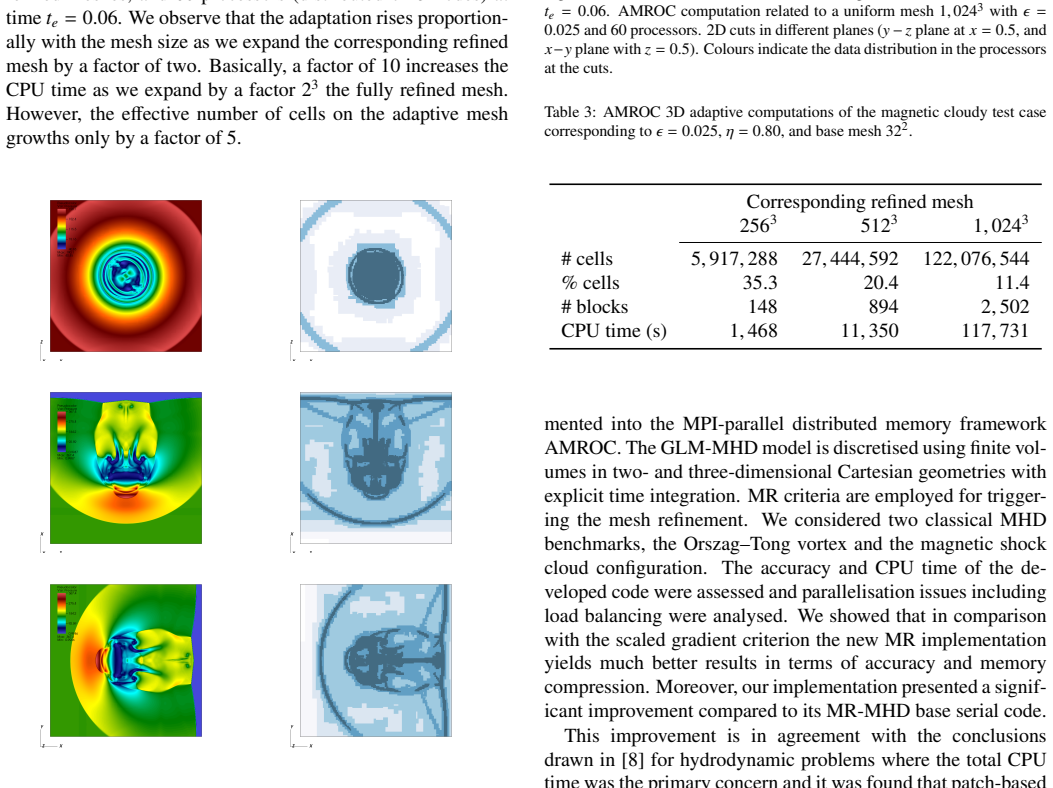
- [Section 4.1, Table 1 and Figure 4] The SG-versus-MR superiority claim is supported by a single threshold pair chosen to give similar errors (ε=0.20 for SG, ε=0.05 for MR), with L1 errors 2.30 vs 2.15 and cell counts 411,392 vs 333,064. This is one operating point; threshold choices directly control both accuracy and cell count. To establish the claim of much better results in terms of accuracy and memory compression, the authors should show error-versus-cell-count curves for both criteria across several thresholds, analogous to Figure 4, which is shown only for MR. As it stands, the conclusion is plausible but underdetermined.
- [Section 4.2, Tables 2 and 3] The 3D magnetic cloud performance results are not tied to any reported error measure. No L1,AMR (or equivalent) error against a uniform reference is given for the 3D adaptive runs, and for the 2D cloud only qualitative agreement with Carmen-MHD is reported. Since the stated purpose is controlling the precision with dynamically adapted meshes, the CPU times for the 3D runs should be accompanied by an accuracy measure at the same effective resolution, or by a clear statement of why such a measure is unavailable. Without this, the scaling and speedup numbers for the 3D configuration are difficult to interpret.
minor comments (6)
- [Section 5] In the first sentence of the conclusions, 'Orszag–Tong vortex' should be 'Orszag–Tang vortex'.
- [Section 4.2] The text twice reads 'base mesh 32^2' where the context indicates a three-dimensional base mesh 32^3; please correct the superscripts.
- [References] The reference list begins with a duplicated 'References' heading, which should be removed.
- [References] References [25] and [33] are the same Bell–Berger–Saltzman–Welcome paper; consolidate or cite them distinctly.
- [Section 3.1, Eq. (7)] Equation (7) uses |Ω|, which is described as 'cell area' in the text; in the 3D case this should be the cell volume. Please clarify the meaning of |Ω| for d=2 and d=3.
- [Figure 4] The legend labels for the two curves in Figure 4 are not fully explicit in the text; please label the curves directly as 'number of cells' and 'L1,AMR', with clear axis descriptions, to avoid ambiguity.
Circularity Check
No circularity: the wavelet refinement comparisons are empirical benchmarks against independent uniform-mesh references, with tuning parameters and self-citations that are not load-bearing.
full rationale
This paper contains no derived quantity that is fitted to the target result and then reported as a prediction. The wavelet refinement criterion is constructed from Harten's multiresolution projection/prediction operators (Eqs. (3)-(6)) and applied with a level-dependent threshold; the threshold and clustering parameters (epsilon, eta) are tuning choices, not constants calibrated to produce the accuracy or speedup claims. Accuracy is measured against independent uniform-mesh reference solutions at the same maximum resolution (L1,AMR), so the comparison does not presuppose the adaptive result. The CPU-time comparisons with Carmen-MHD and the comparison with the scaled-gradient criterion are empirical benchmarks against an earlier implementation and an alternative refinement indicator; even if the compared runs differ in parameters or effective resolution, that is a fairness or correctness question, not a circularity in the derivation. Citing the authors' prior papers [7,8] for context and motivation is not load-bearing to the central claim, and no uniqueness theorem, imported ansatz, or self-definitional equation was found. The derivation is therefore self-contained, and the appropriate score is 0.
Assumptions & free parameters
free parameters (4)
- MR threshold epsilon (hierarchical) =
0.05 (Orszag-Tang), 0.01/0.025 (magnetic cloud)
- SG threshold epsilon =
0.20 (Orszag-Tang)
- Clustering efficiency eta =
0.80 (mostly), 0.99 (2D magnetic cloud AMROC run)
- GLM divergence parameter alpha_p =
0.4
assumptions (3)
- standard math Finite volume discretization with HLLD flux and MinMod limiter is second-order accurate and stable.
- domain assumption The GLM-MHD model with hyperbolic divergence cleaning and alpha_p in [0,1] sufficiently controls div B for the benchmarks.
- domain assumption Thresholding a single scalar variable (density or pressure) is sufficient to flag all dynamically important MHD features.
Cite this review
Pith. "Pith review of Wavelet-based parallel dynamic mesh adaptation for magnetohydrodynamics in the AMROC framework." pith.science (2026). https://pith.science/paper/BNVCE74X
@misc{pith2026190806332,
  author       = {Pith},
  title        = {Pith review of: Wavelet-based parallel dynamic mesh adaptation for magnetohydrodynamics in the AMROC framework},
  year         = {2026},
  howpublished = {\url{https://pith.science/paper/BNVCE74X}},
  note         = {Machine review of arXiv:1908.06332}
}
read the original abstract
Computational magnetohydrodynamics (MHD) for space physics has become an essential area in understanding the multiscale dynamics of geophysical and astrophysical plasma processes, partially motivated by the lack of space data. Full MHD simulations are typically very demanding and may require substantial computational efforts. In particular, computational space-weather forecasting is an essential long-term goal in this area, motivated for instance by the needs of modern satellite communication technology. We present a new feature of a recently developed compressible two- and three-dimensional MHD solver, which has been successfully implemented into the parallel AMROC (Adaptive Mesh Refinement in Object-oriented C++) framework with improvements concerning the mesh adaptation criteria based on wavelet techniques. The developments are related to computational efficiency while controlling the precision using dynamically adapted meshes in space-time in a fully parallel context.
Figures


Figures from the paper (4 more)


Reference graph
Works this paper leans on
-
[1]
C. J. Schrijver, K. Kauristie, A. D. Aylward, C. M. Denardini, S. E. Gib- son, A. Glover, N. Gopalswamy, M. Grande, M. Hapgood, D. Heynd- erickx, N. Jakowski, V . V . Kalegaev, G. Lapenta, J. A. Linker, S. Liu, C. H. Mandrini, I. R. Mann, T. Nagatsuma, D. Nandy, T. Obara, T. P. OBrien, T. Onsager, H. J. Opgenoorth, M. Terkildsen, C. E. Valladares, N. Vilm...
work page 2015
- [2]
-
[3]
Bittencourt, Fundamentals of Plasma Physics, Springer, 2004
J. Bittencourt, Fundamentals of Plasma Physics, Springer, 2004
work page 2004
-
[4]
A. K. F. Gomes, M. O. Domingues, K. Schneider, O. Mendes, R. Deiter- ding, An adaptive multiresolution method for ideal magnetohydrodynam- ics using divergence cleaning with parabolic-hyperbolic correction, Appl. Numer. Math. 95 (2015) 199–213
work page 2015
-
[5]
M. O. Domingues, A. K. F. Gomes, S. M. Gomes, O. Mendes, B. Di Pierro, K. Schneider, Extended generalized Lagrangian multipli- ers for magnetohydrodynamics using adaptive multiresolution methods, ESAIM: Proc. 43 (2013) 95–107
work page 2013
-
[6]
B. Hejazialhosseini, D. Rossinelli, M. Bergdorf, P. Koumoutsakos, High order finite volume methods on wavelet-adapted grids with local time- stepping on multicore architectures for the simulation of shock-bubble interactions, Journal of Computational Physics 229 (22) (2010) 8364 – 8383
work page 2010
-
[7]
R. Deiterding, M. O. Domingues, S. M. Gomes, O. Roussel, K. Schneider, Adaptive multiresolution or adaptive mesh refinement? a case study for 2D Euler equations, ESAIM Proceedings 16 (2009) 181–194
work page 2009
-
[8]
R. Deiterding, M. O. Domingues, S. M. Gomes, K. Schneider, Compari- son of adaptive multiresolution and adaptive mesh refinement applied to simulations of the compressible Euler equations, SIAM Journal on Scien- tific Computing 38 (5) (2016) S173–S193
work page 2016
Show all 43 references
-
[9]
Deiterding, Parallel adaptive simulation of multi-dimensional deto- nation structures, Ph.D
R. Deiterding, Parallel adaptive simulation of multi-dimensional deto- nation structures, Ph.D. thesis, Brandenburgische Technische Universit¨at Cottbus (Sep 2003)
2003
-
[10]
Deiterding, Block-structured adaptive mesh refinement - theory, im- plementation and application, ESAIM: Proc
R. Deiterding, Block-structured adaptive mesh refinement - theory, im- plementation and application, ESAIM: Proc. 34 (2011) 97–150
2011
-
[11]
Moreira Lopes, R
M. Moreira Lopes, R. Deiterding, A. K. F. Gomes, O. Mendes, M. O. Domingues, An ideal compressible magnetohydrodynamic solver with parallel block-structured adaptive mesh refinement, Comput. Fluids 173 (2018) 293–298
2018
-
[12]
Kallenrode, Space Physics An Introduction to Plasmas and Parti- cles in the Heliosphere and Magnetospheres, Germany, Springer-Verlag, 2004
M.-B. Kallenrode, Space Physics An Introduction to Plasmas and Parti- cles in the Heliosphere and Magnetospheres, Germany, Springer-Verlag, 2004
2004
-
[13]
M. G. Kivelson, C. T. Russell (Eds.), Introduction to Space Physics, Cam- bridge, Cambridge University, 1996
1996
-
[14]
T. E. Cravens, Physics of Solar System Plasmas, Cambridge, Cambridge University, 2004
2004
-
[15]
C. T. Russell, J. G. Luhmann, R. J. Strangeway, Space Physics An Intro- duction, Cambridge, Cambridge University, 2016
2016
-
[16]
Baumjohann, R
W. Baumjohann, R. A. Treumann, Basic Space Plasma Physics, London, Imperial College, 1999
1999
-
[17]
S. A. Orszag, C.-M. Tang, Small-scale structure of two-dimensional mag- netohydrodynamic turbulence, J. Fluid Mech. 90 (1) (1979) 129–143
1979
-
[18]
Balogh, , R
A. Balogh, , R. A. Treumann, Physics of Collisionless Shocks Space Plasma Shock Waves, New York, Springer, 2013
2013
-
[19]
P. F. Hopkins, A constrained-gradient method to control divergence errors in numerical MHD, Mon. Notices Royal Astron. Soc. 462 (11) (2016) 576–587
2016
-
[20]
Dedner, F
A. Dedner, F. Kemm, D. Kr ¨oner, C.-D. Munz, T. Schnitzer, M. Wesen- berg, Hyperbolic divergence cleaning for the MHD equations, J. Comput. Phys. 175 (2) (2002) 645–673
2002
-
[21]
Mignone, P
A. Mignone, P. Tzeferacos, A second-order unsplit Godunov scheme for cell-centered MHD: The CTU-GLM scheme, J. Comput. Phys. 229 (6) (2010) 2117–2138
2010
-
[22]
R. J. Leveque, Finite V olume Methods for Hyperbolic Systems, Cam- bridge University, 2002
2002
-
[23]
M. J. Berger, J. Oliger, Adaptive mesh refinement for hyperbolic partial differential equations, J. Comput. Phys. 53 (1984) 484–512
1984
-
[24]
Berger, P
M. Berger, P. Colella, Local adaptive mesh refinement for shock hydro- dynamics, J. Comput. Phys. 82 (1988) 64–84
1988
-
[25]
J. Bell, M. Berger, J. Saltzmann, M. Welcome, Three-dimensional adap- tive mesh refinement for hyperbolic conservation laws, SIAM J. Sci. Comput. 15 (1994) 127–138
1994
-
[26]
M. O. Domingues, S. M. Gomes, O. Roussel, K. Schneider, Adaptive multiresolution methods, ESAIM: Proc. 34 (2011) 1–96
2011
-
[27]
M ¨uller, Adaptive Multiscale Schemes for Conservation Laws, V ol
S. M ¨uller, Adaptive Multiscale Schemes for Conservation Laws, V ol. 27 of Lecture Notes in Computational Science and Engineering, Springer- Verlag, Heidelberg, 2003
2003
-
[28]
Harten, Multiresolution algorithms for the numerical solution of hyper- bolic conservation laws, Comm
A. Harten, Multiresolution algorithms for the numerical solution of hyper- bolic conservation laws, Comm. Pure Appl. Math. 48 (1995) 1305–1342
1995
-
[29]
Harten, Multiresolution representation of data: a general framework, SIAM J
A. Harten, Multiresolution representation of data: a general framework, SIAM J. Numer. Anal. 33 (3) (1996) 385–394
1996
-
[30]
Cohen, S
A. Cohen, S. M. Kaber, S. M ¨uller, M. Postel, Fully adaptive multirresolu- tion finite volume schemes for conservation laws, Math. Comp. 72 (2003) 183–225
2003
-
[31]
Cohen, Wavelet methods in numerical analysis, in: P
A. Cohen, Wavelet methods in numerical analysis, in: P. G. Ciarlet, J. L. Lions (Eds.), Handbook of Numerical Analysis, V ol. VII, Elsevier, Ams- terdam, 2000
2000
-
[32]
M. O. Domingues, S. M. Gomes, O. Roussel, K. Schneider, Space-time adaptive multiresolution methods for hyperbolic conservation laws: Ap- plications to compressible Euler equations, Appl. Numer. Math. 59 (9) (2009) 2303–2321
2009
-
[33]
J. Bell, M. Berger, J. Saltzmann, M. Welcome, Three-dimensional adap- tive mesh refinement for hyperbolic conservation laws, SIAM J. Sci. Comput. 15 (1994) 127
1994
-
[34]
Deiterding, Construction and application of an AMR algorithm for distributed memory computers, in: T
R. Deiterding, Construction and application of an AMR algorithm for distributed memory computers, in: T. Plewa, T. Linde, V . G. Weirs (Eds.), Adaptive Mesh Refinement - Theory and Applications, Springer, 2005, pp. 361–372
2005
-
[35]
Miyoshi, K
T. Miyoshi, K. A. Kusano, A multi-state HLL approximate Riemann solver for ideal magnetohydrodynamics, J. Comput. Phys. 208 (2005) 315–344
2005
-
[36]
E. F. Toro, Riemann Solvers and Numerical Methods for Fluid Dynamics, Springer, 1999
1999
-
[37]
L. D. Landau, E. M. Lifshitz, L. P. Pitaevskii, Electrodynamics of Contin- uous Media, 2nd Edition, V ol. V olume 8 of Course of Theoretical Physics S, Pergamon, 2004
2004
-
[38]
Zachary, A
A. Zachary, A. Malagoli, P. Colella, A higher-order Godunov method for multidimensional ideal magnetohydrodynamics, SIAM Journal on Scien- tific Computing 15 (2) (1994) 263–284
1994
-
[39]
Londrillo, L
P. Londrillo, L. Del Zanna, High-order upwind schemes for multidimen- 9 sional magnetohydrodynamics, Astrophys. J. 530 (1) (2000) 508–524
2000
-
[40]
Deiterding, M
R. Deiterding, M. O. Domingues, K. Schneider, Multiresolution analysis as a criterion for e ffective dynamic mesh adaptation - a case study for Euler equations in the SAMR framework AMROC., Computer & Flu- ids(submitted)
-
[41]
Touma, P
R. Touma, P. Arminjon, Central finite volume schemes with constrained transport divergence treatment for three-dimensional ideal MHD, Journal of Computational Physics 212 (2) (2006) 617 – 636
2006
-
[42]
A. K. F. Gomes, Simulac ¸ ˜ao num ´erica de um modelo magneto- hidrodinˆamico multidimensional no contexto da multirresoluc ¸˜ao adapta- tiva por m ´edias celulares, Ph.D. thesis, Instituto Nacional de Pesquisas Espaciais (INPE), S˜ao Jos´e dos Campos, in Portuguese (Dec 2018)
2018
-
[43]
Roussel, K
O. Roussel, K. Schneider, A. Tsigulin, H. Bockhorn, A conservative fully adaptive multiresolution algorithm for parabolic PDEs, J. Comput. Phys. 188 (2) (2003) 493–523. 10
2003
Reviewed August 14, 2026 · model on record in the stance chip above.
Discussion (0). Continue with ORCID to comment.