REVIEW 3 major objections 4 minor 61 references
Stochastic Analysis of Taxis and Kinesis Properties of Colonial Protozoa
T0 review · 3 major / 4 minor · reviewed 2026-08-05 · deepseek-v4-flash
Pith's one-line read Steering-based taxis fails in protozoan colonies: up-gradient drift shrinks with colony size while a size-independent down-gradient drift dominates; noise-based kinesis keeps working at any size.
desk verdict Careful multiscale asymptotic derivation of colony-level taxis/kinesis drift; new and honest about its limits, but the headline biological claim is architecture-specific. read the letter →
The pith
A machine-rendered reading of the paper's core claim, the machinery that carries it, and where it could break.
The reading
What carries the argument
Central object: a rigid circular colony of N cells, each exerting a flagellar force of fixed magnitude at a stochastic angle to the local surface normal, with flagellar attachment points randomly displaced and force orientations fluctuating in time. The argument rests on a time-scale separation: fast flagellar orientation dynamics (rate γΘ) are averaged out to give slow colony rotation and translation, with ε = σΘζ/N² the small parameter. Results are organized by two asymmetry measures χ and χ₂ — the vector sums of flagellar positions and their second harmonics — since uniform placement cancels all gradient response; drift scales with χ/√N (taxis) or contains a shape-independent part (kinesi
What would settle it
Track colonies of S. rosetta of different cell counts in a steady oxygen gradient and measure net drift: the taxis prediction is up-gradient speed that decreases with N and turns negative for large or unusually symmetric colonies, while kinesis predicts positive, approximately size-independent drift. A clean sign reversal with colony size would support the taxis-failure mechanism; a more direct test varies flagellar placement disorder u and checks whether taxis effectiveness scales as (u/l)²/N as Eq. (17) predicts.
Extended reading notes
Core claim
Under the taxis model (Eq. 8), where each cell only reorients a constant-magnitude flagellar force to steer itself up the gradient, colony drift has a constructive part proportional to flagellar-placement asymmetry χ that shrinks with colony size N and a counterproductive down-gradient part that does not; at χ = 0 the colony drifts purely down-gradient (Eq. 16). Under the kinesis model (Eq. 9), where rotational noise grows when a flagellum faces away from the gradient, the colony drifts up-gradient at a speed independent of N even with symmetric flagella, because noisier wrongly-oriented flagella lose more directed force (Eq. 19). Both effective colony response coefficients scale as χ N^{-1/
Load-bearing premise
The central conclusions follow from the assumption that each cell responds to the gradient only by reorienting a flagellar force of fixed strength, with flagellar dynamics much faster than colony rotation; the authors note the down-gradient taxis drift would disappear if the steering response saturated quickly or modulated force magnitude, and the time-scale separation is only marginally satisfied at the largest forces and fluctuation levels tested.
Editorial extensions
If this is right
- Colonies that steer by reorienting constant-strength flagellar forces lose the ability to navigate up gradients as cell number grows; at large N the down-gradient drift dominates and the colony moves toward lower stimulus.
- Perfectly symmetric flagellar placement makes steering-based taxis actively harmful: with torques cancelled, all the steering deflections rotate the flagellar forces to push down the gradient.
- Kinesis delivers up-gradient motion independent of colony size, so a colony can keep responding to gradients without coordination or geometric regularity, consistent with the observed dominance of kinesis in S. rosetta.
- The asymmetry-dependent part of the kinesis drift decays roughly as N^{-3} for the parameter range studied, so small colonies get a geometric boost but large ones rely on the shape-independent mechanism.
- The derived drift formulas give a direct, parameterized route to Keller-Segel-type continuum models for suspensions of colonies.
Reading between the lines
- If real choanoflagellate flagella modulate force magnitude rather than only orientation — or saturate their steering response quickly — the paper's own analysis implies the down-gradient taxis drift disappears; measuring beat asymmetry versus force magnitude in a gradient would discriminate the two response classes.
- The size-independence of kinesis drift may be a general principle for the transition to multicellularity: a noise-modulated response keeps functioning as cells are added and geometry becomes disordered, whereas a steering response demands sustained symmetry, so kinesis should be favored in lineages where colonies grow by adding independently beating cells.
- The formula predicting taxis effectiveness scaling as (u/l)²/N suggests a quantitative experiment: colonies with deliberately controlled flagellar placement disorder u should show net up-gradient drift only when N(u/l)² exceeds a threshold.
- The 2D model likely underestimates the minimal colony size needed for the asymptotic analysis in 3D (colony radius grows as √N rather than N), so the taxis-failure and kinesis-success predictions should be most robust for larger 3D colonies.
Signed reviews
Editorial analysis
A structured set of objections, weighed in public.
Referee Report
Summary. The paper develops a two-dimensional stochastic model of a rigid circular colony of flagellated cells, where each flagellum exerts a constant-magnitude force with orientation governed by either a taxis drift-diffusion process (Eq. 8) or a kinesis noise-modulation process (Eq. 9). Through nondimensionalization and homogenization with formal small parameter ε = σΘ ζ/N^2, the authors derive effective colony-level SDEs and long-time drift formulas. The taxis analysis yields an up-gradient drift that decays with colony size plus a counterproductive down-gradient drift; for perfectly symmetric flagellar placement the colony drifts down-gradient. The kinesis analysis yields an up-gradient drift whose leading term is independent of colony size in the two-dimensional disc geometry. Monte Carlo simulations are compared to the asymptotic formulas, with good agreement for moderate parameters.
Significance. If correct, the paper gives a concrete mechanical explanation for why colonial protozoa such as S. rosetta may rely on kinesis rather than steering-based taxis: the steering response of individual cells can produce a colony-level drift in the wrong direction, whereas noise modulation produces a robust up-gradient drift. The derivation is a strength: the effective drift formulas are obtained from the stated stochastic models rather than fitted, with explicit self-consistency conditions (42) and (53) and Monte Carlo validation. The limitations are equally clear: the taxis conclusion depends on the specific linear, unsaturated, orientation-only response in Eq. (8), and the kinesis size-independence is a consequence of the two-dimensional disc scaling. These scope restrictions must be reflected in the abstract and conclusions.
major comments (3)
- [Section 3.2, Eq. (16)] The counterproductive down-gradient drift for χ=0 (or as the first term in the expansion) is an artifact of the linear, unsaturated, orientation-only steering response in Eq. (8). The authors explicitly state that this drift "would drop out under various model variations, such as having a quick saturation to the steering response... or modulating the flagellar force rather than orientation." Because Eq. (8) is not independently constrained by data, the paper cannot claim a general failure of colonial taxis; it establishes a failure of one response architecture. Please either analyze robustness (e.g., saturating response or force modulation) or qualify the abstract/conclusions to "within the linear orientation-steering model."
- [Section 3.3, Eq. (19) and Section 7] The claimed colony-size independence of kinesis drift follows from the two-dimensional disc scaling a ∝ N and γ_t ∝ a. For a three-dimensional spherical colony with cells on the surface, N ∝ a^2 while γ_t ∝ a, so the factor N/γ_t in Eq. (19) scales as a ∝ N^{1/2}, not as N^0. The discussion in Section 7 only says "general aspects" carry over and does not retract the abstract's unconditional statement. Please derive or at least state the 3D scaling and qualify all N-independence claims as 2D disc-geometry results.
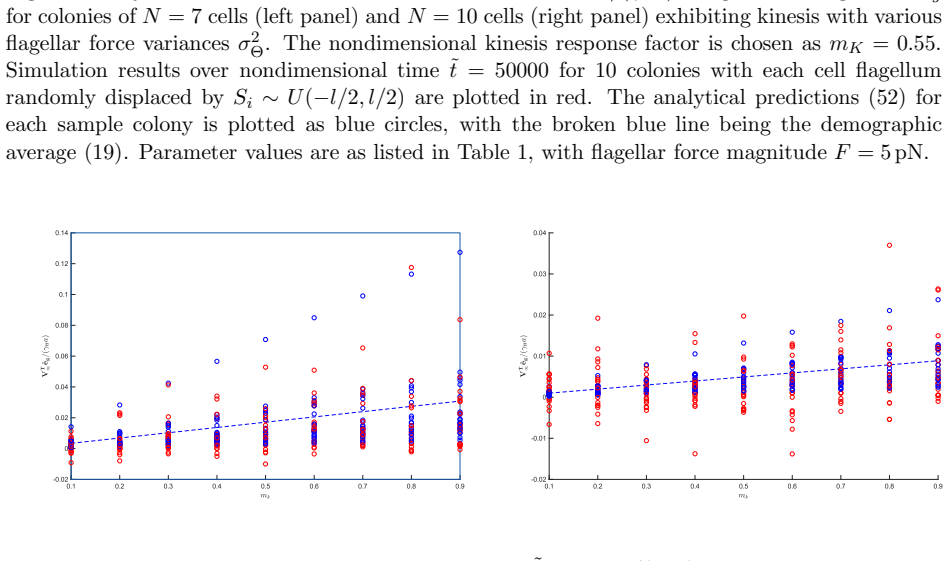
- [Section 6.2, Eqs. (42)/(53), Fig. 9] For the large σΘ^2 values used in the kinesis Monte Carlo comparison, the formal self-consistency condition N ≫ (ζδ^2 + σΘ^2 ζ^2)^{1/3} is violated at N=7, and the asymptotic theory overpredicts the simulation drift (as the authors note). This does not invalidate the physical parameter regime (σΘ^2 ≈ 0.002), but it overstates the claim of "quantitative agreement." Please add simulations at physically relevant σΘ^2 and/or a higher-order correction, and clearly separate validated from exploratory parameter regimes.
minor comments (4)
- [Section 6 preamble] The response coefficients k_T and k_K are taken from fits to the same S. rosetta colony data used for qualitative comparison; the later claim of consistency with Kirkegaard et al. is therefore not an independent test. Please clarify that this is a parameter-matching exercise, not validation.
- [Eq. (4b)] The second component uses Θ(c)(\tilde t) with a tilde, likely a typo for Θ(c)(t); please correct.
- [Figure 9] The horizontal axis label appears truncated: the explicit variable σΘ^2 is missing. This makes the figure hard to read without referring to the text.
- [Abstract] The abstract states the kinesis drift is "independent of colony size" without the two-dimensional qualifier that the model and Section 7 rely on. A brief qualifier such as "in the two-dimensional disc model" would align the abstract with the actual results.
Circularity Check
No significant circularity: the drift formulas are derived from the stated cell-level stochastic models and validated by Monte Carlo simulation; self-citations are not load-bearing.
full rationale
The paper's central results are obtained by a transparent derivation chain: cell-level stochastic differential equations for flagellar orientation (Eqs. 8 and 9) are homogenized to produce colony-level effective dynamics (Eqs. 11-12 and 18), and long-time drift formulas (Eqs. 16, 17, 19, 20) are obtained by averaging over the stationary orientation distribution. The asymmetry measures χ and χ2 are defined geometrically in Section 3.1, independently of the drift, and the drift is then computed from them; this is a derivation, not a definitional tautology. The taxis down-gradient term and the kinesis shape-independent term are algebraic consequences of the model structure, not fitted quantities. Monte Carlo simulations in Section 6 compare the theoretical formulas to direct simulation of the original SDEs; this is a self-consistency check, not circular reasoning. The parameters k_T and k_K are taken from Kirkegaard et al. (2016a) as inputs, but the qualitative conclusions (e.g., the counterproductive taxis drift being independent of N, and the kinesis drift being independent of colony size) are structural and hold over the parameter ranges explored. The paper explicitly notes that the taxis result would drop out under model variations such as saturation or force modulation, which shows the conclusion is conditional rather than circular. Self-citations to Ashenafi and Kramer (2024) are used for the baseline colony dynamics and non-stimulus swimming properties, and are not load-bearing for the taxis/kinesis derivations. The agreement with the experimental prevalence of kinesis over taxis is presented as consistency, not as a prediction extracted from the same fitted data. No circular step could be identified with the required specificity.
Assumptions & free parameters
free parameters (3)
- kT (taxis response factor) =
none; simulation input mT = kT g / σΘ = 0.67
- kK (kinesis response factor) =
none; simulation input mK = kK g / (γΘ σΘ²) = 0.55
- u (half-width of uniform flagellar placement noise, Eq. 6) =
u = l/2 in most simulations
assumptions (6)
- standard math Ito SDE formalism, Fokker-Planck equations, stochastic averaging and homogenization theorems (Pavliotis and Stuart 2008), CLT for fast-slow systems (Bouchet et al. 2016)
- domain assumption Rigid 2D circular disc colony; each flagellum exerts constant force F; drag coefficients from the oblate spheroid limit, γt = (32/3)ηa and γr = (32/3)ηa³
- domain assumption Spatial (relative) gradient sensing with logarithmic gradient g and direction θg constant over the colony motion scale
- ad hoc to paper Linear response without saturation: kT g << 1 for taxis (Eq. 8) and kK g < γΘ σΘ² for kinesis (Eq. 10)
- ad hoc to paper Time-scale separation ǫ = σΘ ζ / N² << 1 with self-consistency conditions (42) and (53)
- domain assumption Flagellar displacements Si are independent and uniformly distributed on (−u, u), Eq. (6)
Cite this review
Pith. "Pith review of Stochastic Analysis of Taxis and Kinesis Properties of Colonial Protozoa." pith.science (2026). https://pith.science/paper/BNYLVDEL
@misc{pith2026250901817,
  author       = {Pith},
  title        = {Pith review of: Stochastic Analysis of Taxis and Kinesis Properties of Colonial Protozoa},
  year         = {2026},
  howpublished = {\url{https://pith.science/paper/BNYLVDEL}},
  note         = {Machine review of arXiv:2509.01817}
}
read the original abstract
Protozoan colonies undergo stimulus driven motion for purposes such as nutrient acquisition. Colonial response to a stimulus is mediated through a mechanical aggregation of the response properties of members of the colony. We develop and apply asymptotic analysis to a stochastic model for the integration of two classes of stimulus responses of the constituent cells -- taxis and kinesis. We investigate in particular the maintenance of effectiveness of taxis and kinesis in the transition from unicellular to multicellular organisms, using experimental observations of chemotaxis and aerotaxis of protozoa as a reference. Our taxis model based on a steering response of individual cells actually leads to a counterproductive drift of the colony down the stimulus gradient, together with a constructive drift up the gradient which is proportional to a measure of asymmetry of the flagellar placement. The strength of taxis drift up the stimulus gradient decreases with colony size while the counterproductive term does not, indicating a failure for colonial taxis based on a steering response of individual cells. Under a kinesis response of the cellular flagellar motion, enhancing the noise as the cell is facing away from the stimulus gradient, the colony does drift up the gradient with a speed independent of colony size, even under a completely symmetric placement of flagella.
Figures


Figures from the paper (13 more)




Reference graph
Works this paper leans on
-
[1]
Negative chemotaxis in E scherichia coli
Wung-Wai Tso and Julius Adler. Negative chemotaxis in E scherichia coli. Journal of Bacteriology, 118 0 (2): 0 560--576, 1974. ISSN 0021-9193. URL https://jb.asm.org/content/118/2/560
work page 1974
-
[2]
E. Hildebrand and U. B. Kaupp. Sperm chemotaxis: A primer. Annals of the New York Academy of Sciences, 1061 0 (1): 0 221--225, 2005. doi:10.1196/annals.1336.024. URL https://nyaspubs.onlinelibrary.wiley.com/doi/abs/10.1196/annals.1336.024
-
[3]
Fertilization kinetics of sea urchin eggs
Helmut Vogel, Gerhard Czihak, Patrick Chang, and Wieland Wolf. Fertilization kinetics of sea urchin eggs. Mathematical Biosciences, 58 0 (2): 0 189 -- 216, 1982. ISSN 0025-5564. doi:https://doi.org/10.1016/0025-5564(82)90073-6. URL http://www.sciencedirect.com/science/article/pii/0025556482900736
arXiv 1982
-
[4]
Behavioral mechanism during human sperm chemotaxis: Involvement of hyperactivation
Leah Armon and Michael Eisenbach. Behavioral mechanism during human sperm chemotaxis: Involvement of hyperactivation. PloS one, 6: 0 e28359, 12 2011. doi:10.1371/journal.pone.0028359
-
[5]
Dictyostelium: a model for regulated cell movement during morphogenesis
Richard A Firtel and Ruedi Meili. Dictyostelium: a model for regulated cell movement during morphogenesis. Current Opinion in Genetics & Development, 10 0 (4): 0 421 -- 427, 2000. ISSN 0959-437X. doi:https://doi.org/10.1016/S0959-437X(00)00107-6. URL http://www.sciencedirect.com/science/article/pii/S0959437X00001076
-
[6]
ADAPTATION KINETICS IN BACTERIAL CHEMOTAXIS
SM Block, JE Segall, and HC Berg. ADAPTATION KINETICS IN BACTERIAL CHEMOTAXIS . JOURNAL OF BACTERIOLOGY , 154 0 ( 1 ): 0 312--323 , 1983 . ISSN 0021-9193
work page 1983
-
[7]
Robert M. Macnab and D. E. Koshland. The gradient-sensing mechanism in bacterial chemotaxis. Proceedings of the National Academy of Sciences, 69 0 (9): 0 2509--2512, 1972. ISSN 0027-8424. doi:10.1073/pnas.69.9.2509. URL https://www.pnas.org/content/69/9/2509
-
[8]
The physics of eukaryotic chemotaxis
Herbert Levine and Wouter-Jan Rappel. The physics of eukaryotic chemotaxis . PHYSICS TODAY , 66 0 ( 2 ): 0 24--30 , FEB 2013 . ISSN 0031-9228 . 10.1063/PT.3.1884
Show all 61 references
-
[9]
Aerotaxis in the closest relatives of animals
Julius Kirkegaard, Raymond Goldstein, Ambre Bouillant, Alan Marron, and Kyriacos Leptos. Aerotaxis in the closest relatives of animals. eLife, 5, 2016 a . doi:10.7554/eLife.18109
2016 doi
-
[10]
Sherratt
Jonathan A. Sherratt. Chemotaxis and chemokinesis in eukaryotic cells: The keller-segel equations as an approximation to a detailed model. Bulletin of Mathematical Biology, 56 0 (1): 0 129--146, Jan 1994. ISSN 1522-9602. doi:10.1007/BF02458292. URL https://doi.org/10.1007/BF02458292
1994 doi
-
[11]
Spontaneous Creation of Macroscopic Flow and Metachronal Waves in an Array of Cilia
Boris Guirao and Jean-Fran c ois Joanny. Spontaneous Creation of Macroscopic Flow and Metachronal Waves in an Array of Cilia . Biophysical Journal, 92 0 (6): 0 1900--1917, March 2007. ISSN 00063495. doi:10.1529/biophysj.106.084897. URL https://linkinghub.elsevier.com/retrieve/...
1900 doi
-
[12]
Brumley, Marco Polin, Timothy J
Douglas R. Brumley, Marco Polin, Timothy J. Pedley, and Raymond E. Goldstein. Hydrodynamic synchronization and metachronal waves on the surface of the colonial alga V olvox carteri. Physical Review Letters, 109 0 (26): 0 Article 268102, 2012. doi:10.1103/PhysRevLett.109.268102
2012 doi
-
[13]
Dayel, Rosanna A
Mark J. Dayel, Rosanna A. Alegado, Stephen R. Fairclough, Tera C. Levin, Scott A. Nichols, Kent McDonald, and Nicole King. Cell differentiation and morphogenesis in the colony-forming choanoflagellate Salpingoeca rosetta. Developmental Biology, 357 0 (1): 0 73--82, September 2...
2011 doi
-
[14]
Spatial cell disparity in the colonial choanoflagellate S alpingoeca rosetta
Benjamin Naumann and Pawel Burkhardt. Spatial cell disparity in the colonial choanoflagellate S alpingoeca rosetta. Frontiers in Cell and Developmental Biology, 7: 0 231, 2019. ISSN 2296-634X. doi:10.3389/fcell.2019.00231. URL https://www.frontiersin.org/article/10.3389/fcell....
2019
-
[15]
Kirkegaard, Alan O
Julius B. Kirkegaard, Alan O. Marron, and Raymond E. Goldstein. Motility of colonial choanoflagellates and the statistics of aggregate random walkers. Phys. Rev. Lett., 116: 0 038102, Jan 2016 b . doi:10.1103/PhysRevLett.116.038102. URL https://link.aps.org/doi/10.1103/PhysRev...
2016 doi
-
[16]
Dayel, Rachel E
Marcus Roper, Mark J. Dayel, Rachel E. Pepper, and M. A. R. Koehl. Cooperatively generated stresslet flows supply fresh fluid to multicellular choanoflagellate colonies. Phys. Rev. Lett., 110: 0 228104, May 2013. doi:10.1103/PhysRevLett.110.228104. URL https://link.aps.org/doi...
2013 doi
-
[17]
Kirkegaard and Raymond E
Julius B. Kirkegaard and Raymond E. Goldstein. Filter-feeding, near-field flows, and the morphologies of colonial choanoflagellates. Physical Review E, 94 0 (5), November 2016. ISSN 2470-0045, 2470-0053. doi:10.1103/PhysRevE.94.052401. URL https://link.aps.org/doi/10.1103/Phys...
2016 doi
-
[18]
M. A. R. Koehl. Selective factors in the evolution of multicellularity in choanoflagellates. Journal of Experimental Zoology Part B: Molecular and Developmental Evolution, March 2020. ISSN 15525007. doi:10.1002/jez.b.22941. URL http://doi.wiley.com/10.1002/jez.b.22941
2020 doi
-
[19]
Hoa Nguyen, M. a. R. Koehl, Christian Oakes, Greg Bustamante, and Lisa Fauci. Effects of cell morphology and attachment to a surface on the hydrodynamic performance of unicellular choanoflagellates. Journal of The Royal Society Interface, 16 0 (150): 0 20180736, January 2019. ...
2019
-
[20]
The swimming cell and its world: Structures and mechanisms of orientation in protists
Hans Machemer. The swimming cell and its world: Structures and mechanisms of orientation in protists. European Journal of Protistology, 37 0 (1): 0 3--14, January 2001. ISSN 0932-4739. doi:10.1078/0932-4739-00816. URL http://www.sciencedirect.com/science/article/pii/S0932473904700024
2001 doi
-
[21]
Vroomans, and Roeland M.H
Enrico Sandro Colizzi, Renske M.A. Vroomans, and Roeland M.H. Merks. Evolution of multicellularity by collective integration of spatial information. bioRxiv, 2020. doi:10.1101/2020.02.20.957647. URL https://www.biorxiv.org/content/early/2020/02/20/2020.02.20.957647
2020 doi
-
[22]
Austin Hopkins and Brian A. Camley. Leader cells in collective chemotaxis: Optimality and trade-offs. Physical Review E, 100 0 (3): 0 032417, September 2019. doi:10.1103/PhysRevE.100.032417. URL https://link.aps.org/doi/10.1103/PhysRevE.100.032417. Publisher: American Physical Society
2019 doi
-
[23]
Emergent versus Individual - Based Multicellular Chemotaxis
Sean Fancher, Bumsoo Han, Andrew Mugler, and Julien Varennes. Emergent versus Individual - Based Multicellular Chemotaxis . Physical Review Letters, 119 0 (18): 0 188101, October 2017. doi:10.1103/PhysRevLett.119.188101. URL https://link.aps.org/doi/10.1103/PhysRevLett.119.188...
2017 doi
-
[24]
Collective gradient sensing and chemotaxis: modeling and recent developments
Brian A Camley. Collective gradient sensing and chemotaxis: modeling and recent developments. Journal of Physics: Condensed Matter, 30 0 (22): 0 223001, may 2018. doi:10.1088/1361-648x/aabd9f. URL https://doi.org/10.1088/1361-648x/aabd9f
2018 doi
-
[25]
Traveling bands of chemotactic bacteria: a theoretical analysis
Evelyn F Keller and Lee A Segel. Traveling bands of chemotactic bacteria: a theoretical analysis. Journal of theoretical biology, 30 0 (2): 0 235--248, 1971
1971
-
[26]
From 1970 until present: the K eller- S egel model in chemotaxis and its consequences
Dirk Horstmann. From 1970 until present: the K eller- S egel model in chemotaxis and its consequences. 2003
1970
-
[27]
Basic model of purposeful kinesis
Alexander N Gorban and Nurdan C abukoǧlu. Basic model of purposeful kinesis. Ecological Complexity, 33: 0 75--83, 2018
2018
-
[28]
Xue and Hans G
Chuan. Xue and Hans G. Othmer. Multiscale models of taxis-driven patterning in bacterial populations. SIAM Journal on Applied Mathematics, 70 0 (1): 0 133--167, 2009. doi:10.1137/070711505. URL https://doi.org/10.1137/070711505
2009 doi
-
[29]
Bacterial strategies for chemotaxis response
Antonio Celani and Massimo Vergassola. Bacterial strategies for chemotaxis response. Proceedings of the National Academy of Sciences, 107 0 (4): 0 1391--1396, 2010. doi:10.1073/pnas.0909673107. URL https://www.pnas.org/doi/abs/10.1073/pnas.0909673107
2010 doi
-
[30]
Yonatan Ashenafi and Peter R. Kramer. Statistical Mobility of Multicellular Colonies of Flagellated Swimming Cells . Bulletin of Mathematical Biology, 86 0 (10): 0 1--56, October 2024. ISSN 1522-9602. doi:10.1007/s11538-024-01351-8. URL https://link.springer.com/article/10.100...
2024 doi
-
[31]
M. Carr, B. S. C. Leadbeater, R. Hassan, M. Nelson, and S. L. Baldauf. Molecular phylogeny of choanoflagellates, the sister group to metazoa. Proceedings of the National Academy of Sciences, 105 0 (43): 0 16641--16646, 2008. ISSN 0027-8424. doi:10.1073/pnas.0801667105. URL htt...
2008 doi
-
[32]
Goldstein
Bruce Gottlieb and Melvin E. Goldstein. Colony development in eudorina elegans (chlorophyta, volvocales)1. Journal of Phycology, 13 0 (4): 0 358--364, 1977. doi:10.1111/j.1529-8817.1977.tb02942.x. URL https://onlinelibrary.wiley.com/doi/abs/10.1111/j.1529-8817.1977.tb02942.x
1977
-
[33]
The Origin of Animal Multicellularity and Cell Differentiation
Thibaut Brunet and Nicole King. The Origin of Animal Multicellularity and Cell Differentiation . Developmental Cell, 43 0 (2): 0 124--140, October 2017. ISSN 1534-5807. doi:10.1016/j.devcel.2017.09.016. URL http://www.sciencedirect.com/science/article/pii/S1534580717307694
2017 doi
-
[34]
Hongfei Chen, Tom Hata, Ricardo Cortez, Hoa Nguyen, M. A. R. Koehl, and Lisa Fauci. A new optimized regularized Stokeslet model reveals the effects of multicellular protozoan colony configuration on hydrodynamic performance. Mathematical Biosciences, page 109519, August 2025. ...
2025
-
[35]
Stochastic Methods : A Handbook for the Natural and Social Sciences
Crispin Gardiner. Stochastic Methods : A Handbook for the Natural and Social Sciences . Springer, Berlin, 4th ed. 2009 edition edition, January 2009. ISBN 978-3-540-70712-7
2009
-
[36]
Sangtae Kim and Seppo J. Karrila. Microhydrodynamics: Principles and Selected Applications. Butterworth-Heinemann Series in Chemical Engineering. Butterworth-Heinemann, 1991. ISBN 978-0-7506-9173-4. doi:https://doi.org/10.1016/B978-0-7506-9173-4.50001-3. URL http://www.science...
1991 doi
-
[37]
Skupsky, W
R. Skupsky, W. Losert, and R.J. Nossal. Distinguishing modes of eukaryotic gradient sensing. Biophysical Journal, 89 0 (4): 0 2806 -- 2823, 2005. ISSN 0006-3495. doi:https://doi.org/10.1529/biophysj.105.061564. URL http://www.sciencedirect.com/science/article/pii/S0006349505729222
2005 doi
-
[38]
Devreotes, and Pablo A
Chris Janetopoulos, Lan Ma, Peter N. Devreotes, and Pablo A. Iglesias. Chemoattractant-induced phosphatidylinositol 3,4,5-trisphosphate accumulation is spatially amplified and adapts, independent of the actin cytoskeleton. Proceedings of the National Academy of Sciences, 101 0...
2004 doi
-
[39]
Logarithmic sensing in E scherichia coli bacterial chemotaxis
Yevgeniy Kalinin, Lili Jiang, Yuhai Tu, and Mingming Wu. Logarithmic sensing in E scherichia coli bacterial chemotaxis. Biophysical journal, 96: 0 2439--48, 04 2009. doi:10.1016/j.bpj.2008.10.027
2009 doi
-
[40]
Ordal, and Julius Adler
Robert Mesibov, George W. Ordal, and Julius Adler. The Range of Attractant Concentrations for Bacterial Chemotaxis and the Threshold and Size of Response over This Range : Weber law and related phenomena . Journal of General Physiology, 62 0 (2): 0 203--223, 08 1973. ISSN 0022...
1973 doi
-
[41]
Brumley, Fran c ois J
Riccardo Foffi, Douglas R. Brumley, Fran c ois J. Peaudecerf, Roman Stocker, and Jonasz S omka. Slower swimming promotes chemotactic encounters between bacteria and small phytoplankton. Proceedings of the National Academy of Sciences, 122 0 (2): 0 e2411074122, January 2025. do...
2025 doi
-
[42]
Goldstein
Raymond E. Goldstein. Green algae as model organisms for biological fluid dynamics. Annual Review of Fluid Mechanics, 47 0 (1): 0 343--375, 2015. doi:10.1146/annurev-fluid-010313-141426. URL https://doi.org/10.1146/annurev-fluid-010313-141426
2015 doi
-
[43]
Elgeti, R
J. Elgeti, R. G. Winkler, and G. Gompper. Physics of microswimmers---single particle motion and collective behavior: a review. Reports on Progress in Physics, 78 0 (5): 0 056601, May 2015. ISSN 0034-4885. doi:10.1088/0034-4885/78/5/056601. URL http://iopscience.iop.org/0034-48...
2015 doi
-
[44]
M. C. Marchetti, J. F. Joanny, S. Ramaswamy, T. B. Liverpool, J. Prost, Madan Rao, and R. Aditi Simha. Hydrodynamics of soft active matter. Reviews of Modern Physics, 85 0 (3): 0 1143--1189, July 2013
2013
-
[45]
Correlations and fluctuations of stress and velocity in suspensions of swimming microorganisms
Patrick T Underhill and Michael D Graham. Correlations and fluctuations of stress and velocity in suspensions of swimming microorganisms. Physics of Fluids, 23 0 (12): 0 121902--121902--15, December 2011. ISSN 10706631. doi:doi:10.1063/1.3670420
2011 doi
-
[46]
Mi \ n o, Adolfo J
Javier Sparacino, Gast \'o n L. Mi \ n o, Adolfo J. Banchio, and V. I. Marconi. Solitary choanoflagellate dynamics and microconfined directed transport. Journal of Physics D: Applied Physics, 53 0 (50): 0 505403, October 2020. ISSN 0022-3727. doi:10.1088/1361-6463/abb160. URL ...
2020 doi
-
[47]
Larson, Kent McDonald, Nicole King, and Pawel Burkhardt
Davis Laundon, Ben T. Larson, Kent McDonald, Nicole King, and Pawel Burkhardt. The architecture of cell differentiation in choanoflagellates and sponge choanocytes. PLOS Biology, 17 0 (4): 0 e3000226, April 2019. ISSN 1545-7885. doi:10.1371/journal.pbio.3000226. URL https://jo...
2019 doi
-
[48]
Fairclough, Mark J
Stephen R. Fairclough, Mark J. Dayel, and Nicole King. Multicellular development in a choanoflagellate. Current Biology, 20 0 (20): 0 R875 -- R876, 2010. ISSN 0960-9822. doi:https://doi.org/10.1016/j.cub.2010.09.014. URL http://www.sciencedirect.com/science/article/pii/S096098...
2010 doi
-
[49]
Alternative evolution of a spheroidal colony in volvocine algae: developmental analysis of embryogenesis in A strephomene ( V olvocales, C hlorophyta)
Shota Yamashita, Yoko Arakaki, Hiroko Kawai-Toyooka, Akira Noga, Masafumi Hirono, and Hisayoshi Nozaki. Alternative evolution of a spheroidal colony in volvocine algae: developmental analysis of embryogenesis in A strephomene ( V olvocales, C hlorophyta). BMC Evolutionary Biol...
2016 doi
-
[50]
Kumler, Justin Jorge, Paul M
William E. Kumler, Justin Jorge, Paul M. Kim, Noama Iftekhar, and M. A. R. Koehl. Does Formation of Multicellular Colonies by Choanoflagellates Affect Their Susceptibility to Capture by Passive Protozoan Predators ? Journal of Eukaryotic Microbiology, page jeu.12808, June 2020...
2020 doi
-
[51]
Larson, Teresa Ruiz-Herrero, Stacey Lee, Sanjay Kumar, L
Ben T. Larson, Teresa Ruiz-Herrero, Stacey Lee, Sanjay Kumar, L. Mahadevan, and Nicole King. Biophysical principles of choanoflagellate self-organization. Proceedings of the National Academy of Sciences, 117 0 (3): 0 1303--1311, January 2020. ISSN 0027-8424, 1091-6490. doi:10....
2020 doi
-
[52]
Stochastic L iouville equations
Ryogo Kubo. Stochastic L iouville equations. J. Math. Phys., 4 0 (2): 0 174--183, February 1963
1963
-
[53]
A new interpretation of the K eller- S egel model based on multiphase modelling
Helen Byrne and Markus Owen. A new interpretation of the K eller- S egel model based on multiphase modelling. Journal of mathematical biology, 49: 0 604--26, 01 2005. doi:10.1007/s00285-004-0276-4
2005 doi
-
[54]
Large Deviations in Fast -- Slow Systems
Freddy Bouchet, Tobias Grafke, Tom \'a s Tangarife, and Eric Vanden-Eijnden. Large Deviations in Fast -- Slow Systems . Journal of Statistical Physics, 162 0 (4): 0 793--812, January 2016. ISSN 0022-4715, 1572-9613. doi:10.1007/s10955-016-1449-4. URL http://link.springer.com.l...
2016 doi
-
[55]
Newby, Paul C
Jay M. Newby, Paul C. Bressloff, and James P. Keener. Breakdown of Fast - Slow Analysis in an Excitable System with Channel Noise . Physical Review Letters, 111 0 (12): 0 128101, September 2013. doi:10.1103/PhysRevLett.111.128101. URL http://link.aps.org/doi/10.1103/PhysRevLet...
2013 doi
-
[56]
Multiscale Methods: Averaging and Homogenization, volume 53
Andrew Stuart and Grigorious Pavliotis. Multiscale Methods: Averaging and Homogenization, volume 53. 01 2008. doi:10.1007/978-0-387-73829-1
2008 doi
-
[57]
Solari, John O
Cristian A. Solari, John O. Kessler, and Raymond E. Goldstein. A General Allometric and Life - History Model for Cellular Differentiation in the Transition to Multicellularity . The American Naturalist, 181 0 (3): 0 369--380, March 2013. ISSN 0003-0147, 1537-5323. doi:10.1086/...
2013 doi
-
[58]
Solari, John O
Cristian A. Solari, John O. Kessler, Richard E. Michod, Associate Editor: Peter C. Wainwright, and Editor: Jonathan B. Losos. A Hydrodynamics Approach to the Evolution of Multicellularity : Flagellar Motility and Germ ‐ Soma Differentiation in Volvocalean Green Algae . The Ame...
2006 doi
-
[59]
The unicellular ancestry of animal development
Nicole King. The unicellular ancestry of animal development. Developmental Cell, 7 0 (3): 0 313 -- 325, 2004. ISSN 1534-5807. doi:https://doi.org/10.1016/j.devcel.2004.08.010. URL http://www.sciencedirect.com/science/article/pii/S1534580704002886
2004 doi
-
[60]
Vuijk, Holger Merlitz, Michael Lang, Abhinav Sharma, and Jens-Uwe Sommer
Hidde D. Vuijk, Holger Merlitz, Michael Lang, Abhinav Sharma, and Jens-Uwe Sommer. Chemotaxis of Cargo - Carrying Self - Propelled Particles . Physical Review Letters, 126 0 (20): 0 208102, May 2021. doi:10.1103/PhysRevLett.126.208102. URL https://link.aps.org/doi/10.1103/Phys...
2021 doi
-
[61]
Perspectives on Principles of Cellular Behavior from the Biophysics of Protists
Ben T Larson. Perspectives on Principles of Cellular Behavior from the Biophysics of Protists . Integrative And Comparative Biology, 63 0 (6): 0 1405--1421, December 2023. ISSN 1540-7063, 1557-7023. doi:10.1093/icb/icad106. URL https://academic.oup.com/icb/article/63/6/1405/7231788
2023 doi
Reviewed August 5, 2026 · model on record in the stance chip above.
Discussion (0). Continue with ORCID to comment.