REVIEW 3 major objections 5 minor 65 references
RadioMamba: Breaking the Accuracy-Efficiency Trade-off in Radio Map Construction via a Hybrid Mamba-UNet
T0 review · 3 major / 5 minor · reviewed 2026-08-06 · deepseek-v4-flash
Pith's one-line read RadioMamba claims a single-pass U-Net with a Mamba branch can build radio maps more accurately than iterative diffusion models while running nearly 20 times faster and using 2.9 percent of the parameters.
desk verdict A useful engineering paper whose headline accuracy claim is undercut by an uncontrolled loss-function comparison, but whose efficiency gains are real and worth reviewing. read the letter →
The pith
A machine-rendered reading of the paper's core claim, the machinery that carries it, and where it could break.
The reading
What carries the argument
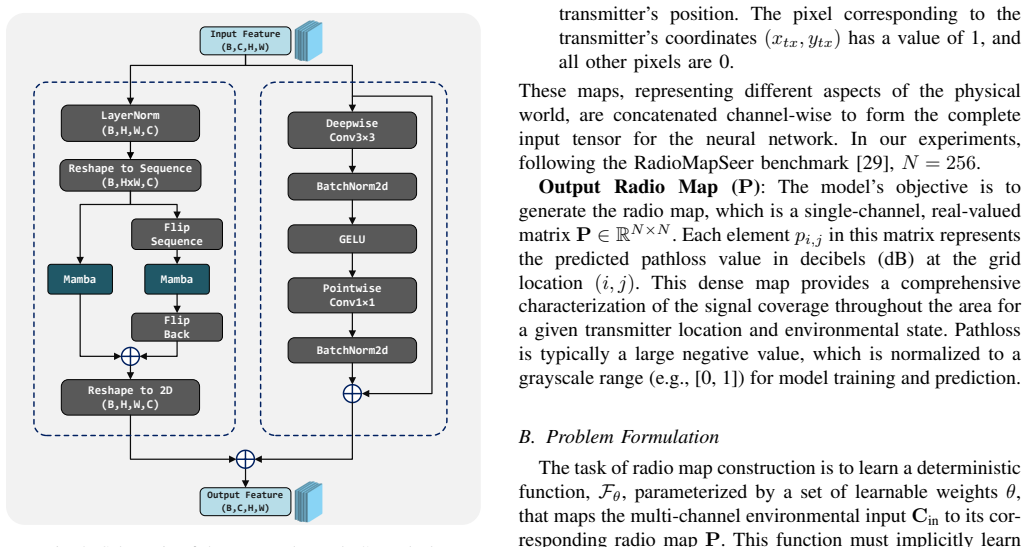
The load-bearing component is the MambaConvBlock, a parallel two-branch module used at every encoder and decoder stage of a U-Net. One branch, SS2D-Mamba, flattens the feature map into a sequence, runs a selective state-space model in both forward and backward directions (a bidirectional raster scan), and reshapes the result, so each pixel can aggregate information from the whole map in linear time; the other branch is a residual depthwise-separable convolution that captures local edges and fine detail. The outputs are combined by element-wise addition, and the paper argues that the convolutional branch's isotropic inductive bias also compensates for the anisotropic scan of the Mamba branch. These blocks are embedded in a standard U-Net with skip connections, and the model is trained with a composite loss of L1, MSE, SSIM, and gradient terms.
What would settle it
Run RadioUNet, RME-GAN, and RadioDiff on the RadioMapSeer test split under exactly the conditions used for RadioMamba—same normalization, same composite loss, same optimizer schedule, same batch size, and same GPU—and compare per-map inference time and NMSE. The central claim fails if RadioDiff then matches or beats RadioMamba's NMSE, or if its inference time drops to RadioMamba's level.
Extended reading notes
Core claim
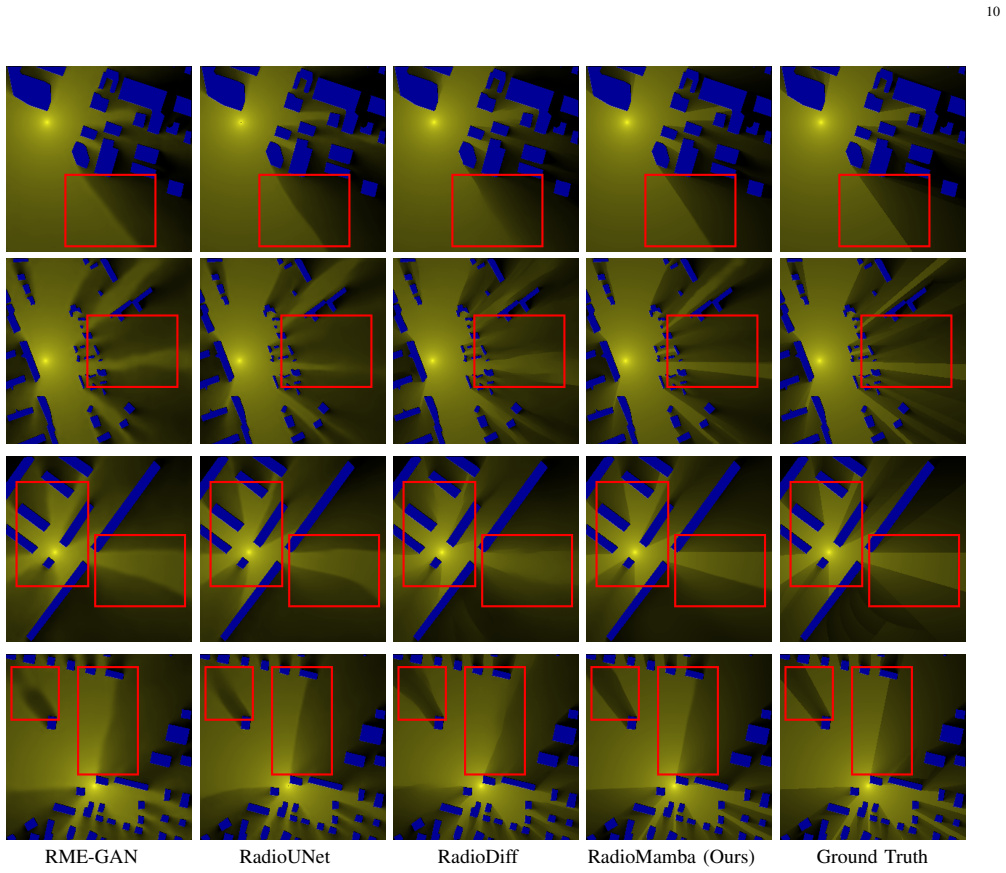
The central claim is that a hybrid Mamba-convolutional U-Net can outperform the current state of the art, including diffusion-based RadioDiff, on both accuracy and efficiency for sampling-free radio map construction. The paper attributes this to physics: pathloss at any point depends on long-range spatial structure such as distant buildings casting shadows, so a model needs a global receptive field, but it also needs sharp local boundaries around obstacles. RadioMamba's MambaConvBlock provides both: a bidirectional Mamba scan over the rasterized feature map models global dependencies in linear time, while a depthwise-separable convolutional branch handles local texture, and the two are fused by element-wise addition. On the static-map task the reported NMSE is 0.0050 versus 0.0072 for RadioDiff, and on the dynamic-map task 0.0063 versus 0.0090, with inference time of 0.0280 s versus 0.5535 s and 8.6 million versus 297.74 million parameters.
Load-bearing premise
The headline numbers assume that the baselines, especially RadioDiff, were evaluated under the same preprocessing, loss, training schedule, and hardware as RadioMamba; if RadioDiff's 553 ms timing came from a different setup, the claimed 20x speedup and accuracy advantage would not be a like-for-like comparison.
Editorial extensions
If this is right
- Radio maps can be produced at 28 ms per 256x256 map, within the latency budget for real-time network control loops and UAV trajectory planning.
- The 97 percent parameter reduction relative to RadioDiff makes edge-device deployment a realistic option for the same accuracy class.
- Because accuracy improves while inference is single-pass, iterative diffusion sampling is not required to reach state-of-the-art results on this benchmark.
- The dynamic-obstacle channel shows the same gains, so the method extends beyond static city maps to changing environments with transient blockers.
Reading between the lines
- Beyond the paper: the reported speedup and parameter ratio would be decisive only if baselines were retrained or re-measured under identical conditions; a head-to-head rerun is the test that would settle the comparison.
- Beyond the paper: the architecture's anisotropic raster scan may be a limitation, but the convolutional branch's isotropic bias may mask it; trying a space-filling-curve scan could test whether alignment with isotropic propagation further improves accuracy.
- Beyond the paper: the same MambaConvBlock could plausibly transfer to other physics-driven image-to-image tasks, such as indoor coverage maps or channel knowledge maps, wherever long-range spatial dependencies dominate.
Editorial analysis
A structured set of objections, weighed in public.
Referee Report
Summary. The paper proposes RadioMamba, a hybrid Mamba-UNet architecture for sampling-free radio map construction. The core MambaConvBlock combines a bidirectional Mamba branch meant to capture long-range spatial dependencies with a depthwise-separable convolutional branch that extracts local features. On the RadioMapSeer benchmark, the authors report NMSE 0.0050 for static radio map construction and 0.0063 for dynamic radio map construction, outperforming RadioUNet, RME-GAN, and the diffusion-based RadioDiff, while inference time is 0.028 s and parameter count is 8.6M. The paper includes ablations of the block components, the use of depthwise separable convolutions, and the composite loss function.
Significance. If the accuracy comparison is fair, the paper would make a strong practical contribution by showing that a single-pass, lightweight model can match or beat an iterative diffusion model at a fraction of the computational cost. The architectural motivation is sound, and the ablations support the usefulness of both branches and of depthwise separable convolutions. The efficiency and parameter-count advantages are likely robust. However, the headline accuracy claim is currently threatened by the loss-function confound and by the lack of a controlled baseline protocol, so the significance of the accuracy result cannot be fully assessed as presented.
major comments (3)
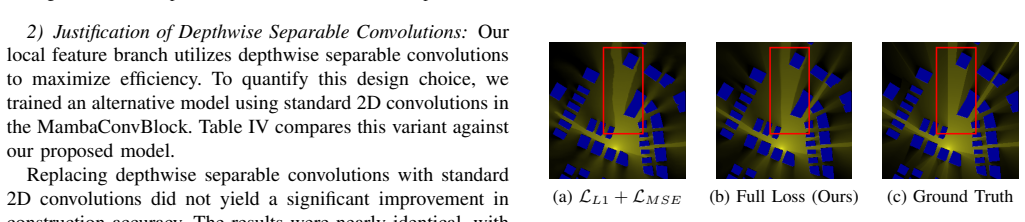
- [V-A4, Eq. (26), Table V] The composite loss is a major confound. Training with only L1+MSE yields NMSE 0.0075 on SRM, which is worse than RadioDiff's reported 0.0072; the full loss improves NMSE to 0.0050, a 33% relative improvement. The paper's headline margin over RadioDiff is 30.5%, so the loss function alone can account for the entire accuracy gap. Since Section V-A2 does not state that baselines were trained with the same loss, the central 'higher accuracy' claim is not established. Please retrain RadioDiff (and other baselines) with the same composite loss, or otherwise demonstrate that the loss does not preferentially benefit RadioMamba.
- [V-A2, V-A3] The baseline comparison is not controlled. The paper never states whether RadioUNet, RME-GAN, and RadioDiff were retrained under the same preprocessing, loss, optimizer schedule, hardware, and batching, or whether the numbers are copied from prior publications. In particular, RadioDiff's 0.5535 s inference time may come from a different GPU or batch configuration; without a common timing protocol the 'nearly 20 times faster' claim is not convincing. Please specify the baseline evaluation protocol and, ideally, rerun all baselines in the same environment.
- [Tables II and V] No error bars, confidence intervals, or repeated seeds are reported. Accuracy metrics like NMSE 0.0050 vs 0.0072 are point estimates from, presumably, a single run. Given the small absolute differences, these results do not establish statistical significance. Please report mean and standard deviation over at least three seeds and make the code available to support reproducibility.
minor comments (5)
- [Fig. 1] The abbreviations 'NMSA' and 'RMSA' in the radar chart are not defined; please spell them out in the caption or use the standard NMSE and RMSE names.
- [III-A] Please clarify whether the dynamic obstacle channel is zero-filled for the SRM task or omitted from the input tensor, since the current text says it 'may be zero-filled or omitted.'
- [IV-B2] The acknowledgment of the anisotropy of raster-scan flattening is a useful caveat; please also mention it in the conclusions as a known limitation.
- [Table III] State explicitly in the table footnote that the percentages indicate improvement relative to RadioDiff, to avoid ambiguity about the reference point.
- [V-A1] The data split of 550/50/100 maps sums to 700 total maps; please confirm that this follows the original RadioMapSeer split and cite the corresponding benchmark documentation.
Circularity Check
No significant circularity: empirical benchmark study; the composite-loss confound is an experimental-fairness issue, not a tautological derivation.
full rationale
RadioMamba is an empirical architecture paper whose central claims are (i) a Mamba-Conv block design, (ii) a composite loss function, and (iii) measured results on the external RadioMapSeer benchmark. No quantity is defined in terms of another in a way that makes a reported result equivalent to an input by construction. The loss weights w1..w4 are described as set 'through empirical validation', which is standard hyperparameter selection on a validation split rather than fitting the test-set metric and then renaming it as a prediction. Table V does show a real confound: with only L1+MSE the model reaches NMSE 0.0075, slightly worse than RadioDiff's reported 0.0072, while the full loss gives 0.0050, so the accuracy advantage is substantially attributable to loss engineering rather than the architecture alone. However, this is a methodological question about whether baselines were trained under comparable loss and tuning conditions, not a circular derivation. The RadioDiff baseline is self-cited, but citing a published prior work for baseline numbers is standard practice; the efficiency and parameter-count claims are measured on RadioMamba itself and do not reduce to a self-citation chain. No specific equation or fitted parameter is shown to be equivalent to the claimed result, so no circularity step meeting the required evidence standard can be exhibited.
Assumptions & free parameters
free parameters (3)
- Loss weights in composite loss =
w1=0.4, w2=0.1, w3=0.2, w4=0.3
- Architecture hyperparameters =
channels 48, 96, 192, 384; block counts and Mamba state dimension unspecified
- Optimizer and training hyperparameters =
AdamW, lr 9e-4, weight decay 1e-4
assumptions (3)
- domain assumption RadioMapSeer ground-truth maps generated with a dominant path model are a valid proxy for real radio propagation
- domain assumption Bidirectional raster-scan Mamba plus a convolutional branch captures the isotropic global dependencies of wave propagation
- standard math Standard SSM discretization and depthwise separable convolution cost formulas are correct
Cite this review
Pith. "Pith review of RadioMamba: Breaking the Accuracy-Efficiency Trade-off in Radio Map Construction via a Hybrid Mamba-UNet." pith.science (2026). https://pith.science/paper/BOB4YNEV
@misc{pith2026250809140,
  author       = {Pith},
  title        = {Pith review of: RadioMamba: Breaking the Accuracy-Efficiency Trade-off in Radio Map Construction via a Hybrid Mamba-UNet},
  year         = {2026},
  howpublished = {\url{https://pith.science/paper/BOB4YNEV}},
  note         = {Machine review of arXiv:2508.09140}
}
read the original abstract
Radio map (RM) has recently attracted much attention since it can provide real-time and accurate spatial channel information for 6G services and applications. However, current deep learning-based methods for RM construction exhibit well known accuracy-efficiency trade-off. In this paper, we introduce RadioMamba, a hybrid Mamba-UNet architecture for RM construction to address the trade-off. Generally, accurate RM construction requires modeling long-range spatial dependencies, reflecting the global nature of wave propagation physics. RadioMamba utilizes a Mamba-Convolutional block where the Mamba branch captures these global dependencies with linear complexity, while a parallel convolutional branch extracts local features. This hybrid design generates feature representations that capture both global context and local detail. Experiments show that RadioMamba achieves higher accuracy than existing methods, including diffusion models, while operating nearly 20 times faster and using only 2.9\% of the model parameters. By improving both accuracy and efficiency, RadioMamba presents a viable approach for real-time intelligent optimization in next generation wireless systems.
Figures


Figures from the paper (4 more)


Reference graph
Works this paper leans on
-
[1]
S. Dang, O. Amin, B. Shihada, and M.-S. Alouini, “What should 6G be?” Nat. Electron, vol. 3, no. 1, pp. 20–29, 2020
work page 2020
-
[2]
F. Tao, B. Xiao, Q. Qi, J. Cheng, and P. Ji, “Digital twin modeling,” Manuf. Syst, vol. 64, pp. 372–389, 2022. 13
work page 2022
-
[3]
6G-enabled edge AI for metaverse: Challenges, methods, and future research directions,
L. Chang, Z. Zhang, P. Li, S. Xi, W. Guo, Y . Shen, Z. Xiong, J. Kang, D. Niyato, X. Qiao et al., “6G-enabled edge AI for metaverse: Challenges, methods, and future research directions,” Commun. Inf. Networks, vol. 7, no. 2, pp. 107–121, 2022
work page 2022
-
[4]
6G digital twin networks: From theory to practice,
X. Lin, L. Kundu, C. Dick, E. Obiodu, T. Mostak, and M. Flaxman, “6G digital twin networks: From theory to practice,” IEEE Commun. Mag , vol. 61, no. 11, pp. 72–78, 2023
work page 2023
-
[5]
Digital-twin- enabled 6G: Vision, architectural trends, and future directions,
L. U. Khan, W. Saad, D. Niyato, Z. Han, and C. S. Hong, “Digital-twin- enabled 6G: Vision, architectural trends, and future directions,” IEEE Commun. Mag, vol. 60, no. 1, pp. 74–80, 2022
work page 2022
-
[6]
Digital twin networks: A survey,
Y . Wu, K. Zhang, and Y . Zhang, “Digital twin networks: A survey,” IEEE Internet Things J. , vol. 8, no. 18, pp. 13 789–13 804, 2021
work page 2021
-
[7]
The roadmap to 6G: AI empowered wireless networks,
K. B. Letaief, W. Chen, Y . Shi, J. Zhang, and Y .-J. A. Zhang, “The roadmap to 6G: AI empowered wireless networks,”IEEE Commun. Mag, vol. 57, no. 8, pp. 84–90, 2019
work page 2019
-
[8]
N. Ansari, “Toward 6G and Beyond: AI-driven synergies across terres- trial, non-terrestrial, and digital twin networks,” IEEE Wirel. Commun., vol. 32, no. 3, pp. 4–5, 2025
work page 2025
Show all 65 references
-
[9]
UA V- NIDD: A dynamic dataset for cybersecurity and intrusion detection in UA V networks,
H. J. Hadi, Y . Cao, M. K. Khan, N. Ahmad, Y . Hu, and C. Fu, “UA V- NIDD: A dynamic dataset for cybersecurity and intrusion detection in UA V networks,”IEEE Trans. Netw. Sci. Eng , 2025
2025
-
[10]
Digital twin for wireless networks: Security attacks and solutions,
W. Wang, Y . Yang, L. U. Khan, D. Niyato, Z. Han, and M. Guizani, “Digital twin for wireless networks: Security attacks and solutions,” IEEE Wirel. Commun., vol. 31, no. 3, pp. 278–285, 2023
2023
-
[11]
Localization in digital twin MIMO networks: A case for massive fingerprinting,
J. Morais and A. Alkhateeb, “Localization in digital twin MIMO networks: A case for massive fingerprinting,” in2024 IEEE International Conference on Communications Workshops (ICC Workshops) . IEEE, 2024, pp. 276–281
2024
-
[12]
Integrated sensing and communications: Toward dual-functional wire- less networks for 6G and beyond,
F. Liu, Y . Cui, C. Masouros, J. Xu, T. X. Han, Y . C. Eldar, and S. Buzzi, “Integrated sensing and communications: Toward dual-functional wire- less networks for 6G and beyond,” IEEE J. Sel. Areas Commun, vol. 40, no. 6, pp. 1728–1767, 2022
2022
-
[13]
A survey on fundamental limits of integrated sensing and communication,
A. Liu, Z. Huang, M. Li, Y . Wan, W. Li, T. X. Han, C. Liu, R. Du, D. K. P. Tan, J. Lu et al., “A survey on fundamental limits of integrated sensing and communication,” IEEE Commun Surv Tut , vol. 24, no. 2, pp. 994–1034, 2022
2022
-
[14]
Engineering radio maps for wireless resource management,
S. Bi, J. Lyu, Z. Ding, and R. Zhang, “Engineering radio maps for wireless resource management,” IEEE Wirel. Commun. , vol. 26, no. 2, pp. 133–141, 2019
2019
-
[15]
Radio map-based 3D path planning for cellular- connected UA V,
S. Zhang and R. Zhang, “Radio map-based 3D path planning for cellular- connected UA V,” IEEE Trans. Wireless Commun. , vol. 20, no. 3, pp. 1975–1989, 2020
1975
-
[16]
Reconfigurable intelligent surfaces for 6G: Nine fundamental issues and one critical problem,
Z. Zhang and L. Dai, “Reconfigurable intelligent surfaces for 6G: Nine fundamental issues and one critical problem,” Tsinghua Sci. Technol. , vol. 28, no. 5, pp. 929–939, 2023
2023
-
[17]
Dynamic digital twin and federated learning with incentives for air-ground networks,
W. Sun, N. Xu, L. Wang, H. Zhang, and Y . Zhang, “Dynamic digital twin and federated learning with incentives for air-ground networks,” IEEE Trans. Netw. Sci. Eng , vol. 9, no. 1, pp. 321–333, 2020
2020
-
[18]
Multi-agent assessment with qos enhancement for hd map updates in a vehicular network and multi-service environment,
J. Redondo, N. Aslam, J. Zhang, and Z. Yuan, “Multi-agent assessment with qos enhancement for hd map updates in a vehicular network and multi-service environment,” IEEE Trans. Netw. Sci. Eng , 2024
2024
-
[19]
Constructing accurate radio environment maps with kriging interpolation in cognitive radio networks,
D. Mao, W. Shao, Z. Qian, H. Xue, X. Lu, and H. Wu, “Constructing accurate radio environment maps with kriging interpolation in cognitive radio networks,” in 2018 Cross Strait Quad-Regional Radio Science and Wireless Technology Conference (CSQRWC). IEEE, 2018, pp. 1–3
2018
-
[20]
Nearest neighbor pattern classification,
T. Cover and P. Hart, “Nearest neighbor pattern classification,” IEEE Trans. Inform. Theory , vol. 13, no. 1, pp. 21–27, 1967
1967
-
[21]
Local polynomial regression estimators in survey sampling,
F. J. Breidt and J. D. Opsomer, “Local polynomial regression estimators in survey sampling,” Ann. Stat, pp. 1026–1053, 2000
2000
-
[22]
3D radio map reconstruction and trajectory optimization for cellular-connected UA Vs,
Q. Gong, F. Wu, D. Yang, L. Xiao, and Z. Liu, “3D radio map reconstruction and trajectory optimization for cellular-connected UA Vs,” Commun. Inf. Networks , vol. 8, no. 4, pp. 357–368, 2023
2023
-
[23]
Radio map assisted path planning for UA V anti-jamming communications,
Y . Dong, C. He, Z. Wang, and L. Zhang, “Radio map assisted path planning for UA V anti-jamming communications,”IEEE Signal Process. Lett., vol. 29, pp. 607–611, 2022
2022
-
[24]
Intelligent UA Vs trajectory optimization from space-time for data collection in social networks,
X. Liu, H. Song, and A. Liu, “Intelligent UA Vs trajectory optimization from space-time for data collection in social networks,” IEEE Trans. Netw. Sci. Eng , vol. 8, no. 2, pp. 853–864, 2020
2020
-
[25]
MIMO channel estimation method using ray-tracing propagation model,
S.-H. Oh and N.-H. Myung, “MIMO channel estimation method using ray-tracing propagation model,” Electron. Lett, vol. 40, no. 21, pp. 1350– 1352, 2004
2004
-
[26]
Electromagnetic modeling of radiowave propagation and scattering from targets in the atmosphere with a ray-tracing technique,
B. Salski, P. Czekala, J. Cuper, P. Kopyt, H. Jeon, and W. Yang, “Electromagnetic modeling of radiowave propagation and scattering from targets in the atmosphere with a ray-tracing technique,” IEEE Trans. Antennas Propagat., vol. 69, no. 3, pp. 1588–1595, 2020
2020
-
[27]
Advancing 6G network performance: AI/ML framework for proactive management and dynamic optimal routing,
P. M. Tshakwanda, S. T. Arzo, and M. Devetsikiotis, “Advancing 6G network performance: AI/ML framework for proactive management and dynamic optimal routing,” IEEE open j. Comput. Soc , 2024
2024
-
[28]
Exploring the transition from 5G to 6G: Advancements in ultra-low latency, high-speed connectivity, and AI-driven network optimization,
M. Nandy and Y . D. Kumar, “Exploring the transition from 5G to 6G: Advancements in ultra-low latency, high-speed connectivity, and AI-driven network optimization,” in 2025 International Conference on Automation and Computation (AUTOCOM) . IEEE, 2025, pp. 1234– 1239
2025
-
[29]
RadioUNet: Fast radio map estimation with convolutional neural networks,
R. Levie, C ¸ . Yapar, G. Kutyniok, and G. Caire, “RadioUNet: Fast radio map estimation with convolutional neural networks,” IEEE Trans. Wireless Commun., vol. 20, no. 6, pp. 4001–4015, 2021
2021
-
[30]
RME-GAN: A learning framework for radio map estimation based on conditional generative adversarial network,
S. Zhang, A. Wijesinghe, and Z. Ding, “RME-GAN: A learning framework for radio map estimation based on conditional generative adversarial network,” IEEE Internet Things J. , vol. 10, no. 20, pp. 18 016–18 027, 2023
2023
-
[31]
RadioDiff: An effective generative diffusion model for sampling- free dynamic radio map construction,
X. Wang, K. Tao, N. Cheng, Z. Yin, Z. Li, Y . Zhang, and X. Shen, “RadioDiff: An effective generative diffusion model for sampling- free dynamic radio map construction,” IEEE Trans. Cogn. Commun. Networking, 2024
2024
-
[32]
Denoising diffusion probabilistic model for radio map estimation in generative wireless networks,
X. Luo, Z. Li, Z. Peng, M. Chen, and Y . Liu, “Denoising diffusion probabilistic model for radio map estimation in generative wireless networks,” IEEE Trans. Cogn. Commun. Networking , 2025
2025
-
[33]
Transformers in vision: A survey,
S. Khan, M. Naseer, M. Hayat, S. W. Zamir, F. S. Khan, and M. Shah, “Transformers in vision: A survey,” ACM computing surveys (CSUR) , vol. 54, no. 10s, pp. 1–41, 2022
2022
-
[34]
An image is worth 16x16 words: Transformers for image recognition at scale,
A. Dosovitskiy, L. Beyer, A. Kolesnikov, D. Weissenborn, X. Zhai, T. Unterthiner, M. Dehghani, M. Minderer, G. Heigold, S. Gelly et al., “An image is worth 16x16 words: Transformers for image recognition at scale,” arXiv preprint arXiv:2010.11929 , 2020
2010 arXiv
-
[35]
Efficiently modeling long sequences with structured state spaces,
A. Gu, K. Goel, and C. R ´e, “Efficiently modeling long sequences with structured state spaces,” arXiv preprint arXiv:2111.00396 , 2021
2021 arXiv
-
[36]
Mamba: Linear-time sequence modeling with selective state spaces,
A. Gu and T. Dao, “Mamba: Linear-time sequence modeling with selective state spaces,” arXiv preprint arXiv:2312.00752 , 2023
2023 arXiv
-
[37]
Vision Mamba: A comprehensive survey and taxonomy,
X. Liu, C. Zhang, and L. Zhang, “Vision Mamba: A comprehensive survey and taxonomy,” arXiv preprint arXiv:2405.04404 , 2024
2024 arXiv
-
[38]
MambaVision: A hybrid mamba- transformer vision backbone,
A. Hatamizadeh and J. Kautz, “MambaVision: A hybrid mamba- transformer vision backbone,” in Proceedings of the Computer Vision and Pattern Recognition Conference , 2025, pp. 25 261–25 270
2025
-
[39]
Transformers are SSMs: Generalized models and efficient algorithms through structured state space duality,
T. Dao and A. Gu, “Transformers are SSMs: Generalized models and efficient algorithms through structured state space duality,” arXiv preprint arXiv:2405.21060, 2024
2024 arXiv
-
[40]
MobileMamba: Lightweight multi-receptive visual mamba network,
H. He, J. Zhang, Y . Cai, H. Chen, X. Hu, Z. Gan, Y . Wang, C. Wang, Y . Wu, and L. Xie, “MobileMamba: Lightweight multi-receptive visual mamba network,” in Proceedings of the Computer Vision and Pattern Recognition Conference, 2025, pp. 4497–4507
2025
-
[41]
Model- based and data-driven approaches for downlink massive MIMO channel estimation,
A. Ghazanfari, T. Van Chien, E. Bj ¨ornson, and E. G. Larsson, “Model- based and data-driven approaches for downlink massive MIMO channel estimation,” IEEE Trans. Commun., vol. 70, no. 3, pp. 2085–2101, 2021
2021
-
[42]
Analysis of large scale propagation models for mobile communications in urban area,
M. Alim, M. Rahman, M. Hossain, and A. A. Nahid, “Analysis of large scale propagation models for mobile communications in urban area,” arXiv preprint arXiv:1002.2187 , 2010
2010 arXiv
-
[43]
The impact of different radio propagation models for mobile ad hoc networks (MANET) in urban area environment,
I. K. Eltahir, “The impact of different radio propagation models for mobile ad hoc networks (MANET) in urban area environment,” in The 2nd International Conference on Wireless Broadband and Ultra Wideband Communications (AusWireless 2007) . IEEE, 2007, pp. 30– 30
2007
-
[44]
Ray tracing as a design tool for radio networks,
J. W. McKown and R. L. Hamilton, “Ray tracing as a design tool for radio networks,” IEEE Net., vol. 5, no. 6, pp. 27–30, 1991
1991
-
[45]
Ray tracing for radio propagation modeling: Principles and applications,
Z. Yun and M. F. Iskander, “Ray tracing for radio propagation modeling: Principles and applications,” IEEE Access, vol. 3, pp. 1089–1100, 2015
2015
-
[46]
Indoor radio map construction via ray tracing with RGB-D sensor-based 3D reconstruction: Concept and experiments in WLAN systems,
N. Suga, Y . Maeda, and K. Sato, “Indoor radio map construction via ray tracing with RGB-D sensor-based 3D reconstruction: Concept and experiments in WLAN systems,” IEEE Access , vol. 11, pp. 24 863– 24 874, 2023
2023
-
[47]
Three-dimensional urban EM wave prop- agation model for radio network planning and optimization over large areas,
Y . Corre and Y . Lostanlen, “Three-dimensional urban EM wave prop- agation model for radio network planning and optimization over large areas,” IEEE Trans. Veh. Technol, vol. 58, no. 7, pp. 3112–3123, 2009
2009
-
[48]
Data-driven modeling: concept, techniques, challenges and a case study,
M. K. Habib, S. A. Ayankoso, and F. Nagata, “Data-driven modeling: concept, techniques, challenges and a case study,” in 2021 IEEE inter- national conference on mechatronics and automation (ICMA) . IEEE, 2021, pp. 1000–1007
2021
-
[49]
AI-enabled data-driven channel modeling for future communications,
M. Yang, R. He, B. Ai, C. Huang, C. Wang, Y . Zhang, and Z. Zhong, “AI-enabled data-driven channel modeling for future communications,” IEEE Commun. Mag , vol. 62, no. 4, pp. 112–118, 2023
2023
-
[50]
U-net: Convolutional networks for biomedical image segmentation,
O. Ronneberger, P. Fischer, and T. Brox, “U-net: Convolutional networks for biomedical image segmentation,” in Medical image computing and 14 computer-assisted intervention–MICCAI 2015: 18th international con- ference, Munich, Germany, October 5-9, 2015, proceedings, part III ...
2015
-
[51]
Generative adversarial networks,
I. Goodfellow, J. Pouget-Abadie, M. Mirza, B. Xu, D. Warde-Farley, S. Ozair, A. Courville, and Y . Bengio, “Generative adversarial networks,” Communications of the ACM , vol. 63, no. 11, pp. 139–144, 2020
2020
-
[52]
Conditional generative adversarial nets,
M. Mirza and S. Osindero, “Conditional generative adversarial nets,” arXiv preprint arXiv:1411.1784 , 2014
2014 arXiv
-
[53]
Fast and accurate cooperative radio map estimation enabled by GAN,
Z. Zhang, G. Zhu, J. Chen, and S. Cui, “Fast and accurate cooperative radio map estimation enabled by GAN,” in 2024 IEEE International Conference on Communications Workshops (ICC Workshops) . IEEE, 2024, pp. 1641–1646
2024
-
[54]
Denoising diffusion probabilistic models,
J. Ho, A. Jain, and P. Abbeel, “Denoising diffusion probabilistic models,” Adv. Neural Inf. Process. , vol. 33, pp. 6840–6851, 2020
2020
-
[55]
CKMDiff: A generative diffusion model for CKM construction via inverse problems with learned priors,
S. Fu, Y . Zeng, Z. Wu, D. Wu, S. Jin, C.-X. Wang, and X. Gao, “CKMDiff: A generative diffusion model for CKM construction via inverse problems with learned priors,” arXiv preprint arXiv:2504.17323, 2025
2025 arXiv
-
[56]
Enhancing physical layer communication security through generative AI with mixture of experts,
C. Zhao, H. Du, D. Niyato, J. Kang, Z. Xiong, D. I. Kim, X. S. Shen, and K. B. Letaief, “Enhancing physical layer communication security through generative AI with mixture of experts,” IEEE Wirel. Commun., 2025
2025
-
[57]
Multi-agent reinforcement learning for dynamic resource management in 6G in-X subnetworks,
X. Du, T. Wang, Q. Feng, C. Ye, T. Tao, L. Wang, Y . Shi, and M. Chen, “Multi-agent reinforcement learning for dynamic resource management in 6G in-X subnetworks,” IEEE Trans. Wireless Commun., vol. 22, no. 3, pp. 1900–1914, 2022
1900
-
[58]
Federated reinforcement learning-based resource allocation in D2D-enabled 6G,
Q. Guo, F. Tang, and N. Kato, “Federated reinforcement learning-based resource allocation in D2D-enabled 6G,” IEEE Net., vol. 37, no. 5, pp. 89–95, 2022
2022
-
[59]
Avgnet: Adaptive visibility graph neural network and its application in modulation classification,
Q. Xuan, J. Zhou, K. Qiu, Z. Chen, D. Xu, S. Zheng, and X. Yang, “Avgnet: Adaptive visibility graph neural network and its application in modulation classification,” IEEE Trans. Netw. Sci. Eng , vol. 9, no. 3, pp. 1516–1526, 2022
2022
-
[60]
Model compression for communication efficient federated learning,
S. M. Shah and V . K. Lau, “Model compression for communication efficient federated learning,” IEEE Trans. Neural Networks Learn. Syst. , vol. 34, no. 9, pp. 5937–5951, 2021
2021
-
[61]
Hypernetworks-based hierarchical fed- erated learning on hybrid non-IID datasets for digital twin in industrial IoT,
J. Yang, W. Jiang, and L. Nie, “Hypernetworks-based hierarchical fed- erated learning on hybrid non-IID datasets for digital twin in industrial IoT,” IEEE Trans. Netw. Sci. Eng , vol. 11, no. 2, pp. 1413–1423, 2023
2023
-
[62]
Adaptive caching scheme for jointly optimizing delay and energy consumption in heterogeneous digital twin IoT,
J. Tan, F. Tang, M. Zhao, and Y . Zhu, “Adaptive caching scheme for jointly optimizing delay and energy consumption in heterogeneous digital twin IoT,” IEEE Trans. Netw. Sci. Eng, vol. 10, no. 6, pp. 4020– 4032, 2023
2023
-
[63]
Federated deep reinforcement learning for task offloading in digital twin edge networks,
Y . Dai, J. Zhao, J. Zhang, Y . Zhang, and T. Jiang, “Federated deep reinforcement learning for task offloading in digital twin edge networks,” IEEE Trans. Netw. Sci. Eng , vol. 11, no. 3, pp. 2849–2863, 2024
2024
-
[64]
Toward secure blockchain-enabled internet of vehicles: Optimizing consensus management using reputation and contract theory,
J. Kang, Z. Xiong, D. Niyato, D. Ye, D. I. Kim, and J. Zhao, “Toward secure blockchain-enabled internet of vehicles: Optimizing consensus management using reputation and contract theory,” IEEE Trans. Veh. Technol, vol. 68, no. 3, pp. 2906–2920, 2019
2019
-
[65]
Vmamba: Visual state space model,
Y . Liu, Y . Tian, Y . Zhao, H. Yu, L. Xie, Y . Wang, Q. Ye, J. Jiao, and Y . Liu, “Vmamba: Visual state space model,” Adv. Neural Inf. Process., vol. 37, pp. 103 031–103 063, 2024
2024
Reviewed August 6, 2026 · model on record in the stance chip above.
Discussion (0). Sign in to comment.