REVIEW 3 major objections 4 minor 2 cited by
Non-parametric reconstructions of cosmic curvature: current constraints and forecasts
T0 review · 3 major / 4 minor · reviewed 2026-08-12 · deepseek-v4-flash
Pith's one-line read The paper tests the cosmological principle and spatial flatness by reconstructing cosmic curvature with Gaussian processes, and finds no deviation from zero curvature or any redshift evolution.
desk verdict Competent application of known null tests to updated data, but the H0 normalization mismatch between SNe and CC biases the central curvature result—needs fixing before the conclusions can be trusted. read the letter →
The pith
A machine-rendered reading of the paper's core claim, the machinery that carries it, and where it could break.
The reading
What carries the argument
The machinery is the pair of exact consistency relations derived from the FLRW luminosity-distance formula, evaluated with a Gaussian Process implemented by GaPP using a squared exponential kernel. Equation (8) tests whether $\Omega_{k,0}$ is a constant, which the FLRW metric demands; Eq. (10) tests whether curvature vanishes at every redshift, which flatness demands. The Gaussian Process provides model-independent reconstructions and uncertainties of $E(z)$, $D(z)$, and especially $D'(z)$, the redshift derivative whose behaviour controls both test statistics.
What would settle it
A future sample of gravitational-wave standard sirens with known redshifts and distances at $z>1$, or a denser supernova survey at $1.5<z<2.5$, would settle the claim: if the reconstructed $\Omega_{k,0}(z)$ from Eq. (8) deviates from a constant by more than the one-$\sigma$ band at any redshift bin, the FLRW-based consistency relation is violated and the central conclusion fails.
Extended reading notes
Core claim
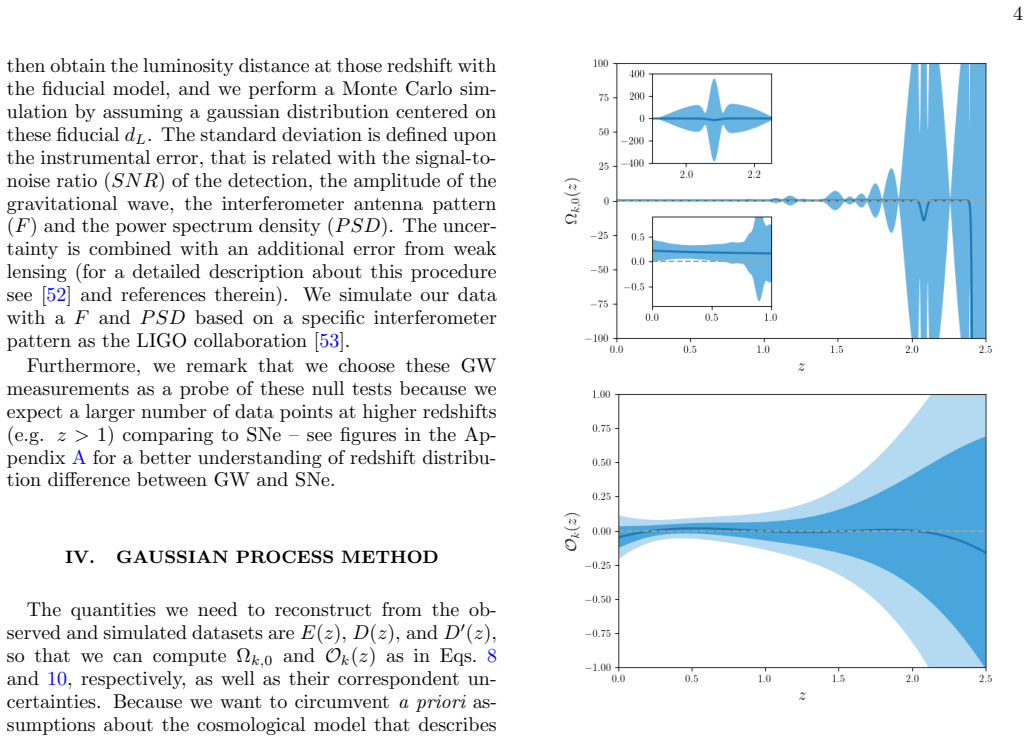
Within the FLRW framework, the curvature parameter at redshift zero satisfies $\Omega_{k,0} = (E^2(z)D'^2(z)-1)/D^2(z)$, so if $\Omega_{k,0}$ reconstructed from independent $E(z)$ and $D(z)$ data changes with redshift, the FLRW metric fails; likewise $O_k(z) = E(z)D'(z)-1$ must vanish at all $z$ if the Universe is flat. The paper evaluates both relations with Gaussian-process reconstructions of $E(z)$ from 31 cosmic-chronometer $H(z)$ measurements and $D(z)$ from 1701 Pantheon+ supernova apparent magnitudes, adopting $M_B = -19.25$ and propagating the values $H_0 = 73.6$ and $67.4\,\mathrm{km\,s^{-1}\,Mpc^{-1}}$ for the two samples. Both null conditions are satisfied: $\Omega_{k,0}$ is consistent with a constant equal to zero and $O_k(z)$ is consistent with zero across $0<z<2.5$, with uncertainties growing at $z>1.5$ because of sparse data. Simulations of 1000 gravitational-wave standard sirens and 23 radial-BAO $H(z)$ points, generated from a flat $\Lambda$CDM fiducial model, reproduce the null result with uncertainties reduced by over an order of magnitude at $z>1$.
Load-bearing premise
The conclusion depends on the Gaussian-process estimate of $D'(z)$ being unbiased when supernova distances are sparse at high redshift, and on the two adopted $H_0$ values ($73.6$ and $67.4\,\mathrm{km\,s^{-1}\,Mpc^{-1}}$) not systematically distorting the reconstructed curvature.
Editorial extensions
If this is right
- If the central claim holds, current Type Ia supernova and cosmic chronometer data give no reason to abandon the FLRW metric or the assumption of spatial flatness.
- The $O_k(z)$ null test extends flatness constraints to every redshift probed, not just $z=0$, so non-flat models with curvature that changes with redshift are disfavoured.
- A combination of J-PAS-style radial BAO Hubble measurements with LIGO-style gravitational-wave standard sirens should reduce curvature uncertainties by more than an order of magnitude at $z>1$ within the next decade.
- The joint fit with current supernovae plus simulated future data tightens the low-redshift end, so the strongest constraints come from combining standard candles, chronometers, BAO, and standard sirens.
Reading between the lines
- Editorial inference: the paper adopts $H_0=73.6$ for the supernova sample and $H_0=67.4$ for the chronometer sample without a joint calibration; a shared $H_0$ prior or an explicit treatment of the Hubble tension as a systematic could shift the reconstructed curves, so the flatness conclusion should be re-checked under a unified calibration.
- Editorial inference: the squared exponential kernel acts as a smoothness prior that can underestimate the derivative $D'(z)$ where data are sparse; testing Matern kernels or adding a derivative prior would show whether the null result is kernel-dependent.
- Editorial inference: the same consistency relations could be applied to strong-lensing time delays or cosmic opacity measurements, providing independent cross-checks of the flatness conclusion with different systematics.
- Editorial inference: if future gravitational-wave standard sirens reach the simulated density, the method can distinguish a constant $\Omega_{k,0}$ from models with redshift-dependent curvature, because the forecast uncertainties at $z>1$ drop below the level where current data are blind.
Editorial analysis
A structured set of objections, weighed in public.
Referee Report
Summary. The paper applies two null tests of the FLRW metric and spatial flatness, Eqs. (8) and (10), using Gaussian-process reconstructions of the Hubble parameter E(z) from cosmic chronometers and the dimensionless comoving distance D(z) from Pantheon+ supernovae. It reports that current data show no statistically significant redshift evolution of the reconstructed curvature parameter and no departure from zero curvature, and it forecasts that future J-PAS-like H(z) measurements combined with LIGO-like gravitational-wave standard sirens will reduce the uncertainties by more than an order of magnitude at z > 1.
Significance. The approach is potentially valuable: the null tests are exact consequences of the FLRW metric, the analysis is non-parametric, and the forecast section targets a realistic combination of upcoming probes. The authors are transparent that the forecast uses simulated data drawn from a flat Lambda-CDM fiducial model, so the forecast is informative about precision rather than about the validity of the cosmological principle. The main scientific claim, however, is currently undermined by the inconsistent H0 normalization adopted for the two reconstructed functions, and the absence of quantitative goodness-of-fit statistics makes the central 'no departure' statement difficult to evaluate.
major comments (3)
- [III.A, V.A] The two null tests are exact only when E(z) and D(z) are normalized with the same H0. In Sec. III.A, D(z) is built from Pantheon+ apparent magnitudes with MB = -19.25 and Eq. (7) with H0 = 73.6 km/s/Mpc, while in Sec. V.A, E(z) is normalized by H0 = 67.4 km/s/Mpc obtained from the GP extrapolation of the cosmic-chronometer H(z) data. Consequently, in a flat universe the product E_rec D'_rec is biased by the factor H0_SN/H0_CC = 1.092, so Eq. (10) is offset by about 0.09 and Eq. (8) by about 0.19/D^2, which grows at small redshift. Propagating the two H0 uncertainties separately broadens the error bars but does not correct the central-value bias. The central claim that current data are compatible with flatness therefore requires either a common H0 normalization for both reconstructions or a consistent marginalization over H0 and the SN absolute-magnitude zero point.
- [V.A, Fig. 1] The statement that Omega_k0(z) is constant and that there is 'no statistically significant departure' is supported only by visual inspection. The paper does not provide a quantitative statistic, such as a chi-square per degree of freedom, a p-value for the GP mean against a constant zero, or the fraction of reconstructed realizations consistent with zero. Given the large error bars and the H0-normalization issue above, a numerical compatibility test is necessary to substantiate the paper's main conclusion.
- [IV, V.A] The Ok(z) test relies on the Gaussian-process derivative D'(z) of the supernova distance reconstruction, yet the analysis fixes the squared-exponential kernel and does not test robustness to other kernel choices or to variations in the GP prior. Since D'(z) is especially sensitive to kernel hyperparameters and to the sparse high-redshift supernova coverage, kernel-robustness checks (or comparisons with an independent derivative estimator) are needed before the claimed null result can be considered robust.
minor comments (4)
- [V.A] The phrase 'H0 values ... directly obtained from the SN and CC data' is imprecise: H0 = 73.6 km/s/Mpc is adopted from the SH0ES distance-ladder measurement, not obtained from the Pantheon+ data within this paper, while H0 = 67.4 km/s/Mpc comes from a GP extrapolation of the CC data to z = 0.
- [VI] The sentence 'if we fail to reject any of these null hypotheses are rejected' is garbled and should read something like 'if we reject any of these null hypotheses'.
- [VI] There is a typo in 'non-pametric'; it should be 'non-parametric'.
- [References] Reference [55] appears in the bibliography but does not appear to be cited in the text; please either cite it where relevant or remove it.
Circularity Check
No significant circularity: the null tests are exact FLRW consistency relations applied to independent CC and SNe data, and the forecast is an explicitly fiducial-model precision projection.
full rationale
The central tests are not equivalent to their inputs by construction. Equations (8) and (10) are algebraic identities obtained from the FLRW distance relation, Eq. (5); they are not fitted to the data. E(z) is reconstructed from 31 cosmic-chronometer H(z) measurements and D(z) from Pantheon+ SN distances, which are independent probes, and the Gaussian-process reconstruction does not assume the curvature or flatness being tested. The observational null result therefore has independent content: it could have failed if the two datasets were mutually inconsistent under FLRW. The forecast section generates mock H(z) and GW distance data from a flat Lambda-CDM fiducial model and then recovers Ok(z) = 0; this is a self-consistency check for a precision forecast, and the paper explicitly states that simulated datasets require a fiducial model. The claimed deliverable is the uncertainty reduction, not a new physical detection, so the mock-data null result is not a prediction extracted from the data. The only self-citations, e.g., Bengaly et al. [43] for the CC compilation and the homogeneity papers [33]-[36], are data-source or background citations; the H(z) measurements are standard cosmic-chronometer data reproducible from external compilations, so the citations are not load-bearing. A genuine caveat is the use of H0 = 73.6 km/s/Mpc for D(z) and H0 = 67.4 km/s/Mpc for E(z), which introduces a normalization offset of order 9% in E D' for a flat universe; this is a systematic robustness concern, not a circularity, because the null-test relations and the data reconstruction do not reduce to the adopted H0 values.
Assumptions & free parameters
free parameters (7)
- Supernova absolute magnitude MB =
-19.25 ± 0.03
- H0 for SNe D(z) reconstruction =
73.6 ± 1.1 km/s/Mpc
- H0 for CC E(z) reconstruction =
67.4 ± 4.7 km/s/Mpc
- Fiducial Omega_m =
0.334
- Fiducial H0 =
73.6 km/s/Mpc
- Redshift distribution parameters theta and k =
theta=0.647, k=1.048
- GP kernel hyperparameters =
optimized by GaPP
assumptions (5)
- domain assumption The FLRW metric and Friedmann equations describe the background Universe
- domain assumption Type Ia supernovae are standardizable candles with a known absolute magnitude
- domain assumption Cosmic chronometer H(z) measurements are model-independent
- domain assumption A Gaussian process with a squared exponential kernel is a suitable prior for E(z) and D(z)
- ad hoc to paper Simulated future data are drawn from flat Lambda-CDM with specified parameters
Cite this review
Pith. "Pith review of Non-parametric reconstructions of cosmic curvature: current constraints and forecasts." pith.science (2026). https://pith.science/paper/BOSXC6QF
@misc{pith2026241119252,
  author       = {Pith},
  title        = {Pith review of: Non-parametric reconstructions of cosmic curvature: current constraints and forecasts},
  year         = {2026},
  howpublished = {\url{https://pith.science/paper/BOSXC6QF}},
  note         = {Machine review of arXiv:2411.19252}
}
abstract
The assumption of a flat Universe that follows the cosmological principle, i.e., that the universe is statistically homogeneous and isotropic at large scales, comprises one of the core foundations of the standard cosmological model -- namely, the $\Lambda$CDM paradigm. Nevertheless, it has been rarely tested in the literature. In this work, we assess the validity of this hypothesis by reconstructing the cosmic curvature with currently available observations, such as Type Ia Supernova and Cosmic Chronometers. We do so by means of null tests, given by consistency relations within the standard model scenario, using a non-parametric method -- which allows us to circumvent prior assumptions on the underlying cosmology. We find no statistically significant departure from the cosmological principle and null curvature in our analysis. In addition, we show that future cosmological observations, specifically those expected from Hubble parameter measurements from redshift surveys, along with gravitational wave observations as standard sirens, will be able to significantly reduce the uncertainties of current reconstructions.
Figures


Figures from the paper (1 more)

Forward citations
Cited by 2 Pith papers
-
The cosmic tetrarchy: four estimators breaking the assumption degeneracy in cosmological distance tensions
The cosmic tetrarchy decomposes BAO-based measurements into four channels that isolate distinct assumptions to test whether the dimensionless sound-horizon ratio remains a single redshift-independent number.
-
Intrinsic Torsion, Extrinsic Torsion, and the Hubble Parameter
The second fundamental form of a spatial slice in a torsional spacetime is a sum of the Hubble term and an extrinsic torsion term, producing a negative bias in Hubble estimates when torsion is neglected.
Reference graph
Works this paper leans on
-
[1]
= 1 and D′(z) = 1 /E(z), then we have the second null condition as: Ok(z) ̸= 0 implies that a flat universe is ruled out at any non-zero redshifts [23]. It is worth noticing that the first null condition is valid for z = 0, while the second null condition regards to z >0. We also stress that the E(z) and D(z) measurements we hereafter use in our analysis ...
work page 2023
-
[2]
Obser- vational evidence from supernovae for an accelerating universe and a cosmological constant,
A. G. Riess et al. [Supernova Search Team], “Obser- vational evidence from supernovae for an accelerating universe and a cosmological constant,” Astron. J. 116 (1998), 1009-1038 [arXiv:astro-ph/9805201 [astro-ph]]
arXiv 1998
-
[3]
Measurements of Ω and Λ from 42 High Redshift Super- novae,
S. Perlmutter et al. [Supernova Cosmology Project], “Measurements of Ω and Λ from 42 High Redshift Super- novae,” Astrophys. J. 517 (1999), 565-586 [arXiv:astro- ph/9812133 [astro-ph]]
arXiv 1999
-
[4]
Planck 2018 results. VI. Cosmological parameters,
N. Aghanim et al. [Planck], “Planck 2018 results. VI. Cosmological parameters,” Astron. Astrophys. 641 (2020), A6 [erratum: Astron. Astrophys. 652 (2021), C4] [arXiv:1807.06209 [astro-ph.CO]]
arXiv 2020
-
[5]
The Pantheon+ Analysis: Cosmolog- ical Constraints,
D. Brout, D. Scolnic, B. Popovic, A. G. Riess, J. Zuntz, R. Kessler, A. Carr, T. M. Davis, S. Hinton and D. Jones, et al. “The Pantheon+ Analysis: Cosmolog- ical Constraints,” Astrophys. J. 938 (2022) no.2, 110 [arXiv:2202.04077 [astro-ph.CO]]
arXiv 2022
-
[6]
Union Through UNITY: Cosmology with 2,000 SNe Using a Unified Bayesian Framework,
D. Rubin, G. Aldering, M. Betoule, A. Fruchter, X. Huang, A. G. Kim, C. Lidman, E. Linder, S. Perlmut- ter and P. Ruiz-Lapuente,et al. “Union Through UNITY: Cosmology with 2,000 SNe Using a Unified Bayesian Framework,” [arXiv:2311.12098 [astro-ph.CO]]
-
[7]
T. M. C. Abbott et al. [DES], “The Dark Energy Sur- vey: Cosmology Results With ˜1500 New High-redshift Type Ia Supernovae Using The Full 5-year Dataset,” [arXiv:2401.02929 [astro-ph.CO]]
-
[8]
Unveiling the Universe with emerging cosmological probes,
M. Moresco, L. Amati, L. Amendola, S. Birrer, J. P. Blakeslee, M. Cantiello, A. Cimatti, J. Darling, M. Della Valle and M. Fishbach, et al. “Unveiling the Universe with emerging cosmological probes,” Living Rev. Rel. 25 (2022) no.1, 6 [arXiv:2201.07241 [astro- ph.CO]]
arXiv 2022
Show all 56 references
-
[9]
Completed SDSS-IV extended Baryon Oscillation Spectroscopic Survey: Cosmological implications from two decades of spectroscopic surveys at the Apache Point Observatory,
S. Alam et al. [eBOSS], “Completed SDSS-IV extended Baryon Oscillation Spectroscopic Survey: Cosmological implications from two decades of spectroscopic surveys at the Apache Point Observatory,” Phys. Rev. D 103 (2021) no.8, 083533 [arXiv:2007.08991 [astro-ph.CO]]
2021 arXiv
-
[10]
KiDS- 1000 Cosmology: Multi-probe weak gravitational lensing and spectroscopic galaxy clustering constraints,
C. Heymans, T. Tr¨ oster, M. Asgari, C. Blake, H. Hildebrandt, B. Joachimi, K. Kuijken, C. A. Lin, A. G. S´ anchez and J. L. van den Busch, et al. “KiDS- 1000 Cosmology: Multi-probe weak gravitational lensing and spectroscopic galaxy clustering constraints,” Astron. Astrophys....
2021 arXiv
-
[11]
Dark Energy Survey Year 3 results: Cosmological constraints from galaxy cluster- ing and weak lensing,
T. M. C. Abbott et al. [DES], “Dark Energy Survey Year 3 results: Cosmological constraints from galaxy cluster- ing and weak lensing,” Phys. Rev. D 105 (2022) no.2, 023520 [arXiv:2105.13549 [astro-ph.CO]]
2022 arXiv
-
[12]
Hubble Tension or Distance Ladder Crisis?,
L. Perivolaropoulos, “Hubble Tension or Distance Ladder Crisis?,” [arXiv:2408.11031 [astro-ph.CO]]
-
[13]
In the realm of the Hubble tension—a review of so- lutions,
E. Di Valentino, O. Mena, S. Pan, L. Visinelli, W. Yang, A. Melchiorri, D. F. Mota, A. G. Riess and J. Silk, “In the realm of the Hubble tension—a review of so- lutions,” Class. Quant. Grav. 38 (2021) no.15, 153001 [arXiv:2103.01183 [astro-ph.CO]]
2021 arXiv
-
[14]
Hubble Tension: The Ev- idence of New Physics,
J. P. Hu and F. Y. Wang, “Hubble Tension: The Ev- idence of New Physics,” Universe 9 (2023) no.2, 94 [arXiv:2302.05709 [astro-ph.CO]]
2023 arXiv
-
[15]
Challenges for ΛCDM: An update,
L. Perivolaropoulos and F. Skara, “Challenges for ΛCDM: An update,” New Astron. Rev. 95 (2022), 101659 [arXiv:2105.05208 [astro-ph.CO]]
2022 arXiv
-
[16]
Is the observable Universe consistent with the cosmological principle?,
P. K. Aluri, P. Cea, P. Chingangbam, M. C. Chu, R. G. Clowes, D. Hutsem´ ekers, J. P. Kochappan, A. M. Lopez, L. Liu and N. C. M. Martens, et al. “Is the observable Universe consistent with the cosmological principle?,” Class. Quant. Grav. 40 (2023) no.9, 094001 [arXiv:2207.05...
2023 arXiv
-
[17]
Inhomogeneity and the foundations of concordance cosmology,
C. Clarkson and R. Maartens, “Inhomogeneity and the foundations of concordance cosmology,” Class. Quant. Grav. 27 (2010), 124008 [arXiv:1005.2165 [astro-ph.CO]]
2010 arXiv
-
[18]
Is the Universe homogeneous?,
R. Maartens, “Is the Universe homogeneous?,” Phil. Trans. Roy. Soc. Lond. A 369 (2011), 5115-5137 [arXiv:1104.1300 [astro-ph.CO]]
2011 arXiv
-
[19]
Establishing homogeneity of the universe in the shadow of dark energy,
C. Clarkson, “Establishing homogeneity of the universe in the shadow of dark energy,” Comptes Rendus Physique 13 (2012), 682-718 [arXiv:1204.5505 [astro-ph.CO]]
2012 arXiv
-
[20]
A general test of the Copernican Principle,
C. Clarkson, B. Bassett and T. H. C. Lu, “A general test of the Copernican Principle,” Phys. Rev. Lett. 101 (2008), 011301 [arXiv:0712.3457 [astro-ph]]
2008 arXiv
-
[21]
Dynamical Dark Energy or Simply Cosmic Curvature?,
C. Clarkson, M. Cortes and B. A. Bassett, “Dynamical Dark Energy or Simply Cosmic Curvature?,” JCAP 08 (2007), 011 [arXiv:astro-ph/0702670 [astro-ph]]
2007 arXiv
-
[22]
Curvature versus distances: Testing the FLR W cosmology,
D. Sapone, E. Majerotto and S. Nesseris, “Curvature versus distances: Testing the FLR W cosmology,” Phys. Rev. D 90 (2014) no.2, 023012 [arXiv:1402.2236 [astro- ph.CO]]
2014 arXiv
-
[23]
New Test of the Friedmann-Lema ˆ ıtre-Robertson-Walker Metric Using the Distance Sum Rule,
S. R¨ as¨ anen, K. Bolejko and A. Finoguenov, “New Test of the Friedmann-Lema ˆ ıtre-Robertson-Walker Metric Using the Distance Sum Rule,” Phys. Rev. Lett. 115 (2015) no.10, 101301 [arXiv:1412.4976 [astro-ph.CO]]
2015 arXiv
-
[24]
Null test of the cos- mic curvature using H(z) and supernovae data,
R. G. Cai, Z. K. Guo and T. Yang, “Null test of the cos- mic curvature using H(z) and supernovae data,” Phys. Rev. D 93 (2016) no.4, 043517 [arXiv:1509.06283 [astro- ph.CO]]
2016 arXiv
-
[25]
Dodging the cosmic curvature to probe the constancy of the speed of light,
R. G. Cai, Z. K. Guo and T. Yang, “Dodging the cosmic curvature to probe the constancy of the speed of light,” JCAP 08 (2016), 016 [arXiv:1601.05497 [astro-ph.CO]]
2016 arXiv
-
[26]
Model-independent Constraints on Cosmic Curvature and Opacity,
G. J. Wang, J. J. Wei, Z. X. Li, J. Q. Xia and Z. H. Zhu, “Model-independent Constraints on Cosmic Curvature and Opacity,” Astrophys. J. 847 (2017) no.1, 45 [arXiv:1709.07258 [astro-ph.CO]]
2017 arXiv
-
[27]
New model-independent method to test the curvature of the universe,
H. Yu and F. Y. Wang, “New model-independent method to test the curvature of the universe,” Astrophys. J. 828 (2016) no.2, 85 [arXiv:1605.02483 [astro-ph.CO]]
2016 arXiv
-
[28]
Model- Independent Determination of H0 and ΩK0 from Strong Lensing and Type Ia Supernovae,
T. Collett, F. Montanari and S. Rasanen, “Model- Independent Determination of H0 and ΩK0 from Strong Lensing and Type Ia Supernovae,” Phys. Rev. Lett. 123 (2019) no.23, 231101 [arXiv:1905.09781 [astro-ph.CO]]
2019 arXiv
-
[29]
Measurement on the cosmic curvature using the Gaussian process method,
Y. Yang and Y. Gong, “Measurement on the cosmic curvature using the Gaussian process method,” Mon. Not. Roy. Astron. Soc. 504 (2021) no.2, 3092-3097 [arXiv:2007.05714 [astro-ph.CO]]
2021 arXiv
-
[30]
Constraining the curva- ture density parameter in cosmology,
P. Mukherjee and N. Banerjee, “Constraining the curva- ture density parameter in cosmology,” Phys. Rev. D 105 (2022) no.6, 063516 [arXiv:2202.07886 [astro-ph.CO]]
2022 arXiv
-
[31]
Null test for cosmic curvature using Gaussian process*,
P. J. Wu, J. Z. Qi and X. Zhang, “Null test for cosmic curvature using Gaussian process*,” Chin. Phys. C 47 (2023) no.5, 055106 [arXiv:2209.08502 [astro-ph.CO]]
2023 arXiv
-
[32]
A 14 h−3 Gpc3 study of cosmic ho- mogeneity using BOSS DR12 quasar sample,
P. Laurent, J. M. Le Goff, E. Burtin, J. C. Hamilton, D. W. Hogg, A. Myers, P. Ntelis, I. Pˆ aris, J. Rich and E. Aubourg, et al. “A 14 h−3 Gpc3 study of cosmic ho- mogeneity using BOSS DR12 quasar sample,” JCAP 11 8 (2016), 060 [arXiv:1602.09010 [astro-ph.CO]]
2016 arXiv
-
[33]
Exploring cosmic homogeneity with the BOSS DR12 galaxy sample,
P. Ntelis, J. C. Hamilton, J. M. Le Goff, E. Burtin, P. Laurent, J. Rich, N. G. Busca, J. Tinker, E. Aubourg and H. Bourboux, et al. “Exploring cosmic homogeneity with the BOSS DR12 galaxy sample,” JCAP 06 (2017), 019 [arXiv:1702.02159 [astro-ph.CO]]
2017 arXiv
-
[34]
Cosmic homogeneity: a spectroscopic and model-independent measurement,
R. S. Gon¸ calves, G. C. Carvalho, C. A. P. Ben- galy, J. C. Carvalho, A. Bernui, J. S. Alcaniz and R. Maartens, “Cosmic homogeneity: a spectroscopic and model-independent measurement,” Mon. Not. Roy. As- tron. Soc. 475 (2018) no.1, L20-L24 [arXiv:1710.02496 [astro-ph.CO]]
2018 arXiv
-
[35]
Measuring the scale of cosmic homogeneity with SDSS-IV DR14 quasars,
R. S. Gon¸ calves, G. C. Carvalho, C. A. P. Bengaly, J. C. Carvalho and J. S. Alcaniz, “Measuring the scale of cosmic homogeneity with SDSS-IV DR14 quasars,” Mon. Not. Roy. Astron. Soc. 481 (2018) no.4, 5270-5274 [arXiv:1809.11125 [astro-ph.CO]]
2018 arXiv
-
[36]
Measuring the cosmic homogeneity scale with SDSS-IV DR16 Quasars,
R. S. Gon¸ calves, G. C. Carvalho, U. Andrade, C. A. P. Bengaly, J. C. Carvalho and J. Alcaniz, “Measuring the cosmic homogeneity scale with SDSS-IV DR16 Quasars,” JCAP 03 (2021), 029 [arXiv:2010.06635 [astro-ph.CO]]
2021 arXiv
-
[37]
The an- gular scale of homogeneity with SDSS-IV DR16 luminous red galaxies,
U. Andrade, R. S. Gon¸ calves, G. C. Carvalho, C. A. P. Bengaly, J. C. Carvalho and J. Alcaniz, “The an- gular scale of homogeneity with SDSS-IV DR16 luminous red galaxies,” JCAP 10 (2022), 088 [arXiv:2205.07819 [astro-ph.CO]]
2022 arXiv
-
[38]
In- vestigating cosmic homogeneity using multifractal anal- ysis of the SDSS-IV eBOSS DR16 quasar catalogue,
P. Goyal, S. Malik, J. k. Yadav and T. R. Seshadri, “In- vestigating cosmic homogeneity using multifractal anal- ysis of the SDSS-IV eBOSS DR16 quasar catalogue,” Mon. Not. Roy. Astron. Soc. 530 (2024) no.3, 2866-2876 [arXiv:2404.09197 [astro-ph.CO]]
2024 arXiv
-
[39]
J-PAS: The Javalambre- Physics of the Accelerated Universe Astrophysical Sur- vey,
N. Benitez et al. [J-PAS], “J-PAS: The Javalambre- Physics of the Accelerated Universe Astrophysical Sur- vey,” [arXiv:1403.5237 [astro-ph.CO]]
-
[40]
GWTC- 2.1: Deep extended catalog of compact binary coales- cences observed by LIGO and Virgo during the first half of the third observing run,
R. Abbott et al. [LIGO Scientific and VIRGO], “GWTC- 2.1: Deep extended catalog of compact binary coales- cences observed by LIGO and Virgo during the first half of the third observing run,” Phys. Rev. D 109 (2024) no.2, 022001 [arXiv:2108.01045 [gr-qc]]
2024 arXiv
-
[41]
What is flat ΛCDM, and may we choose it?,
S. Anselmi, M. F. Carney, J. T. Giblin, S. Kumar, J. B. Mertens, M. O’Dwyer, G. D. Starkman and C. Tian, “What is flat ΛCDM, and may we choose it?,” JCAP 02 (2023), 049 [arXiv:2207.06547 [astro-ph.CO]]
2023 arXiv
-
[42]
The Pantheon+ Analysis: The Full Data Set and Light-curve Release,
D. Scolnic, D. Brout, A. Carr, A. G. Riess, T. M. Davis, A. Dwomoh, D. O. Jones, N. Ali, P. Charvu and R. Chen, et al. “The Pantheon+ Analysis: The Full Data Set and Light-curve Release,” Astrophys. J. 938 (2022) no.2, 113 [arXiv:2112.03863 [astro-ph.CO]]
2022 arXiv
-
[43]
A Comprehensive Measurement of the Local Value of the Hubble Constant with 1 km s −1 Mpc−1 Uncertainty from the Hubble Space Telescope and the SH0ES Team,
A. G. Riess, W. Yuan, L. M. Macri, D. Scolnic, D. Brout, S. Casertano, D. O. Jones, Y. Murakami, L. Breuval and T. G. Brink, et al. “A Comprehensive Measurement of the Local Value of the Hubble Constant with 1 km s −1 Mpc−1 Uncertainty from the Hubble Space Telescope and the S...
2022 arXiv
-
[44]
Measuring the Hubble constant with cosmic chronome- ters: a machine learning approach,
C. Bengaly, M. A. Dantas, L. Casarini and J. Alcaniz, “Measuring the Hubble constant with cosmic chronome- ters: a machine learning approach,” Eur. Phys. J. C 83 (2023) no.6, 548 [arXiv:2209.09017 [astro-ph.CO]]
2023 arXiv
-
[45]
Re- constructing Functions and Estimating Parameters with Artificial Neural Networks: A Test with a Hubble Pa- rameter and SNe Ia,
G. J. Wang, X. J. Ma, S. Y. Li and J. Q. Xia, “Re- constructing Functions and Estimating Parameters with Artificial Neural Networks: A Test with a Hubble Pa- rameter and SNe Ia,” Astrophys. J. Suppl. 246 (2020) no.1, 13 [arXiv:1910.03636 [astro-ph.CO]]
2020 arXiv
-
[46]
Constraining cosmological pa- rameters based on relative galaxy ages,
R. Jimenez and A. Loeb, “Constraining cosmological pa- rameters based on relative galaxy ages,” Astrophys. J. 573 (2002), 37-42 [arXiv:astro-ph/0106145 [astro-ph]]
2002 arXiv
-
[47]
Measuring the expansion history of the Universe with cosmic chronometers,
M. Moresco, “Measuring the expansion history of the Universe with cosmic chronometers,” [arXiv:2412.01994 [astro-ph.CO]]
-
[48]
Clustering of Lu- minous Red Galaxies IV: Baryon Acoustic Peak in the Line-of-Sight Direction and a Direct Measurement of H(z),
E. Gaztanaga, A. Cabre and L. Hui, “Clustering of Lu- minous Red Galaxies IV: Baryon Acoustic Peak in the Line-of-Sight Direction and a Direct Measurement of H(z),” Mon. Not. Roy. Astron. Soc. 399 (2009), 1663- 1680 [arXiv:0807.3551 [astro-ph]]
2009 arXiv
-
[49]
J-PAS: forecasts on dark energy and modified gravity theories,
M. Aparicio Resco, A. L. Maroto, J. S. Alcaniz, L. R. Abramo, C. Hern´ andez-Monteagudo, N. Ben ´ ıtez, S. Carneiro, A. J. Cenarro, D. Crist´ obal-Hornillos and R. A. Dupke, et al. “J-PAS: forecasts on dark energy and modified gravity theories,” Mon. Not. Roy. Astron. Soc. 493...
2020 arXiv
-
[50]
Determination of dark energy by the Einstein Tele- scope: Comparing with CMB, BAO, and SNIa observa- tions
W. Zhao, C. Van Den Broeck, D. Baskaran, and T. G. F. Li, “Determination of dark energy by the Einstein Tele- scope: Comparing with CMB, BAO, and SNIa observa- tions”, Phys. Rev. D 83 (2011), 023005 [arXiv:1009.0206 [astro-ph.CO]]
2011 arXiv
-
[51]
Population of Merging Compact Binaries Inferred Using Gravitational Waves through GWTC-3
R. Abbot, et al. [KAGRA, VIRGO, LIGO Scientific Col- laboration], “Population of Merging Compact Binaries Inferred Using Gravitational Waves through GWTC-3”, Phys. Rev. X 13 (2023), no. 1, 011048 [arXiv:2111.03634 [astro-ph.CO]]
2023 arXiv
-
[52]
Estimating cosmological param- eters by the simulated data of gravitational waves from the Einstein Telescope,
R. G. Cai and T. Yang, “Estimating cosmological param- eters by the simulated data of gravitational waves from the Einstein Telescope,” Phys. Rev. D 95, no. 4, 044024 (2017) [arXiv:1608.08008 [astro-ph.CO]]
2017 arXiv
-
[53]
Cosmological parameter estimation with future gravita- tional wave standard siren observation from the Einstein Telescope
J.-F. Zhang, M. Zhang, S.-J. Jin, J.-Z. Qi and X. Zhang, “Cosmological parameter estimation with future gravita- tional wave standard siren observation from the Einstein Telescope”, JCAP 2019 (2019), 016 [arXiv:1907.03238v2 [astro-ph.CO]]
2019 arXiv
-
[54]
Networks of gravitational wave detec- tors and three figures of merit
B. F. Schutz, “Networks of gravitational wave detec- tors and three figures of merit”, Class. Quant. Grav. 28 (2011), 125023 [arXiv:1102.5421 [astro-ph.CO]]
2011 arXiv
-
[55]
Reconstruction of dark energy and expansion dynamics using Gaussian processes,
M. Seikel, C. Clarkson and M. Smith, “Reconstruction of dark energy and expansion dynamics using Gaussian processes,” JCAP 06 (2012), 036 [arXiv:1204.2832 [astro- ph.CO]]
2012 arXiv
-
[56]
Shafieloo, A
A. Shafieloo, A. G. Kim and E. V. Linder, Phys. Rev. D 85 (2012), 123530 doi:10.1103/PhysRevD.85.123530 [arXiv:1204.2272 [astro-ph.CO]]. Appendix 9 Appendix A: Reconstructions ofE(z), D(z) and D′(z) For the sake of completeness, we present below the reconstruction curves obtai...
2012 arXiv
Reviewed August 12, 2026 · model on record in the stance chip above.
Discussion (0). Continue with ORCID to comment.