REVIEW 3 major objections 6 minor 14 references
Federated Learning in Chemical Engineering: A Tutorial on a Framework for Privacy-Preserving Collaboration Across Distributed Data Sources
T0 review · 3 major / 6 minor · reviewed 2026-08-12 · deepseek-v4-flash
Pith's one-line read Federated learning can match or beat centralized training on chemical classification tasks while keeping raw data local.
desk verdict A genuinely useful tutorial whose abstract overclaims what its own Table 1 shows; needs revision to temper the claim and report basic experimental detail. read the letter →
The pith
A machine-rendered reading of the paper's core claim, the machinery that carries it, and where it could break.
The reading
What carries the argument
The load-bearing mechanism is the FedAvg aggregation rule, in which the server forms $$\$theta^{{(t+1)}}$ = \sum_{k=1}^{K} \frac{|D_k|}{N} \$theta_k^{{(t)}}$,$$ a weighted average of client models, and sends the result back for the next round. This identity is what lets the system combine knowledge from distributed clients without any party seeing another's data. Around it, the paper builds a simulation pipeline: a custom server strategy, client classes that download weights, train locally, and upload updates, and an evaluation step. Equal data visitation is enforced by matching 200 centralized epochs to 20 rounds of 10 local epochs across 10 clients.
What would settle it
Repeat each configuration over multiple random seeds and check whether the centralized and federated accuracy ranges overlap; if the PILL gap (93.27% vs 94.79%) and DNA gap (93.59% vs 94.09%) vanish, the claim that FL "will often maintain or improve" performance would lose its numerical support.
Extended reading notes
Core claim
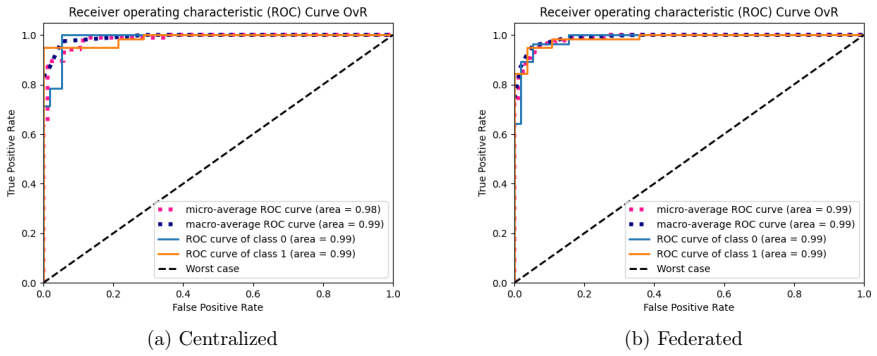
The central claim is that federated learning — training copies of the same model on separate clients and averaging only the model weights — will usually maintain or improve classification performance compared with centralized training, particularly when the data are complex and heterogeneous. The evidence is a matched comparison: each federated configuration runs 20 communication rounds with 10 clients doing 10 local epochs, for 200 passes over the data, the same number of passes as 200 centralized epochs. Across the PILL, DNA, and HIV datasets the federated test accuracies are 94.79%, 94.09%, and 95.34% versus 93.27%, 93.59%, and 95.51% centralized; the MRI task is the exception, at 85.56% versus 90.88%. The paper presents this as evidence that privacy-preserving collaboration can be offered at no accuracy cost in many practical settings, with the caveat that multimodal and heterogeneous data remain the hardest case.
Load-bearing premise
The whole comparison rests on treating a single run without random seeds as a fair measure of performance, so the claim is only as strong as the assumption that the reported accuracy gaps are not run-to-run noise.
Editorial extensions
If this is right
- On the pill-quality task, federated training reaches 94.79% test accuracy versus 93.27% centralized, so pharmaceutical plants could train a shared defect detector without sharing images of their production lines.
- On DNA gene-family classification, the federated model reaches 94.09% versus 93.59% centralized, supporting the paper's thesis that distributed training can handle heterogeneous biological data.
- On HIV drug screening, the federated graph model reaches 95.34% versus 95.51% centralized, so multi-institution collaborative screening could proceed with essentially no accuracy penalty.
- The MRI result (85.56% federated versus 90.88% centralized) marks multimodal data spread across clients as the current weak point, which the paper itself acknowledges as a direction for refinement.
Reading between the lines
- A natural next test would be to repeat the same four configurations across many random seeds; if the reported gaps, such as 93.27% versus 94.79% on PILL, fall within run-to-run noise, the claim of consistent improvement would need to be weakened to a claim of no accuracy loss.
- If the equal-data-visits result generalizes, federated training could become a drop-in replacement for centralized training in regulated chemical settings, delivering privacy as a side benefit rather than a cost.
- The MRI drop suggests a research direction: personalized or modality-aware aggregation methods that let each client retain its own fusion weights, rather than forcing a single global multimodal model.
- Because the datasets are public benchmarks, the comparison could be extended to a plant-style partition where each client sees one production line's distribution, which is the realistic non-IID regime the paper motivates.
Editorial analysis
A structured set of objections, weighed in public.
Referee Report
Summary. This paper is a tutorial on federated learning (FL) aimed at the chemical engineering community. It introduces FL concepts and aggregation methods (FedAvg, FedMedian, FedProx, FedOpt), describes the Flower and TensorFlow Federated frameworks, and presents three case studies: pill image classification for pharmaceutical manufacturing, a multimodal DNA+MRI mixture-of-experts (MMoE) model, and graph-neural-network-based HIV drug discovery. The central empirical claim, stated in the abstract, is that FL "will often maintain or improve classification performance, particularly for complex and heterogeneous data," supported by a comparison of centralized and federated test accuracies in Table 1. The paper also provides an open-source repository with implementations.
Significance. If its empirical claims were properly supported, this tutorial would be a useful entry point for chemical engineers interested in privacy-preserving distributed learning, and the open-source code is a concrete strength. The pedagogic material on FL theory and frameworks is serviceable. However, the paper's headline claim rests entirely on a small set of single-run comparisons with no statistical support, and one of its own experiments contradicts the "particularly for complex and heterogeneous data" qualifier. The tutorial value is real, but the empirical contribution needs substantial strengthening or the claims need to be scaled back.
major comments (3)
- [Abstract and Table 1] The abstract's claim that FL "will often maintain or improve classification performance, particularly for complex and heterogeneous data" is not supported by the paper's own results. In Table 1, the federated MRI (MMoE) test accuracy is 85.56% versus 90.88% centralized, a drop of 5.32 percentage points, which is the largest difference in the table and occurs in the most complex, multimodal setting. The text in the MMoE section even concedes that "the centralized model is better suited to handle the MRI dataset." The claim should be revised to reflect the actual pattern of results, or additional evidence should be provided that federated learning maintains performance on heterogeneous data.
- [Computational results and Table 1] The central comparison is based on one unseeded run per configuration, with no confidence intervals, error bars, or significance tests. The paper states that 200 centralized epochs and 20 federated rounds of 10 local epochs guarantee that both methods visit the data the same number of times, but it does not report the client partitioning of the data, the per-client learning rates, batch sizes, or optimization details. For PILL and DNA, the observed federated improvements are only 1.52 and 0.50 percentage points, respectively, which could plausibly fall within run-to-run noise; the MRI deficit of 5.32 points could also be an artifact of a particular split. Reporting results over multiple seeds with variance and describing the data partition and hyperparameters is load-bearing for the claim that FL "will often maintain or improve" accuracy.
- [Multimodal Mixture of Experts] There is an internal inconsistency in the MMoE discussion. The text claims that the federated model "improves classification accuracy and reduces misclassification for most classes" for MRI and that the federated approach "consistently improves classification performance across different data modalities," yet Table 1 shows a substantial drop in overall MRI test accuracy from 90.88% to 85.56%, and the same subsection later states that the centralized model is better suited for MRI. The per-class confusion-matrix entries cited in the text are conditional row-wise accuracies and do not imply better overall accuracy, especially under class imbalance. This contradiction needs to be explained and resolved.
minor comments (6)
- [Introduction] Two consecutive paragraphs in the Introduction present nearly the same survey of FL applications in chemical engineering (the paragraphs beginning "Some works applying FL..."), with redundant descriptions of Heyndrickx et al. and Bassani et al.; one should be removed or merged.
- [Title] The title contains a spacing typo: "A T utorial" should be "A Tutorial."
- [References] Reference 11 lists arXiv identifier 2404.02595 but the URL points to arXiv:2405.07735; the identifier should be corrected.
- [Multimodal Mixture of Experts] The text writes "HIPPA compliance," but the correct acronym for the U.S. health privacy law is "HIPAA."
- [Table 1] The table note states that for FL, train loss and accuracy refer to a single client, while the centralized values refer to the full training set; this asymmetry should be explained in the text so readers do not compare training metrics directly.
- [Tutorial on Federated Learning] The definition of the train/test split for the MVTec pill dataset is not given; the paper reports test accuracies but does not state how many images were used for testing or how they were selected, which is needed to interpret the results.
Circularity Check
No circularity: the FL-versus-CL comparisons are self-contained empirical evaluations, and the few self-citations are not load-bearing.
full rationale
This paper does not attempt a theoretical derivation from which a prediction is extracted; its central claim is an empirical comparison of federated and centralized training on four externally sourced datasets (MVTec AD pills, DNA sequences, brain-tumor MRI, and MoleculeNet HIV). The comparison is implemented directly with Flower/TFF FedAvg against a centralized baseline, with the stated control that both methods make the same number of passes over the data. No parameter is fitted to the reported test accuracies and then renamed a prediction; instead, the accuracies are the direct outputs of the stated training protocols, so the empirical results are not forced by construction. The aggregator equations (3)-(7) are standard textbook definitions and are not used to define the outcome being compared. The minor self-citations (e.g., refs. 11, 83, 95, 96) appear only in survey/outlook or contextual passages and are not used to justify the central FL-versus-CL claim, so they do not constitute load-bearing circularity. The manuscript's real weakness, namely that each configuration is reported from a single unseeded run without confidence intervals or partitioning details, is a robustness/statistical-evidence concern rather than a circularity concern. Accordingly, no circular step can be exhibited with a quote from the paper.
Assumptions & free parameters
free parameters (3)
- Training schedule (centralized epochs vs FL rounds times local epochs) =
200 epochs; 20 rounds x 10 epochs
- Number of clients =
10
- Per-client learning rates =
not reported
assumptions (4)
- domain assumption A single run per configuration is treated as representative of federated versus centralized performance.
- domain assumption Matching the number of passes over data makes the centralized and federated comparisons fair.
- domain assumption Standard dataset splits are used as-is or with unspecified modifications.
- domain assumption Federated learning preserves privacy without additional mechanisms.
Cite this review
Pith. "Pith review of Federated Learning in Chemical Engineering: A Tutorial on a Framework for Privacy-Preserving Collaboration Across Distributed Data Sources." pith.science (2026). https://pith.science/paper/BP2W3AR7
@misc{pith2026241116737,
  author       = {Pith},
  title        = {Pith review of: Federated Learning in Chemical Engineering: A Tutorial on a Framework for Privacy-Preserving Collaboration Across Distributed Data Sources},
  year         = {2026},
  howpublished = {\url{https://pith.science/paper/BP2W3AR7}},
  note         = {Machine review of arXiv:2411.16737}
}
abstract
Federated Learning (FL) is a decentralized machine learning approach that has gained attention for its potential to enable collaborative model training across clients while protecting data privacy, making it an attractive solution for the chemical industry. This work aims to provide the chemical engineering community with an accessible introduction to the discipline. Supported by a hands-on tutorial and a comprehensive collection of examples, it explores the application of FL in tasks such as manufacturing optimization, multimodal data integration, and drug discovery while addressing the unique challenges of protecting proprietary information and managing distributed datasets. The tutorial was built using key frameworks such as $\texttt{Flower}$ and $\texttt{TensorFlow Federated}$ and was designed to provide chemical engineers with the right tools to adopt FL in their specific needs. We compare the performance of FL against centralized learning across three different datasets relevant to chemical engineering applications, demonstrating that FL will often maintain or improve classification performance, particularly for complex and heterogeneous data. We conclude with an outlook on the open challenges in federated learning to be tackled and current approaches designed to remediate and improve this framework.
Figures


Figures from the paper (5 more)


Reference graph
Works this paper leans on
-
[1]
M.; Pouriyeh, S.; Huang, Y.; Dehghantanha, A.; Srivas- tava, G
(1) Mothukuri, V.; Parizi, R. M.; Pouriyeh, S.; Huang, Y.; Dehghantanha, A.; Srivas- tava, G. A survey on security and privacy of federated learning.Future Generation Computer Systems 2021, 115, 619–640. (2) Caviglione, L.; Mazurczyk, W.; Wendzel, S.; Zander, S. Emerging and Unconventional: New Attacks and Innovative Detection Techniques.Security and Comm...
arXiv 2021
-
[3]
(49) Gómez, Á. L. P.; Beltrán, E. T. M.; Sánchez, P. M. S.; Celdrán, A. H. Tempo- ralFED: Detecting cyberattacks in industrial time-series data using decentralized feder- ated learning. arXiv preprint arXiv:2308.03554, 2023;https://arxiv.org/abs/2308. 03554, (accessed 2025-02-08). (50) Chen, Y.; Chen, Z.; Guo, S.; Zhao, Y.; Liu, Z.; Wu, P.; Yang, C.; Li, ...
-
[9]
N.; Gomes, J.; Geniesse, C.; Pappu, A
(68) Wu, Z.; Ramsundar, B.; Feinberg, E. N.; Gomes, J.; Geniesse, C.; Pappu, A. S.; Leswing, K.; Pande, V. MoleculeNet: a benchmark for molecular machine learning. Chemical science 2018, 9, 513–530. 49 (69) Kipf, T. N.; Welling, M. Semi-supervised classification with graph convolutional net- works. arXiv preprint arXiv:1609.02907, 2016;https://arxiv.org/a...
arXiv 2018
-
[36]
FedMedICL: Towards Holistic Evaluation of Distribution Shifts in Federated Medical Imaging
(35) Li, L.; Fan, Y.; Tse, M.; Lin, K.-Y. A review of applications in federated learning. Computers & Industrial Engineering2020, 149, 106854. (36) Alhamoud, K.; Ghunaim, Y.; Alfarra, M.; Hartvigsen, T.; Torr, P.; Ghanem, B.; Bibi, A.; Ghassemi, M. FedMedICL: Towards Holistic Evaluation of Distribution 45 Shifts in Federated Medical Imaging. arXiv preprin...
work page Pith review arXiv 2024
-
[94]
Fully homomorphic encryption using ideal lattices
(72) Gentry, C. Fully homomorphic encryption using ideal lattices. Proceedings of the Forty- First Annual ACM Symposium on Theory of Computing. New York, NY, USA, 2009; p 169–178. (73) Xie, Q.; Jiang, S.; Jiang, L.; Huang, Y.; Zhao, Z.; Khan, S.; Dai, W.; Liu, Z.; Wu, K. Efficiency Optimization Techniques in Privacy-Preserving Federated Learning With Homo...
work page 2009
-
[158]
(48) Zhu, W.; Luo, J.; White, A. D. Federated learning of molecular properties with graph neural networks in a heterogeneous setting.Patterns 2022,
work page 2022
-
[374]
47 (52) Abadi, M. et al. TensorFlow: Large-Scale Machine Learning on Heterogeneous Dis- tributed Systems. arXiv preprint arXiv:1603.04467, 2016; https://arxiv.org/abs/ 1603.04467, (accessed 2024-10-9). Software available from tensorflow.org. (53) International Council for Harmonisation of Technical Requirements for Pharmaceu- ticals for Human Use (ICH) IC...
arXiv 2016
-
[597]
(17) Nguyen, D. C.; Ding, M.; Pathirana, P. N.; Seneviratne, A.; Li, J.; Niyato, D.; Poor, H. V. Federated learning for industrial internet of things in future industries. IEEE Wireless Communications2021, 28, 192–199. (18) Qu, Y.; Pokhrel, S. R.; Garg, S.; Gao, L.; Xiang, Y. A blockchained federated learning framework for cognitive computing in industry ...
arXiv 2020
Show all 14 references
-
[743]
Privacy preserving machine learning with homomorphic encryption and federated learning.Future Internet 2021, 13,
(71) Fang, H.; Qian, Q. Privacy preserving machine learning with homomorphic encryption and federated learning.Future Internet 2021, 13,
2021
-
[2018]
E.; Uysal, A.; Masry, A.; Ozkasap, O.; Akgun, B
(78) Korkmaz, C.; Kocas, H. E.; Uysal, A.; Masry, A.; Ozkasap, O.; Akgun, B. Chain FL: Decentralized Federated Machine Learning via Blockchain. 2020 Second International Conference on Blockchain Computing and Applications (BCCA). 2020; pp 140–146. (79) Chen, H.-Y.; Chao, W.-L....
2020 arXiv
-
[2019]
(57) Good, I. J. Rational Decisions.Journal of the Royal Statistical Society Series B: Sta- tistical Methodology 1952, 14, 107—-114. (58) Majeed, I. A.; Kaushik, S.; Bardhan, A.; Tadi, V. S. K.; Min, H.-K.; Kumaraguru, K.; Muni, R. D. Comparative assessment of federated and ce...
1952 arXiv
-
[2021]
FLChain: A Blockchain for Auditable Federated Learning with Trust and Incentive
(76) Bao, X.; Su, C.; Xiong, Y.; Huang, W.; Hu, Y. FLChain: A Blockchain for Auditable Federated Learning with Trust and Incentive. 2019 5th International Conference on Big Data Computing and Communications (BIGCOM). 2019; pp 151–159. 50 (77) Ahmad, A.; Saad, M.; Bassiouni, M....
2019
-
[3053]
Q.; Ding, Z.; Peng, M
(81) Zhao, Z.; Wang, J.; Hong, W.; Quek, T. Q.; Ding, Z.; Peng, M. Ensemble federated learning with non-IID data in wireless networks.IEEE Transactions on Wireless Com- munications 2023, 23, 3557–3571. (82) Ficco, M.; Guerriero, A.; Milite, E.; Palmieri, F.; Pietrantuono, R.; ...
2023 arXiv
-
[4744]
Federated learning-based natural language processing: a systematic literature review.2024, 57, 1–39
48 (60) Khan, Y.; Sánchez, D.; Domingo-Ferrer, J. Federated learning-based natural language processing: a systematic literature review.2024, 57, 1–39. (61) Singh, N. DNA Sequence Dataset. Kaggle Dataset, 2023;https://www.kaggle.com/ datasets/nageshsingh/dna-sequence-dataset, (...
2024 arXiv
Reviewed August 12, 2026 · model on record in the stance chip above.
Discussion (0). Continue with ORCID to comment.