REVIEW 4 major objections 4 minor 33 references
Bound dark energy: Particle origin of dark energy with DESI BAO and DES supernova data
T0 review · 4 major / 4 minor · reviewed 2026-08-15 · deepseek-v4-flash
Pith's one-line read Dark energy is the lightest meson of a dark SU(3) gauge group, with no free dark-energy parameters; the same fit lowers the reduced BAO chi-squared by 42% and 37% relative to the two standard models while matching them on CMB and…
desk verdict A real model with new data constraints, but the headline BAO improvement is inflated by a parameter-count error and the BBN predictions are left unaddressed. read the letter →
The pith
A machine-rendered reading of the paper's core claim, the machinery that carries it, and where it could break.
The reading
What carries the argument
The load-bearing object is the lightest meson $\phi$ of a supersymmetric dark $\mathrm{SU}(3)$ gauge theory with $N_f=6$ flavors, whose non-perturbative dynamics generate an inverse-power-law potential $V(\phi)=\Lambda_c^{4+2/3}\phi^{-2/3}$ from the Affleck-Dine-Seiberg superpotential. The argument runs on the condensation relation $a_c\Lambda_c=1.0939\times10^{-4}$ eV, which fixes when the dark sector changes from free-streaming radiation to a rolling scalar by equating the dark energy density at condensation, $\rho_{DG}(a_c)=3\Lambda_c^4$, to the present radiation energy density. That single relation converts the fitted condensation scale $\Lambda_c=43.806\pm0.190$ eV into a complete expansion history, which is why the model can predict $w_0$ and $w_a$ rather than fit them. The dark gauge coupling is assumed unified with the Standard Model coupling at the grand-unification scale, which removes the last free parameter from the dark energy sector.
What would settle it
A first-principles computation of the dark gauge theory that produced a condensation scale outside the quoted interval $\Lambda_c=43.806\pm0.190$ eV would shift the derived expansion history and remove the BAO improvement; alternatively, a future BAO data release showing no preference for $w_0>-1$ and $w_a<0$ would directly falsify the claimed fit.
Extended reading notes
Core claim
The paper's central claim is that a single physical input, the energy scale $\Lambda_c$ at which a dark $\mathrm{SU}(3)$ gauge group with six flavors confines, reproduces the observed late-time acceleration and organizes the BAO data without any free parameter in the dark energy sector. The dark energy field is the lightest dark meson $\phi$, governed by $V(\phi)=\Lambda_c^{4+2/3}\phi^{-2/3}$, and the condensation epoch is tied to the radiation density through $a_c\Lambda_c=1.0939\times10^{-4}$ eV. The resulting equation of state moves from radiation-like behavior, through a phase transition, to a present value $w_0=-0.9301\pm0.0004$ with $w_a=-0.8085\pm0.0053$; the $w_0$--$w_a$ posterior is about 10,000 times smaller than in the conventional dynamical dark energy fit. By this accounting the model has one fewer parameter than $\Lambda$CDM and three fewer than $w_0w_a$CDM, yet it lowers the reduced $\chi^2$ of the BAO data by 42% relative to the former and 37% relative to the latter while keeping CMB and supernova fits essentially unchanged.
Load-bearing premise
The whole argument hinges on a previously derived relation that fixes the product of the condensation energy scale and the condensation epoch from today's radiation density, and this strongly coupled quantity is assumed rather than independently computed in this paper.
Editorial extensions
If this is right
- The BAO measurements are better described by a fixed, particle-physics trajectory than by either a cosmological constant or a free $w_0$-$w_a$ pair, so the observed preference for evolving dark energy would not require new free parameters.
- The model predicts $w_0>-1$ and $w_a<0$ with very tight errors, so future surveys could falsify it by measuring a present equation of state outside that small contour.
- The condensation phase transition leaves observable imprints, including extra relativistic energy before $a_c$ and a roughly 16--20% enhancement of small-scale matter power around $k\approx4.3$ Mpc$^{-1}$.
- The amount of dark energy today is linked to high-energy physics inputs through the fitted scale $\Lambda_c$, so the model connects the dark energy density to particle physics in a way that the cosmological constant does not.
- Because CMB and supernova fits remain comparable to standard models, the claimed improvement is specific to distance data that probe the expansion history, pointing to where future data would most directly test it.
Reading between the lines
- An independent non-perturbative computation of the dark gauge theory, for example on a spacetime lattice, could turn the fitted $\Lambda_c$ into a true prediction of the Standard Model couplings; the paper itself does not carry out such a check.
- The same condensation mechanism could be adapted to other cosmological roles such as early dark energy or a dark radiation component, but any such extension must respect the tight relation between the condensation epoch and today's radiation density.
- The 10,000-fold shrinkage of the $w_0$--$w_a$ contour is a structural feature of having no free dark-energy parameters rather than an independent measure of data constraining power, so information criteria such as AIC and BIC carry more weight than contour area.
- Future BAO releases with comparable precision could search for a detectable signature of the sharp equation-of-state transition near the condensation epoch in distance or structure-growth data.
Signed reviews
Editorial analysis
A structured set of objections, weighed in public.
Referee Report
Summary. The paper proposes a 'Bound Dark Energy' (BDE) model in which dark energy is the lightest meson field of a supersymmetric dark SU(3) gauge group, evolving under an inverse power-law potential. The authors fit BDE, LambdaCDM, and w0waCDM to DESI DR1 BAO, Planck CMB, and DESY5 supernova data using MCMC, and report that BDE improves the reduced chi-square of the BAO dataset by 42% and 37% relative to w0waCDM and LambdaCDM, respectively, with lower AIC/BIC values and a much smaller (w0,wa) contour. They also report very precise derived values of w0=-0.9301 and wa=-0.8085 and argue that the model has no free dark-energy parameters.
Significance. If the statistical claims were correct, the paper would present a substantial result: a particle-physics origin of dark energy that fits DESI BAO better than LambdaCDM and w0waCDM while using fewer parameters. The manuscript also contains useful material, including explicit MCMC implementation details, comparisons across multiple datasets, and falsifiable predictions for the matter power spectrum, fsigma8, the BAO peak, and the sound horizon. However, the central statistical comparison is internally inconsistent: the stated number of free parameters differs between the methodology section and the results table, and correcting this arithmetic substantially weakens the reported preference. The paper is therefore not currently a reliable source for its headline observational claims, although the underlying model may merit further study in a revised form.
major comments (4)
- [Section III, Table II, Section IV.C] Section III states that the MCMC varies the six base LambdaCDM parameters plus Lambda_c, so BDE has seven free parameters. Table II and Section IV.C instead use p=5 for BDE, giving reduced chi2_BAO = 12.11/(12-5)=1.73. With the stated p=7, the reduced chi-square is 12.11/5=2.42, so the claimed 42.35% and 37.29% BAO improvements reduce to about 19% and 12% relative to w0waCDM and LambdaCDM, respectively. The information criteria also change: AIC_BAO = 12.11 + 2*7 = 26.11 and BIC_BAO = 12.11 + 7*ln(12) = 29.51, giving DeltaAIC = -2.44 and DeltaBIC = -1.94 relative to LambdaCDM. These values fall below the 'strong evidence' threshold of 6 that the paper itself adopts in Section IV.C, so the abstract's claim that BDE is strongly favored is not supported by the paper's own statistical setup.
- [Section III and Section IV.A] The abstract and Section IV.A describe BDE as having no dark-energy free parameters and present w0=-0.9301 +/- 0.0004 and wa=-0.8085 +/- 0.0053 as precise predictions, but Section III explicitly leaves Lambda_c free with a uniform prior U[20,100] and Table I reports Lambda_c = 43.806 +/- 0.190 eV. Since Eq. (3) and the potential V(phi) determine the equation of state once Lambda_c is chosen, the quoted (w0,wa) are outputs of a fitted parameter rather than independent predictions. The comparison of the (w0,wa) contour area with that of w0waCDM is therefore not a valid measure of predictive power; it reflects the tight posterior on Lambda_c induced by the data. The manuscript needs to either correct the 'no dark-energy free parameters' language or explicitly distinguish fitted parameters from derived parameters.
- [Section II, Eq. (3)] The model's entire expansion history and all derived quantities rest on the non-perturbative relation rho_DG(ac)=3*Lambda_c^4 and Eq. (3), which fixes ac*Lambda_c = 1.0939e-4 eV. This relation is imported from earlier work by the authors and is not checked by lattice simulations, experimental data, or any independent non-perturbative calculation. If the condensation dynamics differ from the assumed form, the predicted w0, wa, and the BAO agreement would change. The paper should state this assumption clearly and estimate the systematic uncertainty associated with the strongly coupled regime.
- [Table I] Table I reports BDE predictions for the baryon abundance parameters Yp = 0.25882 +/- 0.00005 and D/H = (2.858 +/- 0.027)e-5, which differ from the LambdaCDM values 0.24674 +/- 0.00005 and (2.575 +/- 0.023)e-5 by roughly 5% and 11%, respectively. The extra dark radiation component present for a < ac contributes during big bang nucleosynthesis, and these values are in strong tension with standard BBN measurements. The paper does not discuss BBN constraints at all, despite reporting these quantities. This is a physical viability issue that must be addressed before the model can be considered consistent with observations.
minor comments (4)
- [Table I] In the 100theta_MC row, the LambdaCDM entry reads '104106 +/- 0.00028' and should be '1.04106 +/- 0.00028'.
- [Section IV.B and Table II] The text says the reduced chi-square for DESY5 is 0.908 for BDE and 0.904 for LambdaCDM and w0waCDM, while Table II lists 0.602, 0.599, and 0.598 for DESY5 and 0.908 for CMB; the labels appear to be swapped between the text and the table.
- [Table II and Section II] The parameter-count convention is unclear: Section II says w0waCDM has three dark-energy parameters (w0, wa, Lambda), but Table II lists 8 total parameters rather than 9; the manuscript should define precisely which parameters are counted for each model and use the same convention throughout.
- [Figure 2 caption] The caption describes BDE (red), LambdaCDM (green), and w0waCDM, while Figure 1 and the text use blue for BDE and red for LambdaCDM; the color conventions should be consistent across all figures.
Circularity Check
The central 'parameter-free prediction' reduces to the fitted input: Λc is varied in the MCMC, and the quoted w0/wa are deterministic functions of the fitted Λc; Eq. (3), the pivot of the whole derivation, is imported from the authors' prior work.
-
fitted input called prediction
[Section II and Section III (Data and Methodology); results in Section IV A and Table I]
"The condensation energy scale Λc is no longer a free parameter in BDE model. ... The parameters that are left free in our MCMC runs are the usual 6 base-ΛCDM parameters {Ωbh2, Ωch2, τ, ns, 100θMC, ln(1010As)} plus the condensation energy scale Λc of the BDE model. ... and for Λc the prior used is U[20, 100]."
The abstract's headline quantities (w0=-0.9301±0.0004, wa=-0.8085±0.0053, and the 10,000-times-smaller contour) are not independent model predictions: they are deterministic solutions of the Klein-Gordon equation for V(φ)=Λc^{4+2/3}φ^{-2/3} with initial condition fixed by Eq. (3). Because Λc is explicitly varied in the MCMC with a flat prior, the (w0,wa) posterior is a one-to-one reparameterization of the fitted Λc posterior. The claim of 'no dark energy free parameters' holds only if Λc were fixed externally; the analysis instead fits it, so the predicted equation of state is the fitted input renamed as a prediction.
-
self citation load bearing
[Section II, Eq. (3); consistency check in Section IV B]
"Solving for acΛc, we get the constraint equation [11, 12]: acΛc/eV = 1.0939×10⁻⁴."
The entire BDE expansion history — the pre-condensation radiation density ρDG(a)=3(acΛc)^4 a^-4, the condensation epoch, and hence the late-time EoS w(z) — is fixed by this constraint, which is cited to the authors' own earlier papers [11,12] rather than derived or independently verified in this work. The later consistency statement that Λc=43.806±0.190 eV is 'consistent with the theoretical limit Λth c=34+16−11 eV' compares the MCMC-fitted value with Eq. (2), produced from the same BDE/gauge-unification framework. Thus the central determinacy of the model rests on a self-citation chain; if Eq. (3) or the imported condensation relation is changed, the predicted w0/wa and the claimed BAO agreement change.
full rationale
The data sets (DESI BAO, Planck CMB, DESY5) are external, and a genuine test would be possible if Λc were fixed by an independent high-energy calculation. But the paper does not do that: it varies Λc with prior U[20,100] in the MCMC, then reports the resulting w0/wa as 'predictions' with extraordinarily small uncertainties. That is the core circular step: the predicted equation of state is a derived function of a fitted parameter. A second, load-bearing element is Eq. (3), which converts Λc into ac and sets the entire expansion history; this relation is imported from [11,12], the authors' own prior framework, without independent lattice, numerical, or experimental verification. Separately, but reinforcing the same concern, Table II lists five free parameters for BDE while Section III states seven are varied (six base-ΛCDM parameters plus Λc); recomputing the reduced χ²_BAO with p=7 gives 12.11/(12−7)=2.42 instead of 1.73, shrinking the quoted 42% and 37% improvements to roughly 19% and 12%, and lowering ΔAIC_BAO from −6.44 to about −2.4, below the paper's own 'strong evidence' threshold of 6. That is an arithmetic inconsistency rather than a circular reduction, but it shows that the statistical advantage is partly an artifact of the parameter count. Overall, the central quantitative claims are partially circular: a fitted parameter is presented as a parameter-free prediction, and the model's determinacy relies on the authors' own earlier results.
Assumptions & free parameters
free parameters (7)
- Lambda_c (condensation energy scale) =
43.806 ± 0.190 eV (best fit 43.998 eV; prior U[20,100])
- Omega_b h^2 =
0.02258 ± 0.00013
- Omega_c h^2 =
0.1186 ± 0.0008
- tau =
0.0573 ± 0.0081
- n_s =
0.9729 ± 0.0037
- 100 theta_MC =
1.04101 ± 0.00029
- ln(10^10 A_s) =
3.050 ± 0.016
assumptions (5)
- domain assumption A supersymmetric dark SU(3) gauge group with Nf=6 flavors exists and confines at a low energy scale.
- domain assumption The lightest meson of the confined dark sector obeys the Affleck-Dine-Seiberg potential V(phi)=Lambda_c^{4+2/3} phi^{-2/3} and can be treated as a canonical scalar field.
- domain assumption Gauge coupling unification with the Standard Model fixes Lambda_c via Eq. (2), with b0=3, g_gut^2=4pi/25.83, and Lambda_gut=1.05e16 GeV.
- ad hoc to paper Before condensation the dark gauge sector contributes radiation with rho_DG(ac)=3 Lambda_c^4, and Eq. (3) fixes ac Lambda_c / eV = 1.0939e-4.
- standard math The background universe is flat FLRW with standard Friedmann and Klein-Gordon equations, and the DESI/CMB/DESY5 likelihoods and priors are taken as correct.
invented entities (1)
-
Dark SU(3) gauge sector (supersymmetric, Nf=6) and its lightest meson phi
independent evidence
Cite this review
Pith. "Pith review of Bound dark energy: Particle origin of dark energy with DESI BAO and DES supernova data." pith.science (2026). https://pith.science/paper/BPCSCZV4
@misc{pith2026250719619,
  author       = {Pith},
  title        = {Pith review of: Bound dark energy: Particle origin of dark energy with DESI BAO and DES supernova data},
  year         = {2026},
  howpublished = {\url{https://pith.science/paper/BPCSCZV4}},
  note         = {Machine review of arXiv:2507.19619}
}
abstract
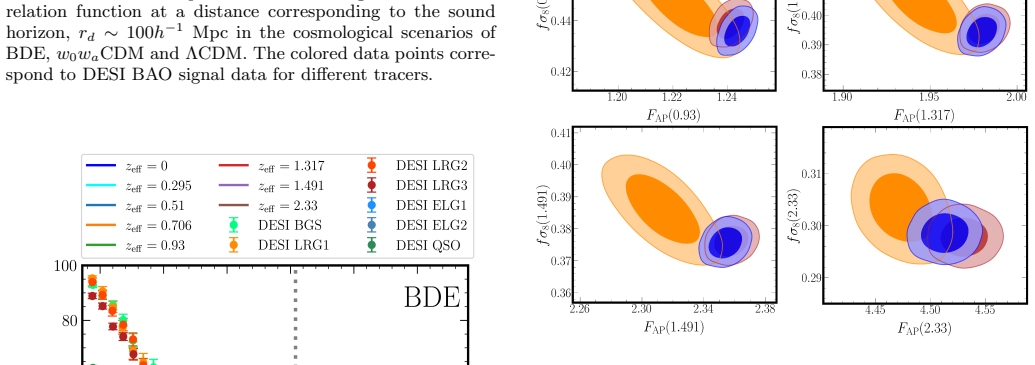
The recent findings from the Dark Energy Spectroscopic Instrument (DESI) indicate a preference for dynamical dark energy at a significance level above $2.5 \sigma$, with baryon acoustic oscillation (BAO) combined with cosmic microwave background (CMB) data and Type Ia supernovae (SNe) data, favoring a time dependent equation of state $w(z)$ rather than the cosmological constant ($w = -1$). We introduce the Bound Dark Energy (BDE) model, in which dark energy arises from the lightest meson field $\phi$ in a dark SU(3) gauge group, developing dynamically through non perturbative interactions. Governed by an inverse power law potential $V(\phi) = \Lambda_c^{4+2/3}\phi^{-2/3}$, BDE features no dark energy free parameters: one less than $\Lambda$CDM ($\Lambda$) and three less than the $ w_{0}w_{a} $CDM ($ w_{0}, w_{a},\Lambda $) models. By integrating DESI BAO measurements, CMB data and Dark Energy Survey SN Ia distance data collected during the fifth year, BDE demonstrates a reduction of $42$ and $37$ percent in the reduced $\chi^{2}_{BAO}$ as well as lower AIC and BIC values compared to the $w_{0}w_{a}$CDM and $\Lambda$CDM models, respectively, while maintaining a comparable fit for both type Ia supernovae and the cosmic microwave background data. Although the ($w_{0},w_{a}$) contour in BDE is 10,000 times smaller than that found in the $w_{0}w_{a}$CDM model, the BDE model suggests a dynamical dark energy scenario with precise values of $w_{0}=$-0.9301 $\pm$ 0.0004 and $w_{a}=$ -0.8085 $\pm$ 0.0053 while providing a consistency on the six Planck and derived parameters at the 1$\sigma$ level between BDE, $\Lambda$CDM and $w_{0}w_{a}$CDM models. The critical parameters condensation energy scale $\Lambda_{c} = 43.806 \pm 0.190$ eV and epoch $a_{c} = (2.497 \pm 0.011) \times 10^{-6}$ are consistent with predictions from high energy physics.
Figures


Figures from the paper (8 more)




Reference graph
Works this paper leans on
-
[1]
A. G. Riess, A. V. Filippenko, P. Challis, A. Clocchiatti, A. Diercks, P. M. Garnavich, R. L. Gilliland, C. J. Hogan, S. Jha, R. P. Kirshner, B. Leibundgut, M. M. Phillips, D. Reiss, B. P. Schmidt, R. A. Schommer, R. C. Smith, J. Spyromilio, C. Stubbs, N. B. Suntzeff, and J. Tonry, The Astronomical Journal 116, 1009 (1998)
1998
-
[2]
B. P. Schmidt, N. B. Suntzeff, M. M. Phillips, R. A. Schommer, A. Clocchiatti, R. P. Kirshner, P. Garnavich, P. Challis, B. Leibundgut, J. Spyromilio, A. G. Riess, A. V. Filippenko, M. Hamuy, R. C. Smith, C. Hogan, C. Stubbs, A. Diercks, D. Reiss, R. Gilliland, J. Tonry, J. Maza, A. Dressler, J. Walsh, and R. Ciardullo, The Astrophysical Journal 507, 46 (1998)
work page 1998
-
[3]
S. Perlmutter, G. Aldering, G. Goldhaber, R. A. Knop, P. Nugent, P. G. Castro, S. Deustua, S. Fabbro, A. Goo- bar, D. E. Groom, I. M. Hook, A. G. Kim, M. Y. Kim, J. C. Lee, N. J. Nunes, R. Pain, C. R. Penny- packer, R. Quimby, C. Lidman, R. S. Ellis, M. Irwin, R. G. McMahon, P. Ruiz-Lapuente, N. Walton, B. Schae- fer, B. J. Boyle, A. V. Filippenko, T. Mat...
work page 1999
-
[4]
C. L. Bennett, D. Larson, J. L. Weiland, N. Jarosik, G. Hinshaw, N. Odegard, K. M. Smith, R. S. Hill, B. Gold, M. Halpern, E. Komatsu, M. R. Nolta, L. Page, D. N. Spergel, E. Wollack, J. Dunkley, A. Kogut, M. Limon, S. S. Meyer, G. S. Tucker, and E. L. Wright, The Astrophysical Journal Supplement Series 208, 20 (2013)
work page 2013
-
[5]
Planck Collaboration, A&A 641, A6 (2020)
work page 2020
-
[6]
For the w0waCDM model, the calculation gives (χ2)w0waCDM BAO = 12.01/(12−8) = 3
= 2 .76. For the w0waCDM model, the calculation gives (χ2)w0waCDM BAO = 12.01/(12−8) = 3. The reduced χ2 for the BDE model is ( χ2)BDE BAO = 12.11/(12− 5) = 1.73, with five free parameters. In terms of the fit of the five-year supernova survey data from DES, the values of χ2 red are mostly equivalent for all three models: BDE (χ2 red = 0.908), ΛCDM (χ2 re...
- [7]
-
[8]
D. Scolnic, D. Brout, A. Carr, A. G. Riess, T. M. Davis, A. Dwomoh, D. O. Jones, N. Ali, P. Charvu, R. Chen, E. R. Peterson, B. Popovic, B. M. Rose, C. M. Wood, P. J. Brown, K. Chambers, D. A. Coulter, K. G. Dettman, G. Dimitriadis, A. V. Filippenko, R. J. Foley, S. W. Jha, C. D. Kilpatrick, R. P. Kirshner, Y.-C. Pan, A. Rest, C. Rojas-Bravo, M. R. Sieber...
work page 2022
Show all 33 references
-
[9]
DESI Collaboration, A. G. Adame, J. Aguilar, S. Ahlen, S. Alam, D. M. Alexander, M. Alvarez, O. Alves, A. Anand, U. Andrade, E. Armengaud, S. Avila, A. Aviles, H. Awan, B. Bahr-Kalus, S. Bailey, C. Bal- tay, A. Bault, J. Behera, S. BenZvi, A. Bera, F. Beutler, D. Bianchi, C. B...
2024 arXiv
-
[10]
DES Collaboration, T. M. C. Abbott, M. Acevedo, M. Aguena, A. Alarcon, S. Allam, O. Alves, A. Amon, F. Andrade-Oliveira, J. Annis, P. Armstrong, J. Asorey, S. Avila, D. Bacon, B. A. Bassett, K. Bechtol, P. H. Bernardinelli, G. M. Bernstein, E. Bertin, J. Blazek, S. Bocquet, D....
2024 arXiv
-
[11]
de la Macorra and E
A. de la Macorra and E. Almaraz, Phys. Rev. Lett. 121, 161303 (2018)
2018
-
[12]
de la Macorra and J
A. de la Macorra and J. A. L. Torres, Bound dark energy: a particle’s origin of dark energy (2025), arXiv:2503.19098 [astro-ph.CO]
2025 arXiv
-
[13]
de la Macorra, Phys
A. de la Macorra, Phys. Rev. D 72, 043508 (2005)
2005
-
[14]
Almaraz and A
E. Almaraz and A. de la Macorra, Phys. Rev. D 99, 103504 (2019)
2019
-
[15]
de la Macorra, Journal of High Energy Physics 2003, 033 (2003)
A. de la Macorra, Journal of High Energy Physics 2003, 033 (2003)
2003
-
[16]
Affleck, M
I. Affleck, M. Dine, and N. Seiberg, Nuclear Physics B 241, 493 (1984)
1984
-
[17]
de la Macorra, Journal of High Energy Physics 2003, 033 (2003), arXiv:hep-ph/0111292 [hep-ph]
A. de la Macorra, Journal of High Energy Physics 2003, 033 (2003), arXiv:hep-ph/0111292 [hep-ph]
2003 arXiv
-
[18]
Burgess, A
C. Burgess, A. de la Macorra, I. Maksymyk, and F. Quevedo, Physics Letters B 410, 181 (1997)
1997
-
[19]
Navas et al
S. Navas et al. (Particle Data Group), Phys. Rev. D 110, 030001 (2024)
2024
-
[20]
Bourilkov, Journal of High Energy Physics 2015, 10.1007/jhep11(2015)117 (2015)
D. Bourilkov, Journal of High Energy Physics 2015, 10.1007/jhep11(2015)117 (2015)
2015 doi
-
[21]
D. J. Fixsen, The Astrophysical Journal 707, 916 (2009)
2009
-
[22]
Navas, C
S. Navas, C. Amsler, T. Gutsche, C. Hanhart, J. J. Hern´ andez-Rey, C. Louren¸ co, A. Masoni, M. Mikhasenko, R. E. Mitchell, C. Patrignani, C. Schwanda, S. Spanier, G. Venanzoni, C. Z. Yuan, K. Agashe, G. Aielli, B. C. Allanach, J. Alvarez-Mu˜ niz, M. Antonelli, E. C. Aschenau...
2024
-
[23]
Lewis, A
A. Lewis, A. Challinor, and A. Lasenby, The Astrophys- ical Journal 538, 473 (2000)
2000
-
[24]
Furthermore, we obtained the best-fit values for each cosmological model utilizing the Powell’s 2009 BOBYQA bounded minimization routine, as integrated into CosmoMC
code. Furthermore, we obtained the best-fit values for each cosmological model utilizing the Powell’s 2009 BOBYQA bounded minimization routine, as integrated into CosmoMC. This process involved executing four indepen- dent minimizations from various random starting points to e...
2009
-
[25]
Lewis and S
A. Lewis and S. Bridle, Phys. Rev. D 66, 103511 (2002)
2002
-
[26]
Lewis, Getdist: a python package for analysing monte carlo samples (2019), arXiv:1910.13970 [astro-ph.IM]
A. Lewis, Getdist: a python package for analysing monte carlo samples (2019), arXiv:1910.13970 [astro-ph.IM]
2019 arXiv
-
[27]
Sahni, A
V. Sahni, A. Shafieloo, and A. A. Starobinsky, Phys. Rev. D 78, 103502 (2008)
2008
-
[28]
Zunckel and C
C. Zunckel and C. Clarkson, Phys. Rev. Lett. 101, 181301 (2008)
2008
-
[29]
Lodha, R
K. Lodha, R. Calderon, W. L. Matthewson, A. Shafieloo, M. Ishak, J. Pan, C. Garcia-Quintero, D. Huterer, G. Val- ogiannis, L. A. Ure˜ na-L´ opez, N. V. Kamble, D. Parkin- son, A. G. Kim, G. B. Zhao, J. L. Cervantes-Cota, J. Rohlf, F. Lozano-Rodr´ ıguez, J. O. Rom´ an-Herrera, ...
2025 arXiv
-
[30]
Cereskaite, E
R. Cereskaite, E. Mueller, C. Howlett, T. M. Davis, J. Aguilar, S. Ahlen, D. Bianchi, D. Brooks, F. J. Castander, T. Claybaugh, A. Cuceu, A. de la Ma- corra, S. Ferraro, A. Font-Ribera, J. E. Forero-Romero, E. Gaztanaga, G. Gutierrez, C. Hahn, K. Honscheid, D. Huterer, M. Isha...
2025 arXiv
-
[31]
Akaike, IEEE Transactions on Automatic Control 19, 716 (1974)
H. Akaike, IEEE Transactions on Automatic Control 19, 716 (1974)
1974
-
[32]
Schwarz, The Annals of Statistics 6, 461 (1978)
G. Schwarz, The Annals of Statistics 6, 461 (1978)
1978
-
[33]
Z. Li, B. Zhang, and N. Liang, Monthly Notices of the Royal Astronomical Society 521, 4406 (2023), https://academic.oup.com/mnras/article- pdf/521/3/4406/49688935/stad838.pdf
2023
Reviewed August 15, 2026 · model on record in the stance chip above.
Discussion (0). Continue with ORCID to comment.