Proximity-Induced Skyrmion Stabilization at the Cu2OSeO3/Bi2Se3 Interface
Pith reviewed 2026-07-01 04:07 UTC · model grok-4.3
The pith
Proximity effects at the Cu2OSeO3/Bi2Se3 interface stabilize a distinct skyrmion phase over a wider magnetic field range than in bulk.
A machine-rendered reading of the paper's core claim, the machinery that carries it, and where it could break.
Core claim
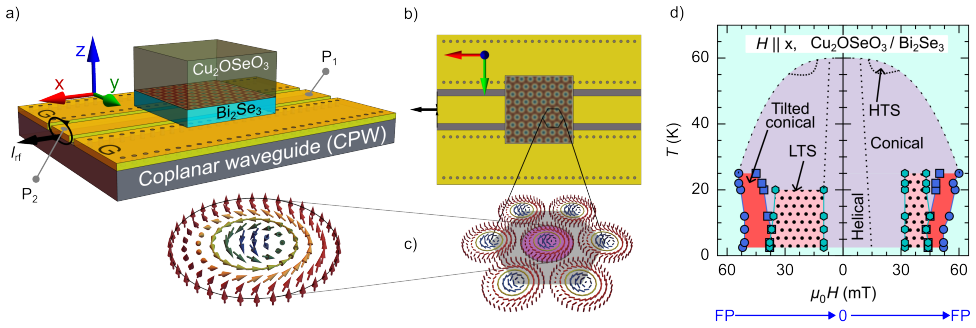
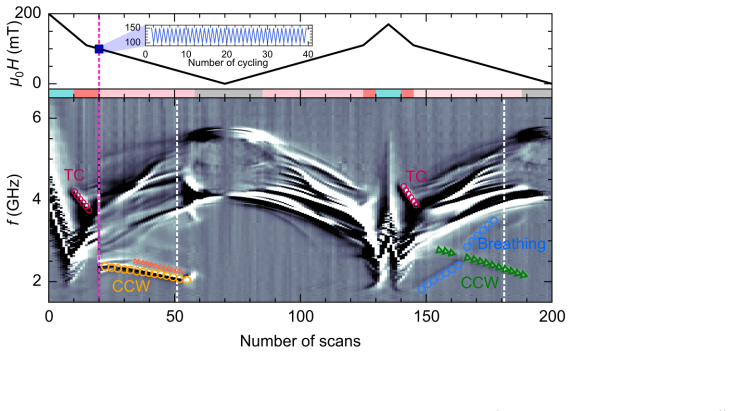
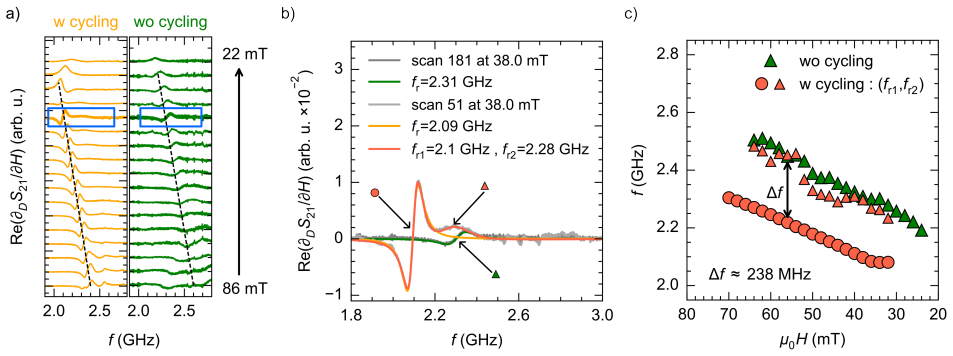
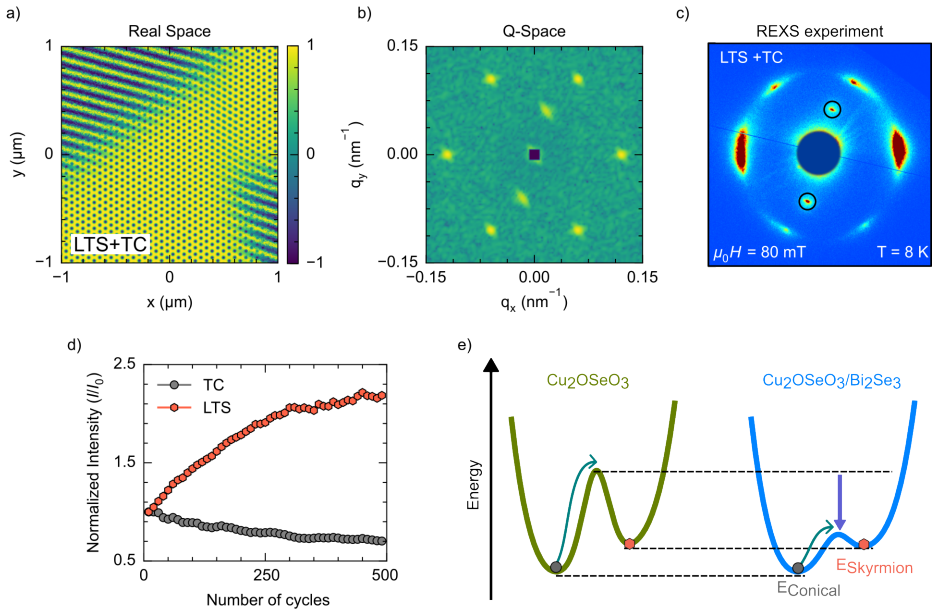
Proximity-induced exchange coupling and enhanced interfacial Dzyaloshinskii-Moriya interactions stabilize an interfacial skyrmion phase that coexists with the bulk skyrmion lattice, producing an additional resonance mode absent in bare Cu2OSeO3 and extending the field range of skyrmion stability as shown by split resonance branches at 238 MHz separation and resonant elastic x-ray scattering data.
What carries the argument
Proximity-induced exchange coupling combined with enhanced interfacial Dzyaloshinskii-Moriya interactions that create a distinct interfacial skyrmion energy landscape.
If this is right
- Skyrmion and tilted-conical phases can be stabilized over wider magnetic field conditions in the heterostructure than in bare material.
- Two skyrmion phases with similar resonance character but distinct energy landscapes can coexist at the interface.
- Interface engineering provides a route to tune the stability regime of topological spin textures in topological-magnetic heterostructures.
- Broadband ferromagnetic resonance can resolve separate bulk and interfacial skyrmion contributions through frequency splitting.
Where Pith is reading between the lines
- Similar proximity stabilization might occur in other topological insulator-chiral magnet pairs, potentially raising the temperature range for skyrmion stability.
- The 238 MHz frequency separation could enable selective addressing of bulk versus interface skyrmions in potential spintronic devices.
- Systematic variation of layer thickness or interface quality would help isolate the contribution of Dzyaloshinskii-Moriya enhancement from other interface effects.
Load-bearing premise
The extra resonance mode, 238 MHz separation, and broader field stability arise from proximity-induced coupling rather than from strain, roughness, or defects in the specific sample.
What would settle it
Observation of the same extra resonance mode and extended field range in a control heterostructure using a non-topological insulator layer instead of Bi2Se3 would falsify the proximity-induced origin.
Figures
read the original abstract
We investigate proximity-induced magnetic interactions at the interface between the topological insulator Bi2Se3 and the chiral magnetic insulator Cu2OSeO3, with particular focus on the low temperature skyrmion phase. Broadband ferromagnetic resonance spectroscopy reveals enhanced stability of noncollinear spin textures in the Cu2OSeO3/Bi2Se3 heterostructure compared with bare Cu2OSeO3. In addition to an extra resonance mode in the tilted conical phase that is absent in bare Cu2OSeO3, field cycling resolves two counterclockwise skyrmion resonance branches separated by approximately 238 MHz, consistent with the coexistence of a bulk skyrmion lattice and an interfacial skyrmion phase stabilized by proximity-induced exchange coupling and enhanced interfacial Dzyaloshinskii-Moriya interactions. The finite frequency separation indicates that the two skyrmion phases occupy distinct magnetic energy landscapes while retaining similar resonance character. Resonant elastic x-ray scattering measurements further confirm that the interfacial skyrmion phase spans a broader magnetic-field range than the bulk phase, demonstrating enhanced stability and ordering of topological spin textures at the interface. These findings establish interface engineering as a promising route for extending the stability regime of skyrmion and tilted-conical phases in topological-magnetic heterostructures.
Editorial analysis
A structured set of objections, weighed in public.
Referee Report
Summary. The manuscript reports experimental results on Cu2OSeO3/Bi2Se3 heterostructures using broadband ferromagnetic resonance (FMR) spectroscopy and resonant elastic x-ray scattering (REXS). It claims that proximity effects at the interface stabilize an interfacial skyrmion phase, evidenced by an additional resonance mode in the tilted conical phase, two counterclockwise skyrmion resonance branches separated by ~238 MHz (indicating distinct energy landscapes), and a broader magnetic-field stability range for the interfacial skyrmion phase compared to the bulk phase in bare Cu2OSeO3, attributed to proximity-induced exchange coupling and enhanced interfacial Dzyaloshinskii-Moriya interactions.
Significance. If the attribution to proximity effects holds, the findings would be significant for interface engineering of topological spin textures, extending skyrmion stability regimes in chiral magnetic heterostructures with potential implications for spintronic applications. The use of two independent techniques (FMR and REXS) provides complementary signatures for bulk vs. interfacial phases.
major comments (1)
- [Abstract] Abstract: The central claim that the 238 MHz frequency separation and extended REXS field range arise specifically from proximity-induced exchange/DMI (rather than strain, roughness, or defects) is load-bearing for the interpretation, yet the abstract provides no quantification of interface quality verification or controls, leaving the attribution open to sample-specific artifacts as noted in the weakest assumption.
minor comments (1)
- Ensure all FMR and REXS data presentations include explicit error bars, raw spectra, and statements on data availability to allow quantitative verification of the reported frequency separation and field ranges.
Simulated Author's Rebuttal
We thank the referee for their careful reading of our manuscript and for highlighting the need for clearer attribution in the abstract. We address the major comment below and will revise the manuscript accordingly.
read point-by-point responses
-
Referee: [Abstract] Abstract: The central claim that the 238 MHz frequency separation and extended REXS field range arise specifically from proximity-induced exchange/DMI (rather than strain, roughness, or defects) is load-bearing for the interpretation, yet the abstract provides no quantification of interface quality verification or controls, leaving the attribution open to sample-specific artifacts as noted in the weakest assumption.
Authors: We agree that the abstract, due to its brevity, does not explicitly reference the interface characterization data. The full manuscript (Section II and Supplementary Note 1) presents TEM cross-sections and XRD rocking curves confirming atomically sharp interfaces with RMS roughness below 0.5 nm and minimal strain mismatch, together with control measurements on bare Cu2OSeO3 films. These data support the proximity-effect interpretation over sample-specific artifacts. We will revise the abstract to include a concise statement quantifying interface quality and referencing the controls, thereby strengthening the central claim without altering the manuscript's length or focus. revision: yes
Circularity Check
No circularity; purely experimental observations with no derivations or self-referential predictions
full rationale
The paper reports FMR spectroscopy and REXS measurements comparing the Cu2OSeO3/Bi2Se3 heterostructure to bare Cu2OSeO3. It observes an extra resonance mode, 238 MHz splitting of skyrmion branches, and extended field range for the interfacial phase, then interprets these as evidence of proximity-induced stabilization. No equations, fitted parameters, or predictions appear that reduce by construction to the inputs; the central claims rest on direct experimental comparison rather than any self-definitional loop, fitted-input prediction, or self-citation chain. The work is self-contained against external benchmarks (bare-sample controls) and does not invoke uniqueness theorems or ansatzes from prior author work.
Axiom & Free-Parameter Ledger
axioms (2)
- standard math Standard assumptions of ferromagnetic resonance theory apply to the interpretation of resonance modes in noncollinear magnetic phases.
- domain assumption Resonant elastic x-ray scattering patterns can be used to distinguish bulk versus interfacial skyrmion ordering.
Reference graph
Works this paper leans on
-
[1]
S. Koraltan, C. Abert, M. Albrecht, M. Azhar, C. Back, H. B´ ea, M. T. Birch, S. Bl¨ ugel, O. Boulle, F. B¨ uttner,et al., The 2026 skyrmionics roadmap, arXiv preprint arXiv:2601.16575 (2026)
-
[2]
A. Fert, N. Reyren, and V. Cros, Magnetic skyrmions: advances in physics and potential applications, Nature Reviews Materials2, 1 (2017)
2017
-
[3]
Zhang, M
X. Zhang, M. Ezawa, and Y. Zhou, Magnetic skyrmion logic gates: conversion, duplication and merging of skyrmions, Scientific reports5, 1 (2015)
2015
-
[4]
Nagaosa and Y
N. Nagaosa and Y. Tokura, Topological properties and dynamics of magnetic skyrmions, Nature nanotechnology8, 899 (2013)
2013
-
[5]
O. Lee, T. Wei, K. D. Stenning, J. C. Gartside, D. Prestwood, S. Seki, A. Aqeel, K. Karube, N. Kanazawa, Y. Taguchi,et al., Task-adaptive physical reservoir computing, Nature materials 23, 79 (2024). 13
2024
-
[6]
R. E. Camley and K. L. Livesey, Consequences of the dzyaloshinskii-moriya interaction, Sur- face Science Reports78, 100605 (2023)
2023
-
[7]
Dzyaloshinsky, A thermodynamic theory of “weak” ferromagnetism of antiferromagnetics, Journal of physics and chemistry of solids4, 241 (1958)
I. Dzyaloshinsky, A thermodynamic theory of “weak” ferromagnetism of antiferromagnetics, Journal of physics and chemistry of solids4, 241 (1958)
1958
-
[8]
Moriya, Anisotropic superexchange interaction and weak ferromagnetism, Physical review 120, 91 (1960)
T. Moriya, Anisotropic superexchange interaction and weak ferromagnetism, Physical review 120, 91 (1960)
1960
-
[9]
Adams, A
T. Adams, A. Chacon, M. Wagner, A. Bauer, G. Brandl, B. Pedersen, H. Berger, P. Lemmens, and C. Pfleiderer, Long-wavelength helimagnetic order and skyrmion lattice phase in cu 2 oseo 3, Physical review letters108, 237204 (2012)
2012
-
[10]
S. Seki, X. Yu, S. Ishiwata, and Y. Tokura, Observation of skyrmions in a multiferroic material, Science336, 198 (2012)
2012
-
[11]
M¨ uhlbauer, B
S. M¨ uhlbauer, B. Binz, F. Jonietz, C. Pfleiderer, A. Rosch, A. Neubauer, R. Georgii, and P. B¨ oni, Skyrmion lattice in a chiral magnet, Science323, 915 (2009)
2009
-
[12]
X. Yu, Y. Onose, N. Kanazawa, J. H. Park, J. Han, Y. Matsui, N. Nagaosa, and Y. Tokura, Real-space observation of a two-dimensional skyrmion crystal, Nature465, 901 (2010)
2010
-
[13]
Versteeg, I
R. Versteeg, I. Vergara, S. Sch¨ afer, D. Bischoff, A. Aqeel, T. Palstra, M. Gr¨ uninger, and P. Van Loosdrecht, Optically probed symmetry breaking in the chiral magnet cu 2 oseo 3, Physical Review B94, 094409 (2016)
2016
-
[14]
Stasinopoulos, S
I. Stasinopoulos, S. Weichselbaumer, A. Bauer, J. Waizner, H. Berger, S. Maendl, M. Garst, C. Pfleiderer, and D. Grundler, Low spin wave damping in the insulating chiral magnet cu2oseo3, Applied Physics Letters111(2017)
2017
-
[15]
Aqeel, J
A. Aqeel, J. Sahliger, G. Li, J. Baas, G. R. Blake, T. T. Palstra, and C. H. Back, Growth and helicity of noncentrosymmetric cu2oseo3 crystals, physica status solidi (b)259, 2100152 (2022)
2022
-
[16]
S. Mehboodi, V. Ukleev, C. Luo, R. Abrudan, F. Radu, C. Back, and A. Aqeel, Observation of distorted tilted conical phase at the surface of a bulk chiral magnet with resonant elastic x-ray scattering, arXiv preprint arXiv:2412.15882 (2024)
-
[17]
Azhar, V
M. Azhar, V. P. Kravchuk, and M. Garst, Screw dislocations in chiral magnets, Physical Review Letters128, 157204 (2022)
2022
-
[18]
Marchiori, G
E. Marchiori, G. Romagnoli, L. Schneider, B. Gross, P. Sahafi, A. Jordan, R. Budakian, P. R. Baral, A. Magrez, J. S. White,et al., Imaging magnetic spiral phases, skyrmion clusters, and 14 skyrmion displacements at the surface of bulk cu2oseo3, Communications Materials5, 202 (2024)
2024
-
[19]
Halder, A
M. Halder, A. Chacon, A. Bauer, W. Simeth, S. M¨ uhlbauer, H. Berger, L. Heinen, M. Garst, A. Rosch, and C. Pfleiderer, Thermodynamic evidence of a second skyrmion lattice phase and tilted conical phase in cu 2 oseo 3, Physical review B98, 144429 (2018)
2018
-
[20]
Chacon, L
A. Chacon, L. Heinen, M. Halder, A. Bauer, W. Simeth, S. M¨ uhlbauer, H. Berger, M. Garst, A. Rosch, and C. Pfleiderer, Observation of two independent skyrmion phases in a chiral magnetic material, Nature physics14, 936 (2018)
2018
-
[21]
L. J. Bannenberg, H. Wilhelm, R. Cubitt, A. Labh, M. P. Schmidt, E. Leli` evre-Berna, C. Pap- pas, M. Mostovoy, and A. O. Leonov, Multiple low-temperature skyrmionic states in a bulk chiral magnet, npj Quantum Materials4, 11 (2019)
2019
-
[22]
Aqeel, J
A. Aqeel, J. Sahliger, T. Taniguchi, S. M¨ andl, D. Mettus, H. Berger, A. Bauer, M. Garst, C. Pfleiderer, and C. H. Back, Microwave spectroscopy of the low-temperature skyrmion state in cu 2 oseo 3, Physical Review Letters126, 017202 (2021)
2021
-
[23]
O. Lee, J. Sahliger, A. Aqeel, S. Khan, S. Seki, H. Kurebayashi, and C. H. Back, Tunable gigahertz dynamics of low-temperature skyrmion lattice in a chiral magnet, Journal of Physics: Condensed Matter34, 095801 (2021)
2021
-
[24]
Huang, M
P. Huang, M. Cantoni, A. Kruchkov, J. Rajeswari, A. Magrez, F. Carbone, and H. M. Rønnow, In situ electric field skyrmion creation in magnetoelectric cu2oseo3, Nano letters18, 5167 (2018)
2018
-
[25]
White, K
J. White, K. Prˇ sa, P. Huang, A. Omrani, I. ˇZivkovi´ c, M. Bartkowiak, H. Berger, A. Ma- grez, J. Gavilano, G. Nagy,et al., Electric-field-induced skyrmion distortion and giant lattice rotation in the magnetoelectric insulator cu 2 oseo 3, Physical review letters113, 107203 (2014)
2014
-
[26]
Okamura, F
Y. Okamura, F. Kagawa, M. Mochizuki, M. Kubota, S. Seki, S. Ishiwata, M. Kawasaki, Y. Onose, and Y. Tokura, Microwave magnetoelectric effect via skyrmion resonance modes in a helimagnetic multiferroic, Nature Communications4, 2391 (2013)
2013
-
[27]
Navabi, Y
A. Navabi, Y. Liu, P. Upadhyaya, K. Murata, F. Ebrahimi, G. Yu, B. Ma, Y. Rao, M. Yazdani, M. Montazeri,et al., Control of spin-wave damping in yig using spin currents from topological insulators, Physical review applied11, 034046 (2019). 15
2019
-
[28]
G¨ obel, I
B. G¨ obel, I. Mertig, and O. A. Tretiakov, Beyond skyrmions: Review and perspectives of alternative magnetic quasiparticles, Physics Reports895, 1 (2021)
2021
-
[29]
K. Ran, Y. Liu, Y. Guang, D. M. Burn, G. van der Laan, T. Hesjedal, H. Du, G. Yu, and S. Zhang, Creation of a chiral bobber lattice in helimagnet-multilayer heterostructures, Physical Review Letters126, 017204 (2021)
2021
-
[30]
L¨ uthi, L
C. L¨ uthi, L. Flacke, A. Aqeel, A. Kamra, R. Gross, C. Back, and M. Weiler, Hybrid magne- tization dynamics in cu2oseo3/nife heterostructures, Applied Physics Letters122(2023)
2023
-
[31]
Fanchiang, K
Y. Fanchiang, K. Chen, C. Tseng, C. Chen, C. Cheng, S. Yang, C. Wu, S. Lee, M. Hong, and J. Kwo, Strongly exchange-coupled and surface-state-modulated magnetization dynamics in bi2se3/yttrium iron garnet heterostructures, Nature communications9, 223 (2018)
2018
-
[32]
Y. Lv, J. Kally, D. Zhang, J. S. Lee, M. Jamali, N. Samarth, and J.-P. Wang, Unidirectional spin-hall and rashba- edelstein magnetoresistance in topological insulator-ferromagnet layer heterostructures, Nature communications9, 111 (2018)
2018
-
[33]
Y. Wang, S. V. Mambakkam, Y.-X. Huang, Y. Wang, Y. Ji, C. Xiao, S. A. Yang, S. A. Law, and J. Q. Xiao, Observation of nonlinear planar hall effect in magnetic-insulator–topological- insulator heterostructures, Physical Review B106, 155408 (2022)
2022
-
[34]
Y. Lv, J. Kally, T. Liu, P. Quarterman, T. Pillsbury, B. J. Kirby, A. J. Grutter, P. Sahu, J. A. Borchers, M. Wu,et al., Large unidirectional spin hall and rashba- edelstein magnetoresis- tance in topological insulator/magnetic insulator heterostructures, Applied Physics Reviews 9(2022)
2022
-
[35]
T. Liu, J. Kally, T. Pillsbury, C. Liu, H. Chang, J. Ding, Y. Cheng, M. Hilse, R. Engel-Herbert, A. Richardella,et al., Changes of magnetism in a magnetic insulator due to proximity to a topological insulator, Physical review letters125, 017204 (2020)
2020
-
[36]
H. Wang, J. Kally, J. S. Lee, T. Liu, H. Chang, D. R. Hickey, K. A. Mkhoyan, M. Wu, A. Richardella, and N. Samarth, Surface-state-dominated spin-charge current conversion in topological-insulator–ferromagnetic-insulator heterostructures, Physical review letters117, 076601 (2016)
2016
-
[37]
S. Zhu, D. Meng, G. Liang, G. Shi, P. Zhao, P. Cheng, Y. Li, X. Zhai, Y. Lu, L. Chen,et al., Proximity-induced magnetism and an anomalous hall effect in bi 2 se 3/lacoo 3: A topological insulator/ferromagnetic insulator thin film heterostructure, Nanoscale10, 10041 (2018). 16
2018
-
[38]
Singh, K
J. Singh, K. V. Raman, and N. Mohanta, Anisotropic planar hall effects in bi 2 se 3/eus interfaces: Deciphering the role of proximity-induced spin canting and topological spin texture, Physical Review B110, 125133 (2024)
2024
-
[39]
Katmis, V
F. Katmis, V. Lauter, F. S. Nogueira, B. A. Assaf, M. E. Jamer, P. Wei, B. Satpati, J. W. Free- land, I. Eremin, D. Heiman,et al., A high-temperature ferromagnetic topological insulating phase by proximity coupling, Nature533, 513 (2016)
2016
-
[40]
Q. L. He, X. Kou, A. J. Grutter, G. Yin, L. Pan, X. Che, Y. Liu, T. Nie, B. Zhang, S. M. Dis- seler,et al., Tailoring exchange couplings in magnetic topological-insulator/antiferromagnet heterostructures, Nature materials16, 94 (2017)
2017
-
[41]
S. V. Eremeev, V. Men’Shov, V. Tugushev, P. M. Echenique, and E. V. Chulkov, Magnetic proximity effect at the three-dimensional topological insulator/magnetic insulator interface, Physical Review B—Condensed Matter and Materials Physics88, 144430 (2013)
2013
-
[42]
Yasuda, R
K. Yasuda, R. Wakatsuki, T. Morimoto, R. Yoshimi, A. Tsukazaki, K. Takahashi, M. Ezawa, M. Kawasaki, N. Nagaosa, and Y. Tokura, Geometric hall effects in topological insulator heterostructures, Nature Physics12, 555 (2016)
2016
-
[43]
J. Chen, L. Wang, M. Zhang, L. Zhou, R. Zhang, L. Jin, X. Wang, H. Qin, Y. Qiu, J. Mei, et al., Evidence for magnetic skyrmions at the interface of ferromagnet/topological-insulator heterostructures, Nano letters19, 6144 (2019)
2019
-
[44]
P. Li, J. Ding, S. S.-L. Zhang, J. Kally, T. Pillsbury, O. G. Heinonen, G. Rimal, C. Bi, A. DeMann, S. B. Field,et al., Topological hall effect in a topological insulator interfaced with a magnetic insulator, Nano letters21, 84 (2020)
2020
-
[45]
Mochizuki, Spin-wave modes and their intense excitation effects in skyrmion crystals, Physical review letters108, 017601 (2012)
M. Mochizuki, Spin-wave modes and their intense excitation effects in skyrmion crystals, Physical review letters108, 017601 (2012)
2012
-
[46]
Onose, Y
Y. Onose, Y. Okamura, S. Seki, S. Ishiwata, and Y. Tokura, Observation of magnetic excita- tions of skyrmion crystal in a helimagnetic insulator cu 2 oseo 3, Physical review letters109, 037603 (2012)
2012
-
[47]
Schwarze, J
T. Schwarze, J. Waizner, M. Garst, A. Bauer, I. Stasinopoulos, H. Berger, C. Pfleiderer, and D. Grundler, Universal helimagnon and skyrmion excitations in metallic, semiconducting and insulating chiral magnets, Nature materials14, 478 (2015)
2015
-
[48]
F. Qian, L. J. Bannenberg, H. Wilhelm, G. Chaboussant, L. M. Debeer-Schmitt, M. P. Schmidt, A. Aqeel, T. T. Palstra, E. Br¨ uck, A. J. Lefering,et al., New magnetic phase of 17 the chiral skyrmion material cu2oseo3, Science Advances4, eaat7323 (2018)
2018
-
[49]
Maier-Flaig, S
H. Maier-Flaig, S. T. Goennenwein, R. Ohshima, M. Shiraishi, R. Gross, H. Huebl, and M. Weiler, Note: Derivative divide, a method for the analysis of broadband ferromagnetic resonance in the frequency domain, Review of Scientific Instruments89(2018)
2018
-
[50]
See Supplemental Material at [URL will be inserted by publisher] for experimental details and supporting measurements
-
[51]
Fedel, M
S. Fedel, M. Villa, S. Damerio, E. Demiroglu, C. Deger, J. Gazquez, and C. O. Avci, Evidence of long-range dzyaloshinskii–moriya interaction at ferrimagnetic insulator/nonmagnetic metal interfaces, Advanced Functional Materials , 2418653 (2025). 18 Supplemental Material for Proximity-Induced Skyrmion Stabilization at the Cu2OSeO3/Bi2Se3 Interface S. Mehbo...
2025
discussion (0)
Sign in with ORCID, Apple, or X to comment. Anyone can read and Pith papers without signing in.