REVIEW 3 minor 77 references
Engineering Schr\"odinger cat states with a photonic even-parity detector
T0 review · 0 major / 3 minor · reviewed 2026-08-14 · deepseek-v4-flash
Pith's one-line read A photon-pair coincidence on a balanced beam splitter projects light onto even-photon-number states, and with a coherent control state this heralds Schrödinger cat states whose fidelity approaches unity as the cat grows.
desk verdict A clean, honest method paper: the even-parity detector based on time-reversed Holland-Burnett interference is genuinely new, the two-component cat scheme is insensitive to finite squeezing, and the main caveats are stated in the paper itself. read the letter →
The pith
A machine-rendered reading of the paper's core claim, the machinery that carries it, and where it could break.
The reading
What carries the argument
The load-bearing object is the Holland-Burnett interference effect: when $|n,n\rangle$ enters a balanced beam splitter, the output state $\hat{U}|n,n\rangle$ contains only even photon numbers in both modes. The matrix elements $A_{j,n}$ of this state (Eq. 4) govern how the control state is reshaped by the detection, and Stirling's approximation shows they are nearly constant over a window of width $\sim\sqrt{n}$ around $j=n$. That flatness, together with the approximate symmetry of a coherent state's photon-number distribution about $n$, is what turns 'delete the odd terms' into 'symmetrize the control state into a cat.' The same effect, iterated with a displacement between stages, produces four-component cats.
What would settle it
Measure the heralded state by quantum state tomography after the $(n,n)$ outcome for a range of cat sizes $|\beta|^2\approx n$ with the control amplitude $\alpha=\beta/\lambda$, using detectors whose efficiency is independently characterized, and compare the reconstructed fidelity with Eq. (9) and Fig. 4(a). If the fidelity does not approach unity as $n$ grows after correcting for the known detection-efficiency model of Eq. (14), the central claim fails; in particular, the predicted dip for small $n$ should be visible.
Extended reading notes
Core claim
At the core of the paper is the projection rule $|\chi\rangle = \langle \varphi|\hat{U}^\dagger|n,n\rangle$: conditioning on the outcome $(n,n)$ at the output of a balanced beam splitter realizes the projector $|\chi\rangle\langle\chi|$ on the second input, where $|\chi\rangle$ has only even photon numbers. The coefficients in $|\chi\rangle$ are the product of the control-state amplitudes $c_{2n-j}$ and the Holland-Burnett matrix elements $A_{j,n}=\langle j,2n-j|\hat{U}|n,n\rangle$, which are almost flat in $j$ near $j=n$. Consequently, when the control is a coherent state $|\beta\rangle$, the projected state is the coherent state with all odd photon-number terms removed, which is approximately $(|\beta\rangle+|-\beta\rangle)$. Using a two-mode squeezed vacuum as the entangled resource, the paper shows the heralded state $|\psi_{\rm cat}\rangle$ has fidelity with the ideal cat that asymptotically reaches unity as the cat size $|\beta|^2$ grows, and the same reasoning extends by concatenation to four-component cats.
Load-bearing premise
The preparation works as an ideal cat only because the Holland-Burnett coefficients are treated as constant over the photon-number window where the control state has weight, and the control distribution is treated as symmetric about the detected number $n$; both conditions are only asymptotically exact.
Editorial extensions
If this is right
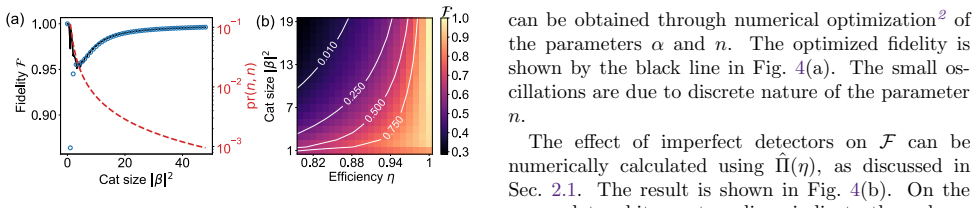
- As the cat size $|\beta|^2$ grows, the heralded two-component cat approaches the ideal state $|{\rm cat}_\beta\rangle$ with fidelity tending to 1 (Eq. 9 and Fig. 4a).
- The success probability of the heralding event scales roughly as $|\beta|^{-5/2}$, so larger cats come at a higher post-selection cost.
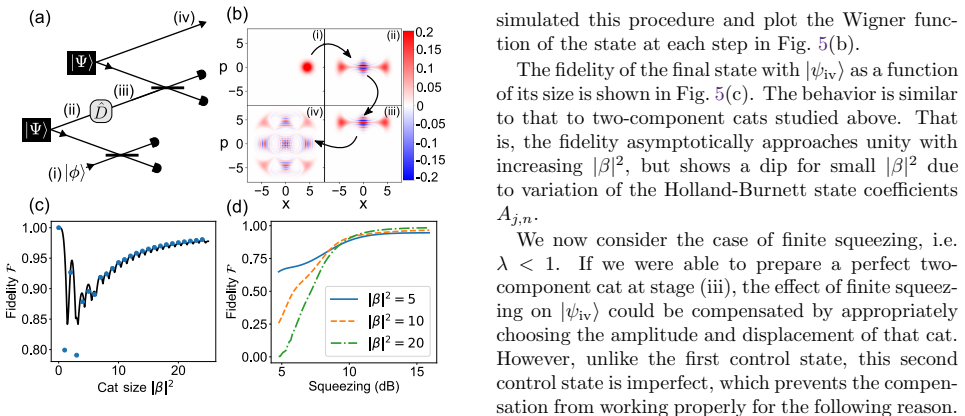
- Four-component cat states, the logical states of the 'cat code,' can be produced by concatenating two even-parity detectors with a displacement, with fidelity again tending to 1 as the cat grows under ideal detection.
- With realistic photon-number-resolving detectors (about 20 detected photons at greater than 95% efficiency), cats large enough to show Wigner-function negativity are within experimental reach at projected heralding rates around 100 Hz for $|\beta|^2=20$ with 13 dB of squeezing.
- Using squeezed coherent control states extends the same method to squeezed cats and, in principle, to Gottesman-Kitaev-Preskill states.
Reading between the lines
- Beyond the paper: the same projection rule can be read as a generalized non-Gaussian 'parity filter' that does not require an initial non-Gaussian resource; any entanglement structure with photon-number correlations could feed it, not only two-mode squeezing.
- Beyond the paper: because the control state's amplitudes are programmable, the detector is effectively a recipe for a broad class of even-parity states; one testable extension is to use squeezed or Fock-state superpositions as controls to target states other than cats, such as approximate GKP grid states.
- Beyond the paper: the scheme's sensitivity to detection inefficiency, which scales as $(1-\eta)n\gtrsim1$, suggests that the practical bottleneck is the dynamic range of the detectors rather than the squeezing; increasing that range at fixed efficiency would directly extend the accessible cat size.
Signed reviews
Editorial analysis
A structured set of objections, weighed in public.
Referee Report
Summary. The manuscript proposes an even-parity detector based on post-selecting the (n,n) detection outcome at the output of a balanced beam splitter, which realizes a projection onto an even-parity state |χ⟩ determined by an ancillary control state. By applying this detector to one mode of a two-mode squeezed vacuum, the other mode is heralded in an even-parity state |ψ⟩ (Eq. 7). With a coherent control state of appropriately chosen amplitude, this state approximates the two-component Schrödinger cat state with fidelity approaching unity as the cat size grows (Eq. 9, Fig. 4). The authors also analyze the effects of detector inefficiency via a derived POVM, extend the scheme to four-component cat states by concatenating two detectors, and discuss experimental feasibility.
Significance. The scheme is interesting because it uses Gaussian resources (two-mode squeezing and a coherent state) together with a non-Gaussian measurement (photon-number-resolving detection) to produce non-Gaussian states, complementing earlier schemes that require non-Gaussian input states and Gaussian measurements. The central projection formula and the loss POVM are derived carefully, the fidelity calculations are explicit, and the paper provides concrete numbers for experimental parameters (squeezing levels, detector efficiencies, rates). The proposed extension to four-component cat states, which are relevant for quantum error correction, is a valuable addition. The paper is transparent about the asymptotic nature of the fidelity and the finite-squeezing limitation for four-component cats.
minor comments (3)
- [Sec. 3.1] The statement that the success probability scales as pr(n,n) ~ |β|^{-5/2} is made without derivation; please either provide an analytic argument or state explicitly that this is a numerical observation, since the scaling is used to claim a fundamental limit on the success rate.
- [Sec. 3.2] The text says "there is no preparation scheme in the optical domain" but immediately cites Ref. [69] as a deterministic scheme; please rephrase to avoid the apparent contradiction, e.g., "apart from a recently proposed deterministic scheme [69]".
- [Fig. 4(a)] The red dashed line showing pr(n,n) appears to be plotted on a different scale from the fidelity; the caption should state the scale or indicate that two vertical axes are used.
Circularity Check
No significant circularity: the derivation is self-contained and benchmarked against external ideal cat states.
full rationale
The paper's central derivation chain is internally consistent and does not reduce to its inputs by construction. The even-parity detector is defined by the Born-rule projector |chi> = <phi|U^dag|n,n> (Eq. 3), with the Holland-Burnett matrix elements A_{j,n} taken from the independently established beam-splitter literature (Ref. [61] and the Campos-Saleh-Teich paper, Ref. [63]). The heralded state |psi> = <chi|Psi> (Eq. 7) follows from direct overlap of that projector with the two-mode squeezed vacuum, and the choice alpha = beta*lambda is explicitly constructed so that the lambda^j factor cancels exactly, leaving the beta-dependent superposition (Eq. 8). The central claim is then evaluated by fidelity against the ideal external target |cat_beta> = N(|beta> + |-beta>), not against any quantity fitted from the scheme itself; the closed-form fidelity in Eq. (9) is a genuine overlap of the heralded state with that independent benchmark. The numerical optimization of alpha and n for small cats is a finite-size improvement over the analytic choice, not a fit of the claimed prediction. The finite-squeezing limitation for four-component cats (12-13 dB) is explicitly stated and acknowledged, and the success-probability scaling pr ~ |beta|^{-5/2} is presented as a numerical finding that affects rate, not the state-fidelity claim. Self-citations that appear (e.g., Refs. [26] and [74]) are contextual comparisons or practical feasibility remarks and are not load-bearing for the derivation. No ansatz is smuggled in through self-citation, and no known result is merely renamed. The conclusion that the scheme prepares states approaching the ideal even cat with high fidelity is therefore an independent, externally benchmarked result.
Assumptions & free parameters
free parameters (3)
- Control coherent amplitude α =
chosen based on target β and squeezing λ; numerically optimized for small cat sizes
- Post-selected photon number n =
closest integer to |β|²
- Squeezing parameter λ =
optimized to maximize heralding probability (up to about 15 dB for |β|² = 50)
assumptions (4)
- standard math The balanced beam splitter is a unitary transformation Û, and the Fock-state matrix element A_{j,n} is given by Eq. (4).
- domain assumption Photon-number-resolving detectors project onto Fock states |n,n⟩ in the ideal case; loss is modeled with a Bernoulli transformation (Eqs. 13-14).
- domain assumption The entangled resource is a two-mode squeezed vacuum of the form Eq. (6) with real positive λ.
- domain assumption The control state is a pure coherent state, whose photon-number distribution is centered and localized on the flat portion of A_{j,n}.
Cite this review
Pith. "Pith review of Engineering Schr\"odinger cat states with a photonic even-parity detector." pith.science (2026). https://pith.science/paper/BPOZG4QN
@misc{pith2026190810314,
  author       = {Pith},
  title        = {Pith review of: Engineering Schr\"odinger cat states with a photonic even-parity detector},
  year         = {2026},
  howpublished = {\url{https://pith.science/paper/BPOZG4QN}},
  note         = {Machine review of arXiv:1908.10314}
}
read the original abstract
When two equal photon-number states are combined on a balanced beam splitter, both output ports of the beam splitter contain only even numbers of photons. Consider the time-reversal of this interference phenomenon: the probability that a pair of photon-number-resolving detectors at the output ports of a beam splitter both detect the same number of photons depends on the overlap between the input state of the beam splitter and a state containing only even photon numbers. Here, we propose using this even-parity detection to engineer quantum states containing only even photon-number terms. As an example, we demonstrate the ability to prepare superpositions of two coherent states with opposite amplitudes, i.e. two-component Schr\"odinger cat states. Our scheme can prepare cat states of arbitrary size with nearly perfect fidelity. Moreover, we investigate engineering more complex even-parity states such as four-component cat states by iteratively applying our even-parity detector.
Figures


Figures from the paper (1 more)
Reference graph
Works this paper leans on
-
[1]
A. I. Lvovsky, Photonics: Scientific Foundations, Technology and Applications 1, 121 (2015)
work page 2015
-
[2]
Weedbrook, S
C. Weedbrook, S. Pirandola, R. Garc´ ıa-Patr´ on, N. J. Cerf, T. C. Ralph, J. H. Shapiro, and S. Lloyd, Rev. Mod. Phys. 84, 621 (2012)
2012
-
[3]
S. L. Braunstein and P. van Loock, Rev. Mod. Phys. 77, 513 (2005)
2005
-
[4]
C. M. Caves, Phys. Rev. D 23, 1693 (1981)
1981
-
[5]
Schr¨ odinger, Naturwissenschaften 23, 823 (1935)
E. Schr¨ odinger, Naturwissenschaften 23, 823 (1935)
work page 1935
-
[6]
M. J. Holland and K. Burnett, Phys. Rev. Lett. 71, 1355 (1993)
work page 1993
-
[7]
Gottesman, A
D. Gottesman, A. Kitaev, and J. Preskill, Phys. Rev. A 64, 012310 (2001)
2001
-
[8]
Yurke and D
B. Yurke and D. Stoler, Phys. Rev. Lett. 57, 13 (1986)
1986
Show all 77 references
-
[9]
C. K. Law and J. H. Eberly, Phys. Rev. Lett. 76, 1055 (1996)
1996
-
[10]
C. C. Gerry, A. Benmoussa, and R. A. Campos, Phys. Rev. A 72, 053818 (2005)
2005
-
[11]
Hacker, S
B. Hacker, S. Welte, S. Daiss, A. Shaukat, S. Rit- ter, L. Li, and G. Rempe, Nat. Photonics 13, 110 (2019). Accepted in Quantum 2020-02-24, click title to verify. Published under CC-BY 4.0. 6
2019
-
[12]
A. I. Lvovsky and J. Mlynek, Phys. Rev. Lett. 88, 250401 (2002)
2002
-
[13]
Zavatta, S
A. Zavatta, S. Viciani, and M. Bellini, Science 306, 660 (2004)
2004
-
[14]
Fiur´ aˇ sek, R
J. Fiur´ aˇ sek, R. Garc´ ıa-Patr´ on, and N. J. Cerf, Phys. Rev. A 72, 033822 (2005)
2005
-
[15]
Bimbard, N
E. Bimbard, N. Jain, A. MacRae, and A. Lvovsky, Nat. Photonics 4, 243 (2010)
2010
-
[16]
Sperling, W
J. Sperling, W. Vogel, and G. S. Agarwal, Phys. Rev. A 89, 043829 (2014)
2014
-
[17]
Glancy and H
S. Glancy and H. M. de Vasconcelos, J. Opt. Soc. Am. B 25, 712 (2008)
2008
-
[18]
Dakna, T
M. Dakna, T. Anhut, T. Opatrn´ y, L. Kn¨ oll, and D.-G. Welsch, Phys. Rev. A 55, 3184 (1997)
1997
-
[19]
J. S. Neergaard-Nielsen, B. M. Nielsen, C. Het- tich, K. Mølmer, and E. S. Polzik, Phys. Rev. Lett. 97, 083604 (2006)
2006
-
[20]
Ourjoumtsev, R
A. Ourjoumtsev, R. Tualle-Brouri, J. Laurat, and P. Grangier, Science 312, 83 (2006)
2006
-
[21]
Ourjoumtsev, H
A. Ourjoumtsev, H. Jeong, R. Tualle-Brouri, and P. Grangier, Nature 448, 784 (2007)
2007
-
[22]
Wakui, H
K. Wakui, H. Takahashi, A. Furusawa, and M. Sasaki, Opt. Express 15, 3568 (2007)
2007
-
[23]
Marek, H
P. Marek, H. Jeong, and M. S. Kim, Phys. Rev. A 78, 063811 (2008)
2008
-
[24]
Takahashi, K
H. Takahashi, K. Wakui, S. Suzuki, M. Takeoka, K. Hayasaka, A. Furusawa, and M. Sasaki, Phys. Rev. Lett. 101, 233605 (2008)
2008
-
[25]
Huang, H
K. Huang, H. Le Jeannic, J. Ruaudel, V. B. Verma, M. D. Shaw, F. Marsili, S. W. Nam, E. Wu, H. Zeng, Y.-C. Jeong, R. Filip, O. Morin, and J. Laurat, Phys. Rev. Lett. 115, 023602 (2015)
2015
-
[26]
D. V. Sychev, A. E. Ulanov, A. A. Pushkina, M. W. Richards, I. A. Fedorov, and A. I. Lvovsky, Nat. Photonics 11, 379 (2017)
2017
-
[27]
Etesse, M
J. Etesse, M. Bouillard, B. Kanseri, and R. Tualle-Brouri, Phys. Rev. Lett. 114, 193602 (2015)
2015
-
[28]
A. E. Lita, A. J. Miller, and S. W. Nam, Opt. Express 16, 3032 (2008)
2008
-
[29]
Karimi, Int
A. Karimi, Int. J. Quantum Inf 16, 1850003 (2018)
2018
-
[30]
Quesada, L
N. Quesada, L. G. Helt, J. Izaac, J. M. Arra- zola, R. Shahrokhshahi, C. R. Myers, and K. K. Sabapathy, Phys. Rev. A 100, 022341 (2019)
2019
-
[31]
D. Su, C. R. Myers, and K. K. Sabapathy, arXiv:1902.02331
1902 arXiv
-
[32]
D. Su, C. R. Myers, and K. K. Sabapathy, Phys. Rev. A 100, 052301 (2019)
2019
-
[33]
Gerrits, S
T. Gerrits, S. Glancy, T. S. Clement, B. Calkins, A. E. Lita, A. J. Miller, A. L. Migdall, S. W. Nam, R. P. Mirin, and E. Knill, Phys. Rev. A 82, 031802 (2010)
2010
-
[34]
K. T. McCusker and P. G. Kwiat, Phys. Rev. Lett. 103, 163602 (2009)
2009
-
[35]
T. J. Bartley, G. Donati, J. B. Spring, X.-M. Jin, M. Barbieri, A. Datta, B. J. Smith, and I. A. Walmsley, Phys. Rev. A 86, 043820 (2012)
2012
-
[36]
R. J. Birrittella, M. El Baz, and C. C. Gerry, J. Opt. Soc. Am. B 35, 1514 (2018)
2018
-
[37]
Eaton, R
M. Eaton, R. Nehra, and O. Pfister, New J. Phys. 21, 113034 (2019)
2019
-
[38]
Schleich, M
W. Schleich, M. Pernigo, and F. L. Kien, Phys. Rev. A 44, 2172 (1991)
1991
-
[39]
B. C. Sanders, Phys. Rev. A 45, 6811 (1992)
1992
-
[40]
Wenger, M
J. Wenger, M. Hafezi, F. Grosshans, R. Tualle- Brouri, and P. Grangier, Phys. Rev. A 67, 012105 (2003)
2003
-
[41]
Jeong, W
H. Jeong, W. Son, M. S. Kim, D. Ahn, and C. Brukner, Phys. Rev. A 67, 012106 (2003)
2003
-
[42]
Stobi´ nska, H
M. Stobi´ nska, H. Jeong, and T. C. Ralph, Phys. Rev. A 75, 052105 (2007)
2007
-
[43]
Haroche, Rev
S. Haroche, Rev. Mod. Phys. 85, 1083 (2013)
2013
-
[44]
D. J. Wineland, Rev. Mod. Phys. 85, 1103 (2013)
2013
-
[45]
Vlastakis, A
B. Vlastakis, A. Petrenko, N. Ofek, L. Sun, Z. Leghtas, K. Sliwa, Y. Liu, M. Hatridge, J. Blu- moff, L. Frunzio, et al. , Nat. Commun. 6, 8970 (2015)
2015
-
[46]
C. Wang, Y. Y. Gao, P. Reinhold, R. W. Heeres, N. Ofek, K. Chou, C. Axline, M. Reagor, J. Blu- moff, K. Sliwa, et al. , Science 352, 1087 (2016)
2016
-
[47]
S. J. van Enk and O. Hirota, Phys. Rev. A 64, 022313 (2001)
2001
-
[48]
Jeong, M
H. Jeong, M. S. Kim, and J. Lee, Phys. Rev. A 64, 052308 (2001)
2001
-
[49]
T. C. Ralph, A. Gilchrist, G. J. Milburn, W. J. Munro, and S. Glancy, Phys. Rev. A 68, 042319 (2003)
2003
-
[50]
Gilchrist, K
A. Gilchrist, K. Nemoto, W. J. Munro, T. C. Ralph, S. Glancy, S. L. Braunstein, and G. J. Milburn, J. Opt. B: Quantum Semiclass. Opt. 6, S828 (2004)
2004
-
[51]
A. P. Lund, T. C. Ralph, and H. L. Haselgrove, Phys. Rev. Lett. 100, 030503 (2008)
2008
-
[52]
Vlastakis, G
B. Vlastakis, G. Kirchmair, Z. Leghtas, S. E. Nigg, L. Frunzio, S. M. Girvin, M. Mirrahimi, M. H. Devoret, and R. J. Schoelkopf, Science 342, 607 (2013)
2013
-
[53]
N. Ofek, A. Petrenko, R. Heeres, P. Reinhold, Z. Leghtas, B. Vlastakis, Y. Liu, L. Frunzio, S. Girvin, L. Jiang, et al. , Nature 536, 441 (2016)
2016
-
[54]
Leghtas, G
Z. Leghtas, G. Kirchmair, B. Vlastakis, R. J. Schoelkopf, M. H. Devoret, and M. Mirrahimi, Phys. Rev. Lett. 111, 120501 (2013)
2013
-
[55]
Mirrahimi, Z
M. Mirrahimi, Z. Leghtas, V. V. Albert, S. Touzard, R. J. Schoelkopf, L. Jiang, and M. H. Devoret, New J. Phys. 16, 045014 (2014)
2014
-
[56]
V. V. Albert, K. Noh, K. Duivenvoorden, D. J. Young, R. T. Brierley, P. Reinhold, C. Vuillot, L. Li, C. Shen, S. M. Girvin, B. M. Terhal, and L. Jiang, Phys. Rev. A 97, 032346 (2018). Accepted in Quantum 2020-02-24, click title to verify. Published under CC-BY 4.0. 7
2018
-
[57]
W. H. Zurek, Nature 412, 712 (2001)
2001
-
[58]
G. S. Agarwal and P. K. Pathak, Phys. Rev. A 70, 053813 (2004)
2004
-
[59]
D. A. Dalvit, R. de Matos Filho, and F. Toscano, New J. Phys. 8, 276 (2006)
2006
-
[60]
U. Roy, S. Ghosh, P. K. Panigrahi, and D. Vitali, Phys. Rev. A 80, 052115 (2009)
2009
-
[61]
Leonhardt, Measuring the Quantum State of Light (Cambridge University Press, 1997)
U. Leonhardt, Measuring the Quantum State of Light (Cambridge University Press, 1997)
1997
-
[62]
C. K. Hong, Z. Y. Ou, and L. Mandel, Phys. Rev. Lett. 59, 2044 (1987)
1987
-
[63]
R. A. Campos, B. E. A. Saleh, and M. C. Teich, Phys. Rev. A 40, 1371 (1989)
1989
-
[64]
J. R. Johansson, P. D. Nation, and F. Nori, Com- put. Phys. Commun. 184, 1234 (2013)
2013
-
[65]
P. C. Humphreys, B. J. Metcalf, T. Gerrits, T. Hiemstra, A. E. Lita, J. Nunn, S. W. Nam, A. Datta, W. S. Kolthammer, and I. A. Walm- sley, New J. Phys. 17, 103044 (2015)
2015
-
[66]
Kenfack and K
A. Kenfack and K. ˙Zyczkowski, J. Opt. B: Quan- tum Semiclass. Opt. 6, 396 (2004)
2004
-
[67]
L. A. Howard, T. J. Weinhold, F. Shahandeh, J. Combes, M. R. Vanner, A. G. White, and M. Ringbauer, Phys. Rev. Lett. 123, 020402 (2019)
2019
-
[68]
Ringbauer, T
M. Ringbauer, T. J. Weinhold, L. Howard, A. White, and M. Vanner, New J. Phys. 20, 053042 (2018)
2018
-
[69]
Hastrup, J
J. Hastrup, J. S. Neergaard-Nielsen, and U. L. Andersen, Opt. Lett. 45, 640 (2020)
2020
-
[70]
Y. Eto, A. Koshio, A. Ohshiro, J. Sakurai, K. Horie, T. Hirano, and M. Sasaki, Opt. Lett. 36, 4653 (2011)
2011
-
[71]
Harder, T
G. Harder, T. J. Bartley, A. E. Lita, S. W. Nam, T. Gerrits, and C. Silberhorn, Phys. Rev. Lett. 116, 143601 (2016)
2016
-
[72]
Eberle, V
T. Eberle, V. H¨ andchen, and R. Schnabel, Opt. Express 21, 11546 (2013)
2013
-
[73]
Vahlbruch, M
H. Vahlbruch, M. Mehmet, K. Danzmann, and R. Schnabel, Phys. Rev. Lett. 117, 110801 (2016)
2016
-
[74]
G. S. Thekkadath, D. S. Phillips, J. F. F. Bul- mer, W. R. Clements, A. Eckstein, B. A. Bell, J. Lugani, T. A. W. Wolterink, A. Lita, S. W. Nam, T. Gerrits, C. G. Wade, and I. A. Walm- sley, arXiv:1908.04765
1908 arXiv
-
[75]
H. M. Vasconcelos, L. Sanz, and S. Glancy, Opt. Lett. 35, 3261 (2010)
2010
-
[76]
A. L. Grimsmo, J. Combes, and B. Q. Baragiola, arXiv:1901.08071
1901 arXiv
-
[77]
T. Kiss, U. Herzog, and U. Leonhardt, Phys. Rev. A 52, 2433 (1995). Accepted in Quantum 2020-02-24, click title to verify. Published under CC-BY 4.0. 8
1995
Reviewed August 14, 2026 · model on record in the stance chip above.
Discussion (0). Continue with ORCID to comment.