REVIEW 3 major objections 4 minor 34 references
Bending of Light from Reissner-Nordstr\"om-de Sitter-Monopole Black Hole
T0 review · 3 major / 4 minor · reviewed 2026-08-14 · deepseek-v4-flash
Pith's one-line read The paper derives a complete weak-field formula for light deflection around a charged black hole with a global monopole and a cosmological constant, separating mass/charge/monopole and Λ contributions.
desk verdict Plausible second-order deflection formulas for RN-dS-monopole, but the key orbit solution is asserted rather than shown; worth a referee with a request for the missing algebra. read the letter →
The pith
A machine-rendered reading of the paper's core claim, the machinery that carries it, and where it could break.
The reading
What carries the argument
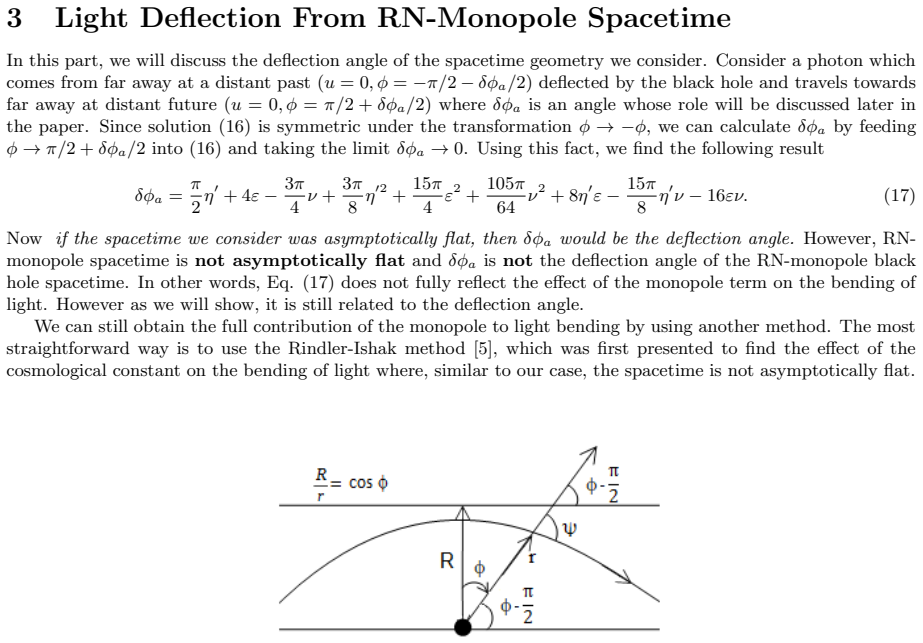
The load-bearing object is the metric function $\Delta_r$ together with the second-order perturbative orbit $u(\varphi)=1/r(\varphi)$ given in Eq. (16). The orbit is the solution of the modified Binet equation that also satisfies the first-integral orbit equation; the paper discards antisymmetric $\sin\varphi$ terms on symmetry grounds and fixes the remaining arbitrary functions through Eq. (11). The deflection is then computed from the small-angle expression $\psi\approx [\sqrt{\Delta_r/r^2}\,r|dr/d\varphi|^{-1}]_{\varphi=\pi/2}$, which is the mechanism that converts the non-flat metric into a finite bending angle. Expanding this expression along the orbit separates the cosmological-constant contribution from the asymptotically-flat part and produces the polynomial (30).
What would settle it
Integrate the null geodesic equations (4)–(6) numerically for a few parameter sets with $0<b^2<1$ and small $\Lambda$, measure the deflection angle by tracking the asymptote of the orbit, and compare with Eqs. (23) and (30); any disagreement beyond the stated truncation order would show that the perturbative orbit (16) is not the true solution.
Extended reading notes
Core claim
Working in the equatorial plane of the line element $ds^2 = -\frac{\Delta_r}{r^2}dt^2 + \frac{r^2}{\Delta_r}dr^2 + r^2(d\theta^2+\sin^2\theta\,d\varphi^2)$ with $\Delta_r = b^2 r^2 - 2Mr - \frac{\Lambda}{3}r^4 + Q^2$ and $b^2 = 1 - 8\pi\eta^2$, the paper solves the null-geodesic orbit equation to second order in $M$, $Q^2$, and $\eta'=8\pi\eta^2$. Applying the method of [5] for non-asymptotically flat geometries, it obtains the total deflection angle $\delta\varphi = \delta\varphi_M + \delta\varphi_\Lambda$, with $\delta\varphi_M$ given by Eq. (23) in terms of impact parameter $R$ and equivalently by Eq. (26) in terms of minimum distance $r_{\min}$, and with $\delta\varphi_\Lambda = \Lambda(L_0 + L_1 R + L_2 R^2 + L_3 R^3 + L_4 R^4)$ and explicit coefficients. The monopole contributes both a leading angle-deficit deflection $4\pi^2\eta^2$ and second-order couplings to mass, charge, and the cosmological constant; the effect of the monopole is to increase the bending, while the charge opposes it.
Load-bearing premise
The calculation stands on the unshown premise that the second-order perturbative orbit written in Eq. (16), with all antisymmetric $\sin\varphi$ terms discarded and with arbitrary functions fixed through the first-integral equation, is the exact orbit to that order; if a term is missing or the fixing is inconsistent, Eqs. (23), (26), and (30) all inherit the error.
Editorial extensions
If this is right
- Monopole strength $\eta$ adds a deflection $4\pi^2\eta^2$ plus higher-order terms, so a global monopole acts as a magnifying lens, increasing the bending relative to a purely Reissner-Nordström-de Sitter black hole.
- The cosmological constant makes a concrete, impact-parameter-dependent contribution to lensing even in the weak-field regime; the polynomial structure in $R$ could in principle be distinguished from mass and charge terms observationally.
- The monopole enlarges the photon-sphere radius and shrinks the cosmological horizon, so the allowed parameter window for observing deflection narrows as $\eta$ grows.
- The second-order charge terms, though negligible for typical astrophysical charges, can become sizable in scenarios with large effective tidal charge, such as brane-world black-hole analogues.
Reading between the lines
- A direct numerical ray-tracing test of Eqs. (23) and (30) on the exact geodesic equations would be a cheap way to check whether the discarded antisymmetric terms in the perturbative orbit are truly harmless; the paper does not perform such a check.
- Because the solid-angle-deficit structure is shared by radial string-hedgehog configurations, the same deflection polynomial may carry over to those spacetimes, with the monopole parameter reinterpreted—this is an application the paper mentions but does not develop.
- The explicit coupling terms between $\Lambda$ and $\eta'$ suggest that measurements of weak lensing by clusters could, in principle, place a bound on the monopole parameter, if systematic uncertainties in mass and charge can be controlled; turning this into an observational strategy would require a separate statistical analysis.
Signed reviews
Editorial analysis
A structured set of objections, weighed in public.
Referee Report
Summary. The paper studies null geodesics in the Reissner-Nordström–de Sitter–global-monopole spacetime (Eqs. (1)-(2)). The authors solve the modified Binet equation (14) perturbatively to second order in ε=M/R, ν=Q²/R², and η'=8πη², obtaining the orbit solution (16). For Λ=0 they use the Rindler-Ishak method to derive the deflection angle δφ_M in terms of the impact parameter R (Eq. (23)) and of the minimum distance r_min (Eq. (26)). For Λ≠0 they absorb Λ/3 into the definition of R, so the orbit equation takes the Λ=0 form, and they obtain the total deflection 2ψ=δφ_M+δφ_Λ, with δφ_Λ=Λ(L0+L1R+L2R²+L3R³+L4R⁴) given by Eq. (30), to first order in Λ and first order in M, Q², η' where multiplied by Λ. The paper also discusses the domain of validity of the Rindler-Ishak construction in Section 4.1.
Significance. If the derivation is correct, the paper provides a unified weak-field lensing formula for a charged black hole embedded in a global monopole with a cosmological constant, including new cross-terms between the monopole parameter and M, Q², and Λ. The paper's main strengths are the recovery of known limits: the Einstein 4M/R deflection, the standard Reissner-Nordström charge terms, the pure global-monopole solid-angle-deficit term, and the Rindler-Ishak Schwarzschild–de Sitter Λ term. The formulas are falsifiable predictions, and no constants are fitted to data, so there is no circularity. The principal weakness is that the central perturbative orbit (16) and the coefficients (30) are presented as results of unshown algebra, making the new cross-terms difficult to verify independently. The paper does not include a reproducibility artifact such as a computer-algebra notebook.
major comments (3)
- [Section 2.3, Eq. (16)] The perturbative orbit solution (16) is the foundation of every subsequent result, but the manuscript does not show how it satisfies both the Binet equation (14) and the first-integral equation (11). Because (16) contains secular terms (φ sinφ, φ² cosφ) and all mixed second-order terms η'ε, η'ν, εν, an error in any of these terms would propagate directly into Eqs. (17), (23), (26), and (30). Please include an explicit substitution (or a supplementary notebook) verifying (16) to the claimed order, and identify the arbitrary functions fixed by Eq. (11). This verification is also needed to support the claim in Section 4 that Eq. (10) of Ref. [32] has a missing 37 sinφ term.
- [Section 4, Eq. (30)] The coefficients L0–L4 are the main new Λ-dependent result, but they are introduced after 'some long calculations' and no derivation is provided. Since the expressions contain terms such as Q^6/M^4 and η'^2 Q^4/M^4 that diverge as M→0, it is not possible to check the truncation and the cancellation structure without a reproducible calculation. Please provide a step-by-step derivation of Eq. (28)→Eq. (30), or a computer-algebra file, and state explicitly which terms are kept at each order in M, Q², η', and Λ.
- [Section 3, Eq. (26)] The coefficient of the η²Q² term appears to contain a typo. Combining Eq. (23)'s term -12π²η²Q²/R² = -(3π/2)η'Q²/R² with the η' correction that arises when -3πQ²/(4R²) is converted via Eq. (25) gives a net coefficient -3π/4 η'Q²/r_min² = -6π²η²Q²/r_min², whereas Eq. (26) displays -6πη²Q²/r_min². The printed expression appears to be missing one factor of π. Please check and correct this coefficient.
minor comments (4)
- [Section 2.3, Eq. (16)] Equation (16) is hard to parse because the placement of denominators is ambiguous in the typeset expression. Please use explicit parentheses, e.g. -ε(cos2φ-3)/(2R) and η'(cosφ+φ sinφ)/(2R), so that each term is unambiguous.
- [Section 3, Eqs. (19)-(20)] The expressions (19) and (20) contain terms such as 15πη'ν/(32ε), where a ratio of perturbation parameters appears. It would aid the reader to display these results as ordered expansions in ε, ν, and η' rather than as ratios involving 1/ε.
- [Section 4, Eqs. (27)-(30)] The paper redefines the impact parameter via 1/R²=E²/L²+Λ/3 and then uses Eq. (23) inside Eq. (28). Please state explicitly in the final formulas that R denotes the redefined impact parameter, and give the relation to the physical impact parameter b=L/E to first order in Λ, so that the comparison with Refs. [30]-[32] is unambiguous.
- [Abstract and Introduction] The phrase 'up to second-order' is used without specifying the perturbation parameters. Please state more explicitly that the Λ=0 deflection is second order in M, Q², and η', while the Λ contribution is first order in Λ and first order in M, Q², and η' in the terms multiplied by Λ.
Circularity Check
No circularity: the deflection-angle results follow from the explicitly stated metric, orbit solution, and Rindler-Ishak formula without fitted parameters or self-citation used as evidence.
full rationale
The paper's central results, Eqs. (23), (26), and (30), are obtained by direct substitution: the metric function Δr from Eq. (2), the conserved-energy geodesic equations (4)-(6), the perturbative orbit solution (16), and the Rindler-Ishak bending-angle formula (18) are combined algebraically. No parameter is fitted to data or to a target deflection angle, and no 'prediction' is constructed from a previously fitted quantity. The orbit solution (16) is introduced as a perturbative ansatz whose consistency with Eq. (11) is asserted rather than demonstrated, but that is an unverified derivation premise or correctness risk, not a circular reduction: the final deflection formulas are not assumed as inputs. The redefinition of the impact parameter in Sec. 4, 1/R^2 = E^2/L^2 + Λ/3, is a legitimate change of notation that leaves the Binet equation form unchanged, while the cosmological-constant contribution still enters through the explicit -Λr^2/3 term in the metric function inside Eq. (18), so it is not inserted by hand. Comparisons with prior works such as Refs. [5, 18, 30, 31, 32] are consistency checks rather than calibration steps. The only self-citation, Ref. [13] by one of the authors, is used for the incidental interpretation of the spacetime as a string-hedgehog configuration and plays no role in the deflection-angle derivation. Accordingly, no significant circularity is present.
Assumptions & free parameters
assumptions (4)
- domain assumption The metric (1)-(2) with Delta_r = b^2 r^2 - 2Mr - (Lambda/3) r^4 + Q^2 and b^2 = 1 - 8 pi eta^2 correctly describes the far field of a global monopole swallowed by an RN-dS black hole.
- domain assumption The monopole strength is small, 8 pi eta^2 << 1, so the parameter eta' = 8 pi eta^2 can be used as a perturbative expansion parameter around flat spacetime.
- domain assumption The Rindler-Ishak formula (18), borrowed from [5], gives the physically meaningful bending angle in non-asymptotically flat spacetimes when evaluated at phi = pi/2.
- ad hoc to paper The particular solution (16), with sin phi terms discarded and arbitrary functions fixed via Eq. (11), is the correct perturbative solution to the orbit equations to second order.
Cite this review
Pith. "Pith review of Bending of Light from Reissner-Nordstr\"om-de Sitter-Monopole Black Hole." pith.science (2026). https://pith.science/paper/BQ2ZJ2PC
@misc{pith2026190800509,
  author       = {Pith},
  title        = {Pith review of: Bending of Light from Reissner-Nordstr\"om-de Sitter-Monopole Black Hole},
  year         = {2026},
  howpublished = {\url{https://pith.science/paper/BQ2ZJ2PC}},
  note         = {Machine review of arXiv:1908.00509}
}
read the original abstract
We study light deflection from a Reissner-Nordstr\"om-de Sitter black hole in the gravitational monopole background. We first calculate the orbit equation and the contribution of the monopole and black hole parameters to the deflection angle up to second-order for the vanishing cosmological constant case using the Rindler-Ishak method. We also obtain the contribution of the cosmological constant to light deflection in this geometry in the weak field limit using the same method.
Figures

Reference graph
Works this paper leans on
-
[27]
Light deflection by a rotating global monopole spacetime,
K. Jusufi, M. C. Werner, A. Banerjee, and A. ¨Ovg¨ un, “Light deflection by a rotating global monopole spacetime,” Phys. Rev. D , vol. 95, no. 10, p. 104012, 2017
work page 2017
-
[32]
Contribution of the cosmological constant to the bending of light in kerr–de sitter spacetime,
J. Sultana, “Contribution of the cosmological constant to the bending of light in kerr–de sitter spacetime,” Phys. Rev. D , vol. 88, p. 042003, 2013
work page 2013
-
[1]
First M87 Event Horizon Telescope results. I. The shadow of the supermassive black hole,
E. H. T. Collaboration et al., “First M87 Event Horizon Telescope results. I. The shadow of the supermassive black hole,” Astrophys. J. Lett., vol. 875, no. 1, p. L1, 2019
work page 2019
-
[2]
F. W. Dyson, A. S. Eddington, and C. Davidson, “A determination of the deflection of light by the Sun’s gravitational field, from observations made at the total eclipse of May 29, 1919,”Philosophical Transactions of the Royal Society of London. Series A, Containing Papers of a Mathematical or Physical Character , vol. 220, pp. 291–333, 1920
work page 1919
-
[3]
A. Vilenkin and E. P. S. Shellard, Cosmic strings and other topological defects . Cambridge University Press, 2000
work page 2000
-
[4]
Gravitational field of a global monopole,
M. Barriola and A. Vilenkin, “Gravitational field of a global monopole,” Phys. Rev. Lett. , vol. 63, no. 4, p. 341, 1989
work page 1989
-
[5]
Contribution of the cosmological constant to the relativistic bending of light revisited,
W. Rindler and M. Ishak, “Contribution of the cosmological constant to the relativistic bending of light revisited,” Phys. Rev. D , vol. 76, no. 4, p. 043006, 2007
work page 2007
-
[6]
The relevance of the cosmological constant for lensing,
M. Ishak and W. Rindler, “The relevance of the cosmological constant for lensing,” General Relativity and Gravitation, vol. 42, no. 9, pp. 2247–2268, 2010
work page 2010
Show all 34 references
-
[7]
On the Exact gravitational lens equation in spherically symmetric and static space-times,
V. Perlick, “On the Exact gravitational lens equation in spherically symmetric and static space-times,” Phys. Rev., vol. D69, p. 064017, 2004
2004
-
[8]
The Deflection Angle of A Gravitational Source with Global Monopole in the Strong Field Limit,
H. Cheng and J. Man, “The Deflection Angle of A Gravitational Source with Global Monopole in the Strong Field Limit,” Class. Quant. Grav. , vol. 28, p. 015001, 2011
2011
-
[9]
Gravitational field of a hedgehog and the evolution of vacuum bubbles,
E. Guendelman and A. Rabinowitz, “Gravitational field of a hedgehog and the evolution of vacuum bubbles,” Phys. Rev. D , vol. 44, no. 10, p. 3152, 1991
1991
-
[10]
Global monopole in asymptotically dS / AdS space-time,
Li, Xin-zhou and Hao, Jian-gang, “Global monopole in asymptotically dS / AdS space-time,” Phys. Rev. D , vol. 66, p. 107701, 2002
2002
-
[11]
de Sitter / anti-de Sitter global monopoles,
B. Bertrand, Y. Brihaye, and B. Hartmann, “de Sitter / anti-de Sitter global monopoles,” Class. Quant. Grav., vol. 20, pp. 4495–4502, 2003
2003
-
[12]
Clouds of strings in general relativity,
P. S. Letelier, “Clouds of strings in general relativity,” Phys. Rev. D , vol. 20, no. 6, p. 1294, 1979
1979
-
[13]
Gravitational hedgehog, stringy hedgehog and stringy sphere,
O. Delice, “Gravitational hedgehog, stringy hedgehog and stringy sphere,” Journal of High Energy Physics , vol. 2003, no. 11, p. 058, 2003
2003
-
[14]
The cosmological constant and classical tests of general relativity,
J. N. Islam, “The cosmological constant and classical tests of general relativity,” Phys. Lett. , vol. A97, pp. 239–241, 1983
1983
-
[15]
On the influence of the cosmological constant on trajectories of light and associated measurements in Schwarzschild de Sitter space,
D. Lebedev and K. Lake, “On the influence of the cosmological constant on trajectories of light and associated measurements in Schwarzschild de Sitter space,” arXiv preprint arXiv:1308.4931 , 2013
2013 arXiv
-
[16]
Influence of the cosmological constant on gravitational lensing in small systems,
M. Sereno, “Influence of the cosmological constant on gravitational lensing in small systems,” Physical Review D, vol. 77, no. 4, p. 043004, 2008
2008
-
[17]
Gravitational lensing effects of a reissner–nordstrom–de sitter black hole,
F. Zhao, J. Tang, and F. He, “Gravitational lensing effects of a reissner–nordstrom–de sitter black hole,” Physical Review D, vol. 93, no. 12, p. 123017, 2016
2016
-
[18]
Second-order light deflection by tidal charged black holes on the brane,
L. A. Gergely, Z. Keresztes, and M. Dwornik, “Second-order light deflection by tidal charged black holes on the brane,” Class. Quant. Grav. , vol. 26, no. 14, p. 145002, 2009
2009
-
[19]
Repulsive gravitational effects of global monopoles,
D. Harari and C. Lousto, “Repulsive gravitational effects of global monopoles,” Phys. Rev. D , vol. 42, no. 8, p. 2626, 1990
1990
-
[20]
Rindler, Relativity: Special, General, and Cosmological
W. Rindler, Relativity: Special, General, and Cosmological . Oxford University Press, 2006
2006
-
[21]
Post-post-Newtonian deflection of light by the Sun,
R. Epstein and I. I. Shapiro, “Post-post-Newtonian deflection of light by the Sun,” Phys. Rev. D , vol. 22, no. 12, p. 2947, 1980
1980
-
[22]
Second-order contribution to the gravitational deflection of light,
E. Fischbach and B. S. Freeman, “Second-order contribution to the gravitational deflection of light,” Phys. Rev. D, vol. 22, no. 12, p. 2950, 1980. 9
1980
-
[23]
Second-order contributions to gravitational deflection of light in the parametrized post-Newtonian formalism,
G. W. Richter and R. A. Matzner, “Second-order contributions to gravitational deflection of light in the parametrized post-Newtonian formalism,” Phys. Rev. D , vol. 26, no. 6, p. 1219, 1982
1982
-
[24]
Second order Kerr deflection,
A. Edery and J. Godin, “Second order Kerr deflection,” General Relativity and Gravitation , vol. 38, no. 11, pp. 1715–1722, 2006
2006
-
[25]
Determining the dimensionality of spacetime by gravitational lensing,
J. Briet and D. Hobill, “Determining the dimensionality of spacetime by gravitational lensing,” arXiv preprint arXiv:0801.3859, 2008
2008 arXiv
-
[26]
Black holes on the brane,
N. Dadhich, R. Maartens, P. Papadopoulos, and V. Rezania, “Black holes on the brane,” Phys. Lett. , vol. B487, pp. 1–6, 2000
2000
-
[28]
Gravitational field of a rotating global monopole,
R. Teixeira Filho and V. Bezerra, “Gravitational field of a rotating global monopole,” Physical Review D , vol. 64, no. 8, p. 084009, 2001
2001
-
[29]
Applications of the Gauss-Bonnet theorem to gravitational lensing,
G. W. Gibbons and M. C. Werner, “Applications of the Gauss-Bonnet theorem to gravitational lensing,” Class. Quant. Grav. , vol. 25, p. 235009, 2008
2008
-
[30]
Effect of the cosmological constant on the bending of light and the cosmological lens equation,
H. Arakida and M. Kasai, “Effect of the cosmological constant on the bending of light and the cosmological lens equation,” Phys. Rev., vol. D85, p. 023006, 2012
2012
-
[31]
Light bending in Reissner-Nordstrom-de Sitter black hole by Rindler-Ishak method,
M. Heydari-Fard, S. Mojahed, and S. Rokni, “Light bending in Reissner-Nordstrom-de Sitter black hole by Rindler-Ishak method,” Astrophysics and Space Science, vol. 351, 05 2014
2014
-
[33]
A New Independent Limit on the Cosmological Constant/Dark Energy from the Relativistic Bending of Light by Galaxies and Clusters of Galaxies,
M. Ishak, W. Rindler, J. Dossett, J. Moldenhauer, and C. Allison, “A New Independent Limit on the Cosmological Constant/Dark Energy from the Relativistic Bending of Light by Galaxies and Clusters of Galaxies,” Mon. Not. Roy. Astron. Soc. , vol. 388, pp. 1279–1283, 2008
2008
-
[34]
C. W. Misner, K. S. Thorne, and J. A. Wheeler, Gravitation. San Francisco: W. H. Freeman, 1973. 10
1973
Reviewed August 14, 2026 · model on record in the stance chip above.
Discussion (0). Continue with ORCID to comment.