REVIEW 2 major objections 2 minor 41 references
MR-IQA: A Unified Margin View of Regression and Ranking for Blind Image Quality Assessment
T0 review · 2 major / 2 minor · reviewed 2026-07-01 · grok-4.3
Pith's one-line read Regression and ranking in blind image quality assessment both optimize quality margins at the objective-optimization level.
desk verdict The paper's main move is a claimed derivation that regression and ranking both optimize quality margins, then an RL method built on that; the derivation is the part that needs checking. read the letter →
The pith
A machine-rendered reading of the paper's core claim, the machinery that carries it, and where it could break.
The reading
What carries the argument
Quality margin, the pairwise relational distance that serves as the common bridge between regression and ranking at the objective-optimization level.
What would settle it
An experiment in which separately optimized regression and ranking objectives show no shared margin structure and yield no performance gain when margins are explicitly optimized would falsify the unification.
Extended reading notes
Core claim
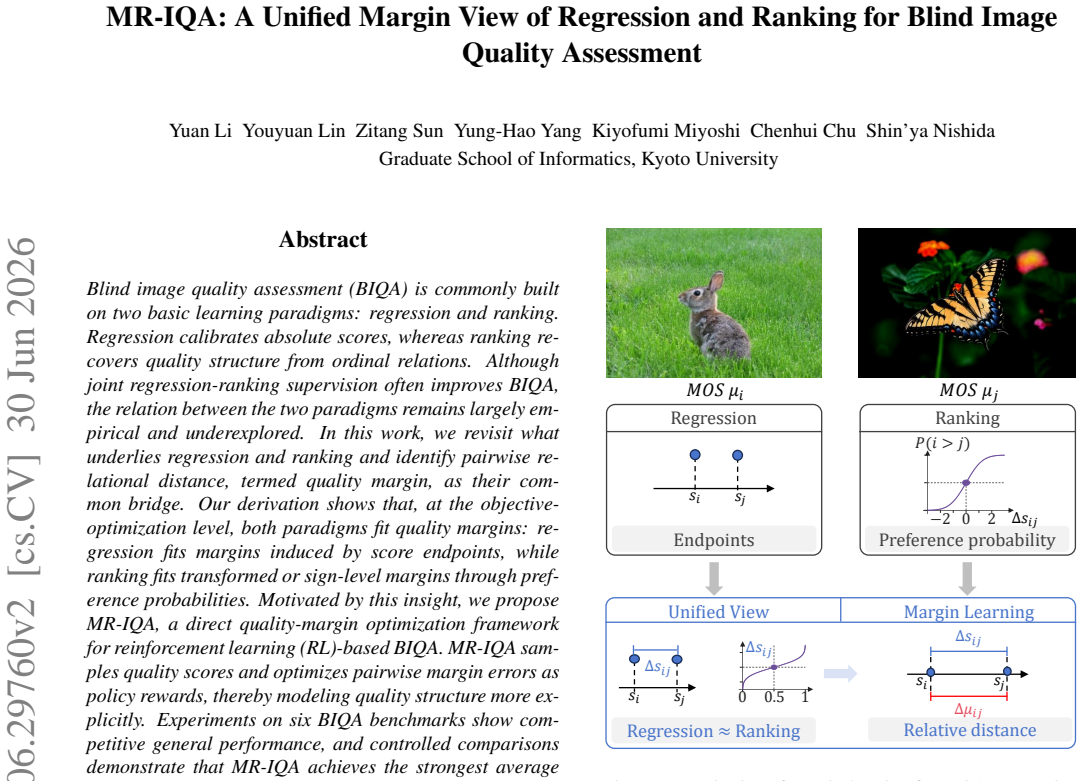
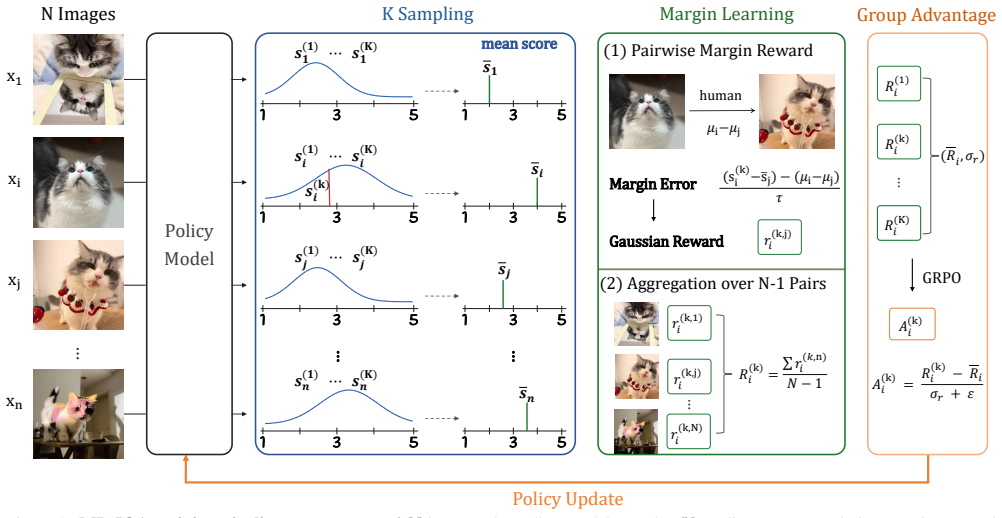
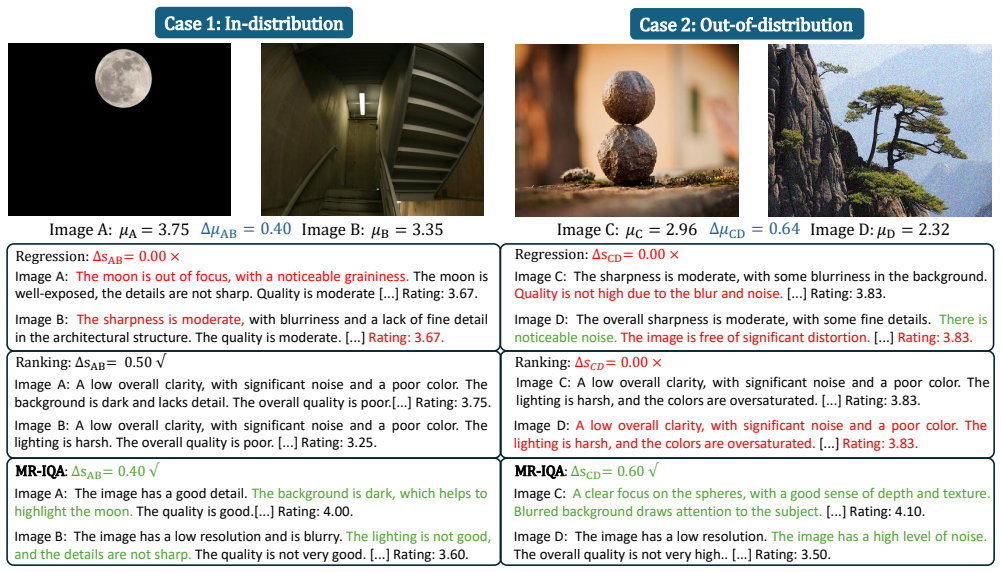
At the objective-optimization level, both regression and ranking paradigms fit quality margins: regression fits margins induced by score endpoints, while ranking fits transformed or sign-level margins through preference probabilities. Motivated by this insight, MR-IQA samples quality scores and optimizes pairwise margin errors as policy rewards, thereby modeling quality structure more explicitly and achieving the strongest average PLCC/SRCC over regression- or ranking-based RL methods on six BIQA benchmarks.
Load-bearing premise
The assumption that pairwise relational distance serves as the common bridge between regression and ranking at the objective-optimization level.
Editorial extensions
If this is right
- Direct margin optimization produces competitive general performance across six BIQA benchmarks.
- MR-IQA achieves the strongest average PLCC/SRCC among RL-based methods that use either regression or ranking.
- The margin view supplies a theoretical basis for quality-structure modeling that can replace empirical joint supervision.
- Sampling quality scores and treating margin errors as rewards models ordinal relations more explicitly than separate regression or ranking losses.
Reading between the lines
- The same margin-bridge argument might apply to other domains that combine absolute regression with ordinal ranking, such as preference learning or recommendation.
- Explicit margin optimization could simplify loss design in any setting where regression and ranking are combined empirically.
- Controlled tests on non-image ordinal tasks would reveal whether the unification holds outside BIQA.
Signed reviews
Editorial analysis
A structured set of objections, weighed in public.
Referee Report
Summary. The paper claims that regression and ranking in blind image quality assessment (BIQA) share a common objective-level structure through 'quality margins' (pairwise relational distances). It derives that regression fits margins induced by score endpoints while ranking fits transformed or sign-level margins via preference probabilities. This unification motivates MR-IQA, an RL-based framework that samples quality scores and optimizes pairwise margin errors as policy rewards. Experiments on six BIQA benchmarks report competitive PLCC/SRCC performance, with controlled comparisons showing superiority over regression- or ranking-based RL baselines. Code is released.
Significance. If the derivation is rigorous, the work supplies a theoretical lens for relating two dominant BIQA paradigms and a practical margin-optimization method. Reproducibility is strengthened by public code and multi-benchmark evaluation. The result could inform hybrid supervision strategies beyond the reported RL setting.
major comments (2)
- [§3] §3 (derivation of the common bridge): The central claim equates both paradigms to quality-margin fitting at the objective level. The algebraic reduction from standard regression loss to endpoint-induced margins and from ranking loss to sign-level margins must be shown explicitly (including any independence or transformation assumptions) so readers can verify absence of loss-of-generality or re-labeling; without these steps the unification remains difficult to assess as load-bearing.
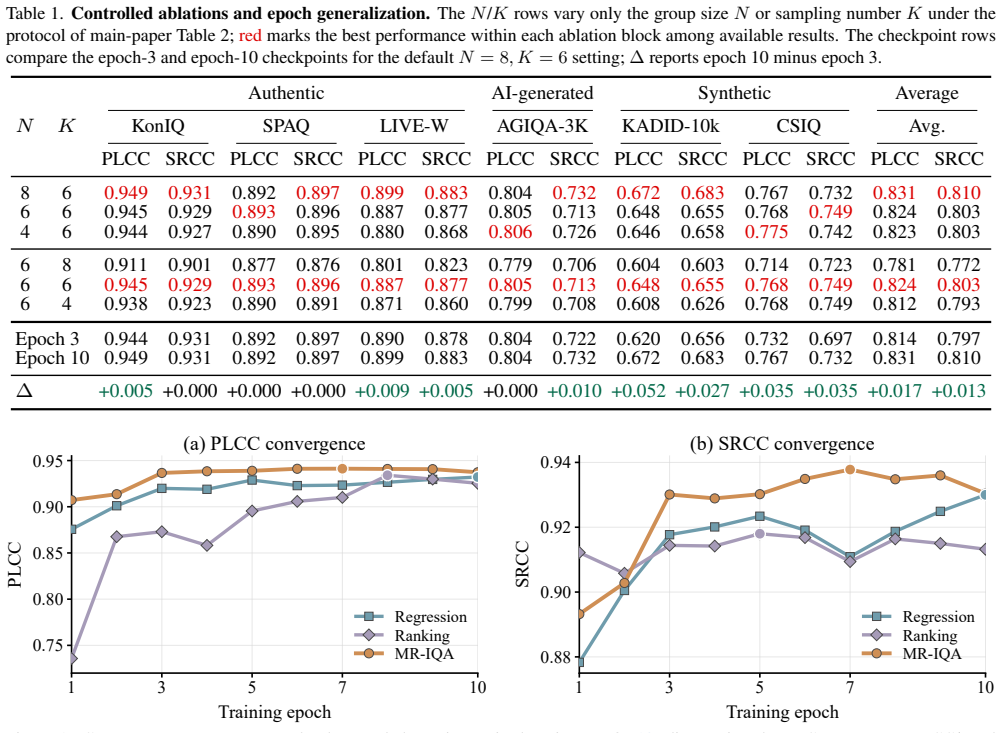
- [§4.2] §4.2 (controlled comparisons): The claim that MR-IQA achieves the strongest average PLCC/SRCC over regression- or ranking-based RL methods requires the exact baseline implementations, shared RL components (policy network, reward scaling, sampling strategy), and hyper-parameter budgets to be identical; any mismatch would undermine the attribution of gains to the margin formulation.
minor comments (2)
- [Abstract, §2] Abstract and §2: The term 'quality margin' is used before its formal definition; an early inline gloss would improve accessibility for readers unfamiliar with the margin view.
- [Tables 1-6] Table 1–6: Reporting only mean PLCC/SRCC without standard deviations across runs or statistical tests leaves the significance of reported improvements unclear.
Simulated Author's Rebuttal
We thank the referee for the constructive feedback. We address each major comment below and will revise the manuscript to improve clarity where needed.
read point-by-point responses
-
Referee: [§3] §3 (derivation of the common bridge): The central claim equates both paradigms to quality-margin fitting at the objective level. The algebraic reduction from standard regression loss to endpoint-induced margins and from ranking loss to sign-level margins must be shown explicitly (including any independence or transformation assumptions) so readers can verify absence of loss-of-generality or re-labeling; without these steps the unification remains difficult to assess as load-bearing.
Authors: We agree that expanding the algebraic steps will strengthen verifiability. In the revision we will insert the complete derivations in §3, showing the reductions from standard regression and ranking losses to the endpoint-induced and sign-level margin forms, with all independence and transformation assumptions stated explicitly. This addition will allow direct verification that the unification holds without loss of generality. revision: yes
-
Referee: [§4.2] §4.2 (controlled comparisons): The claim that MR-IQA achieves the strongest average PLCC/SRCC over regression- or ranking-based RL methods requires the exact baseline implementations, shared RL components (policy network, reward scaling, sampling strategy), and hyper-parameter budgets to be identical; any mismatch would undermine the attribution of gains to the margin formulation.
Authors: The experiments in §4.2 used identical policy networks, reward scaling, sampling strategies, and hyper-parameter budgets for all RL variants; the sole difference was the reward formulation. We will add an explicit statement of these shared components plus implementation pseudocode to §4.2 and the supplement to make the controlled nature of the comparison fully transparent. revision: partial
Circularity Check
No circularity: derivation presented as independent analytical insight
full rationale
The abstract claims a derivation that both regression and ranking optimize quality margins (regression via score-endpoint margins, ranking via preference-probability margins), with pairwise relational distance as the bridge. No equations, self-citations, or fitted-parameter renamings are visible in the provided text. The central unification is offered as a first-principles observation motivating the new MR-IQA framework, followed by external benchmark experiments. No load-bearing step reduces by construction to its own inputs, and no self-citation chain or ansatz smuggling is exhibited. The derivation is therefore treated as self-contained against external validation.
Assumptions & free parameters
Cite this review
Pith. "Pith review of MR-IQA: A Unified Margin View of Regression and Ranking for Blind Image Quality Assessment." pith.science (2026). https://pith.science/paper/BQRRLJN7
@misc{pith2026260629760,
  author       = {Pith},
  title        = {Pith review of: MR-IQA: A Unified Margin View of Regression and Ranking for Blind Image Quality Assessment},
  year         = {2026},
  howpublished = {\url{https://pith.science/paper/BQRRLJN7}},
  note         = {Machine review of arXiv:2606.29760}
}
read the original abstract
Blind image quality assessment (BIQA) is commonly built on two basic learning paradigms: regression and ranking. Regression calibrates absolute scores, whereas ranking recovers quality structure from ordinal relations. Although joint regression-ranking supervision often improves BIQA, the relation between the two paradigms remains largely empirical and underexplored. In this work, we revisit what underlies regression and ranking and identify pairwise relational distance, termed quality margin, as their common bridge. Our derivation shows that, at the objective-optimization level, both paradigms fit quality margins: regression fits margins induced by score endpoints, while ranking fits transformed or sign-level margins through preference probabilities. Motivated by this insight, we propose MR-IQA, a direct quality-margin optimization framework for reinforcement learning (RL)-based BIQA. MR-IQA samples quality scores and optimizes pairwise margin errors as policy rewards, thereby modeling quality structure more explicitly. Experiments on six BIQA benchmarks show competitive general performance, and controlled comparisons demonstrate that MR-IQA achieves the strongest average PLCC/SRCC over regression- or ranking-based RL methods. Our findings provide a new insight into unifying regression and ranking, offering a theoretical basis for understanding quality-structure modeling in BIQA and beyond. Code is available at https://github.com/RobinY99/MR-IQA.
Figures
Figures from the paper (3 more)
Reference graph
Works this paper leans on
-
[1]
Arniqa: Learning distortion mani- fold for image quality assessment
Lorenzo Agnolucci, Leonardo Galteri, Marco Bertini, and Alberto Del Bimbo. Arniqa: Learning distortion mani- fold for image quality assessment. InProceedings of the IEEE/CVF Winter Conference on Applications of Computer Vision, pages 189–198, 2024
work page 2024
-
[2]
Shuai Bai, Yuxuan Cai, Ruizhe Chen, Keqin Chen, Xionghui Chen, Zesen Cheng, Lianghao Deng, Wei Ding, Chang Gao, Chunjiang Ge, et al. Qwen3-vl technical report.arXiv preprint arXiv:2511.21631, 2025
work page Pith review arXiv 2025
-
[3]
Qwen2.5-vl technical report, 2025
Shuai Bai, Keqin Chen, Xuejing Liu, Jialin Wang, Wenbin Ge, Sibo Song, Kai Dang, Peng Wang, Shijie Wang, Jun Tang, Humen Zhong, Yuanzhi Zhu, Mingkun Yang, Zhao- hai Li, Jianqiang Wan, Pengfei Wang, Wei Ding, Zheren Fu, Yiheng Xu, Jiabo Ye, Xi Zhang, Tianbao Xie, Zesen Cheng, Hang Zhang, Zhibo Yang, Haiyang Xu, and Junyang Lin. Qwen2.5-vl technical report, 2025
work page 2025
-
[4]
Simone Bianco, Luigi Celona, Paolo Napoletano, and Rai- mondo Schettini. On the use of deep learning for blind image quality assessment.Signal, Image and Video Processing, 12 (2):355–362, 2018
work page 2018
-
[5]
Q-ponder: A unified train- ing pipeline for reasoning-based visual quality assessment
Zhuoxuan Cai, Jian Zhang, Xinbin Yuan, Peng-Tao Jiang, Wenxiang Chen, Bowen Tang, Lujian Yao, Qiyuan Wang, Jinwen Chen, and Bo Li. Q-ponder: A unified train- ing pipeline for reasoning-based visual quality assessment. arXiv preprint arXiv:2506.05384, 2025
-
[6]
Pair- wise comparisons are all you need.arXiv preprint arXiv:2403.09746, 2024
Nicolas Chahine, Sira Ferradans, and Jean Ponce. Pair- wise comparisons are all you need.arXiv preprint arXiv:2403.09746, 2024
-
[7]
An Image is Worth 16x16 Words: Transformers for Image Recognition at Scale
Alexey Dosovitskiy, Lucas Beyer, Alexander Kolesnikov, Dirk Weissenborn, Xiaohua Zhai, Thomas Unterthiner, Mostafa Dehghani, Matthias Minderer, Georg Heigold, Syl- vain Gelly, et al. An image is worth 16x16 words: Trans- formers for image recognition at scale.arXiv preprint arXiv:2010.11929, 2020
work page Pith review arXiv 2010
-
[8]
Perceptual quality assessment of smartphone pho- tography
Yuming Fang, Hanwei Zhu, Yan Zeng, Kede Ma, and Zhou Wang. Perceptual quality assessment of smartphone pho- tography. InProceedings of the IEEE/CVF conference on computer vision and pattern recognition, pages 3677–3686, 2020
work page 2020
Show all 41 references
-
[9]
Learn- ing to rank for blind image quality assessment.IEEE trans- actions on neural networks and learning systems, 26(10): 2275–2290, 2015
Fei Gao, Dacheng Tao, Xinbo Gao, and Xuelong Li. Learn- ing to rank for blind image quality assessment.IEEE trans- actions on neural networks and learning systems, 26(10): 2275–2290, 2015
2015
-
[10]
Live in the wild image quality challenge database.Online: http://live
Deepti Ghadiyaram and Alan C Bovik. Live in the wild image quality challenge database.Online: http://live. ece. utexas. edu/research/ChallengeDB/index. html [Mar, 2017], 2(5):6, 2015
2017
-
[11]
No-reference image quality assessment via transformers, rel- ative ranking, and self-consistency
S Alireza Golestaneh, Saba Dadsetan, and Kris M Kitani. No-reference image quality assessment via transformers, rel- ative ranking, and self-consistency. InProceedings of the IEEE/CVF winter conference on applications of computer vision, pages 1220–1230, 2022
2022
-
[12]
No-reference image quality assessment with reinforcement recursive list-wise ranking
Jie Gu, Gaofeng Meng, Cheng Da, Shiming Xiang, and Chunhong Pan. No-reference image quality assessment with reinforcement recursive list-wise ranking. InProceedings of the AAAI conference on artificial intelligence, pages 8336– 8343, 2019
2019
-
[13]
Koniq-10k: An ecologically valid database for deep learning of blind image quality assessment.IEEE Transactions on Image Processing, 29:4041–4056, 2020
Vlad Hosu, Hanhe Lin, Tamas Sziranyi, and Dietmar Saupe. Koniq-10k: An ecologically valid database for deep learning of blind image quality assessment.IEEE Transactions on Image Processing, 29:4041–4056, 2020
2020
-
[14]
Convolu- tional neural networks for no-reference image quality assess- ment
Le Kang, Peng Ye, Yi Li, and David Doermann. Convolu- tional neural networks for no-reference image quality assess- ment. InProceedings of the IEEE conference on computer vision and pattern recognition, pages 1733–1740, 2014
2014
-
[15]
Musiq: Multi-scale image quality transformer
Junjie Ke, Qifei Wang, Yilin Wang, Peyman Milanfar, and Feng Yang. Musiq: Multi-scale image quality transformer. InProceedings of the IEEE/CVF international conference on computer vision, pages 5148–5157, 2021
2021
-
[16]
Most apparent dis- tortion: full-reference image quality assessment and the role of strategy.Journal of electronic imaging, 19(1):011006– 011006, 2010
Eric C Larson and Damon M Chandler. Most apparent dis- tortion: full-reference image quality assessment and the role of strategy.Journal of electronic imaging, 19(1):011006– 011006, 2010
2010
-
[17]
Agiqa-3k: An open database for ai-generated image quality assessment.IEEE Transactions on Circuits and Sys- tems for Video Technology, 34(8):6833–6846, 2023
Chunyi Li, Zicheng Zhang, Haoning Wu, Wei Sun, Xiongkuo Min, Xiaohong Liu, Guangtao Zhai, and Weisi Lin. Agiqa-3k: An open database for ai-generated image quality assessment.IEEE Transactions on Circuits and Sys- tems for Video Technology, 34(8):6833–6846, 2023
2023
-
[18]
Q-insight: Understanding image qual- ity via visual reinforcement learning.Advances in Neural Information Processing Systems, 38:36802–36827, 2026
Weiqi Li, Xuanyu Zhang, Shijie Zhao, Yabin Zhang, Junlin Li, Jian Zhang, et al. Q-insight: Understanding image qual- ity via visual reinforcement learning.Advances in Neural Information Processing Systems, 38:36802–36827, 2026
2026
-
[19]
Guiding perception-reasoning closer to human in blind image quality assessment.arXiv preprint arXiv:2512.16484, 2025
Yuan Li, Yahan Yu, Youyuan Lin, Yong-Hao Yang, Chen- hui Chu, and Shin’ya Nishida. Guiding perception-reasoning closer to human in blind image quality assessment.arXiv preprint arXiv:2512.16484, 2025
2025
-
[20]
Zoom-iqa: Image quality assessment with reliable region-aware reasoning.arXiv preprint arXiv:2601.02918, 2026
Guoqiang Liang, Jianyi Wang, Zhonghua Wu, and Shangchen Zhou. Zoom-iqa: Image quality assessment with reliable region-aware reasoning.arXiv preprint arXiv:2601.02918, 2026
2026
-
[21]
Kadid-10k: A large-scale artificially distorted iqa database
Hanhe Lin, Vlad Hosu, and Dietmar Saupe. Kadid-10k: A large-scale artificially distorted iqa database. In2019 Eleventh International Conference on Quality of Multimedia Experience (QoMEX), pages 1–3. IEEE, 2019
2019
-
[22]
Rankiqa: Learning from rankings for no-reference image quality assessment
Xialei Liu, Joost Van De Weijer, and Andrew D Bagdanov. Rankiqa: Learning from rankings for no-reference image quality assessment. InProceedings of the IEEE international conference on computer vision, pages 1040–1049, 2017
2017
-
[23]
Decoupled weight decay regularization.arXiv preprint arXiv:1711.05101, 2017
Ilya Loshchilov and Frank Hutter. Decoupled weight decay regularization.arXiv preprint arXiv:1711.05101, 2017
2017 arXiv
-
[24]
dipiq: Blind image quality assessment by learning-to-rank discriminable image pairs.IEEE Transac- tions on image processing, 26(8):3951–3964, 2017
Kede Ma, Wentao Liu, Tongliang Liu, Zhou Wang, and Dacheng Tao. dipiq: Blind image quality assessment by learning-to-rank discriminable image pairs.IEEE Transac- tions on image processing, 26(8):3951–3964, 2017
2017
-
[25]
No-reference image quality assessment in the spatial domain.IEEE Transactions on image processing, 21(12): 4695–4708, 2012
Anish Mittal, Anush Krishna Moorthy, and Alan Conrad Bovik. No-reference image quality assessment in the spatial domain.IEEE Transactions on image processing, 21(12): 4695–4708, 2012
2012
-
[26]
completely blind
Anish Mittal, Rajiv Soundararajan, and Alan C Bovik. Mak- ing a “completely blind” image quality analyzer.IEEE Sig- nal processing letters, 20(3):209–212, 2012. 9
2012
-
[27]
Controllable list-wise ranking for univer- sal no-reference image quality assessment.arXiv preprint arXiv:1911.10566, 2019
Fu-Zhao Ou, Yuan-Gen Wang, Jin Li, Guopu Zhu, and Sam Kwong. Controllable list-wise ranking for univer- sal no-reference image quality assessment.arXiv preprint arXiv:1911.10566, 2019
1911
-
[28]
Deepseekmath: Pushing the limits of math- ematical reasoning in open language models.arXiv preprint arXiv:2402.03300, 2024
Zhihong Shao, Peiyi Wang, Qihao Zhu, Runxin Xu, Junxiao Song, Xiao Bi, Haowei Zhang, Mingchuan Zhang, YK Li, Yang Wu, et al. Deepseekmath: Pushing the limits of math- ematical reasoning in open language models.arXiv preprint arXiv:2402.03300, 2024
2024 arXiv
-
[29]
Nima: Neural image assessment.IEEE transactions on image processing, 27(8): 3998–4011, 2018
Hossein Talebi and Peyman Milanfar. Nima: Neural image assessment.IEEE transactions on image processing, 27(8): 3998–4011, 2018
2018
-
[30]
Rank-smoothed pairwise learning in per- ceptual quality assessment
Hossein Talebi, Ehsan Amid, Peyman Milanfar, and Man- fred K Warmuth. Rank-smoothed pairwise learning in per- ceptual quality assessment. In2020 IEEE International Conference on Image Processing (ICIP), pages 3413–3417. IEEE, 2020
2020
-
[31]
A law of comparative judgment.Psy- chological review, 101(2):266, 1994
Louis L Thurstone. A law of comparative judgment.Psy- chological review, 101(2):266, 1994
1994
-
[32]
Ex- ploring clip for assessing the look and feel of images
Jianyi Wang, Kelvin CK Chan, and Chen Change Loy. Ex- ploring clip for assessing the look and feel of images. InPro- ceedings of the AAAI conference on artificial intelligence, pages 2555–2563, 2023
2023
-
[33]
Q-align: Teaching lmms for visual scoring via discrete text-defined levels.arXiv preprint arXiv:2312.17090, 2023
Haoning Wu, Zicheng Zhang, Weixia Zhang, Chaofeng Chen, Chunyi Li, Liang Liao, Annan Wang, Erli Zhang, Wenxiu Sun, Qiong Yan, Xiongkuo Min, Guangtao Zhai, and Weisi Lin. Q-align: Teaching lmms for visual scoring via discrete text-defined levels.arXiv preprint arXiv:2312.17090,...
2023 arXiv
-
[34]
Q-instruct: Improving low-level visual abilities for multi-modality foundation models
Haoning Wu, Zicheng Zhang, Erli Zhang, Chaofeng Chen, Liang Liao, Annan Wang, Kaixin Xu, Chunyi Li, Jingwen Hou, Guangtao Zhai, et al. Q-instruct: Improving low-level visual abilities for multi-modality foundation models. In Proceedings of the IEEE/CVF conference on computer v...
2024
-
[35]
Visualquality-r1: Reasoning-induced image quality assess- ment via reinforcement learning to rank.Advances in Neural Information Processing Systems, 38:88167–88190, 2026
Tianhe Wu, Jian Zou, Jie Liang, Lei Zhang, and Kede Ma. Visualquality-r1: Reasoning-induced image quality assess- ment via reinforcement learning to rank.Advances in Neural Information Processing Systems, 38:88167–88190, 2026
2026
-
[36]
Maniqa: Multi-dimension attention network for no-reference image quality assessment
Sidi Yang, Tianhe Wu, Shuwei Shi, Shanshan Lao, Yuan Gong, Mingdeng Cao, Jiahao Wang, and Yujiu Yang. Maniqa: Multi-dimension attention network for no-reference image quality assessment. InProceedings of the IEEE/CVF conference on computer vision and pattern recognition, pages...
2022
-
[37]
Depicting beyond scores: Advanc- ing image quality assessment through multi-modal language models
Zhiyuan You, Zheyuan Li, Jinjin Gu, Zhenfei Yin, Tianfan Xue, and Chao Dong. Depicting beyond scores: Advanc- ing image quality assessment through multi-modal language models. InEuropean Conference on Computer Vision, pages 259–276. Springer, 2024
2024
-
[38]
Teaching large language models to regress accurate image quality scores using score distribution
Zhiyuan You, Xin Cai, Jinjin Gu, Tianfan Xue, and Chao Dong. Teaching large language models to regress accurate image quality scores using score distribution. InProceedings of the Computer Vision and Pattern Recognition Conference, pages 14483–14494, 2025
2025
-
[39]
Blind image quality assessment using a deep bilinear convolutional neural network.IEEE Transactions on Cir- cuits and Systems for Video Technology, 30(1):36–47, 2018
Weixia Zhang, Kede Ma, Jia Yan, Dexiang Deng, and Zhou Wang. Blind image quality assessment using a deep bilinear convolutional neural network.IEEE Transactions on Cir- cuits and Systems for Video Technology, 30(1):36–47, 2018
2018
-
[40]
Reasoning as representation: Rethinking visual reinforcement learning in image quality assessment.arXiv preprint arXiv:2510.11369, 2025
Shijie Zhao, Xuanyu Zhang, Weiqi Li, Junlin Li, Li Zhang, Tianfan Xue, and Jian Zhang. Reasoning as representation: Rethinking visual reinforcement learning in image quality assessment.arXiv preprint arXiv:2510.11369, 2025
2025
-
[41]
Thurstone- style
Hanwei Zhu, Haoning Wu, Yixuan Li, Zicheng Zhang, Bao- liang Chen, Lingyu Zhu, Yuming Fang, Guangtao Zhai, Weisi Lin, and Shiqi Wang. Adaptive image quality as- sessment via teaching large multimodal model to compare. Advances in Neural Information Processing Systems, 37: 3261...
2024
Reviewed July 1, 2026 · model on record in the stance chip above.
Discussion (0). Continue with ORCID to comment.