REVIEW 3 major objections 5 minor 32 references
Exact hopping and collision times for two hard discs in a box
T0 review · 3 major / 5 minor · reviewed 2026-08-14 · deepseek-v4-flash
Pith's one-line read This paper derives exact, analytical mean times for hops, wall collisions, and disc–disc collisions between two hard discs in a box, using a billiard description and an ergodic return-time formula.
desk verdict Solid idea, sound method, but the hopping-time formula is internally inconsistent and the paper needs a careful proofread before its exact expressions can be trusted. read the letter →
The pith
A machine-rendered reading of the paper's core claim, the machinery that carries it, and where it could break.
The reading
What carries the argument
The load-bearing identity is the ergodic mean-return-time formula $\langle\tau\rangle = \frac{|\mathcal{Q}|}{|\mathcal{A}|}\frac{|\mathbb{S}^{d-1}|}{|\mathbb{B}^{d-1}|}\frac{1}{s}$, where $|\mathcal{Q}|$ is the volume of the billiard table, $|\mathcal{A}|$ is the $(d-1)$-dimensional area of the event surface, $|\mathbb{S}^{d-1}|/|\mathbb{B}^{d-1}|$ is the sphere-ball constant, and $s$ is the sidedness factor. To use it, the paper represents two discs as one point in a four-dimensional rectangle with a cylindrical hole, and represents each event—hop, disc collision, wall collision—as a codimension-one surface defined by an equation $g=0$. Surface areas are evaluated through the coarea formula as integrals of the form $\int 1_Z(x)\,\delta(g(x))\,dx$, with the correct $\|\nabla g\|$ normalization. The identity carries the entire argument because it converts all three dynamical waiting times into purely geometric quantities: volumes and areas that can be computed by quadrature and checked by Monte Carlo sampling.
What would settle it
Run a long molecular-dynamics trajectory for a fixed box, say $w=1.5$, $h=1.0$, at several radii below $\min(w,h)/4$, and count every crossing of $x_1=x_2$ separately by direction and total. Compare the mean interval between all crossings with Eq. (26). A systematic multiplicative mismatch, or a left-to-right rate differing from the right-to-left rate, would show that the sidedness factor is not simply 2 or that the geometric volume/area calculation is incomplete; matching to statistical error would support the paper's claim.
Extended reading notes
Core claim
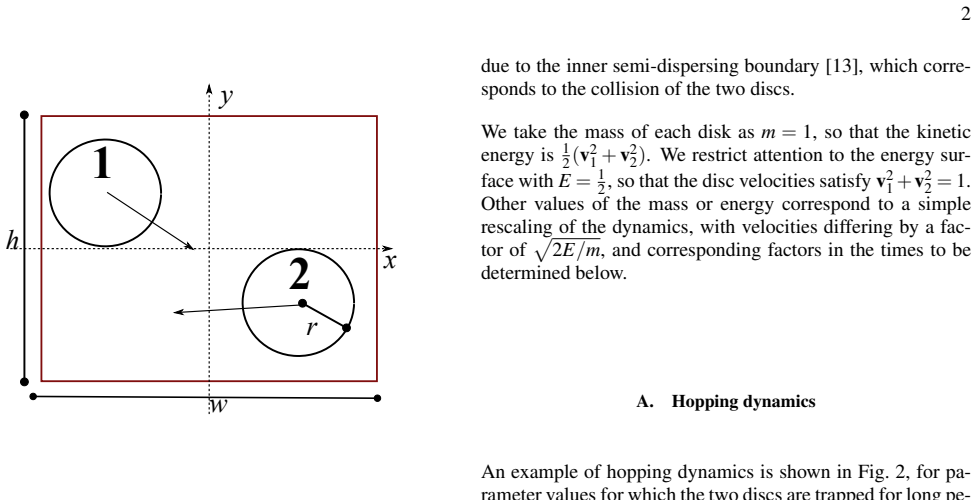
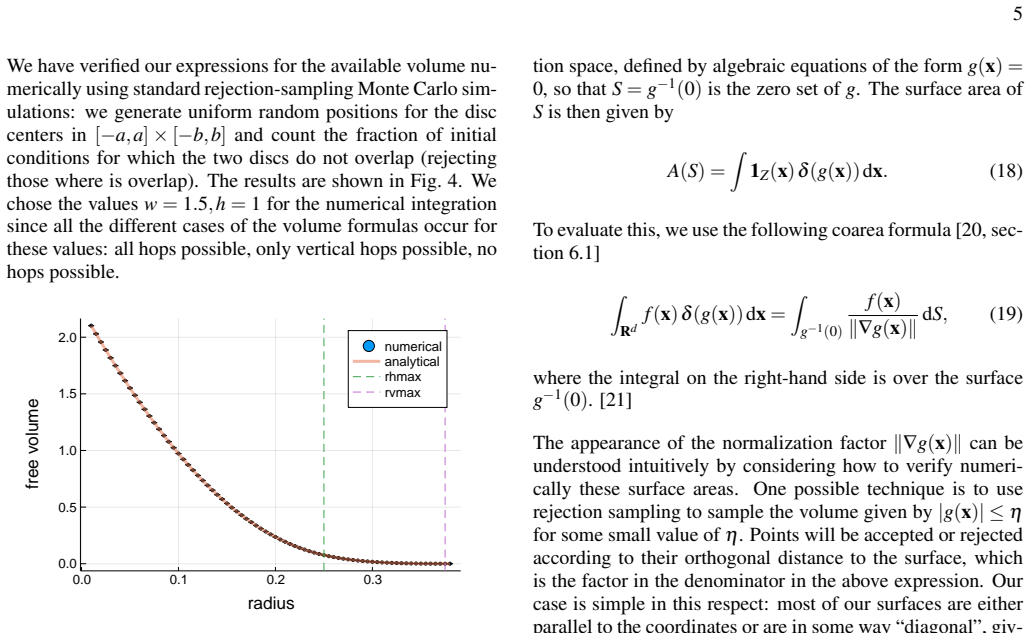
The paper's central claim is that the mean waiting times for the three basic events are exact closed-form functions of the geometric parameters. The configuration space of two equal discs is first mapped by an orthogonal change of coordinates to a four-dimensional rectangular prism of half-widths $a=\frac{w}{2}-r$ and $b=\frac{h}{2}-r$, with a diagonal excluded cylinder of radius $r\sqrt{2}$; the remaining volume is $V_{\mathrm{free}}$ (Eq. 14). Each event is a codimension-one surface inside that prism, and its three-dimensional area is computed as a delta-function integral with the coarea formula. Substituting $V_{\mathrm{free}}$ and the three areas into the ergodic mean-return-time formula (Eq. 2) yields the exact mean hopping time (Eq. 26), mean disc-collision time (Eq. 28), and mean wall-collision time (Eq. 30), valid when $r<\min(w/4,h/4)$ and in piecewise form when it is not. The hopping formula, for example, is $$\langle\tau_{\mathrm{hop}}\rangle = \frac{3\pi}{4\sqrt{2}}\,\frac{$2a^{2}$$b^{2}$-2\pi ab $r^{2}$+\frac{a+b}{3}(2r)^3-$r^{4}$}{b\sqrt{2}(a-r)^2},$$ with the $s=2$ sidedness factor included. Because the numerator appearing in all three formulas is $V_{\mathrm{free}}/8$, the relative rates of hopping, wall collision, and disc collision are determined by cross-sectional areas alone.
Load-bearing premise
The load-bearing premise is that a hop surface crossed from either side should count as having twice the area in the return-time formula, giving $s=2$; the paper states this factor rather than deriving it, and every hopping-time formula inherits it.
Editorial extensions
If this is right
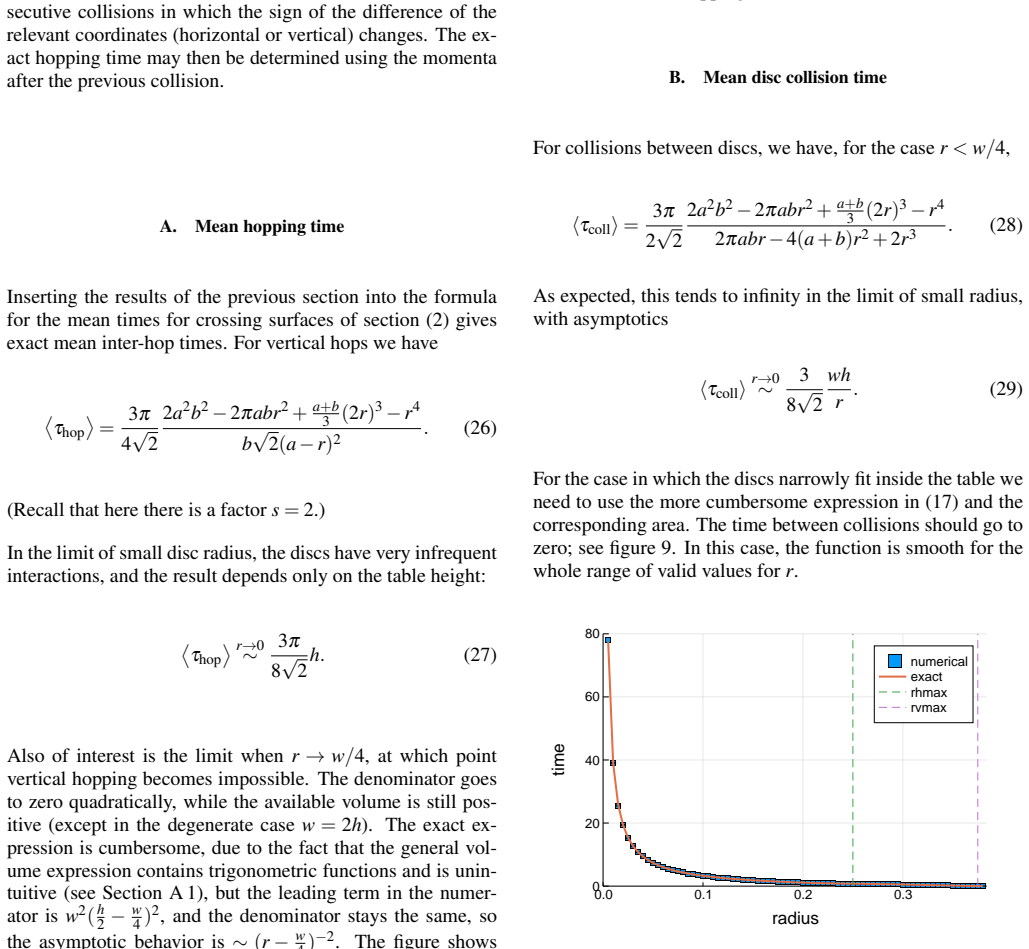
- As the radius approaches the value at which one direction of passing is blocked, the exact hopping time diverges as $(r-w/4)^{-2}$, giving a sharp power-law precursor to the loss of hopping.
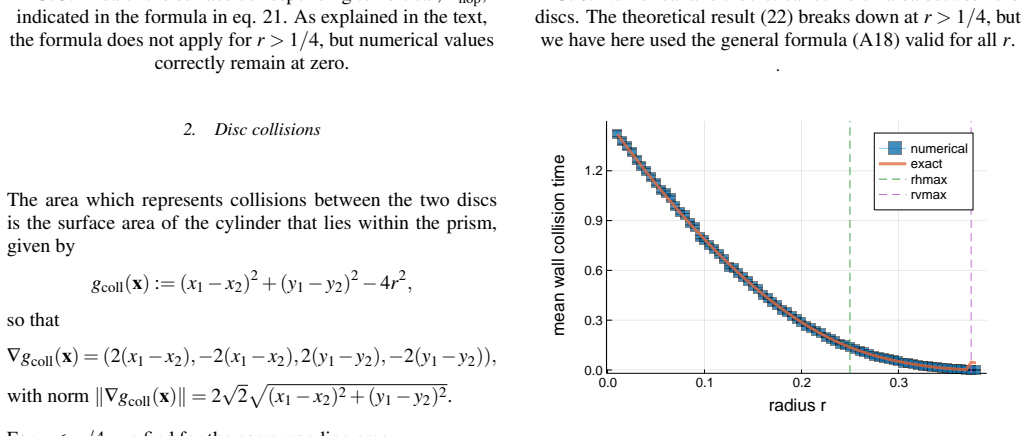
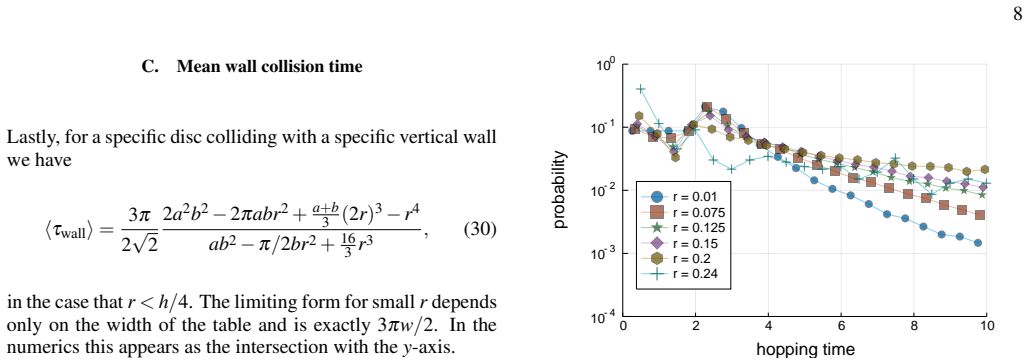
- In the point-particle limit, the mean time between collisions with a given vertical wall tends to $3\pi w/2$, the mean disc-collision time diverges as $\frac{3wh}{8\sqrt{2}\,r}$, and the mean vertical-hoping time tends to $\frac{3\pi}{8\sqrt{2}}h$.
- The formulas reproduce the asymptotic power-law exponents obtained earlier from transition-state reasoning, upgrading those scaling estimates to exact coefficients.
- Since the three mean times share one volume numerator, ratios such as $\langle\tau_{\mathrm{hop}}\rangle/\langle\tau_{\mathrm{coll}}\rangle$ depend only on surface areas, so relative event rates in simulations can be used as direct probes of the computed cross-section areas.
Reading between the lines
- If the mean-return-time theorem is the only dynamical input, the same volume/area ratio should also control the mean time to other codimension-one events in the same billiard, such as passages through a narrow window in a partition; the formulas here are the cleanest test case.
- The exact expressions should extend to unequal disc radii and to two discs in a channel with periodic boundary conditions, at the price of clumsier algebra, because neither the billiard mapping nor the return-time theorem depends on equal radii.
- The observed exponential tail suggests a stronger conjecture: for ergodic billiards of this type the full hopping-time distribution may be fixed by its exact mean, so these closed forms would supply the rate constant in effective one-dimensional models of confined fluids.
Signed reviews
Editorial analysis
A structured set of objections, weighed in public.
Referee Report
Summary. This paper treats two equal hard discs moving inertially in a rectangular box and maps their dynamics to a four-dimensional billiard. Using Chernov's mean-return-time formula (Eq. 2), the authors compute the volume of the available configuration space and the cross-sectional areas of three types of events—particle interchange ("hop"), disc-disc collision, and wall collision—and obtain closed-form expressions for the corresponding mean inter-event times, Eqs. (26), (28), and (30). The analytical results are compared with Monte Carlo area/volume estimates and molecular-dynamics simulations, with reported excellent agreement, and small-radius asymptotics are compared with earlier transition-state results.
Significance. The approach is appropriate and the geometric calculations are mostly explicit and checkable, which is a strength: the paper derives, rather than fits, the collision-time formulas, and machine-readable code is promised. If the normalization inconsistencies described below are corrected, exact mean hopping and collision times for a prototypical confined hard-disc system would be a useful benchmark for statistical-mechanics approximations. However, as printed, the hopping-time formula is not uniquely determined by the derivation, and the numerical verification for hopping is compromised by an admitted common multiplicative error; the wall-time formula also appears inconsistent with its own limiting statement.
major comments (3)
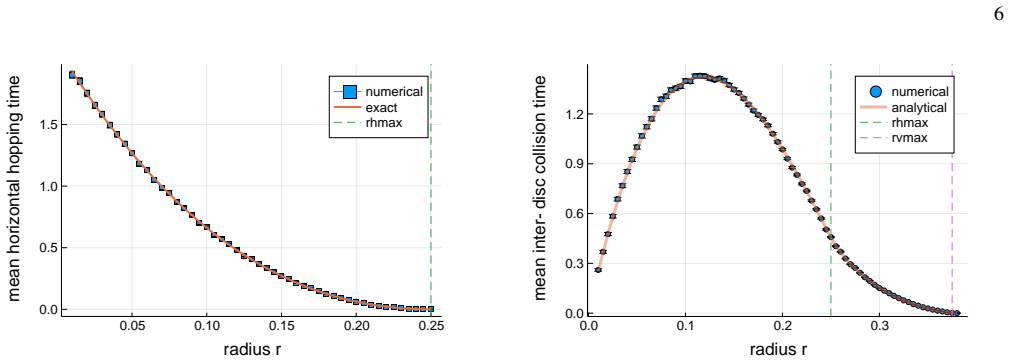
- [V.A / Eq. (26); IV.B.1 / Eq. (21); Appendix A / Eq. (A13)] The hopping surface area is printed with two different values, 16√2 b(a−r)^2 in Eq. (21) and 8√2 b(a−r)^2 in Eq. (A13). Using the Appendix value together with s=2 in Eq. (2) gives τ_hop = 3π/(4√2) · N/[b(a−r)^2], where N is the numerator shown in Eq. (26); the extra √2 in the denominator of Eq. (26) makes the printed result smaller by 1/√2, and using Eq. (21) gives yet another factor. The Fig. 14 caption states that 'both the numeric and the wrongly solved analytic formula have the same multiplicative mistake,' which means that the agreement shown in Fig. 8 does not, as it stands, validate Eq. (26). Please remove the normalization ambiguity, state whether A_hop is the geometric or the doubled effective area, and re-verify against independent numerics.
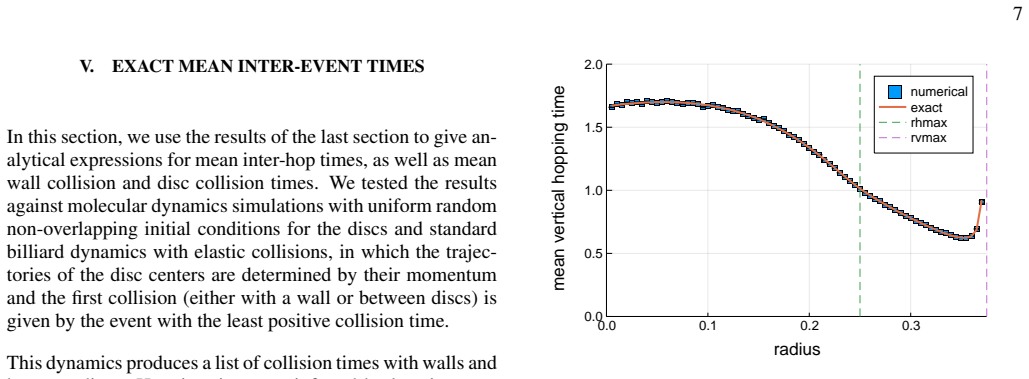
- [V.C / Eq. (30); IV.B.3 / Eq. (24)] The wall-collision time as printed does not follow from the stated area. For a specific disc with a specific wall, s=1, so Eq. (2) gives ⟨τ_wall⟩=(3π/2) V/A_wall. At small r this yields (3π/2)(16a^2b^2)/(8ab^2)=3πa=3πw/2, exactly the limit announced in the text. Equation (30) instead has prefactor 3π/(2√2) and denominator with small-r limit ab^2, which tends to 3πw/(2√2), and its r^3 coefficient does not match A_wall/8. Please correct the prefactor and denominator, or explain the different normalization.
- [III; IV.B.1] The sidedness factor s=2 for hop surfaces is asserted without derivation. Because the hopping surface is symmetric and its two sides correspond to the two directions of interchange, a factor of 2 in the flux is plausible, but the manuscript conflates this with the factor between Eq. (21) and Eq. (A13). Please derive the factor from the return-time theorem, or at least state a convention (geometric area vs crossed area) that makes Eq. (21), Eqs. (A8)–(A13), and Eq. (26) mutually consistent.
minor comments (5)
- [Eq. (16)] After substituting a=(w−2r)/2 and b=(h−2r)/2 into Eq. (14), the cubic term should be (32/3)(w+h−4r)r^3 and the last term should be −8r^4; the printed '−84' and the (w+h−2r) factor are typos.
- [Fig. 5 caption] The caption says 'mean horizontal hopping time' for what the text and Eq. (20) define as vertical hopping; please correct the caption.
- [Fig. 14 caption] The caption contains a typo 'analityc' and should say 'analytic'.
- [Introduction] The sentence 'interchange position, either vertically or horizontally, and; this plays' has a stray fragment and semicolon.
- [References] Reference [10] misspells 'Adsorption'; the reference list also has inconsistent formatting for Van Kampen.
Circularity Check
No significant circularity: the mean-event-time results follow from an external ergodic-theory formula plus independently computed configuration-space volumes and areas; internal prefactor inconsistencies are correctness issues, not circularity.
full rationale
The derivation chain is self-contained and not circular. The mean return times are obtained by inserting configuration-space volumes (Eq. 14) and cross-sectional areas (Eqs. 21, 22, 24) into Chernov's mean-return-time formula (Eq. 2), which is cited to Chernov's 1997 J. Stat. Phys. paper as an external theorem. No parameter is fitted to the Monte Carlo or molecular dynamics data; the simulations are used only as post-hoc checks. The volume expression agrees with Munakata and Hu, but it is also rederived in this paper, so the argument does not rest on that citation. The `s = 2` sidedness factor for hopping surfaces (Section III) is introduced by a geometric argument about the surface being hit from either side, not by fitting or by importing a conclusion from the paper's own target result; even if that argument is debatable, it is an input assumption, not a circular recycling of the output. The Fig. 14 caption admits that 'both the numeric and the wrongly solved analytic formula have the same multiplicative mistake' and that the error becomes evident only when plugged into the Machta-Zwanzig formula; this is a genuine validation weakness and an internal-consistency defect (e.g., Eq. (21) and Eq. (A13) differ by a factor of 2), but it does not make the derivation circular, because the final formulas are not used as inputs to themselves. Accordingly, no circular step is present and the score is 0.
Assumptions & free parameters
assumptions (4)
- domain assumption Chernov's mean return time formula (Eq. 2): ⟨τ⟩ = |Q|/|A| · |S^{d-1}|/|B^{d-1}| · 1/s
- domain assumption Ergodicity and hyperbolicity of the two-disc billiard when discs can pass each other (r < min(w/4,h/4)), and decomposition into ergodic components otherwise
- ad hoc to paper The sidedness factor s = 2 for hopping surfaces
- standard math Coarea formula (Eq. 19) for computing surface areas via Dirac delta
Cite this review
Pith. "Pith review of Exact hopping and collision times for two hard discs in a box." pith.science (2026). https://pith.science/paper/BQSOFZ4V
@misc{pith2026190804749,
  author       = {Pith},
  title        = {Pith review of: Exact hopping and collision times for two hard discs in a box},
  year         = {2026},
  howpublished = {\url{https://pith.science/paper/BQSOFZ4V}},
  note         = {Machine review of arXiv:1908.04749}
}
read the original abstract
We study the molecular dynamics of two discs undergoing Newtonian ("inertial") dynamics, with elastic collisions in a rectangular box. Using a mapping to a billiard model and a key result from ergodic theory, we obtain exact, analytical expressions for the mean times between the following events: hops, i.e.~horizontal or vertical interchanges of the particles; wall collisions; and disc collisions. To do so, we calculate volumes and cross-sectional areas in the four-dimensional configuration space. We compare the analytical results against Monte Carlo and molecular dynamics simulations, with excellent agreement.
Figures
Figures from the paper (11 more)
Reference graph
Works this paper leans on
-
[1]
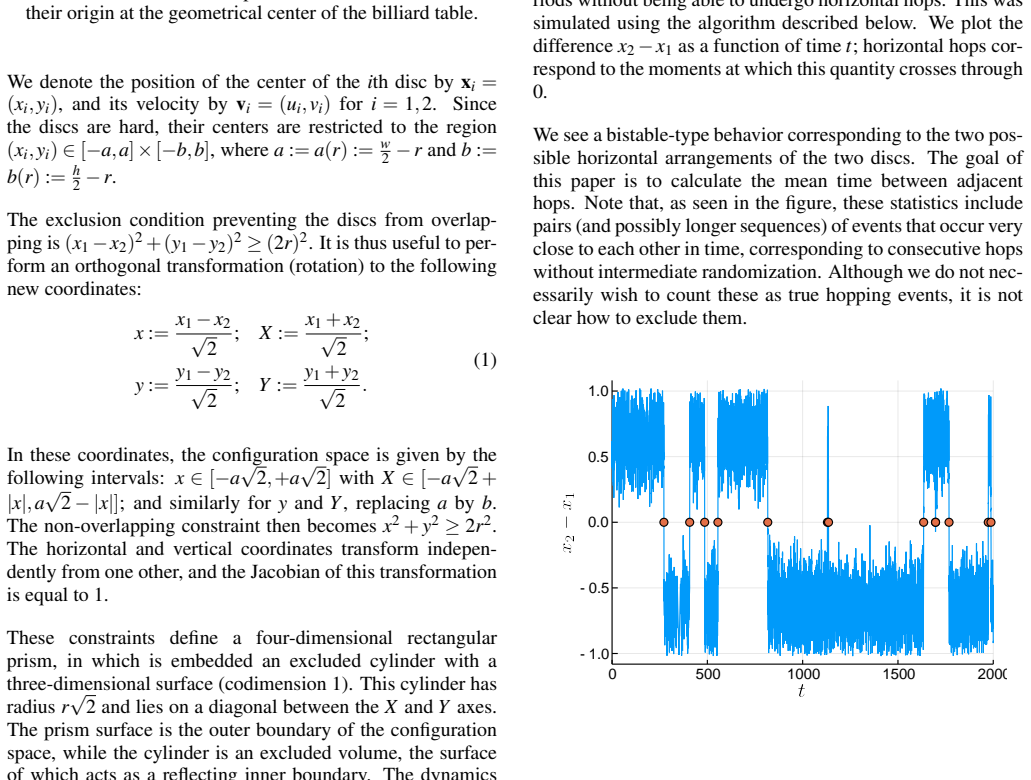
Hopping Vertical hopping occurs when the vertical positions of the two discs are equal: y1− y2 = 0. In the above for- mulation we define ghop(x1,x2,y1,y2) := y1− y2, so that ∇ghop(x) = (0,0,1,−1) and‖∇ghop(x)‖ = √
-
[2]
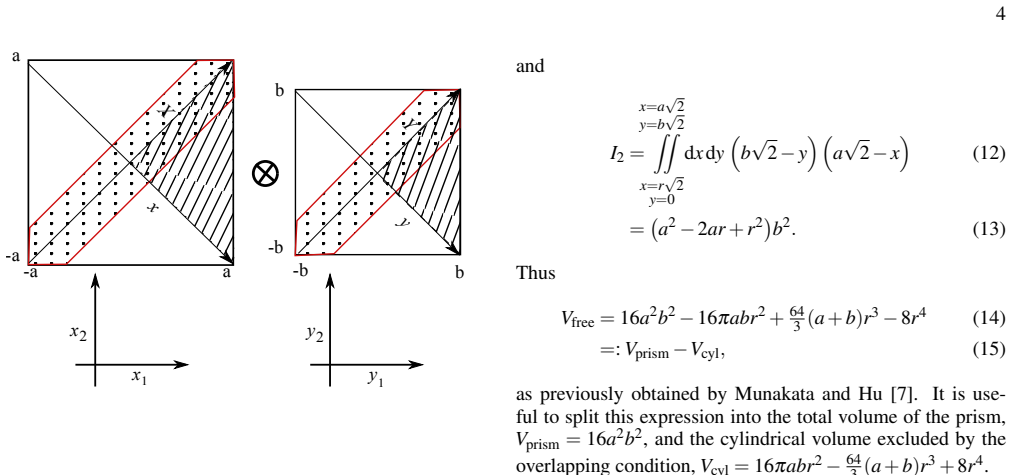
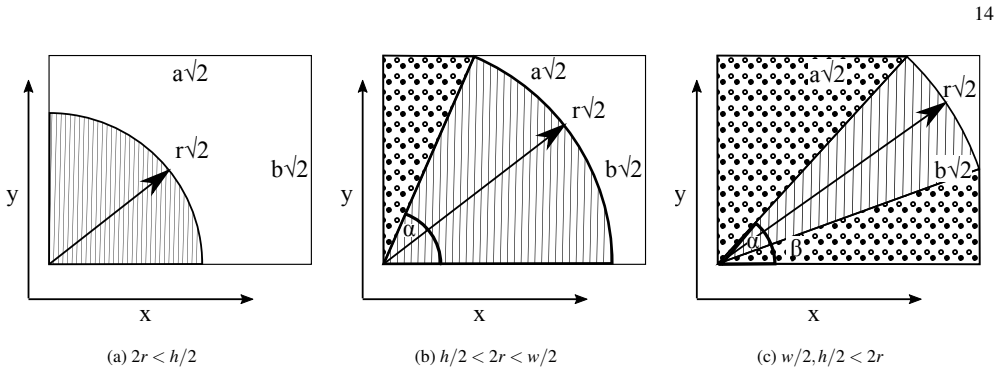
Due to symmetry, we evaluate the integral for X,Y,x,y > 0 (indicated with hatching in the figure), and multiply by 16. ing integrals are trivial, giving Vfree = x=a √ 2 y=b √ 2∫∫ x=−a √ 2 y=−b √ 2 dxdy2 ( a √ 2−| x| ) 2 ( b √ 2−| y| ) 1{x2+y2≥2r2} (8) = 16 x=a √ 2 y=b √ 2∫∫ x=0 y=0 dxdy ( a √ 2− x )( b √ 2− y ) 1{x2+y2≥2r2}, (9) where we have used the symm...
-
[3]
Alternatively, we can integrate directly in the (x,X,y,Y ) coordinates, where g(x,X,y,Y ) = y, and then return to the original coordinates. This results in the following expression: Ahop = x1,x2=a y1,y2=b∫∫∫∫ x1,x2=−a y1,y2=−b dx 1dx 2dy 1dy 2 1{(x1−x2)2+(y1−y2)2≥(2r)2} δ (y1− y2√ 2 ) . (20) Carrying out the integrals (see Appendix A) gives Ahop = 16 √ 2b...
-
[4]
For r < w/4, we find for the corresponding area Acoll = √ 2(16πabr− 32(a + b)r2 + 16r3)
Disc collisions The area which represents collisions between the two discs is the surface area of the cylinder that lies within the prism, given by gcoll(x) := (x1− x2)2 + (y1− y2)2− 4r2, so that ∇gcoll(x) = (2(x1−x2),−2(x1−x2),2(y1−y2),−2(y1−y2)), with norm‖∇gcoll(x)‖ = 2 √ 2 √ (x1− x2)2 + (y1− y2)2. For r < w/4, we find for the corresponding area Acoll =...
-
[5]
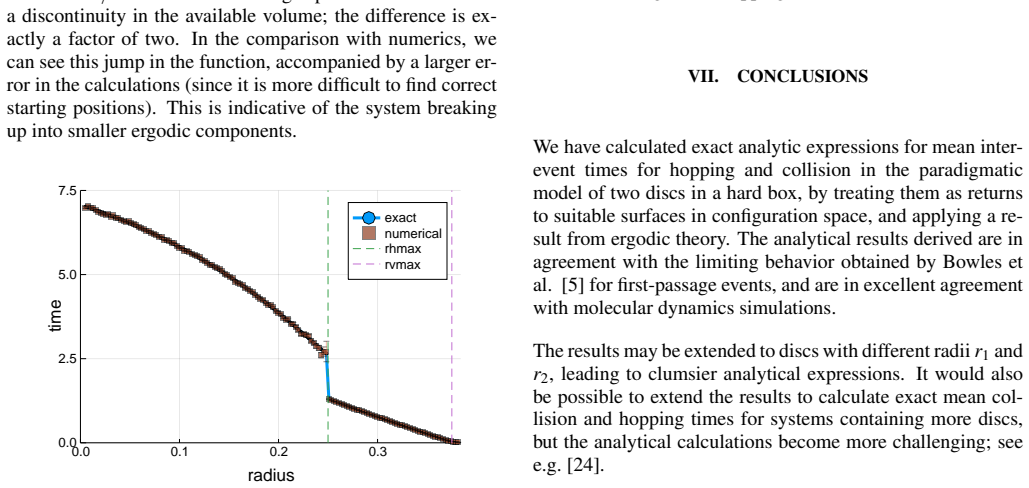
Wall collisions We restrict attention to collisions of disc 1 with the right wall, for which gwall(x) := x1− a. The corresponding area, after taking the delta function into account, is Awall = x2=a y1,y2=b∫∫∫ x2=−a y1,y2=−b dx 2dy 1dy 2 1{(a−x2)2+(y1−y2)2≥4r2} (23) 0.0 0.1 0.2 0.3 0.0 0.3 0.6 0.9 1.2 radius r mean inter-disc collision time numerical analy...
-
[6]
If w,h > 4r, then the limits of integration are unaffected by the radius of the circles
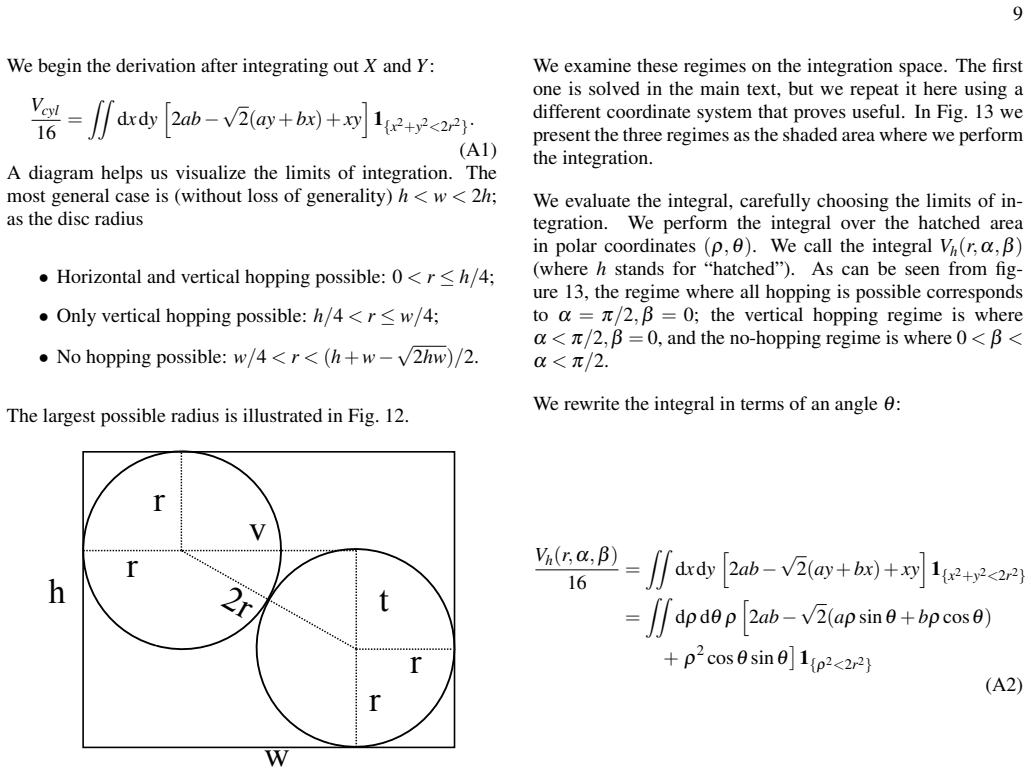
V olume An implicit assumption was made on the limits of integration in (7). If w,h > 4r, then the limits of integration are unaffected by the radius of the circles. In order to avoid the same positive term 16a2b2, in the formulas, we work here with the excluded volume Vcyl, instead of the available one Vfree. 9 We begin the derivation after integrating o...
-
[7]
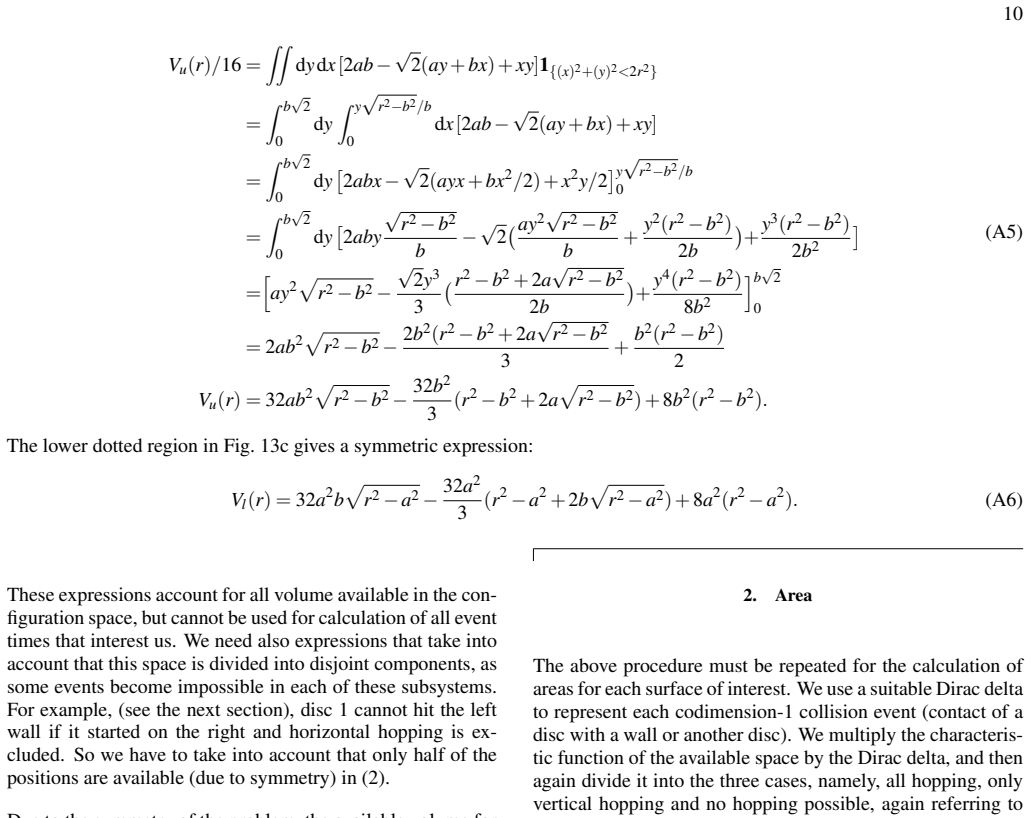
Area The above procedure must be repeated for the calculation of areas for each surface of interest. We use a suitable Dirac delta to represent each codimension-1 collision event (contact of a disc with a wall or another disc). We multiply the characteris- tic function of the available space by the Dirac delta, and then again divide it into the three case...
-
[8]
(A11) = [ 2abx− x2b√ 2 ]a √ 2 r √ 2 (A12) Ahopp = 8 √ 2b(a− r)2 (A13) 11 Note that in (A8) we do not use symmetry in y, due to the Dirac delta. b. Disc collisions For other cross-section areas we proceed in a similar manner. Disc collisions occur when √ x2 + y2 = r √ 2, giving Acol 16 = x=a √ 2,X=a √ 2−x y=b √ 2,Y =b √ 2−y∫∫∫∫ x,X,y,Y =0 dxdX dydY δ ( √ x...
Show all 32 references
-
[9]
Boltzmann, Sitz
L. Boltzmann, Sitz. der K. Akademie des Wissenschaften (1872)
-
[10]
R. C. Tolman, The Principles of Statistical Mechanics (Oxford University Press, 1938)
1938
-
[11]
VanKampen, Stochastic Processes in Physics and Chemistry (North Holland Personal Library, 2007)
2007
-
[12]
Szasz, ed., Hard Ball Systems and the Lorentz Gas , Enc
D. Szasz, ed., Hard Ball Systems and the Lorentz Gas , Enc. Math. Sci., V ol. 101 (Springer Verlag, 2000)
2000
-
[13]
Bowles, K
R. Bowles, K. Mon, and J. Percus, J. Chem. Phys. 121, 10668 (2004)
2004
-
[14]
Awazu, Phys
A. Awazu, Phys. Rev. E 63, 032102 (2001)
2001
-
[15]
Munakata and G
T. Munakata and G. Hu, Phys. Rev. E 65, 066104 (2002)
2002
-
[16]
S. Suh, J. Lee, H. Moon, and J. Macelroy, Adsorption 11, 373 (2005)
2005
-
[17]
S.-H. Suh, J. W. Lee, H. Moon, and J. MacElroy, Korean J. Chem. Eng 21, 504 (2004)
2004
-
[18]
S.-H. Suh, J. W. Lee, H. Moon, and J. MacElroy, Adsoption 11, 373 (2005)
2005
-
[19]
C. Ball, N. MacWilliam, J. Percus, and R. Bowles, J. Chem. Phys. 130, 054504 (2009)
2009
-
[20]
Uraganase and T
M. Uraganase and T. Munakata, Phys. Rev. E 67, 066101 (2006)
2006
-
[21]
Simanyi, Ergodic Theory and Dynamical Systems19 (1999)
N. Simanyi, Ergodic Theory and Dynamical Systems19 (1999)
1999
-
[22]
Chernov, J
N. Chernov, J. Stat. Phys. 88, 1 (1997)
1997
-
[23]
Bezanson, A
J. Bezanson, A. Edelman, S. Karpinski, and V . B. Shah, SIAM Review 59, 65 (2017)
2017
-
[24]
https://github.com/dpsanders/hopping_times
-
[25]
Y . G. Sinai, Russian Mathematical Surveys25, 137 (1970)
1970
-
[26]
Chernov and R
N. Chernov and R. Markarian, Chaotic Billiards (Amer. Math. Soc., 2006) and references therein
2006
-
[27]
Machta and R
J. Machta and R. Zwanzig, Phys. Rev. Lett. 50, 1959 (1983)
1983
-
[28]
H ¨ormander, The Analysis of Linear Partial Differential Op- erators I (Springer, 1983)
L. H ¨ormander, The Analysis of Linear Partial Differential Op- erators I (Springer, 1983)
1983
-
[29]
Zappa, M
E. Zappa, M. Holmes-Cerfon, and J. Goodman, Comm. Pure Appl. Math. 71, 2609 (2018)
2018
-
[30]
Hirata, B
M. Hirata, B. Saussol, and S. Vaienti, Comm. Math. Phys. 206, 33 (1999)
1999
-
[31]
E. G. Altmann and H. Kantz, Phys. Rev. E 71, 056106 (2005)
2005
-
[32]
Z. Cao, H. Li, T. Munakata, D. He, and G. Hu, Physica A: Statistical Mechanics and its Applications 334, 187 (2004). 14 r√2 a√2 b√2 x y (a) 2r < h/2 r√2 a√2 b√2 x y α (b) h/2 < 2r < w/2 r√2 x y α a√2 b√2 β (c) w/2,h/2 < 2r FIG. 13: Three hopping regimes. The integral must be e...
2004
Reviewed August 14, 2026 · model on record in the stance chip above.
Discussion (0). Continue with ORCID to comment.