REVIEW 4 major objections 4 minor 31 references
Self-Propelled Droplet Transport on Shaped-Liquid Surfaces
T0 review · 4 major / 4 minor · reviewed 2026-08-14 · deepseek-v4-flash
Pith's one-line read A shaped liquid surface formed by nanotextured rails imbibed with silicone oil creates a liquid-on-liquid wetting state with sub-degree contact-angle hysteresis and a wettability gradient strong enough to self-propel water droplets…
desk verdict Liquid-on-liquid wettability gradients largely remove pinning and give real, long-range droplet transport; the qualitative mechanism holds up, but the high-fs endpoint and the fitted parameters need attention before the quantitative story is clean. read the letter →
The pith
A machine-rendered reading of the paper's core claim, the machinery that carries it, and where it could break.
The reading
What carries the argument
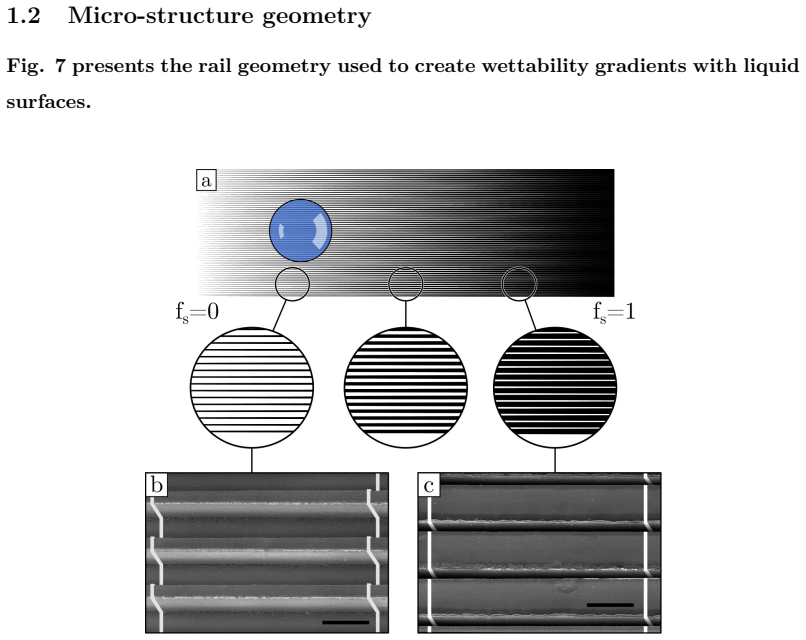
The load-bearing object is the shaped liquid surface: a solid micro-structure (rails, 60 µm high with spacing 75 µm) conformally coated with a hydrophobic nanoparticle layer and imbibed with 20 cSt silicone oil, so that the droplet rests on a composite surface of oil and trapped air. The apparent contact angle is set by the effective Young's law for liquid-on-liquid wetting, $\cos\theta_e = (\gamma_{oa}-\gamma_{wo})/\gamma_{eff}$, combined with a Cassie-Baxter-type area fraction $f_l$. The mechanism that carries the argument is the force balance: the wettability gradient produces a driving force $F_d = 8k\gamma_{oa}\alpha R^2$ along the droplet perimeter, while dissipation at the moving contact line, $F_v \propto f_s \mu_o v R \ln(R/L_o)$, provides the dominant resistance, yielding $v \propto \gamma_{oa} \alpha R/(\mu_o f_s)$. This single scaling law links the observed velocity, the measured driving and pinning forces, and the threshold gradient for motion.
What would settle it
Measure the apparent contact angle of a droplet at positions along the transport gradient, especially in the $f_s > 0.7$ region, while simultaneously imaging the substrate from below. If the air pockets are replaced by oil at any position, the contact angle should drop from the Eq. 2 value to $\theta_e = 108.4^\circ$, and the droplet speed should deviate from $v \propto 1/f_s$ — directly contradicting the claim of solid-free, mixed-state transport across the full gradient.
Extended reading notes
Core claim
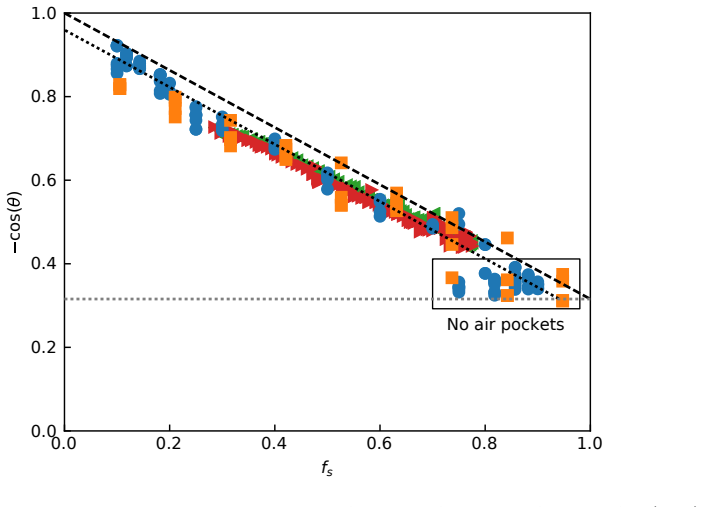
The paper establishes that a dual-length-scale substrate — a nanoparticulate coating that holds silicone oil, superimposed on larger micron-scale rails whose solid fraction $f_s$ varies in space — forms a shaped liquid surface on which water droplets move spontaneously. The apparent contact angle follows a liquid Cassie-Baxter relation, $\cos\theta = f_l \cos\theta_e - (1-f_l)$ with $f_l \approx f_s + 0.059$, where $\theta_e = 108.4^\circ$ is the flat liquid-surface contact angle. Because the liquid surface has contact-angle hysteresis below one degree, the pinning force is tiny ($F_p \approx 1.1 \, \mu\text{N}$ measured), so even weak wettability gradients, down to $\alpha \approx 0.03 \, \text{mm}^{-1}$, overcome pinning and propel droplets over centimetre distances. Balancing the capillary driving force $F_d \propto \gamma_{oa} \alpha R^2$ against viscous dissipation from the droplet contact line gives the terminal velocity $v \propto \gamma_{oa} \alpha R / (\mu_o f_s)$, matching the observed slowdown with increasing rail fraction. The same surface captures and transports impacting droplets, including hanging droplets on inverted substrates, because the liquid layer increases dissipation and normal adhesion compared with a superhydrophobic solid.
Load-bearing premise
The whole argument depends on the droplet remaining in a mixed liquid-and-air Cassie-Baxter state, with stable air pockets underneath it, so that the apparent contact angle follows Eq. 2 and the droplet never touches the solid; the paper itself notes that for $f_s > 0.7$ the air pockets are sometimes filled with oil, which would change the contact angle to the flat-liquid value and could weaken the gradient that drives motion.
Editorial extensions
If this is right
- If the scaling law is correct, droplet speed can be tuned continuously by adjusting the local rail fraction gradient and the lubricant viscosity, without any external actuation.
- The low pinning force means that much weaker wettability gradients than those needed on superhydrophobic solids can drive transport, enabling longer travel distances per unit gradient.
- Because the transport works on inverted and inclined surfaces, the design should allow droplet collection and removal in orientations where gravity opposes motion, such as fog harvesting or condensation management.
- The ability to capture impacting droplets and then move them uphill suggests that shaped liquid surfaces can combine drop capture, coalescence, and directional delivery in a single passive device.
- The rate $v \propto 1/f_s$ gives a practical design rule: to slow droplets down, increase the local solid fraction, which the paper demonstrates over a range of volumes and gradients.
Reading between the lines
- A direct corollary not spelled out in the paper is that the driving force scales with the oil-air surface tension $\gamma_{oa}$ but not the water-oil tension, so choosing a lower-$\gamma_{oa}$ lubricant should increase droplet speed at fixed gradient; this is a testable prediction that follows from the model.
- The observed failure of air pockets at $f_s > 0.7$, where oil fills the gaps and the contact angle drops to $\theta_e$, implies a design constraint: wettability-gradient devices should keep the operating rail fraction below this threshold if solid-free transport and the $1/f_s$ scaling are to be maintained.
- The paper's force balance neglects inertial effects during impact; extending the model to include droplet deformation and oil-layer displacement during capture could predict the maximum impact velocity for which the surface still captures rather than bounces a droplet.
- Because the apparent contact angle is set by the liquid surface rather than the solid chemistry, the same design could be adapted to transport other immiscible liquids, provided the lubricant has negative spreading power on the transported liquid.
Signed reviews
Editorial analysis
A structured set of objections, weighed in public.
Referee Report
Summary. The manuscript presents a dual-length-scale 'shaped liquid surface' formed by nanotextured rails imbibed with silicone oil. It reports measurements of low contact angle hysteresis, a linear variation of apparent contact angle with solid fraction, spontaneous droplet motion toward higher solid fraction, self-propelled transport along gradient rails with speed decreasing as 1/f_s, uphill and inverted transport, and capture of impacting droplets. A force-balance model balances a capillary driving force F_d = 8kγ_oa α R^2 with viscous dissipation at the contact line to yield v ∝ γ_oa α R/(μ_o f_s). The qualitative phenomena are directly demonstrated, while the quantitative model contains fitted corrections and unmeasured parameters.
Significance. If validated, the approach offers a passive, energy-free route to droplet transport with low hysteresis, including in inverted orientations, with potential applications in microfluidics, self-cleaning surfaces, fog harvesting, and heat transfer. The strengths are the clear experimental demonstrations, the use of control super-hydrophobic surfaces that remain pinned, the direct measurement of low hysteresis, and the explicit reporting of a limitation in SI §1.4. The main weaknesses are that the driving-force model relies on a fitted wetting law, an unreported footprint aspect ratio, and a Cassie-state assumption that is known to break down at f_s > 0.7; these issues make the quantitative comparison partly a consistency check rather than a falsifiable prediction.
major comments (4)
- [SI §1.4 and main text Fig. 2a] SI §1.4 explicitly reports that for f_s > 0.7 the air pockets under the droplet are sometimes filled with oil, in which case the apparent contact angle falls to θ_e and loses its dependence on f_s. Because the gradient substrate spans f_s = 0 to 1, a droplet with a finite base radius must sample f_s > 0.7 before the end of the pattern. The driving force F_d = 8kγ_oa α R^2 in SI §1.7.1 is derived by integrating Eq. (2) over the entire footprint, so it overestimates the wettability contrast in the terminal portion of the transport. The 'sustained self-propulsion over the pattern' claim is therefore not supported by the presented data, which end near f_s = 0.77 in Fig. 2a; the authors should either restrict the claim to the regime where the composite Cassie state is stable, demonstrate that the droplet completes the pattern before entering the oil-filled regime, or include a model for the transition to the filled state.
- [SI §1.7.1, Eq. (5)] The driving force expression F_d = 8kγ_oa α R^2 contains the droplet footprint aspect ratio k, but k is never measured or reported anywhere in the manuscript. The comparison in Fig. 3c between the measured driving force and the model is therefore not fully quantitative: an order-one value of k could be chosen to bring the model into agreement, and the reported error bars do not constrain k. To make the force-balance model testable, the authors should report k from direct footprint measurements or perform the integration over the actual contact-line shape.
- [Fig. 1c and Eq. (2)] Eq. (2) is fit to the contact-angle data using the correction f_l = f_s + 0.059, and this fitted correction is inherited by the force-balance model, since SI §1.7.1 uses Eq. (2) directly. Consequently the quantitative agreement in Fig. 3c is not a parameter-free test of the driving-force model. The authors should clearly separate fitted from predicted quantities and show the sensitivity of F_d and the terminal velocity v to the fitted offset δ = 0.059, especially because the offset is close to the coating-thickness estimate and may vary between samples.
- [Main text, paragraph following Fig. 3] The measured pinning force F_p ≈ 1.11 ± 0.25 μN is more than a factor of two larger than the value estimated from contact angle hysteresis, F_p ≈ 0.48 μN. This discrepancy is not discussed, yet it is relevant to the claim that pinning is overcome by the gradient. The authors should explain whether the hysteresis-based estimate underestimates the relevant pinning or whether an additional dissipative or pinning mechanism contributes to the critical-angle measurements.
minor comments (4)
- [Fig. 3c axis label] The vertical axis label 'F [ N]' appears to be missing the micro symbol; it should read 'F [μN]' to match the values in the text.
- [SI §1.7.4, Eq. (13)] In Eq. (13) the symbol 'ν' is used where the droplet velocity 'v' is meant; this typo makes the equation momentarily confusing.
- [Main text, first paragraph of the propulsion section] The phrase 'the liquid surface area fractions f_l increases linearly' should be 'the liquid surface area fraction f_l increases linearly'.
- [Abstract] The sentence fragment 'the conical shape of cactus spines to create self-propelled motion' is grammatically incomplete and should be revised for clarity.
Circularity Check
No significant circularity: the wetting law is validated in-paper, the fitted correction cancels in the force model, and the transport scaling is tested against independent measurements.
full rationale
The derivation chain is self-contained and does not reduce to its inputs by construction. The central wetting relation, cos(θ)=fl cos(θe)-(1-fl), is attributed to prior work by overlapping authors (ref. 28), but it is independently validated in this paper against contact-angle measurements on the actual fabricated surfaces (Fig. 1c and SI Fig. 8), so the self-citation is not the load-bearing justification. The small correction fl=fs+0.059 is fitted to those measurements, but it cancels identically in the driving-force integral: substituting fl=fs+0.059 into g=(γoa+γwo)cosθ gives a gradient contribution 2γoa(dfs/dx)R, independent of the 0.059 offset, yielding Fd=8kγoaαR^2. Thus the force model does not secretly reuse the fitted correction as a prediction. The terminal-velocity scaling v∝γoaαR/(μo fs) is derived from a separate force balance and then compared with measured velocities from a different dataset (Fig. 2c), while the critical-angle measurements in Fig. 3 provide an independent route to Fd and Fp. None of the paper's predictions is statistically forced by a fitted parameter renamed as a prediction, and no uniqueness theorem or ansatz is imported solely through self-citation. The SI note that air pockets are sometimes oil-filled for fs>0.7 identifies a possible limitation of the Cassie-state assumption at the high-fraction end, but this is a correctness or robustness concern, not a circularity in the derivation.
Assumptions & free parameters
free parameters (4)
- liquid fraction correction δ = 0.059 =
0.059
- droplet footprint aspect ratio k =
not reported
- terminal velocity proportionality constant =
not reported
- slip length L_o =
not measured
assumptions (5)
- standard math Effective Young's law for a droplet on a thin immiscible liquid film, cosθe = (γ_oa - γ_wo)/γ_eff (Eq. 1)
- domain assumption Cassie-Baxter-type linear averaging of cosθ for a composite liquid-air surface (Eq. 2)
- domain assumption Air pockets remain stable beneath the droplet for all fs along the transport path
- ad hoc to paper Droplet footprint is a rectangle of length R and width kR for force integration
- ad hoc to paper Viscous dissipation at the moving contact line dominates over bulk and oil-layer dissipation
Cite this review
Pith. "Pith review of Self-Propelled Droplet Transport on Shaped-Liquid Surfaces." pith.science (2026). https://pith.science/paper/BQXRDW7E
@misc{pith2026190801305,
  author       = {Pith},
  title        = {Pith review of: Self-Propelled Droplet Transport on Shaped-Liquid Surfaces},
  year         = {2026},
  howpublished = {\url{https://pith.science/paper/BQXRDW7E}},
  note         = {Machine review of arXiv:1908.01305}
}
read the original abstract
The transport of small quantities of liquid on a solid surface is inhibited by the resistance to motion caused by the contact between the liquid and the solid. To overcome such resistance, motion can be externally driven through gradients in electric fields, but these all inconveniently involve the input of external energy. Alternatively, gradients in physical shape and wettability - the conical shape of cactus spines to create self-propelled motion. However, such self-propelled motion to date has limited success in overcoming the inherent resistance to motion of the liquid contact with the solid. Here we propose a simple solution in the form of shaped-liquid surface, where solid topographic structures at one length scale provides the base for a smaller length-scale liquid conformal layer. This dual-length scale render possible slippery surfaces with superhydrophobic properties. Combined to an heterogeneous topography, it provides a gradient in liquid-on-liquid wettability with minimal resistance to motion and long range directional self-propelled droplet transport. Moreover, the liquid-liquid contact enables impacting droplets to be captured and transported, even when the substrate is inverted. These design principles are highly beneficial for droplet transport in microfluidics, self-cleaning surfaces, fog harvesting and in heat transfer.
Figures


Figures from the paper (9 more)




Reference graph
Works this paper leans on
-
[1]
Pollack, M. G., Fair, R. B. & Shenderov, A. D. Electrowetting-based actuation of liquid droplets for microfluidic applications.Applied Physics Letters 77, 1725–1726 (2000)
work page 2000
-
[2]
Jones, T. B., Gunji, M., Washizu, M. & Feldman, M. Dielectrophoretic liquid actuation and nanodroplet formation.Journal of applied Physics 89, 1441–1448 (2001)
work page 2001
-
[3]
Motions of droplets on solid surfaces induced by chemical or thermal gradients
Brochard, F. Motions of droplets on solid surfaces induced by chemical or thermal gradients. langmuir 5, 432–438 (1989)
work page 1989
-
[4]
Darhuber, A. A., Valentino, J. P., Davis, J. M., Troian, S. M. & Wagner, S. Microfluidic actuationbymodulationofsurfacestresses. Applied Physics Letters82,657–659(2003)
work page 2003
-
[5]
Yarin, A. L., Liu, W. & Reneker, D. H. Motion of droplets along thin fibers with temperature gradient. Journal of applied physics 91, 4751–4760 (2002)
work page 2002
-
[6]
Oh, S.-K., Nakagawa, M. & Ichimura, K. Photocontrol of liquid motion on an azoben- zene monolayer. Journal of Materials Chemistry 12, 2262–2269 (2002). 8 1 mm 0 5 10 15 20 25 hr [mm] B = 2B=1 B=0 0 5 10 15 20 25 hr [mm] 6 8 10 12V [µL] B ≥ 5 B=0 c d Figure 4: Impact, capture and transport of droplets.(a): 5 µL water droplet impact- ing on a tilted (β= 2.3...
work page 2002
-
[7]
Photo-actuation of liquids for light-driven microfluidics: state of the art and perspectives
Baigl, D. Photo-actuation of liquids for light-driven microfluidics: state of the art and perspectives. Lab on a Chip 12, 3637–3653 (2012)
work page 2012
-
[8]
Squires, T. M. & Quake, S. R. Microfluidics: Fluid physics at the nanoliter scale. Reviews of modern physics 77, 977 (2005)
work page 2005
Show all 31 references
-
[9]
Linke, H. et al. Self-propelled Leidenfrost droplets.Physical review letters 96, 154502 (2006)
2006
-
[10]
& Quéré, D
Lagubeau, G., Le Merrer, M., Clanet, C. & Quéré, D. Leidenfrost on a ratchet.Nature Physics 7, 395 (2011)
2011
-
[11]
Ju, J. et al. A multi-structural and multi-functional integrated fog collection system in cactus. Nature communications 3, 1247 (2012)
2012
-
[12]
Liu,C.,Ju,J.,Zheng,Y.&Jiang,L.Asymmetricratcheteffectfordirectionaltransport of fog drops on static and dynamic butterfly wings.ACS nano 8, 1321–1329 (2014)
2014
-
[13]
Chaudhury, M. K. & Whitesides, G. M. How to make water run uphill.Science 256, 1539–1541 (1992)
1992
-
[14]
& Guo, Z
Li, J. & Guo, Z. Spontaneous directional transportations of water droplets on surfaces driven by gradient structures.Nanoscale 10, 13814–13831 (2018)
2018
-
[15]
& Liao, G
Tan, X., Zhu, Y., Shi, T., Tang, Z. & Liao, G. Patterned gradient surface for sponta- neous droplet transportation and water collection: simulation and experiment.Journal of Micromechanics and Microengineering 26, 115009 (2016)
2016
-
[16]
D., Burnett-Hall, G
Bain, C. D., Burnett-Hall, G. D. & Montgomerie, R. R. Rapid motion of liquid drops. Nature 372, 414 (1994)
1994
-
[17]
Li, J. et al. Oil droplet self-transportation on oleophobic surfaces.Science advances 2, e1600148 (2016)
2016
-
[18]
Dong, Z. et al. Superoleophobic Slippery Lubricant-Infused Surfaces: Combining Two Extremes in the Same Surface.Advanced Materials 30, 1803890 (2018)
2018
-
[19]
Smith, J. D. et al. Droplet mobility on lubricant-impregnated surfaces.Soft Matter 9, 1772–1780 (2013)
2013
-
[20]
V., Li, R., Velling, S
Daniel, D., Timonen, J. V., Li, R., Velling, S. J. & Aizenberg, J. Oleoplaning droplets on lubricated surfaces.Nature Physics 13, 1020 (2017)
2017
-
[21]
& Kusumaatmaja, H
Semprebon, C., McHale, G. & Kusumaatmaja, H. Apparent contact angle and contact angle hysteresis on liquid infused surfaces.Soft matter 13, 101–110 (2017)
2017
-
[22]
Kreder, M. J. et al. Film dynamics and lubricant depletion by droplets moving on lubricated surfaces. Physical Review X 8, 031053 (2018). 10
2018
-
[23]
Wong, T.-S. et al. Bioinspired self-repairing slippery surfaces with pressure-stable om- niphobicity. Nature 477, 443 (2011)
2011
-
[24]
Luo, J. T. et al. Slippery liquid-infused porous surfaces and droplet transportation by surface acoustic waves.Physical Review Applied 7, 014017 (2017)
2017
-
[25]
B., Yang, S
Dai, X., Stogin, B. B., Yang, S. & Wong, T.-S. Slippery wenzel state.Acs Nano 9, 9260–9267 (2015)
2015
-
[26]
& Baxter, S
Cassie, A. & Baxter, S. Wettability of porous surfaces. Transactions of the Faraday society 40, 546–551 (1944)
1944
-
[27]
Wetting and roughness.Annu
Quéré, D. Wetting and roughness.Annu. Rev. Mater. Res. 38, 71–99 (2008)
2008
-
[28]
V., Wells, G
McHale, G., Orme, B. V., Wells, G. G. & Ledesma-Aguilar, R. Apparent Contact An- gles on Lubricant-Impregnated Surfaces/SLIPS: From Superhydrophobicity to Elec- trowetting. Langmuir 35, 4197–4204 (2019)
2019
-
[29]
Mao, T., Kuhn, D. C. & Tran, H. Spread and rebound of liquid droplets upon impact on flat surfaces.AIChE Journal 43, 2169–2179 (1997)
1997
-
[30]
Yarin, A. L. Drop impact dynamics: splashing, spreading, receding, bouncing...Annu. Rev. Fluid Mech. 38, 159–192 (2006)
2006
-
[31]
& Rothstein, J
Kim, J.-H. & Rothstein, J. P. Droplet impact dynamics on lubricant-infused superhy- drophobic surfaces: The role of viscosity ratio.Langmuir 32, 10166–10176 (2016). 11 1 Supplemental Material 1.1 Surface fabrication process We describe here the fabrication process of the super...
2016
Reviewed August 14, 2026 · model on record in the stance chip above.
Discussion (0). Continue with ORCID to comment.