REVIEW 3 major objections 4 minor 49 references
Non-Exponential Relaxation in the Rotating Frame of a Driven Nanomechanical Mode
T0 review · 3 major / 4 minor · reviewed 2026-08-05 · deepseek-v4-flash
Pith's one-line read A driven nanomechanical mode's in-phase component decays at twice its damping rate at first, then at the ordinary rate, so its rotating-frame ring-down is non-exponential.
desk verdict A clean rotating-frame ring-down experiment showing q–p relaxation asymmetry, with a theory gap at the largest drive amplitudes that a numerical check should close. read the letter →
The pith
A machine-rendered reading of the paper's core claim, the machinery that carries it, and where it could break.
The reading
What carries the argument
The load-bearing object is the rotating-frame Hamiltonian of the Duffing oscillator, H0(q,p) = (3γ/32ω1)(q²+p²)² − ½δω1(q²+p²) − F1 q/2ω1, with linear damping Γ added to both equations of motion. The asymmetric term −F1 q/2ω1 breaks inversion symmetry in the rotating frame and, together with the near-comparable harmonic part at the chosen working point, makes the second harmonic of q grow as the oscillation energy increases until |q2| ≈ |q1|. Ring-down is then governed by the quasi-linear rule that the n-th harmonic decays as e^{-nΓt}: the second harmonic of q (rate 2Γ) initially controls δq, and after it dies away the fundamental (rate Γ) takes over, producing the non-exponential crossover.
What would settle it
Numerically integrate the full Duffing equation (Eq. 1) without the rotating-wave approximation using the measured Γ, γ, F1, F2, and detunings, switch F2 off at t = 0, and compare the computed envelopes of q and p with the measured ones; if q's decay rate does not start near 2Γ and relax toward Γ, the harmonic-decay mechanism is falsified.
Extended reading notes
Core claim
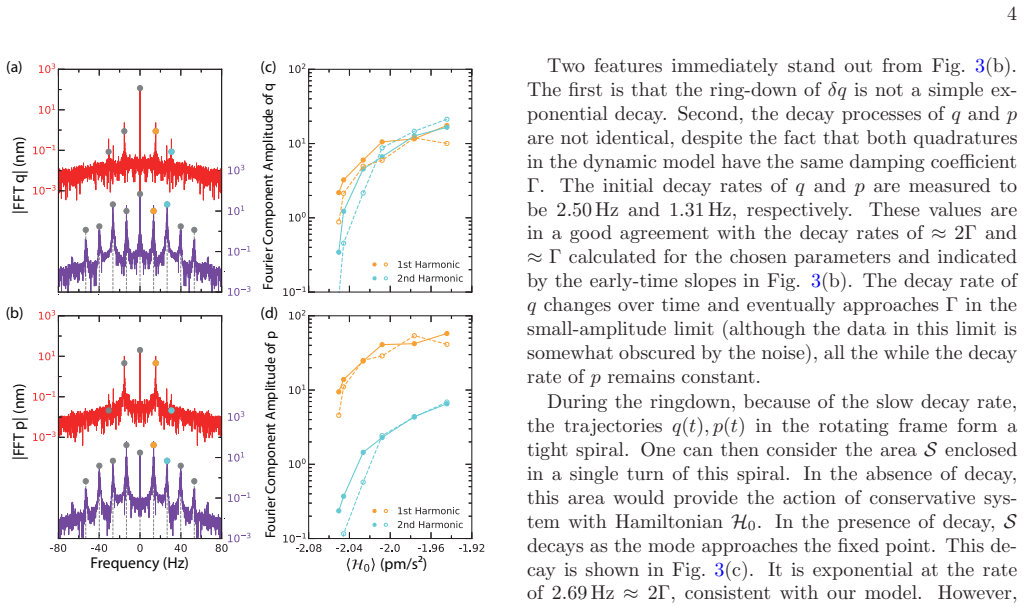
The core discovery is a quadrature-dependent, non-exponential relaxation law for a single mode. In a doubly clamped silicon-nitride beam driven at 248 kHz with Q ≈ 580,000 (Γ ≈ 1.35 Hz), a primary resonant drive F1 establishes a fixed point in the rotating frame, and a secondary drive F2 excites nearly periodic rotating-frame oscillations around it. When F2 is switched off, homodyne measurements show that the deviation δq of the in-phase component decays with an initial rate of 2.50 Hz ≈ 2Γ that asymptotically approaches Γ, while δp decays at 1.31 Hz ≈ Γ throughout; the phase-space area enclosed per cycle decays at 2.69 Hz ≈ 2Γ. The model attributes these rates to the harmonic structure: Fou
Load-bearing premise
The non-exponential prediction rests on a truncated perturbation expansion that assumes the secondary drive is much weaker than the primary drive and damping much slower than the rotating-frame oscillation; the paper does not separately verify that the omitted higher-order terms are negligible at the largest secondary-drive amplitudes it uses.
Editorial extensions
If this is right
- Rotating-frame ring-down of a Duffing-type mode cannot be characterized by a single exponential rate; at large initial excitation the in-phase decay begins at 2Γ and only approaches Γ at late times.
- Measuring both quadrature envelopes in the same ring-down gives an internal consistency check on Γ: the early slope of p and the late slope of q should both equal Γ, while the area decay gives 2Γ.
- Frequency-comb spectra and ring-down transients are two views of the same nonlinear rotating-frame dynamics, so the measured harmonic ratios can predict the initial decay rate and the crossover time.
- The second-harmonic amplitude in q can serve as a time-domain diagnostic of the rotating-frame asymmetry, not just of the Duffing nonlinearity.
Reading between the lines
- A generic version of this mechanism should appear in any driven oscillator whose rotating-frame potential has a comparable asymmetric term, not only in Duffing beams; computing q2/q1 for such potentials would predict where non-exponential relaxation shows up.
- Varying the initial secondary-drive amplitude F2 should shift the crossover from 2Γ to Γ in a predictable way; plotting the initial decay rate of q against F2 would test the harmonic-decay picture more sharply than the single case shown.
- Because the early-time q slope isolates 2Γ without needing spectral linewidths, the same phase-locked ring-down protocol could measure damping in high-Q devices where frequency noise broadens the resonance, a use the authors gesture toward in their conclusion.
Editorial analysis
A structured set of objections, weighed in public.
Referee Report
Summary. The paper reports ring-down measurements in the rotating frame of a driven, single-mode Duffing nanomechanical resonator. A primary resonant drive establishes a stable fixed point in the rotating frame, and a secondary near-resonant drive excites finite-amplitude oscillations around it. When the secondary drive is removed, homodyne detection of the in-phase and quadrature components q(t) and p(t) shows that the in-phase signal decays non-exponentially, with an initial rate of about 2.50 Hz ≈ 2Γ that slows toward Γ, while the quadrature signal decays exponentially at about 1.31 Hz ≈ Γ. The area enclosed by the phase-space trajectories decays exponentially at about 2.69 Hz ≈ 2Γ. The authors model the dynamics with a minimal RWA Duffing description, using Γ, ω0, and γ obtained from independent measurements, and explain the non-exponential relaxation through the second harmonic of q decaying as e^{-2Γt}. Spectral measurements in the driven state connect the same model to the observed first- and second-harmonic amplitudes.
Significance. If the result holds, it is a clean and useful demonstration that rotating-frame relaxation of a single nonlinear mode can be multi-rate even though the laboratory-frame damping is linear: different rotating-frame quadratures can display different apparent decay rates, and the decay can be non-exponential. The paper's strengths are the direct time-domain measurement, the use of independently determined parameters, the absence of ad hoc fitting of the decay itself, and the exact area-decay relation S(t)=S(0)e^{-2Γt}, which is confirmed experimentally. The observation is falsifiable and the model is minimal. The main weakness is that the quantitative explanation of the e^{-2Γt} scaling of the second harmonic is derived from a perturbation expansion that is pushed to amplitudes where the expansion parameter is no longer small; this requires an additional numerical validation.
major comments (3)
- [SM, Eqs. (S7)-(S16); Fig. 3] The central mechanism—q2 ∝ e^{-2Γt}, so the in-phase component initially decays at 2Γ—is derived from a perturbation expansion in which u and p are O(ε), damping is O(ε²), and F2 is O(ε³). The ring-down is initiated at F2 = 150 mm/s², where Fig. 4(c) shows |q2/q1| ≈ 1, so the SM condition |H0 - H0(qeq)|/|H0(qeq)| ≪ 1 is violated. The paper does not test whether the e^{-2Γt} scaling of the second harmonic survives at these amplitudes. Please add a direct numerical integration of the full RWA equations (S1)-(S2), and ideally also of Eq. (1), using the experimental parameters and initial conditions, and compare the resulting q(t) envelope with the measured 2.50-Hz initial slope and with the data. If the theoretical envelopes in Fig. 3 were already obtained by numerical integration rather than from the truncated perturbation series, this should be stated explicitly; the current text and SM p
- [Fig. 3(b)] The two central quantitative values, 2.50 Hz and 1.31 Hz, are quoted without a fitting protocol or uncertainty. Because the q-decay is non-exponential, the extracted 'initial' slope depends on the chosen time window and on how the envelope points are selected. In addition, the claimed crossover to the Γ slope occurs in a regime the authors themselves describe as obscured by noise. Please specify the fit range, the definition of maximal-deviation points, and the statistical uncertainty, and provide a residual plot of the data against the model so that the non-exponential departure is quantitative rather than visual.
- [SM Eq. (S25); final Results paragraph] The exact result S(t) = S(0)e^{-2Γt} is a strong check, but it does not by itself imply q2 ∝ e^{-2Γt} in the strongly nonlinear regime, where harmonic amplitudes are nonlinear functions of the action. The paper connects the area decay to the component decay rates only through a 'quasi-linear' argument. The requested numerical integration should be used to compute S(t) and the q,p harmonic amplitudes from the same initial state, so that the three observables (q envelope, p envelope, and area) are demonstrated to follow from a single simulation without additional assumptions.
minor comments (4)
- [Title/header] The running title contains 'Drive n Nanomechanical'; it should be 'Driven Nanomechanical'.
- [SM Eq. (S16)] The term with sin(2δω2t - 2θ) appears to have a typo: the denominator should likely contain (8ω1δω1 - 9γqeq²)(8ω1δω1 - 3γqeq²) for dimensional consistency, matching Eq. (S15).
- [Fig. S2 caption and axes] Some axis labels are garbled, e.g., 'Frequency (H )' and the overline notation for the filtered Hamiltonian. Please check all supplemental figure labels and caption text.
- [Introduction] The phrase 'unexpectedly strong nonlinear damping in the rotating frame' may be misread as amplitude-dependent mechanical damping. Since the underlying damping is linear, consider phrasing such as 'strongly multi-rate effective relaxation in the rotating frame'.
Circularity Check
No significant circularity: the rotating-frame ring-down prediction follows from the independently parameterized Duffing model; the claimed non-exponential decay is not used as an input.
full rationale
Score 0. The central claim is not circular. The non-exponential relaxation is derived from the stated Duffing model: after the RWA, the local variables around the fixed point satisfy SM Eqs. (S7)-(S8), and a standard multiple-scale expansion gives u = q1 cos(δω2t-θ) + q2 cos(2δω2t-2θ) + DC with q1∝a and q2∝a^2 (SM Eqs. S15-S16). With F2=0, the slow equation da/d(ε²t) = -Γa (SM Eq. S12) yields a∝e^{-Γt}, hence the second harmonic decays as q2∝e^{-2Γt}. All parameters entering this prediction (Γ, ω0, γ, F1, δω1) are measured independently of the in-phase ring-down: Γ from the linear ring-down slope, γ from the Duffing backbone curve, and the detunings and drive amplitudes from experimental settings. The measured initial rates 2.50 Hz and 1.31 Hz are compared with the independently calculated 2Γ≈2.7 Hz and Γ≈1.35 Hz; these rates are not fitted to the target data. The area decay S(t)=S(0)e^{-2Γt} is an exact identity from the divergence theorem applied to the damped RWA vector field (SM Eq. S25), not a fitted result. The paper's self-citations (frequency combs, squeezing, prior ring-down studies) provide context and contrast but do not carry the derivation. The only substantive caveat is the validity of the truncated perturbation expansion at the largest F2 where q2/q1~1, outside the stated small-deviation regime; this is an accuracy and validation concern, not circularity, because the e^{-2Γt} scaling is not assumed as the conclusion but obtained by solving the model equations. No quoted step reduces to its own input.
Assumptions & free parameters
free parameters (2)
- Γ =
1.35 Hz
- γ =
1.597e23 m^-2 s^-2
assumptions (5)
- domain assumption The mode is well described by a single Duffing oscillator with linear viscous damping (Eq. 1).
- standard math Rotating-wave approximation (RWA) is valid, dropping rapidly oscillating terms and keeping the slow rotating-frame dynamics.
- domain assumption The secondary drive is small, F2 ≪ F1, allowing a perturbation expansion in ε up to O(ε^3).
- domain assumption The rotating-frame vibrations are underdamped, Γ ≪ Ω.
- domain assumption The homodyne demodulation bandwidth is sufficient to capture all harmonics of the slow rotating-frame dynamics.
Cite this review
Pith. "Pith review of Non-Exponential Relaxation in the Rotating Frame of a Driven Nanomechanical Mode." pith.science (2026). https://pith.science/paper/BR4UDXMG
@misc{pith2026250818885,
  author       = {Pith},
  title        = {Pith review of: Non-Exponential Relaxation in the Rotating Frame of a Driven Nanomechanical Mode},
  year         = {2026},
  howpublished = {\url{https://pith.science/paper/BR4UDXMG}},
  note         = {Machine review of arXiv:2508.18885}
}
read the original abstract
We present direct observation of the ring-down dynamics in the rotating frame of a resonantly driven single-mode nonlinear nanomechanical resonator. An additional close to resonance harmonic force excites nonlinear oscillations about the fixed point in the rotating frame. When the secondary drive is removed, we measure decay of the in-phase and quadrature components toward this fixed point. We show that the decay of the in-phase signal is non-exponential, even though the vibration amplitude decays exponentially if both forces are switched off. A minimalistic model captures these dynamics as well as the spectrum of the vibrations excited by the additional force, relating them to the dissipation-induced symmetry breaking of the dynamics in the rotating frame.
Figures


Figures from the paper (1 more)
Reference graph
Works this paper leans on
-
[1]
have drive amplitudes F1 and F2, and drive frequencies ω1 and ω2, respectively. While the driving frequencies, ω1 and ω2, are kept close to the mode eigenfrequency, the magnitude of the forces differs significantly, with F1 ≫ F2, and hence F1 is des- ignated as the primary drive. The measured eigenfrequency of the mode is ω0/2π ≈ 248.013 kHz and the relaxat...
work page 2023
-
[2]
K. L. Ekinci and M. L. Roukes, Nanoelectromechani- cal systems, Review of Scientific Instruments 76, 061101 (2005)
work page 2005
-
[3]
Q. P. Unterreithmeier, T. Faust, and J. P. Kotthaus, Damping of Nanomechanical Resonators, Physical Re- view Letters 105, 027205 (2010) , 1003.1868
work page Pith review arXiv 2010
-
[4]
C. Chen, D. H. Zanette, D. A. Czaplewski, S. Shaw, and D. L´ opez, Direct observation of coherent energy transfer in nonlinear micromechanical oscillators, Nature Com- munications 8, 15523 (2017) , 1612.00490
work page Pith review arXiv 2017
-
[5]
A. A. Clerk, M. H. Devoret, S. M. Girvin, F. Marquardt, and R. J. Schoelkopf, Introduction to quantum noise, measurement, and amplification, Rev. Mod. Phys. 82, 1155 (2010)
2010
-
[6]
A. Bachtold, J. Moser, and M. I. Dykman, Mesoscopic physics of nanomechanical systems, Reviews of Modern Physics 94, 045005 (2022)
work page 2022
-
[7]
O. Maillet, X. Zhou, R. Gazizulin, A. M. Cid, M. De- foort, O. Bourgeois, and E. Collin, Nonlinear frequency transduction of nanomechanical brownian motion, Phys. Rev. B 96, 165434 (2017)
work page 2017
-
[8]
Y. Zhang and M. I. Dykman, Spectral effects of dispersive mode coupling in driven mesoscopic systems, Phys. Rev. B 92, 165419 (2015)
work page 2015
Show all 49 references
-
[9]
K. Y. Fong, W. H. P. Pernice, and H. X. Tang, Frequency and phase noise of ultrahigh q silicon nitride nanome- chanical resonators, Phys. Rev. B 85, 161410 (2012)
2012
-
[10]
Huang, S
L. Huang, S. M. Soskin, I. A. Khovanov, R. Mannella, K. Ninios, and H. B. Chan, Frequency stabilization and noise-induced spectral narrowing in resonators with zero dispersion, Nature Communications 10, 3930 (2019) , 1909.01090
2019 arXiv
-
[11]
Schmid, K
S. Schmid, K. D. Jensen, K. H. Nielsen, and A. Boisen, Damping mechanisms in high- q micro and nanomechan- ical string resonators, Phys. Rev. B 84, 165307 (2011)
2011
-
[12]
G¨ uttinger, A
J. G¨ uttinger, A. Noury, P. Weber, A. M. Eriksson, C. Lagoin, J. Moser, C. Eichler, A. Wallraff, A. Isacsson, and A. Bachtold, Energy-dependent path of dissipation in nanomechanical resonators, Nature Nanotechnology 12, 631 (2017) . 6
2017
-
[13]
M. Wang, D. J. Perez-Morelo, D. Lopez, and V. A. Aksyuk, Persistent Nonlinear Phase-Locking and Non- monotonic Energy Dissipation in Micromechanical Resonators, Physical Review X 12, 041025 (2022) , 2206.01089
2022 arXiv
-
[14]
Shoshani, S
O. Shoshani, S. W. Shaw, and M. I. Dykman, Anomalous Decay of Nanomechanical Modes Going Through Nonlin- ear Resonance, Scientific Reports 7, 18091 (2017)
2017
-
[15]
B. H. Schneider, V. Singh, W. J. Venstra, H. B. Meer- waldt, and G. A. Steele, Observation of decoherence in a carbon nanotube mechanical resonator, Nature Commu- nications 5, 5819 (2014) , 1503.06815
2014 arXiv
-
[16]
Eichler, J
A. Eichler, J. Moser, J. Chaste, M. Zdrojek, I. Wilson- Rae, and A. Bachtold, Nonlinear damping in mechanical resonators made from carbon nanotubes and graphene, Nature Nanotechnology 6, 339 (2011) , 1103.1788
2011 arXiv
-
[17]
P. M. Polunin, Y. Yang, M. I. Dykman, T. W. Kenny, and S. W. Shaw, Characterization of mems resonator nonlin- earities using the ringdown response, Journal of Micro- electromechanical Systems 25, 297 (2016)
2016
-
[18]
J. S. Huber, G. Rastelli, M. J. Seitner, J. K¨ olbl, W. Belzig, M. I. Dykman, and E. M. Weig, Spectral Evi- dence of Squeezing of a Weakly Damped Driven Nanome- chanical Mode, Physical Review X 10, 021066 (2020) , 1903.07601
2020 arXiv
-
[19]
J. S. Ochs, M. Seitner, M. I. Dykman, and E. M. Weig, Amplification and spectral evidence of squeezing in the response of a strongly driven nanoresonator to a probe field, Physical Review A 103, 013506 (2021) , 2007.15382
2021 arXiv
-
[20]
F. Yang, M. Fu, B. Bosnjak, R. H. Blick, Y. Jiang, and E. Scheer, Mechanically Modulated Sideband and Squeezing Effects of Membrane Resonators, Physical Re- view Letters 127, 184301 (2021) , 2107.10355
2021 arXiv
-
[21]
Zhang, Y
B. Zhang, Y. Yan, X. Dong, M. Dykman, and H. Chan, Frequency stabilization of self-sustained oscillations i n a sideband-driven electromechanical resonator, Phys. Rev. Appl. 22, 034072 (2024)
2024
-
[22]
Houri, M
S. Houri, M. Asano, H. Okamoto, and H. Yamaguchi, Self-sustained libration regime in nonlinear microelec- tromechanical devices, Phys. Rev. Appl. 16, 064015 (2021)
2021
-
[23]
D. A. Czaplewski, C. Chen, D. Lopez, O. Shoshani, A. M. Eriksson, S. Strachan, and S. W. Shaw, Bifur- cation Generated Mechanical Frequency Comb, Physical Review Letters 121, 244302 (2018)
2018
-
[24]
M. I. Dykman, G. Rastelli, M. L. Roukes, and E. M. Weig, Resonantly Induced Friction and Frequency Combs in Driven Nanomechanical Systems, Physical Review Let- ters 122, 254301 (2019) , 1903.08602
2019 arXiv
-
[25]
J. S. Ochs, D. K. J. Boneß, G. Rastelli, M. Seitner, W. Belzig, M. I. Dykman, and E. M. Weig, Frequency Comb from a Single Driven Nonlinear Nanomechanical Mode, Physical Review X 12, 041019 (2022)
2022
-
[26]
Kesk ¸ekler, H
A. Kesk ¸ekler, H. Arjmandi-Tash, P. G. Steeneken, and F. Alijani, Symmetry-Breaking-Induced Frequency Combs in Graphene Resonators, Nano Letters 22, 6048 (2022), 2202.03318
2022 arXiv
-
[27]
M. H. J. d. Jong, A. Ganesan, A. Cupertino, S. Gr¨ oblacher, and R. A. Norte, Mechanical overtone fre- quency combs, Nature Communications 14, 1458 (2023) , 2207.06401
2023 arXiv
-
[28]
X. Wang, Q. Yang, R. Huan, Z. Shi, W. Zhu, Z. Jiang, Z. Deng, and X. Wei, Frequency comb in 1:3 internal res- onance of coupled micromechanical resonators, Applied Physics Letters 120, 173506 (2022)
2022
-
[29]
Singh, A
R. Singh, A. Sarkar, C. Guria, R. J. Nicholl, S. Chakraborty, K. I. Bolotin, and S. Ghosh, Giant Tun- able Mechanical Nonlinearity in Graphene–Silicon Ni- tride Hybrid Resonator, Nano Letters 20, 4659 (2020) , 1904.01613
2020 arXiv
-
[30]
Mouharrar, S
H. Mouharrar, S. Rahmanian, R. Abdelrahman, Y. S. Shama, M. Akbari, M. Yavuz, and E. Abdel-Rahman, Generation of Soliton Frequency Combs in NEMS, Nano Letters 10.1021/acs.nanolett.4c02249 (2024)
2024 doi
-
[31]
Houri, M
S. Houri, M. Asano, H. Yamaguchi, N. Yoshimura, Y. Koike, and L. Minati, Generic Rotating-Frame-Based Approach to Chaos Generation in Nonlinear Micro- and Nanoelectromechanical System Resonators, Physical Re- view Letters 125, 174301 (2020) , 2005.09215
2020 arXiv
-
[32]
Defoort, L
M. Defoort, L. Rufer, L. Fesquet, and S. Basrour, A dy- namical approach to generate chaos in a micromechanical resonator, Microsystems & Nanoengineering 7, 17 (2021), 2101.11976
2021 arXiv
-
[33]
Shoshani and S
O. Shoshani and S. W. Shaw, Nonlinear interactions be- tween vibration modes with vastly different eigenfrequen- cies, Communications Physics 6, 213 (2023)
2023
-
[34]
A. M. Eriksson, O. Shoshani, D. L´ opez, S. W. Shaw, and D. A. Czaplewski, Controllable branching of robust re- sponse patterns in nonlinear mechanical resonators, Na- ture Communications 14, 161 (2023)
2023
-
[35]
Houri, D
S. Houri, D. Hatanaka, M. Asano, R. Ohta, and H. Ya- maguchi, Limit cycles and bifurcations in a nonlinear MEMS resonator with a 1:3 internal resonance, Applied Physics Letters 114, 103103 (2019)
2019
-
[36]
W. Luo, N. Gao, and D. Liu, Multimode Nonlinear Cou- pling Induced by Internal Resonance in a Microcantilever Resonator, Nano Letters 21, 1062 (2021)
2021
-
[37]
D. A. Czaplewski, S. Strachan, O. Shoshani, S. W. Shaw, and D. L´ opez, Bifurcation diagram and dynamic response of a MEMS resonator with a 1:3 internal resonance, Ap- plied Physics Letters 114, 254104 (2019)
2019
-
[38]
B¨ uckle, Y
M. B¨ uckle, Y. S. Klaß, F. B. N¨ agele, R. Braive, and E. M. Weig, Universal Length Dependence of Tensile Stress in Nanomechanical String Resonators, Physical Review Ap- plied 15, 034063 (2021) , 2012.00507
2021 arXiv
-
[39]
Y. S. Klaß, J. Doster, M. B¨ uckle, R. Braive, and E. M. Weig, Determining young’s modulus via the eigenmode spectrum of a nanomechanical string resonator, Applied Physics Letters 121, 083501 (2022)
2022
-
[40]
L. D. Landau and E. M. Lifshitz, Mechanics, 2nd ed., Vol. 1 (Pergamon Press, Oxford, 1976)
1976
-
[41]
J. S. Ochs, G. Rastelli, M. Seitner, M. I. Dykman, and E. M. Weig, Resonant nonlinear response of a nanome- chanical system with broken symmetry, Phys. Rev. B 104, 155434 (2021)
2021
-
[42]
C. S. Barquist, W. G. Jiang, K. Gunther, N. Eng, Y. Lee, and H. B. Chan, Damping of a microelectromechanical oscillator in turbulent superfluid 4He: A probe of quan- tized vorticity in the ultralow temperature regime, Phys. Rev. B 101, 174513 (2020)
2020
-
[43]
Guthrie, S
A. Guthrie, S. Kafanov, M. T. Noble, Y. A. Pashkin, G. R. Pickett, V. Tsepelin, A. A. Dorofeev, V. A. Kru- penin, and D. E. Presnov, Nanoscale real-time detection of quantum vortices at millikelvin temperatures, Nature Communications 12, 2645 (2021)
2021
-
[44]
C. S. Barquist, W. G. Jiang, K. Gunther, Y. Lee, and H. B. Chan, Phase noise in a duffing oscillator induced by quantum turbulence, Phys. Rev. B 106, 094502 (2022) . Supplemental Material: Non-Exponential Relaxation in the Rotating Frame of a Drive n Nanomechanical Mode Hyunjin ...
2022
-
[45]
Guckenheimer and P
J. Guckenheimer and P. J. Holmes, Nonlinear Oscillations, Dynamical Systems, and Bifurcati ons of Vector Fields (Springer, New York, 2013)
2013
-
[46]
A. N. Cleland and M. L. Roukes, Fabrication of high freque ncy nanometer scale mechanical resonators from bulk si crys tals, Applied Physics Letters 69, 2653 (1996)
1996
-
[47]
Maillet, F
O. Maillet, F. Vavrek, A. D. Fefferman, O. Bourgeois, and E . Collin, Classical decoherence in a nanomechanical resona tor, New Journal of Physics 18, 073022 (2016), 1511.02120
2016 arXiv
-
[48]
Zurich Instruments, Principles of Lock-in Detection , Tech. Rep. (Zurich Instruments AG, Zurich, Switzerland, 2 023)
-
[49]
Kumar, S
S. Kumar, S. Rebari, S. P. Pal, S. S. Yadav, A. Kumar, A. Agg arwal, S. Indrajeet, and A. Venkatesan, Temperature- Dependent Nonlinear Damping in Palladium Nanomechanical R esonators, Nano Letters 21, 2975 (2021), 2009.08324
2021 arXiv
Reviewed August 5, 2026 · model on record in the stance chip above.
Discussion (0). Sign in to comment.