Infrastructure for the Agentic Web: Gap Analysis and Architecture from the Agentverse Platform
Pith reviewed 2026-07-01 09:28 UTC · model grok-4.3
The pith
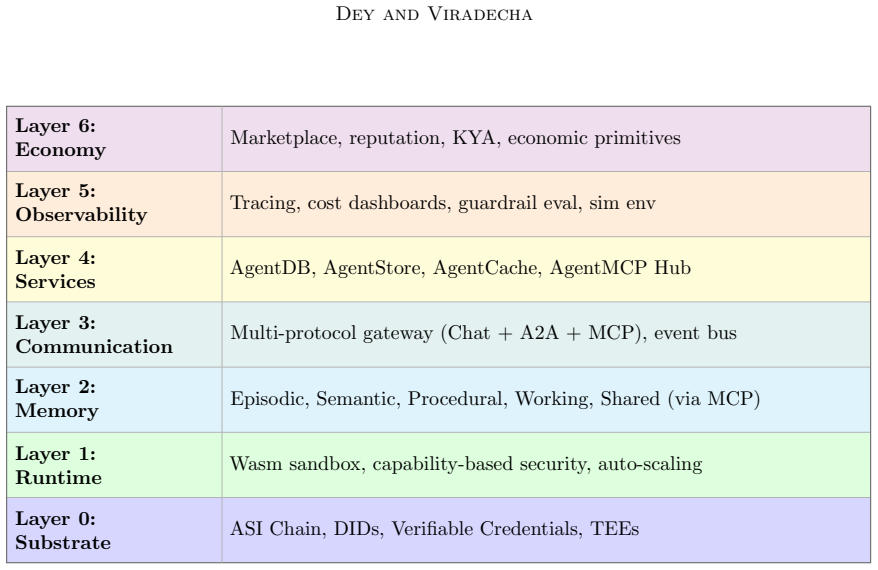
An empirical audit of 204 Agentverse API endpoints identifies 62 missing capabilities across eight categories and proposes a seven-layer Agent Cloud Stack for agent-native infrastructure by 2030.
A machine-rendered reading of the paper's core claim, the machinery that carries it, and where it could break.
Core claim
Through cataloguing 204 API endpoints in Agentverse the authors establish that current agent platforms lack 62 distinct capabilities grouped into eight categories; these gaps motivate a seven-layer Agent Cloud Stack as the necessary reference architecture to support reliable large-scale operation of the agentic web, or Web4, by 2030, along with five concrete evolution paths from ephemeral storage to full agent memory cloud, from keyword to semantic trust-weighted discovery, from single to multi-protocol communication, from single-instance to orchestrated hosting, and from basic to rich economic primitives.
What carries the argument
The Gap Taxonomy derived from the endpoint audit together with the seven-layer Agent Cloud Stack that maps the missing capabilities to required infrastructure layers.
If this is right
- Current single-protocol agent communication must expand to a multi-standard lingua franca.
- Storage must evolve from ephemeral to a dedicated Agent Memory Cloud.
- Discovery services must incorporate semantic and trust-weighted matching rather than keyword search.
- Hosting must scale from single instances to Kubernetes-style multi-agent orchestration.
- Payment mechanisms must incorporate richer economic primitives beyond basic token transfers.
Where Pith is reading between the lines
- The proposed stack could serve as a checklist for cloud providers evaluating support for autonomous agents.
- Standardization efforts in agent communication might accelerate if the multi-protocol path is pursued.
- Security and observability gaps identified here may intersect with existing enterprise cloud compliance requirements.
- If adopted, the architecture would shift agent development focus from reasoning alone toward infrastructure dependencies.
Load-bearing premise
That the specific gaps found in Agentverse are representative of the general infrastructure shortfalls that must be addressed for agent systems to operate reliably at scale.
What would settle it
A comparable audit across several other agent platforms that shows they already implement most or all of the 62 listed capabilities, or that agents fail at scale for reasons outside the eight taxonomy categories.
Figures
read the original abstract
The emergence of autonomous AI agents as first-class participants in digital infrastructure marks a fundamental inflection point in the evolution of the Web. While significant research has been directed at agent behaviour and reasoning, comparatively little attention has been paid to the infrastructure those agents require to operate reliably at scale. This paper addresses that gap with a systematic analysis of Agentverse, the agent cloud platform developed by Fetch.ai under the Artificial Superintelligence (ASI) Alliance, which represents one of the most mature production deployments of agent-native infrastructure available today. We make three principal contributions. First, we conduct an empirical audit of the Agentverse platform, cataloguing 204 API endpoints (Q1 2026) and characterising what is operational, partially deployed, or absent. From this audit we derive a Gap Taxonomy of eight categories encompassing 62 distinct missing capabilities, ranging from agent memory and observability to security, economic primitives, and enterprise scaling. Second, we propose a seven-layer Agent Cloud Stack -- a reference architecture for what a fully realised agent-native cloud should provide by 2030, grounded in the specific gaps we identify. Third, we characterise five critical evolution paths: from ephemeral storage to a full Agent Memory Cloud; from keyword discovery to a semantic, trust-weighted Agent DNS; from a single-protocol model to a multi-standard agent lingua franca; from single-instance hosting to Kubernetes-scale orchestration; and from simple token payments to rich agent economic primitives. Together these contributions provide a diagnostic of current agent infrastructure and a technically grounded vision for what the agent cloud must become to support the agentic web -- Web4 -- by 2030.
Editorial analysis
A structured set of objections, weighed in public.
Referee Report
Summary. The paper claims that an empirical audit of 204 API endpoints in the Agentverse platform (Q1 2026) reveals 62 missing capabilities across an eight-category Gap Taxonomy (memory, observability, security, economic primitives, enterprise scaling, etc.). From this it derives a seven-layer Agent Cloud Stack reference architecture and five evolution paths (ephemeral to Agent Memory Cloud; keyword to semantic Agent DNS; single-protocol to multi-standard lingua franca; single-instance to Kubernetes-scale orchestration; simple tokens to rich economic primitives) needed for a fully realised agent-native cloud supporting the agentic web (Web4) by 2030.
Significance. If the audit methodology proves reproducible and the gaps are shown to be representative rather than Agentverse-specific, the work would supply a practically grounded diagnostic and architectural roadmap for agent infrastructure. The production-platform grounding and explicit 2030 target distinguish it from purely conceptual proposals; however, the absence of cross-platform validation currently limits its load-bearing status for field-wide claims.
major comments (3)
- [Empirical audit description (first contribution)] The section describing the empirical audit provides no methodology: no criteria for classifying the 204 endpoints as operational/partial/absent, no enumeration process for the 62 gaps, and no verification steps. This renders the Gap Taxonomy and all downstream claims (stack layers, evolution paths) unevaluable.
- [Gap Taxonomy derivation and Agent Cloud Stack proposal] The eight-category taxonomy and seven-layer stack are derived solely from Agentverse observations and presented as general requirements for the agentic web, yet no comparative audit of other runtimes, formal requirements elicitation, or cross-validation is reported. The premise that filling these 62 specific gaps will enable reliable large-scale operation therefore rests on an untested generalization.
- [Evolution paths and reference architecture] The five evolution paths and 2030 reference architecture are asserted as critical, but the manuscript supplies no explicit mapping from the 62 gaps to the seven layers nor any argument why these particular capabilities are necessary and sufficient for 'reliable large-scale operation' across heterogeneous ecosystems.
minor comments (2)
- [Abstract] The abstract states the audit date as 'Q1 2026'; clarify whether this is a projected or retrospective date and ensure consistency with any timeline figures in the main text.
- [Evolution paths] The term 'agent lingua franca' is introduced without a precise definition or reference to existing multi-agent communication standards; add a brief clarification or citation.
Simulated Author's Rebuttal
We thank the referee for their thorough review and constructive comments on our manuscript. We address each of the major comments below, indicating the revisions we will make to improve clarity and rigor.
read point-by-point responses
-
Referee: [Empirical audit description (first contribution)] The section describing the empirical audit provides no methodology: no criteria for classifying the 204 endpoints as operational/partial/absent, no enumeration process for the 62 gaps, and no verification steps. This renders the Gap Taxonomy and all downstream claims (stack layers, evolution paths) unevaluable.
Authors: We agree that the methodology for the empirical audit requires more explicit documentation to ensure reproducibility. In the revised version, we will expand the relevant section to include: (1) precise criteria for classifying endpoints (e.g., 'operational' for fully implemented and tested features, 'partial' for limited or beta implementations, 'absent' for no support); (2) the step-by-step enumeration process used to derive the 62 gaps from the 204 endpoints; and (3) verification procedures, such as independent review by co-authors and consistency checks. This will allow readers to evaluate the Gap Taxonomy and subsequent claims. revision: yes
-
Referee: [Gap Taxonomy derivation and Agent Cloud Stack proposal] The eight-category taxonomy and seven-layer stack are derived solely from Agentverse observations and presented as general requirements for the agentic web, yet no comparative audit of other runtimes, formal requirements elicitation, or cross-validation is reported. The premise that filling these 62 specific gaps will enable reliable large-scale operation therefore rests on an untested generalization.
Authors: The paper presents the audit as an in-depth case study of Agentverse, one of the leading production agent platforms, to ground the proposed architecture in real-world observations. While we do not claim the gaps are exhaustive across all platforms, we posit that they highlight systemic needs for the agentic web. To strengthen this, we will add a limitations section discussing the single-platform focus and the need for future multi-platform studies. The generalization is framed as a hypothesis derived from this mature deployment rather than a proven universal requirement. revision: partial
-
Referee: [Evolution paths and reference architecture] The five evolution paths and 2030 reference architecture are asserted as critical, but the manuscript supplies no explicit mapping from the 62 gaps to the seven layers nor any argument why these particular capabilities are necessary and sufficient for 'reliable large-scale operation' across heterogeneous ecosystems.
Authors: We will revise the manuscript to include a clear mapping (e.g., via a table) that associates each identified gap with the relevant layer(s) in the seven-layer Agent Cloud Stack. We will also elaborate on the rationale for necessity, based on how the absence of these capabilities currently limits Agentverse's scalability, and discuss sufficiency in terms of enabling the described evolution paths. We acknowledge that demonstrating sufficiency across all heterogeneous ecosystems would require additional empirical work beyond this paper's scope. revision: yes
Circularity Check
Empirical audit of single platform yields taxonomy and stack with no self-referential reduction
full rationale
The paper's chain begins with a direct empirical audit of 204 Agentverse API endpoints (Q1 2026), from which the eight-category Gap Taxonomy (62 capabilities) and seven-layer Agent Cloud Stack are derived. No equations, fitted parameters, self-definitional constructs, or load-bearing self-citations appear. The taxonomy and stack are explicitly grounded in the observed absences rather than presupposing them. Generalization from one platform to field-wide gaps is a substantive claim open to external validation but does not reduce the stated results to the inputs by construction.
Axiom & Free-Parameter Ledger
axioms (1)
- domain assumption The Agentverse platform is representative of current agent infrastructure capabilities.
Reference graph
Works this paper leans on
-
[1]
Hadfield and Markus Anderljung , title =
Alan Chan and Kevin Wei and Sihao Huang and Nitarshan Rajkumar and Elija Perrier and Seth Lazar and Gillian K. Hadfield and Markus Anderljung , title =. Transactions on Machine Learning Research , year =
-
[2]
2025 , howpublished =
Gamal Refai-Ahmed and Mallik Tatipamula and Victor Zhirnov and Ahmed Refaey Hussein and Abdallah Shami , title =. 2025 , howpublished =
2025
-
[3]
Hadfield and Andrew Koh , title =
Gillian K. Hadfield and Andrew Koh , title =. 2025 , howpublished =
2025
-
[4]
2025 , howpublished =
Mohamad Abou Ali and Fadi Dornaika , title =. 2025 , howpublished =
2025
-
[5]
2025 , howpublished =
Zep:. 2025 , howpublished =
2025
-
[6]
2026 , howpublished =
Chang Yang and Chuang Zhou and others , title =. 2026 , howpublished =
2026
-
[7]
2026 , howpublished =
State of. 2026 , howpublished =
2026
-
[8]
2026 , howpublished =
Introducing. 2026 , howpublished =
2026
-
[9]
2025 , howpublished =
Sandro Rodriguez Garzon and others , title =. 2025 , howpublished =
2025
-
[10]
2026 , howpublished =
Trust Infrastructure for. 2026 , howpublished =
2026
-
[11]
2022 , howpublished =
Decentralized Identifiers (. 2022 , howpublished =
2022
-
[12]
2026 , howpublished =
2026
-
[13]
Model Context Protocol Specification (2025-11-25) , year =
2025
-
[14]
2026 , howpublished =
The 2026. 2026 , howpublished =
2026
-
[15]
2025 , howpublished =
2025
-
[16]
2026 , howpublished =
Introducing the. 2026 , howpublished =
2026
-
[17]
2026 , howpublished =
Securing. 2026 , howpublished =
2026
-
[18]
Agentverse Platform Documentation , year =
-
[19]
2024 , howpublished =
Fetch.ai,. 2024 , howpublished =
2024
-
[20]
2025 , howpublished =
The. 2025 , howpublished =
2025
-
[21]
Fetch.ai Agent Payment System , year =
-
[22]
2026 , howpublished =
Michael Kantor , title =. 2026 , howpublished =
2026
-
[23]
2026 , howpublished =
Know Your Agent (. 2026 , howpublished =
2026
-
[24]
2026 , howpublished =
An App Store for. 2026 , howpublished =
2026
-
[25]
Myerson , title =
Roger B. Myerson , title =. 2007 , howpublished =
2007
-
[26]
2026 , howpublished =
Langfuse: Open-Source. 2026 , howpublished =
2026
discussion (0)
Sign in with ORCID, Apple, or X to comment. Anyone can read and Pith papers without signing in.