The age of the Universe from a large sample of the oldest Galactic stars
Pith reviewed 2026-07-02 06:43 UTC · model grok-4.3
The pith
Oldest Milky Way stars reach 13.73 billion years, matching CMB-based cosmology and challenging younger-universe fixes for the Hubble tension.
A machine-rendered reading of the paper's core claim, the machinery that carries it, and where it could break.
Core claim
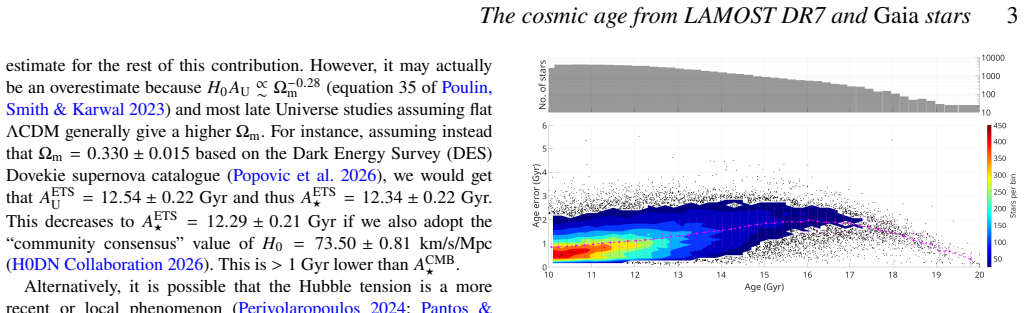
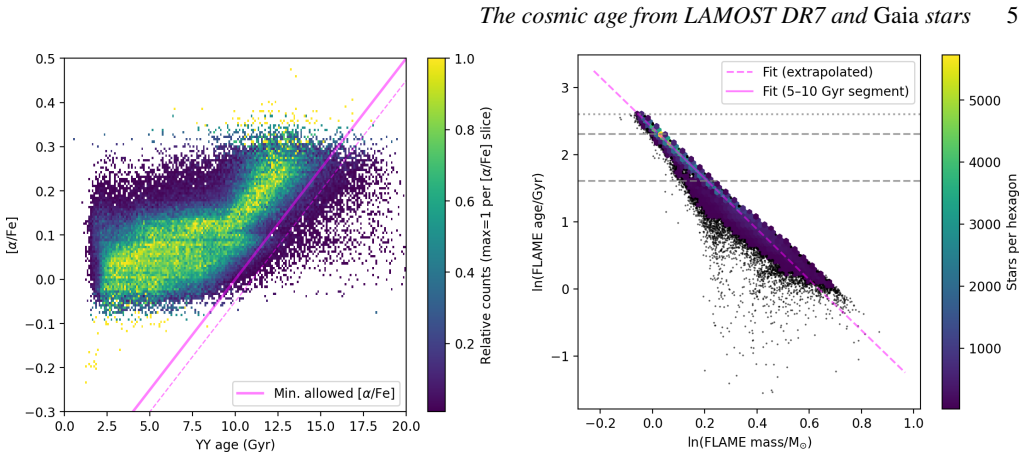
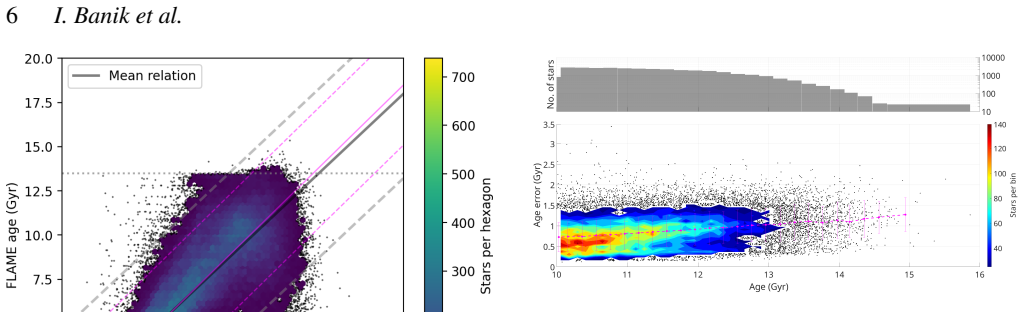
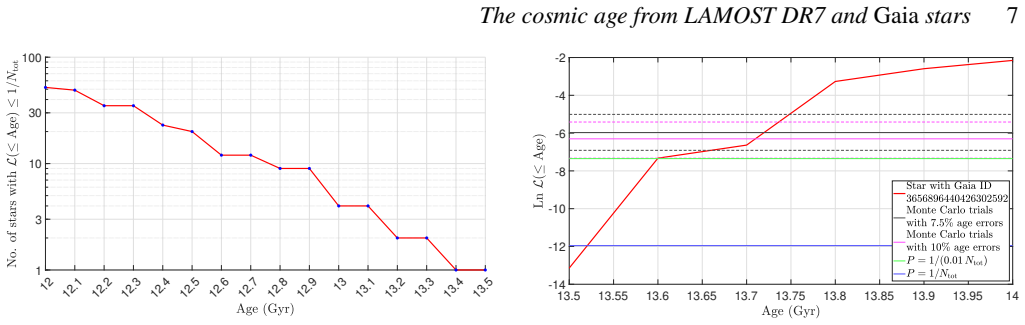
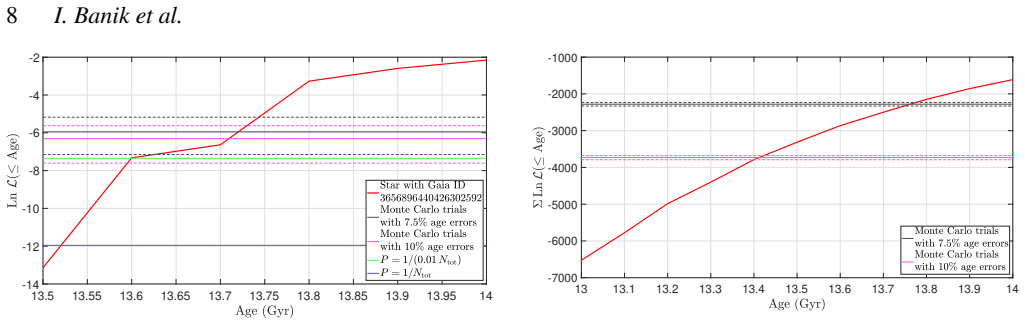
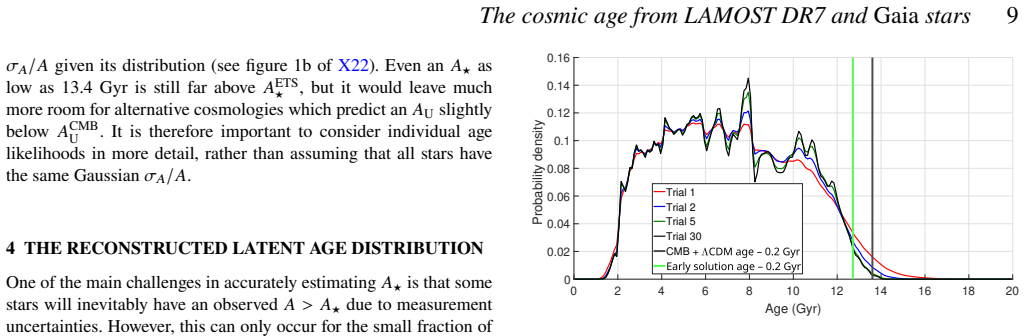
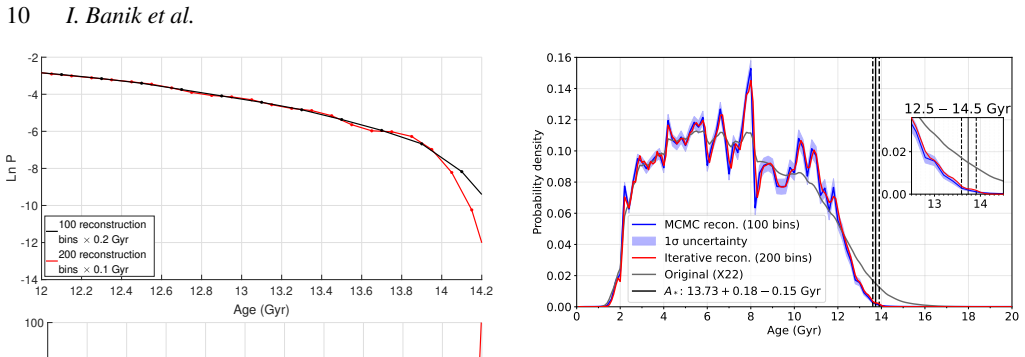
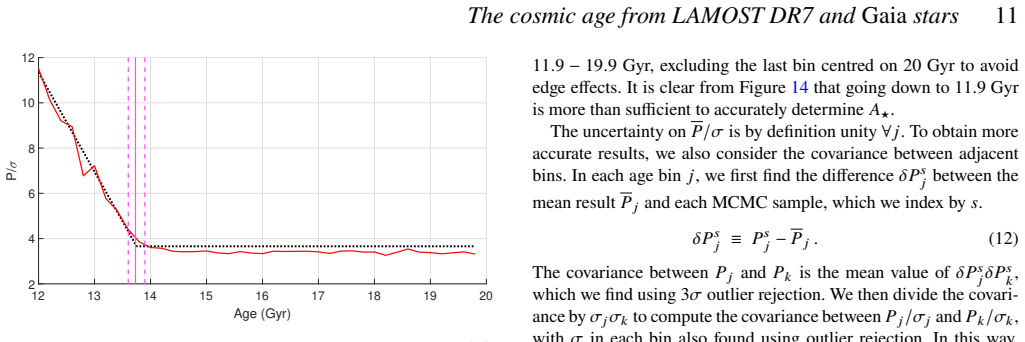
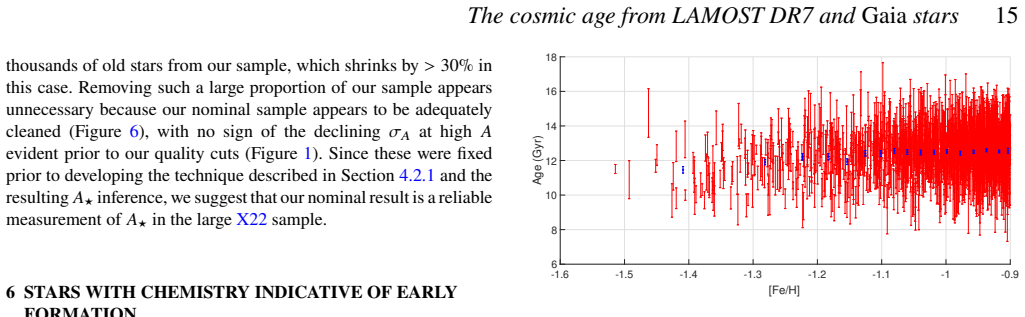
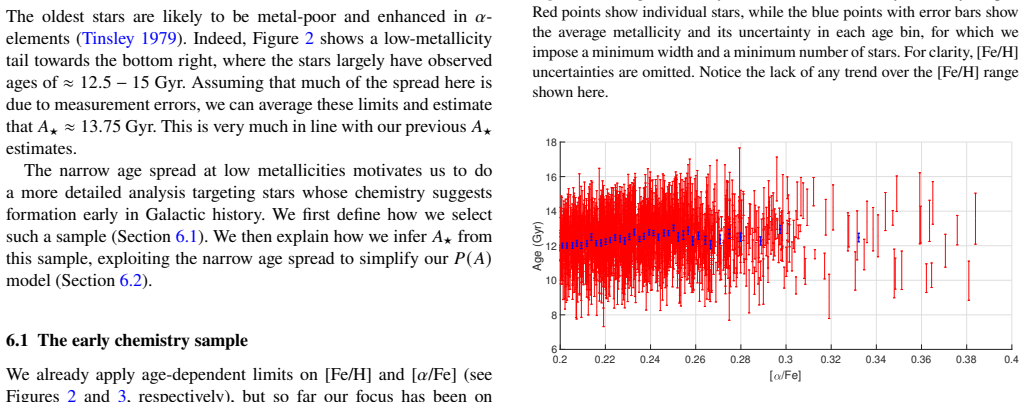
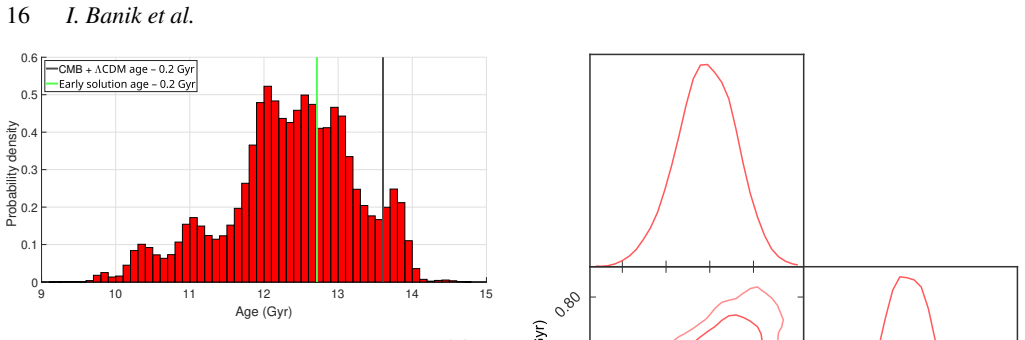
Applying YY isochrones to a sample of 247,103 stars with LAMOST spectroscopy and Gaia parallaxes, then restricting to metal-poor alpha-enhanced objects with consistent FLAME ages, produces a final catalog of 155,600 stars within 5 kpc. MCMC reconstruction of the latent age distribution gives an oldest-star age A_star of 13.73^{+0.18}_{-0.15} Gyr. This matches the 13.6 Gyr expected in CMB-calibrated Lambda-CDM under the assumption that the first long-lived stars formed 0.2 Gyr after the Big Bang, thereby casting doubt on pre-recombination solutions to the Hubble tension that imply a cosmic age of only 12.9 plus or minus 0.2 Gyr.
What carries the argument
MCMC reconstruction of the latent age distribution from the selected sample of 155,600 metal-poor alpha-enriched stars with consistent YY and FLAME ages.
If this is right
- The cosmic age must be at least 13.5 Gyr once allowance is made for the 0.2 Gyr delay to first star formation.
- Any Hubble-tension resolution that alters only pre-recombination physics and forces a 12.9 Gyr universe is disfavored.
- Stellar modeling uncertainties are unlikely to shift the oldest-star age down by the required 0.8 Gyr given the low metallicities involved.
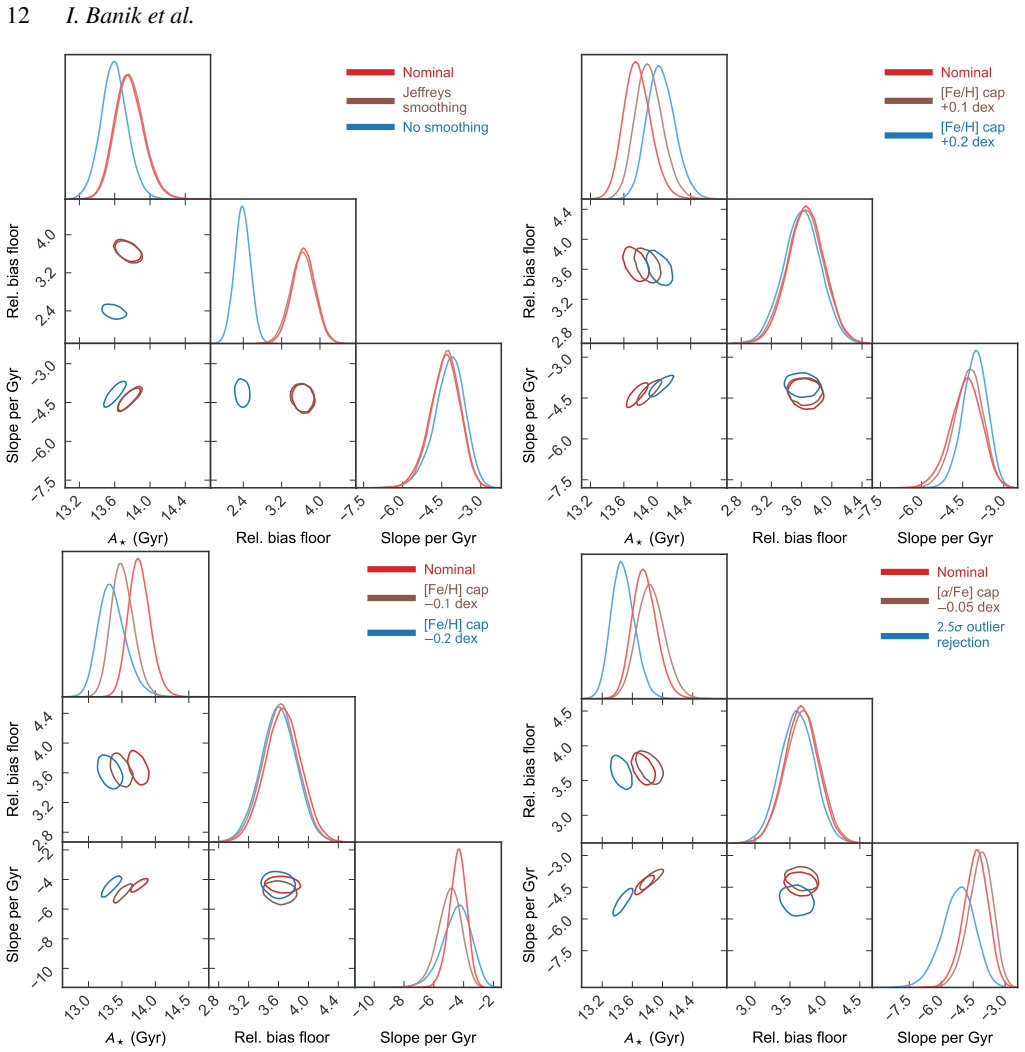
- Quality cuts on the sample can move the inferred A_star by at most 0.4 Gyr in either direction.
Where Pith is reading between the lines
- Future Gaia data releases or larger spectroscopic samples could tighten the uncertainty on A_star below 0.1 Gyr.
- If the result holds, it strengthens the case for post-recombination or local explanations of the Hubble tension.
- The same selection technique could be applied to other large surveys to test whether the oldest-star age is uniform across the Milky Way.
Load-bearing premise
Stellar ages from YY isochrones remain accurate for these low-metallicity, alpha-enriched stars even after accounting for possible systematic modeling errors.
What would settle it
An independent asteroseismic or alternative isochrone analysis of the same metal-poor stars returning a maximum age near 12.9 Gyr would falsify the claimed consistency with 13.6 Gyr cosmology.
Figures

read the original abstract
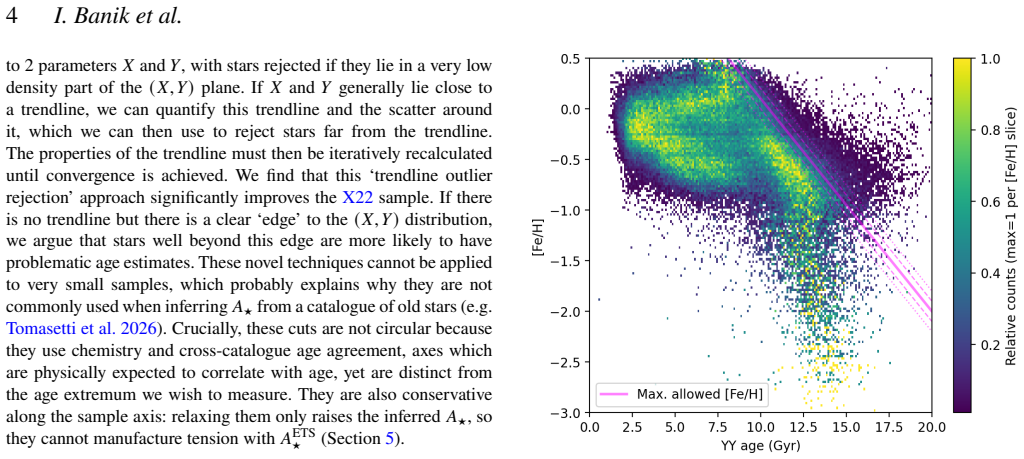
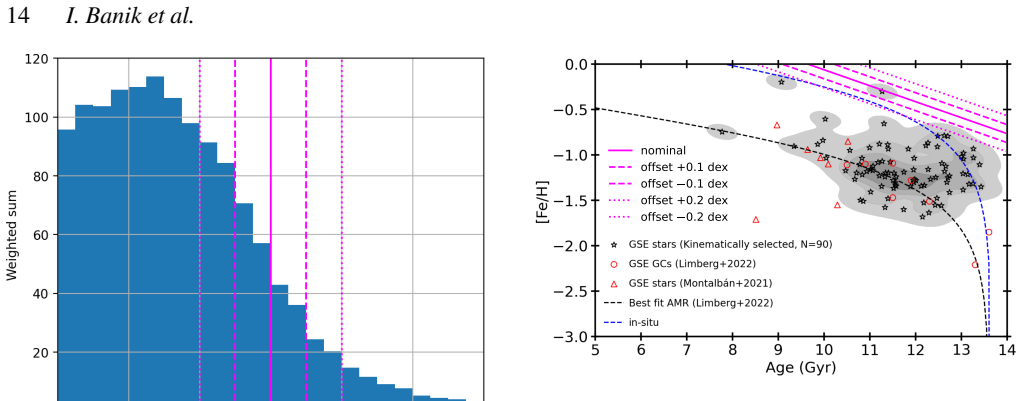
We estimate the age of the Universe using the Xiang & Rix sample of 247,103 Milky Way stars with high-resolution spectroscopy from LAMOST DR7 and $Gaia$ eDR3 parallaxes. Stellar ages were estimated using YY isochrones up to 20 Gyr. To remove stars with unusually high and precise ages, we require old stars to be metal-poor and $\alpha$-enriched. We also require consistency between YY ages and those obtained with FLAME based only on $Gaia$ data. Our final sample of 155,600 stars within 5 kpc provides consistent cosmic age estimates using several techniques of increasing rigour. Our main results use an MCMC reconstruction of the latent age distribution, though our iterative reconstruction is very similar. Applying an innovative approach to our MCMC reconstruction and its uncertainties, we find that the oldest star has an age of $A_\star = 13.73^{+0.18}_{-0.15}$ Gyr. Varying the quality cuts can at most reduce this to $A_\star = 13.31^{+0.21}_{-0.18}$ Gyr or raise it to $14.02^{+0.18}_{-0.15}$ Gyr using a much lower or higher age-dependent metallicity ceiling, respectively. Our inferred $A_\star$ is consistent with the 13.6 Gyr expected in CMB-calibrated $\Lambda$CDM, assuming the first long-lived stars formed when the Universe was 0.2 Gyr old. This agreement casts doubt on solutions to the Hubble tension solely through new physics prior to recombination, which generally imply a cosmic age of $12.9 \pm 0.2$ Gyr to match low redshift probes. It is difficult for stellar modelling uncertainties to reconcile such a low age with our result given the low metallicities of the oldest stars in our sample and independent asteroseismic constraints.
Editorial analysis
A structured set of objections, weighed in public.
Referee Report
Summary. The manuscript estimates the age of the Universe from the oldest stars in a sample of 155,600 Milky Way stars drawn from LAMOST DR7 spectroscopy and Gaia eDR3 parallaxes. Stellar ages are computed with YY isochrones (up to 20 Gyr), subject to cuts requiring metal-poor, α-enriched stars and consistency with FLAME ages; an MCMC reconstruction of the latent age distribution then yields A_★ = 13.73^{+0.18}_{-0.15} Gyr for the oldest star. The result is stated to be consistent with the 13.6 Gyr expected in CMB-calibrated ΛCDM (assuming first long-lived stars formed at 0.2 Gyr) while casting doubt on 12.9 ± 0.2 Gyr cosmologies invoked to resolve the Hubble tension via pre-recombination new physics. Variations in quality cuts shift the lower edge to at most 13.31 Gyr.
Significance. If the central result holds after addressing modeling systematics, the work supplies a statistically large, independent lower bound on cosmic age from Galactic stellar archaeology. The use of multiple reconstruction techniques (MCMC and iterative) and cross-checks with FLAME ages constitutes a methodological strength; the direct comparison to specific early-universe solutions of the Hubble tension makes the claim falsifiable.
major comments (1)
- [Abstract and stellar modelling uncertainties discussion] Abstract (final paragraph) and the discussion of stellar modelling uncertainties: the assertion that 'it is difficult for stellar modelling uncertainties to reconcile such a low age with our result' is load-bearing for the claim that the measurement rules out 12.9 Gyr cosmologies, yet no numerical upper bound is supplied on the maximum plausible systematic overestimation of YY isochrone ages for the metal-poor ([Fe/H] ≲ −1), α-enriched stars. No propagation of plausible variations in mixing length, helium abundance, or diffusion through the MCMC latent-age reconstruction is presented, leaving the tension with 12.9 Gyr conditional on an unquantified assumption.
minor comments (2)
- [Sample selection] The precise functional form of the 'age-dependent metallicity ceiling' used to exclude high-age outliers is not stated explicitly; its impact on the final sample of 155,600 stars and on the MCMC posterior should be documented with a supplementary table or equation.
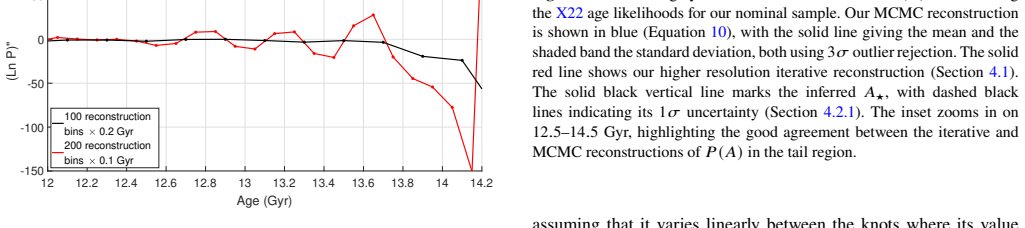
- [Results] Figure or table showing the posterior distribution of the oldest-star age under the baseline MCMC run versus the lowest-quality-cut variant would help readers assess how close 13.31 Gyr lies to the 12.9 Gyr threshold.
Simulated Author's Rebuttal
We thank the referee for their thoughtful and constructive report. The single major comment raises a valid point about the need for more explicit quantification of stellar modeling systematics to support the claim regarding tension with 12.9 Gyr cosmologies. We address this below and will revise the manuscript accordingly.
read point-by-point responses
-
Referee: Abstract (final paragraph) and the discussion of stellar modelling uncertainties: the assertion that 'it is difficult for stellar modelling uncertainties to reconcile such a low age with our result' is load-bearing for the claim that the measurement rules out 12.9 Gyr cosmologies, yet no numerical upper bound is supplied on the maximum plausible systematic overestimation of YY isochrone ages for the metal-poor ([Fe/H] ≲ −1), α-enriched stars. No propagation of plausible variations in mixing length, helium abundance, or diffusion through the MCMC latent-age reconstruction is presented, leaving the tension with 12.9 Gyr conditional on an unquantified assumption.
Authors: We agree that a quantitative assessment of the maximum plausible systematic overestimation would make the argument more robust. In the revised manuscript we will add a dedicated subsection (and supporting appendix) that compiles literature constraints on the effects of mixing-length variations, helium abundance, and atomic diffusion for metal-poor, α-enhanced stars in the relevant parameter range. We will then perform a sensitivity analysis by shifting the YY isochrone grid within these bounds, re-running the MCMC latent-age reconstruction on the shifted ages, and reporting the resulting shift in the inferred A★ lower edge. This will supply the requested numerical upper bound on overestimation and allow direct propagation into the final uncertainty budget. revision: yes
Circularity Check
No circularity: stellar age derived from data and models, cosmology used only for post-hoc comparison
full rationale
The derivation chain starts from LAMOST+Gaia observations, applies YY isochrone fitting to obtain individual stellar ages, imposes quality cuts (metal-poor, alpha-enriched, FLAME consistency), and reconstructs the latent age distribution via MCMC to extract A_star. None of these steps reference cosmological parameters or prior results from the same authors. The subsequent comparison of A_star to the 13.6 Gyr ΛCDM expectation (with 0.2 Gyr formation delay) is an external consistency test, not an input to the age reconstruction. No self-citations, fitted inputs renamed as predictions, or ansatzes imported via citation appear in the load-bearing steps. The result is therefore self-contained against external benchmarks.
Axiom & Free-Parameter Ledger
free parameters (2)
- age-dependent metallicity ceiling
- first star formation time =
0.2 Gyr
axioms (2)
- domain assumption YY isochrones provide reliable ages for metal-poor alpha-enriched stars up to 20 Gyr
- domain assumption The selected stars within 5 kpc are representative of the oldest population without significant contamination by younger stars
Reference graph
Works this paper leans on
-
[1]
Sitzungsberichte der K
Die Feldgleichungen der Gravitation. Sitzungsberichte der K
-
[2]
Sitzungsberichte der K
Kosmologische Betrachtungen zur allgemeinen Relativit \"a tstheorie. Sitzungsberichte der K
-
[3]
Royal Society of London Philosophical Transactions Series A , year = 1920, volume = 220, pages =
A Determination of the Deflection of Light by the Sun's Gravitational Field, from Observations Made at the Total Eclipse of May 29, 1919. Royal Society of London Philosophical Transactions Series A , year = 1920, volume = 220, pages =. doi:10.1098/rsta.1920.0009 , adsurl =
-
[4]
\"U ber die Kr \"u mmung des Raumes. Zeitschrift fur Physik , year = 1922, month = jan, volume =. doi:10.1007/BF01332580 , adsurl =
-
[5]
\"U ber die M \"o glichkeit einer Welt mit konstanter negativer Kr \"u mmung des Raumes. Zeitschrift fur Physik , year = 1924, month = dec, volume =. doi:10.1007/BF01328280 , adsurl =
-
[6]
MNRAS , year = 1931, month = mar, volume =
A homogeneous universe of constant mass and increasing radius accounting for the radial velocity of extra-galactic nebulae. MNRAS , year = 1931, month = mar, volume =. doi:10.1093/mnras/91.5.483 , adsurl =
-
[7]
ApJ , year = 1935, month = nov, volume =
Kinematics and World-Structure. ApJ , year = 1935, month = nov, volume =. doi:10.1086/143681 , adsurl =
-
[8]
ApJ , year = 1936, month = apr, volume =
Kinematics and World-Structure II. ApJ , year = 1936, month = apr, volume =. doi:10.1086/143716 , adsurl =
-
[9]
ApJ , year = 1936, month = may, volume =
Kinematics and World-Structure III. ApJ , year = 1936, month = may, volume =. doi:10.1086/143726 , adsurl =
-
[10]
Proceedings of the London Mathematical Society , year = 1937, month = jan, volume =
On Milne's Theory of World-Structure. Proceedings of the London Mathematical Society , year = 1937, month = jan, volume =. doi:10.1112/plms/s2-42.1.90 , adsurl =
-
[11]
Philosophical Magazine , year = 1933, month = jan, volume =
On the Definition of Distance in General Relativity. Philosophical Magazine , year = 1933, month = jan, volume =. doi:10.1007/s10714-007-0447-x , adsurl =
-
[12]
Physical Review D , year = 1981, month = jan, volume =
Inflationary universe: A possible solution to the horizon and flatness problems. Physical Review D , year = 1981, month = jan, volume =. doi:10.1103/PhysRevD.23.347 , adsurl =
-
[13]
Physics of the Dark Universe , keywords =
Smoothing the H _ 0 tension with a phantom dynamical dark energy model. Physics of the Dark Universe , keywords =. doi:10.1016/j.dark.2023.101266 , archivePrefix =. 2301.04200 , primaryClass =
-
[14]
Physical review D , keywords =
Dissipative quintessence and its cosmological implications. Physical review D , keywords =. doi:10.1103/PhysRevD.107.123507 , archivePrefix =. 2305.14845 , primaryClass =
-
[15]
Physics of the Dark Universe , keywords =
Can interacting dark energy with dynamical coupling resolve the Hubble tension. Physics of the Dark Universe , keywords =. doi:10.1016/j.dark.2022.101165 , archivePrefix =. 2207.05955 , primaryClass =
-
[16]
European Physical Journal C , keywords =
Towards a possible solution to the Hubble tension with Horndeski gravity. European Physical Journal C , keywords =. doi:10.1140/epjc/s10052-024-12577-0 , archivePrefix =. 2301.09382 , primaryClass =
-
[17]
Accelerating Universes with Scaling Dark Matter
Accelerating Universes with Scaling Dark Matter. International Journal of Modern Physics D , keywords =. doi:10.1142/S0218271801000822 , archivePrefix =. gr-qc/0009008 , primaryClass =
work page internal anchor Pith review Pith/arXiv arXiv doi:10.1142/s0218271801000822
-
[18]
Exploring the Expansion History of the Universe
Exploring the Expansion History of the Universe. Physical Review Letters , keywords =. doi:10.1103/PhysRevLett.90.091301 , archivePrefix =. astro-ph/0208512 , primaryClass =
work page internal anchor Pith review Pith/arXiv arXiv doi:10.1103/physrevlett.90.091301
-
[19]
Robust preference for Dynamical Dark Energy in DESI BAO and SN measurements. JCAP , keywords =. doi:10.1088/1475-7516/2024/10/035 , archivePrefix =. 2407.16689 , primaryClass =
-
[20]
Cascading Dark Energy. ApJ , keywords =. doi:10.3847/1538-4357/ad7b16 , archivePrefix =. 2208.07631 , primaryClass =
-
[21]
Astronomische Nachrichten , year = 1922, month = apr, volume =
Einiges zur Statistik der Radialbewegungen von Spiralnebeln und Kugelsternhaufen. Astronomische Nachrichten , year = 1922, month = apr, volume =. doi:10.1002/asna.19212151703 , adsurl =
-
[22]
Astronomische Nachrichten , year = 1924, month = jul, volume =
De Sitters Kosmologie und die Radialbewegungen der Spiralnebel. Astronomische Nachrichten , year = 1924, month = jul, volume =. doi:10.1002/asna.19242220203 , adsurl =
-
[23]
ApJ , year = 1929, month = mar, volume =
A spiral nebula as a stellar system, Messier 31. ApJ , year = 1929, month = mar, volume =. doi:10.1086/143167 , adsurl =
-
[24]
Helvetica Physica Acta , year = 1933, month = jan, volume =
Die Rotverschiebung von extragalaktischen Nebeln. Helvetica Physica Acta , year = 1933, month = jan, volume =
1933
-
[25]
ApJ , year = 1937, month = oct, volume =
On the Masses of Nebulae and of Clusters of Nebulae. ApJ , year = 1937, month = oct, volume = 86, pages =. doi:10.1086/143864 , adsurl =
-
[26]
ApJ , year = 1959, month = nov, volume = 130, pages =
Intergalactic Matter and the Galaxy. ApJ , year = 1959, month = nov, volume = 130, pages =. doi:10.1086/146762 , adsurl =
-
[27]
Astrofizika , year = 1970, month = jan, volume =
The space structure of perturbations and the origin of rotation of galaxies in the theory of fluctuation. Astrofizika , year = 1970, month = jan, volume =
1970
-
[28]
Core condensation in heavy halos: a two-stage theory for galaxy formation and clustering. MNRAS , keywords =. doi:10.1093/mnras/183.3.341 , adsurl =
-
[29]
Angular momentum growth in protogalaxies. ApJ , keywords =. doi:10.1086/162573 , adsurl =
-
[30]
Physical Review Letters , keywords =
Experimental tests of the 'invisible' axion. Physical Review Letters , keywords =. doi:10.1103/PhysRevLett.51.1415 , adsurl =
-
[31]
High Energy Physics and Cosmology, 1997 Summer School , year = 1998, eprint =
WIMP and Axion Dark Matter. High Energy Physics and Cosmology, 1997 Summer School , year = 1998, eprint =
1997
-
[32]
Astronomische Nachrichten , year = 1958, month = jan, volume = 284, pages =
Verzeichnis von 62 O-und B-Sterngruppen. Astronomische Nachrichten , year = 1958, month = jan, volume = 284, pages =
1958
-
[33]
Does the missing mass problem signal the breakdown of Newtonian gravity?. ApJ , keywords =. doi:10.1086/162570 , adsurl =
-
[34]
Isothermal spheres in the modified dynamics. ApJ , keywords =. doi:10.1086/162716 , adsurl =
-
[35]
The fundamental plane of elliptical galaxies with modified Newtonian dynamics. MNRAS , keywords =. doi:10.1046/j.1365-8711.2000.03272.x , archivePrefix =. astro-ph/9907326 , primaryClass =
-
[36]
Remarks on the properties of elliptical galaxies in modified Newtonian dynamics
Remarks on the properties of elliptical galaxies in modified Newtonian dynamics. A&A , keywords =. doi:10.1051/0004-6361/201116531 , archivePrefix =. 1103.3040 , primaryClass =
work page internal anchor Pith review Pith/arXiv arXiv doi:10.1051/0004-6361/201116531
-
[37]
MNRAS , archivePrefix = "arXiv", eprint =
A dynamical model of the local cosmic expansion. MNRAS , archivePrefix = "arXiv", eprint =. doi:10.1093/mnras/stu879 , adsurl =
-
[38]
MNRAS , archivePrefix = "arXiv", eprint =
A timing constraint on the (total) mass of the Large Magellanic Cloud. MNRAS , archivePrefix = "arXiv", eprint =. doi:10.1093/mnrasl/slv160 , adsurl =
-
[39]
What galaxy masses perturb the local cosmic expansion?
What galaxy masses perturb the local cosmic expansion?. MNRAS , keywords =. doi:10.1093/mnras/stx323 , archivePrefix =. 1609.07147 , primaryClass =
work page internal anchor Pith review Pith/arXiv arXiv doi:10.1093/mnras/stx323
-
[40]
Lowell Observatory Bulletin , year = 1913, volume = 2, pages =
The radial velocity of the Andromeda Nebula. Lowell Observatory Bulletin , year = 1913, volume = 2, pages =
1913
-
[41]
MNRAS , archivePrefix = "arXiv", eprint =
Inferring the Andromeda Galaxy's mass from its giant southern stream with Bayesian simulation sampling. MNRAS , archivePrefix = "arXiv", eprint =. doi:10.1093/mnras/stt1121 , adsurl =
-
[42]
The Need for Speed: Escape velocity and dynamical mass measurements of the Andromeda galaxy
The need for speed: escape velocity and dynamical mass measurements of the Andromeda galaxy. MNRAS , keywords =. doi:10.1093/mnras/sty082 , archivePrefix =. 1801.03949 , primaryClass =
work page internal anchor Pith review Pith/arXiv arXiv doi:10.1093/mnras/sty082
-
[43]
Milky Way total Mass derived by Rotation Curve and Globular Cluster kinematics from Gaia EDR3. MNRAS , keywords =. doi:10.1093/mnras/stab3258 , adsurl =
-
[44]
How Close Dark Matter Halos and MOND Are to Each Other: Three-Dimensional Tests Based on Gaia DR2. MNRAS , keywords =. doi:10.1093/mnras/stac3483 , archivePrefix =. 2211.13153 , primaryClass =
-
[45]
The Circular Velocity Curve of the Milky Way from 5-25 kpc Using Luminous Red Giant Branch Stars. ApJ , keywords =. doi:10.3847/1538-4357/acadd9 , archivePrefix =. 2212.10393 , primaryClass =
-
[46]
Dark Matter Halo Masses from Abundance Matching and Kinematics: Tensions for the Milky Way and M31. RNAAS , keywords =. doi:10.3847/2515-5172/abe1ba , adsurl =
-
[47]
Resolving the mystery of the dwarf galaxy HIZSS003. MNRAS , eprint =. doi:10.1111/j.1745-3933.2005.00040.x , adsurl =
-
[48]
The Local Group and Other Neighboring Galaxy Groups. AJ , eprint =. doi:10.1086/426368 , adsurl =
-
[49]
Masses of the local group and of the M81 group estimated from distortions in the local velocity field. Astrophysics , keywords =. doi:10.1007/s10511-006-0002-6 , adsurl =
-
[50]
PASA , archivePrefix = "arXiv", eprint =
The Distance to NGC 5128 (Centaurus A). PASA , archivePrefix = "arXiv", eprint =. doi:10.1071/AS09061 , adsurl =
-
[51]
A Lockdown Perspective on the Hubble Tension (with comments from the SH0ES team). ArXiv e-prints , keywords =. doi:10.48550/arXiv.2007.10716 , archivePrefix =. 2007.10716 , primaryClass =
-
[52]
Peculiar velocities in the local Universe: comparison of different models and the implications for H _ 0 and dark matter. MNRAS , keywords =. doi:10.1093/mnras/stab2320 , archivePrefix =. 2010.01119 , primaryClass =
-
[53]
ApJ , archivePrefix = "arXiv", eprint =
A Study of Cepheids in M81 with the Large Binocular Telescope (Efficiently Calibrated with Hubble Space Telescope). ApJ , archivePrefix = "arXiv", eprint =. doi:10.1088/0004-637X/743/2/176 , adsurl =
-
[54]
A&A , archivePrefix = "arXiv", eprint =
Galactic kinematics with modified Newtonian dynamics. A&A , archivePrefix = "arXiv", eprint =. doi:10.1051/0004-6361/200809978 , adsurl =
-
[55]
The local dark matter density. Journal of Physics G Nuclear Physics , keywords =. doi:10.1088/0954-3899/41/6/063101 , archivePrefix =. 1404.1938 , primaryClass =
work page internal anchor Pith review Pith/arXiv arXiv doi:10.1088/0954-3899/41/6/063101 1938
-
[56]
Revisiting north-south asymmetries and dark matter density at large heights
Kinematics and dynamics of Gaia red clump stars. Revisiting north-south asymmetries and dark matter density at large heights. A&A , keywords =. doi:10.1051/0004-6361/202038535 , archivePrefix =. 2009.04495 , primaryClass =
-
[57]
Reports on Progress in Physics , keywords =
Dark matter local density determination: recent observations and future prospects. Reports on Progress in Physics , keywords =. doi:10.1088/1361-6633/ac24e7 , archivePrefix =. 2012.11477 , primaryClass =
-
[58]
Physical Review D , keywords =
Testing dark matter and modifications to gravity using local Milky Way observables. Physical Review D , keywords =. doi:10.1103/PhysRevD.100.083009 , archivePrefix =. 1812.08169 , primaryClass =
-
[59]
The tilt of the velocity ellipsoid in the Milky Way with Gaia DR2. A&A , keywords =. doi:10.1051/0004-6361/201935264 , archivePrefix =. 1902.05268 , primaryClass =
-
[60]
The tilt of the local velocity ellipsoid as seen by Gaia. MNRAS , keywords =. doi:10.1093/mnras/stz2217 , archivePrefix =. 1904.08460 , primaryClass =
-
[61]
Measuring the local dark matter density with LAMOST DR5 and Gaia DR2. MNRAS , keywords =. doi:10.1093/mnras/staa1483 , archivePrefix =. 2005.12018 , primaryClass =
-
[62]
Tracing the Dynamical Mass in Galaxy Disks Using HI Velocity Dispersion and its Implications for the Dark Matter Distribution in Galaxies. ApJ , keywords =. doi:10.3847/1538-4357/ab5fcd , adsurl =
-
[63]
AJ , archivePrefix = "arXiv", eprint =
Infrared Tip of the Red Giant Branch and Distances to the Maffei/IC 342 Group. AJ , archivePrefix = "arXiv", eprint =. doi:10.1088/0004-6256/148/1/7 , adsurl =
-
[64]
A past Milky Way-Andromeda encounter at z 0.8
Local Group timing in Milgromian dynamics. A past Milky Way-Andromeda encounter at z 0.8. A&A , archivePrefix = "arXiv", eprint =. doi:10.1051/0004-6361/201321879 , adsurl =
-
[65]
2012, , 427, 127, 10.1111/j.1365-2966.2012.21948.x
Galactic rotation and solar motion from stellar kinematics. MNRAS , archivePrefix = "arXiv", eprint =. doi:10.1111/j.1365-2966.2012.21631.x , adsurl =
-
[66]
The base models and a new line index system
Local kinematics and the local standard of rest. MNRAS , archivePrefix = "arXiv", eprint =. doi:10.1111/j.1365-2966.2010.16253.x , adsurl =
-
[67]
Mass models of the Milky Way. MNRAS , archivePrefix = "arXiv", eprint =. doi:10.1111/j.1365-2966.2011.18564.x , adsurl =
-
[68]
Celestial Mechanics and Dynamical Astronomy , archivePrefix = "arXiv", eprint =
The local standard of rest and the well in the velocity distribution. Celestial Mechanics and Dynamical Astronomy , archivePrefix = "arXiv", eprint =. doi:10.1007/s10569-014-9541-z , adsurl =
-
[69]
The power spectrum of the Milky Way: Velocity fluctuations in the Galactic disk
The Power Spectrum of the Milky Way: Velocity Fluctuations in the Galactic Disk. ApJ , keywords =. doi:10.1088/0004-637X/800/2/83 , archivePrefix =. 1410.8135 , primaryClass =
work page internal anchor Pith review Pith/arXiv arXiv doi:10.1088/0004-637x/800/2/83
-
[70]
The Sloan Digital Sky Survey: Technical Summary. AJ , eprint =. doi:10.1086/301513 , adsurl =
-
[71]
Astronomy & Geophysics , keywords =
GAMA: towards a physical understanding of galaxy formation. Astronomy & Geophysics , keywords =. doi:10.1111/j.1468-4004.2009.50512.x , archivePrefix =. 0910.5123 , primaryClass =
-
[72]
The base models and a new line index system
Galaxy and Mass Assembly (GAMA): survey diagnostics and core data release. MNRAS , keywords =. doi:10.1111/j.1365-2966.2010.18188.x , archivePrefix =. 1009.0614 , primaryClass =
-
[73]
Nature , archivePrefix = "arXiv", eprint =
The remnants of galaxy formation from a panoramic survey of the region around M31. Nature , archivePrefix = "arXiv", eprint =. doi:10.1038/nature08327 , adsurl =
-
[74]
The Large-scale Structure of the Halo of the Andromeda Galaxy. II. Hierarchical Structure in the Pan-Andromeda Archaeological Survey. ApJ , keywords =. doi:10.3847/1538-4357/aae8e7 , archivePrefix =. 1810.08234 , primaryClass =
work page internal anchor Pith review Pith/arXiv arXiv doi:10.3847/1538-4357/aae8e7
-
[75]
Nature , archivePrefix = "arXiv", eprint =
A vast, thin plane of corotating dwarf galaxies orbiting the Andromeda galaxy. Nature , archivePrefix = "arXiv", eprint =. doi:10.1038/nature11717 , adsurl =
-
[76]
HST Proper Motions of NGC 147 and NGC 185: Orbital Histories and Test of Dynamically Coherent Andromeda Satellite Plane. ApJ , keywords =. doi:10.3847/1538-4357/abaf49 , adsurl =
-
[77]
On the Co-orbitation of Satellite Galaxies along the Great Plane of Andromeda: NGC 147, NGC 185, and Expectations from Cosmological Simulations. ApJ , keywords =. doi:10.3847/1538-4357/ac2aa9 , archivePrefix =. 2109.13253 , primaryClass =
-
[78]
The Clustering of Orbital Poles Induced by the LMC: Hints for the Origin of Planes of Satellites. ApJ , keywords =. doi:10.3847/1538-4357/ac2c05 , archivePrefix =. 2108.07321 , primaryClass =
-
[79]
Measuring the Milky Way mass distribution in the presence of the LMC. MNRAS , keywords =. doi:10.1093/mnras/stab3726 , archivePrefix =. 2110.00018 , primaryClass =
-
[80]
On the Effect of the Large Magellanic Cloud on the Orbital Poles of Milky Way Satellite Galaxies. ApJ , keywords =. doi:10.3847/1538-4357/ac6ce0 , adsurl =
discussion (0)
Sign in with ORCID, Apple, or X to comment. Anyone can read and Pith papers without signing in.