Analytical calculation of the spectrum of nonlinear Compton scattering beyond local approximations
Pith reviewed 2026-06-26 10:23 UTC · model grok-4.3
The pith
Compact analytical formulae are derived for the nonlinear Compton scattering spectrum in finite plane-wave pulses with smooth envelopes.
A machine-rendered reading of the paper's core claim, the machinery that carries it, and where it could break.
Core claim
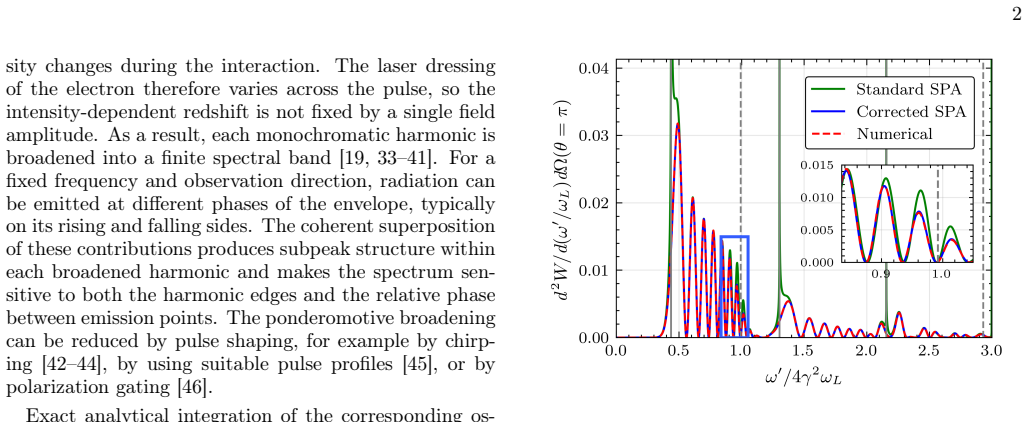
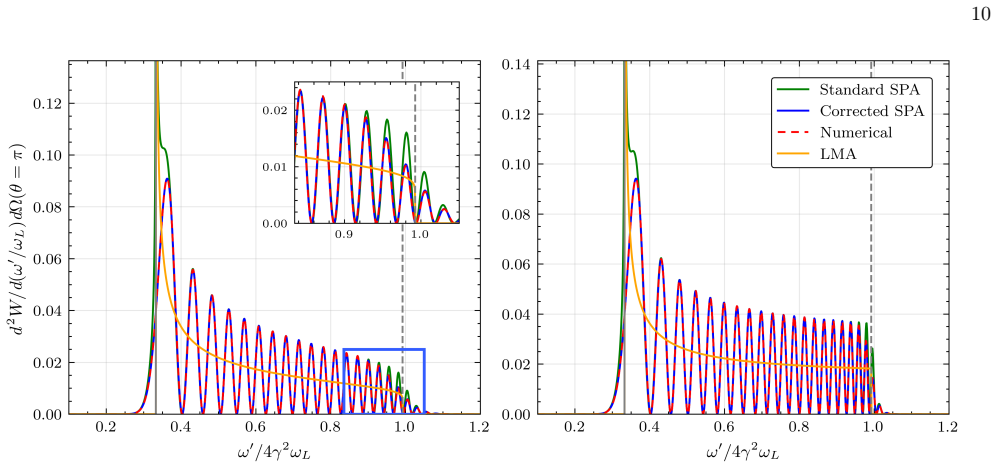
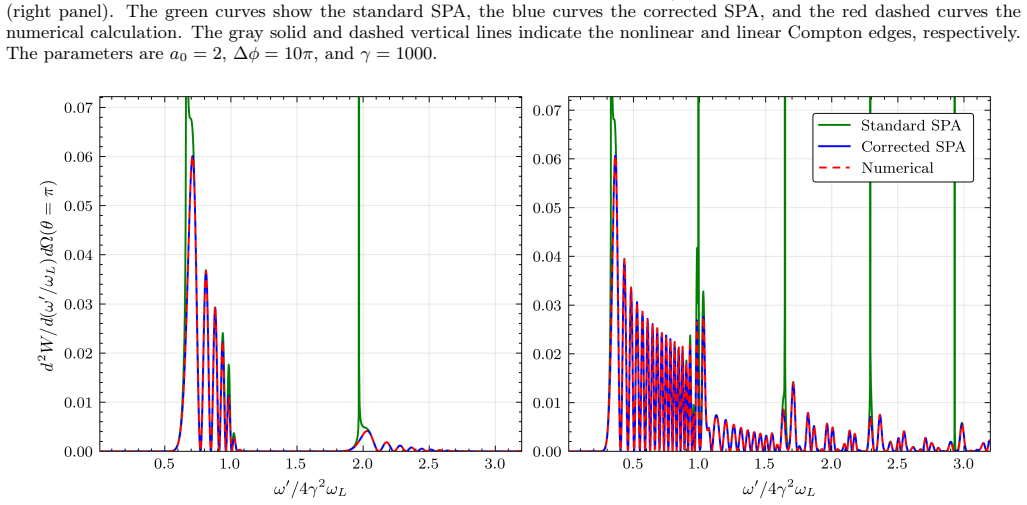
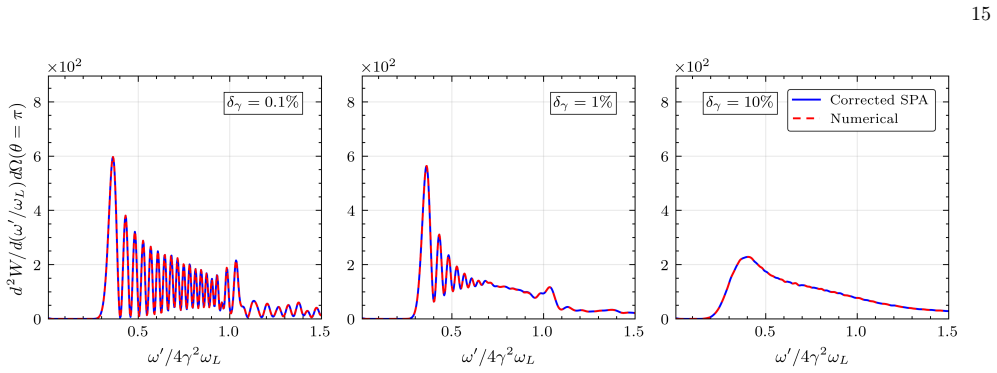
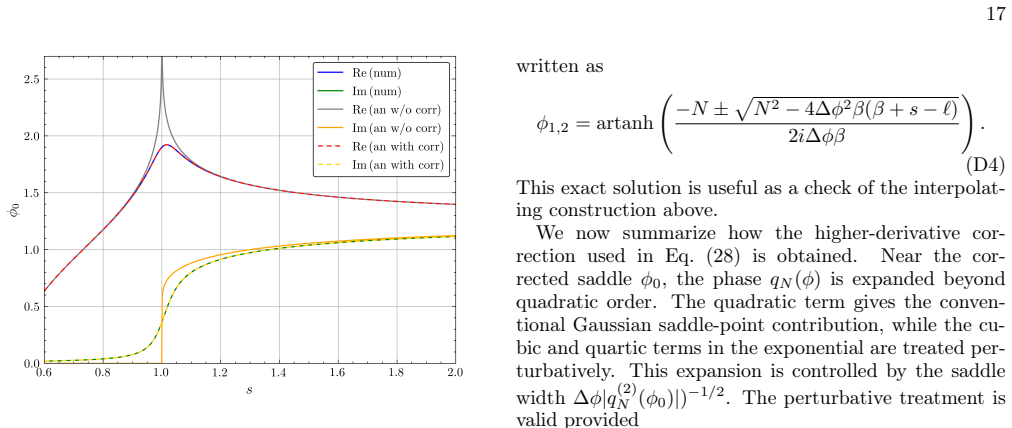
We derive compact analytical formulae for the spectrum of nonlinear Compton scattering in a finite plane-wave pulse with a smooth temporal envelope. The strong-field QED probability is reduced to finite-pulse phase integrals, which are evaluated asymptotically for multicycle pulses with a broad class of smooth envelopes. We use the uniform approximation to remove the caustic divergences that appear at the nonlinear edges of broadened harmonics. Away from the caustics, it reduces to the standard saddle-point result. The behavior near the linear edge is further improved by an envelope-corrected saddle-point approximation. The approach retains the harmonic substructure in the spectral-angular r
What carries the argument
Finite-pulse phase integrals evaluated asymptotically via the uniform approximation to handle caustics and envelope-corrected saddle-point method.
If this is right
- The resulting formulae agree with direct numerical calculations within their asymptotic domain.
- The harmonic substructure is retained in the dominant part of the emitted radiation.
- The locally monochromatic approximation is recovered by averaging the finite-pulse interference.
- Spectra from an electron beam can be evaluated analytically using these expressions.
Where Pith is reading between the lines
- The approach may apply to other strong-field QED processes involving finite pulses with similar envelopes.
- Testable by comparing the analytical spectra to numerical results for pulses with different smooth envelopes.
- Could simplify calculations in experiments where electron beams collide with intense laser pulses.
Load-bearing premise
The pulse is multicycle with a smooth temporal envelope from the broad class where the uniform approximation and envelope-corrected saddle-point method are valid.
What would settle it
A direct numerical evaluation of the phase integrals or spectrum for a multicycle smooth pulse that shows significant deviation from the analytical formulae outside the caustics would falsify the asymptotic expressions.
Figures
read the original abstract
We derive compact analytical formulae for the spectrum of nonlinear Compton scattering in a finite plane-wave pulse with a smooth temporal envelope. The strong-field QED probability is reduced to finite-pulse phase integrals, which are evaluated asymptotically for multicycle pulses with a broad class of smooth envelopes. We use the uniform approximation to remove the caustic divergences that appear at the nonlinear edges of broadened harmonics. Away from the caustics, it reduces to the standard saddle-point result. The behavior near the linear edge is further improved by an envelope-corrected saddle-point approximation. The approach retains the harmonic substructure in the spectral-angular region carrying the dominant part of the emitted radiation. The locally monochromatic approximation is recovered by averaging the finite-pulse interference. Within their asymptotic domain of applicability, the resulting formulae agree with direct numerical calculations and can be used to evaluate spectra from an electron beam.
Editorial analysis
A structured set of objections, weighed in public.
Referee Report
Summary. The manuscript derives compact analytical formulae for the spectrum of nonlinear Compton scattering in a finite plane-wave pulse with a smooth temporal envelope. The strong-field QED probability is reduced to finite-pulse phase integrals that are evaluated asymptotically for multicycle pulses using the uniform approximation to remove caustic divergences at the nonlinear edges of broadened harmonics; away from caustics the result reduces to an envelope-corrected saddle-point approximation. The expressions retain harmonic substructure, recover the locally monochromatic limit upon averaging the finite-pulse interference, and are stated to agree with direct numerical calculations inside the asymptotic domain of multicycle pulses with smooth envelopes.
Significance. If the central derivations and numerical agreement hold, the work supplies practical analytical tools that capture finite-pulse effects and harmonic structure beyond the locally monochromatic approximation, which is valuable for interpreting strong-field QED experiments and for rapid evaluation of spectra from electron beams.
minor comments (2)
- [Abstract] The abstract and introduction should state the precise class of envelopes for which the uniform and envelope-corrected saddle-point methods remain valid, including any explicit conditions on the number of cycles or smoothness parameters.
- Explicit error estimates or bounds on the neglected higher-order terms in the asymptotic expansion would strengthen the claim of agreement with numerical calculations.
Simulated Author's Rebuttal
We thank the referee for the positive assessment of our work and the recommendation for minor revision. No specific major comments appear in the report, so we have no points requiring point-by-point rebuttal or revision at this stage.
Circularity Check
No significant circularity; derivation is self-contained from standard QED
full rationale
The paper reduces the standard strong-field QED probability to finite-pulse phase integrals and evaluates them asymptotically using the uniform approximation and envelope-corrected saddle-point methods for multicycle pulses with smooth envelopes. These steps rely on established mathematical techniques applied to the phase integrals, with no reduction to fitted parameters, self-definitional loops, or load-bearing self-citations. The claim of agreement with direct numerical calculations supplies an independent external check within the stated domain. No load-bearing step reduces by construction to the inputs; the central analytical formulae retain independent content from the asymptotic evaluation.
Axiom & Free-Parameter Ledger
axioms (2)
- domain assumption The laser pulse is multicycle with a smooth temporal envelope belonging to a broad class amenable to asymptotic evaluation
- standard math Standard saddle-point and uniform asymptotic techniques from mathematical physics apply to the finite-pulse phase integrals
Reference graph
Works this paper leans on
-
[1]
(33) The locally reduced phase integrals are then A0 A± A2 ≈∆ϕ +∞X ℓ=1 (−1)ℓD(ℓ) 1 eiℓφ0 × g−1 0 Jℓ(g0) −e∓iφ0 Jℓ∓1 g0 Jℓ + cos 2ξ 2 e−2iφ0 Jℓ−2 +e i2φ0 Jℓ+2
= +∞X n=−∞ (−1)ne−2inφ0 Jℓ−2n(¯αg0)J n ¯βg2 0 . (33) The locally reduced phase integrals are then A0 A± A2 ≈∆ϕ +∞X ℓ=1 (−1)ℓD(ℓ) 1 eiℓφ0 × g−1 0 Jℓ(g0) −e∓iφ0 Jℓ∓1 g0 Jℓ + cos 2ξ 2 e−2iφ0 Jℓ−2 +e i2φ0 Jℓ+2 . (34) VI. CONNECTION WITH THE LMA The LMA [58, 62] is obtained from the local Bessel representation by replacing the remaining fin...
2025
-
[2]
The corrected phase then satisfies qN(−ϕ∗
-
[3]
=q ∗ N(ϕ0)andq (2) N (−ϕ∗
-
[4]
= (q (2) N (ϕ0))∗. There- fore the two saddle contributions combine into a real os- cillatory expression, D(ℓ) N,lin = s 8π ∆ϕ|q (2) N (ϕ0)| |Σ|e ∆ϕReq N(ϕ0) ×cos [∆ϕImq N(ϕ0) + arg(h0Σ)],(D8) with h0 = s − 2 q(2) N (ϕ0) .(D9) Away from the linear edge, the envelope-induced term in qN becomes a small correction, and the result reduces to the ordinary two-...
-
[5]
Fedotov, A
A. Fedotov, A. Ilderton, F. Karbstein, B. King, D. Seipt, H. Taya, and G. Torgrimsson, Physics Reports1010, 1 (2023)
2023
-
[6]
Di Piazza, C
A. Di Piazza, C. Müller, K. Z. Hatsagortsyan, and C. H. Keitel, Reviews of Modern Physics84, 1177 (2012)
2012
-
[7]
Gonoskov, T
A. Gonoskov, T. G. Blackburn, M. Marklund, and S. S. Bulanov, Reviews of Modern Physics94, 045001 (2022)
2022
-
[8]
W. P. Leemans, R. W. Schoenlein, P. Volfbeyn, A. H. Chin, T. E. Glover, P. Balling, M. Zolotorev, K. J. Kim, S. Chattopadhyay, and C. V. Shank, Physical review let- ters77, 4182 (1996)
1996
-
[9]
Albert, S
F. Albert, S. G. Anderson, D. J. Gibson, C. A. Hagmann, M.S.Johnson, M.Messerly, V.Semenov, M.Y.Shverdin, B. Rusnak, A. M. Tremaine,et al., Physical Review Spe- cial Topics—Accelerators and Beams13, 070704 (2010)
2010
-
[10]
S. G. Rykovanov, C. G. R. Geddes, J. L. Vay, C. B. Schroeder, E. Esarey, and W. P. Leemans, Journal of Physics B: Atomic, Molecular and Optical Physics47, 234013 (2014)
2014
-
[11]
Khrennikov, J
K. Khrennikov, J. Wenz, A. Buck, J. Xu, M. Heigoldt, L. Veisz, and S. Karsch, Physical review letters114, 195003 (2015)
2015
-
[12]
W. S. Graves, J. Bessuille, P. Brown, S. Carbajo, V. Dolgashev, K.-H. Hong, E. Ihloff, B. Khaykovich, H. Lin, K. Murari,et al., Physical Review Special Topics- Accelerators and Beams17, 120701 (2014)
2014
-
[13]
K. J. Weeks, V. N. Litvinenko, and J. M. J. Madey, Med- ical physics24, 417 (1997)
1997
-
[14]
Tashima and T
H. Tashima and T. Yamaya, Radiological Physics and Technology15, 187 (2022)
2022
-
[15]
Toyokawa, H
H. Toyokawa, H. Ohgaki, T. Mikado, and K. Yamada, Review of scientific instruments73, 3358 (2002)
2002
-
[16]
Tommasini, S
R. Tommasini, S. P. Hatchett, D. S. Hey, C. Iglesias, N. Izumi, J. A. Koch, O. L. Landen, A. J. MacKinnon, C. Sorce, J. A. Delettrez,et al., Physics of Plasmas18, 056309 (2011)
2011
-
[17]
Kulpe, M
S. Kulpe, M. Dierolf, B. Günther, J. Brantl, M. Busse, K. Achterhold, F. Pfeiffer, and D. Pfeiffer, Physica Med- ica79, 137 (2020)
2020
-
[18]
V. G. Nedorezov, A. A. Turinge, and Y. M. Shatunov, Physics-Uspekhi47, 341 (2004)
2004
-
[19]
Gales, D
S. Gales, D. L. Balabanski, F. Negoita, O. Tesileanu, C. A. Ur, D. Ursescu, and N. V. Zamfir, Physica Scripta 91, 093004 (2016)
2016
-
[20]
Tesileanu, C
D.L.Balabanski, R.Popescu, D.Stutman, K.A.Tanaka, O. Tesileanu, C. A. Ur, D. Ursescu, and N. V. Zamfir, Europhysics Letters117, 28001 (2017)
2017
-
[21]
V. G. Nedorezov, S. G. Rykovanov, and A. B. Savel’ev, Physics-Uspekhi64, 1214 (2021)
2021
-
[22]
E. S. Sarachik and G. T. Schappert, Physical Review D 1, 2738 (1970)
1970
-
[23]
Esarey, S
E. Esarey, S. K. Ride, and P. Sprangle, Physical Review E48, 3003 (1993)
1993
-
[24]
S. V. Popruzhenko and A. M. Fedotov, Uspekhi Fizich- eskikh Nauk193, 491 (2023)
2023
-
[25]
C. Bula, K. T. McDonald, E. J. Prebys, C. Bamber, S. Boege, T. Kotseroglou, A. C. Melissinos, D. D. Mey- erhofer, W. Ragg, D. L. Burke,et al., Physical Review Letters76, 3116 (1996)
1996
-
[26]
T. G. Blackburn, Reviews of Modern Plasma Physics4, 5 (2020)
2020
-
[27]
Burke, R
D. Burke, R. Field, G. Horton-Smith, J. Spencer, D. Walz, S. Berridge, W. Bugg, K. Shmakov, A. Weide- mann, C. Bula,et al., Physical Review Letters79, 1626 (1997)
1997
-
[28]
Bamber, S
C. Bamber, S. J. Boege, T. Koffas, T. Kotseroglou, A. C. Melissinos, D. D. Meyerhofer, D. A. Reis, W. Ragg, C. Bula, K. T. McDonald,et al., Physical Review D60, 092004 (1999)
1999
-
[29]
A. I. Nikishov and V. I. Ritus, JETP19, 529 (1964)
1964
-
[30]
V. I. Ritus, J. Sov. Laser Res.6, 10.1007/BF01120220 (1985)
-
[31]
W. H. Furry, Physical Review81, 115 (1951)
1951
-
[32]
V. B. Berestetskii, E. M. Lifshitz, and L. P. Pitaevskii,Quantum Electrodynamics, Course of Theo- retical Physics, Vol. 4 (Butterworth-Heinemann, London, 1982)
1982
-
[33]
Mirzaie, C
M. Mirzaie, C. I. Hojbota, D. Y. Kim, V. B. Pathak, T. G. Pak, C. M. Kim, H. W. Lee, J. W. Yoon, S. K. Lee, Y. J. Rhee,et al., Nature Photonics18, 1212 (2024)
2024
-
[34]
Har-Shemesh and A
O. Har-Shemesh and A. Di Piazza, Optics Letters37, 1352 (2012)
2012
-
[35]
Blackburn, E
T. Blackburn, E. Gerstmayr, S. Mangles, and M. Mark- lund, Physical Review Accelerators and Beams23, 064001 (2020)
2020
-
[36]
C. He, A. Longman, J. Pérez-Hernández, M. De Marco, C.Salgado, G.Zeraouli, G.Gatti, L.Roso, R.Fedosejevs, and W. Hill III, Optics Express27, 30020 (2019)
2019
-
[37]
F. V. Hartemann and A. K. Kerman, Physical review letters76, 624 (1996)
1996
-
[38]
Y. Y. Lau, F. He, D. P. Umstadter, and R. Kowalczyk, Physics of Plasmas10, 2155 (2003)
2003
-
[39]
G. A. Krafft, Physical review letters92, 204802 (2004)
2004
-
[40]
C. A. Brau, Physical Review Special Top- ics—Accelerators and Beams7, 020701 (2004)
2004
-
[41]
Boca and V
M. Boca and V. Florescu, Physical Review A—Atomic, Molecular, and Optical Physics80, 053403 (2009)
2009
-
[42]
Mackenroth and A
F. Mackenroth and A. Di Piazza, Physical Review A—Atomic, Molecular, and Optical Physics83, 032106 (2011)
2011
-
[43]
Seipt and B
D. Seipt and B. Kämpfer, Physical Review A—Atomic, Molecular, and Optical Physics83, 022101 (2011)
2011
-
[44]
Krajewska and J
K. Krajewska and J. Z. Kamiński, Physical Review A—Atomic, Molecular, and Optical Physics85, 062102 (2012)
2012
-
[45]
Seipt and B
D. Seipt and B. Kämpfer, Laser Physics23, 075301 (2013)
2013
-
[46]
Ghebregziabher, B
I. Ghebregziabher, B. A. Shadwick, and D. Um- stadter, Physical Review Special Topics—Accelerators and Beams16, 030705 (2013)
2013
-
[47]
Maroli, V
C. Maroli, V. Petrillo, I. Drebot, L. Serafini, B. Terzić, and G. A. Krafft, Journal of Applied Physics124, 063105 (2018)
2018
-
[48]
Seipt, V
D. Seipt, V. Y. Kharin, and S. G. Rykovanov, Physical review letters122, 204802 (2019)
2019
-
[49]
Timoshenko, M
A. Timoshenko, M. Malakhov, A. Fedotov, and S. Ryko- vanov, Physical Review A112, L061501 (2025)
2025
-
[50]
M. A. Valialshchikov, V. Y. Kharin, and S. G. Ryko- vanov, Physical Review Letters126, 194801 (2021)
2021
-
[51]
Seipt, V
D. Seipt, V. Kharin, S. Rykovanov, A. Surzhykov, and S. Fritzsche, Journal of Plasma Physics82, 655820203 (2016). 19
2016
-
[52]
M. P. Malakhov and A. M. Fedotov, Bulletin of the Lebe- dev Physics Institute52, S291 (2025)
2025
-
[53]
A. G. R. Thomas, Physical Review Special Topics – Ac- celerators and Beams13, 020702 (2010)
2010
-
[54]
V. Y. Kharin, D. Seipt, and S. G. Rykovanov, Physical Review A93, 063801 (2016)
2016
-
[55]
Di Piazza, M
A. Di Piazza, M. Tamburini, S. Meuren, and C. H. Keitel, Physical Review A98, 012134 (2018)
2018
-
[56]
Ilderton, B
A. Ilderton, B. King, and D. Seipt, Physical Review A 99, 042121 (2019)
2019
-
[57]
E. G. Gelfer, A. M. Fedotov, A. A. Mironov, and S. We- ber, Physical Review D106, 056013 (2022)
2022
-
[58]
Gonoskov, S
A. Gonoskov, S. Bastrakov, E. Efimenko, A. Ilderton, M. Marklund, I. Meyerov, A. Muraviev, A. Sergeev, I. Surmin, and E. Wallin, Physical Review E92, 023305 (2015)
2015
-
[59]
Di Piazza, M
A. Di Piazza, M. Tamburini, S. Meuren, and C. H. Keitel, Physical Review A99, 022125 (2019)
2019
-
[60]
V. Dinu, C. Harvey, A. Ilderton, M. Marklund, and G. Torgrimsson, Physical Review Letters116, 044801 (2016)
2016
-
[61]
C. N. Harvey, A. Ilderton, and B. King, Physical Review A91, 013822 (2015)
2015
-
[62]
Heinzl, B
T. Heinzl, B. King, and A. J. MacLeod, Physical Review A102, 063110 (2020)
2020
-
[63]
T. G. Blackburn, A. J. MacLeod, and B. King, New Jour- nal of Physics23, 085008 (2021)
2021
-
[64]
C. F. Nielsen, R. Holtzapple, and B. King, Physical Re- view D106, 013010 (2022)
2022
-
[65]
T. G. Blackburn, B. King, and S. Tang, Physics of Plas- mas30, 093903 (2023)
2023
-
[66]
Larin and D
N. Larin and D. Seipt, Physical Review A112, 032819 (2025)
2025
-
[67]
N. B. Narozhnyi and M. S. Fofanov, Journal of Experi- mental and Theoretical Physics83, 14 (1996)
1996
-
[68]
V. Y. Kharin, D. Seipt, and S. G. Rykovanov, Physical review letters120, 044802 (2018)
2018
-
[69]
Seipt and B
D. Seipt and B. Kämpfer, Physical Review A—Atomic, Molecular, and Optical Physics88, 012127 (2013)
2013
-
[70]
D. M. Volkov, Z. Phys.94, 250 (1935)
1935
-
[71]
Abramowitz and I
M. Abramowitz and I. A. Stegun,Handbook of Mathe- matical Functions(Dover, New York, 1964)
1964
-
[72]
M. V. Fedoryuk,Saddle-Point Method(Nauka, Moscow,
-
[73]
(in Russian);Asymptotics: Integrals and Series (Nauka, Moscow, 1987) (in Russian)
1987
-
[74]
Chester, B
C. Chester, B. Friedman, and F. Ursell, inMathemati- cal Proceedings of the Cambridge Philosophical Society, Vol. 53 (Cambridge University Press, 1957) pp. 599–611
1957
-
[75]
L. B. Felsen and N. Marcuvitz,Radiation and Scattering of Waves, IEEE Press Series on Electromagnetic Wave Theory (Wiley-IEEE Press, Piscataway, NJ, USA, 1994) p. 924
1994
-
[76]
D. B. Milošević, Physical Review A111, 053105 (2025)
2025
-
[77]
S. M. Wiggins, R. C. Issac, G. H. Welsh,et al., Plasma Physics and Controlled Fusion52, 124032 (2010)
2010
-
[78]
Winkler, M
P. Winkler, M. Trunk, L. Hübner, A. Martinez de la Ossa, S. Jalas, M. Kirchen, I. Agapov, S. A. An- tipov, R. Brinkmann, T. Eichner, A. Ferran Pousa, T. Hülsenbusch, G. Palmer, M. Schnepp, K. Schubert, M. Thévenet, P. A. Walker, C. Werle, W. P. Leemans, and A. R. Maier, Nature640, 907 (2025)
2025
discussion (0)
Sign in with ORCID, Apple, or X to comment. Anyone can read and Pith papers without signing in.