REVIEW 4 major objections 2 minor 18 references
New exact traversable wormhole solution to the Einstein-scalar-Gauss-Bonnet Equations coupled to a power-Maxwell electrodynamics
T0 review · 4 major / 2 minor · reviewed 2026-08-14 · deepseek-v4-flash
Pith's one-line read This paper presents an exact two-parameter traversable wormhole in Einstein-scalar-Gauss-Bonnet gravity with a power-Maxwell source, in which the scalar-Gauss-Bonnet term alone violates the null energy condition at the throat.
desk verdict Central two-parameter wormhole family is sound; the t-t equation checks out on substitution, though the QS=0 limit is overclaimed. read the letter →
The pith
A machine-rendered reading of the paper's core claim, the machinery that carries it, and where it could break.
The reading
What carries the argument
The central object is the two-parameter metric (9), whose shape function is $b(r)=2Q_e-Q_S/r$ and whose redshift function is constant, so it has the standard static wormhole form. The scalar field $\phi(r)$ is chosen so that its kinetic invariant $\nabla_\alpha\phi\nabla^\alpha\phi=4Q_S/r^4$ is regular at the throat even though $\phi'(r)$ diverges there, and the coupling function $f(\phi)$ is reverse-engineered: $\dot f(\phi)$ in Eq. (11) is selected so that the field equations, in particular the time-time component (35), hold with $L=(-\kappa F)^{3/2}$ as the matter Lagrangian. The traversability verdict comes from the flaring-out condition $b'(r_0)<1$ and the explicit negativity of the null-null projection of the sGB tensor at the throat, Eq. (14).
What would settle it
Substitute the metric (9), the scalar field (10), and $\dot f(\phi)$ from Eq. (11) into the time-time field equation (35) and check whether the result is an identity; a direct symbolic verification at representative parameters such as $Q_e=1$, $Q_S=0.5$ would settle it. If the left- and right-hand sides differ, Eq. (11) does not solve Eq. (35) and the central claim fails.
Extended reading notes
Core claim
The paper claims that the line element $\mathrm{d}s^2=-\mathrm{d}t^2+\left(1-2Q_e/r+Q_S/r^2\right)^{-1}\mathrm{d}r^2+r^2(\mathrm{d}\theta^2+\sin^2\theta\,\mathrm{d}\phi^2)$, together with the scalar field and Gauss-Bonnet coupling derivative in Eqs. (10)-(11), is an exact solution of the EsGB-power-Maxwell field equations. For $Q_e^2>Q_S>0$ it has a wormhole throat at $r_0=Q_e+\sqrt{Q_e^2-Q_S}$, satisfies the flaring-out condition, and the scalar-Gauss-Bonnet effective energy-momentum tensor violates the null energy condition at the throat while the electromagnetic field does not contribute to that violation. The spacetime is asymptotically flat, its curvature invariants are finite on the wormhole domain, and the two limiting cases are the classic Ellis wormhole ($Q_e=0$, phantom scalar) and a wormhole supported by the Gauss-Bonnet curvature plus the nonlinear electromagnetic field ($Q_S=0$).
Load-bearing premise
The solution is exact only if the time-time component of the field equations is actually satisfied by the proposed coupling function; the paper asserts this equality without displaying the substitution, and the wormhole claim collapses if that identity fails.
Editorial extensions
If this is right
- The throat radius is $r_0=Q_e+\sqrt{Q_e^2-Q_S}$: for fixed scalar charge, increasing the electric charge widens the throat, while for fixed electric charge, increasing the scalar charge shrinks it.
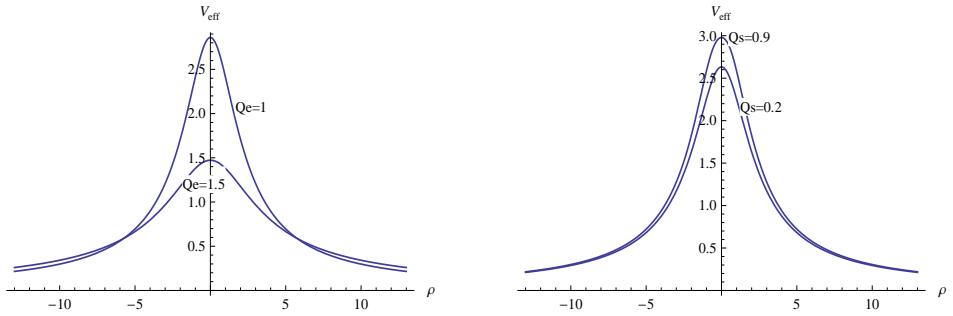
- Photons on the unstable circular orbit at the throat have impact parameter $b=r_0$, so the capture cross section is $\sigma=\pi r_0^2$; the two charges therefore directly control how much light the wormhole captures.
- In the $Q_e=0$ limit the solution becomes the classic Ellis wormhole with a phantom scalar field, and in the $Q_S=0$ limit the wormhole remains traversable, held open by the Gauss-Bonnet curvature together with the nonlinear electromagnetic field.
- The solution provides an exact, closed-form example in a string-motivated theory where the null energy condition is violated by a curvature term rather than by the matter fields themselves.
Reading between the lines
- A testable extension is to apply the same reverse-engineering strategy to other prescribed metrics and see which choices are compatible with the time-time equation; if the pattern repeats, the method could generate a family of exact EsGB wormholes rather than an isolated example.
- Because the paper leaves stability open, the explicit metric makes a perturbation analysis feasible; the sign and magnitude of the sGB null-energy violation at the throat is a natural input for such a study.
- The $Q_S=0$ limit depends on controlling divergent $\dot f$ and $\ddot f$ through their products with $\phi'$ and $\phi''$; if that control can be made fully rigorous, the result would be a wormhole supported purely by curvature plus nonlinear electrodynamics, useful as a benchmark for numerical studies.
Signed reviews
Editorial analysis
A structured set of objections, weighed in public.
Referee Report
Summary. The paper presents a static, spherically symmetric, asymptotically flat line element (9) with g_tt = -1 and g_rr = (1 - 2Qe/r + QS/r^2)^{-1}, together with a power-Maxwell Lagrangian L = (-κF)^{3/2}, a scalar field φ(r) (10), and a coupling function f(φ) defined by the integral of Eq. (11). The authors claim that for Qe^2 > QS > 0 this is an exact traversable wormhole solution of Einstein-scalar-Gauss-Bonnet theory coupled to NLED, with the sGB term responsible for NEC violation at the throat. They analyze the flaring-out condition, the null energy condition at the throat, proper radial distance, photon trajectories and capture cross-section. They also discuss two limits: Qe = 0, in which they claim the Ellis wormhole is recovered, and QS = 0, in which they claim the wormhole is supported by the GB curvature and NLED without exotic matter.
Significance. If the solution were fully correct, it would be a valuable addition to the small set of exact traversable wormholes in EsGB gravity, showing that derivative couplings can sustain a wormhole throat without phantom matter. The construction is transparent and the paper includes many concrete checks (curvature invariants, NEC projection, photon potential). The algebraic core for 0 < QS < Qe^2 appears internally consistent. However, the manuscript does not provide the crucial verification of the t-t field equation, and I identify several load-bearing problems in the limiting cases and in the regularity of the scalar field across the throat. These issues prevent acceptance of the paper in its present form.
major comments (4)
- [§IV, Eq. (11) and Appendix Eq. (35)] The t-t field equation is asserted to be satisfied, but no substitution is shown. Equation (35) contains non-trivial combinations of φ', φ'', ˙f and ¨f, and whether Eq. (11) makes the two sides of Eq. (35) identical is the central verification for the claimed exact solution. The r-r and θ-θ equations and the scalar equation are relatively easy to check by hand, but the t-t equation is not. Please include the explicit substitution (or a compact derivation) showing that the right-hand side of Eq. (35) reduces to the Einstein tensor of the metric (9). Without this, a reader cannot verify the central claim.
- [§V, Eqs. (25)-(27)] The QS = 0 limit is not a well-defined solution of the theory with a regular coupling function. When φ = const, the sGB effective stress tensor (30)-(32) formally vanishes because every term contains φ' or φ''. For the metric (25), G^t_t = 0 (since A = 0 and B' is chosen accordingly), whereas the NLED stress tensor from Eqs. (33)-(34) with L = (-κF)^{3/2} and F given by Eq. (10) yields 8π(E^t_t)_NLED = -2Qe/r^3. Thus Eq. (35) cannot balance unless the sGB part supplies a non-vanishing contribution, but the limits (26)-(27) are formal 0·∞ products and do not define a regular coupling function f(φ). The statement that "there is no conflict with the field equations when QS = 0" is therefore not supported.
- [§IV, Eq. (10) and Eq. (16)] The scalar field is not differentiable in the regular two-sided coordinate across the throat. In the coordinate ρ defined by Eq. (16), ρ = 0 is a regular point of the metric, but near ρ = 0 one has Δ = r^2 - 2Qe r + QS ∝ ρ^2, so sqrt(Δ) ∝ |ρ|. Consequently φ(ρ) behaves as φ0 + β|ρ|, and ∂_ρ φ has a finite jump at the throat. Since g_tt = -1 implies the Gauss-Bonnet invariant vanishes, the scalar equation (38) reduces to the free scalar equation □φ = 0, which acquires a δ(ρ) source from the kink. The remark that φ' is not a scalar-field invariant does not address the relevant question of whether φ is C^1 on the two-sided manifold. If the throat is treated as a boundary, the spacetime is not a complete wormhole; if it is internal, the field equations are not satisfied there unless a thin shell is introduced.
- [§V, Eq. (22)] The claimed recovery of the Ellis wormhole appears incorrect. For the metric (24) and the action (23), the massless phantom scalar field satisfies ∂_ρ((ρ^2+q^2)∂_ρψ) = 0, whose regular solution is ψ = 2 arctan(ρ/q) (in the proper-distance coordinate ρ). The expression ψ = 2 tan^{-1}(sqrt(r^2-q^2)/q^2) in Eq. (22) does not satisfy this equation and is dimensionally inconsistent (the argument of arctan has dimensions of inverse length). The authors should provide the correct phantom scalar field that supports the metric (24), or qualify the sense in which the Ellis solution is recovered.
minor comments (2)
- [§V, Eq. (22)] There is a typographical inconsistency in the displayed formula: the scalar field expression in Eq. (10) contains a mismatched bracket in the absolute value (a square bracket closes after QS). Please correct the notation.
- [§IV, Eq. (20)] Equation (20) is an equation for V_max with V_max appearing on both sides; the intermediate algebra leading to V_max = ℓ/r0 should be displayed for readability.
Circularity Check
No significant circularity: the coupling function is solved for, not fitted to a prediction.
full rationale
The paper does not present a fitted parameter as a prediction. Its construction method is to propose the metric (9) and scalar field (10), then determine the electromagnetic charge Q and the Gauss-Bonnet coupling derivative fdot(phi) from the field equations (Eq. (11) and the comparison following Eq. (10)). This is reverse-engineering of the free coupling function f(phi), which is a standard and legitimate solution-generating technique in EsGB theory; it does not make the resulting solution equivalent to the input by definition, because the field equations (35)-(38) are nontrivial differential constraints and the authors explicitly provide the resulting fdot. The self-citation [14] is used only as an alternative interpretation of the Ellis wormhole and is not load-bearing for the new solution; the Ellis limit is attributed to [13]. The only potentially weak point is that the t-t equation (35) is asserted rather than shown to be satisfied by (11), but this is an omitted verification/rigor issue, not circularity. No step reduces to its own input via a fitted parameter, a self-citation chain, or a uniqueness claim.
Assumptions & free parameters
free parameters (2)
- Qe
- QS
assumptions (5)
- domain assumption The EsGB action (2) is the correct theory for the solution.
- domain assumption The power-Maxwell NLED Lagrangian L=(-κF)^{3/2} is the matter source.
- domain assumption The static, spherically symmetric, asymptotically flat metric ansatz has zero redshift function, A=0.
- ad hoc to paper The coupling function f(φ) is defined by the integral of Eq. (11).
- ad hoc to paper The scalar field ansatz (10) is assumed to satisfy ∇^2φ=0.
Cite this review
Pith. "Pith review of New exact traversable wormhole solution to the Einstein-scalar-Gauss-Bonnet Equations coupled to a power-Maxwell electrodynamics." pith.science (2026). https://pith.science/paper/BRSYO5VI
@misc{pith2026190804690,
  author       = {Pith},
  title        = {Pith review of: New exact traversable wormhole solution to the Einstein-scalar-Gauss-Bonnet Equations coupled to a power-Maxwell electrodynamics},
  year         = {2026},
  howpublished = {\url{https://pith.science/paper/BRSYO5VI}},
  note         = {Machine review of arXiv:1908.04690}
}
abstract
We present a novel, exact, traversable wormhole (T-WH) solution for $(3+1)$-dimensional Einstein-scalar-Gauss-Bonnet theory (EsGB) coupled to a power-Maxwell nonlinear electrodynamics (NLED). The solution is characterized by two parameters, $\mathcal{Q}\!_{\rm e}$ and $\mathcal{Q}\!_{_{ \mathcal{S} }}$, associated respectively with the electromagnetic field and the scalar field. We show that for $\mathcal{Q}^2_{\rm e} - \mathcal{Q}\!_{_{ \mathcal{S} }}>0$ the solution can be interpreted as a traversable wormhole. In the general case, with non-vanishing electromagnetic field, the scalar-Gauss-Bonnet term (sGB) is the only responsible for the negative energy density necessary for the traversability. In the limiting case of vanishing electromagnetic field, the scalar field becomes a phantom one keeping the WH throat open and in this case the Ellis WH solution \cite{Ellis} is recovered.
Figures

Reference graph
Works this paper leans on
- [1]
- [2]
-
[3]
D. J. Gross, E. Witten, Nucl. Phys. B 277 1 (1986); R. R. Metsaev, A. A. Tseytlin, Phys. Lett. B 191 354 (1987); C. G. Callan, R. C. Myers, M. J. Perry, Nucl. Phys. B 311, 673 (1988)
work page 1986
-
[4]
R. C. Myers, Phys. Rev. D 36 392 (1987)
work page 1987
- [5]
- [6]
-
[7]
Antoniou, A
G. Antoniou, A. Bakopoulos and P. Kanti, Phys. Rev. Lett. 120, 131102 (2018)
2018
- [8]
Show all 18 references
-
[9]
Kanti, B
P. Kanti, B. Kleihaus, J. Kunz, Phys. Rev. Lett. 107, 271101 (2011); G. Antoniou, A. Bakopoulos, P. Kanti, B. Kle ihaus, J. Kunz, arXiv:1904.13091 [hep-th]
2011 arXiv
-
[10]
Prat-Camps, C
J. Prat-Camps, C. Navau, A. Sanchez, Sci. Rep. 5, 12488 (2015)
2015
-
[11]
Hassaine, C
M. Hassaine, C. Mart ´ ınez, Class. Quantum Grav. 25, 195023 (2008), arXiv: hep-th/0803.2946
2008 arXiv
-
[12]
Gurtug, S
O. Gurtug, S. H. Mzharimousavi, M. Halilsoy, Phys. Rev. D 85, 104004 (2012); arXiv: gr-qc/1010.2340
2012 arXiv
-
[13]
Ellis, J
H.G. Ellis, J. Math. Phys. 14, 104 (1973); H.G. Ellis, Gen. Relativ. Gravit. 10, 105 (1979)
1973
- [14]
-
[15]
K. K. Nandi, Y. Z. Zhang, A. V. Zakharov, Phys. Rev. D. 74, (2006) 024020; K. Nakajima, H. Asada, Phys. Rev. D, 85, 107501 (2012); N. Tsukamoto, Phys. Rev. D 94, 124001 (2016); F. Abe, Astrophys. J. 725, 787 (2010); V. Bozza, Phys. Rev. D 66, 103001 (2002)
2006
-
[16]
J. L. Bl´ azquez-Salcedo, X. Y. Chew, J. Kunz, Phys. Rev. D. 98, 044035 (2018)
2018
-
[17]
Shinkai, S
H. Shinkai, S. A. Hayward, Phys. Rev. D. 66, 044005 (2002); K. K. Nandi, A. A. Potapov, R. N. Izmailov, A. Tamang, J. C. Evans, Phys. Rev. D. 93, 104044 (2016)
2002
-
[18]
Ohgami and N
T. Ohgami and N. Sakai, Phys. Rev. D. 91, 124020 (2015). 8
2015
Reviewed August 14, 2026 · model on record in the stance chip above.
Discussion (0). Continue with ORCID to comment.