REVIEW 5 major objections 4 minor 154 references
Quantum entanglement entropy and Tomonaga-Luttinger liquid to liquid transition in biquadratic spin-1 XY chain with rhombic single-ion anisotropy
T0 review · 5 major / 4 minor · reviewed 2026-08-12 · deepseek-v4-flash
Pith's one-line read The spin-1 biquadratic XY chain with rhombic single-ion anisotropy hosts two gapless c=1 Tomonaga-Luttinger liquid phases and three spin-nematic phases, and entanglement entropy exposes the liquid-to-liquid transition that energy…
desk verdict A careful iMPS phase diagram whose central TL-liquid claim is undermined by its own staggered ⟨Qxy⟩ order parameter. read the letter →
The pith
A machine-rendered reading of the paper's core claim, the machinery that carries it, and where it could break.
The reading
What carries the argument
The load-bearing tool is the bipartite von Neumann entanglement entropy of the infinite matrix-product-state ground state, computed by the infinite time-evolving block decimation algorithm. Its scaling with the correlation length, $S(\chi) = (c/6)\log_2 \xi(\chi)$, supplies the central charge $c \approx 1$ of the Tomonaga-Luttinger liquid phases, while saturation versus growing bond dimension identifies the gapped nematic phases. The mutual information $I(i:j)$ and spin correlation $C(r)=\langle S^z_i S^z_j\rangle$ provide the algebraic-versus-exponential decay criterion, and the quantum fidelity per lattice site $d(1,n)$ among ground states obtained from different random initial states establishes the high degeneracy at $\theta=0$. The off-diagonal quadrupole tensor component $\langle Q^{xy}_i\rangle$, which is staggered between neighboring sites, is the local quantity that appears exactly in the liquid regions and marks the BKT-type boundaries.
What would settle it
Compute the staggered expectation value $\langle S^x_i S^y_i\rangle$ on consecutive sites inside the claimed liquid phase (for example at $\theta=0.14\pi$) for increasing bond dimensions $\chi$ and simultaneously measure the block entanglement entropy $S(n)$ as a function of block size $n$; if the staggering extrapolates to a nonzero value while $S(n)$ saturates instead of growing logarithmically, the state is ordered and gapped rather than a $c=1$ Tomonaga-Luttinger liquid, and the BKT classification at $\theta=\pm\theta_{c1}$ would be wrong.
Extended reading notes
Core claim
On the paper's own terms, the central discovery is that the ground states of Hamiltonian (1) realize three spin-nematic ferroquadrupolar phases (x-FQ, z-FQ, y-FQ) and two gapless Tomonaga-Luttinger liquid phases with central charge $c \simeq 1$, with the liquid regions occupying parameter windows where the biquadratic coupling is roughly twice the magnitude of the rhombic anisotropy. The transitions out of the liquids at $\theta = \pm\theta_{c1}$ are of Berezinskii-Kosterlitz-Thouless type, invisible in the ground-state energy and its derivatives up to second order but signaled by diverging entanglement entropy and by the onset of algebraic decay of mutual information and spin correlations. The transition between the two liquids at $\theta = 0$ is continuous and lands on a highly degenerate ground-state manifold; there the spin-block entanglement entropy grows as $\tfrac{1}{2}\log_2 n$, in contrast to the $\tfrac{1}{3}\log_2 n$ growth of an ordinary $c=1$ critical chain, and the energy derivatives show only a soft cusp that cannot be classified numerically. The staggered off-diagonal quadrupole moment $\langle Q^{xy}_i\rangle = -\langle Q^{xy}_{i+1}\rangle$ appears only inside the liquid phases, acting as an effective marker of the liquid and of the BKT boundaries.
Load-bearing premise
The argument rests on assuming that the small staggered pattern in the spin fluctuation $\langle S^x_i S^y_i\rangle$, which the paper finds unchanged as numerical precision rises, can exist inside a gapless liquid phase; ordinarily a non-vanishing staggered local quantity means the system has long-range order and an energy gap, which would break the paper's picture of liquid phases and transition types.
Editorial extensions
If this is right
- The zero-temperature phase diagram contains three gapped spin-nematic ferroquadrupolar phases and two gapless $c=1$ Tomonaga-Luttinger liquid phases, with transitions at $\theta=\pm\theta_{c2}$, $\theta=\pm\theta_{c1}$, and $\theta=0$.
- The ground-state energy and its first two derivatives detect only the first-order nematic-to-nematic transitions, so identifying the full phase diagram requires entanglement entropy, mutual information, and spin correlations.
- Inside each Tomonaga-Luttinger liquid, both mutual information and spin-spin correlation decay algebraically with exponents that vary continuously with $\theta$ and satisfy $\eta_z < \eta_I$.
- At $\theta=0$, the liquid-to-liquid transition point has a highly degenerate ground state whose spin-block entanglement entropy grows as $\tfrac{1}{2}\log_2 n$, distinguishing it from an ordinary $c=1$ critical point.
- The staggered off-diagonal quadrupole moment $\langle Q^{xy}_i\rangle = -\langle Q^{xy}_{i+1}\rangle$ appears only in the liquid phases and marks the BKT-type boundaries at $\theta=\pm\theta_{c1}$.
Reading between the lines
- Beyond the paper: if the phase diagram survives higher-precision checks, this model is a clean one-dimensional example in which the energy up to second order is blind to a continuous quantum phase transition, suggesting similar hidden transitions in other spin chains with competing biquadratic and single-ion terms.
- Beyond the paper: the exponent inequality $\eta_z < \eta_I$ means mutual information outlives spin correlations, hinting that the mutual information carries contributions from quadrupolar fluctuations; deriving both exponents from a single bosonized description would sharpen the identification of the liquid fixed point.
- Beyond the paper: a direct computation of the excitation gap inside the claimed liquid regions would settle whether the nonzero staggered local expectation value $\langle S^x_i S^y_i\rangle$ is compatible with gaplessness or signals a hidden ordered state.
- Beyond the paper: the BKT classification can be tested by tracking the correlation length as the gapped side approaches $\theta_{c1}$; an exponential divergence would confirm the infinite-order transition, while a power-law divergence would imply a different universality class.
Signed reviews
Editorial analysis
A structured set of objections, weighed in public.
Referee Report
Summary. The paper studies the zero-temperature phase diagram of the one-dimensional spin-1 chain with biquadratic XY exchange and rhombic single-ion anisotropy, Hamiltonian (1), using iMPS/iTEBD ground states. It computes the ground-state energy and its derivatives, bipartite entanglement entropy, mutual information, spin-spin correlations, and spin quadrupole moments over the circular parameter angle θ. The central claim is that the phase diagram contains three gapped spin-nematic ferroquadrupolar (FQ) phases and two gapless Tomonaga-Luttinger liquid (TLL) phases with central charge c=1; the TLL-FQ boundaries at θ=±θ_c1 are BKT-type infinite-order transitions, the FQ-FQ boundaries at θ=±θ_c2 are first-order, and the two TLL phases meet at θ=0 in a continuous, highly degenerate quantum phase transition. The paper further claims that ground-state energy derivatives miss the liquid transitions, while entanglement entropy and mutual information detect them, and it reports a staggered off-diagonal quadrupole moment <Qxy_i> = -<Qxy_{i+1}> that is nonzero in the purported TLL phases.
Significance. If the central claim were established, the paper would be a useful demonstration that bipartite entanglement entropy and mutual information can identify phase transitions that are invisible in low-order derivatives of the ground-state energy, and the liquid-to-liquid transition at θ=0 would be an interesting addition to the known physics of biquadratic spin-1 chains. The iTEBD numerics are standard, the reported c=1 central-charge fits from finite-entanglement scaling over χ=16-200 are plausible, and the phase diagram is presented clearly. However, the central claim is currently undermined by an apparent internal contradiction: a nonzero, chi-insensitive staggered local expectation value in the purported gapless TLL phases. The BKT classification is also inferred from the absence of low-order energy nonanalyticities rather than from a direct BKT diagnostic, and the quoted critical exponents are obtained at fixed bond dimension without a thermodynamic extrapolation. These issues make the paper's main conclusions not yet supported by the evidence presented.
major comments (5)
- [Sec. VI B, Fig. 10, Eq. (6)] The staggered local expectation value <Qxy_i> = -<Qxy_{i+1}>, reported as nonzero and insensitive to the truncation dimension in the TLL regions, contradicts the gapless c=1 TLL characterization. By cluster decomposition, a nonzero local expectation value in a pure thermodynamic state implies that <Qxy_i Qxy_{i+r}> tends to <Qxy>^2 for even r, i.e., long-range order; in a gapless c=1 TLL, all local correlation functions must decay algebraically to zero. The manuscript does not address this contradiction. Please compute the correlation function <Qxy_i Qxy_{i+r}> and provide a systematic χ→∞ extrapolation of <Qxy_i>. If the order persists, the phases are gapped ordered (dimerized/staggered quadrupolar) states rather than TLLs, and the central claim collapses; if the order vanishes, the statement that the values are chi-insensitive 'nor in the thermodynamic limit' must be revised.
- [Sec. IV B 3, Figs. 1-3] The classification of the transitions at θ=±θ_c1 as BKT-type is based solely on the continuity of the ground-state energy and its first two derivatives near those points. Absence of nonanalyticity in low-order derivatives is not a sufficient diagnostic for a BKT transition; higher-order transitions and quantum crossovers can also have smooth low derivatives. A direct BKT test is needed, for example the exponential divergence of the correlation length with bond dimension, ξ(χ) ~ exp(constant × χ), or a finite-size level spectroscopy/BKT scaling analysis. Without such a test, the identification of the transition as BKT-type is not established.
- [Sec. V, Table II and text after Fig. 7] The exponents η_I and η_z are quoted at fixed χ=200 without a thermodynamic extrapolation. The χ-sequence reported for θ=0.14π shows η_I still drifting from 0.71(2) at χ=60 to 0.606(9) at χ=200, so the numerical values in Table II and the trend of the exponents toward zero as θ→0 are not converged. Please provide a systematic extrapolation in χ for each exponent and state the fitting ranges explicitly. In addition, because C(r) is described as decaying to a χ-dependent saturation value, the pure power-law fit C(r)=b0 r^{-η_z} needs justification, such as subtracting the saturation background before fitting.
- [Sec. IV C, Fig. 5] The claim that θ=0 is 'not in the TL phase' and has spin-block entanglement entropy S(n) ∝ 1/2 log_2 n rests on Refs. [137,140,141], which are not reproduced in this manuscript and which overlap with the current author group. The 30-state calculation at χ=30 demonstrates degeneracy of the iMPS fixed points at finite bond dimension, but it does not by itself establish the thermodynamic-limit scaling of the spin-block entropy or the nature of the transition at θ=0. Please provide the authors' own spin-block entropy data at θ=0 and in the adjacent TLL phases, or explicitly present the θ=0 conclusion as relying on external results.
- [Sec. VI B, text near Fig. 10] Calling <Qxy_i> an 'order parameter of the TL liquid phase' is conceptually misleading: a gapless TLL has no local order parameter, and if <Qxy_i> indeed survives the thermodynamic limit, the transition at θ_c1 would more naturally be an Ising-type dimerization or staggered-quadrupole transition rather than a BKT transition. The authors should either demonstrate that <Qxy_i> vanishes as χ→∞ while the TLL correlations remain algebraic, or reinterpret the phases and transitions accordingly. This issue is load-bearing for the paper's main phase diagram.
minor comments (4)
- [Title, abstract, and throughout] There are numerous typos: 'liqu id' in the title, 'ferroquarupole' in the abstract, 'spin-sin' instead of 'spin-spin', 'quardupole' instead of 'quadrupole', and 'Fige.' in the caption of Fig. 2. These should be corrected.
- [Introduction, first paragraph] 'LWG' should be 'LGW' (Landau-Ginzburg-Wilson).
- [Fig. 5 caption] The caption states 'n=30 is the number of the random initial state trials,' but the x-axis of Fig. 5 is labeled n and ranges from 0 to 30; it would be clearer to label the axis as 'trial index' to avoid confusion with block size n used in the spin-block entropy discussion.
- [Reference [137]] Reference [137] lists the year as 2004, but the volume number 133 and the surrounding context suggest the article appeared in 2024; please verify and correct the citation details.
Circularity Check
The θ=0 'not a TL liquid' conclusion rests on a same-group citation for S(n) ∝ 1/2 log n, not on an in-paper derivation.
-
self citation load bearing
[Section IV C (paragraph following Fig. 5), and used again in Section VII summary]
"Moreover, the spin-block entanglement entropy has been numerically shown to be logarithmically divergent with the spin block size n in the thermodynamic limit L → ∞ as S(n) ∝ 1/2 log2 n [141]."
This sentence is the only evidence distinguishing θ = 0 from the c = 1 TL liquids. The paper contrasts the cited S(n) ∝ 1/2 log n with the c = 1 value S(n) ∝ 1/3 log n and concludes 'the biquadratic spin-1 XY chain at θ = 0 is not in the TL phase.' Ref. [141] is arXiv:2201.01071 by Shi, Dai, Zhou, and McCulloch, overlapping with the present authors, and the block-entropy scaling is not recomputed or reproduced in this paper; Fig. 5 only shows degenerate iMPS fixed points at χ = 30 with equal energy and different entanglement entropies. Thus the central 'not TL' label at θ = 0, and with it the claimed TL-liquid-to-liquid transition, is carried by a load-bearing self-citation rather than by an in-paper derivation.
full rationale
Apart from the θ = 0 step, the central phase identification is self-contained against standard scalings: the c ≈ 1 TL phases follow from the finite-entanglement scaling S = (c/6) log2 ξ (Eq. 3) with χ = 16–200; the gapped FQ phases are identified by saturation of S(χ); the mutual information and spin correlations show algebraic versus exponential decay; and the BKT-type assignment at ±θc1 is inferred from the absence of energy-derivative nonanalyticities together with the gapless-to-gapped entropy change. The ηz < ηI relation is computed from the paper's own fits; Ref. [148] is only a comparison, not an input. The nonzero staggered ⟨Qxy⟩ reported in the purported TL phases is a serious physical-consistency concern (a chi-insensitive local order parameter in a gapless c = 1 phase), but that is a correctness risk, not a circularity of the kind defined here. Because one load-bearing conclusion—that θ = 0 is not a TL liquid and therefore a liquid-to-liquid transition occurs—is imported from same-group numerical work not independently reproduced in the paper, the circularity score is 4 rather than 0–2.
Assumptions & free parameters
free parameters (7)
- theta_c1(infinity) (BKT boundary) =
0.152(1) pi
- extrapolation amplitude a =
0.09(4) pi
- extrapolation exponent b =
-0.8(2)
- central charge c =
0.99(2), 0.981(1), 0.99(1), 0.99(1), 0.995(6) at theta=0.06pi to 0.14pi
- mutual information exponent eta_I(theta) =
0.41(1) to 0.606(9)
- spin-spin correlation exponent eta_z(theta) =
0.085(1) to 0.216(1)
- power-law prefactors a0 and b0 =
a0 about -0.64 to -0.67; b0 about -0.51 to -0.53
assumptions (5)
- domain assumption Finite-entanglement scaling S(chi)=c/6 log2 xi(chi)+S0 is valid for iMPS ground states of the gapless regions.
- domain assumption iTEBD with the stated time-step schedule converges to the ground state for every theta and chi; at theta=0, random initial states sample the degenerate manifold.
- ad hoc to paper Continuity of dE/dtheta and d^2E/dtheta^2 up to the numerically accessible precision at theta=+-theta_c1 is enough to establish a BKT-type infinite-order transition.
- domain assumption The previously established L+1 degeneracy and S_block(n) ~ 1/2 log2 n at theta=0 (Refs [137-141]) apply to the infinite chain and imply that theta=0 is not part of the TL liquid phases.
- ad hoc to paper A nonzero staggered off-diagonal quadrupole moment <Qxy_i> = -<Qxy_{i+1}> can coexist with a gapless c=1 TL liquid.
Cite this review
Pith. "Pith review of Quantum entanglement entropy and Tomonaga-Luttinger liquid to liquid transition in biquadratic spin-1 XY chain with rhombic single-ion anisotropy." pith.science (2026). https://pith.science/paper/BRT2I7WV
@misc{pith2026241200739,
  author       = {Pith},
  title        = {Pith review of: Quantum entanglement entropy and Tomonaga-Luttinger liquid to liquid transition in biquadratic spin-1 XY chain with rhombic single-ion anisotropy},
  year         = {2026},
  howpublished = {\url{https://pith.science/paper/BRT2I7WV}},
  note         = {Machine review of arXiv:2412.00739}
}
abstract
Quantum phase transitions (QPTs) are investigated in biquadratic spin-$1$ XY chain with rhombic single-ion anisotropy by using the ground state energy (GE), the bipartite entanglement entropy (BEE), and the mutual information (MI). It turns out that there are three spin nematic phases and two Tomonaga-Luttinger (TL) liquid phases with the central charge $c = 1$. The TL Liquid phases emerge roughly for biquadratic interaction strength two times stronger than the absolute value of the single-ion anisotropy. The GE and the derivatives up to the second order reveal a first-order QPT between spin nematic ferroquarupole (FQ) phases but cannot capture an evident signal of QPTs between the spin nematic phases and the TL Liquid phases as well as QPT between the two TL liquid phases. The TL liquid-to-liquid transition point features a highly degenerate state and the spin-block entanglement entropy increases logarithmically with block size. The BEE exhibits a divergent or convergent behavior identifying the TL Liquid or spin nematic FQ phases, respectively. Similarly, the MI and the spin-spin correlation are shown to decay algebraically or exponentially with increasing the lattice distance in the TL Liquid or spin nematic FQ phases, respectively. In the TL liquid phase, the exponents $\eta_I$ and $\eta_z$ of the MI and the spin-spin correlation vary with the interaction parameter of the biquadratic interaction strength and the rhombic single-ion anisotropy and satisfy the relationship of $\eta_z <\eta_I$. Such changes of characteristic behavior of the BEE, the MI and the spin-spin correlation indicate an occurrence of the Berezinskii-Kosterlitz-Thouless (BKT)-type QPT between the TL Liquid phase and the spin nematic FQ phase. The staggered spin fluctuation $\langle S^x S^y \rangle$ is shown to play a significant role for the emergence of the TL liquid phase and thus give rise to the BKT-type QPT.
Figures


Figures from the paper (6 more)


Reference graph
Works this paper leans on
-
[1]
It turns out a symmetric behavior of the bipartite entanglement entropy, i.e., S (θ) = S (−θ) for the chosen parameter points
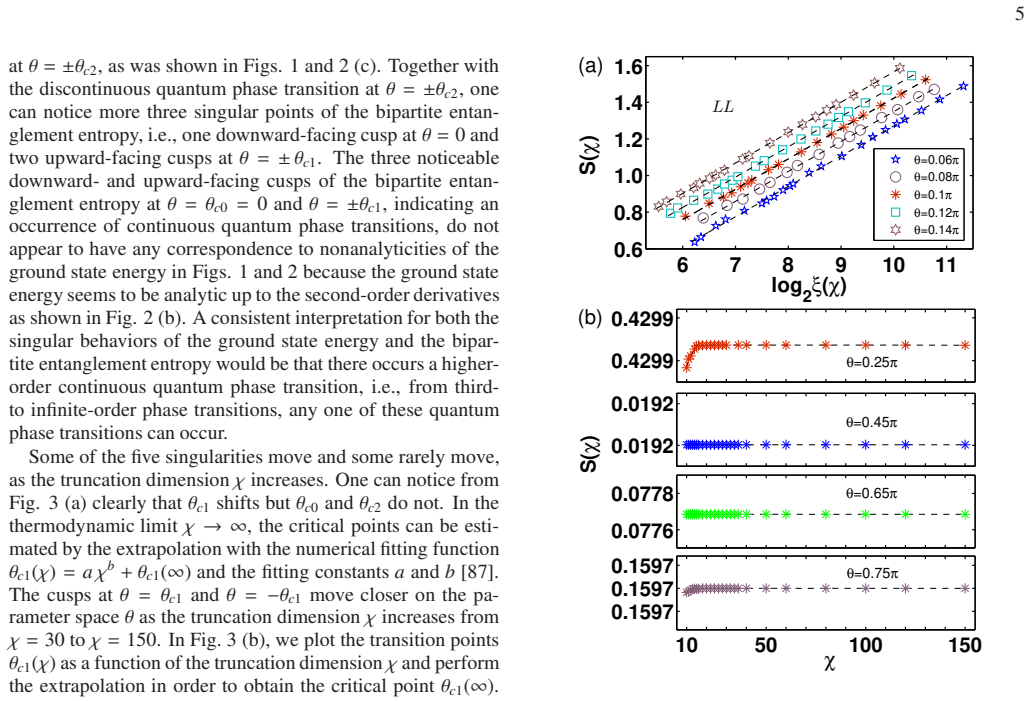
Critical entanglement - Gapless Tomonaga-Luttinger liq uid (TLL) phase (massless phase) We have calculated the bipartite entanglement entropy for −θc1(∞)<θ< 0 and 0<θ<θ c1(∞). It turns out a symmetric behavior of the bipartite entanglement entropy, i.e., S (θ) = S (−θ) for the chosen parameter points. We plot the bipartite 6 TABLE I: Estimates for the cen...
-
[2]
4 (b) shows that the bipartite en- tanglement entropy exhibits a simple saturation behavior a t θ = 0.25π, 0.45π, 0.65π and 0.75π as the truncation dimen- sion χ increases
Noncritical entanglement - Gapped massive phases In contrast to the TL liquid phases for − θc1(∞) < θ <0 and 0 < θ < θc1(∞), Fig. 4 (b) shows that the bipartite en- tanglement entropy exhibits a simple saturation behavior a t θ = 0.25π, 0.45π, 0.65π and 0.75π as the truncation dimen- sion χ increases. Such saturation behaviors in the bipartite entanglemen...
-
[3]
In Fig. 3, it should be noted that at θ = ±π/2 and for −π < θ < −θc2 and θc2 < θ < π, the bipartite entangle- ment entropy becomes zero, which implies that the ground state becomes a product state. Consequently, our iMPS resul ts show the distinct diverging behavior of the bipartite entan gle- ment entropy for − θc1(∞) < θ <0 and 0 < θ < θc1(∞) in Fig. 4 ...
-
[4]
Sachev, Phys
S. Sachev, Phys. World 12, 33 (1999)
1999
-
[5]
Berezinskii-Kosterlitz-Thouless (BKT)-type quantum p hase transition However, as shown in Figs. 1 and 2 (b), the ground state energy and the derivatives of the ground state energy up to the second order are continuous and exhibit no nonanalyt- icity near the critical points θ = θc1 of the bipartite entan- glement entropy in Fig. 3. As a typical example of...
-
[6]
(1), the quantum mutual information and the cor- relation can be calculated
Mutual information and spin-spin correlations of the nea rest neighbor two spins: Quantum phase transitions Once one obtains the iMPS ground state for the Hamilto- nian of Eq. (1), the quantum mutual information and the cor- relation can be calculated. In our case, the adjacent two spi ns are considered. In Fig. 6, (a) the mutual information I(θ) and (b) ...
-
[7]
6, the mutual information I(θ) and spin- spin correlation ⟨S z i S z i+1⟩of the adjacent two spins are sym- metric with respect to θ = 0
Mutual information and spin-spin correlations: Critica l exponents in the massless phase As shown in Fig. 6, the mutual information I(θ) and spin- spin correlation ⟨S z i S z i+1⟩of the adjacent two spins are sym- metric with respect to θ = 0. We can focus on the parameter range of positive θ > 0. In Figs. 7 (a) and (b), we plot the mutual information I(r...
-
[8]
L. D. Carr, Understanding Quantum phase transitions (CRC Press, Boca Raton, FL, 2010)
2010
Show all 154 references
-
[9]
J. A. Hertz Phys. Rev. B 14, 1165 (1976)
1976
-
[10]
V ojta, Rep
M. V ojta, Rep. Prog. Phys. 66, 2069 (2003)
2003
-
[11]
Campisi, P
M. Campisi, P . H¨ anggi, and P . Talkner, Rev. Mod. Phys. 83, 771 (2011)
2011
-
[12]
L. D. Landau and E. M. Lifschitz, Statistical Physics, Course of Theoretical Physics V ol. 5 (Pergamon, London, 1958)
1958
-
[13]
Sachdev, Quantum Phases of Matter (Cambridge Univer- sity Press, Cambridge, England, 2023)
S. Sachdev, Quantum Phases of Matter (Cambridge Univer- sity Press, Cambridge, England, 2023)
2023
-
[14]
Sachdev, Quantum Phase Transitions (Cambridge Univer- sity Press, Cambridge, England, 2011)
S. Sachdev, Quantum Phase Transitions (Cambridge Univer- sity Press, Cambridge, England, 2011)
2011
-
[15]
Wen, Quantum Field Theory of Many-Body Systems (Oxford University Press, Oxford, 2004)
X.-G. Wen, Quantum Field Theory of Many-Body Systems (Oxford University Press, Oxford, 2004)
2004
-
[16]
D. C. Tsui, H. L. Stormer, and A. C. Gossard, Phys. Rev. Le tt. 48, 1559 (1982)
1982
-
[17]
Ashida, Quantum Many-Body Physics in Open Systems : Measurement and Strong Correlations (Springer Nature, 2020)
Y . Ashida, Quantum Many-Body Physics in Open Systems : Measurement and Strong Correlations (Springer Nature, 2020)
2020
-
[18]
L. E. Reichl, A Modern Course in Statistical Physics (John Wiley & Sons, New Y ork, 1998)
1998
-
[19]
L.-A. Wu, M. S. Sarandy, and D. A. Lidar, Phys. Rev. Lett. 93, 250404 (2004)
2004
-
[20]
Trebst, P
S. Trebst, P . Werner, M. Troyer, K. Shtengel, and C. Naya k, Phys. Rev. Lett. 98, 070602 (2007)
2007
-
[21]
P . W. Anderson, Basic Notions of Condensed Matter Physics (Addison-Wesley, Reading, MA, 1997)
1997
-
[22]
Coleman, An Introduction to Spontaneous Symmetry Breakdown and gauge Fields, Laws of Hadronic Matter , edited by A
S. Coleman, An Introduction to Spontaneous Symmetry Breakdown and gauge Fields, Laws of Hadronic Matter , edited by A. Zichichi (Academic, New Y ork, 1975)
1975
-
[23]
K. V . Klitzing, G. Dorda, and M. Pepper, Phys. Rev. Lett. 45, 494 (1980)
1980
-
[24]
H. D. Chen and Z. Nussinov, J. Phys. A: Math. Theor. 41, 075001 (2008)
2008
-
[25]
Wen, Phys
X.-G. Wen, Phys. Rev. B 40, 7387 (1989)
1989
-
[26]
Wen, Phys
X.-G. Wen, Phys. Rev. Lett. 48, 13749 (1993); X.-G. Wen, Phys. Rev. B 65, 165113 (2002)
1993
-
[27]
A. Y . Kitaev, Ann. Phys. (NY) 303, 2 (2003)
2003
-
[28]
F. D. M. Haldane, Phys. Lett. A 93, 464 (1983)
1983
-
[29]
Hamma and D.A
A. Hamma and D.A. Lidar, Phys. Rev. Lett. 100, 030502 (2008)
2008
-
[30]
Castelnovo and C
C. Castelnovo and C. Chamon, Phys. Rev. B 76, 174416 (2007)
2007
-
[31]
Feng, G.-M
X.-Y . Feng, G.-M. Zhang, and T. Xiang, P hys. Rev. Lett. 98, 087204 (2007)
2007
-
[32]
Read and S
N. Read and S. Sachdev, Phys. Rev. Lett. 66, 1773 (1991)
1991
-
[33]
Y u, S.-P
J. Y u, S.-P . Kou, and X.-G. Wen, Europhys. Lett. 84, 17004 (2008)
2008
-
[34]
Vidal, R
J. Vidal, R. Thomale, K. P . Schmidt, and S. Dusuel, Phys. Rev. B 80, 081104 (2009)
2009
-
[35]
R. B. Laughlin, Phys. Rev. Lett. 50, 1395 (1983)
1983
-
[36]
Quantum Communication and Quantum Computer
as (i) the x-FQ phase with ⟨Qx2−y2 i ⟩< 0 and ⟨Q3z2−r2 i ⟩= 1 for 0 < θ < θc2, (ii) the z-FQ phase with ⟨Qx2−y2 i ⟩= 0 and ⟨Q3z2−r2 i ⟩= −2 for θc2 < θ < θc3, and (iii) the y-FQ phase with ⟨Qx2−y2 i ⟩> 0 and ⟨Q3z2−r2 i ⟩= 1 for θc3 < θ <2π. As a result, ⟨Qx2−y2 i ⟩can play a r...
-
[37]
H.-T. Wang, B. Li and S. Y . Cho, Phys. Rev. B 87, 054402 (2013)
2013
-
[38]
Kalmeyer and R
V . Kalmeyer and R. B. Laughlin, Phys. Rev. Lett. 59, 2095 (1987)
1987
-
[39]
Wilczek, and A
X.-G.Wen, F. Wilczek, and A. Zee, Phys. Rev. B 39, 11413 (1989)
1989
-
[40]
Perali, P
A. Perali, P . Pieri, and G. C. Strinati, Phys. Rev. Lett. 93, 100404 (2004)
2004
-
[41]
Wen, Phys
X.-G. Wen, Phys. Rev. B 44, 2664 (1991)
1991
-
[42]
Moessner and S
R. Moessner and S. L. Sondhi, Phys. Rev. Lett. 86, 1881 (2001)
2001
-
[43]
Khan and P
A. Khan and P . Pieri, Phys. Rev. A 80, 012303 (2009)
2009
-
[44]
Mao, Y .-W
R. Mao, Y .-W. Dai, S. Y . Cho, and H.-Q. Zhou, phys. Rev. B 103, 014446 (2021)
2021
-
[45]
Zhang, Phys
J. Zhang, Phys. Rev. B 104, 205112 (2021)
2021
-
[46]
J.Leggett, in Modern Trends in the Theory of Con- densed Matter , Lecture Notes in Physics V ol
A. J.Leggett, in Modern Trends in the Theory of Con- densed Matter , Lecture Notes in Physics V ol. 115, edited by A.Pekalski and R. Przystawa (Springer-V erlag,Berlin,198 0), p.13
-
[47]
Nozi` eres and S
P . Nozi` eres and S. Schmitt-Rink, J. Low Temp. Phys. 59, 195 (1985)
1985
-
[48]
J. M. Kosterlitz and D.J. Thouless, J. Phys. C 5, L124 (1972)
1972
-
[49]
Ovchinnikov, Sov
A. Ovchinnikov, Sov. Phys. JETP 30, 1160 (1970)
1970
-
[50]
F. D. M. Haldane, Phys. Rev. B 25, 4925 (1982)
1982
-
[51]
Nakamura, Phys
M. Nakamura, Phys. Rev. B 61, 16377 (2000)
2000
-
[52]
W. Chen, K. Hida, and B. C. Sanctuary, Phys. Rev. B 67, 104401 (2003)
2003
-
[53]
Zhang, Y
J. Zhang, Y . Meurice, and S.-W. Tsai, Phys. Rev. B 103, 245137 (2021). 13
2021
-
[54]
V . L. Berezinskii, Zhur. Eksp. Teor. Fiz. 59, 907 (1970) [Sov. Phys. JETP 32, 493 (1971)]
1970
-
[55]
V . L. Berezinskii, Zhur. Eksp. Teor. Fiz.61, 1144 (1971) [ Sov. Phys. JETP 34, 610 (1971)]
1971
-
[56]
Blume and Y
M. Blume and Y . Y . Hsieh, J. Appl. Phys. 40, 1249 (1969)
1969
-
[57]
J. M. Kosterlitz and D.J. Thouless, J. Phys. C 6, 1181 (1973)
1973
-
[58]
J. M. Kosterlitz, J. Phys. C 7, 1046 (1974)
1974
-
[59]
Z. Hu, Z. Ma, Y .-D. Liao, H. Li, C. Ma, Y . Cui, Y . Shangguan, Z. Huang, Y . Qi, W. Li, Z. Y . Meng, J. Wen, and W. Y u, Nat. Commun. 11, 5631 (2020)
2020
-
[60]
Schollw¨ ock, J
U. Schollw¨ ock, J. Richter, D. J. J. Farnell, and R. F. Bi sho, Quantum Magnetism (Springer, New Y ork, 2008)
2008
-
[61]
Lacroix, P
C. Lacroix, P . Mendels, and F. Mila,Introduction to Frustrated Magnetism: Materials, Experiments, Theory (Springer Berlin Heidelberg, Berlin, Heidelberg, 2011)
2011
-
[62]
H. T. Diep, Frustrated Spin Systems, 3nd ed. (World Scientific, London, 2020)
2020
-
[63]
Udagawa and L
M. Udagawa and L. Jaubert, Spin Ice (Springer International Publishing, Cham, 2021)
2021
-
[64]
M. E. Zhitomirsky and H. Tsunetsugu, Europhys. Lett. 92, 37001 (2010)
2010
-
[65]
A. F. Andreev and I. A. Grishchuk, Sov. Phys. JETP 60, 267 (1984);[Zh. Eksp. Teor. Fiz. 87, 467 (1984)]
1984
-
[66]
V . M. Matveev, Sov. Phys. JETP 38, 813 (1974);[Zh. Eksp. Teor. Fiz. 65, 1626 (1973)]
1974
-
[67]
Papanicolaou, Nucl
N. Papanicolaou, Nucl. Phys. B 305, 367 (1988)
1988
-
[68]
Tsunetsugu and M
H. Tsunetsugu and M. Arikawa, J. Phys. Soc. Jpn. 75, 083701 (2006)
2006
-
[69]
L¨ achli, F
A. L¨ achli, F. Mila, and K. Penc, Phys. Rev. Lett. 97, 087205 (2006)
2006
-
[70]
Sudan, A
J. Sudan, A. L¨ uscher, and A. M. L¨ auchli, Phys. Rev. B 80, 140402(R) (2009)
2009
-
[71]
Sakai, R
T. Sakai, R. Nakanishi, T. Yamada, R. Furuchi, H. Nakano , H. Kaneyasu, K. Okamoto, and T. Tonegawa, Phys. Rev. B 106, 064433 (2022)
2022
-
[72]
Smerald and N
A. Smerald and N. Shannon, Phys. Rev. B 93, 184419 (2016)
2016
-
[73]
Balents and O
L. Balents and O. A. Starykh, Phys. Rev. Lett. 116, 177201 (2016)
2016
-
[74]
H. T. Ueda, J. Phys. Soc. Jpn. 84, 023601 (2015)
2015
-
[75]
Spin Nematic Phases in Quan- tum Spin Systems,
K. Penc and A. M. L¨ achli, “Spin Nematic Phases in Quan- tum Spin Systems,” in Introduction to Frustrated Magnetism: Materials, Experiments, Theory , edited by C. Lacroix, P . Mendels, and F. Mila (Springer Berlin Heidelberg, Berlin, Heidelberg, 2011) pp. 331-362
2011
-
[76]
L¨ auchli, J
A. L¨ auchli, J. C. Domenge, C. Lhuillier, P . Sindzingre, and M. Troyer, Phys. Rev. Lett. 95, 137206 (2005)
2005
-
[77]
Shannon, T
N. Shannon, T. Momoi, and P . Sindzingre, Phys. Rev. Lett. 96, 027213 (2006)
2006
-
[78]
Sindzingre, N
P . Sindzingre, N. Shannon, and T. Momoi, J. Magn. Magn. Mater. 310, 1340 (2007)
2007
-
[79]
Smerald, H
A. Smerald, H. T. Ueda, and N. Shannon, Phys. Rev. B 91, 174402 (2015)
2015
-
[80]
Eisert, M
J. Eisert, M. Cramer and M. B. Plenio, Rev. Mod. Phys. 82, 277 (2010)
2010
-
[81]
Kohama, H
Y . Kohama, H. Ishikawa, A. Matsuo, K. Kindo, N. Shannon, and Z. Hiroi, Proc. Natl. Acad. Sci. U.S.A. 116, 10686 (2019)
2019
-
[82]
Kim, J.-K
H. Kim, J.-K. Kim, J. Kwon, J. Kim, H.-W. J. Kim, S. Ha, K. Kim, W. Lee, J. Kim, G. Y . Cho, H. Heo, J. Jang, C. J. Sahle, A. Longo, J. Strempfer, G. Fabbris, Y . Choi, D. Haskel, J. Kim, and J. W. Kim et al., Nature (London) 625, 264 (2024)
2024
-
[83]
W. K. Wootters, Phys. Rev. Lett. 80, 2245 (1998)
1998
-
[84]
Vidal, J
G. Vidal, J. I. Latorre, E. Rico and A. Kitaev, Phys. Rev. Lett. 90, 227902 (2003)
2003
-
[85]
Schollw¨ ock, Rev
U. Schollw¨ ock, Rev. Mod. Phys.77, 259 (2005)
2005
-
[86]
S. Y . Cho and R. H. McKenzie, Phys. Rev. A 73, 012109 (2006)
2006
-
[87]
Amico, R
L. Amico, R. Fazio, A. Osterloh and V . V edral, Rev. Mod. Phys. 80, 517 (2008)
2008
-
[88]
Pollmann, S
F. Pollmann, S. Mukerjee, A. M. Turner, and J. E. Moore, Phys. Rev. Lett. 102, 255701 (2009)
2009
-
[89]
K. Modi, A. Brodutch, H. Cable, T. Paterek and V . V edral, Rev. Mod. Phys. 84, 1655 (2012)
2012
-
[90]
Preskill, J
J. Preskill, J. Mod. Opt. 47, 127 (2000)
2000
-
[91]
T. J. Osborne and M. A. Nielsen, Phys. Rev. A 66, 032110 (2002)
2002
-
[92]
Vidal, J
G. Vidal, J. I. Latorre, E. Rico, and A. Kitaev, Phys. Rev . Lett. 90, 227902 (2003)
2003
-
[93]
Evenbly and G
G. Evenbly and G. Vidal, Phys. Rev. B 81, 235102 (2010)
2010
-
[94]
Kitaev and J
A. Kitaev and J. Preskill, Phys. Rev. Lett. 96, 110404 (2006)
2006
-
[95]
Tagliacozzo, T
L. Tagliacozzo, T. R. de Oliveira, S. Iblisdir, and J. I. Latorre, Phys. Rev. B 78, 024410 (2008)
2008
-
[96]
Baumgratz, M
T. Baumgratz, M. Cramer, and M. B. Plenio, Phys. Rev. Let t. 113, 140401 (2014)
2014
-
[97]
M.Wolf, F
M. M.Wolf, F. V erstraete, M. B. Hastings, and J. I. Cirac, Phys. Rev. Lett. 100, 070502 (2008)
2008
-
[98]
Groisman, S
B. Groisman, S. Popescu, and A. Winter, Phys. Rev. A 72, 032317 (2005)
2005
-
[99]
Adami and N
C. Adami and N. J. Cerf, Phys. Rev. A 56, 3470 (1997)
1997
-
[100]
F. C. Alcaraz and M. A. Rajabpour, Phys. Rev. B 91, 155122 (2015)
2015
-
[101]
Schumacher and M
B. Schumacher and M. D. Westmoreland, Phys. Rev. A 74, 042305 (2006)
2006
-
[103]
Dai, X.-H
Y .-W. Dai, X.-H. Chen, S. Y . Cho, and H.-Q. Zhou, Phys. Rev. E 104, 044137(2021)
2021
-
[104]
Hu, Y .-Y
M.-L. Hu, Y .-Y . Gao, and H. Fan, Phys. Rev. A 101, 032305 (2020)
2020
-
[105]
J.-J. Chen, J. Cui, Y .-R. Zhang, and H. Fan, Phys. Rev. A 94, 022112 (2016)
2016
-
[106]
Karpat, B
G. Karpat, B. C ¸ akmak, and F. F. Fanchini, Phys. Rev. B 90, 104431 (2014)
2014
-
[107]
Chen, G.-Q
Q. Chen, G.-Q. Zhang, J.-Q. Cheng, and J.-B. Xu, Quantum Inf Process 18, 8 (2019)
2019
-
[108]
Yi, W.-L
T.-C. Yi, W.-L. Y ou, N. Wu, and A. M. Ole´ s, Phys. Rev. B 100, 024423 (2019)
2019
-
[109]
During th e procedure, the convergence of energy yields a ground state wavefunction |ψG⟩in the iMPS representation for a given trun- cation dimension
has been completed with the time step decreased from dt = 0.1 to dt = 10−6 according to a power law when the chosen initial state approaches to a ground state. During th e procedure, the convergence of energy yields a ground state wavefunction |ψG⟩in the iMPS representation fo...
-
[110]
Thakur and P
P . Thakur and P . Durganandini, Phys. Rev. B 102, 064409 (2020)
2020
-
[111]
Sha, Y .Wang, Z.-H
Y .-T. Sha, Y .Wang, Z.-H. Sun, and X.-W. Hou, Ann. Phys. 392, 229 (2018)
2018
-
[112]
Li and H.-Q
Y .-C. Li and H.-Q. Lin, Sci. Rep. 6, 26365 (2016)
2016
-
[113]
A. L. Malvezzi, G. Karpat, B. C ¸ akmak, F. F. Fanchini, T. De- barba, and R. O. Vianna, Phys. Rev. B 93, 184428 (2016)
2016
-
[114]
Y . C. Li, J. Zhang, and H.-Q. Lin, Phys. Rev. B 101, 115142 (2020)
2020
-
[115]
Vidal, J
G. Vidal, J. I. Latorre, E. Rico, and A. Kitaev, Phys. Re v. Lett. 90, 227902 (2003)
2003
-
[116]
J. I. Latorre, E. Rico, and G. Vidal, Quantum Inf. Compu t. 4, 48 (2004)
2004
-
[117]
Vidal, Phys
G. Vidal, Phys. Rev. Lett, 98, 070201 (2007)
2007
-
[118]
Y . H. Su, S. Y . Cho, B. Li, H. L. Wang, and H. Q. Zhou, J. Phys. Soc. Jpn. 81, 074003 (2012)
2012
-
[119]
Y . H. Su, B.-Q. Hu, S.-H. Li and S. Y . Cho, Phys. Rev. E 88, 032110 (2013)
2013
-
[120]
Tomonaga, Prog
S. Tomonaga, Prog. Theor. Phys. 5, 544 (1950)
1950
-
[121]
J. M. Luttinger, J. Math. Phys. 4, 1154 (1963)
1963
-
[122]
F. D. M. Haldane, J. Phys. C 14, 2585 (1981). 14
1981
-
[123]
A. A. Belavin, A. M. Polyakov, and A. B. Zamolodcchikov , Nucl. Phys. B 241, 333 (1983)
1983
-
[124]
J. L. Cardy, J. Phys. A 17, L385 (1984)
1984
-
[125]
A ffleck, Nucl
I. A ffleck, Nucl. Phys. B 265, 409 (1986)
1986
-
[126]
A. M. Tsvelik, Quantum Field Theory in Condensed Matter Physics 2nd edn (Cambridge Univ. Press, Cambridge, 2003)
2003
-
[127]
B. Lake, D. A. Tennant, C. D. Frost, and S. E. Nagler, Nat ure Mater. 4, 329 (2005). (2005)
2005
-
[128]
I. A. Zaliznayak, Nat. Mater. 4, 273 (2005)
2005
-
[129]
Giamarchi, Quantum physics in one dimension , (Oxford Univ.Press, Oxford, 2004)
T. Giamarchi, Quantum physics in one dimension , (Oxford Univ.Press, Oxford, 2004)
2004
-
[130]
Takahashi, Thermodynamics of one-dimensional solvable models, (Cambridge University Press: Cambridge, 1999)
M. Takahashi, Thermodynamics of one-dimensional solvable models, (Cambridge University Press: Cambridge, 1999)
1999
-
[131]
Calabrese and J
P . Calabrese and J. Cardy, J. Stat. Mech. P06002 (2004)
2004
-
[132]
V . E. Korepin, Phys. Rev. Lett. 92 096402 (2004)
2004
-
[133]
Calabrese and J
P . Calabrese and J. Cardy, J. Phys. A 42 504005 (2009)
2009
-
[134]
Ginsparg, in Fields, Strings and Critical Phenomena , Proceedings of the Les Houches Summer School, Session XLIX, 1988, edited by E
P . Ginsparg, in Fields, Strings and Critical Phenomena , Proceedings of the Les Houches Summer School, Session XLIX, 1988, edited by E. Br´ ezin and J. Zinn Justin, 1989 (hep-th/9108028)
1988 arXiv
-
[135]
Srednicki, Phys
M. Srednicki, Phys. Rev. Lett. 71, 666 (1993)
1993
-
[136]
C. G. Callan and F. Wilczek, Phys. Lett. B 333, 55 (1994)
1994
-
[137]
T. M. Fiola, J. Preskill, A. Strominger, and S. P . Trive di, Phys. Rev. D 50, 3987 (1994)
1994
-
[139]
C. N. Yang and C. P . Yang, Phys. Rev. 150, 321 (1966)
1966
-
[140]
C. N. Yang and C. P . Yang, Phys. Rev. 150, 327 (1966)
1966
-
[141]
Li, Y .-H
Y .-C. Li, Y .-H. Zhu, and Z.-G. Y uan, Phys. Lett. A 380, 1066 (2016)
2016
-
[142]
H. B. Choi and J.-W. Lee, J. Korean Phys. Soc. Kor. 71, 29 3 (2017)
2017
-
[143]
G.-H. Liu, W. Li, W.-L. Y ou, G. Su, and G.-S. Tian, Physi ca B: Conden. Matt. 443, 63 (2014)
2014
-
[144]
Y .-W. Dai, S. Y . Cho, M. T. Batchelor, and H.-Q. Zhou, Phys. Rev. B 95, 014419 (2017)
2017
-
[145]
Watanabe, H
H. Watanabe, H. Katsura, and J. Y . Lee, Phys. Rev. Lett. 133, 176001 (2004)
2004
-
[146]
Saito and C
H. Saito and C. Hotta, Phys. Rev. Lett. 132, 166701 (2024)
2024
- [147]
- [148]
-
[149]
Shi, Y .-W
Q.-Q. Shi, Y .-W. Dai, H.-Q. Zhou, and I. P . McCulloch, arXiv:2201.01071 (2022)
2022
-
[150]
Popkov and M
V . Popkov and M. Salerno, Phys. Rev. A 71, 012301 (2005)
2005
-
[151]
Popkov, M
V . Popkov, M. Salerno, and G. Sch¨ utz, Phys. Rev. A 72, 032327 (2005)
2005
-
[152]
A Castro-Alvaredo and B
O. A Castro-Alvaredo and B. Doyon, Phys. Rev. Lett. 108, 120401 (2012)
2012
-
[153]
A ffleck and A
I. A ffleck and A. W. W. Ludwig, Phys. Rev. Lett 67, 161 (1991)
1991
-
[154]
Holzhey, F
C. Holzhey, F. Larsen, and F. Wilczek, Nucl. Phys. B 424, 443 (1994)
1994
-
[155]
Calabrese and J
P . Calabrese and J. Cardy, J. Stat. Mech. (2004) P06002
2004
-
[156]
Dai, X.-H
Y .-W. Dai, X.-H. Chen, S. Y . Cho, H.-Q. Zhou, and D.-X. Yao, arXiv:1805.03464 (2018)
2018 arXiv
Reviewed August 12, 2026 · model on record in the stance chip above.
Discussion (0). Continue with ORCID to comment.