REVIEW 3 major objections 6 minor 22 references
KGCache: Amortized Subgraph Retrieval for KG Reasoning with LLMs
T0 review · 3 major / 6 minor · reviewed 2026-08-12 · deepseek-v4-flash
Pith's one-line read KGCache places an in-memory cache for one-hop knowledge graph neighborhoods between the KGQA engine and the KG backend, cutting repeated backend queries and speeding up KG retrieval by up to 1.91x while preserving the LLM call sequence.
desk verdict Honest, modest systems paper with useful reuse data and real caveats on subgraph-only latency and semantic caching; deserves peer review with revision. read the letter →
The pith
A machine-rendered reading of the paper's core claim, the machinery that carries it, and where it could break.
The reading
What carries the argument
The central object is an entity-granularity cache keyed by entity identifier $e$ that stores the complete one-hop neighborhood $N(e)$, including all incident subject-relation-object triples, and sits between the KGQA engine and the KG backend. On a request for $N(e)$, a hit returns the neighborhood from memory and a miss fetches it from the backend and inserts it under an LRU, LFU, or trace-aware Oracle eviction policy. A second, complementary mechanism is the semantic-context cache, which stores a query embedding together with the verbalized KG context and reuses that context when an incoming query's cosine similarity meets a threshold $\tau$; embeddings are computed with all-MiniLM-L6-v2 and compared by dot product in 384 dimensions. Together these mechanisms amortize repeated subgraph retrieval across questions without altering the answer-generation LLM call.
What would settle it
Run the same WebQSP and CWQ traces against a full Freebase backend or another production KG instead of the dataset-specific incident-triple subgraphs, and repeat the semantic-cache F1 evaluation multiple times at $\tau=0.90$; if the per-hit KG speedup or the F1 gap moves outside the reported ranges, the central caching claim needs qualification.
Extended reading notes
Core claim
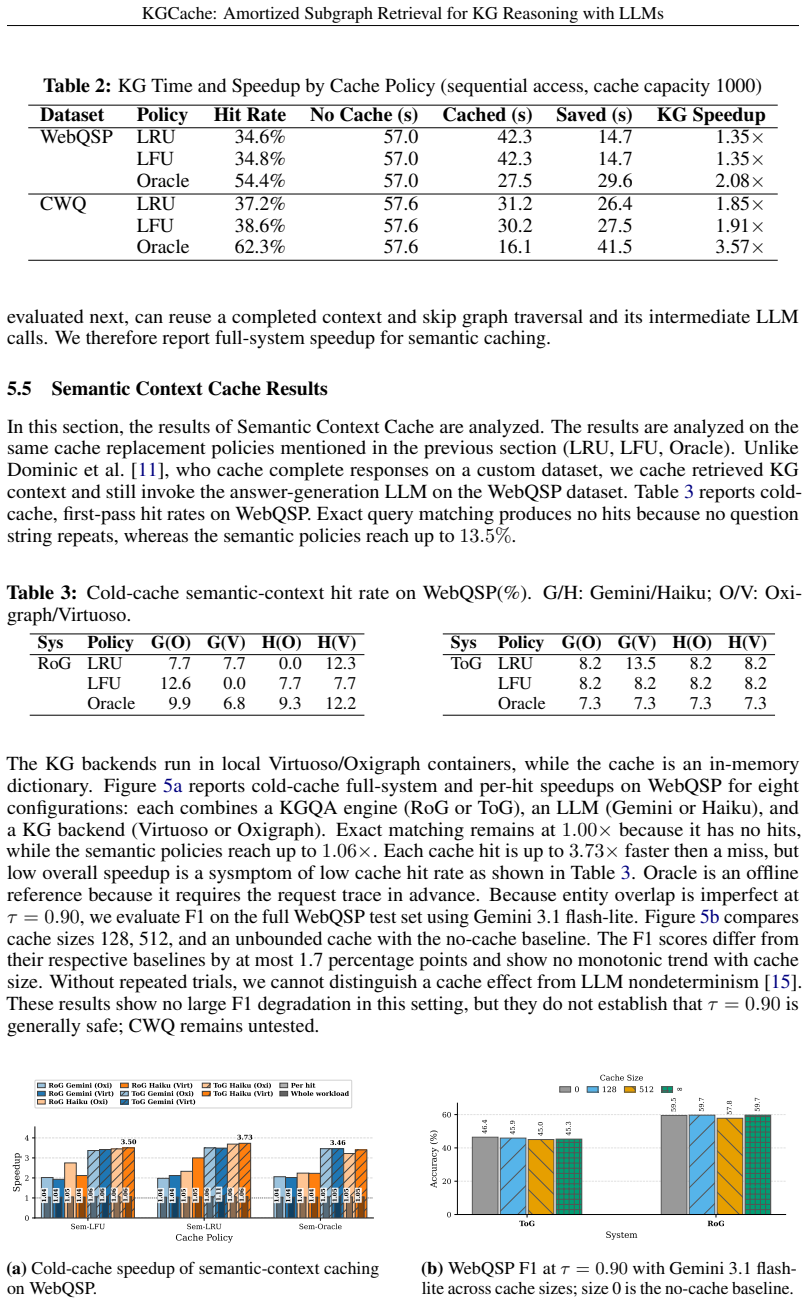
The paper claims that KGQA workloads are dominated by repeated entity access, concentrated in a relatively small set of frequently visited entities, and that placing a cache of one-hop entity neighborhoods between the KGQA engine and the KG backend removes a large share of the repeated backend work. Entity caching accelerates KG retrieval by up to 1.91x, while semantic-context caching achieves up to 1.06x full-system speedup in the evaluated WebQSP configurations, with each hit being up to 3.73x faster. The cache does not change the LLM call sequence for entity-level hits, because each traversal step still invokes the reasoning engine, whereas the semantic cache reuses an already constructed context and skips both backend invocation and the intermediate traversal steps. The paper also finds that the benefits are not artifacts of question ordering, since shuffled-access traces match sequential-access results.
Load-bearing premise
The reported speedups assume that latencies measured on evaluation-specific Freebase subgraphs transfer to a real production KG backend, and that $\tau=0.90$ semantic reuse preserves answer quality beyond the single WebQSP run without repeated trials.
Editorial extensions
If this is right
- KGQA engines that use iterative traversal can cut a large fraction of backend KG queries with a small cache: LRU reaches a 30.7% hit rate on WebQSP with only 50 cached entities.
- Entity caching accelerates KG retrieval by up to 1.91x on CWQ and 1.35x on WebQSP while leaving the LLM call sequence unchanged, so the optimization composes with any frontend LLM.
- Semantic-context caching can skip entire traversal pipelines for similar questions, reaching up to 13.5% cold-cache hit rate on WebQSP and 1.06x full-system speedup in the evaluated configurations.
- The workload characterization predicts that other KGQA benchmarks with similarly skewed entity access will show comparable cacheability, since reuse persists under shuffled question order.
- Multi-hop neighborhood caching is a plausible next step, but it requires preserving reusable structure across different questions that start from the same entity.
Reading between the lines
- Extension: The reported 1.06x full-system speedup is bounded by KG retrieval being a small fraction of total runtime; if a production backend has slower per-request latency, the end-to-end gain from the same hit rates would grow, and if the backend is faster, the gain would shrink or disappear.
- Extension: The semantic cache's threshold $\tau=0.90$ is not validated as F1-neutral on CWQ, and the paper reports incomplete entity overlap for CWQ at every threshold, so deploying semantic caching on CWQ would require per-dataset accuracy checks before trusting hit-rate gains.
- Extension: Because the cache stores unpruned one-hop neighborhoods, it preserves all information needed for question-specific LLM pruning; this design could be extended to a hybrid cache that also memoizes pruned subgraphs per question type, though the paper does not explore that.
- Extension: The workload reuse patterns suggest that caching could be coordinated with LLM pruning schedules, for example by prefetching neighborhoods of frequently reused entities before a traversal begins, a testable optimization not evaluated in the paper.
Editorial analysis
A structured set of objections, weighed in public.
Referee Report
Summary. This paper proposes KGCache, an in-memory cache that stores one-hop knowledge-graph neighborhoods at entity granularity and is placed between a KGQA reasoning engine and a KG backend. The authors characterize entity reuse in WebQSP and CWQ, evaluate LRU, LFU, and a trace-aware Oracle policy on cache hit rates and on KG retrieval time, and explore a semantic-context cache that reuses retrieved KG context for similar questions. The main reported results are entity-reuse fractions of 62.0% (WebQSP) and 67.0% (CWQ) of traversal-level entity occurrences, entity-cache KG speedups up to 1.91x (LFU on CWQ), and semantic-cache full-system speedups up to 1.06x on WebQSP.
Significance. The workload characterization is a useful and falsifiable empirical finding, and the entity cache is a simple, orthogonal optimization that leaves the LLM call sequence unchanged and could benefit any KGQA system exhibiting repeated entity access. The paper is unusually honest about its limitations: it explicitly labels the Oracle as not a theoretical upper bound, states that measured latencies apply to evaluation-specific subgraphs, and acknowledges the absence of repeated trials for the semantic F1 experiments. If the speedups transfer to a production KG backend, the contribution is practically relevant; however, transferability of the measured latency profile is the main open risk.
major comments (3)
- [Section 4 / Abstract] The abstract states that "Entity caching accelerates KG retrieval by up to 1.91x," but the runtime experiments in Table 2 are run on dataset-specific incident-triple subgraphs, and Section 4 explicitly says the reported KG latency "should be interpreted for these evaluation-specific subgraphs." Since Table 2 shows that similar hit rates yield very different speedups (WebQSP 34.8% hit rate gives 1.35x, CWQ 38.6% gives 1.91x), the speedup depends on the request-cost distribution, which may differ on a full production backend. The paper should temper the abstract or provide evidence that the cost distribution transfers.
- [Section 5.4 / Table 2] The text in Section 5.4 says "Oracle is excluded because it requires the complete request trace in advance," yet Table 2 lists Oracle rows with concrete KG times and speedups (2.08x and 3.57x). This is a direct contradiction. The authors must clarify whether the Oracle times were measured after pre-population, simulated, or estimated from hit rates; if Oracle was not actually run, the rows should not appear as if they came from the same runtime experiment.
- [Section 5.5 / Section 7] The semantic-cache F1 results at tau=0.90 are based on a single run, and the paper itself states that "Without repeated trials, we cannot distinguish a cache effect from LLM nondeterminism" and that CWQ remains untested. This transparency is good, but Section 7 then claims "We proved that both work on both iterative and one-shot planning approaches," which overstates the evidence: the entity cache is only empirically evaluated with ToG, and the semantic cache's quality safety is explicitly unresolved. The conclusion should be reworded to match the stated evidence.
minor comments (6)
- [Section 1] The sentence "75.9% and 44.7% of entities recur across CWQ and WebQSP benchmarks" is imprecise; Figure 1a reports percentages of entity mentions (occurrences) that are reused, not percentages of distinct entities.
- [Table 3] Table 3 does not state the similarity threshold used for the semantic hits; specify whether all rows use tau=0.90 as in Figure 5b.
- [Section 5.5] The "per-hit speedup" shown in Figure 5a is not defined in the text; please provide the formula or a prose definition.
- [Section 5.5] There are two typos: "sysmptom" should be "symptom," and "then a miss" should be "than a miss."
- [Section 7] The phrase "We proved that both work" is too strong for an empirical evaluation; consider "we demonstrated" or "we found."
- [Section 5.4] Please clarify how the 400-input subset for each dataset was selected and whether the reported results are stable across different random subsets.
Circularity Check
No significant circularity: all reported speedups are measured against external benchmarks, with the semantic threshold swept and openly not validated, and the Oracle explicitly not an upper bound.
full rationale
KGCache reports measured cache hit rates, KG-component times, and end-to-end times on WebQSP and CWQ against external baselines (ToG/RoG implementations). No result is derived from a fitted parameter: the semantic threshold tau is swept over 0.80-0.99, and the paper explicitly states that tau=0.90 F1 safety is not established ('Without repeated trials, we cannot distinguish a cache effect from LLM nondeterminism... they do not establish that tau=0.90 is generally safe; CWQ remains untested'). The trace-aware Oracle is explicitly labeled as not an upper bound ('It is not a theoretical upper bound since LRU can outperform it when reuse is concentrated in short temporal windows'), so the evaluation does not rely on an oracle-derived prediction. The workload characterization defines reuse by counting repeated identifiers in the same traces, but the subsequent cache hit rates and speedups are measured, not implied by that definition. Section 4's dataset-specific subgraph construction is a stated external-validity caveat ('the reported KG latency should be interpreted for these evaluation-specific subgraphs'), not a circular step. The paper contains no self-citations by the authors and imports no uniqueness theorem. All central claims are empirical and self-contained against external benchmarks; any concern about transfer of speedup numbers to production backends is a correctness/robustness matter, not circularity.
Assumptions & free parameters
free parameters (1)
- semantic similarity threshold tau =
0.90
assumptions (3)
- domain assumption The KG snapshot is static during the workload
- domain assumption Dataset-specific incident-triple subgraphs are representative for latency measurement
- domain assumption Embedding cosine similarity is a valid proxy for context overlap between questions
Cite this review
Pith. "Pith review of KGCache: Amortized Subgraph Retrieval for KG Reasoning with LLMs." pith.science (2026). https://pith.science/paper/BRXKJS7H
@misc{pith2026260807954,
  author       = {Pith},
  title        = {Pith review of: KGCache: Amortized Subgraph Retrieval for KG Reasoning with LLMs},
  year         = {2026},
  howpublished = {\url{https://pith.science/paper/BRXKJS7H}},
  note         = {Machine review of arXiv:2608.07954}
}
abstract
Large language models can answer knowledge-intensive questions more reliably when they are grounded with knowledge graphs, but systems such as Think-on-Graph and Reasoning-on-Graph repeatedly query the same graph neighborhoods across different questions. In this work, we study this repeated retrieval in Knowledge Graph Question Answering~(KGQA) workloads and propose KGCache, an in-memory cache for one-hop knowledge graph neighborhoods. KGCache is designed to be compatible with both iterative traversal (ToG) and one shot planning (RoG) KGQA paradigms. KGCache is placed between the KGQA engine and the backend serving the KG, so repeated entity requests can be served from cache instead of issuing new KG queries. We evaluate KGCache on WebQSP and CWQ using LRU, LFU, and a trace-aware Oracle policy. Our analysis shows that both datasets contain substantial entity reuse among starting entities and entities reached during traversal. We also explore semantic caching for similar queries, which shows additional hit-rate gains on WebQSP and needs further accuracy testing on CWQ. Entity caching accelerates KG retrieval by up to $1.91\times$, while semantic-context caching achieves up to $1.06\times$ full-system speedup in the evaluated WebQSP configurations, with each hit being up to $3.73\times$ faster.
Figures


Figures from the paper (2 more)

Reference graph
Works this paper leans on
-
[1]
Knowledge graph retrieval-augmented generation via gnn-guided prompting
Haochen Liu, Song Wang, and Jundong Li. Knowledge graph retrieval-augmented generation via gnn-guided prompting. InSecond Conference on Language Modeling, 2025. 1
work page 2025
-
[2]
Large language models meet knowledge graphs for question answering: Synthesis and opportunities
Chuangtao Ma, Yongrui Chen, Tianxing Wu, Arijit Khan, and Haofen Wang. Large language models meet knowledge graphs for question answering: Synthesis and opportunities. In Proceedings of the 2025 Conference on Empirical Methods in Natural Language Processing, pages 24589–24608, 2025. 1, 2
work page 2025
-
[3]
Jiashuo Sun, Chengjin Xu, Lumingyuan Tang, Saizhuo Wang, Chen Lin, Yeyun Gong, Lionel M Ni, Heung-Yeung Shum, and Jian Guo. Think-on-graph: Deep and responsible reasoning of large language model on knowledge graph.arXiv preprint arXiv:2307.07697, 2023. 1, 2, 9
arXiv 2023
-
[4]
Shengjie Ma, Chengjin Xu, Xuhui Jiang, Muzhi Li, Huaren Qu, Cehao Yang, Jiaxin Mao, and Jian Guo. Think-on-graph 2.0: Deep and faithful large language model reasoning with knowledge-guided retrieval augmented generation.arXiv preprint arXiv:2407.10805, 2024. 1, 9
arXiv 2024
-
[5]
Xiaojun Wu, Cehao Yang, Xueyuan Lin, Chengjin Xu, Xuhui Jiang, Yuanliang Sun, Hui Xiong, Jia Li, and Jian Guo. Think-on-graph 3.0: Efficient and adaptive llm reasoning on heterogeneous graphs via multi-agent dual-evolving context retrieval.arXiv preprint arXiv:2509.21710, 2025. 1
arXiv 2025
-
[6]
Reasoning on graphs: Faithful and interpretable large language model reasoning
Linhao Luo, Yuan-Fang Li, Reza Haffari, and Shirui Pan. Reasoning on graphs: Faithful and interpretable large language model reasoning. InInternational Conference on Learning Representations, volume 2024, pages 14400–14423, 2024. 1, 2, 9
work page 2024
-
[7]
The web as a knowledge-base for answering complex questions
Alon Talmor and Jonathan Berant. The web as a knowledge-base for answering complex questions. InProceedings of the 2018 Conference of the North American Chapter of the Association for Computational Linguistics: Human Language Technologies, V olume 1 (Long Papers), pages 641–651, 2018. 1
work page 2018
-
[8]
The value of semantic parse labeling for knowledge base question answering
Wen-tau Yih, Matthew Richardson, Christopher Meek, Ming-Wei Chang, and Jina Suh. The value of semantic parse labeling for knowledge base question answering. InProceedings of the 54th Annual Meeting of the Association for Computational Linguistics (V olume 2: Short Papers), pages 201–206, 2016. 1, 6
work page 2016
Show all 22 references
-
[9]
Query-aware graph neural networks for enhanced retrieval-augmented generation.arXiv preprint arXiv:2508.05647, 2025
Vibhor Agrawal, Fay Wang, and Rishi Puri. Query-aware graph neural networks for enhanced retrieval-augmented generation.arXiv preprint arXiv:2508.05647, 2025. 2
2025 arXiv
-
[10]
Simgrag: Leveraging similar subgraphs for knowledge graphs driven retrieval-augmented generation
Yuzheng Cai, Zhenyue Guo, Yiwen Pei, Wanrui Bian, and Weiguo Zheng. Simgrag: Leveraging similar subgraphs for knowledge graphs driven retrieval-augmented generation. InFindings of the Association for Computational Linguistics: ACL 2025, pages 3139–3158, 2025. 2
2025
-
[11]
Knowledge graph-enhanced semantic cache for low-latency and cost-effective inference in large language models
Nicholas Dominic and Bens Pardamean. Knowledge graph-enhanced semantic cache for low-latency and cost-effective inference in large language models. In2024 International Conference on Information Management and Technology (ICIMTech), pages 340–344, 2024. doi: 10.1109/ICIMTech63...
2024
-
[12]
Virtuoso universal server.https://virtuoso.openlinksw.com
OpenLink Software. Virtuoso universal server.https://virtuoso.openlinksw.com. Multi- model RDBMS and graph database, accessed August 2026. 5
2026
-
[13]
Oxigraph
Oxigraph developers. Oxigraph. https://github.com/oxigraph/oxigraph, 2023. SPARQL graph database implemented in Rust. 5
2023
-
[14]
Freebase: a collaboratively created graph database for structuring human knowledge
Kurt Bollacker, Colin Evans, Praveen Paritosh, Tim Sturge, and Jamie Taylor. Freebase: a collaboratively created graph database for structuring human knowledge. InProceedings of the 2008 ACM SIGMOD international conference on Management of data, pages 1247–1250, 2008. 5
2008
-
[15]
deterministic
Berk Atil, Sarp Aykent, Alexa Chittams, Lisheng Fu, Rebecca J Passonneau, Evan Radcliffe, Guru Rajan Rajagopal, Adam Sloan, Tomasz Tudrej, Ferhan Ture, et al. Non-determinism of" deterministic" llm settings.arXiv preprint arXiv:2408.04667, 2024. 8
2024 arXiv
-
[16]
Search-on-graph: Iterative informed navigation for large language model reasoning on knowledge graphs, 2025
Jia Ao Sun, Hao Yu, Fabrizio Gotti, Fengran Mo, Yihong Wu, Yuchen Hui, and Jian-Yun Nie. Search-on-graph: Iterative informed navigation for large language model reasoning on knowledge graphs, 2025. URLhttps://arxiv.org/abs/2510.08825. 9 10 KGCache: Amortized Subgraph Retrieval...
2025 arXiv
-
[17]
Plan-on-graph: Self-correcting adaptive planning of large language model on knowledge graphs, 2024
Liyi Chen, Panrong Tong, Zhongming Jin, Ying Sun, Jieping Ye, and Hui Xiong. Plan-on-graph: Self-correcting adaptive planning of large language model on knowledge graphs, 2024. URL https://arxiv.org/abs/2410.23875. 9
2024 arXiv
-
[18]
Karpa: A training-free method of adapting knowledge graph as references for large language model’s reasoning path aggregation, 2024
Siyuan Fang, Kaijing Ma, Tianyu Zheng, Xinrun Du, Ningxuan Lu, Ge Zhang, and Qingkun Tang. Karpa: A training-free method of adapting knowledge graph as references for large language model’s reasoning path aggregation, 2024. URL https://arxiv.org/abs/2412. 20995. 9
2024
-
[19]
Subgraph retrieval enhanced model for multi-hop knowledge base question answering
Jing Zhang, Xiaokang Zhang, Jifan Yu, Jian Tang, Jie Tang, Cuiping Li, and Hong Chen. Subgraph retrieval enhanced model for multi-hop knowledge base question answering. In Proceedings of the 60th Annual Meeting of the Association for Computational Linguistics (V olume 1: Long ...
-
[20]
Reasoninglm: Enabling structural subgraph reasoning in pre-trained language models for question answering over knowledge graph, 2023
Jinhao Jiang, Kun Zhou, Wayne Xin Zhao, Yaliang Li, and Ji-Rong Wen. Reasoninglm: Enabling structural subgraph reasoning in pre-trained language models for question answering over knowledge graph, 2023. URLhttps://arxiv.org/abs/2401.00158. 9
2023 arXiv
-
[21]
Simple is effective: The roles of graphs and large language models in knowledge-graph-based retrieval-augmented generation, 2025
Mufei Li, Siqi Miao, and Pan Li. Simple is effective: The roles of graphs and large language models in knowledge-graph-based retrieval-augmented generation, 2025. URL https:// arxiv.org/abs/2410.20724. 9 8 Appendix 8.1 AI disclosure In this work, we used generative AI tools fo...
2025 arXiv
-
[2022]
URL http://dx.doi.org/10.18653/v1/2022
doi: 10.18653/v1/2022.acl-long.396. URL http://dx.doi.org/10.18653/v1/2022. acl-long.396. 9
2022 doi
Reviewed August 12, 2026 · model on record in the stance chip above.
Discussion (0). Continue with ORCID to comment.