Unitary Designs from Doped Matchgate Circuits
Pith reviewed 2026-06-26 07:59 UTC · model grok-4.3
The pith
Doping matchgate circuits with non-Gaussian gates produces approximate unitary 2-designs with rigorous bounds on gate count.
A machine-rendered reading of the paper's core claim, the machinery that carries it, and where it could break.
Core claim
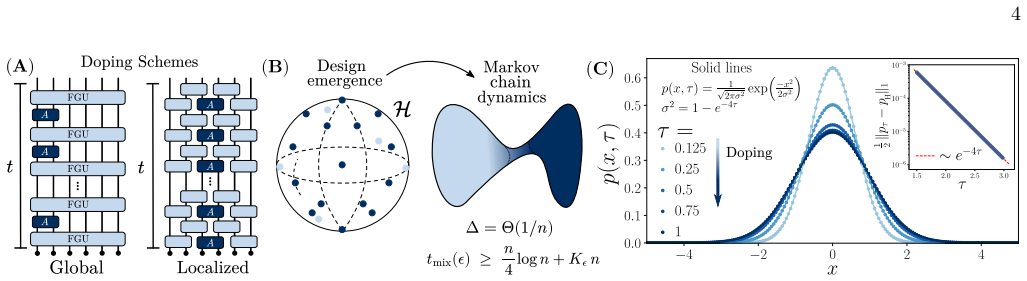
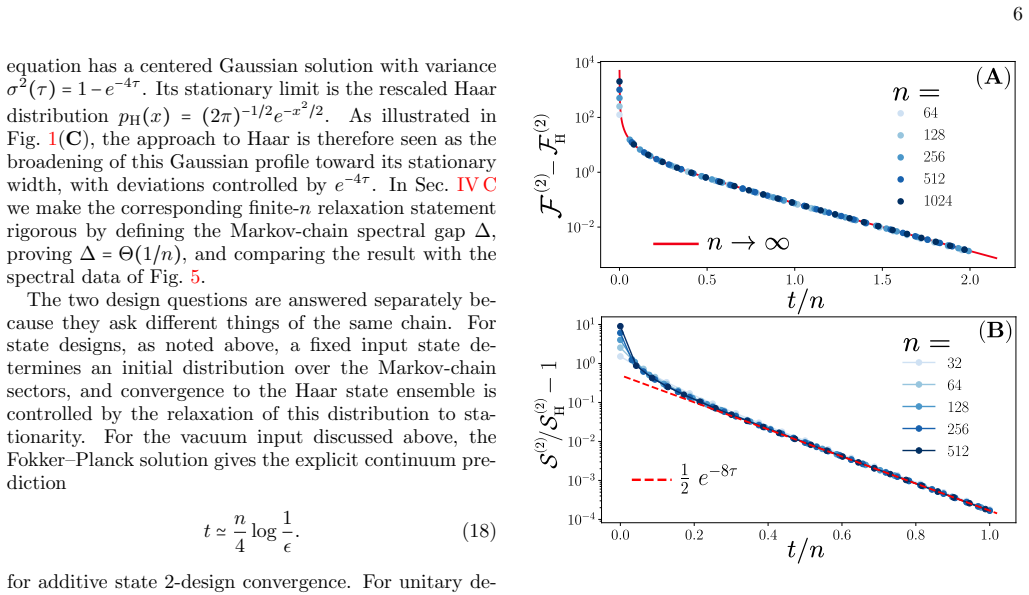
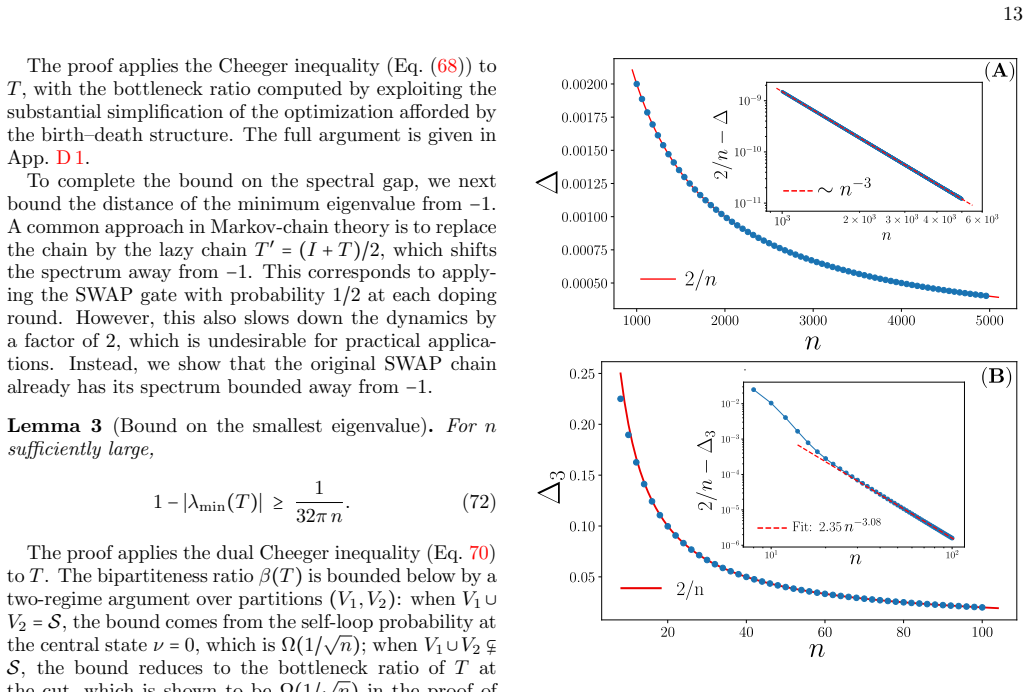
By doping matchgate circuits with non-Gaussian gates the design problem for globally scrambled dynamics maps exactly onto a classical birth-death Markov chain with an Ornstein-Uhlenbeck continuum limit. This recasts the emergence of quantum randomness in terms of spectral gaps and mixing times and yields rigorous bounds on the number of non-Gaussian gates needed for approximate 2-designs. The bounds apply to a broad class of parity-preserving non-Gaussian gates independently of microscopic details.
What carries the argument
The matchgate commutant framework, which maps the quantum unitary design formation exactly onto a classical Markov chain.
If this is right
- Approximate parity-preserving 2-designs are obtained in polylogarithmic depth with sparse non-Gaussian gate count.
- Page-like entanglement growth is expected in the doped circuits.
- Fermionic classical-shadow protocols become feasible with these designs.
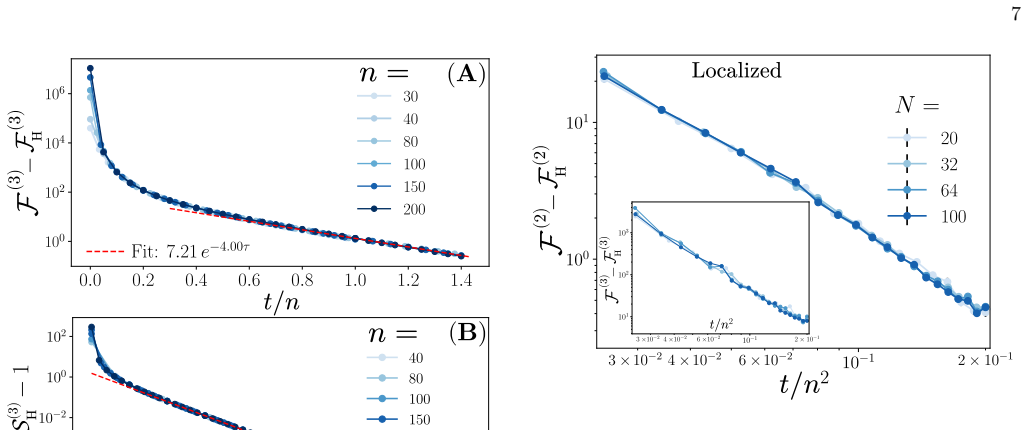
- Numerics indicate the same mechanism governs higher-order designs.
Where Pith is reading between the lines
- Local brickwork dynamics being diffusion-limited suggests that global scrambling assumptions are crucial for fast design formation.
- This approach could be extended to study design formation in other integrable systems doped with interactions.
- The Markov chain mapping might allow exact calculation of design times for specific gate sets beyond the continuum limit.
Load-bearing premise
The matchgate commutant framework permits an exact mapping of the quantum design problem to a classical Markov chain that holds independently of microscopic details for globally scrambled dynamics.
What would settle it
A numerical simulation showing that the number of non-Gaussian gates required for a given design fidelity deviates significantly from the predicted bound for a parity-preserving gate would falsify the claim.
Figures
read the original abstract
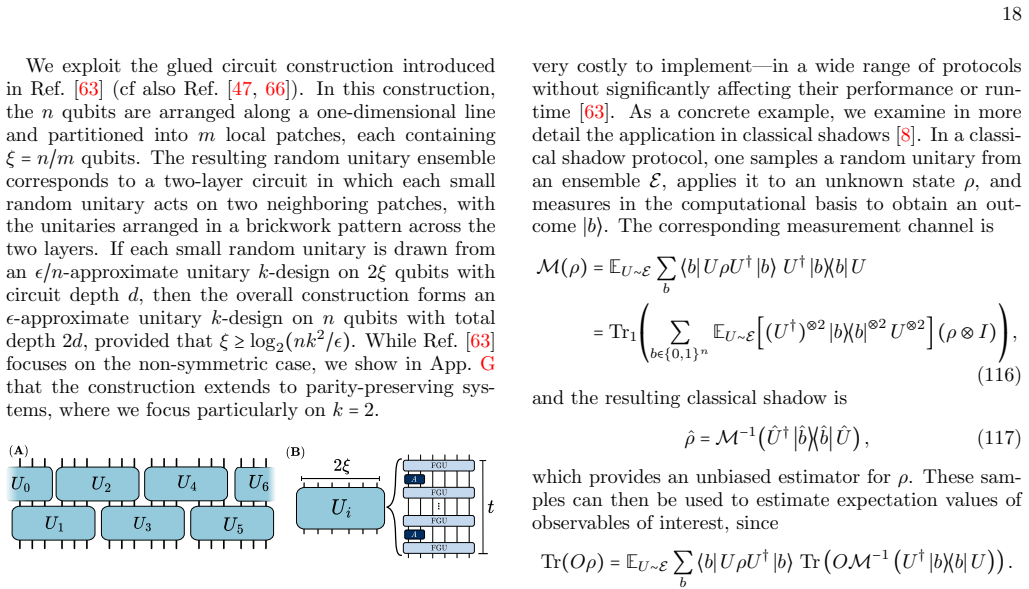
Matchgate circuits realize free-fermion dynamics: they are efficiently classically simulable, yet cannot on their own generate the generic randomness required for universal computation or unitary design formation. We study a controlled route beyond this integrable limit by doping matchgate circuits with non-Gaussian gates-physically, the injection of fermionic interactions into an otherwise free system. Using the matchgate commutant framework, we obtain analytic control over unitary $2$-design formation. For globally scrambled dynamics, the design problem maps exactly onto a classical birth-death Markov chain with an Ornstein-Uhlenbeck continuum limit, recasting the emergence of quantum randomness in terms of spectral gaps and mixing times and yielding rigorous bounds on the number of non-Gaussian gates needed for approximate $2$-designs. These bounds hold for a broad class of parity-preserving non-Gaussian gates, independently of microscopic details, with numerics indicating that the same mechanism governs higher-order designs. Used as local building blocks in a glued-circuit architecture, they yield approximate parity-preserving $2$-designs in polylogarithmic depth with a sparse non-Gaussian gate count, with implications for Page-like entanglement growth and fermionic classical-shadow protocols. Finally, locality reshapes this picture: in local brickwork dynamics, design formation is diffusion-limited and far slower. Our results establish doped matchgate circuits as a controlled, analytically tractable route from free fermions to interaction-generated quantum designs.
Editorial analysis
A structured set of objections, weighed in public.
Referee Report
Summary. The manuscript studies doped matchgate circuits, in which free-fermion matchgate dynamics are supplemented by a controlled number of parity-preserving non-Gaussian gates. Using the matchgate commutant framework, the authors claim that, for globally scrambled dynamics, the problem of forming an approximate unitary 2-design maps exactly onto a classical birth-death Markov chain whose continuum limit is an Ornstein-Uhlenbeck process. This mapping is asserted to yield rigorous, detail-independent bounds on the number of non-Gaussian gates required. The work further examines glued-circuit constructions that achieve polylogarithmic depth and contrasts these with slower, diffusion-limited local brickwork dynamics, while noting numerical indications that the same mechanism extends to higher-order designs and implications for entanglement growth and fermionic classical shadows.
Significance. If the claimed exact reduction to a parameter-free Markov chain holds, the paper supplies an analytically tractable route from integrable free-fermion circuits to interaction-generated randomness, with explicit mixing-time bounds that apply uniformly across a broad gate class. The recasting of design formation in terms of spectral gaps and the OU limit constitutes a genuine technical contribution, and the glued-architecture results offer concrete depth and gate-count scalings with potential utility for shadow protocols.
major comments (2)
- [commutant-framework section] The central claim of an exact, microscopic-detail-independent mapping (abstract and the section introducing the commutant projection) rests on the assertion that the projected quantum channel reduces precisely to a birth-death process whose gap is uniform over the stated gate class. The manuscript must exhibit the explicit generator of this chain and demonstrate that its eigenvalues are independent of the particular non-Gaussian gate chosen; otherwise the independence statement is not load-bearing.
- [Markov-chain analysis] The rigorous bounds on the number of non-Gaussian gates (abstract and the Markov-chain analysis) are derived from the spectral gap of the OU process. The paper should state the precise dependence of the gap on system size and doping density, and confirm that the polylogarithmic depth claim for the glued architecture follows directly from this gap without additional assumptions on the scrambling time.
minor comments (3)
- The abstract is information-dense; separating the mapping claim, the bound statement, and the architectural results into distinct sentences would improve readability.
- [numerics paragraph] Numerical evidence that the mechanism extends to higher-order designs is mentioned only in passing; a brief table or plot summarizing the observed scaling for k>2 would strengthen the claim without altering the main 2-design focus.
- Notation for the birth-death rates and the OU drift and diffusion coefficients should be introduced with explicit definitions to avoid ambiguity in the continuum limit derivation.
Simulated Author's Rebuttal
We thank the referee for the careful reading, positive assessment of significance, and recommendation for minor revision. The comments help clarify the presentation of the commutant mapping and the scaling bounds. We respond to each major comment below and indicate the revisions that will be incorporated.
read point-by-point responses
-
Referee: [commutant-framework section] The central claim of an exact, microscopic-detail-independent mapping (abstract and the section introducing the commutant projection) rests on the assertion that the projected quantum channel reduces precisely to a birth-death process whose gap is uniform over the stated gate class. The manuscript must exhibit the explicit generator of this chain and demonstrate that its eigenvalues are independent of the particular non-Gaussian gate chosen; otherwise the independence statement is not load-bearing.
Authors: The mapping follows from the fact that the matchgate commutant is spanned by parity and excitation-number operators; any parity-preserving non-Gaussian gate projects onto the same tridiagonal birth-death generator on the doping coordinate, with off-diagonal rates set by the doping density alone. The eigenvalues of this generator are therefore identical for the entire gate class. To make the claim fully explicit we will add, in the revised commutant-framework section, the concrete (N+1)×(N+1) rate matrix together with the short algebraic argument that its spectrum depends only on system size and doping density. revision: yes
-
Referee: [Markov-chain analysis] The rigorous bounds on the number of non-Gaussian gates (abstract and the Markov-chain analysis) are derived from the spectral gap of the OU process. The paper should state the precise dependence of the gap on system size and doping density, and confirm that the polylogarithmic depth claim for the glued architecture follows directly from this gap without additional assumptions on the scrambling time.
Authors: In the continuum limit the OU gap is 1; after rescaling by doping density ρ = k/N the discrete birth-death gap is Θ(ρ), so the ε-mixing time is O(ρ^{-1} log(1/ε)). The glued architecture interleaves fast global matchgate scrambling (O(log N) depth by existing results) with O(ρ^{-1} log N) doping layers, yielding overall polylog depth with no further assumptions. The revised Markov-chain analysis section will contain an explicit paragraph stating these scalings and deriving the depth bound directly from the gap. revision: yes
Circularity Check
No significant circularity; derivation self-contained
full rationale
The paper invokes the matchgate commutant framework to derive an exact mapping of the 2-design problem onto a classical birth-death Markov chain (with OU limit) for globally scrambled dynamics. This reduction is presented as analytic and rigorous, yielding bounds independent of microscopic gate details for a broad class of parity-preserving gates. No step reduces by construction to a fitted parameter, self-defined quantity, or load-bearing self-citation; the central claim rests on the framework producing new spectral-gap and mixing-time control rather than renaming or refitting inputs. The derivation is therefore self-contained against external benchmarks.
Axiom & Free-Parameter Ledger
axioms (2)
- domain assumption Properties of matchgate circuits and their commutant
- standard math Existence of Ornstein-Uhlenbeck continuum limit for the Markov chain
Reference graph
Works this paper leans on
-
[1]
Rigol, V
M. Rigol, V. Dunjko, and M. Olshanii, Thermalization and its mechanism for generic isolated quantum sys- tems, Nature452, 854 (2008)
2008
-
[2]
D’Alessio, Y
L. D’Alessio, Y. Kafri, A. Polkovnikov, and M. Rigol, From quantum chaos and eigenstate thermalization to statistical mechanics and thermodynamics, Adv. Phys. 65, 239–362 (2016)
2016
-
[3]
Srednicki, Chaos and quantum thermalization, Phys
M. Srednicki, Chaos and quantum thermalization, Phys. Rev. E50, 888 (1994)
1994
-
[4]
Magesan, J
E. Magesan, J. M. Gambetta, and J. Emerson, Scal- able and robust randomized benchmarking of quantum processes, Phys. Rev. Lett.106, 180504 (2011)
2011
-
[5]
Elben, S
A. Elben, S. T. Flammia, H.-Y. Huang, R. Kueng, J. Preskill, B. Vermersch, and P. Zoller, The randomized measurement toolbox, Nat. Rev. Phys.5, 9 (2023)
2023
-
[6]
M. Heinrich, M. Kliesch, and I. Roth, Randomized benchmarking with random quantum circuits (2023), arXiv:2212.06181 [quant-ph]
arXiv 2023
-
[7]
Knill, D
E. Knill, D. Leibfried, R. Reichle, J. Britton, R. B. Blakestad, J. D. Jost, C. Langer, R. Ozeri, S. Sei- delin, and D. J. Wineland, Randomized benchmarking of quantum gates, Phys. Rev. A77, 012307 (2008)
2008
-
[8]
Huang, R
H.-Y. Huang, R. Kueng, and J. Preskill, Predicting many properties of a quantum system from very few measurements, Nat. Phys.16, 1050 (2020)
2020
-
[9]
Huang, Learning quantum states from their clas- sical shadows, Nat
H.-Y. Huang, Learning quantum states from their clas- sical shadows, Nat. Rev. Phys.4, 81 (2022)
2022
-
[10]
A. Zhao, N. C. Rubin, and A. Miyake, Fermionic partial tomography via classical shadows, Phys. Rev. Lett.127, 110504 (2021)
2021
-
[11]
R. King, D. Gosset, R. Kothari, and R. Babbush, Triply efficient shadow tomography, PRX Quantum6, 010336 (2025)
2025
-
[12]
Majsak, D
J. Majsak, D. McNulty, and M. Oszmaniec, A simple and efficient joint measurement strategy for estimating fermionic observables and hamiltonians, npj Quantum Info.11, 61 (2025)
2025
-
[13]
Dankert, R
C. Dankert, R. Cleve, J. Emerson, and E. Livine, Exact and approximate unitary 2-designs and their application to fidelity estimation, Phys. Rev. A80, 012304 (2009)
2009
-
[14]
Gross, K
D. Gross, K. Audenaert, and J. Eisert, Evenly dis- tributed unitaries: On the structure of unitary designs, J. Math. Phys.48, 052104 (2007)
2007
-
[15]
D. A. Roberts and B. Yoshida, Chaos and complex- ity by design, Journal of High Energy Physics2017, 10.1007/jhep04(2017)121 (2017)
-
[16]
Surace and L
J. Surace and L. Tagliacozzo, Fermionic Gaussian states: an introduction to numerical approaches, SciPost Phys. Lect. Notes , 54 (2022)
2022
-
[17]
G. B. Mbeng, A. Russomanno, and G. E. Santoro, The quantum Ising chain for beginners, SciPost Phys. Lect. Notes , 82 (2024)
2024
-
[18]
P. Echenique and J. L. Alonso, A mathematical and computational review of hartree–fock scf methods in quantum chemistry, Mol. Phys.105, 3057 (2007), https://doi.org/10.1080/00268970701757875
-
[19]
V. Bach, E. H. Lieb, and J. P. Solovej, Generalized hartree-fock theory and the hubbard model, J. Stat. Phys.76, 3 (1994)
1994
-
[20]
Bardeen, L
J. Bardeen, L. N. Cooper, and J. R. Schrieffer, Theory of superconductivity, Phys. Rev.108, 1175 (1957)
1957
-
[21]
D. J. Dean and M. Hjorth-Jensen, Pairing in nuclear systems: from neutron stars to finite nuclei, Rev. Mod. Phys.75, 607 (2003)
2003
-
[22]
Funai, Gaussian states in quantum field theory: Ex- act representations of relative phase in superpositions of gaussian states, Phys
N. Funai, Gaussian states in quantum field theory: Ex- act representations of relative phase in superpositions of gaussian states, Phys. Rev. D111, 105031 (2025)
2025
-
[23]
P. Sala, T. Shi, S. K¨ uhn, M. C. Ba˜ nuls, E. Demler, and J. I. Cirac, Variational study of u(1) and su(2) lattice gauge theories with gaussian states in 1+1 dimensions, Phys. Rev. D98, 034505 (2018)
2018
-
[24]
Zohar, M
E. Zohar, M. Burrello, T. B. Wahl, and J. I. Cirac, Fermionic projected entangled pair states and local u(1) gauge theories, Ann. Phys.363, 385 (2015)
2015
-
[25]
L. G. Valiant, Quantum computers that can be simu- lated classically in polynomial time, inProceedings of the Thirty-Third Annual ACM Symposium on Theory of Computing, STOC ’01 (Association for Computing Machinery, New York, NY, USA, 2001) p. 114–123
2001
-
[26]
L. G. Valiant, Quantum Circuits That Can Be Simu- lated Classically in Polynomial Time, SIAM J. Comput. 31, 1229 (2012). 22
2012
-
[27]
B. M. Terhal and D. P. DiVincenzo, Classical simulation of noninteracting-fermion quantum circuits, Phys. Rev. A65, 032325 (2002)
2002
-
[28]
Jozsa and A
R. Jozsa and A. Miyake, Matchgates and classical sim- ulation of quantum circuits, Proc. R. Soc. A464, 3089–3106 (2008)
2008
-
[29]
Knill, Fermionic linear optics and matchgates (2001), arXiv:quant-ph/0108033 [quant-ph]
E. Knill, Fermionic linear optics and matchgates (2001), arXiv:quant-ph/0108033 [quant-ph]
Pith/arXiv arXiv 2001
-
[30]
D. J. Brod and E. F. Galv˜ ao, Extending matchgates into universal quantum computation, Phys. Rev. A84, 022310 (2011)
2011
-
[31]
A. A. Mele and Y. Herasymenko, Efficient learning of quantum states prepared with few fermionic non- gaussian gates, PRX Quantum6, 010319 (2025)
2025
-
[32]
Paviglianiti, L
A. Paviglianiti, L. Lumia, E. Tirrito, A. Silva, M. Col- lura, X. Turkeshi, and G. Lami, Emergence of generic entanglement structure in doped matchgate circuits, Phys. Rev. Lett.136, 020403 (2026)
2026
-
[33]
Oszmaniec, N
M. Oszmaniec, N. Dangniam, M. E. Morales, and Z. Zimbor´ as, Fermion sampling: A robust quantum computational advantage scheme using fermionic linear optics and magic input states, PRX Quantum3, 020328 (2022)
2022
-
[34]
Dias and R
B. Dias and R. Koenig, Classical simulation of non- Gaussian fermionic circuits, Quantum8, 1350 (2024)
2024
-
[35]
Reardon-Smith, M
O. Reardon-Smith, M. Oszmaniec, and K. Korzekwa, Improved simulation of quantum circuits dominated by free fermionic operations, Quantum8, 1549 (2024)
2024
-
[36]
C. Oh, M. Oszmaniec, O. Reardon-Smith, and Z. Zim- bor´ as, Classical simulation of free-fermionic dynam- ics and quantum chemistry with magic input (2026), arXiv:2604.26813 [quant-ph]
Pith/arXiv arXiv 2026
-
[37]
Hebenstreit, R
M. Hebenstreit, R. Jozsa, B. Kraus, S. Strelchuk, and M. Yoganathan, All pure fermionic non-gaussian states are magic states for matchgate computations, Phys. Rev. Lett.123, 080503 (2019)
2019
-
[38]
Bravyi and A
S. Bravyi and A. Kitaev, Universal quantum computa- tion with ideal clifford gates and noisy ancillas, Phys. Rev. A71, 022316 (2005)
2005
-
[39]
Bittel and L
L. Bittel and L. Leone, Adaptively secure unitary de- signs with constant non-clifford cost, Phys. Rev. Lett. 136, 210802 (2026)
2026
-
[40]
Veitch, S
V. Veitch, S. A. H. Mousavian, D. Gottesman, and J. Emerson, The resource theory of stabilizer quantum computation, New J. Phys.16, 013009 (2014)
2014
-
[41]
Leone, S
L. Leone, S. F. E. Oliviero, Y. Zhou, and A. Hamma, Quantum Chaos is Quantum, Quantum5, 453 (2021)
2021
-
[42]
Haferkamp, F
J. Haferkamp, F. Montealegre-Mora, M. Heinrich, J. Eisert, D. Gross, and I. Roth, Efficient unitary designs with a system-size independent number of non-clifford gates, Commun. Math. Phys.397, 995 (2022)
2022
-
[43]
Liu and A
Z.-W. Liu and A. Winter, Many-body quantum magic, PRX Quantum3, 020333 (2022)
2022
-
[44]
A. Gu, S. F. Oliviero, and L. Leone, Magic-induced computational separation in entanglement theory, PRX Quantum6, 020324 (2025)
2025
-
[45]
Magni, A
B. Magni, A. Christopoulos, A. De Luca, and X. Turkeshi, Anticoncentration in clifford circuits and beyond: From random tensor networks to pseudomagic states, Phys. Rev. X15, 031071 (2025)
2025
-
[46]
Magni and X
B. Magni and X. Turkeshi, Quantum Complexity and Chaos in Many-Qudit Doped Clifford Circuits, Quan- tum9, 1956 (2025)
1956
-
[47]
B. Magni, M. Heinrich, L. Leone, and X. Turkeshi, An- ticoncentration and state design of doped real clifford circuits and tensor networks (2025), arXiv:2512.15880 [quant-ph]
Pith/arXiv arXiv 2025
-
[48]
Leone, S
L. Leone, S. F. Oliviero, A. Hamma, J. Eisert, and L. Bittel, Non-clifford cost of random unitaries, PRX Quantum7, 020321 (2026)
2026
-
[49]
Zhang, S
Y. Zhang, S. Vijay, Y. Gu, and Y. Bao, Designs from magic-augmented clifford circuits, PRX Quantum7, 010344 (2026)
2026
-
[50]
P. S. Tarabunga, Fermionic non-gaussianity via bell sampling: monotones and efficient quantum algorithms (2026), arXiv:2606.05066 [quant-ph]
Pith/arXiv arXiv 2026
-
[51]
K. Wan, W. J. Huggins, J. Lee, and R. Babbush, Match- gate shadows for fermionic quantum simulation, Com- mun. Math. Phys.404, 629–700 (2023)
2023
-
[52]
P. Sierant, X. Turkeshi, and P. S. Tarabunga, Theory of the matchgate commutant (2026), arXiv:2603.12392 [quant-ph]
arXiv 2026
-
[53]
M. Lastres and S. Moudgalya, Geometry of free fermion commutants (2026), arXiv:2604.05031 [quant-ph]
Pith/arXiv arXiv 2026
-
[54]
P. Braccia, N. L. Diaz, M. Larocca, M. Cerezo, and D. Garc´ ıa-Mart´ ın, The commutant of fermionic gaussian unitaries (2026), arXiv:2603.19210 [quant-ph]
arXiv 2026
-
[55]
D. A. Levin, Y. Peres, and E. L. Wilmer,Markov chains and mixing times(American Mathematical So- ciety, 2006)
2006
-
[56]
F. B. Anders and A. Schiller, Real-time dynamics in quantum-impurity systems: A time-dependent numer- ical renormalization-group approach, Phys. Rev. Lett. 95, 196801 (2005)
2005
-
[57]
Thoenniss, A
J. Thoenniss, A. Lerose, and D. A. Abanin, Nonequilib- rium quantum impurity problems via matrix-product states in the temporal domain, Phys. Rev. B107, 195101 (2023)
2023
-
[58]
Y. Li, P. Sala, F. Pollmann, S. Moudgalya, and O. Motrunich, Dynamics in the presence of local symmetry-breaking impurities, Phys. Rev. B112, 155108 (2025)
2025
-
[59]
Bravyi and D
S. Bravyi and D. Gosset, Complexity of quantum impu- rity problems, Commun. Math. Phys.356, 451 (2017)
2017
-
[60]
Roy and A
A. Roy and A. J. Scott, Unitary designs and codes, Des. Codes Cryptogr.53, 13 (2009)
2009
-
[61]
A. A. Mele, Introduction to Haar Measure Tools in Quantum Information: A Beginner’s Tutorial, Quan- tum8, 1340 (2024)
2024
-
[62]
Aharonov, A
D. Aharonov, A. Kitaev, and N. Nisan, Quantum cir- cuits with mixed states, inProc. Annu. ACM Symp. Theory Comput., STOC ’98 (Association for Comput- ing Machinery, New York, NY, USA, 1998) p. 20–30
1998
-
[63]
Schuster, J
T. Schuster, J. Haferkamp, and H.-Y. Huang, Ran- dom unitaries in extremely low depth, Science389, 92 (2025)
2025
-
[64]
LaRacuente and F
N. LaRacuente and F. Leditzky, Approximate unitary k- designs from shallow, low-communication circuits, Com- mun. Math. Phys.407, 51 (2026)
2026
-
[65]
M. Heinrich, J. Haferkamp, I. Roth, and J. Helsen, Anti-concentration is (almost) all you need (2025), arXiv:2510.23719 [quant-ph]
arXiv 2025
-
[66]
L. Grevink, J. Haferkamp, M. Heinrich, J. Helsen, M. Hinsche, T. Schuster, and Z. Zimbor´ as, Will it glue? on short-depth designs beyond the unitary group (2025), arXiv:2506.23925 [quant-ph]
arXiv 2025
-
[67]
N. Dowling, J. D. Nardis, M. Heinrich, X. Turkeshi, and S. Pappalardi, Free independence and unitary de- 23 sign from random matrix product unitaries (2025), arXiv:2508.00051 [quant-ph]
arXiv 2025
-
[68]
Christopoulos, A
A. Christopoulos, A. Chan, and A. De Luca, Universal distributions of overlaps from generic dynamics in quan- tum many-body systems, Phys. Rev. Res.7, 043035 (2025)
2025
-
[69]
Sauliere, B
A. Sauliere, B. Magni, G. Lami, X. Turkeshi, and J. De Nardis, Universality in the anticoncentration of chaotic quantum circuits, Phys. Rev. B112, 134312 (2025)
2025
-
[70]
G. Lami, A. D. Luca, X. Turkeshi, and J. D. Nardis, Quantum state design and emergent confinement mech- anism in measured tensor network states (2025), arXiv:2504.16995 [quant-ph]
arXiv 2025
-
[71]
G. Lami, J. De Nardis, and X. Turkeshi, Anticoncentra- tion and state design of random tensor networks, Phys. Rev. Lett.134, 010401 (2025)
2025
-
[72]
F. G. S. L. Brand˜ ao, A. W. Harrow, and M. Horodecki, Local random quantum circuits are approximate polynomial-designs, Commun. Math. Phys.346, 397–434 (2016)
2016
-
[73]
B. C. Dias, M. Haque, P. Ribeiro, and P. McClarty, Diffusive operator spreading for random unitary free fermion circuits (2021), arXiv:2102.09846 [cond-mat.str- el]
arXiv 2021
-
[74]
Nahum, J
A. Nahum, J. Ruhman, S. Vijay, and J. Haah, Quantum entanglement growth under random unitary dynamics, Phys. Rev. X7, 031016 (2017)
2017
-
[75]
Swann, D
T. Swann, D. Bernard, and A. Nahum, Spacetime picture for entanglement generation in noisy fermion chains, Phys. Rev. B112, 064301 (2025)
2025
-
[76]
Sinclair and M
A. Sinclair and M. Jerrum, Approximate counting, uni- form generation and rapidly mixing markov chains, Inf. Comput.82, 93–133 (1989)
1989
-
[77]
G. F. Lawler and A. D. Sokal, Bounds on the l 2 spec- trum for markov chains and markov processes: A gen- eralization of cheeger’s inequality, Trans. Amer. Math. Soc.309, 557 (1988)
1988
-
[78]
Trevisan, Max cut and the smallest eigenvalue, in Proc
L. Trevisan, Max cut and the smallest eigenvalue, in Proc. Annu. ACM Symp. Theory Comput., STOC ’09 (ACM, 2009) p. 263–272
2009
-
[79]
Bauer and J
F. Bauer and J. Jost, Bipartite and neighborhood graphs and the spectrum of the normalized graph laplace operator, Commun. Anal. Geom.21, 787–845 (2013)
2013
- [80]
discussion (0)
Sign in with ORCID, Apple, or X to comment. Anyone can read and Pith papers without signing in.