Magnetic precession induced spin accumulation in collinear antiferromagnets
Pith reviewed 2026-06-29 06:34 UTC · model grok-4.3
The pith
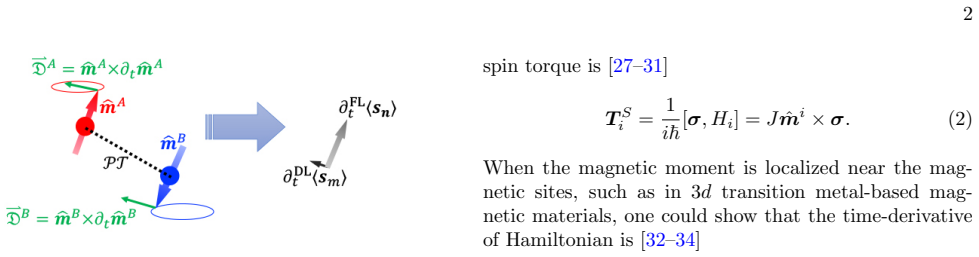
Magnetic precession generates uniform and staggered spin polarization at opposite sublattices in single collinear antiferromagnets
A machine-rendered reading of the paper's core claim, the machinery that carries it, and where it could break.
Core claim
In collinear antiferromagnets belonging to PT-invariant symmetry groups, magnetic precession near the equilibrium magnetic axis generates finite uniform and staggered spin polarization at the opposite magnetic sublattices, corresponding to total magnetic moment and Néel vector generation. The effect is captured by perturbative theory and symmetry analysis that reveal the allowed fieldlike and dampinglike responses. Electric gate fields and light dressing provide routes to manipulate the resulting spin accumulation.
What carries the argument
PT-invariant symmetry groups that permit staggered spin accumulation responses under magnetic precession, identified through group-theoretical constraints and perturbative expansion
Load-bearing premise
The low-energy perturbative regime and the specific PT-invariant symmetry groups chosen are sufficient to capture the dominant spin accumulation response without higher-order corrections or material-specific damping that would suppress the effect.
What would settle it
Measurement showing zero uniform and staggered spin polarization during magnetic precession in a PT-symmetric collinear antiferromagnet would falsify the central claim.
Figures
read the original abstract
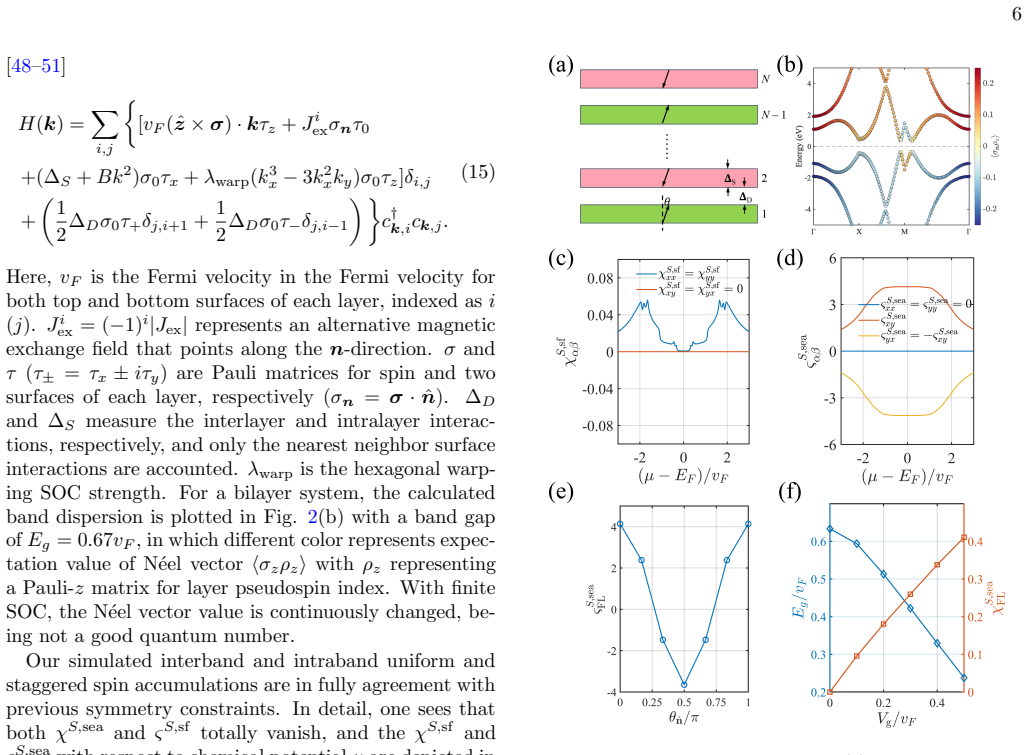
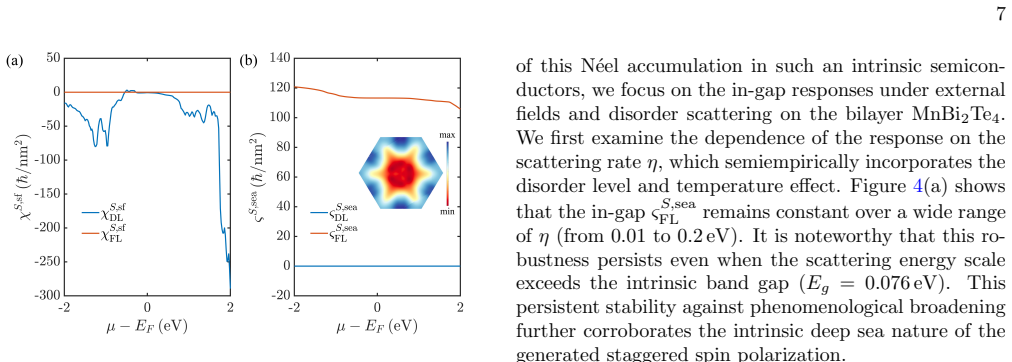
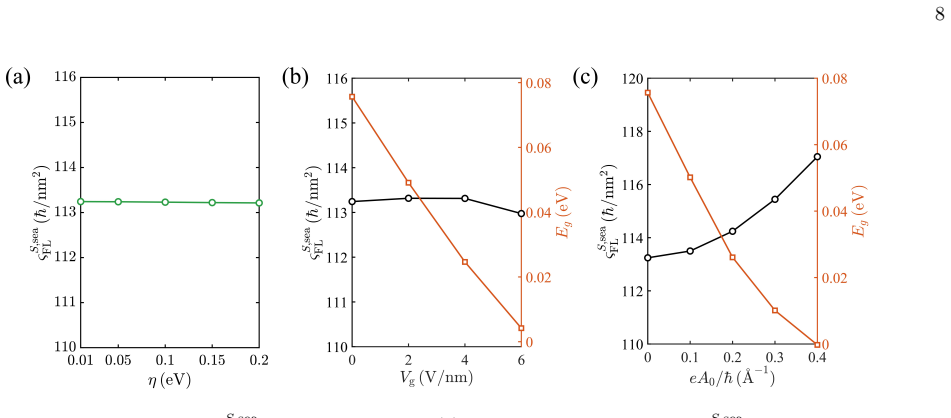
Generating and characterizing uniform and staggered spin polarization in antiferromagnets is one of the key challenges for antiferromagnetic spintronic technology. Here, we perform perturbative theory, group-theoretical symmetry analysis, low energy and ab initio simulations to propose that the magnetic precession near the equilibrium magnetic axis could generate finite uniform and staggered spin polarization at the opposite magnetic sublattices (referring to total magnetic and N\'eel vector generation) in a single AFM semiconductors. This response does not require the heterojunction setup and could eliminate the lattice mismatch issues at the junction. Through scrutinizing all symmetrically-protected vanishing magnetic moment groups and especially focusing on parity-time (PT ) invariant groups, we identify the symmetry constraints that describe the staggered spin accumulation responses, and disclose their fieldlike and dampinglike characters. This unravels a hidden spin accumulation mode in AFM semiconductors. Furthermore, we simulate such an effect using a perturbative approach and suggest that electric gate field and Floquet light-dressing can effectively manipulate these responses.
Editorial analysis
A structured set of objections, weighed in public.
Referee Report
Summary. The manuscript claims that magnetic precession near the equilibrium axis in collinear antiferromagnetic semiconductors can generate finite uniform and staggered spin polarization (total moment and Néel vector) at opposite sublattices via symmetry-allowed responses in PT-invariant groups. This is derived from group-theoretical analysis identifying fieldlike and dampinglike channels, supported by perturbative theory and ab initio simulations, and proposed to be manipulable by gate fields or Floquet light-dressing without requiring heterojunctions.
Significance. If the central result holds, the work identifies a hidden spin accumulation mode in single-material AFMs that could simplify spintronic device design by eliminating lattice-mismatch issues at junctions. The explicit use of symmetry constraints to classify responses and the combination of perturbative plus ab initio methods constitute a strength; the proposal is framed as falsifiable through the identified symmetry groups.
major comments (2)
- [§4] §4 (perturbative approach and ab initio simulations): the induced polarization is computed in the low-energy regime without restoring Gilbert damping or magnon-scattering terms in the dynamics; the manuscript therefore does not demonstrate that the response remains appreciable once dissipative channels are included, which directly bears on whether the effect survives in realistic materials.
- [§3] §3 (PT-invariant symmetry analysis): while the classification correctly identifies allowed fieldlike and dampinglike channels, no quantitative bounds or higher-order correction estimates are provided to show that these channels dominate over material-specific effects outside the chosen symmetry groups.
minor comments (2)
- [Abstract] Abstract: quantitative error estimates or specific material examples from the ab initio runs are absent, which would help readers assess the magnitude of the reported responses.
- [Results] Notation: the distinction between uniform and staggered polarization is clearly introduced but the mapping to total magnetic moment versus Néel vector could be stated more explicitly in the first paragraph of the results section.
Simulated Author's Rebuttal
We thank the referee for the detailed and constructive report. We address the two major comments point by point below, indicating where revisions will be made.
read point-by-point responses
-
Referee: §4 (perturbative approach and ab initio simulations): the induced polarization is computed in the low-energy regime without restoring Gilbert damping or magnon-scattering terms in the dynamics; the manuscript therefore does not demonstrate that the response remains appreciable once dissipative channels are included, which directly bears on whether the effect survives in realistic materials.
Authors: We agree that the present calculations omit explicit Gilbert damping and magnon scattering. The symmetry-allowed channels we derive are independent of the specific dynamical model and remain valid whenever a sustained precession is present (e.g., under continuous driving). In low-damping antiferromagnetic semiconductors the induced polarization should therefore survive. We will add a paragraph in the revised §4 discussing this limitation and the conditions under which the effect is expected to remain observable. revision: partial
-
Referee: §3 (PT-invariant symmetry analysis): while the classification correctly identifies allowed fieldlike and dampinglike channels, no quantitative bounds or higher-order correction estimates are provided to show that these channels dominate over material-specific effects outside the chosen symmetry groups.
Authors: The group-theoretical classification is strictly valid inside the PT-invariant groups we enumerate; any material-specific correction that violates those symmetries is excluded by construction. Outside the listed groups the channels are symmetry-forbidden. We will insert a clarifying sentence in §3 stating that the analysis applies exclusively within the identified symmetry classes and does not claim dominance in materials that break those symmetries. revision: partial
Circularity Check
No significant circularity; derivation relies on independent symmetry analysis and simulations
full rationale
The paper's central claim is derived from perturbative theory, group-theoretical symmetry analysis, and ab initio simulations applied to PT-invariant groups in AFM semiconductors. No equations, parameters, or predictions are shown to reduce by construction to fitted inputs or self-citations. The response is framed as emerging from symmetry constraints that identify allowed fieldlike/dampinglike channels, with no load-bearing self-referential definitions or renamings of known results. This is a standard self-contained theoretical proposal against external benchmarks.
Axiom & Free-Parameter Ledger
Reference graph
Works this paper leans on
-
[1]
Antiferromagnetic opto-spintronics,
P. Nˇ emec, M. Fiebig, T. Kampfrath, and A. V. Kimel, “Antiferromagnetic opto-spintronics,” Nat. Phys.14, 229 (2018)
2018
-
[2]
Antiferromagnetic spintronics,
V. Baltz, A. Manchon, M. Tsoi, T. Moriyama, T. Ono, and Y. Tserkovnyak, “Antiferromagnetic spintronics,” Rev. Mod. Phys.90, 015005 (2018)
2018
-
[3]
Antiferromagnetic spintronics,
T. Jungwirth, X. Marti, P. Wadley, and J. Wunderlich, “Antiferromagnetic spintronics,” Nat. Nanotech.11, 231 (2016)
2016
-
[4]
Co- herent antiferromagnetic spintronics,
J. Han, R. Cheng, L. Liu, H. Ohno, and S. Fukami, “Co- herent antiferromagnetic spintronics,” Nat. Mater.22, 684 (2023)
2023
-
[5]
Spin pump- 9 ing and spin-transfer torques in antiferromagnets,
R. Cheng, J. Xiao, Q. Niu, and A. Brataas, “Spin pump- 9 ing and spin-transfer torques in antiferromagnets,” Phys. Rev. Lett.113, 057601 (2014)
2014
-
[6]
Spin pumping of an easy-plane antiferromagnet enhanced by dzyaloshinskii–moriya in- teraction,
H. Wang, Y. Xiao, M. Guo, E. Lee-Wong, G. Q. Yan, R. Cheng, and C. R. Du, “Spin pumping of an easy-plane antiferromagnet enhanced by dzyaloshinskii–moriya in- teraction,” Phys. Rev. Lett.127, 117202 (2021)
2021
-
[7]
Spin pumping and in- verse spin hall voltages from dynamical antiferromag- nets,
Ø. Johansen and A. Brataas, “Spin pumping and in- verse spin hall voltages from dynamical antiferromag- nets,” Phys. Rev. B95, 220408 (2017)
2017
-
[8]
R. Islam, S. Ahmad, and F. Xue, “Spin-orbit torque con- trol of topology in intrinsic antiferromagnetic insulators,” (2025), arXiv:2509.01810 [cond-mat.mes-hall]
work page internal anchor Pith review Pith/arXiv arXiv 2025
-
[9]
Electrical 180 ◦ switch- ing of n´ eel vector in spin-splitting antiferromagnet,
L. Han, X. Fu, R. Peng, X. Cheng, J. Dai, L. Liu, Y. Li, Y. Zhang, W. Zhu, H. Bai,et al., “Electrical 180 ◦ switch- ing of n´ eel vector in spin-splitting antiferromagnet,” Sci. Adv.10, eadn0479 (2024)
2024
-
[10]
Electri- cal switching of altermagnetism,
Y. Chen, X. Liu, H.-Z. Lu, and X. C. Xie, “Electri- cal switching of altermagnetism,” Phys. Rev. Lett.135, 016701 (2025)
2025
-
[11]
Pi- cosecond electric-field-induced switching of antiferromag- nets,
V. Lopez-Dominguez, H. Almasi, and P. K. Amiri, “Pi- cosecond electric-field-induced switching of antiferromag- nets,” Phys. Rev. Appl.11, 024019 (2019)
2019
-
[12]
Effects of filling, strain, and electric field on the n´ eel vector in antiferro- magnetic crsb,
I. J. Park, S. Kwon, and R. K. Lake, “Effects of filling, strain, and electric field on the n´ eel vector in antiferro- magnetic crsb,” Phys. Rev. B102, 224426 (2020)
2020
-
[13]
Out-of-plane edelstein effects: Electric field induced magnetization inp-wave magnets,
M. Ezawa, “Out-of-plane edelstein effects: Electric field induced magnetization inp-wave magnets,” Phys. Rev. B111, L161301 (2025)
2025
-
[14]
Spin pump- ing and spin-transfer torques in antiferromagnets,
R. Cheng, J. Xiao, Q. Niu, and A. Brataas, “Spin pump- ing and spin-transfer torques in antiferromagnets,” Phys. Rev. Lett.113, 057601 (2014)
2014
-
[15]
Subtera- hertz spin pumping from an insulating antiferromagnet,
P. Vaidya, S. Morley, J. Tol, Y. Liu, R. Cheng, A. Brataas, D. Lederman, and E. Del Barco, “Subtera- hertz spin pumping from an insulating antiferromagnet,” Science368, 160–165 (2020)
2020
-
[16]
Tunable dy- namical magnetoelectric effect in antiferromagnetic topo- logical insulator mnbi2te4 films,
T. Zhu, H. Wang, H. Zhang, and D. Xing, “Tunable dy- namical magnetoelectric effect in antiferromagnetic topo- logical insulator mnbi2te4 films,” npj Comput. Mater.7 (2021)
2021
-
[17]
Large spin-orbit torque efficiency enhanced by magnetic structure of collinear an- tiferromagnet irmn,
J. Zhou, X. Wang, Y. Liu, J. Yu, H. Fu, L. Liu, S. Chen, J. Deng, W. Lin, X. Shu,et al., “Large spin-orbit torque efficiency enhanced by magnetic structure of collinear an- tiferromagnet irmn,” Sci. Adv.5, eaau6696 (2019)
2019
-
[18]
Quantifying spin-orbit torques in antiferromagnet–heavy-metal het- erostructures,
E. Cogulu, H. Zhang, N. N. Statuto, Y. Cheng, F. Yang, R. Cheng, and A. D. Kent, “Quantifying spin-orbit torques in antiferromagnet–heavy-metal het- erostructures,” Phys. Rev. Lett.128, 247204 (2022)
2022
-
[19]
Ab initio molecular dynamics for liquid metals,
G. Kresse and J. Hafner, “Ab initio molecular dynamics for liquid metals,” Phys. Rev. B47, 558–561 (1993)
1993
-
[20]
Efficient iterative schemes for ab initio total-energy calculations using a plane-wave basis set,
G. Kresse and J. Furthm¨ uller, “Efficient iterative schemes for ab initio total-energy calculations using a plane-wave basis set,” Phys. Rev. B54, 11169–11186 (1996)
1996
-
[21]
Projector augmented-wave method,
P. E. Bl¨ ochl, “Projector augmented-wave method,” Phys. Rev. B50, 17953–17979 (1994)
1994
-
[22]
Generalized gradient approximation made simple,
J. P. Perdew, K. Burke, and M. Ernzerhof, “Generalized gradient approximation made simple,” Phys. Rev. Lett. 77, 3865–3868 (1996)
1996
-
[23]
Restoring the density-gradient expansion for exchange in solids and surfaces,
J. P. Perdew, A. Ruzsinszky, G. I. Csonka, O. A. Vy- drov, G. E. Scuseria, L. A. Constantin, X. Zhou, and K. Burke, “Restoring the density-gradient expansion for exchange in solids and surfaces,” Phys. Rev. Lett.100, 136406 (2008)
2008
-
[24]
Special points for brillouin-zone integrations,
H. J. Monkhorst and J. D. Pack, “Special points for brillouin-zone integrations,” Phys. Rev. B13, 5188–5192 (1976)
1976
-
[25]
An updated version of wannier90: A tool for obtaining maximally-localised wannier functions,
A. A. Mostofi, J. R. Yates, G. Pizzi, Y.-S. Lee, I. Souza, D. Vanderbilt, and N. Marzari, “An updated version of wannier90: A tool for obtaining maximally-localised wannier functions,” Comput. Phys. Commun.185, 2309– 2310 (2014)
2014
-
[26]
Current-induced torques in the presence of spin-orbit coupling,
P. M. Haney and M. D. Stiles, “Current-induced torques in the presence of spin-orbit coupling,” Phys. Rev. Lett. 105, 126602 (2010)
2010
-
[27]
First-principles study of the angular dependence of the spin-orbit torque in pt/co and pd/co bilayers,
F. Mahfouzi and N. Kioussis, “First-principles study of the angular dependence of the spin-orbit torque in pt/co and pd/co bilayers,” Phys. Rev. B97, 224426 (2018)
2018
-
[28]
Spin-orbit torques in co/pt(111) and mn/w(001) magnetic bilayers from first principles,
F. Freimuth, S. Bl¨ ugel, and Y. Mokrousov, “Spin-orbit torques in co/pt(111) and mn/w(001) magnetic bilayers from first principles,” Phys. Rev. B90, 174423 (2014)
2014
-
[29]
Fully relativistic description of spin-orbit torques by means of linear response theory,
S. Wimmer, K. Chadova, M. Seemann, D. K¨ odderitzsch, and H. Ebert, “Fully relativistic description of spin-orbit torques by means of linear response theory,” Phys. Rev. B94, 054415 (2016)
2016
-
[30]
First-principles calculation of spin-orbit torque in a co/pt bilayer,
K. D. Belashchenko, A. A. Kovalev, and M. van Schilf- gaarde, “First-principles calculation of spin-orbit torque in a co/pt bilayer,” Phys. Rev. Mater.3, 011401 (2019)
2019
-
[31]
Spin-orbit torques inl1 0 −FePt/Pt thin films driven by electrical and thermal currents,
G. G´ eranton, F. Freimuth, S. Bl¨ ugel, and Y. Mokrousov, “Spin-orbit torques inl1 0 −FePt/Pt thin films driven by electrical and thermal currents,” Phys. Rev. B91, 014417 (2015)
2015
-
[32]
Gilbert damping in mag- netic multilayers,
E. ˇSim´ anek and B. Heinrich, “Gilbert damping in mag- netic multilayers,” Phys. Rev. B67, 144418 (2003)
2003
-
[33]
Ferromagnetic resonance relaxation in ultra- thin metal films: The role of the conduction electrons,
D. L. Mills, “Ferromagnetic resonance relaxation in ultra- thin metal films: The role of the conduction electrons,” Phys. Rev. B68, 014419 (2003)
2003
-
[34]
Orbital pumping by magnetization dy- namics in ferromagnets,
D. Go, K. Ando, A. Pezo, S. Bl¨ ugel, A. Manchon, and Y. Mokrousov, “Orbital pumping by magnetization dy- namics in ferromagnets,” Phys. Rev. B111, L140409 (2025)
2025
-
[35]
Ballistic and shift currents in the bulk photovoltaic effect theory,
B. I. Sturman, “Ballistic and shift currents in the bulk photovoltaic effect theory,” Phys.Usp.63, 407–411 (2020)
2020
-
[36]
Theory of the bulk photo- voltaic effect in pure crystals,
R. von Baltz and W. Kraut, “Theory of the bulk photo- voltaic effect in pure crystals,” Phys. Rev. B23, 5590– 5596 (1981)
1981
-
[37]
Recent progress in the theory of bulk photovoltaic effect,
Z. Dai and A. M. Rappe, “Recent progress in the theory of bulk photovoltaic effect,” Chem. Phys. Rev.4, 011303 (2023)
2023
-
[38]
Valley contrast- ing bulk photovoltaic effect in aPT-symmetric MnPSe 3 monolayer,
Q. Xue, X. Mu, Y. Sun, and J. Zhou, “Valley contrast- ing bulk photovoltaic effect in aPT-symmetric MnPSe 3 monolayer,” Phys. Rev. B107, 245404 (2023)
2023
-
[39]
Direct and inverse spin-orbit torques,
F. Freimuth, S. Bl¨ ugel, and Y. Mokrousov, “Direct and inverse spin-orbit torques,” Phys. Rev. B92, 064415 (2015)
2015
-
[40]
[41, 42]
See Supplemental Material for details on the symmetry consideration, and additional simulation results that in- cludes Refs. [41, 42]
-
[41]
Prediction of low-z collinear and noncollinear antiferro- magnetic compounds having momentum-dependent spin splitting even without spin-orbit coupling,
L.-D. Yuan, Z. Wang, J.-W. Luo, and A. Zunger, “Prediction of low-z collinear and noncollinear antiferro- magnetic compounds having momentum-dependent spin splitting even without spin-orbit coupling,” Phys. Rev. Mater.5, 014409 (2021)
2021
-
[42]
Electric control of dirac quasiparticles by spin-orbit torque in an antiferromagnet,
L. ˇSmejkal, J. ˇZelezn´ y, J. Sinova, and T. Jungwirth, “Electric control of dirac quasiparticles by spin-orbit torque in an antiferromagnet,” Phys. Rev. Lett.118, 106402 (2017)
2017
-
[43]
Emerging re- search landscape of altermagnetism,
L. ˇSmejkal, J. Sinova, and T. Jungwirth, “Emerging re- search landscape of altermagnetism,” Phys. Rev. X12, 10 040501 (2022)
2022
-
[44]
Beyond con- ventional ferromagnetism and antiferromagnetism: A phase with nonrelativistic spin and crystal rotation sym- metry,
L. ˇSmejkal, J. Sinova, and T. Jungwirth, “Beyond con- ventional ferromagnetism and antiferromagnetism: A phase with nonrelativistic spin and crystal rotation sym- metry,” Phys. Rev. X12, 031042 (2022)
2022
-
[45]
Contrasting light-induced spin torque in antiferromagnetic and altermagnetic systems,
J. Zhou and C. Zhang, “Contrasting light-induced spin torque in antiferromagnetic and altermagnetic systems,” Phys. Rev. Lett.134, 176902 (2025)
2025
-
[46]
R. R. Birss, ed.,Symmetry and Magnetism(North- Holland Publishing Company, 1964)
1964
-
[47]
Electrically and magnetically switchable nonlinear photocurrent inPT-symmetric magnetic topological quantum materials,
H. Wang and X. Qian, “Electrically and magnetically switchable nonlinear photocurrent inPT-symmetric magnetic topological quantum materials,” npj Comput. Mater.6, 199 (2020)
2020
-
[48]
Weyl semimetal in a topological insulator multilayer,
A. A. Burkov and L. Balents, “Weyl semimetal in a topological insulator multilayer,” Phys. Rev. Lett.107, 127205 (2011)
2011
-
[49]
Hexagonal warping effects in the surface states of the topological insulator bi 2te3,
L. Fu, “Hexagonal warping effects in the surface states of the topological insulator bi 2te3,” Phys. Rev. Lett.103, 266801 (2009)
2009
-
[50]
Magnetized topological insulator multilayers,
C. Lei, S. Chen, and A. H. MacDonald, “Magnetized topological insulator multilayers,” Proceedings of the Na- tional Academy of Sciences117, 27224–27230 (2020)
2020
-
[51]
Stacking-dependent elec- tronic and topological properties in van der waals anti- ferromagnet mnbi2te4 films,
J. Li, Q. Wu, and Weng H., “Stacking-dependent elec- tronic and topological properties in van der waals anti- ferromagnet mnbi2te4 films,” npj Comput. Mater.11, 44 (2025)
2025
-
[52]
Electric polarization reversal and memory in a multiferroic material induced by magnetic fields,
N. Hur, S. Park, P. A. Sharma, J. S. Ahn, S. Guha, and S.-W. Cheong, “Electric polarization reversal and memory in a multiferroic material induced by magnetic fields,” Nature429, 392 (2004)
2004
-
[53]
Spin-orbit coupling and ion displacements in multiferroic tbmno 3,
H. J. Xiang, S.-H. Wei, M.-H. Whangbo, and J. L. F. Da Silva, “Spin-orbit coupling and ion displacements in multiferroic tbmno 3,” Phys. Rev. Lett.101, 037209 (2008)
2008
-
[54]
First-principles approach to lattice-mediated magnetoelectric effects,
J. ´I˜ niguez, “First-principles approach to lattice-mediated magnetoelectric effects,” Phys. Rev. Lett.101, 117201 (2008)
2008
-
[55]
Induced magnetoelectric response inpnmaperovskites,
E. Bousquet and N. Spaldin, “Induced magnetoelectric response inpnmaperovskites,” Phys. Rev. Lett.107, 197603 (2011)
2011
-
[56]
Dynamical magnetic charges and linear magnetoelectricity,
M. Ye and D. Vanderbilt, “Dynamical magnetic charges and linear magnetoelectricity,” Phys. Rev. B89, 064301 (2014)
2014
-
[57]
Giant magnetoelectric effects achieved by tuning spin cone symmetry in y-type hexaferrites,
K. Zhai, Y. Wu, S. Shen, W. Tian, H. Cao, Y. Chai, B. C. Chakoumakos, D. Shang, L. Yan, F. Wang, and Y. Sun, “Giant magnetoelectric effects achieved by tuning spin cone symmetry in y-type hexaferrites,” Nat. Commun. 8, 159 (2017)
2017
-
[58]
Bulk rashba ef- fect in multiferroics: A theoretical prediction for bicoo3,
K. Yamauchi, P. Barone, and S. Picozzi, “Bulk rashba ef- fect in multiferroics: A theoretical prediction for bicoo3,” Phys. Rev. B100, 245115 (2019)
2019
-
[59]
Temporary formation of highly con- ducting domain walls for non-destructive read-out of fer- roelectric domain-wall resistance switching memories,
J. Jiang, Z. L. Bai, Z. H. Chen, L. He, D. W. Zhang, Q. H. Zhang, J. A. Shi, M. H. Park, J. F. Scott, C. S. Hwang, and A. Q. Jiang, “Temporary formation of highly con- ducting domain walls for non-destructive read-out of fer- roelectric domain-wall resistance switching memories,” Nat. Mater.17, 49 (2018)
2018
-
[60]
Colloquium: Atomic quantum gases in pe- riodically driven optical lattices,
A. Eckardt, “Colloquium: Atomic quantum gases in pe- riodically driven optical lattices,” Rev. Mod. Phys.89, 011004 (2017)
2017
-
[61]
Solution of the schr¨ odinger equation with a hamiltonian periodic in time,
J. H. Shirley, “Solution of the schr¨ odinger equation with a hamiltonian periodic in time,” Phys. Rev.138, B979– B987 (1965)
1965
-
[62]
Steady states and quasienergies of a quantum-mechanical system in an oscillating field,
H. Sambe, “Steady states and quasienergies of a quantum-mechanical system in an oscillating field,” Phys. Rev. A7, 2203–2213 (1973)
1973
-
[63]
Dynamic localization of a charged particle moving under the influence of an electric field,
D. H. Dunlap and V. M. Kenkre, “Dynamic localization of a charged particle moving under the influence of an electric field,” Phys. Rev. B34, 3625–3633 (1986)
1986
-
[64]
Perspective: Floquet engineering topological states from effective models towards realistic materials,
F. Zhan, R. Chen, Z. Ning, D.-S. Ma, Z. Wang, D.-H. Xu, and R. Wang, “Perspective: Floquet engineering topological states from effective models towards realistic materials,” Quantum Front.3, 21 (2024)
2024
-
[65]
Light-induced topological phase transition with tunable layer Hall effect in axion antifer- romagnets,
C. Zhou and J. Zhou, “Light-induced topological phase transition with tunable layer Hall effect in axion antifer- romagnets,” Nano Lett.24, 7311 (2024)
2024
-
[66]
Orbi- tronics: The intrinsic orbital current inp-doped silicon,
B. A. Bernevig, T. L. Hughes, and S.-C. Zhang, “Orbi- tronics: The intrinsic orbital current inp-doped silicon,” Phys. Rev. Lett.95, 066601 (2005)
2005
-
[67]
Spintronics meets orbitronics: Emergence of orbital angular momen- tum in solids,
D. Jo, D. Go, G.-M. Choi, and H.-W. Lee, “Spintronics meets orbitronics: Emergence of orbital angular momen- tum in solids,” npj Spintronics2, 19 (2024)
2024
-
[68]
Disentangling or- bital and valley hall effects in bilayers of transition metal dichalcogenides,
T. P. Cysne, M. Costa, L. M. Canonico, M. B. Nardelli, R. B. Muniz, and T. G. Rappoport, “Disentangling or- bital and valley hall effects in bilayers of transition metal dichalcogenides,” Phys. Rev. Lett.126, 056601 (2021)
2021
-
[69]
Long- range orbital torque by momentum-space hotspots,
D. Go, D. Jo, K.-W. Kim, S. Lee, M.-G. Kang, B.-G. Park, S. Bl¨ ugel, H.-W. Lee, and Y. Mokrousov, “Long- range orbital torque by momentum-space hotspots,” Phys. Rev. Lett.130, 246701 (2023)
2023
-
[70]
Orbital pumping incorporating both orbital angular momentum and position,
S. Han, H.-W. Ko, J. H. Oh, H.-W. Lee, K.-J. Lee, and K.-W. Kim, “Orbital pumping incorporating both orbital angular momentum and position,” Phys. Rev. Lett.134, 036305 (2025)
2025
-
[71]
Theory of current-induced angular mo- mentum transfer dynamics in spin-orbit coupled sys- tems,
D. Go, F. Freimuth, J.-P. Hanke, F. Xue, O. Gomonay, K.-J. Lee, S. Bl¨ ugel, P. M. Haney, H.-W. Lee, and Y. Mokrousov, “Theory of current-induced angular mo- mentum transfer dynamics in spin-orbit coupled sys- tems,” Phys. Rev. Research2, 033401 (2020)
2020
-
[72]
Valley-dependent giant orbital mo- ments and transport features in rhombohedral graphene multilayers,
X. Mu and J. Zhou, “Valley-dependent giant orbital mo- ments and transport features in rhombohedral graphene multilayers,” Phys. Rev. B111, 165102 (2025)
2025
discussion (0)
Sign in with ORCID, Apple, or X to comment. Anyone can read and Pith papers without signing in.