REVIEW 2 major objections 6 minor 57 references
Temporal Basis Function Models for Closed-Loop Neural Stimulation
T0 review · 2 major / 6 minor · reviewed 2026-08-06 · deepseek-v4-flash
Pith's one-line read A temporal basis function model predicts single-trial, spatiotemporal responses to optogenetic stimulation from a 20 ms runway of multichannel LFP, with held-out $R^2$ of 0.462 over a 164 ms horizon; the paper argues this makes…
desk verdict Solid forward model with real translational metrics, but the closed-loop simulation claim conflates forecasting with control because no no-stimulation counterfactual is ever generated. read the letter →
The pith
A machine-rendered reading of the paper's core claim, the machinery that carries it, and where it could break.
The reading
What carries the argument
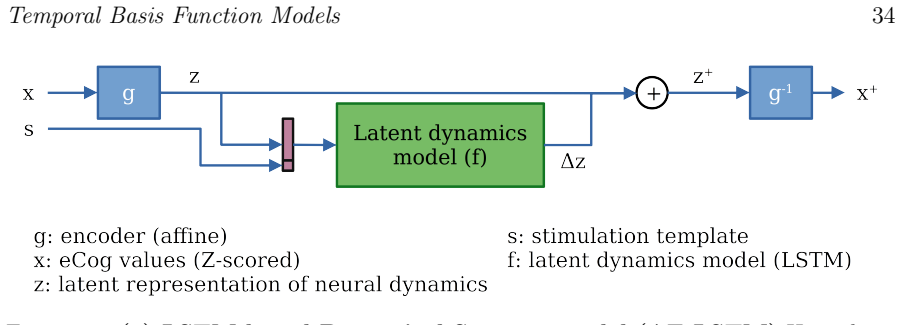
The central object is the temporal basis function model (TBFM), defined by $\hat{y}_c = x_{c,r}\mathbf{1} + \sum_{i=1}^b W(X)_{c,i} B_{i,*}$: the forecast for each channel is the last measured LFP value plus a weighted sum of $b$ temporal basis functions. The basis functions are produced by a small multilayer perceptron from a stimulation descriptor (here, the timing of the two light pulses), and the weight matrix $W$ is an affine function of the Z-scored "runway"—the final 20 ms of multichannel LFP before the forecast begins. This decomposition carries the argument because the nonlinear dependence on stimulation parameters lives in the basis generator, while the trial-specific dependence on brain state lives in the linear weight estimator, and the whole horizon is produced in one forward pass instead of being unrolled through time. After training, the nonlinear generator can be compiled away for a discrete set of stimulation parameters, leaving a linear map that runs in about 0.115 ms on a desktop CPU.
What would settle it
Run the trained TBFM in a real-time closed-loop experiment on the same non-human primate preparation, with the controller instructed not to stimulate on a random subset of trials and the true unstimulated LFP recorded under each initial state; if the decision performance computed against those genuine no-stimulation outcomes does not track the reported simulated AUCs, the closed-loop claim is not supported.
Extended reading notes
Core claim
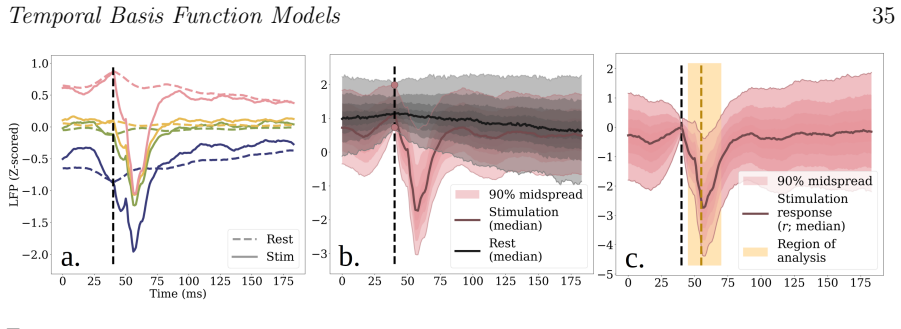
The paper's central claim is that the forward model for optogenetic stimulation does not need to be a deep recurrent network: a weighted sum of a small set of learned temporal basis functions, with weights read off affinely from the recent multichannel LFP, is enough to predict the spatiotemporal response on individual trials. The authors report a mean test-set $R^2$ of 0.462 (stdev 0.207) over the full 164 ms forecast, 0.787 over a 40 ms forecast, and a state-dependent $R^2$ of 0.878 when predictions are binned by initial state. When the model is given a sham runway, test $R^2$ falls to 0.006 (stdev 0.012), which the authors take as evidence that the model is conditioning on the pre-stimulus brain state rather than emitting a mean evoked response. They interpret the overall result as showing that the practical barriers to model-based closed-loop stimulation—sample efficiency, training time, and loop latency—can be addressed without giving up accuracy.
Load-bearing premise
The load-bearing assumption is that a trial recorded with stimulation always delivered is the correct ground-truth outcome even when the controller decides not to stimulate; if true no-stimulation trajectories differ, the simulated closed-loop results do not establish that the controller can shape brain activity.
Editorial extensions
If this is right
- A session can be modeled from about 5,000 early trials (under 20 minutes of collection), trained in 2 to 5 minutes, and then used for stimulation decisions on the rest of the session.
- A clinically deployed stimulation model should feed the controller the ongoing LFP rather than only the stimulation schedule, because state-agnostic models in this dataset achieve near-zero $R^2$.
- The measured forecast latency of about 0.2 ms on a desktop CPU leaves ample room within a 20 ms control loop for sensing, filtering, and stimulation hardware.
- If the comparison with the autoencoder-LSTM baseline generalizes, complex recurrent dynamics are not necessary for this forecasting task, and simpler, easier-to-verify models can be used in safety-critical settings.
- Even a model with test $R^2$ around 0.46 can, in the paper's simulations, time stimulation to predicted target states and toward reference trajectories, suggesting that useful closed-loop control may not require near-perfect prediction.
Reading between the lines
- One extension the paper leaves implicit is that the same architecture should generalize to continuously varying pulse parameters such as width, amplitude, or site, since the stimulation descriptor can be extended; the paper demonstrates only timing variation, so this remains untested.
- Because the basis generator can be compiled into a fixed linear map once the stimulation set is discrete, the paper's latency figures suggest a version of the model could run on low-power embedded hardware for an implantable controller, though the authors do not test this.
- The decisive test of the closed-loop claim would be a real-time experiment with genuine no-stimulation trials, comparing trajectories after a no-stimulate decision with unstimulated baselines matched on initial state; the reported AUCs are computed against recorded trials in which stimulation was always delivered.
Signed reviews
Editorial analysis
A structured set of objections, weighed in public.
Referee Report
Summary. This paper proposes temporal basis function models (TBFMs) for single-trial, spatiotemporal forward prediction of local field potential (LFP) responses to optogenetic stimulation, targeting sample efficiency, short training time, and low inference latency for closed-loop neural stimulation. The authors evaluate the model on 40 sessions of paired-pulse optogenetic stimulation data from two non-human primates, reporting a mean test-set R2 of 0.462 over a 164 ms horizon on time-domain data, with improvements over a linear state-space model and accuracy comparable to or better than a nonlinear AE-LSTM baseline. They also report statistical evidence for state-dependence of the stimulation response, benchmarks of training time and latency, and two simulated closed-loop controllers that use TBFM forecasts to decide whether to stimulate, with reported AUC values of roughly 0.65–0.72.
Significance. If the forward-model claims hold, the contribution is practically important: the model appears to offer a favorable trade-off among prediction accuracy, sample efficiency (about 5k trials), training time (2–5 minutes), and inference latency (about 0.2 ms on a CPU), directly addressing translational barriers for model-based neural co-processors. Strengths of the evaluation include a time-based train/test split that tests generalization across each session, a state-agnostic ablation showing the value of conditioning on the initial state, and a cross-validation control for non-stationarity and plasticity. The authors also release a PyTorch implementation and demo code. However, the closed-loop simulation results do not validly demonstrate closed-loop control, as detailed in the major comments; this limits the scope of the central claim but does not undermine the forward-modeling contribution itself.
major comments (2)
- [§4.9.1, §6.3.1] The evaluation of Demonstration 1 conflates prediction with control. Because stimulation was always applied in the stimulation blocks (§3.1), no true no-stimulation trials exist in those blocks; nevertheless, Appendix 6.3.1 labels test-set trials as 'do not stimulate' trials and uses the recorded (stimulated) trajectory as the ground-truth outcome for both the stimulate and do-not-stimulate decisions. Consequently, the ROC analysis in §4.9.1 measures whether the model can forecast which already-stimulated recorded trials will cross the target range, not whether the controller's decision changes the outcome. The statement in §4.9.1 that 'These results indicate that the TBFM achieved overall controllability' does not follow from the reported analysis.
- [§4.9.2, §6.3.2] Demonstration 2 suffers from the same counterfactual missingness. The reference trajectories are weighted averages of stimulated test trials, and the cost function compares the TBFM forecast (which assumes stimulation) to the reference; the 'actual trajectory assuming stimulation' is the recorded stimulated trial, and no no-stimulation trajectory is ever simulated. The reported AUC values (0.721 raw time domain, 0.637 beta) therefore quantify the model's forecasting skill under a fixed always-stimulate regime, not its ability to control neural activity. The abstract and §3.6 claim that the model 'successfully allowed a closed-loop stimulator to control a neural circuit' is unsupported by the present evidence and should be withdrawn or substantially qualified.
minor comments (6)
- [§4.2 vs. Fig. 14 caption] The text in §4.2 says the TBFM exceeded the AE-LSTM on 'all but 6 of the 40 sessions' (i.e., 34/40), while the Figure 14 caption says 'on 32 of 40 sessions'; these numbers should be reconciled.
- [§4.9.2] The sentence reporting that test-set R2 was 'predictive of the AUC' gives only the p-value (p=1.01e−3); the correlation coefficient and the number of sessions should be reported.
- [§6.1] The phrase 'was loss-pass filtered' should read 'was low-pass filtered'.
- [Table 1] The column heading 'R2 mean-vs-mean' is not defined in the caption; please define it in the caption or in §4.2.
- [§3.5/§4.8] The FSAM stopping rule is described as adding bases until validation-set accuracy no longer increases, but no quantitative convergence threshold is given; please specify the criterion used in Figure 10.
- [§5.3] The code availability statement says the implementation is available under an open-source license but does not name the license; please specify it.
Circularity Check
The closed-loop simulations evaluate both 'stimulate' and 'do not stimulate' decisions against the recorded stimulated trajectory, so the reported AUC reduces to forecasting the training distribution rather than controlling a counterfactual no-stimulation plant.
-
self definitional
[Section 4.9.1 and Appendix 6.3.1]
"For the rest of the trials ('do not stimulate' trials), the target range is some other randomly chosen target. ... False positive here refers to the controller applying stimulation but the trajectory does not in-fact cross into the target zone, and false negative refers to cases where the controller does not apply stimulation but the trajectory does cross into the target zone."
Every trial in the dataset is a stimulated trial, yet the 'do not stimulate' trials are still scored against the recorded stimulated trajectory. The no-stimulation outcome is never generated or modeled, so a controller that chooses not to stimulate is evaluated as though the stimulation response still occurred. The false negative condition, 'no stimulation but the trajectory crosses the target', cannot occur in the actual counterfactual because without stimulation the trajectory would be different. Consequently, the ROC/AUC measures whether the TBFM can forecast which recorded stimulated trajectories will cross a target, not whether deciding not to stimulate avoids the target.
-
self definitional
[Section 4.9.2, Appendix 6.3.2, and Figure 4(b) caption]
"For this demonstration we generate reference trajectories by calculating a weighted average of test set trajectories, beginning at the stimulation onset t=40 ms. ... The simulation evaluates the controller's performance by measuring the L2 distance between the actual trajectory assuming stimulation (blue) and the reference, and comparing that distance to the same threshold ϵs."
The reference trajectories are constructed from stimulated test-set trajectories, and the 'actual trajectory' used for evaluation is always the stimulated trajectory, regardless of whether the controller chooses to stimulate or not. The controller's only decision is whether to apply stimulation, but the no-stimulation branch is never simulated. Therefore both the controller's cost function and the evaluation compare stimulated trajectories to references derived from stimulated trajectories. The reported AUC quantifies how close the TBFM's forecasts are to the stimulated data distribution, not whether the controller's decision changes the neural trajectory. This makes the second closed-loop demonstration's control claim reduce to the model's forecasting performance by construction.
full rationale
The core forward-prediction results are not circular: the TBFM is trained on early-session trials and evaluated on held-out late-session trials, it is compared against independently trained AE-LSTM and LSSM baselines, and the state-dependence ablation against a state-agnostic model is a legitimate experimental control. There is no load-bearing self-citation chain and no imported uniqueness theorem; the cited prior work supplies data and context, not the derivation. The circularity is concentrated in the simulated closed-loop demonstrations of Section 4.9. In Demonstration 1, trials labeled 'do not stimulate' are still recorded stimulated trials, and both true/false labels are defined using the stimulated trajectory, so the no-stimulation counterfactual is absent. In Demonstration 2, reference trajectories are weighted averages of stimulated test trajectories and the 'actual trajectory assuming stimulation' is used as the outcome for both controller actions. In both cases, the reported AUC therefore measures how well the model forecasts the stimulated data it was trained on, rather than whether the controller's decision to withhold stimulation would produce a different outcome. The abstract's claim that the model 'successfully allowed a closed-loop stimulator to control a neural circuit' is thus supported only in the sense that forecast accuracy transfers to the ROC; the control demonstration is partially circular by construction.
Assumptions & free parameters
free parameters (8)
- Number of basis functions b =
12-15 (chosen by validation)
- Regularization coefficient lambda =
0.05
- Learning rate =
2e-4
- MLP hidden layers and width =
4 layers, width 4
- Runway length =
20 ms
- Prediction horizon =
164 ms (default)
- Simulation thresholds delta and epsilon =
Varied over ranges to produce ROC curves
- Training set size =
5k trials
assumptions (5)
- domain assumption The micro-ECoG LFP recordings reflect the neural state relevant to stimulation responses
- domain assumption The 20 ms runway contains sufficient information to predict the state-dependent response
- domain assumption Stimulation response statistics are stable enough across a session for early-training to generalize to late-testing
- domain assumption Each stimulation trial can be paired with a baseline trial with similar initial state to isolate the stimulation response
- ad hoc to paper In the closed-loop simulations, recorded trajectories serve as ground truth for both stimulate and do-not-stimulate decisions
Cite this review
Pith. "Pith review of Temporal Basis Function Models for Closed-Loop Neural Stimulation." pith.science (2026). https://pith.science/paper/BT4LBE53
@misc{pith2026250715274,
  author       = {Pith},
  title        = {Pith review of: Temporal Basis Function Models for Closed-Loop Neural Stimulation},
  year         = {2026},
  howpublished = {\url{https://pith.science/paper/BT4LBE53}},
  note         = {Machine review of arXiv:2507.15274}
}
read the original abstract
Closed-loop neural stimulation provides novel therapies for neurological diseases such as Parkinson's disease (PD), but it is not yet clear whether artificial intelligence (AI) techniques can tailor closed-loop stimulation to individual patients or identify new therapies. Progress requires us to address a number of translational issues, including sample efficiency, training time, and minimizing loop latency such that stimulation may be shaped in response to changing brain activity. We propose temporal basis function models (TBFMs) to address these difficulties, and explore this approach in the context of excitatory optogenetic stimulation. We demonstrate the ability of TBF models to provide a single-trial, spatiotemporal forward prediction of the effect of optogenetic stimulation on local field potentials (LFPs) measured in two non-human primates. We further use simulations to demonstrate the use of TBF models for closed-loop stimulation, driving neural activity towards target patterns. The simplicity of TBF models allow them to be sample efficient, rapid to train (2-4min), and low latency (0.2ms) on desktop CPUs. We demonstrate the model on 40 sessions of previously published excitatory optogenetic stimulation data. For each session, the model required 15-20min of data collection to successfully model the remainder of the session. It achieved a prediction accuracy comparable to a baseline nonlinear dynamical systems model that requires hours to train, and superior accuracy to a linear state-space model. In our simulations, it also successfully allowed a closed-loop stimulator to control a neural circuit. Our approach begins to bridge the translational gap between complex AI-based approaches to modeling dynamical systems and the vision of using such forward prediction models to develop novel, clinically useful closed-loop stimulation protocols.
Figures


Figures from the paper (23 more)





Reference graph
Works this paper leans on
-
[1]
Niparko J K 2009Lippincott Williams and Wilkins(Oxford University Press)
-
[2]
Weiland J D and Humayun M S 2014IEEE transactions on bio-medical engineering61(5) 1412–1424 Retinal prosthesis
-
[3]
Tomlinson T and Miller L E 2016Advances in experimental medicine and biology957367–388 Toward a proprioceptive neural interface that mimics natural cortical activity
-
[4]
Tabot G A, Dammann J F, Berg J A, Tenore F V, Boback J L, Vogelstein R J and Bensmaia S J 2013Proceedings of the National Academy of Sciences11018279–18284 Restoring the sense of touch with a prosthetic hand through a brain interface ISSN 0027-8424 URL https://www.pnas.org/content/110/45/18279
-
[5]
Tyler D J 2015Current opinion in neurology28(6) 574–581 Neural interfaces for somatosensory feedback: bringing life to a prosthesis
-
[6]
Dadarlat M C, O’Doherty J E and Sabes P N 2015Nature neuroscience18(1) 138–144 A learning- based approach to artificial sensory feedback leads to optimal integration Temporal Basis Function Models26
-
[7]
Flesher S N, Collinger J L, Foldes S T, Weiss J M, Downey J E, Tyler-Kabara E C, Bensmaia S J, Schwartz A B, Boninger M L and Gaunt R A 2016Science Translational Medicine 8361ra141–361ra141 Intracortical microstimulation of human somatosensory cortex URL https://www.science.org/doi/abs/10.1126/scitranslmed.aaf8083
-
[8]
Cronin J A, Wu J, Collins K L, Sarma D, Rao R P N, Ojemann J G and Olson J D 2016IEEE transactions on haptics9(4) 515–522 Task-specific somatosensory feedback via cortical stimulation in humans
Show all 57 references
-
[9]
O’Doherty J, Lebedev M, Ifft P, Zhuang K, Shokur S, Bleuler H and Nicolelis M 2011Nature 479(7372) 228–231 Active tactile exploration using a brain–machine–brain interface URL https://doi.org/10.1038/nature10489
-
[10]
Bryan M J, Jiang L P and Rao R P N 2023Journal of Neural Engineering20036004 Neural co-processors for restoring brain function: results from a cortical model of grasping URL https://dx.doi.org/10.1088/1741-2552/accaa9
-
[11]
Bolus M, Willats A, Rozell C and Stanley G 2021Journal of neural engineering18(3) State-space optimal feedback control of optogenetically driven neural activity
-
[12]
Kahana M J e a 2021medRxivBiomarker-guided neuromodulation aids memory in traumatic brain injury URLhttps://www.medrxiv.org/content/early/2021/05/22/2021.05.18.21256980
2021
-
[13]
Berger T W, Song D, Chan R H M, Marmarelis V Z, LaCoss J, Wills J, Hampson R E, Deadwyler S A and Granacki J J 2012IEEE transactions on neural systems and rehabilitation engineering : a publication of the IEEE Engineering in Medicine and Biology Society20(2) 198–211 A hippocam...
-
[14]
Tafazoli S, MacDowell C, Che Z, Letai K, Steinhardt C and Buschman T 2020Journal of Neural Engineering17056007 Learning to control the brain through adaptive closed-loop patterned stimulation URLhttps://doi.org/10.1088/1741-2552/abb860
-
[15]
Casta˜ no-Candamil S, Ferleger B I, Haddock A, Cooper S S, Herron J, Ko A, Chizeck H J and Tangermann M 2020Frontiers in Human Neuroscience14421 A pilot study on data- driven adaptive deep brain stimulation in chronically implanted essential tremor patients URL https://www.fro...
-
[16]
Little S e a 2016Journal of neurology, neurosurgery, and psychiatry87(7) 717–21 Bilateral adaptive deep brain stimulation is effective in parkinson’s disease
-
[17]
Bradley C, Nydam A S, Dux P E and Mattingley J B 2022Nature Reviews Neuroscience23(8) 459–475 State-dependent effects of neural stimulation on brain function and cognition
-
[18]
Zanos S 2019Cold Spring Harb Perspect Med.9(11) Closed-loop neuromodulation in physiological and translational research
-
[19]
Kabir A, Dhami P, Dussault Gomez M A, Blumberger D M, Daskalakis Z J, Moreno S and Farzan F 2024Journal of Neuroscience44Influence of large-scale brain state dynamics on the evoked response to brain stimulation ISSN 0270-6474 URL https://www.jneurosci.org/content/44/ 39/e0782242024
-
[20]
IEEE Engineering in Medicine and Biology Society
Bloch J, Khateeb K, Silversmith D, O’Doherty J, Sabes P and Yazdan-Shahmorad A 2019Conference proceedings: Annual International Conference of the IEEE Engineering in Medicine and Biology Society. IEEE Engineering in Medicine and Biology Society. Conference20196446–6449 Cortica...
-
[21]
Zanos S, Rembado I, Chen D and Fetz E E 2018Current BiologyPhase-locked stimulation during cortical beta oscillations produces bidirectional synaptic plasticity in awake monkeys
-
[22]
Rao R P N 2020 Brain co-processors: Using AI to restore and augment brain functionHandbook of Neuroengineeringed Thakor N (Springer)
2020
-
[23]
Rao R P N 2019Current Opinion in Neurobiology55142–151 Towards neural co-processors for the brain: Combining decoding and encoding in brain-computer interfaces
-
[24]
Gallego J A, Perich M G, Miller L E and Solla S A 2017Neuron94978–984 Neural manifolds for the control of movement Temporal Basis Function Models27
-
[25]
Furht B, Grostick D, Gluch D, Rabbat G, Parker J and McRoberts M 1991Introduction to Real-Time Computing(Boston, MA: Springer US) pp 1–35 ISBN 978-1-4615-3978-0 URL https://doi.org/10.1007/978-1-4615-3978-0_1
-
[26]
Huang J Q and Lewis F 2003IEEE Transactions on Neural Networks14377–389 Neural-network predictive control for nonlinear dynamic systems with time-delay
-
[27]
Yazdan-Shahmorad A, Silversmith D B, Kharazia V and Sabes P N 2018eLife7e31034 Targeted cortical reorganization using optogenetics in non-human primates ISSN 2050-084X URL https://doi.org/10.7554/eLife.31034
-
[28]
URL http://dblp.uni-trier.de/db/journals/corr/corr2406.html#abs-2406-06714
Pan M, Schrum M, Myers V, Biyik E and Dragan A D 2024CoRRabs/2406.06714Coprocessor actor critic: A model-based reinforcement learning approach for adaptive brain stimulation. URL http://dblp.uni-trier.de/db/journals/corr/corr2406.html#abs-2406-06714
-
[29]
Chen X and Tomizuka M 2023Introduction to Modern Controls: with Illustrations in MATLAB and Python(Ind.)
-
[30]
Sutton R S and Barto A G 2019Reinforcement learning: An introduction, 2nd ed.(The MIT Press)
-
[31]
Moerland T M, Broekens J and Jonker C M 2020CoRRabs/2006.16712Model-based reinforcement learning: A survey (Preprint 2006.16712) URL https://arxiv.org/abs/2006. 16712
2006 arXiv
-
[32]
Thornton C H F and M K 2019Wellcome Open ResearchThe virtual electrode recording tool for extracellular potentials (vertex) version 2.0: Modelling in vitro electrical stimulation of brain tissue URLhttps://doi.org/10.12688/wellcomeopenres.15058.1
-
[33]
Yang Y, Qiao S, Sani O, Sedillo J, Ferrentino B, Pesaran B and Shanechi M 2021Nature Biomedical Engineering5(4) 324–345 Modelling and prediction of the dynamic responses of large-scale brain networks during direct electrical stimulation URL https://doi.org/10.1038/ s41551-020-00666-w
-
[34]
Yazdan-Shahmorad A, Diaz-Botia C, Hanson T L, Kharazia V, Ledochowitsch P, Maharbiz M M and Sabes P N 2016Neuron89(5) 927–39 A large-scale interface for optogenetic stimulation and recording in nonhuman primates
-
[35]
Ledochowitsch P and Yazdan-Shahmorad e a 2015Journal of neuroscience methods256220–31 Strategies for optical control and simultaneous electrical readout of extended cortical circuits
-
[36]
IEEE Engineering in Medicine and Biology Society
Yazdan-Shahmorad A, Silversmith D B and Sabes P N 2018Annual International Conference of the IEEE Engineering in Medicine and Biology Society. IEEE Engineering in Medicine and Biology Society. Annual International Conference20185479–5482 Novel techniques for large-scale manipu...
-
[37]
Yazdan-Shahmorad A, Diaz-Botia C, Hanson T, Ledochowitsch P, Maharabiz M and Sabes P 2015 Progress in Biomedical Optics and Imaging - Proceedings of SPIE9305Demonstration of a setup for chronic optogenetic stimulation and recording across cortical areas in non-human primates
2015
-
[38]
Bloch J, Greaves-Tunnell A, Shea-Brown E, Harchaoui Z, Shojaie A and Yazdan-Shahmorad A 2022iScience25104285 Network structure mediates functional reorganization induced by optogenetic stimulation of non-human primate sensorimotor cortex ISSN 2589-0042 URL https://www.scienced...
-
[39]
Flint R D, Ethier C, Oby E R, Miller L E and Slutzky M W 2012Journal of neurophysiology108 18–24 Local field potentials allow accurate decoding of muscle activity
-
[40]
Busch N A, Dubois J and VanRullen R 2009Journal of Neuroscience297869–7876 The phase of ongoing eeg oscillations predicts visual perception ISSN 0270-6474 (Preprint https: //www.jneurosci.org/content/29/24/7869.full.pdf) URL https://www.jneurosci.org/ content/29/24/7869
-
[41]
B´ edard C, Kr¨ oger H and Destexhe A 2006Physical review letters97(11) Does the 1/f frequency scaling of brain signals reflect self-organized critical states?
-
[42]
Papadopoulos S, Darmet L, Szul M J, Congedo M, Bonaiuto J J and Mattout J 2024Imaging Neuroscience21–15 Surfing beta burst waveforms to improve motor imagery-based bci
-
[43]
1316885110
Guggenmos D J, Azin M, Barbay S, Mahnken J D, Dunham C, Mohseni P and Nudo R J 2013 Temporal Basis Function Models28 Proceedings of the National Academy of Sciences11021177–21182 Restoration of function after brain damage using a neural prosthesis URL https://www.pnas.org/doi/...
2013 doi
-
[44]
Murphy K P 2022Probabilistic Machine Learning: An introduction(MIT Press) URL probml.ai
-
[45]
Kim N H, Xie Z and van de Panne M 2020 Learning to correspond dynamical systems (Preprint 1912.03015) URLhttps://arxiv.org/abs/1912.03015
2020 arXiv
-
[46]
Shi H and Meng M Q H 2022 Deep koopman operator with control for nonlinear systems (Preprint 2202.08004) URLhttps://arxiv.org/abs/2202.08004
2022 arXiv
-
[47]
Jung M, da Costa Mendes P R, ¨Onnheim M and Gustavsson E 2023Engineering Applications of Artificial Intelligence123106226 Model predictive control when utilizing lstm as dynamic models ISSN 0952-1976 URL https://www.sciencedirect.com/science/article/ pii/S0952197623004104
1976
-
[48]
Dugu´ e L, Marque P and VanRullen R 2011Journal of Neuroscience3111889–11893 The phase of ongoing oscillations mediates the causal relation between brain excitation and visual perception ISSN 0270-6474 URLhttps://www.jneurosci.org/content/31/33/11889
-
[49]
IEEE Engineering in Medicine and Biology Society
Allison-Walker T J, Ann Hagan M, Chiang Price N S and Tat Wong Y 2020 Local field potential phase modulates neural responses to intracortical electrical stimulation.Annual International Conference of the IEEE Engineering in Medicine and Biology Society. IEEE Engineering in Med...
2020
-
[50]
Nejatbakhsh A, Fumarola F, Esteki S, Toyoizumi T, Kiani R and Mazzucato L 2024Physical review research5Predicting the effect of micro-stimulation on macaque prefrontal activity based on spontaneous circuit dynamics
-
[51]
Venkatraman A, Hebert M and Bagnell J 2015Proceedings of the AAAI Conference on Artificial Intelligence29Improving multi-step prediction of learned time series models URL https: //ojs.aaai.org/index.php/AAAI/article/view/9590
-
[52]
Karamanakos P and Geyer T 2020IEEE Transactions on Power Electronics357434–7450 Guidelines for the design of finite control set model predictive controllers
-
[53]
Kraskov A, St¨ ogbauer H and Grassberger P 2004Phys. Rev. E69(6) 066138 Estimating mutual information URLhttps://link.aps.org/doi/10.1103/PhysRevE.69.066138
-
[54]
Efron B and Hastie T 2021Computer Age Statistical Inference, Student Edition: Algorithms, Evidence, and Data ScienceInstitute of Mathematical Statistics Monographs (Cambridge University Press)
-
[55]
Gretton A, Fukumizu K, Teo C, Song L, Sch¨ olkopf B and Smola A 2007 A kernel statistical test of independenceAdvances in Neural Information Processing Systemsvol 20 ed Platt J, Koller D, Singer Y and Roweis S (Curran Associates, Inc.) URL https://proceedings.neurips.cc/ paper...
2007
-
[56]
Dataset and Processing Our data comes from a previously published excitatory optogenetic stimulation study [27]
Appendix 6.1. Dataset and Processing Our data comes from a previously published excitatory optogenetic stimulation study [27]. That study involved the induction of plasticity using pairs of stimulation pulses which were spaced in time, with spacing ranging from 10-100ms. The p...
-
[57]
clock vector
Their somatosensory (S1) and primary motor (M1) cortices were optogenetically photosensitized using a viral-mediated expression of the C1V1 opsin. Neural data were recorded using a µECoG array, sampled at 24kHz using a Tucker-Davis Technologies system (Florida, USA). Photosens...
Reviewed August 6, 2026 · model on record in the stance chip above.
Discussion (0). Continue with ORCID to comment.