REVIEW 4 major objections 8 minor 36 references
A flat proximity graph that merges full-attribute and single-attribute edges supports arbitrary filtered nearest-neighbor search and beats the prior state of the art when few attributes are specified.
Reviewed by Pith at T0; open to challenge. T0 means a machine referee read the full paper against a public rubric. the ladder, T0–T4 →
T0 review · grok-4.5
2026-07-31 21:55 UTC pith:BTFEYMUD
load-bearing objection Simple labeled merge of full-tuple and single-attribute NSW graphs that beats UNG on partial filters in their setup, with a real but unproved navigability gap the power-law eval mostly avoids. the 4 major comments →
Simple and Fast Algorithm for Graph-based Filtered Approximate Nearest Neighbor Search (Full Version)
The pith
A machine-rendered reading of the paper's core claim, the machinery that carries it, and where it could break.
Core claim
A carefully edge-augmented flat proximity graph, obtained by unioning the graphs of all full attribute combinations with the graphs of all single-attribute partitions and labeling the added edges, lets ordinary greedy search answer arbitrary matching filters. The construction uses only O(nm) space and, under the reported settings, yields higher queries-per-second than UNG at the same recall whenever the query specifies one or two of the three attributes.
What carries the argument
The labeled flat graph G produced by Algorithm 1: every object keeps its ordinary neighbors inside its full-attribute clique (label ⊥) plus neighbors taken from each of its m single-attribute graphs (label = the neighbor’s full attribute list). Greedy search from a medoid simply skips any edge whose label fails the query filter.
Load-bearing premise
Edges drawn only from the full-tuple graphs and the m single-attribute graphs are already enough to keep greedy search navigable inside every intermediate partial filter, without ever materializing the missing combination graphs.
What would settle it
On the same SIFT/Deep/GIST collections with m=3 power-law attributes, measure QPS-versus-recall@10 for two-attribute queries; if the new graph falls below UNG across the operating range, or if recall collapses when the random start-node completion is replaced by a fixed default, the claim fails.
If this is right
- Vector databases can support arbitrary matching filters with a single flat index whose size grows only linearly with the number of attributes.
- The common practical case of one- or two-attribute filters no longer forces a large slowdown relative to unfiltered search.
- Any existing flat proximity-graph builder (NSW, KGraph, Vamana, …) can be dropped in as the Build-Graph primitive without redesigning the filter logic.
- Index construction remains a one-time offline cost of the same asymptotic order as building m ordinary graphs on the whole set.
Where Pith is reading between the lines
- The same labeling trick could be tried on hierarchical graphs (HNSW-style) provided the extra edges are inserted at every layer; the paper never tests this.
- If real attribute cardinalities are far more skewed than the synthetic power-law used here, the single-attribute graphs may become dense hubs and the space bound O(nm) could hide a large constant.
- Dynamic insertion or deletion would require maintaining both the full-tuple and single-attribute neighborhoods; the static assumption leaves that engineering open.
Editorial analysis
A structured set of objections, weighed in public.
Referee Report
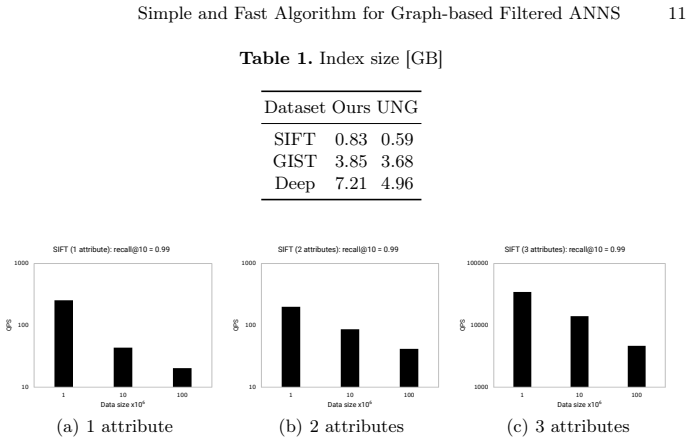
Summary. The paper addresses filtered approximate k-nearest neighbor search (filtered ANNS), where each object has a high-dimensional vector and m integer attribute values, and queries specify a vector plus values for an arbitrary subset of the attributes. The proposed index is a single flat, edge-labeled proximity graph built by merging (i) one NSW graph per full attribute tuple and (ii) one NSW graph per single-attribute value, with edges labeled ⊥ (same full tuple) or by the target's attribute list. Query processing (Algorithm 2) fills null attributes with random values to pick a medoid start node, then runs greedy search traversing only edges whose labels are ⊥ or whose target satisfies the filter. The authors claim O(nm) space, T(nm) build time, and — via QPS-vs-recall@10 experiments on SIFT/GIST/Deep with m=3 power-law attributes — substantial improvements over the state-of-the-art UNG for one- and two-attribute filters, parity for three-attribute filters, and sublinear QPS degradation as n scales to 100M.
Significance. If the empirical results hold up, the contribution is useful: a conceptually simple flat-graph design for multi-attribute filtered ANNS with O(nm) space, support for arbitrary matching filters, and consistent QPS gains over the current state of the art (UNG) in the practically dominant 1–2 attribute regime. The algorithm is easy to implement on top of any flat proximity graph, uses standard public datasets and the baseline's own public implementation, and reports a clear time/space complexity analysis, all of which aid reproducibility. The main limitation is that the central mechanism for intermediate filters is heuristic, and the current evaluation does not probe the regime (rare attribute combinations) where it could fail; the scalability claim is also weakened by the absence of any baseline at 100M points.
major comments (4)
- [§4 Case 3; §5, Fig. 3] §4 (Case 3) and Algorithm 2, lines 11–20: the central mechanism for intermediate filters (2 ≤ |q.A| < m) rests on an unproven navigability assumption, and the evaluation is structured so that this assumption is barely stressed. For a filter q.A=[a,b,*], traversal from a start node in block X_{a,b,c'} can use ⊥-edges (which stay inside X_{a,b,c'}) or labeled edges whose target satisfies q.A. Edges crossing between different c-blocks of X(q.A) exist only incidentally, when two nodes in different c-blocks happen to be NSW-neighbors in a single-attribute graph (G_{a,*,*} mixes all b; G_{*,b,*} mixes all a). Nothing in Algorithm 1 guarantees that the label-permitted subgraph induced on X(q.A) is connected or contains monotonic paths, so for a rare (a,b) pair greedy search can be confined to the starting c'-block and recall for that filter can collapse. Because query filters in §5 are drawn fr
- [§4.2, Algorithm 2] Algorithm 2, lines 2–4: the random null-fill used to determine the start node is ill-defined in a common case. If the randomly chosen value c' for the null attribute makes X_{a,b,c'} empty (possible whenever the joint distribution is not a full product — e.g., under the power-law generator some (a,b,c') triples need not occur), then G_A is empty and 'the medoid node in G_A' does not exist. Even when non-empty, a tiny X_{a,b,c'} gives a badly placed start that interacts with the fragmentation concern above. The algorithm as written never checks non-emptiness. Please state how this is handled in the implementation (e.g., resampling until X_{a,b,c'} ≠ ∅, or falling back to the medoid of G_{a,*,*}), and discuss the cost/quality impact.
- [§5, Figs. 5–6] §5 (scalability test, Figs. 5–6): the scalability claim is weakened by two gaps. First, UNG — the sole baseline — could not be run at 100M (reported segmentation fault in the authors' public implementation), so the paper's headline comparison has no baseline at the scale where the design (flat graph, no trie traversal) should matter most; the 100× claim against Pre-filter (QPS 0.42) is against a strawman. Second, the claim that 'QPS does not drop linearly with n but rather sublinearly' is not quantified — reading log-log slopes off Figs. 5–6 is left to the reader, and sublinear QPS decay is generic for graph ANNS, not evidence specific to this design. Either fit/report the scaling exponents, or tone the claim down; and, if feasible, compare against any baseline that runs at 100M (e.g., ACORN, which the authors' implementation of this framework should readily accommodate).
- [§5 (experimental setup); §4.1] §5: no index build times are reported anywhere, although build cost is a standard evaluation axis for ANNS indices and the paper makes a specific complexity claim (T(nm) for Algorithm 1, §4.1). Algorithm 1 builds one NSW per distinct full attribute tuple — with 68×10×12 possible triples and 1M–100M points, the number of distinct tuples can be very large, and many will be tiny blocks whose per-graph fixed overheads (plus per-tuple medoid computation referenced in Alg. 2, line 4) are invisible in the asymptotic statement. Report wall-clock build time and the number of distinct tuples per dataset, so readers can judge the T(nm) claim and the practicality of per-tuple graphs.
minor comments (8)
- [§2] §2, Preliminary: 'Note that d = O(1) and d is large' is self-contradictory as written; presumably you mean d is treated as a constant in the asymptotics while being large in practice. Please rephrase.
- [§2, after Definition 2] §2, recall definition: recall@k = |S ∩ S*|/k can never reach 1 when |X(q.A)| < k, yet Definition 2 returns X(q.A) in that case. With 68/10/12 distinct values and a power law, small X(q.A) will occur. State whether such queries were excluded or how recall was normalized.
- [§3] §3: 'HSNW' should be 'HNSW' [18].
- [§4.2, Algorithm 2] Algorithm 2, lines 13–21: the control flow would be clearer if the common lines 14–18 were factored out; as written, 'Run lines 14–18' inside the else-branch is informal for a pseudocode block. Also, τ is described as 'the ε·k-th dist in P' only via the comment on line 16 — please define the update rule explicitly.
- [§5, Figs. 2–4] Fig. 2(c): the recall axis spans [0, 1] while the other panels use [0.7, 1] or [0.75, 1], which visually understates the Deep result; harmonize axes or note the difference. Also report whether QPS/recall are means over the 1,000 queries and consider adding variance or percentile information.
- [§5, Table 1] Table 1: clarify whether index size includes the raw vectors or only graph structure plus labels, and give the per-dataset distinct-tuple counts (relevant to both memory and build cost).
- [§5] §5: K = K' = 16 is used throughout without ablation. Since K' controls the density of exactly the cross-block edges on which Case 3 depends, a sensitivity plot (recall vs. K' at fixed K) would substantially strengthen the paper at low cost.
- [§1] §1: 'RAG' is used without a citation or expansion; the motivation would benefit from a reference. Also, 'approximate k nearest neighbor search' is hyphenated inconsistently across the text.
Circularity Check
No circularity: algorithmic construction and empirical QPS/recall evaluation do not reduce inputs to claimed outputs by definition.
full rationale
This is a systems/algorithms paper. The index (Algorithm 1) merges full-tuple NSW graphs with m single-attribute NSW graphs and labels cross edges; query processing (Algorithm 2) is standard greedy search restricted by those labels. Recall@k is defined against exact filtered kNN on the same static data; QPS is wall-clock. Hyperparameters (K, K', ε) control the usual time–recall tradeoff and are not fitted to produce a ‘prediction’ that is forced by construction. Self-citations (authors’ prior ANNS/IVF work and the SISAP short version) appear only as related work or version note and do not supply a uniqueness theorem, ansatz, or load-bearing premise that the evaluation then re-derives. The unproved navigability claim for intermediate filters is an empirical/correctness risk, not a circular reduction of output to input. Derivation chain is self-contained against external baselines (UNG) and standard metrics; circularity score is floor.
Axiom & Free-Parameter Ledger
free parameters (3)
- K (full-tuple graph degree) =
16
- K' (single-attribute graph degree) =
16
- ε (search expansion / candidate multiplier) =
varied (≥1)
axioms (6)
- domain assumption X is static; dynamic inserts/deletes are out of scope
- domain assumption Number of attributes m is small in practice (e.g. ≤3), so O(nm) edge space is acceptable
- domain assumption Flat NSW (with HNSW-style optimization) is a sufficient base proximity graph for high-d Euclidean ANNS
- ad hoc to paper Query filters and attribute values follow the same power-law distributions used to generate labels, with m=3 and fixed distinct-value counts
- domain assumption Matching (equality) filters only; range filters are out of scope
- standard math Standard Euclidean distance and recall@k against exact filtered kNN are the right quality measures
invented entities (1)
-
Labeled merged proximity graph G with edge labels ⊥ or x'.A
no independent evidence
Cite this review
Pith. "Pith review of Simple and Fast Algorithm for Graph-based Filtered Approximate Nearest Neighbor Search (Full Version)." pith.science (2026). https://pith.science/paper/BTFEYMUD
@misc{pith2026260724173,
  author       = {Pith},
  title        = {Pith review of: Simple and Fast Algorithm for Graph-based Filtered Approximate Nearest Neighbor Search (Full Version)},
  year         = {2026},
  howpublished = {\url{https://pith.science/paper/BTFEYMUD}},
  note         = {Machine review of arXiv:2607.24173}
}
read the original abstract
It has been common to represent many objects as high-dimensional vectors due to the proliferation of machine learning-based embedding techniques. One of the most important functions for analyzing high-dimensional vectors is approximate nearest neighbor search, which, given a query vector, retrieves the vector that is approximately the most similar to the query vector. In many real-world applications, such as e-commerce, objects have not only vectors but also attributes, e.g., category, color, and brand, and they require a scenario where users can specify a query vector and a value for each attribute of interest. This problem, called filtered approximate nearest neighbor search, retrieves approximate nearest neighbors from a set of objects that have the specified attribute values. Efficiently solving this problem is challenging because it has to accept arbitrary query vectors and attribute values, which are not known in advance. Existing techniques suffer from slow search performance and difficulty in dealing with arbitrary combinations of attributes. This work overcomes these challenges and proposes a new algorithm for this problem. We conduct extensive experiments, and the results demonstrate the efficiency of our algorithm.
Figures



Reference graph
Works this paper leans on
-
[1]
In: IEEE Big Data
Amagata,D.:Scalableandaccuratedensity-peaksclusteringonfullydynamicdata. In: IEEE Big Data. pp. 445–454 (2022)
2022
-
[2]
In: SIGMOD
Amagata, D., Onizuka, M., Hara, T.: Fast and exact outlier detection in metric spaces: A proximity graph-based approach. In: SIGMOD. pp. 36–48 (2021)
2021
-
[3]
The VLDB Journal 31(4), 797–821 (2022)
Amagata, D., Onizuka, M., Hara, T.: Fast, exact, and parallel-friendly outlier de- tection algorithms with proximity graph in metric spaces. The VLDB Journal 31(4), 797–821 (2022)
2022
-
[4]
Proceedings of the ACM on Management of Data 3(1), 1–31 (2025)
Azizi, I., Echihabi, K., Palpanas, T.: Graph-based vector search: An experimental evaluation of the state-of-the-art. Proceedings of the ACM on Management of Data 3(1), 1–31 (2025)
2025
-
[5]
Proceedings of the ACM on Management of Data2(6), 1–27 (2024)
Cai, Y., Shi, J., Chen, Y., Zheng, W.: Navigating labels and vectors: A unified approach to filtered approximate nearest neighbor search. Proceedings of the ACM on Management of Data2(6), 1–27 (2024)
2024
-
[6]
In: Asilomar Conference on Signals, Systems and Computers
Dearholt, D.W., Gonzales, N., Kurup, G.: Monotonic search networks for computer vision databases. In: Asilomar Conference on Signals, Systems and Computers. vol. 2, pp. 548–553 (1988)
1988
-
[7]
In: World Wide Web
Dong, W., Moses, C., Li, K.: Efficient k-nearest neighbor graph construction for generic similarity measures. In: World Wide Web. pp. 577–586 (2011)
2011
-
[8]
In: ICML (2024)
Engels, J., Landrum, B., Yu, S., Dhulipala, L., Shun, J.: Approximate nearest neighbor search with window filters. In: ICML (2024)
2024
-
[9]
IEEE Transac- tions on Pattern Analysis and Machine Intelligence44(8), 4139–4150 (2021)
Fu, C., Wang, C., Cai, D.: High dimensional similarity search with satellite system graph: Efficiency, scalability, and unindexed query compatibility. IEEE Transac- tions on Pattern Analysis and Machine Intelligence44(8), 4139–4150 (2021)
2021
-
[10]
Proceedings of the VLDB Endowment 12(5), 461–474 (2019)
Fu, C., Xiang, C., Wang, C., Cai, D.: Fast approximate nearest neighbor search with the navigating spreading-out graph. Proceedings of the VLDB Endowment 12(5), 461–474 (2019)
2019
-
[11]
In: Web Conference
Gollapudi, S., Karia, N., Sivashankar, V., Krishnaswamy, R., Begwani, N., Raz, S., Lin, Y., Zhang, Y., Mahapatro, N., Srinivasan, P., et al.: Filtered-diskann: Graph algorithms for approximate nearest neighbor search with filters. In: Web Conference. pp. 3406–3416 (2023)
2023
-
[12]
arXiv preprint arXiv:2308.15014 (2023)
Gupta, G., Yi, J., Coleman, B., Luo, C., Lakshman, V., Shrivastava, A.: Caps: A practical partition index for filtered similarity search. arXiv preprint arXiv:2308.15014 (2023)
Pith/arXiv arXiv 2023
-
[13]
Proceedings of the ACM on Management of Data3(3), 1–26 (2025) Simple and Fast Algorithm for Graph-based Filtered ANNS 13
Jiang, M., Yang, Z., Zhang, F., Hou, G., Shi, J., Zhou, W., Li, F., Wang, S.: Digra: A dynamic graph indexing for approximate nearest neighbor search with range filter. Proceedings of the ACM on Management of Data3(3), 1–26 (2025) Simple and Fast Algorithm for Graph-based Filtered ANNS 13
2025
-
[14]
In: PAKDD
Kido, K., Amagata, D., Hara, T.: Fast approximation algorithm for euclidean min- imum spanning tree building in high dimensions. In: PAKDD. pp. 432–443 (2025)
2025
-
[15]
Proceedings of the ACM on Management of Data3(6), 1–26 (2025)
Li, M., Yan, X., Lu, B., Zhang, Y., Cheng, J., Ma, C.: Attribute filtering in ap- proximate nearest neighbor search: An in-depth experimental study. Proceedings of the ACM on Management of Data3(6), 1–26 (2025)
2025
-
[16]
IEEE Transactions on Knowledge and Data Engineering32(8), 1475–1488 (2019)
Li, W., Zhang, Y., Sun, Y., Wang, W., Li, M., Zhang, W., Lin, X.: Approxi- mate nearest neighbor search on high dimensional data—experiments, analyses, and improvement. IEEE Transactions on Knowledge and Data Engineering32(8), 1475–1488 (2019)
2019
-
[17]
arXiv preprint arXiv:2505.06501 (2025)
Lin, Y., Zhang, K., He, Z., Jing, Y., Wang, X.S.: Survey of filtered approxi- mate nearest neighbor search over the vector-scalar hybrid data. arXiv preprint arXiv:2505.06501 (2025)
Pith/arXiv arXiv 2025
-
[18]
IEEE Transactions on Pattern Analysis and Machine Intelligencee42(4), 824–836 (2018)
Malkov, Y.A., Yashunin, D.A.: Efficient and robust approximate nearest neigh- bor search using hierarchical navigable small world graphs. IEEE Transactions on Pattern Analysis and Machine Intelligencee42(4), 824–836 (2018)
2018
-
[19]
Information Systems 45, 61–68 (2014)
Malkov, Y., Ponomarenko, A., Logvinov, A., Krylov, V.: Approximate nearest neighbor algorithm based on navigable small world graphs. Information Systems 45, 61–68 (2014)
2014
-
[20]
Proceedings of the ACM on Management of Data2(3), 1–27 (2024)
Patel, L., Kraft, P., Guestrin, C., Zaharia, M.: Acorn: Performant and predicate- agnostic search over vector embeddings and structured data. Proceedings of the ACM on Management of Data2(3), 1–27 (2024)
2024
-
[21]
Proceedings of the ACM on Man- agement of Data1(1), 1–27 (2023)
Peng, Y., Choi, B., Chan, T.N., Yang, J., Xu, J.: Efficient approximate nearest neighbor search in multi-dimensional databases. Proceedings of the ACM on Man- agement of Data1(1), 1–27 (2023)
2023
-
[22]
arXiv preprint arXiv:2509.07789 (2025)
Shi, J., Cai, Y., Zheng, W.: Filtered approximate nearest neighbor search: A uni- fied benchmark and systematic experimental study [experiment, analysis & bench- mark]. arXiv preprint arXiv:2509.07789 (2025)
Pith/arXiv arXiv 2025
-
[23]
In: NeurIPS
Subramanya, S.J., Devvrit, Kadekodi, R., Krishaswamy, R., Simhadri, H.V.: Diskann: Fast accurate billion-point nearest neighbor search on a single node. In: NeurIPS. pp. 13766–13776 (2019)
2019
-
[24]
Pattern Recognition12(4), 261–268 (1980)
Toussaint, G.T.: The relative neighbourhood graph of a finite planar set. Pattern Recognition12(4), 261–268 (1980)
1980
-
[25]
In: IEEE International Conference on Big Data
Uemura, R., Amagata, D.: Ivf++: A flexible and efficient algorithm for approxi- mate nearest neighbor search under attribute constraint. In: IEEE International Conference on Big Data. pp. 7444–7451 (2025)
2025
-
[26]
In: SISAP (2024)
Uemura, R., Amagata, D., Hara, T.: An efficient framework for approximate near- est neighbor search on high-dimensional multi-metric data. In: SISAP (2024)
2024
-
[27]
In: SISAP (2026)
Uemura, R., Kido, K., Amagata, D.: Simple and fast algorithm for graph-based filtered approximate nearest neighbor search. In: SISAP (2026)
2026
-
[28]
In: SIGMOD
Wang, J., Yi, X., Guo, R., Jin, H., Xu, P., Li, S., Wang, X., Guo, X., Li, C., Xu, X., et al.: Milvus: A purpose-built vector data management system. In: SIGMOD. pp. 2614–2627 (2021)
2021
-
[29]
arXiv preprint arXiv:2203.13601 (2022)
Wang, M., Lv, L., Xu, X., Wang, Y., Yue, Q., Ni, J.: Navigable proximity graph- driven native hybrid queries with structured and unstructured constraints. arXiv preprint arXiv:2203.13601 (2022)
Pith/arXiv arXiv 2022
-
[30]
In: NeurIPS
Wang, M., Lv, L., Xu, X., Wang, Y., Yue, Q., Ni, J.: An efficient and robust framework for approximate nearest neighbor search with attribute constraint. In: NeurIPS. pp. 15738–15751 (2023)
2023
-
[31]
In: CIKM
Wu, W., He, J., Qiao, Y., Fu, G., Liu, L., Yu, J.: Hqann: Efficient and robust similarity search for hybrid queries with structured and unstructured constraints. In: CIKM. pp. 4580–4584 (2022) 14 Uemura et al
2022
-
[32]
Proceedings of the ACM on Management of Data2(6), 1–26 (2024)
Xu, Y., Gao, J., Gou, Y., Long, C., Jensen, C.S.: irangegraph: Improvising range- dedicated graphs for range-filtering nearest neighbor search. Proceedings of the ACM on Management of Data2(6), 1–26 (2024)
2024
-
[33]
Yamashita, T., Amagata, D., Matsui, Y.: How should we evaluate data deletion in graph-based ann indexes? arXiv preprint arXiv:2512.06200 (2025)
arXiv 2025
-
[34]
Yu, S., Engels, J., Huang, Y., Shun, J.: Pecann: Parallel efficient clustering with graph-basedapproximatenearestneighborsearch.arXivpreprintarXiv:2312.03940 (2023)
Pith/arXiv arXiv 2023
-
[35]
Proceedings of the VLDB Endowment19(2), 183–195 (2025)
Zhu, J., Yuan, J., Yang, K., Chen, X., Yu, S., Lv, H., Li, Y., Zheng, B.: An ex- perimental evaluation of hybrid querying on vectors. Proceedings of the VLDB Endowment19(2), 183–195 (2025)
2025
-
[36]
Proceedings of the ACM on Man- agement of Data2(1), 1–26 (2024)
Zuo, C., Qiao, M., Zhou, W., Li, F., Deng, D.: Serf: Segment graph for range- filtering approximate nearest neighbor search. Proceedings of the ACM on Man- agement of Data2(1), 1–26 (2024)
2024
discussion (0)
Sign in with ORCID, Apple, or X to comment. Anyone can read and Pith papers without signing in.