REVIEW 3 major objections 5 minor 74 references
Uncertainty-quantified $J$-integral computation for quasicontinuum and finite element methods
T0 review · 3 major / 5 minor · reviewed 2026-08-01 · deepseek-v4-flash
Pith's one-line read This paper claims that the J-integral evaluated only in the continuum region of a relaxed quasicontinuum model equals the coupled system's energy release rate, matching virtual crack extension within 3% and Griffith's criterion within 4%.
desk verdict Useful first QC3D J-integral implementation with honest staged validation, but the central path-independence claim needs a direct check and the UQ label oversells the MCMC sensitivity analysis. read the letter →
The pith
A machine-rendered reading of the paper's core claim, the machinery that carries it, and where it could break.
The reading
What carries the argument
The load-bearing machinery is the volume form of the J-integral, written in terms of the Eshelby stress tensor — an energy-momentum quantity defined from the strain energy density and the stress times displacement gradient — and summed element by element over linear tetrahedra in the continuum region. The scalar weight function q of the classical domain integral is promoted to a vector field pointing along the crack direction, so the same q-values serve both the J computation and the nodal perturbation in the virtual crack extension validation. The Cauchy-Born rule makes the continuum stress and energy density inherit the interatomic potential, so the excluded atomistic core and the integrat
What would settle it
Run the same relaxed quasicontinuum fracture test with the inner integration contour moved into the atomistic region, or with the domain substantially enlarged or shrunk, and check whether J shifts by more than the MCMC-reported standard deviation; alternatively, compute an independently constructed atomistic J-integral on a model with a much larger atomistic region fully enclosing the crack tip and compare — if either test gives a discrepancy beyond the quoted ~3%, the claim that the continuum-only domain integral equals the true energy release rate fails.
Extended reading notes
Core claim
The central claim is that a domain-integral form of the J-integral — evaluated entirely in the continuum region of a three-dimensional quasicontinuum model, using stress and strain energy density derived from the interatomic potential through the Cauchy-Born rule — correctly measures the energy release rate of the full atomistic/continuum system. The integration domain is bounded internally by the atomistic/continuum interface, so the atomistic crack tip is excluded, and the weighting function q is set to unity on that interface and zero on the outer boundary. In a fully relaxed, finite-strain silicon model under mode I loading, the continuum-domain J and an independently constructed virtual
Load-bearing premise
The load-bearing premise is that a J-integral evaluated only in the continuum region — with the atomistic crack-tip core excluded and the interface subject to ghost-force corrections — still equals the energy release rate of the entire coupled atomistic/continuum system; the paper tests this only indirectly through agreement with a second numerical method.
Editorial extensions
If this is right
- J can be obtained from a single equilibrated multiscale configuration, avoiding the two-simulation cost of virtual crack extension at every load step.
- The critical J at cleavage directly yields the material's fracture toughness for the interatomic potential, enabling direct comparison with the Griffith criterion and potential-driven toughness predictions.
- The MCMC standard deviation serves as a quantitative certificate of integration-domain quality, usable in ordinary finite element codes for mesh-convergence verification.
- Agreement across linear elastic, nonlinear elastic, and fully relaxed regimes means the method spans the practical range from LEFM-dominated remote loading to atomistically relaxed crack tips.
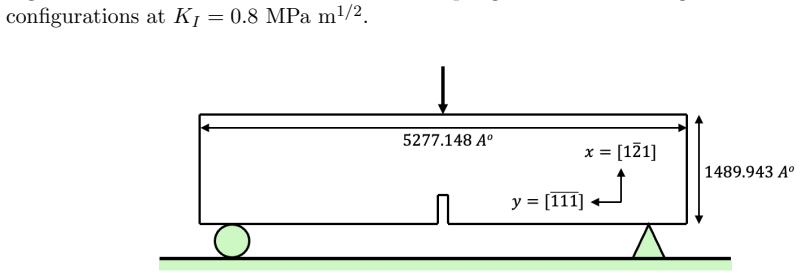
- The three-point bending demonstration shows structural-scale simulations are feasible: 358k repatoms reproduce a model that would require about 12 million atoms fully atomistically.
Reading between the lines
- The vector-q formulation for an arbitrary crack direction suggests a natural route to mixed-mode and curved crack fronts via piecewise integration along straight segments, an extension the paper leaves implicit.
- The MCMC spread could be repurposed as an adaptive-mesh criterion: large local sensitivity of J to q would flag under-resolved regions and drive refinement or domain repositioning automatically.
- Because the integration domain stops at the atomistic/continuum interface, residual ghost forces there could contribute a small systematic error to J; comparing against a ghost-force-free formulation or a much larger atomistic region would isolate that contribution, which the paper does not do.
- The ~3% J–VCE gap at the final stable load step is attributed to VCE's forward-difference error, but testing a central-difference VCE across several crack-extension sizes would show whether the residual is purely numerical or reflects physical lattice trapping.
Signed reviews
Editorial analysis
A structured set of objections, weighed in public.
Referee Report
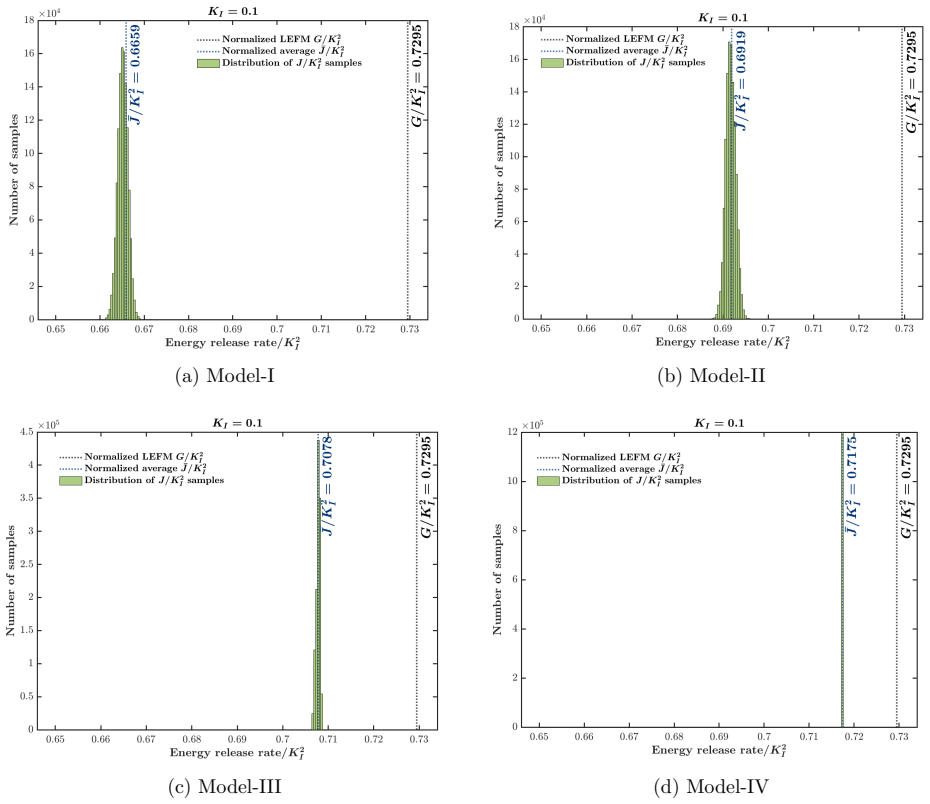
Summary. The paper presents an implementation of the domain-form J-integral in the three-dimensional quasicontinuum (QC3D) method. The J-integral is evaluated from Cauchy–Born continuum fields (stress and strain energy density) in the local (continuum) region of a relaxed QC model, with the integration domain bounded internally by the atomistic/continuum interface. Validation is organized in three regimes: (1) linear elasticity, where the anisotropic LEFM K-field is prescribed and Hooke's law is used; (2) the same prescribed K-field evaluated through the nonlinear Cauchy–Born relation without relaxation; and (3) the same nonlinear relation with full atomic relaxation. In each regime the J-integral is compared with the virtual crack extension (VCE) method; agreement is exact in Regime 1 and within about 3% in Regime 3. The paper also introduces an MCMC sampling scheme over admissible q-fields to quantify sensitivity of the computed J to the choice of interpolation function, and demonstrates the method on a three-point bending test of silicon, reporting J_c = 0.1886 J/m^2 versus 2γ_s = 0.1814 J/m^2 (3.85% error).
Significance. If the central claim holds, this is a valuable contribution: it would allow users of multiscale codes such as QC3D to extract a standard fracture mechanics parameter (the energy release rate) directly from continuum fields in the local region, bridging atomistic crack-tip processes and continuum driving forces. The validation hierarchy is thoughtfully designed: Regime 1 is a genuine exact benchmark, Regime 2 is honestly labeled as code verification rather than physics validation, and the authors state plainly that no closed-form solution exists for Regime 3. The MCMC uncertainty quantification is novel and the detailed-balance proof in Appendix A is a useful addition. The paper is also transparent about the limitations of the interatomic potential and the quasistatic plane-strain scope. However, the load-bearing assertion—that the domain integral evaluated in the continuum region measures the energy release rate of the fully coupled atomistic/continuum system—is not independently established; the Regime 3 validation relies on consistency with VCE, which shares the same q-field and the same energy functional.
major comments (3)
- [Sec. 3.1, Eq. (14); Sec. 2.2, Eq. (10)] The inner contour (q=1) is placed exactly on the atomistic/continuum interface, so the integrand samples the annulus of elements adjacent to that interface. In QC, ghost forces f_ghost act as external dead loads at the interface. A relaxed QC state balances these forces only at repatom nodes; it does not imply div P = 0 in the continuum sense, and therefore the Eshelby tensor is not guaranteed divergence-free in the region that contributes most to the domain integral. Rice's path independence, which is the premise for J = G of the full coupled system, is thus an unverified assumption. The Regime 3 validation does not close this gap because VCE uses the same q-field and the same QC energy functional. A direct numerical check is needed: compute J for a family of inner contours moved progressively into the continuum (away from the interface) and show convergence; or compare with a global en
- [Sec. 4.2, Sec. 4.5, Fig. 10] The claim that VCE provides an 'independently constructed' measure of G is overstated. By the deLorenzi equivalence cited by the authors, VCE reduces to the domain J-integral for elastic equilibrium, and the implementation here uses the same q-field and the same energy functional as the J computation. The 3% agreement in Regime 3 is therefore primarily a consistency check between two implementations, not a validation against an external reference. The only external anchor in Regime 3 is the LEFM limit at small loads, which is insensitive to interface and ghost-force effects. The paper should either soften the wording or supply an independent benchmark, e.g., a fully atomistic simulation of a small model, or an energy-vs-crack-length curve from multiple relaxed simulations with actual crack advance.
- [Sec. 6, Table 1] The three-point bending comparison to 2γ_s is a useful end-to-end sanity check, but it is a single data point and J_c is computed with the same contested domain integral. The surface energy γ_s is not defined or computed in the manuscript (cleavage plane, potential, methodology), so the reader cannot assess whether the 3.85% agreement is meaningful. This check does not address path independence across the atomistic/continuum interface. Please provide details of the γ_s calculation and, if possible, report the MCMC sensitivity for the bending configuration.
minor comments (5)
- [Sec. 4.5] The text says 'as in Region 2' where 'Regime 2' is meant. Please make terminology consistent.
- [Eq. (18), Eq. (20)] The display equations have unbalanced parentheses/brackets; please check the formatting, especially the summation terms.
- [Sec. 4.5, Fig. 10] The sentence 'all three quantities drop suddenly together as the crack propagates' is ambiguous: J is normally defined for a stationary crack. Clarify whether J is reported for the last stable configuration before cleavage and what the post-drop values represent.
- [Sec. 5] The MCMC standard deviation is described as providing 'rigorous error bars' in Sec. 5.2. Since the target distribution is uniform over q-fields and the chain is generated with all proposals accepted, the result is a sensitivity measure, not a rigorous statistical error bar on J. Please temper the wording.
- [General] No data availability or code availability statement is included. Given the reproducibility emphasis of the field, please add one.
Circularity Check
No significant circularity in the J-integral derivation; main caveat is that the Regime-3 VCE agreement is an internal consistency check rather than an independent physical benchmark.
-
other
[Section 4.2 (VCE description) and Section 4.5 (Regime 3 validation)]
"deLorenzi [74] later derived ... showing that the VCE formulation reduces to the J-integral where the essence of nodal shifts is captured by the q-function. This theoretical connection motivated us to use the VCE method to validate the J-integral results at finite deformations where LEFM is not applicable. ... Instead the close correspondence observed between the J and VCE calculations provides strong evidence that both methods correctly capture the energy release rate of the equilibrated, fully nonlinear system."
The paper's own cited result (deLorenzi) makes VCE and the domain J-integral two evaluations of the same energy-release-rate derivative, connected through the same q-field. Therefore the Regime-3 J/VCE agreement is a numerical consistency check, not an independent confirmation that the continuum-domain integral equals the energy release rate of the full atomistic/continuum system. The unverified path-independence assumption across the ghost-force-affected interface is not tested by this comparison. This is a real limitation on validation strength, but it is not a fitted-parameter circularity and does not contaminate the core derivation.
full rationale
The core J-integral implementation is self-contained: Eq. (14) is the standard Shih/deLorenzi domain integral, evaluated from Cauchy-Born stress and strain-energy fields without any fitted parameters. Regime 1 provides an external ground truth (anisotropic LEFM G-K relation) and Regime 2 is explicitly labeled a code-verification step, with the paper honestly stating that J/VCE agreement there follows from calculus alone. Regime 3 correctly notes the absence of a closed-form nonlinear crack-tip solution and relies on J/VCE agreement as mutual consistency; because the paper itself cites the theoretical equivalence of VCE and J, this agreement is a weaker form of validation than an independent benchmark, though it is not circular in the derivation. The three-point-bending comparison of J_c to 2γ_s uses the same interatomic potential for both sides, making it a model-consistency check rather than an externally fitted prediction. Self-citations to prior QC work are for method background, ghost-force corrections, and QC3D implementation, and are not load-bearing for the J-integral formulas. Overall, no central claim reduces to its inputs by construction, so the circularity burden is low.
Assumptions & free parameters
free parameters (4)
- cleavage detection tolerance factor f =
not stated
- initial SIF K_I,0 and load increment ΔK_I =
not stated
- virtual crack extension length Δa =
not stated
- MCMC sample count =
1,200,000
assumptions (4)
- ad hoc to paper Rice J-integral path independence holds for the QC multiscale energy even though the atomistic core is excluded.
- domain assumption The Cauchy-Born rule gives an adequate constitutive description in the continuum region.
- domain assumption Periodic boundary conditions along the crack front enforce plane strain without spurious image interactions.
- domain assumption The modified Stillinger-Weber potential is a faithful enough model for the targeted validation.
Cite this review
Pith. "Pith review of Uncertainty-quantified $J$-integral computation for quasicontinuum and finite element methods." pith.science (2026). https://pith.science/paper/BTGWW4I2
@misc{pith2026260723003,
  author       = {Pith},
  title        = {Pith review of: Uncertainty-quantified $J$-integral computation for quasicontinuum and finite element methods},
  year         = {2026},
  howpublished = {\url{https://pith.science/paper/BTGWW4I2}},
  note         = {Machine review of arXiv:2607.23003}
}
abstract
The $J$-integral is a fundamental concept in fracture mechanics, quantifying the energy release rate that drives crack propagation. While extensively implemented in finite element (FE) codes and adapted for atomistic calculations, its application within multiscale frameworks bridging atomistic and continuum formulations remains unexplored. This work presents a rigorous implementation and validation of the $J$-integral within the three-dimensional quasicontinuum (QC3D) method, computed under plane strain assumptions, using continuum fields (stress, strain energy density) derived from the interatomic potential via the Cauchy-Born rule. The implementation is validated against linear elastic fracture mechanics (LEFM) theory and the virtual crack extension (VCE) method across three regimes: (1) small-strain linear elasticity, with a prescribed anisotropic $K$-field displacement applied throughout; (2) the same field evaluated through the nonlinear Cauchy-Born constitutive relation, without atomic relaxation; and (3) the same relation with atomic relaxation enabled, allowing the crack-tip region to equilibrate. Excellent agreement is shown throughout. We further introduce a Markov chain Monte Carlo framework to statistically quantify the uncertainty of $J$-integral results for a given mesh and integration domain, applicable to conventional FE methods as well. Predictive capability is demonstrated via a QC3D simulation of a three-point bending test of silicon, where the computed critical energy release rate agrees closely with the Griffith criterion. This work establishes a reliable framework for evaluating crack driving forces in multiscale fracture simulations with quantified uncertainty, enabling large-scale fracture simulations while resolving atomistic mechanisms at the crack tip.
Figures


Figures from the paper (17 more)






Reference graph
Works this paper leans on
-
[1]
Banks-Sills
L. Banks-Sills. Application of the finite element method to linear elastic fracture mechanics. Applied mechanics reviews, 44(10):447–461, 1991
1991
-
[2]
S. K. Chan, I. S. Tuba, and W. K. Wilson. On the finite element method in linear fracture mechanics.Engineering fracture mechanics, 2(1):1–17, 1970
1970
-
[3]
Roshdy S. Barsoum. On the use of isoparametric finite elements in linear fracture mechanics. International journal for numerical methods in engineering, 10(1):25–37, 1976
1976
-
[4]
D. M. Parks. A stiffness derivative finite element technique for determination of crack tip stress intensity factors.International journal of fracture, 10(4):87–502, 1974
1974
-
[5]
J. R. Rice. A path independent integral and approximate analysis of strain concentration by notches and cracks.Journal of Applied Mechanics, 35(2):379–386, 1968
1968
-
[6]
T. K. Hellen. On the method of virtual crack extensions.International journal for numerical methods in engineering, 9(1):187–207, 1975
1975
-
[7]
Rybicki and M.F
E.F. Rybicki and M.F. Kanninen. A finite element calculation of stress intensity factors by a modified crack closure integral.Engineering fracture mechanics, 9(4):931–938, 1977
1977
-
[8]
P. B. Lindley. Energy for crack growth in model rubber components.Journal of strain analysis, 7(2):132–140, 1972
1972
Show all 74 references
-
[9]
Fan, P.Y
C. Fan, P.Y. Ben Jar, and J.J. Roger Cheng. Prediction of energy release rates for crack growth using FEM-based energy derivative technique.Engineering fracture mechanics, 74(8):1243– 1254, 2007
2007
-
[10]
Banks-Sills
L. Banks-Sills. Update: Application of the finite element method to linear elastic fracture mechanics.Applied mechanics reviews, 63(2):1–17, 2010
2010
-
[11]
Z., Shih C
Li F. Z., Shih C. F., and A. Needleman. A comparison of methods for calculating energy release rates.Engineering fracture mechanics, 21(2):405–421, 1985
1985
-
[12]
C. F. Shih, B. Moran, and T. Nakamura. Energy release rate along a three-dimensional crack front in a thermally stressed body.International journal of fracture, 30(2):79–102, 1986
1986
-
[13]
Banks-Sills and D
L. Banks-Sills and D. Sherman. On the computation of stress intensity factors for three- dimensional geometries by means of the stiffness derivative and J-integral methods.Interna- tional Journal of Fracture, 53(2):1–20, 1992
1992
-
[14]
K. N. Shivakumar and I. S. Raju. An equivalent domain integral method for three-dimensional mixed-mode fracture problems.Engineering fracture mechanics, 42(6):935–959, 1992
1992
-
[15]
J. F. Yau, S. S. Wang, and H. T. Corten. A mixed-mode crack analysis of isotropic solids using conservation laws of elasticity.Journal of applied mechanics, 47(2):335–341, 1980
1980
-
[16]
S. S. Wang, J. F. Yau, and H. T. Corten. A mixed-mode crack analysis of rectilinear anisotropic solids using conservation laws of elasticity.International journal of fracture, 16(3):247–259, 1980. 31
1980
-
[17]
Simha, F.D
N.K. Simha, F.D. Fischer, G.X. Shan, C.R. Chen, and O. Kolednik. J-integral and crack driving force in elastic–plastic materials.Journal of the mechanics and physics of solids, 56(9):2876–2895, 2008
2008
-
[18]
Hiroshi Okada and Shogo Ohata. Three-dimensional j-integral evaluation for cracks with arbitrary curvatures and kinks based on domain integral method for quadratic tetrahedral finite element.Engineering fracture mechanics, 109:58–77, 2013
2013
-
[19]
Bitzek, J
E. Bitzek, J. R. Kermode, and P. Gumbsch. Atomistic aspects of fracture.International journal of fracture, 191(1–2):13–30, 2015
2015
-
[20]
Inoue, Y
H. Inoue, Y. Akahoshi, and S. Harada. Fracture parameter for molecular dynamics method. International Journal of Fracture, 66(24):R77–R81, 1994
1994
-
[21]
Nakatani, A
K. Nakatani, A. Nakatani, and H. Kitagawa. Molecular dynamics study on fracture mechanisms of fe-amorphous metal (J-integral near mode I crack tip).AIAA conference, 38(4):695–701, 2000
2000
-
[22]
Y. Xu, K. Behdinan, and Z. Fawaz. Molecular dynamics calculation of the J-integral fracture criterion for nano-sized crystals.International Journal of Fracture, 130(2):571–582, 2004
2004
-
[23]
R. E. Jones and J. A. Zimmerman. The construction and application of an atomistic J- integral via hardy estimates of continuum fields.Journal of the Mechanics and Physics of Solids, 58(9):1318–1337, 2010
2010
-
[24]
R. J. Hardy. Formulas for determining local properties in molecular-dynamics simulations: Shock waves.The Journal of the Chemical Physics, 76(1):622–628, 1982
1982
-
[25]
Tadmor and Ronald E
Ellad B. Tadmor and Ronald E. Miller.Modeling Materials: Continuum, Atomistic and Mul- tiscale Techniques. Cambridge University Press, Cambridge, 2011
2011
-
[26]
E. B. Tadmor, M. Ortiz, and R. Phillips. Quasicontinuum analysis of defects in solids.Philo- sophical Magazine A, 73(6):1529–1563, 1996
1996
-
[27]
R. E. Miller, E. B Tadmor, R. Phillips, and M. Ortiz. Quasicontinuum simulation of fracture at the atomic scale.Modelling and simulation in materials science and engineering, 6(5):607–638, 1998
1998
-
[28]
R. E. Miller, M. Ortiz, R. Phillips, V. Shenoy, and E. B. Tadmor. Quasicontinuum models of fracture and plasticity.Engineering fracture mechanics, 61(3):427–444, 1998
1998
-
[29]
Gao and P
H. Gao and P. Klein. Numerical simulation of crack growth in an isotropic solid with random- ized internal cohesive bonds.Journal of the Mechanics and Physics of Solids, 46(2):187–218, 1998
1998
-
[30]
Klein and H
P. Klein and H. Gao. Crack nucleation and growth as strain localization in a virtual-bond continuum.Engineering Fracture Mechanics, 61(1):21–48, 1998
1998
-
[31]
A. R. Pillai and R. E. Miller. Crack behavior at bi-crystal interfaces: A mixed atomistic and continuum approach. InMaterials Research Society Symposium Proceedings, volume 653, pages Z2.9.1–Z2.9.7, 2001
2001
-
[32]
R. E. Miller and E. B. Tadmor. The quasicontinuum method: Overview, applications and current directions.Journal of Computer-Aided Materials Design, 9(3):203–239, 2002. 32
2002
-
[33]
Zhang, P
P. Zhang, P. Klein, Y. Huang, H. Gao, and P. D. Wu. Numerical simulation of cohesive fracture by the virtual-internal-bond model.Computer Modeling in Engineering & Sciences, 3(2):263–278, 2002
2002
-
[34]
Hai and E
S. Hai and E. B. Tadmor. Deformation twinning at aluminum crack tips.Acta Materialia, 51(1):117–131, 2003
2003
-
[35]
E. B. Tadmor and S. Hai. A peierls criterion for the onset of deformation twinning at crack tips.Journal of the Mechanics and Physics of Solids, 51(5):765–793, 2003
2003
-
[36]
Gao and B
H. Gao and B. Ji. Modeling fracture in nanomaterials via a virtual internal bond method. Engineering Fracture Mechanics, 70(14):1777–1791, 2003
2003
-
[37]
Thiagarajan K
G. Thiagarajan K. J. Hsia and Y. Huang. Finite element implementation of virtual internal bond model for simulating crack behavior.Engineering Fracture Mechanics, 71(3):401–423, 2004
2004
-
[38]
Zhang and X
Z. Zhang and X. Ge. A new quasi-continuum constitutive model for crack growth in an isotropic solid.European Journal of Mechanics A, 24(2):243–252, 2005
2005
-
[39]
T. Zhou, X. H. Yang, and C. Y. Chen. Quasicontinuum simulation of single crystal nano-plate with a mixed-mode crack.International Journal of Solids and Structures, 46(9):1975–1980, 2009
1975
-
[40]
N. K. Das, I Tirtom, and T. Shoji. A multiscale modelling study of Ni–Cr crack tip initial stage oxidation at different stress intensities.Materials Chemistry and Physics, 122(2-3):336–342, 2010
2010
-
[41]
J. Mei, J. Li, Y. Ni, and H. Wang. Multiscale simulation of indentation, retraction and fracture processes of nanocontact.Nanoscale Research Letters, 5(4):692–700, 2010
2010
-
[42]
Yu and S
W. Yu and S. Shen. Multiscale study on the tensile fracture of Al-terminated cu(111)/α- Al2O3(0001) interfaces.Computational. Matererials Science, 48(2):228–240, 2010
2010
-
[43]
Y. F. Shao and S. Q. Wang. Quasicontinuum simulation of crack propagation in nanocrystalline Ni.Acta Physica Sinica, 59(10):7258–7265, 2010
2010
-
[44]
Peng and G
Q. Peng and G. Lu. A comparative study of fracture in Al: Quantum mechanical vs. empirical atomistic description.Journal of the Mechanics and Physics of Solids, 59(4):775–786, 2011
2011
-
[45]
I. R. Vatne, E. Østby, C. Thaulow, and D. Farkas. Quasicontinuum simulation of crack propagation in bcc-Fe.Materials Science and Engineering A, 528(15):5122–5134, 2011
2011
-
[46]
I. R. Vatne, E. Østby, and C. Thaulow. Multiscale simulations of mixed-mode fracture in bcc-Fe.Modelling and Simulation in Materials Science and Engineering, 19(8):085006, 2011
2011
-
[47]
J. F. Mei, J. W. Li, Y. S. Ni, and W. T. Wang. Generalized planar fault energy of body- centered cubic Ta and its application to plastic deformation of mode II crack tip.Acta Physica Sinica, 60(6):066104, 2011
2011
-
[48]
H. B. Lu, J. W. Li, Y. S. Ni, J. F. Mei, and H. S. Wang. Multiscale analysis of defect initiation on the atomistic crack tip in body-centered-cubic metal Ta.Acta Physica Sinica, 60(10):106101, 2011. 33
2011
-
[49]
Y. F. Shao, X. Yang, X. Zhao, and S. Q. Wang. Brittle-ductile behavior of a nanocrack in nanocrystalline Ni: A quasicontinuum study.Chinese Physics B, 21:093104, 2017
2017
-
[50]
Comparison of concurrent multiscale methods in the application of fracture in nickel.Journal of Applied Mechanics, 80(5):051003, 2013
Vincent Iacobellis and Kamran Behdinan. Comparison of concurrent multiscale methods in the application of fracture in nickel.Journal of Applied Mechanics, 80(5):051003, 2013
2013
-
[51]
Rokoˇ s, R
O. Rokoˇ s, R. H. J. Peerlings, and J. Zeman. eXtended variational quasicontinuum methodol- ogy for lattice networks with damage and crack propagation.Computer Methods in Applied Mechanics and Engineering, 320:769–792, 2017
2017
-
[52]
R. Z. Qiu, Y. C. Lin, T. H. Fang, and L. R. Tsai. The crack growth and expansion character- istics of Fe and Ni using quasi-continuum method.Materials Research Express, 4(3):035019, 2017
2017
-
[53]
T. L. Xu, J. H. Fan, R. Stewart, X. Zheng, and A. Yao. Quasicontinuum simulation of brittle cracking in single-crystal material.Crystal Research and Technology, 52:1600247, 2017
2017
-
[54]
R. Z. Qiu, Y. C. Lin, and T. H. Fang. Fatigue crack growth characteristics of Fe and Ni under cyclic loading using a quasi-continuum method.Beilstein Journal of Nanotechnology, 9:1000–1014, 2018
2018
-
[55]
Ghareeb and A
A. Ghareeb and A. Elbanna. An adaptive quasicontinuum approach for modeling fracture in networked materials: Application to modeling of polymer networks.Journal of the Mechanics and Physics of Solids, 137:103819, 2020
2020
-
[56]
C. D. Wu, T. H. Fang, W. Su, and Y. C. Fan. Fracture and crack propagation of metallic bilay- ers using quasi-continuum simulations.Digest Journal Of Nanomaterials And Biostructures, 15(2):319–327, 2020
2020
-
[57]
C. D. Wu, T. H. Fang, W. C. Su, and Y. C. Fan. Effects of constituting material and inter- facial crack on mechanical response of nanoscale metallic bilayers – a quasicontinuum study. Molecular Simulation, 46(15):1155–1163, 2020
2020
-
[58]
Ghareeb and A
A. Ghareeb and A. Elbanna. Modeling fracture in rate-dependent polymer networks: A qua- sicontinuum approach.Journal of Applied Mechanics, 88(11):1–22, 2021
2021
-
[59]
J. D. Eshelby. The continuum theory of lattice defects.Solid State Physics, 3:79–144, 1956
1956
-
[60]
J. D. Eshelby. The elastic energy-momentum tensor.Journal of Elasticity, 5:321–335, 1975
1975
-
[61]
Tadmor, Ronald E
Ellad B. Tadmor, Ronald E. Miller, and Ryan S. Elliott.Continuum Mechanics and Ther- modynamics: From Fundamental Principles to Governing Equations. Cambridge University Press, Cambridge, 2012
2012
-
[62]
G. C. Sih, P. C. Paris, and G. R. Irwin. On cracks in rectilinearly anisotropic bodies.Inter- national Journal of Fracture, 1:189–203, 1965
1965
-
[63]
E. B. Tadmor, F. Legoll, W. K. Kim, L. M. Dupuy, and R. E. Miller. Finite-temperature quasi-continuum.Applied Mechanics Reviews, 65(1):010803, 2013
2013
-
[64]
W. K. Kim, M. Luskin, D. Perez, A. F. Voter, and E. B. Tadmor. Hyper-QC: An accelerated finite-temperature quasicontinuum method using hyperdynamics.Journal of the Mechanics and Physics of Solids, 63:94–112, 2014. 34
2014
-
[65]
PhD thesis, University of Minnesota, 2023
Stephen Whalen.QC3D: A Scalable, High Performance Implementation of the Quasicontin- uum Method. PhD thesis, University of Minnesota, 2023
2023
-
[66]
E. B. Tadmor, G. S. Smith, N. Bernstein, and E. Kaxiras. Mixed finite element and atomistic formulation for complex crystals.Physical Revew B, 59(1):235–245, 1999
1999
-
[67]
V. B. Shenoy, R. Miller, E. B. Tadmor, D. Rodney, R. Phillips, and M. Ortiz. An adaptive finite element approach to atomic-scale mechanics: The quasicontinuum method.Journal of the Mechanics and Physics of Solids, 47(3):611–642, 1999
1999
-
[68]
W. K. Kim, A. Kavalur, S. M. Whalen, and E. B. Tadmor. Free energy calculation and ghost force correction for hot-QC.International Journal of Numerical Methods in Engineering, 123(20):4916–4934, 2022
2022
-
[69]
Cambridge University Press, Cambridge, UK, 2nd edition, 1998
Subra Suresh.Fatigue of Materials. Cambridge University Press, Cambridge, UK, 2nd edition, 1998
1998
-
[70]
Balamane, T
H. Balamane, T. Halicioglu, and W. A. Tiller. Comparative study of silicon empirical inter- atomic potentials.Physical review. B, 46(4):2250–2279, 1992
1992
-
[71]
J. A. Hauch, D. Holland, M. P. Marder, and H. L Swinney. Dynamic fracture in single crystal silicon.Physical review letters, 82(19):3823–3826, 1992
1992
-
[72]
E. B. Tadmor, R. S. Elliott, J. P. Sethna, R. E. Miller, and C. A. Becker. The potential of atomistic simulations and the knowledgebase of interatomic models.JOM, 63(7):17, 2011
2011
-
[73]
Stillinger-Weber potential for brittle Si combining the modifications of Balamane et al
Min Shi. Stillinger-Weber potential for brittle Si combining the modifications of Balamane et al. (1992) and Hauch et al. (1999) v003. OpenKIM, https://doi.org/10.25950/3b5dbb97, 2021
1992 doi
-
[74]
H. G. deLorenzi. On the energy release rate and the J-integral for 3-D crack configurations. International journal of fracture, 19(3):183–193, 1982. 35
1982
Reviewed August 1, 2026 · model on record in the stance chip above.
Discussion (0). Continue with ORCID to comment.