Suppressing Parametric Instabilities in Driven Bosonic Lattices through Multi-tone Control
Pith reviewed 2026-07-01 02:37 UTC · model grok-4.3
The pith
Multi-tone driving suppresses parametric instabilities in driven bosonic lattices while controlling tunneling and phase.
A machine-rendered reading of the paper's core claim, the machinery that carries it, and where it could break.
Core claim
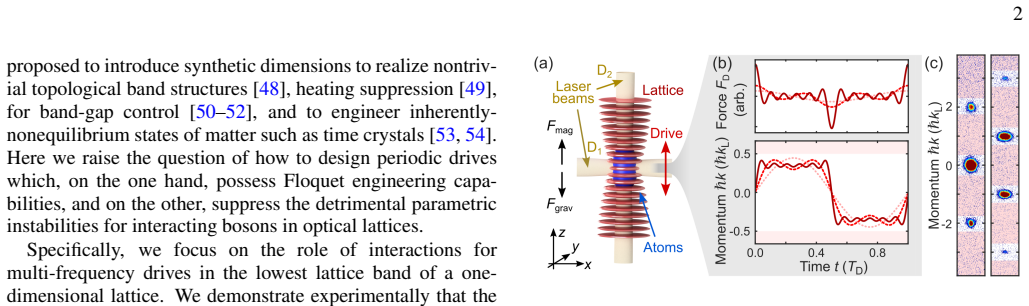
Multifrequency drives stabilize driven many-body systems: pulsed driving composed of odd harmonics and two-tone driving with tunable amplitude and relative phase each allow independent control of the effective tunneling amplitude and Peierls phase factor while significantly reducing phonon excitation and the resulting rapid decay of the condensate, as verified by experiment and by Bogoliubov-de Gennes modeling.
What carries the argument
Multi-tone driving schemes (pulsed odd-harmonic drives and two-tone drives with tunable amplitude and phase) that suppress unstable modes in the Bogoliubov-de Gennes spectrum while preserving control over tunneling and Peierls phase.
If this is right
- Effective tunneling amplitude and Peierls phase factor can be tuned independently of the drive frequency content.
- Phonon excitation is reduced and the condensate lifetime is extended under optimized multi-tone conditions.
- Bogoliubov-de Gennes simulations predict and match the observed suppression of unstable modes.
- The same stabilization principle applies to both pulsed odd-harmonic and continuous two-tone protocols.
Where Pith is reading between the lines
- The technique may extend to higher-dimensional lattices or fermionic systems where similar parametric instabilities appear.
- Longer coherence times could allow direct observation of interaction-driven Floquet phases that are currently masked by heating.
- The method offers a route to parameter-free stabilization once the drive tones are chosen to avoid resonance conditions identified by the Bogoliubov analysis.
Load-bearing premise
That the observed drop in phonon excitation is caused by the multi-tone control rather than by unrelated experimental details and that the Bogoliubov-de Gennes equations capture the dominant unstable modes.
What would settle it
An experiment in which single-tone driving at comparable amplitude produces the same reduction in phonon excitation and condensate lifetime would falsify the claim that the multi-tone character is responsible for the suppression.
Figures
read the original abstract
Periodically driven quantum systems offer remarkable flexibility in tailoring effective Hamiltonians and synthetic band structures. However, such driving also induces heating and dynamical instabilities that limit the coherence and lifetime of many-body states. Here, we demonstrate that these instabilities can be suppressed by employing multi-tone driving schemes. Using a Bose-Einstein condensate of cesium atoms in an optical lattice, we experimentally explore two approaches: pulsed driving composed of odd harmonics and two-tone driving with tunable amplitude and relative phase. We show that both methods allow independent control of the effective tunneling amplitude and Peierls phase factor, while significantly reducing phonon excitation and the resulting rapid decay of the condensate. Numerical simulations and theoretical modeling based on Bogoliubov-de Gennes equations confirm the suppression of unstable modes under optimized driving conditions. Our results establish multifrequency drives as powerful tools for stabilizing driven many-body systems and pave the way toward robust Floquet engineering with interactions.
Editorial analysis
A structured set of objections, weighed in public.
Referee Report
Summary. The manuscript demonstrates that multi-tone driving (pulsed odd-harmonic and two-tone schemes with tunable amplitude/phase) suppresses parametric instabilities in a driven cesium BEC in an optical lattice. This enables independent control of effective tunneling amplitude and Peierls phase while reducing phonon excitation and condensate decay, with the suppression confirmed via Bogoliubov-de Gennes linearization and numerical modeling.
Significance. If the central claim holds, the work establishes multifrequency drives as a practical route to stabilizing interacting Floquet systems against heating, directly addressing a key limitation in driven many-body physics. The combination of experiment on a tunable lattice with independent BdG modeling provides a concrete, falsifiable advance toward robust Floquet engineering.
minor comments (3)
- Abstract: the claim of 'significantly reducing phonon excitation' would be strengthened by a quantitative statement (e.g., factor of reduction or lifetime increase) with reference to the relevant figure or table.
- Methods/experimental section: ensure that the isolation of multi-tone effects from single-tone baselines (via independent amplitude/phase control) is described with sufficient detail on calibration, error bars, and statistical analysis so that the attribution to multi-tone suppression is unambiguous.
- BdG modeling section: clarify the range of parameters over which the linearization remains valid and whether higher-order nonlinear effects could reintroduce instabilities not captured by the reported simulations.
Simulated Author's Rebuttal
We thank the referee for their positive assessment of our work on multi-tone driving for suppressing parametric instabilities in driven bosonic lattices, their recognition of the experimental and theoretical contributions, and the recommendation for minor revision. No specific major comments were provided in the report.
Circularity Check
No significant circularity
full rationale
The paper's claims rest on experimental measurements of condensate decay and phonon excitation under multi-tone vs single-tone drives, cross-validated by standard Bogoliubov-de Gennes linearization of the driven lattice model. No derivation step equates a fitted parameter to a 'prediction' by construction, no load-bearing self-citation chain is invoked to establish uniqueness or ansatz, and the BdG framework is an independent, externally established tool rather than a renaming or self-definition of the target result. The work is therefore self-contained against external benchmarks.
Axiom & Free-Parameter Ledger
Reference graph
Works this paper leans on
-
[1]
This precisely happens for the pulsed drive considered in Eq
Pulsed drive: perfect annihilation of instabilities A sufficient condition to suppress any parametric instability in the system is to select a periodic drive such thathq(t)≡0 for all quasimomentaq, which is the case ifc n(−q)=−c n(q) for alln,0 and allq. This precisely happens for the pulsed drive considered in Eq. (5) in the limitM→ ∞. In this case, the ...
-
[2]
Because this is an odd function ofq, it en- sures the fulfillment of the conditionh q(t)≡0
sinKsin (qdL). Because this is an odd function ofq, it en- sures the fulfillment of the conditionh q(t)≡0. Therefore, a weakly interacting bosonic system subject to the linear pulsed drive above is free from parametric instabilities. We note that a weaker condition to suppress the instability rate may be formulated, by demanding thatc n∗(−q)=−c n∗(q) only...
-
[3]
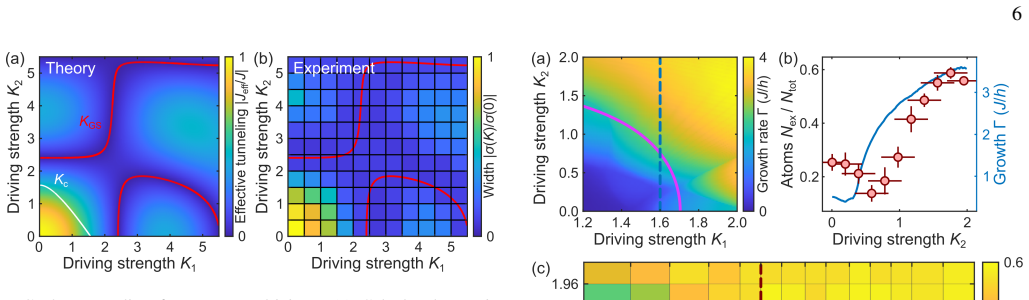
Two-tone drives with tunable amplitudes and phases: restoring stability in strongly-normalized regimes We consider here the case of a single-band optical lattice driven by a two-tone drive, as defined in Eq. (6) ℏk(t)=ℏk 0 + ℏkL π K1 sin(ω1t) +K 2 sin(ω2t+φ ) (A6) whereφis the relative phase between the two components, andω 2 is chosen to be an integer mu...
-
[4]
IV arises from the detailed structure ofΓin the (K1,K 2)-plane
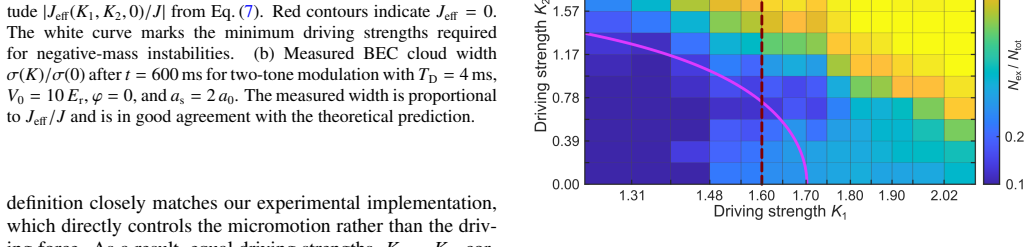
ReducingΓwith two-tone drive The ability to tune the phonon growth rate with a two-tone drive in Sec. IV arises from the detailed structure ofΓin the (K1,K 2)-plane. This structure, calculated in Fig. A1(a) with the BdG equations, can be understood by examiningΓalong the two axes where only one driving frequency is present. Along theK 1-axis, the growth r...
-
[5]
II B and Appendix A 1, and the disappearance of negative-mass instabilities, because the micromotion no longer crosses into regions of negative effec- tive mass [Sec
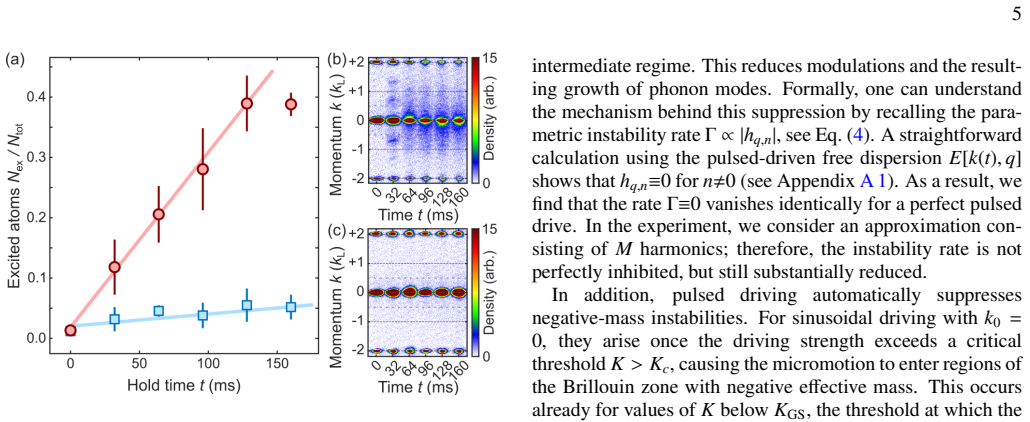
ReducingΓwith pulsed drive The suppression of phonon growth under pulsed driving arises from two mechanisms: the elimination of parametric instabilities, due to the vanishing of the resonant Fourier co- efficientshq,n as discussed in Sec. II B and Appendix A 1, and the disappearance of negative-mass instabilities, because the micromotion no longer crosses...
-
[6]
The quasi-momentum is defined in the lattice frame, whereas our absorption images are recorded in the laboratory frame, in which the lattice itself is oscillating due to the drive
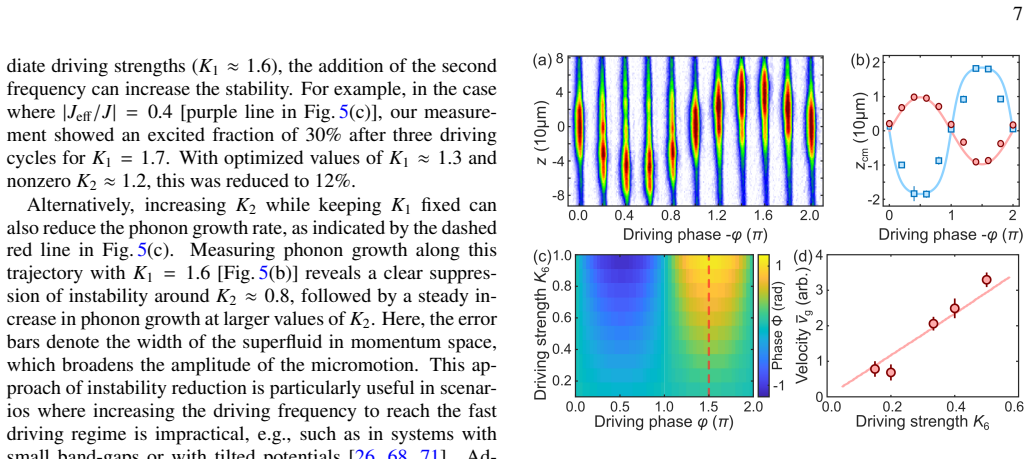
Measuring the micromotion A direct measurement of the atoms’ quasi-momentum dis- tribution using band-mapping techniques is challenging for our driving scheme. The quasi-momentum is defined in the lattice frame, whereas our absorption images are recorded in the laboratory frame, in which the lattice itself is oscillating due to the drive. Instead, we stud...
-
[7]
In the limiting cases,J eff(K) changes fromJJ 0 (4K/π) for a single harmonic (M=1) toJcos (K) in the limit of many harmonics (M→ ∞)
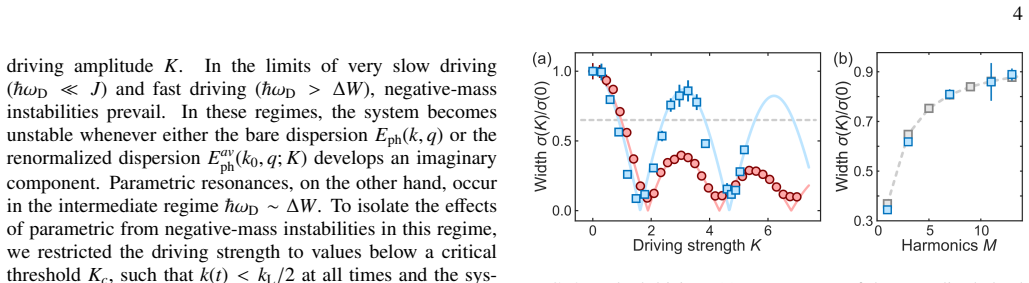
MeasuringJ efffor pulsed driving For pulsed driving, the effective tunneling rateJ eff(K) de- pends on the number of harmonicsMin the drive’s waveform. In the limiting cases,J eff(K) changes fromJJ 0 (4K/π) for a single harmonic (M=1) toJcos (K) in the limit of many harmonics (M→ ∞). For intermediate values ofM, we cal- culatedJ eff(K) numerically using t...
-
[8]
Goldman and J
N. Goldman and J. Dalibard, Periodically driven quantum sys- tems: Effective Hamiltonians and engineered gauge fields, Phys. Rev. X4, 031027 (2014)
2014
-
[9]
Eckardt, Colloquium: Atomic quantum gases in periodically driven optical lattices, Rev
A. Eckardt, Colloquium: Atomic quantum gases in periodically driven optical lattices, Rev. Mod. Phys.89, 011004 (2017)
2017
-
[10]
P. M. Schindler and M. Bukov, Counterdiabatic driving for pe- riodically driven systems, Phys. Rev. Lett.133, 123402 (2024)
2024
-
[11]
Goldman, G
N. Goldman, G. Juzeli ¯unas, P. Öhberg, and I. B. Spielman, Light-induced gauge fields for ultracold atoms, Rep. Prog. Phys.77, 126401 (2014)
2014
-
[12]
Goldman, J
N. Goldman, J. C. Budich, and P. Zoller, Topological quantum matter with ultracold gases in optical lattices, Nat. Phys.12, 639 (2016)
2016
-
[13]
Aidelsburger, S
M. Aidelsburger, S. Nascimbene, and N. Goldman, Artificial gauge fields in materials and engineered systems, C. R. Phys. 19, 394 (2018)
2018
-
[14]
N. R. Cooper, J. Dalibard, and I. B. Spielman, Topological bands for ultracold atoms, Rev. Mod. Phys.91, 015005 (2019)
2019
-
[15]
A. J. Daley, I. Bloch, C. Kokail, S. Flannigan, N. Pearson, M. Troyer, and P. Zoller, Practical quantum advantage in quan- tum simulation, Nature607, 667 (2022)
2022
-
[16]
Bohrdt, L
A. Bohrdt, L. Homeier, C. Reinmoser, E. Demler, and F. Grusdt, Exploration of doped quantum magnets with ultracold atoms, Ann. Phys.435, 168651 (2021), special issue on Philip W. An- derson
2021
-
[17]
Chalopin, P
T. Chalopin, P. Bojovi´c, S. Wang, T. Franz, A. Sinha, Z. Wang, D. Bourgund, J. Obermeyer, F. Grusdt, A. Bohrdt, L. Pollet, A. Wietek, A. Georges, T. Hilker, and I. Bloch, Observation of emergent scaling of spin–charge correlations at the onset of the pseudogap, Proc. Natl. Acad. Sci. U.S.A.123, e2525539123 (2026)
2026
-
[18]
M. Xu, L. H. Kendrick, A. Kale, Y . Gang, C. Feng, S. Zhang, A. W. Young, M. Lebrat, and M. Greiner, A neutral-atom Hub- bard quantum simulator in the cryogenic regime, Nature642, 909 (2025)
2025
-
[19]
Léonard, S
J. Léonard, S. Kim, J. Kwan, P. Segura, F. Grusdt, C. Repellin, N. Goldman, and M. Greiner, Realization of a fractional quan- tum Hall state with ultracold atoms, Nature619, 495 (2023)
2023
-
[20]
F. A. Palm, J. Kwan, B. Bakkali-Hassani, M. Greiner, U. Schollwöck, N. Goldman, and F. Grusdt, Growing extended Laughlin states in a quantum gas microscope: A patchwork construction, Phys. Rev. Res.6, 013198 (2024)
2024
-
[21]
Impertro, S
A. Impertro, S. Huh, S. Karch, J. F. Wienand, I. Bloch, and M. Aidelsburger, Strongly interacting Meissner phases in large bosonic flux ladders, Nat. Phys.21, 895 (2025)
2025
-
[22]
Kalinowski, N
M. Kalinowski, N. Maskara, and M. D. Lukin, Non-abelian flo- quet spin liquids in a digital Rydberg simulator, Phys. Rev. X 13, 031008 (2023)
2023
-
[23]
B.-Y . Sun, N. Goldman, M. Aidelsburger, and M. Bukov, Engi- neering and probing non-abelian chiral spin liquids using pe- riodically driven ultracold atoms, PRX Quantum4, 020329 (2023)
2023
-
[24]
Chen, B.-Z
Y .-H. Chen, B.-Z. Wang, T.-F. J. Poon, X.-C. Zhou, Z.-X. Liu, and X.-J. Liu, Proposal for realization and detection of Kitaev quantum spin liquid with Rydberg atoms, Phys. Rev. Res.6, L042054 (2024)
2024
-
[25]
S. J. Evered, M. Kalinowski, A. A. Geim, T. Manovitz, D. Blu- vstein, S. H. Li, N. Maskara, H. Zhou, S. Ebadi, M. Xu, J. Campo, M. Cain, S. Ostermann, S. F. Yelin, S. Sachdev, M. Greiner, V . Vuleti´c, and M. D. Lukin, Probing the Kitaev honeycomb model on a neutral-atom quantum computer, Na- ture645, 341 (2025)
2025
-
[26]
M. Will, T. A. Cochran, E. Rosenberg, B. Jobst, N. M. Eassa, P. Roushan, M. Knap, A. Gammon-Smith, and F. Pollmann, Probing non-equilibrium topological order on a quantum pro- cessor, Nature645, 348 (2025)
2025
-
[27]
Miyake, G
H. Miyake, G. A. Siviloglou, C. J. Kennedy, W. C. Bur- ton, and W. Ketterle, Realizing the Harper Hamiltonian with laser-assisted tunneling in optical lattices, Phys. Rev. Lett.111, 185302 (2013)
2013
-
[28]
Weinberg, C
M. Weinberg, C. Ölschläger, C. Sträter, S. Prelle, A. Eckardt, K. Sengstock, and J. Simonet, Multiphoton interband excita- tions of quantum gases in driven optical lattices, Phys. Rev. A 92, 043621 (2015)
2015
-
[29]
Reitter, J
M. Reitter, J. Näger, K. Wintersperger, C. Sträter, I. Bloch, A. Eckardt, and U. Schneider, Interaction dependent heating and atom loss in a periodically driven optical lattice, Phys. Rev. Lett.119, 200402 (2017)
2017
-
[30]
Messer, K
M. Messer, K. Sandholzer, F. Görg, J. Minguzzi, R. Des- buquois, and T. Esslinger, Floquet dynamics in driven Fermi- Hubbard systems, Phys. Rev. Lett.121, 233603 (2018)
2018
-
[31]
Rubio-Abadal, M
A. Rubio-Abadal, M. Ippoliti, S. Hollerith, D. Wei, J. Rui, S. L. Sondhi, V . Khemani, C. Gross, and I. Bloch, Floquet prether- malization in a Bose-Hubbard system, Phys. Rev. X10, 021044 (2020)
2020
-
[32]
Di Carli, R
A. Di Carli, R. Cruickshank, M. Mitchell, A. La Rooij, S. Kuhr, C. E. Creffield, and E. Haller, Instabilities of interacting matter waves in optical lattices with Floquet driving, Phys. Rev. Res. 5, 033024 (2023)
2023
-
[33]
Cruickshank, A
R. Cruickshank, A. Di Carli, M. Mitchell, A. La Rooij, S. Kuhr, C. E. Creffield, and E. Haller, Phonon excitations of Floquet- driven superfluids in a tilted optical lattice, Phys. Rev. Res.6, 023323 (2024)
2024
-
[34]
Glück, A
M. Glück, A. R. Kolovsky, and H. J. Korsch, Wannier–Stark resonances in optical and semiconductor superlattices, Phys. Rep.366, 103 (2002)
2002
-
[35]
Bukov and M
M. Bukov and M. Heyl, Parametric instability in periodically driven Luttinger liquids, Phys. Rev. B86, 054304 (2012)
2012
-
[36]
Lellouch, M
S. Lellouch, M. Bukov, E. Demler, and N. Goldman, Parametric instability rates in periodically driven band systems, Phys. Rev. X7, 021015 (2017)
2017
-
[37]
Boulier, J
T. Boulier, J. Maslek, M. Bukov, C. Bracamontes, E. Magnan, S. Lellouch, E. Demler, N. Goldman, and J. V . Porto, Parametric heating in a 2D periodically driven bosonic system: Beyond the weakly interacting regime, Phys. Rev. X9, 011047 (2019)
2019
-
[38]
Wintersperger, M
K. Wintersperger, M. Bukov, J. Näger, S. Lellouch, E. Demler, U. Schneider, I. Bloch, N. Goldman, and M. Aidelsburger, Para- metric instabilities of interacting bosons in periodically driven 1D optical lattices, Phys. Rev. X10, 011030 (2020)
2020
-
[39]
G. Shavit and G. Refael, Parametric instabilities of correlated quantum matter, arXiv:2511.07527 (2025)
-
[40]
Tozzo, M
C. Tozzo, M. Krämer, and F. Dalfovo, Stability diagram and 14 growth rate of parametric resonances in Bose-Einstein con- densates in one-dimensional optical lattices, Phys. Rev. A72, 023613 (2005)
2005
-
[41]
Dupont, L
N. Dupont, L. Gabardos, F. Arrouas, G. Chatelain, M. Ar- nal, J. Billy, P. Schlagheck, B. Peaudecerf, and D. Guéry- Odelin, Emergence of tunable periodic density correlations in a Floquet–Bloch system, Proc. Natl. Acad. Sci. U.S.A.120, e2300980120 (2023)
2023
-
[42]
Liebster, M
N. Liebster, M. Sparn, E. Kath, J. Duchene, K. Fujii, S. L. Gör- litz, T. Enss, H. Strobel, and M. K. Oberthaler, Observation of pattern stabilization in a driven superfluid, Phys. Rev. X15, 011026 (2025)
2025
-
[43]
Bukov, L
M. Bukov, L. D’Alessio, and A. Polkovnikov, Universal high- frequency behavior of periodically driven systems: from dy- namical stabilization to Floquet engineering, Adv. Phys.64, 139 (2015)
2015
-
[44]
Bukov, M
M. Bukov, M. Heyl, D. A. Huse, and A. Polkovnikov, Heating and many-body resonances in a periodically driven two-band system, Phys. Rev. B93, 155132 (2016)
2016
-
[45]
Abanin, W
D. Abanin, W. De Roeck, W. W. Ho, and F. Huveneers, A rig- orous theory of many-body prethermalization for periodically driven and closed quantum systems, Commun. Math. Phys. 354, 809 (2017)
2017
-
[46]
Kuwahara, T
T. Kuwahara, T. Mori, and K. Saito, Floquet–Magnus theory and generic transient dynamics in periodically driven many- body quantum systems, Ann. Phys.367, 96 (2016)
2016
-
[47]
Eckardt, M
A. Eckardt, M. Holthaus, H. Lignier, A. Zenesini, D. Ciampini, O. Morsch, and E. Arimondo, Exploring dynamic localization with a Bose-Einstein condensate, Phys. Rev. A79, 013611 (2009)
2009
-
[48]
V otto, J
M. V otto, J. Zeiher, and B. Vermersch, Universal quantum pro- cessors in spin systems via robust local pulse sequences, Quan- tum8, 1513 (2024)
2024
-
[49]
J. Walkling and M. Bukov, Walsh-Floquet theory of periodic kick drives, arXiv:2505.11071 (2025)
-
[50]
Verdeny and F
A. Verdeny and F. Mintert, Tunable Chern insulator with opti- mally shaken lattices, Phys. Rev. A92, 063615 (2015)
2015
-
[51]
Grossert, M
C. Grossert, M. Leder, S. Denisov, P. Hänggi, and M. Weitz, Ex- perimental control of transport resonances in a coherent quan- tum rocking ratchet, Nat. Commun.7, 10440 (2016)
2016
-
[52]
Murakami, M
Y . Murakami, M. Schüler, R. Arita, and P. Werner, Suppression of heating by multicolor driving protocols in floquet-engineered strongly correlated systems, Phys. Rev. B108, 035151 (2023)
2023
-
[53]
Impens and D
F. Impens and D. Guéry-Odelin, Multichromatic Floquet en- gineering of quantum dissipation, Phys. Rev. A109, 062618 (2024)
2024
-
[54]
H. Zhao, J. Knolle, and F. Mintert, Engineered nearest-neighbor interactions with doubly modulated optical lattices, Phys. Rev. A100, 053610 (2019)
2019
-
[55]
Martin, G
I. Martin, G. Refael, and B. Halperin, Topological frequency conversion in strongly driven quantum systems, Phys. Rev. X 7, 041008 (2017)
2017
-
[56]
T. Banerjee, S. Choudhury, and K. Sengupta, Exact Floquet flat band and heating suppression via two-rate drive protocols, arXiv:2404.06536 (2024)
-
[57]
Sandholzer, A.-S
K. Sandholzer, A.-S. Walter, J. Minguzzi, Z. Zhu, K. Viebahn, and T. Esslinger, Floquet engineering of individual band gaps in an optical lattice using a two-tone drive, Phys. Rev. Res.4, 013056 (2022)
2022
-
[58]
Wang, A.-S
Y . Wang, A.-S. Walter, G. Jotzu, and K. Viebahn, Topological Floquet engineering using two frequencies in two dimensions, Phys. Rev. A107, 043309 (2023)
2023
-
[59]
Y . Chen, Z. Zhu, and K. Viebahn, Mitigating higher-band heat- ing in Floquet-Hubbard lattices via two-tone driving, Phys. Rev. A112, L021301 (2025)
2025
-
[60]
Beatrez, C
W. Beatrez, C. Fleckenstein, A. Pillai, E. de Leon Sanchez, A. Akkiraju, J. Diaz Alcala, S. Conti, P. Reshetikhin, E. Druga, M. Bukov,et al., Critical prethermal discrete time crystal cre- ated by two-frequency driving, Nat. Phys.19, 407 (2023)
2023
-
[61]
L. J. I. Moon, P. M. Schindler, Y . Sun, E. Druga, J. Knolle, R. Moessner, H. Zhao, M. Bukov, and A. Ajoy, Experimen- tal observation of a time rondeau crystal, Nat. Phys.21, 1813 (2025)
2025
-
[62]
Kraemer, J
T. Kraemer, J. Herbig, M. Mark, T. Weber, C. Chin, H.- C. Nägerl, and R. Grimm, Optimized production of a cesium Bose–Einstein condensate, Appl. Phys. B79, 1013 (2004)
2004
-
[63]
Di Carli, C
A. Di Carli, C. Colquhoun, S. Kuhr, and E. Haller, Interferomet- ric measurement of micro-g acceleration with levitated atoms, New J. Phys.21, 053028 (2019)
2019
-
[64]
Gustavsson, E
M. Gustavsson, E. Haller, M. J. Mark, J. G. Danzl, G. Rojas- Kopeinig, and H.-C. Nägerl, Control of interaction-induced de- phasing of Bloch oscillations, Phys. Rev. Lett.100, 080404 (2008)
2008
-
[65]
Ben Dahan, E
M. Ben Dahan, E. Peik, J. Reichel, Y . Castin, and C. Salomon, Bloch oscillations of atoms in an optical potential, Phys. Rev. Lett.76, 4508 (1996)
1996
-
[66]
Lignier, C
H. Lignier, C. Sias, D. Ciampini, Y . Singh, A. Zenesini, O. Morsch, and E. Arimondo, Dynamical control of matter- wave tunneling in periodic potentials, Phys. Rev. Lett.99, 220403 (2007)
2007
-
[67]
C. Sias, H. Lignier, Y . P. Singh, A. Zenesini, D. Ciampini, O. Morsch, and E. Arimondo, Observation of photon-assisted tunneling in optical lattices, Phys. Rev. Lett.100, 040404 (2008)
2008
-
[68]
C. V . Parker, L.-C. Ha, and C. Chin, Direct observation of ef- fective ferromagnetic domains of cold atoms in a shaken optical lattice, Nat. Phys.9, 769 (2013)
2013
-
[69]
L.-C. Ha, L. W. Clark, C. V . Parker, B. M. Anderson, and C. Chin, Roton-Maxon excitation spectrum of Bose conden- sates in a shaken optical lattice, Phys. Rev. Lett.114, 055301 (2015)
2015
-
[70]
Arimondo, D
E. Arimondo, D. Ciampini, A. Eckardt, M. Holthaus, and O. Morsch, Kilohertz-driven Bose–Einstein condensates in op- tical lattices, inAdvances In Atomic, Molecular , and Optical Physics, V ol. 61, edited by P. Berman, E. Arimondo, and C. Lin (Academic Press, 2012) pp. 515–547
2012
-
[71]
Wu and Q
B. Wu and Q. Niu, Superfluidity of Bose–Einstein condensate in an optical lattice: Landau–Zener tunnelling and dynamical instability, New J. Phys.5, 104 (2003)
2003
-
[72]
Cristiani, O
M. Cristiani, O. Morsch, N. Malossi, M. Jona-Lasinio, M. An- derlini, E. Courtade, and E. Arimondo, Instabilities of a Bose- Einstein condensate in a periodic potential: An experimental investigation, Opt. Express12, 4 (2004)
2004
-
[73]
Fallani, L
L. Fallani, L. De Sarlo, J. E. Lye, M. Modugno, R. Saers, C. Fort, and M. Inguscio, Observation of dynamical instability for a Bose-Einstein condensate in a moving 1D optical lattice, Phys. Rev. Lett.93, 140406 (2004)
2004
-
[74]
C. E. Creffield, Instability and control of a periodically driven Bose-Einstein condensate, Phys. Rev. A79, 063612 (2009)
2009
-
[75]
Lellouch and N
S. Lellouch and N. Goldman, Parametric instabilities in resonantly-driven Bose–Einstein condensates, Quantum Sci. Technol.3, 024011 (2018)
2018
-
[76]
[25, 26]
Note that this definition ofKvaries by factor 4/πwith respect to Refs. [25, 26]
-
[77]
Jona-Lasinio, O
M. Jona-Lasinio, O. Morsch, M. Cristiani, N. Malossi, J. H. Müller, E. Courtade, M. Anderlini, and E. Arimondo, Asym- metric Landau-Zener tunneling in a periodic potential, Phys. Rev. Lett.91, 230406 (2003). 15
2003
-
[78]
Hui, X.-Q
N.-J. Hui, X.-Q. Xu, and Y .-Q. Li, Instability of Bose–Einstein condensates in tilted lattices with time-periodical modulation, J. Phys. B43, 205307 (2010)
2010
-
[79]
Alberti, V
A. Alberti, V . V . Ivanov, G. M. Tino, and G. Ferrari, Engineer- ing the quantum transport of atomic wavefunctions over macro- scopic distances, Nat. Phys.5, 547 (2009)
2009
-
[80]
Haller, R
E. Haller, R. Hart, M. J. Mark, J. G. Danzl, L. Reichsöllner, and H.-C. Nägerl, Inducing transport in a dissipation-free lat- tice with super Bloch oscillations, Phys. Rev. Lett.104, 200403 (2010)
2010
discussion (0)
Sign in with ORCID, Apple, or X to comment. Anyone can read and Pith papers without signing in.