REVIEW 4 major objections 5 minor 1 cited by
TransBiolab: A Real-World Multi-View Dataset of Cluttered Transparent Biomedical Objects
T0 review · 4 major / 5 minor · reviewed 2026-08-01 · deepseek-v4-flash
Pith's one-line read TransBiolab builds a real-world multi-view benchmark that exposes clear performance gaps in segmentation, depth, and pose on cluttered transparent biomedical objects.
desk verdict A genuinely new dataset for transparent biomedical objects, with honest disclosure of its self-validated ground truth; the benchmark numbers are usable but would benefit from an external metrology check. read the letter →
The pith
A machine-rendered reading of the paper's core claim, the machinery that carries it, and where it could break.
The reading
What carries the argument
The load-bearing object is the dataset itself, built so that difficulty can be attributed: 88 controlled scenes arranged by 11 procedure-inspired layout patterns, varied across four tabletop backgrounds and two lighting conditions, plus 10 held-out real laboratory scenes. The annotation pipeline is the enabling mechanism: millimetre-precision CAD models of each object, camera trajectories estimated from feature-based visual SLAM, depth fused into scene point clouds, and annotators aligning meshes in a multi-view 3D workspace until RGB reprojection, point clouds, and plane consistency agree across views. The three-axis organization — object category, number of objects in frame, and viewpoint
What would settle it
Place objects at known positions on a calibrated fixture (for example with measured CAD offsets or an external motion-capture tracker), run the released annotation pipeline, and compare every released pose against that independent ground truth; if mean pose errors substantially exceed the reported contour-error level, the benchmark numbers in Sections 4.1–4.3 would need re-normalization.
Extended reading notes
Core claim
On its own terms, the paper claims that TransBiolab supplies the missing joint stress test: real-world RGB-D sequences in which repeated transparent laboratory vessels appear together under occlusion and variable viewpoint, with object-level labels dense enough to train and evaluate modern perception models. The authors release 15 CAD models, full camera trajectories, 6D poses, full and visible masks, and depth for every frame. Their benchmarks find that a promptable segmentation baseline reaches 0.685 mean IoU (with match rate 84.8%), a pose pipeline drops from 91.05 to 80.80 ADD-S AUC compared with a household transparent-object benchmark, and a monocular depth model's object-region relati
Load-bearing premise
The released ground truth is only as accurate as the SLAM-derived camera trajectories and the annotators' mesh alignments, and the paper's own audit re-projects the same CAD models along the same estimated trajectories, so absolute 6D accuracy is assumed rather than independently measured.
Editorial extensions
If this is right
- Perception gaps on transparent labware become measurable: pose accuracy drops by roughly ten ADD-S AUC points and object-region depth error more than doubles relative to a household transparent-object benchmark, so progress on this regime can now be tracked quantitatively.
- Because full calibrated trajectories are released, video- and multi-view-based methods can be tested directly; the viewpoint results suggest that fusing lower-elevation views is a concrete route to improve pose.
- The BOP-format conversion means existing pose-estimation toolchains can be re-run on biomedical transparent objects without new infrastructure.
- The robot trials provide a system-level baseline for task success (65.3% with a two-finger gripper, 56.67% with a dexterous hand), separating perception error from grasp synthesis and control error in later studies.
- The annotation audit, while not independent metrology, gives the community a consistency floor: any future method that claims to fix these tasks can be compared against a common set of CAD models, masks, and trajectories.
Reading between the lines
- If the self-consistency audit is confirmed by an independent measurement, the strongest consequence goes beyond benchmarks: the released CAD models plus calibrated multi-view sequences effectively turn TransBiolab into a controllable testbed for sim-to-real transfer of refraction and reflection appearance models, which the paper does not itself explore.
- The strong viewpoint dependence reported for pose estimation suggests a testable rule for lab automation: plan next-best-view trajectories toward steeper, top-down views, since shallow views are where accuracy collapses; the paper documents the effect but does not propose the planner.
- A cheap way to stress-test the annotation accuracy is to pick held-out frames not used in the audit, re-render the released CAD models from the released poses, and compare silhouettes against raw RGB under novel viewpoints; systematic contour offsets would indicate trajectory drift.
- The same data could support downstream tasks the paper does not annotate, such as fill-level or volume estimation and liquid-handling state recognition, because visible masks and poses already separate each vessel instance.
Signed reviews
Editorial analysis
A structured set of objections, weighed in public.
Referee Report
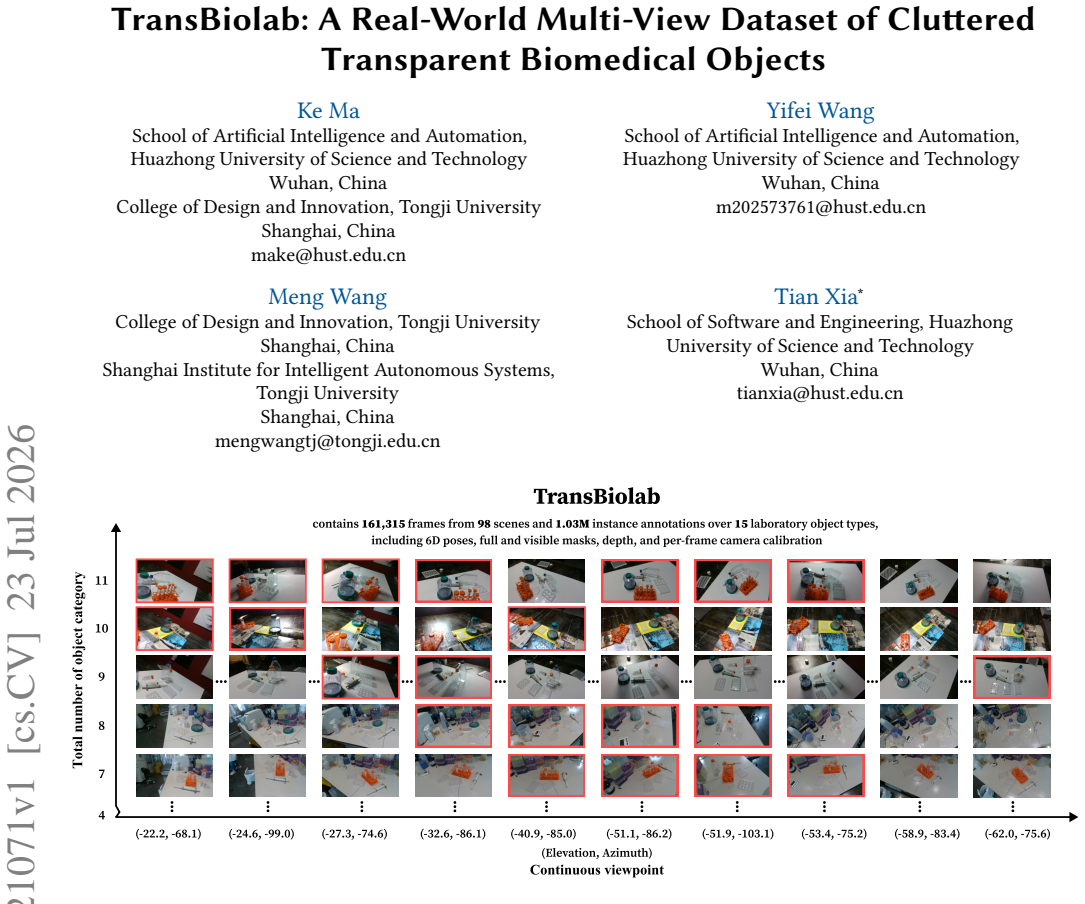
Summary. The paper introduces TransBiolab, a real-world RGB-D dataset of 15 transparent biomedical laboratory objects in cluttered multi-view scenes, totaling 161,315 frames from 98 scenes and about 1.03M instance annotations. The release includes 6D poses, full and visible masks, depth, per-frame camera calibration, object CAD models, and BOP-format conversion utilities. The authors define benchmarks for transparent-object segmentation, depth estimation/completion, and 6D pose estimation, and report a real-robot grasping evaluation. Their central claim is that current foundation models (SAM 3, Depth Anything 3, FoundationPose) show substantial performance gaps on this biomedical cluttered transparent-object regime compared with existing transparent-object datasets such as ClearPose and Trans10K.
Significance. If the dataset holds up, it fills a genuine gap: no existing transparent-object dataset combines biomedical consumables, repeated instances, heavy clutter, and calibrated multi-view capture. The paper's planned release of RGB-D sequences, CAD models, masks, depth, and calibration would be a reusable resource for manipulation research. Strengths include the explicit multi-view trajectory structure, the system-level robot evaluation, cross-dataset comparisons with ClearPose and Trans10K, and the authors' frank admission that their geometry-consistency audit is not independent metrological validation. The dataset is therefore potentially valuable, but the quantitative claims in Sections 4.1–4.4 depend on the absolute accuracy of the annotation pipeline, and that accuracy is not yet established.
major comments (4)
- [§3.3] The annotation-quality audit re-projects the same CAD models along the same ORB-SLAM3 trajectories used to create the labels; silhouette IoU 0.949 and contour errors 0.62–0.91 px measure internal consistency, not absolute accuracy. This matters because the benchmark comparisons in Sections 4.1–4.4 are meaningful only if the ground-truth poses and trajectories are accurate in an absolute sense. The camera is mounted on a 7-DoF Franka arm, so robot forward kinematics or a hand-eye calibration target could provide an independent check on trajectory accuracy; the paper does not report any such check. I request a validation subset (e.g., objects placed on a printed checkerboard/grid, or trajectories compared against kinematics) to bound systematic pose/depth error.
- [Table 6 / §4.2] The held-out scenes are described as harder (new layouts, more distractors, different lighting/backgrounds), yet depth results on TBiolab-HO are substantially better than on TransBiolab-all (DA3 AbsRel 0.302 vs 0.371; ClearGrasp AbsRel 0.179 vs 0.393). This is counterintuitive and suggests possible differences in annotation noise, scene composition, object distance, or mask statistics between splits. If annotation difficulty differs, cross-split conclusions and the overall 'challenging' claim are confounded. Please analyze and explain the held-out advantage.
- [§4.1 / Tables 2 and 5] There are two SAM 3 mIoU numbers: the abstract and the instance-matching protocol quote an overall mIoU of 0.685, while Table 2 reports mask-level SAM 3 IoU of 0.662 on TransBiolab-all. These come from different evaluation protocols, but the paper does not clearly flag this. Additionally, the viewpoint results in Table 5 (mIoU 0.583–0.693) are not obviously reconciled with the instance-matching mIoU of 0.685; the subset and protocol used for Table 5 need explicit specification.
- [§3.4 / Figure 6] Figure 6 introduces an 'initial scene-disjoint training/test partition,' but the benchmark protocols in Section 4 do not consistently use a single defined train/test split: numbers are reported on 'TransBiolab-all' and 'TBiolab-HO.' It would be helpful to state precisely which scenes/splits are used for each benchmark and to provide the split index in the release, so future work can compare fairly.
minor comments (5)
- [Abstract] The abstract contains the typo 'TrainsBiolab' (twice) instead of 'TransBiolab.'
- [Figure 6 / Table 3] Naming is inconsistent: Figure 6 lists '175ml flask' while the text and Table 3 use '125 ml flask'; Figure 6 also lists '50ml centrifuge bottle' while Table 3 uses '50 ml centrifuge tube.' Please standardize.
- [§3.3] No inter-annotator agreement is reported for the manual CAD-alignment step. Even a small double-annotation study on a few sequences would help quantify human variability.
- [Table 4 / Table 9] The geometric-family groupings differ between the segmentation table (Table 4) and the pose table (Table 9): e.g., tube-rack and Grex bioreactor are 'Bottle-like' in Table 4 but grouped separately in Table 9. This is not wrong, but the different groupings should be stated.
- [General] The submitted text contains numerous slash-delimited artifact-like passages (e.g., '/C59/C41...' and long sequences of '/C0/C0/C0') that appear to be formatting/encoding corruption. These should be cleaned before publication.
Circularity Check
No circularity: TransBiolab is a dataset/benchmark paper; its quantitative claims are measurements of external models on released annotations, not outputs of a fitted derivation.
full rationale
The paper's load-bearing claims are the existence of a 161,315-frame, 1.03M-annotation dataset and the benchmark results in Tables 2-10. These are empirical measurements of externally published models (SAM 3, TransLab, Depth Anything 3, ClearGrasp, FoundationPose, MegaPose) on released RGB-D frames, masks, poses, and calibrations; no benchmark number is obtained by inverting a fit or by renaming a fitted parameter. The annotation pipeline (Section 3.3) uses ORB-SLAM3, KinectFusion-style fusion, and manual CAD alignment; the QA audit re-projects the same CAD models along the same estimated trajectories and reports silhouette IoU/contour error, and the paper explicitly disclaims this as metrological validation: 'This geometry-consistency audit does not constitute independent metrological validation.' That is a disclosed self-consistency check, not a circular derivation: it is not used to predict the benchmark numbers or to define the dataset's existence, and the central claims are externally grounded by cross-dataset comparisons with ClearPose and Trans10K as well as held-out scenes. Self-citations in the reference list (e.g., [22,23,32,33]) concern other papers and are not load-bearing for the dataset's validity. The only notable weakness is the absence of independent absolute ground-truth validation of SLAM/annotation accuracy, which the authors themselves flag; this is a correctness/metrology risk, not circularity under the specified criteria.
Assumptions & free parameters
assumptions (3)
- domain assumption ORB-SLAM3 camera trajectories over transparent-object scenes are drift-free enough to support mm-level 6D pose ground truth
- domain assumption Manual alignment of CAD meshes in a multi-view workspace yields metrologically accurate 6D poses
- domain assumption The 11 arrangement patterns, 4 backgrounds, and 2 lighting settings are representative of real laboratory manipulation workloads
Cite this review
Pith. "Pith review of TransBiolab: A Real-World Multi-View Dataset of Cluttered Transparent Biomedical Objects." pith.science (2026). https://pith.science/paper/BTQZSFEZ
@misc{pith2026260721071,
  author       = {Pith},
  title        = {Pith review of: TransBiolab: A Real-World Multi-View Dataset of Cluttered Transparent Biomedical Objects},
  year         = {2026},
  howpublished = {\url{https://pith.science/paper/BTQZSFEZ}},
  note         = {Machine review of arXiv:2607.21071}
}
read the original abstract
Autonomous biomedical laboratories increasingly rely on visual perception to recognize, localize, and manipulate transparent plasticware, yet high-quality real-world datasets for this setting remain limited. The scarcity of domain-relevant data is particularly restrictive in cluttered multi-object scenes, where mutual occlusion and view-dependent appearance changes remain challenging even for contemporary visual foundation models. Existing transparent-object datasets have advanced segmentation, depth, and pose estimation, but they usually do not evaluate the combined setting of multi-object clutter, occlusion, and calibrated multi-view capture that characterizes real laboratory manipulation scenes. To address this gap, we present TrainsBiolab, a real-world RGB-D dataset of cluttered transparent biomedical objects captured as calibrated multi-view sequences. TrainsBiolab contains 161,315 frames from 98 scenes and 1.03M instance annotations over 15 laboratory object types, including 6D poses, full and visible masks, depth, and per-frame camera calibration. The dataset is organized along three axes that reflect operational difficulty: object category, the total number of objects in a frame, and camera viewpoint. We further define dataset-centric benchmarks for segmentation, depth estimation and completion, and 6D pose estimation, and report a system-level robot manipulation evaluation enabled by the released annotations and calibrations. By focusing on repeated transparent instances, clutter, and multi-view laboratory capture, TrainsBiolab provides a resource for segmentation, depth estimation, 6D pose estimation, and multi-view reasoning in autonomous laboratory manipulation. Project page: https://dualtransparency.github.io/TransBiolab/.
Figures


Figures from the paper (5 more)


Forward citations
Cited by 1 Pith paper
-
R4DSG: Relative 4D Scene Graph Memory for Object-Centric Question Answering in Long Egocentric Video
R4DSG builds an anchor-relative 4D scene graph memory from RGB egocentric video and shows improved object-centric QA accuracy over text retrieval.
Reference graph
Works this paper leans on
-
[1]
Milad Abolhasani and Eugenia Kumacheva. 2023. The rise of self-driving labs in chemical and materials sciences.Nature Synthesis2 (2023), 483–492
2023
-
[2]
Berk Calli, Arjun Singh, Aaron Walsman, Siddhartha Srinivasa, Pieter Abbeel, and Aaron M. Dollar. 2015. Benchmarking in manipulation research: The YCB object and model set and benchmarking protocols. InIEEE International Confer- ence on Advanced Robotics (ICAR). 510–517
2015
-
[3]
Gómez Rodríguez, José M
Carlos Campos, Richard Elvira, Juan J. Gómez Rodríguez, José M. M. Montiel, and Juan D. Tardós. 2021. ORB-SLAM3: An accurate open-source library for visual, visual-inertial, and multimap SLAM.IEEE Transactions on Robotics37, 6 (2021), 1874–1890
2021
-
[4]
Nicolas Carion, Laura Gustafson, Yuan-Ting Hu, Shoubhik Debnath, Ronghang Hu, Didac Suris, Chaitanya Ryali, Kalyan Vasudev Alwala, et al. 2025. SAM 3: Segment anything with concepts.arXiv preprint arXiv:2511.16719(2025)
arXiv 2025
-
[5]
Xiaotong Chen, Huijie Zhang, Zeren Yu, Stanley Lewis, and Odest Chadwicke Jenkins. 2022. ProgressLabeller: Visual data stream annotation for training object-centric 3D perception. InIEEE/RSJ International Conference on Intelligent Robots and Systems (IROS). 13066–13073
2022
-
[6]
Xiaotong Chen, Huijie Zhang, Zeren Yu, Anthony Opipari, and Odest Chad- wicke Jenkins. 2022. ClearPose: Large-scale transparent object dataset and benchmark. InEuropean Conference on Computer Vision (ECCV). 381–398
2022
-
[7]
Schmitt, Ingo Martin, Bram de Wildt, Bjorn Spee, et al
Maria-Nefeli Doulgkeroglou, Andrea Di Nubila, Bianca Niessing, Verena Kearns, Robert H. Schmitt, Ingo Martin, Bram de Wildt, Bjorn Spee, et al. 2020. Automa- tion, monitoring, and standardization of cell product manufacturing.Frontiers in Bioengineering and Biotechnology8 (2020), 811
2020
-
[8]
Anastasios Doumanoglou, Rigas Kouskouridas, Tae-Kyun Kim, Sotiris Malassi- otis, and Nikos Komodakis. 2016. Recovering 6D object pose and predicting next-best-view in the crowd. InIEEE Conference on Computer Vision and Pattern Recognition (CVPR). 3583–3592
2016
Show all 47 references
-
[9]
Bertram Drost, Markus Ulrich, Christian Nitschke, et al. 2017. Introducing MVTec ITODD—a dataset for 3D object recognition in industry. InIEEE Inter- national Conference on Computer Vision Workshops (ICCVW)
2017
-
[10]
Hongjie Fang, Hao-Shu Fang, Sheng Xu, and Cewu Lu. 2022. TransCG: A large- scale real-world dataset for transparent object depth completion and a grasping baseline.IEEE Robotics and Automation Letters7, 3 (2022), 7383–7390
2022
-
[11]
Hao-Shu Fang, Chenxi Wang, Minghao Gou, and Cewu Lu. 2020. GraspNet- 1Billion: A large-scale benchmark for general object grasping. InIEEE/CVF Con- ference on Computer Vision and Pattern Recognition (CVPR). 11444–11453
2020
-
[12]
Keiji Fushimi, Yusuke Nakai, Akiko Nishi, Ryo Suzuki, Masahiro Ikegami, Risa Nimura, Taichi Tomono, Ryota Hidese, Hisashi Yasueda, Yusuke Tagawa, et al
-
[13]
Stefan Hinterstoisser, Vincent Lepetit, Slobodan Ilic, Stefan Holzer, Gary Bradski, Kurt Konolige, and Nassir Navab. 2012. Model based training, detection and pose estimation of texture-less 3D objects in heavily cluttered scenes. InAsian Conference on Computer Vision (ACCV). 548–562
2012
-
[14]
Tomas Hodan, Pavel Haluza, Stepan Obdrzalek, Jiri Matas, Manolis Lourakis, and Xenophon Zabulis. 2017. T-LESS: An RGB-D dataset for 6D pose estimation of texture-less objects.IEEE Winter Conference on Applications of Computer Vision (W ACV)(2017), 880–888
2017
-
[15]
Tomas Hodan, Frank Michel, Eric Brachmann, Wadim Kehl, Anders Glent Buch, Dirk Kraft, Anastasios Doumanoglou, et al. 2018. BOP: Benchmark for 6D object pose estimation. InEuropean Conference on Computer Vision (ECCV). 19–35
2018
-
[16]
Yann Labbé, Lucas Manuelli, Arsalan Mousavian, Stephen Tyree, Stan Birchfield, Jonathan Tremblay, Justin Carpentier, Mathieu Aubry, Dieter Fox, and Josef Sivic
-
[17]
Chen, Zhenyu Li, Guang Shi, Jiashi Feng, and Bingyi Kang
Haotong Lin, Sili Chen, Junhao Liew, Donny Y. Chen, Zhenyu Li, Guang Shi, Jiashi Feng, and Bingyi Kang. 2025. Depth Anything 3: Recovering the visual space from any views.arXiv preprint arXiv:2511.10647(2025)
2025 arXiv
-
[18]
Xingyu Liu, Shun Iwase, and Kris M. Kitani. 2021. StereOBJ-1M: Large-scale stereo image dataset for 6D object pose estimation. InIEEE/CVF International Conference on Computer Vision Workshops (ICCVW). 1294–1303
2021
-
[19]
Xingyu Liu, Rico Jonschkowski, Anelia Angelova, and Kurt Konolige. 2020. Key- Pose: Multi-view 3D labeling and keypoint estimation for transparent objects. In IEEE/CVF Conference on Computer Vision and Pattern Recognition (CVPR). 11602– 11610
2020
-
[20]
Alan Lukezic, Ziga Trojer, Jiri Matas, et al. 2024. A new dataset and a distractor- aware architecture for transparent object tracking.International Journal of Com- puter Vision132 (2024), 2729–2742
2024
-
[21]
Ke Ma and Jing Cao. 2019. Design pattern as a practical tool for designing adap- tive interactions connecting human and social robots. InInternational Confer- ence on Intelligent Human Systems Integration. Springer, 613–617
2019
-
[22]
Ke Ma, Yizhou Fang, Jean-Baptiste Weibel, Shuai Tan, Xinggang Wang, Yang Xiao, Yi Fang, and Tian Xia. 2026. Phys-liquid: a physics-informed dataset for estimating 3d geometry and volume of transparent deformable liquids. InPro- ceedings of the AAAI Conference on Artificial Int...
2026
-
[23]
Ke Ma, Cong Fu, Jianing Wang, Yifei Wang, Wenyuan Li, Xinggang Wang, Meng Wang, and Tian Xia. 2026. WPIS: From In-the-Wild Web Images to Physics- Aware 3D Scene Graphs for Physical Reasoning. InProceedings of the ACM Web Conference 2026. 1410–1421
2026
-
[24]
Jones, Yasmine Ainane, Ali Rizvi, Darius Chan, Elaine Dickey, et al
Alice Melocchi, Brigitte Schmittlein, Alexis L. Jones, Yasmine Ainane, Ali Rizvi, Darius Chan, Elaine Dickey, et al. 2024. Development of a robotic cluster for TransBiolab: A Real-World Multi-View Dataset of Cluttered Transparent Biomedical Objects MM ’26, November 10–14, 2026...
2024
-
[25]
Schmitt, Christopher J
Polyxeni Moutsatsou, Julia Ochs, Robert H. Schmitt, Christopher J. Hewitt, and Mariana P. Hanga. 2019. Automation in cell and gene therapy manufacturing: from past to future.Biotechnology Letters41, 11–12 (2019), 1245–1253
2019
-
[26]
Julia Ochs, Mahyar Golkaram, Silja Joussen, Alexander Wittemeier, Max Frank, Christina Möllmann, et al. 2021. Fully automated cultivation of adipose-derived stem cells in the StemCellDiscovery—a robotic laboratory for small-scale, high- throughput cell production including dee...
2021
-
[27]
Nikhila Ravi, Valentin Gabeur, Yuan-Ting Hu, Ronghang Hu, Chaitanya Ryali, Laura Gustafson, et al. 2024. SAM 2: Segment anything in images and videos. arXiv preprint arXiv:2408.00714(2024)
2024 arXiv
-
[28]
De Souza
Colin Rennie, Rohan Shome, Kostas Bekris, and Alberto F. De Souza. 2016. A dataset for improved RGBD-based object detection and pose estimation for ware- house pick-and-place. InIEEE International Conference on Robotics and Automa- tion Workshops (ICRA W)
2016
-
[29]
Nikhil Sajjan, Matthew Moore, Mikey Pan, Gaurav Nagaraja, Jia Lee, Andy Zeng, Shuran Song, and Thomas Funkhouser. 2020. ClearGrasp: 3D shape estimation of transparent objects for manipulation. InIEEE International Conference on Ro- botics and Automation (ICRA). 3634–3642
2020
-
[30]
Jintian Shi and Ke Ma. 2017. Digital touchpoints in campus slow traffic service system. InInternational Conference on Applied Human Factors and Ergonomics. Springer, 349–361
2017
-
[31]
Shuai Tan, Bill Gong, Bin Ji, and Ye Pan. 2025. FixTalk: Taming identity leakage for high-quality talking head generation in extreme cases. InProceedings of the IEEE/CVF International Conference on Computer Vision. 24–36
2025
-
[32]
Shuai Tan, Biao Gong, Ke Ma, Yutong Feng, Qiyuan Zhang, Yan Wang, Yujun Shen, and Hengshuang Zhao. 2026. CoDance: An Unbind-Rebind Paradigm for Robust Multi-Subject Animation.arXiv preprint arXiv:2601.11096(2026)
2026
-
[33]
Shuai Tan, Biao Gong, Yujie Wei, Shiwei Zhang, Zhuoxin Liu, Ke Ma, Yan Wang, Kecheng Zheng, Xing Zhu, Yujun Shen, et al. 2026. Synmotion: Semantic- visual adaptation for motion customized video generation. InProceedings of the IEEE/CVF Conference on Computer Vision and Pattern...
2026
-
[34]
Shuai Tan, Bin Ji, Mengxiao Bi, and Ye Pan. 2024. EDTalk: Efficient disentangle- ment for emotional talking head synthesis. InEuropean Conference on Computer Vision. Springer, 398–416
2024
-
[35]
Schmid, Sterling G
Gary Tom, Stefan P. Schmid, Sterling G. Baird, Zhi Wang, Livia Choi, Naveen Kumar, and Alan Aspuru-Guzik. 2024. Self-driving laboratories for chemistry and materials science.Chemical Reviews124, 16 (2024), 9633–9732
2024
-
[36]
Stephen Tyree, Jonathan Tremblay, Tommy To, Jia Cheng, Terry Mosier, Jeffrey Smith, Stan Birchfield, and Gregory D. Hager. 2022. 6-DoF pose estimation of household objects for robotic manipulation: an accessible dataset and bench- mark. InConference on Robot Learning (CoRL)
2022
-
[37]
Volk and Milad Abolhasani
Amanda A. Volk and Milad Abolhasani. 2024. Performance metrics to unleash the power of self-driving labs in chemistry and materials science.Nature Com- munications15 (2024), 1378
2024
-
[38]
Bowen Wen, Wei Yang, Jan Kautz, and Stan Birchfield. 2024. FoundationPose: Unified 6D pose estimation and tracking of novel objects. InIEEE/CVF Conference on Computer Vision and Pattern Recognition (CVPR). 17868–17879
2024
-
[39]
Yu Xiang, Tanner Schmidt, Venkatraman Narayanan, and Dieter Fox. 2018. PoseCNN: A convolutional neural network for 6D object pose estimation in clut- tered scenes. InRobotics: Science and Systems (RSS)
2018
-
[40]
Enze Xie, Wenjia Wang, Wenhai Wang, Mingyu Ding, Chunhua Shen, and Ping Luo. 2020. Segmenting Transparent Objects in the Wild. InEuropean Conference on Computer Vision (ECCV). 696–711
2020
-
[41]
Enze Xie, Wenjia Wang, Wenhai Wang, Peize Sun, Hang Xu, Ding Liang, and Ping Luo. 2021. Segmenting transparent object in the wild with transformer. In International Joint Conference on Artificial Intelligence (IJCAI). 1003–1009
2021
-
[42]
Haoping Xu, Yi Ru Wang, Sagi Eppel, Alan Aspuru-Guzik, Florian Shkurti, and Animesh Garg. 2022. Seeing glass: Joint point-cloud and depth completion for transparent objects. InConference on Robot Learning (CoRL) (Proceedings of Ma- chine Learning Research, Vol. 164). 827–838
2022
-
[43]
Waslander
Jun Yang, Yizhou Gao, Dong Li, and Steven L. Waslander. 2021. ROBI: A multi- view dataset for reflective objects in robotic bin-picking. InIEEE/RSJ Interna- tional Conference on Intelligent Robots and Systems (IROS)
2021
-
[44]
Lihe Yang, Bingyi Kang, Zilong Huang, Xin Xu, Jiashi Feng, and Hengshuang Zhao. 2024. Depth Anything V2.arXiv preprint arXiv:2406.09414(2024)
2024 arXiv
-
[45]
Yuhang Zhang, Ryohei Ishikawa, Tsuyoshi Tanaka, Koichi Hashimoto, and Hi- royuki Oikawa. 2023. Integrating a manual pipette into a collaborative robot manipulator for flexible liquid dispensing. InIEEE/SICE International Symposium on System Integration (SII). 1–6
2023
-
[2022]
InConference on Robot Learning (CoRL)
MegaPose: 6D Pose Estimation of Novel Objects via Render & Compare. InConference on Robot Learning (CoRL)
-
[2025]
Development of the autonomous lab system to support biotechnology research.Scientific Reports15 (2025), 6648
2025
Reviewed August 1, 2026 · model on record in the stance chip above.
Discussion (0). Continue with ORCID to comment.